


Neonates and infants that require congenital cardiac surgery typically have a baseline increased caloric requirement for growth. It is also suggested that adequate growth in this population is associated with improved neurodevelopmental outcomes. Reference Slicker, Hehir and Horsley1,Reference Ricci, Alton and Ross2 Studies have shown that as high as 65% of these patients suffer from growth failure and at least a quarter of these patients go on to meet the diagnostic criteria of failure to thrive by the first year of life. Reference O.'Neal Maynord, Johnson, Xu, Slaughter and Killen3–Reference Medoff-Cooper and Ravishankar5 Therefore, further understanding of the factors that influence the need for more invasive feeding support beyond supplementation or nasogastric tube feeds is important.
Many studies have focused on attempting to better understand feeding techniques in order to optimise nutrition. Reference Evans, Sorkin, Abraham, Wehman, Kaushal and Rosenthal6–Reference Hebson, Oster, Kirshbom, Clabby, Wulkan and Simsic7 One such technique is the placement of a gastrostomy tube in patients who cannot take in sufficient calories by mouth. Due to significant institutional variation, it is not well understood how often gastrostomy tubes are used in this patient population and what factors may influence this decision. The primary aim of this study was to define the incidence of gastrostomy tube placement in both neonates and infants undergoing congenital cardiac surgery. The secondary aim was to create a risk assessment tool for assessing the potential requirement for gastrostomy tubes in patients requiring congenital cardiac surgery as a neonate or infant.
Materials and methods
The Vizient® Clinical Data Base is a performance improvement analytic database with more than 800 health systems and hospitals participating nationwide, encompassing most academic medical centres. The database utilises multiple quality metrics including mortality, complication rates, diagnosis, procedures, and demographics. A query was performed to identify inpatients ≤12 months of age with International Classification of Diseases 10th Revision procedure codes for congenital cardiac surgery admitted between October 2015 and December 2020. Patients were stratified by age at admission for congenital cardiac surgery: neonates (defined as <1 month of age at time of admission) and infants (defined as ≥1 month of age at time of admission). Data including demographics, in-hospital mortality, length of stay, and total costs were obtained. Subsequent query for International Classification of Diseases 10th Revision procedure codes for gastrostomy and jejunostomy tube placement for both groups were compared and the incidence reported. Pre-defined diagnosis codes were utilised to evaluate comorbidities associated with congenital cardiac surgery admissions. Surgical procedures were pre-defined by a combination of procedure and diagnosis code. Defined variables were created and utilised International Classification of Diseases 10th Revision diagnosis or procedure codes as appropriate including being premature (<36 weeks gestation), having a low birth weight (<2500 g), having a genetic abnormality (defined in this study as Trisomy 21, Turner syndrome, DiGeorge, Williams, CHARGE, VACTERL, Noonan, or Alagille), having upper airway anomalies (including airway malacia, having a cleft lip or palate, or having vocal cord disease to include unilateral or bilateral paresis or paralysis pre- or post-operatively), a congenital gastrointestinal malformation (including transesophageal fistula and intestinal atresias), post-operative complications (limited definition to include extracorporeal membrane oxygenation or chylous effusion), being treated for hospital-acquired infections (sepsis or necrotising enterocolitis), or having other congenital abnormalities (involving the nervous system, respiratory system, eye/ear/face/neck malformations, genitourinary system, and musculoskeletal system as defined by Vizient).
Statistical analyses were carried out separately in the sample of neonates and infants. Within each sample, bivariate associations between gastrostomy tube placement and categorical factors were tested with the chi-squared test; for continuous factors, the non-parametric Kruskal–Wallis test was used. Logistic regression was used to assess the simultaneous effect of demographic characteristics, diagnoses, and procedures on gastrostomy tube placement. Analyses were carried out in SAS 9.4 and GAUSS 22.0.
Results
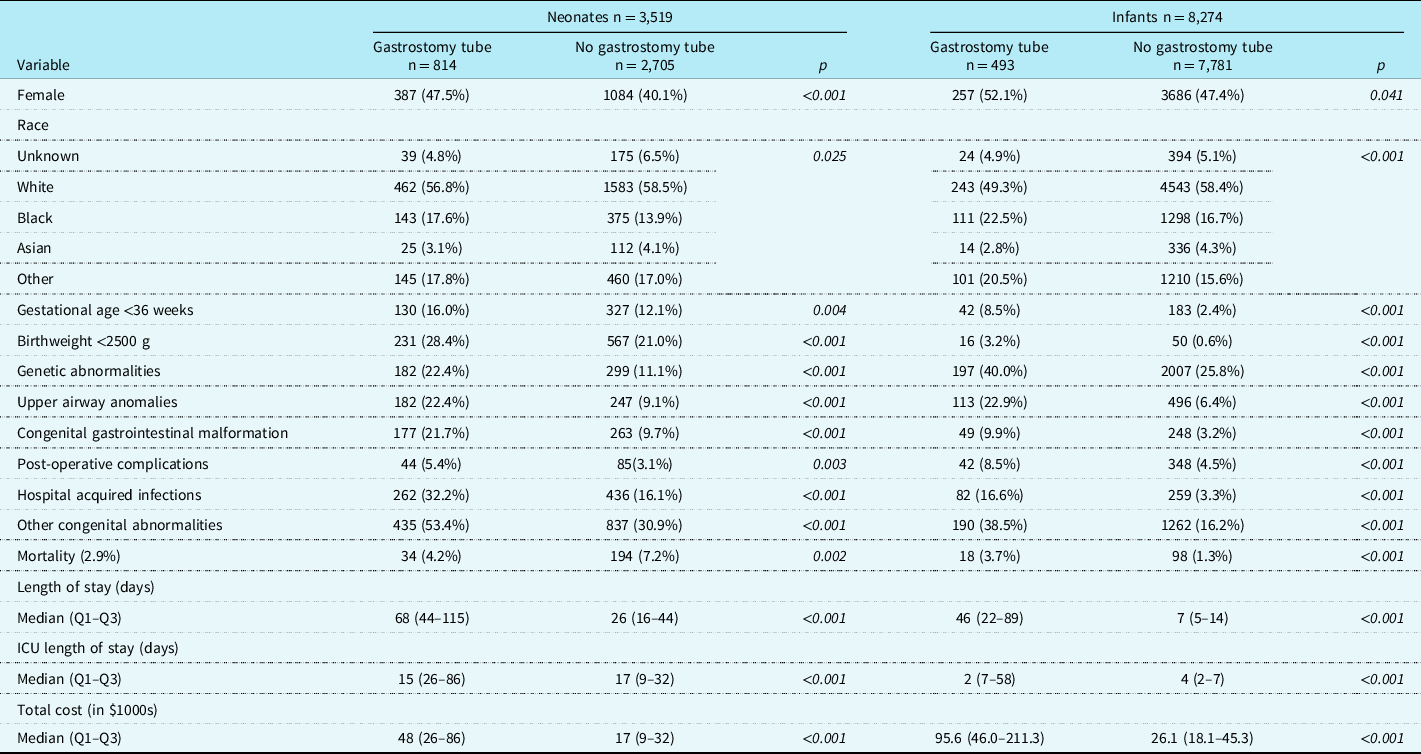
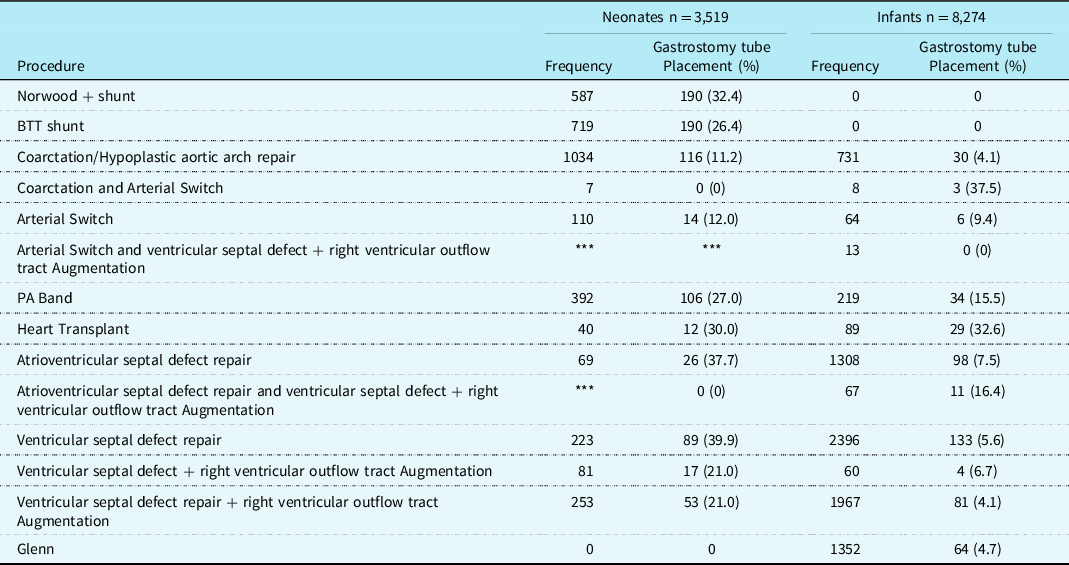
The query yielded 11,793 admissions, 3519 (29.8%) neonates and 8274 (70.2%) infants. Characteristics for each cohort were compared (Table 1). Gastrostomy tube placement in neonates requiring congenital cardiac surgery was higher than infants (23.1% versus 6.0%, p = <0.001). Both neonates and infants had increased mortality, total length of stay, ICU length of stay, and total cost in those requiring gastrostomy tube placement versus those that did not (all p < 0.003) (Table 1). Univariate analysis demonstrated prematurity, low birth weight, genetic abnormalities, upper airway anomalies, congenital gastrointestinal malformations, post-operative complications, hospital acquired infections, or other congenital abnormalities were all statistically significant factors when comparing those with and without gastrostomy tube placement in both neonates and infants (all p ≤ 0.003) (Table 1). Frequency of surgical types varied based on patient age (Table 2).
Comparison of baseline demographics, hospital course, and outcomes of both neonates and infants undergoing congenital cardiac surgery. GT - gastrostomy tube; LOS - length of stay; ICU. Data from the Vizient Clinical Data Base used with permission of Vizient, Inc. All rights reserved

Breakdown of procedure frequency in both Neonates (admitted at age 0 months) and infants (admitted age ≥1–12 months), as well as frequency of GT placement. In the setting of small volume sizes, frequency of surgical procedures were not reported to prevent re-identification of patient information within the database. BTT – Blalock-Thomas-Taussig; PA – pulmonary artery. Data from the Vizient Clinical Data Base used with permission of Vizient, Inc. All rights reserved

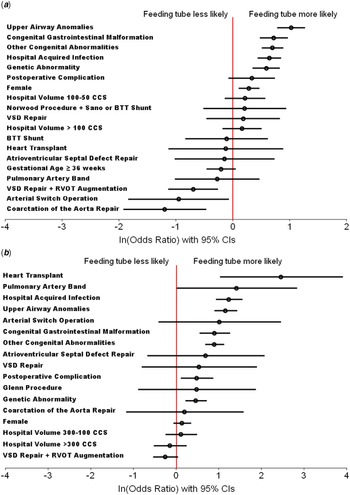
In neonates, we constructed a multivariable model to discriminate the placement of gastrostomy tube (c-index of 0.755) (Fig 1). The presence of upper airway anomalies was associated with the largest increase in the odds of gastrostomy tube placement during the same hospitalisation as congenital cardiac surgery. Other factors that increased the odds of requiring a gastrostomy tube included female gender, congenital gastrointestinal malformations, other congenital abnormalities, and having hospital-acquired infections during the hospitalisation. Race was evaluated but found to be not significant. Among surgical types, ventricular septal defect repair and right ventricular outflow tract augmentation, arterial switch operation, or coarctation repair had the lowest odds of gastrostomy tube placement (Fig 1).
Plot of log odds ratios and 95% CI in ( a ) neonates (c-index 0.754) and ( b ) infants (c-index 0.761). Hospital volume is the only ‘multi-category’ predictor and therefore, the smallest volume group was used as the reference group. OR - odds ratio; CI - confidence interval; VSD - ventricular septal defect; RVOT - right ventricular outflow tract. Data from the Vizient Clinical Data Base used with permission of Vizient, Inc. All rights reserved.

In infants, a separate multivariable model yielded a c-index of 0.766 (Fig 1). Heart transplantation was associated with the highest odds of requiring a gastrostomy tube placement (Fig 1). Similar to neonates, hospital infections, upper airway anomalies, and having other congenital malformations also increased the odds of gastrostomy tube placement. Additionally, having post-operative complications or a genetic syndrome increased the odds of gastrostomy tube placement. There were no factors in infants that decreased the odds of requiring a gastrostomy tube during their hospitalisation (Fig 1).
To evaluate for hospital variation, multivariable analysis was performed based on the highest, middle, and lowest rate of congenital cardiac surgery during the study period in both the neonatal and infant groups. There was no significant difference in overall rates of gastrostomy tube, regardless of centre volume, in either cohort (Fig 1).
Discussion
Oral feeding is the preferred method of nutrition for patients who require congenital cardiac surgery. Reference Lambert, Pike and Medoff-Cooper8 However, complete oral feeding can be challenging following congenital cardiac surgery due to various factors and some patients will require gastrostomy tube placement. In this large, multi-institutional study, our data expands upon the previously reported information regarding gastrostomy tube placement after congenital cardiac surgery while also highlighting the importance of different expectations based on age in the potential need for gastrostomy tube placement. We have demonstrated that certain congenital cardiac surgery, comorbid non-cardiac conditions, and post-operative complications are significantly associated with gastrostomy tube placement. These findings will improve parental counselling and hospital resource allocation.
In patients undergoing congenital cardiac surgery, prolonged intubation and restriction from enteral feeds have been shown to preclude the ability of this population to feed orally. Reference Indramohan, Pedigo, Rostoker, Cambare, Grogan and Federman9 Infants that require congenital cardiac surgery also often have comorbidities and surgical complications placing them at an increased risk of gastrostomy tube placement; however, unlike neonates, their indication for surgery is often, at least in part, secondary to the development of poor growth or stagnant growth associated with their CHD. While gastrostomy tube placement itself is a low-risk procedure that has shown to be beneficial in optimising growth when used for feeding challenges, the decision for another anaesthetic procedure in this population must always be considered. Reference Einhorn, Taicher and Greene10 Having a better understanding of which patients are at highest risk of requiring a gastrostomy tube is important for optimising expectations in patient care and resource allocation planning.
By stratifying our study by age, we were able to look more closely at the factors that influence both neonates and infants individually and define the incidence of gastrostomy tube placement in each group. Overall, neonates were found to be four times as likely to require gastrostomy tube placement prior to discharge than infants. Within each age group, the incidence of gastrostomy tube varied by surgical procedure. While many of the surgical procedures were the same, some congenital cardiac surgery procedures are only performed in neonates or infants (e.g. Norwood/BTT shunt and Glenn, respectively). The isolated ventricular septal defect repair had the most significant difference in gastrostomy tube placement (neonates versus infants; 39.9% versus 5.6%). Often, ventricular septal defect surgery is performed in infants, at or around the time that symptoms develop. For a neonatal ventricular septal defect surgery to be indicated, the patient would most commonly have significant clinical symptoms of heart failure and likely have other comorbidities prompting earlier repair (Table 2).
In neonates, having a coarctation repair, arterial switch, or ventricular septal defect + right ventricular outflow augmentation had the lowest odds of requiring a gastrostomy tube. Neonatal ventricular septal defect repairs when adjusted for proportion were found to be not statistically significant, even though it was noted to have the highest incidence of gastrostomy tube placement in neonates (Table 2). In infants, the highest odds of requiring a gastrostomy tube were in those requiring a heart transplant. This likely goes back to the baseline different types of surgeries the two populations undergo. Patients that require a heart transplant outside of a neonatal admission, often have preceding heart failure and resultant failure to thrive. In order to obtain an anabolic state, optimising nutrition in these patients is vital; however, we do not know if these patients had their gastrostomy tube placement before or after their heart transplants during the admission.
Looking at additional factors that influence the decision for gastrostomy tube outside of the surgical procedure itself, neonates had the highest odds of requiring a gastrostomy tube if they had upper airway anomalies. Upper airway anomalies can be congenital, transient, or a complication from congenital cardiac surgery. The additive affect, however, of a patient that has an increased caloric need and a significant barrier to feeding based on anatomic variations (i.e. facial cleft, vocal cord paresis/paralysis) is consistent with expectation for gastrostomy tube need. Similarly, having a congenital gastrointestinal malformation, other congenital abnormality, or genetic variation that would predispose a patient to additional increased caloric requirement or decreased ability to utilise nutritional intake, is consistent with our findings of increased need for gastrostomy tube placement.
Overall outcomes of patients that have gastrostomy tube placement have previously been evaluated at single institutions where it has been suggested that gastrostomy tube placement did not significantly change morbidity or length of stay in those who require congenital cardiac surgery. Reference Rossi, Fishberger and Hannan11 Looking at both neonates and infants in our study, there was significant increase in mortality, length of stay, ICU length of stay, and total costs in those who require gastrostomy tube versus no gastrostomy tube. Rather than being causative, this observed outcomes are likely reflective of a patient who has a more complicated operative and post-operative course.
As a retrospective database study, there are several limitations to this study. Correct International Classification of Diseases 10th Revision coding and database entry is a source of possible error. However, given the large number in the study population, there is low likelihood that a small number of coding errors would influence the outcomes of the study. Additionally, reasoning for surgical choice or coded procedures is not included in a database study, limiting our understanding of the processes taken or used prior to gastrostomy tube placement in our patients. As this was not the focus of this study but rather the endpoint reported, this presents the opportunity for further investigation of the process of feeding decisions in the future. As well as, defining patient’s anatomy or surgery type can be challenging in database studies due to simplified coding entries. To help address this, we eliminated many patients to keep only well-defined patients in our database as our study population. While this reduced the volume and frequency of commonly encountered procedures, it allowed for the cleanest method of analysing and assessing the data while retaining statistical significance. Lastly, if patients were readmitted and received a gastrostomy tube prior to infant admission, the data may be under-representative of patients who require congenital cardiac surgery as an infant.
Conclusion
This study provides an increased understanding of the age distribution and frequency of gastrostomy tube placement after congenital cardiac surgery, allowing for quality improvement initiatives at the institutional level, and aiding providers in defining expectations when counselling families regarding the potential requirement of a gastrostomy tube. Further studies to assess a specific population’s need for gastrostomy tube placement would be necessary for further resource management and allocation planning.
Acknowledgements
Vizient Clinical Data Base.
Financial support
This research received no specific grant from any funding agency, commercial, or not-for-profit sectors.
Conflicts of interest
None.