1. INTRODUCTION
The search to solve the problem of detecting a small sized target moving in darkness at a considerable distance from the observer and to receive its visual image, has arisen from recent ornithological research investigating bird migration. The phenomenon of bird migration has been actively studied by ornithologists over the last 100 years (e.g. Moreua 1972 and Berthold Reference Able and Gauthreaux2001) with about 80% of bird species of North America, Europe and Asia demonstrating various forms of migratory behaviour (Curry-Lindahl Reference Berthold1982). Research work has focused on key problems of orientation and navigation, energy expenditure and mechanics of flight, as well as mechanisms for the control of period and pattern of migration by internal and external factors. Methods involve natural observation, laboratory experiment and theoretical investigation. Direct observations of birds aloft focus on determining species composition and numbers of migrants, seasonal and daily temporal patterns of passage, height distribution, flight direction and the association with weather, especially wind direction and strength. Of particular importance, more than half of the species nesting in the Northern hemisphere migrate nocturnally and as a consequence are difficult to detect (Hansen Reference Bolshakov, Žalakevičius and Švažas1954, Taylor Reference Gauthreaux1972). Migration at night is typical for many waterfowl, waders, and especially passerine birds (Martin Reference Bruderer and Bold1990) with a size range of 10–50 cm and airspeed 5–20 m/s. In the flat countries of Europe and North America a bulk of passerines (70–80%) fly under the altitude of one kilometre (Zehnder et al. Reference Gauthreaux, Hagan and Johnston2001, Bolshakov et al. Reference Alerstam and Gudmundsson2002, Gauthreaux and Livingston Reference Gauthreaux and Livingston2006).
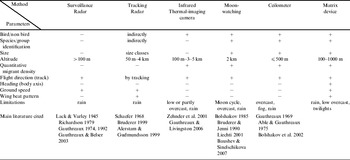
There are various recent techniques for the detection of birds flying at night and observing their flight characteristics. Their main features, presented in Table 1, show differences in the distance of bird detection, accuracy of species or group identification, weather-related limitations and number of detectable parameters. The main problem of nocturnal migration research is the absence of an accurate method for species identification which includes many required parameters at a relatively low cost. Because the stream of nocturnal migrants usually consists of dozens of species which may differ by their migratory directions, altitudes, flight abilities and migratory strategies it is an advantage to distinguish in particular species or groups of species similar in their taxonomy and ecology. The known methods, including radar, practically do not permit us to perform this task and there are doubts that this problem could be technically solved by radar equipment in the near future (Liechti Reference Bruderer, Jenni and Gwinner2007).
Comparison of nocturnal migration research methods.

+ possible to define or measure, − not possible to record the parameter.
Presented here are the results of four years of joint experimental research work at the Biological Station Rybachy and the Pulkovo Astronomical Observatory, culminating in the design and testing of this new system for the detection and recording of nocturnal aerial targets. The images and the significant parameters attainable using this equipment we believe will constitute a significant step forward in bird migration research.
2. DEVICE DESIGN BACKGROUND
The background to the design of a suitable device to meet the needs for further advances in this field of biological research necessitated successfully meeting the required tasks and addressing the contradictory concerns arising from these tasks.
2.1. Requirements for the device
The following requirements for further advances have influenced our design during the development of this device:
• To create a clear image of a flying target to ensure adequate accuracy of measurement of its linear size.
• To collect and store statistically representative data.
• To monitor continuously the migratory activity through a series of complete nights at frequent sample dates throughout the migration seasons.
• To catalogue the following main flight parameters for each recorded bird:
∘ Altitude.
∘ Linear size.
∘ Direction of flight.
∘ Orientation of the body axis.
∘ Ground speed.
∘ Wing-beat frequency and its variation.
∘ Number of wing-beats in each series of beats.
∘ Duration of the pause between series of beats.
∘ Type of flight trajectory.
The principle system design used to meet these requirements is a parallactic computation of the distance from the matrix device to the target. This enables the subsequent calculation of the target linear size from known distance and its angular dimensions; the ground speed from the angular displacement for known time interval; the dynamic characteristics of the target and its orientation in space from the pattern of trajectory with a sequence of the instantaneous images.
2.2. Main concerns taken into account
The main concern was to overcome the contradiction between the need for high angular resolution to ensure the required accuracy of measurements on the one hand and the need for a wide field of vision on the other to achieve a statistically representative sample of targets and to consider trajectory type.
There was also the requirement for an instantaneous clear image while at the same time revealing information on target movement for an adequate period of time.
The large dynamic altitude range creates one-hundred-fold variation in the illumination of the observed targets. This results in over-illuminated images at low altitude but poor detail of images of high flying targets in the same exposure.
The dispersed light from the lowest strata of the column of light and the light spot on the clouds cause background flare.
Finally, real-time storage creates a huge volume of crude data. On the one hand the material from continuous monitoring negates the standard procedure of compression with consequent loss of information (e.g. conversion to *.avi or similar formats); the rate of data receipt is also much higher than the rate of preliminary processing. On the other hand the recording and saving of a huge flux of crude data demand very high computer resources.
Despite these concerns, after experiments and modelling it became possible to find some original technical solutions. These solutions have defined the design of the system device.
3. DESIGN SOLUTIONS FOR THE DEVICE
The Optical Matrix Device consists of two main components: the recording unit (electronic-optical system) and the illumination system.
3.1. The Recording Unit
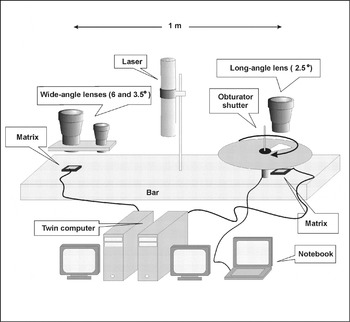
See Figure 1. The image of an object, under artificial illumination of white light in the visible range of wavelength, is received on two high-sensitivity CCD matrices. The optical system consists of two channels with parallel optical axes separated from each other at the locating distance by 1 metre. Each channel includes a high-quality objective lens, a heating anti-condensation system, an image focusing unit, a CCD matrix and a video board (grabber). The objective lenses are interchangeable and have different focal distances. In this project we used three lenses with the following parameters:
1. F (focal length)=50 mm (6°), S (focal length/aperture)=1·7
2. F=86 mm (3·5°), S=1·5
3. F=120 mm (2·5°), S=1·8.
Their combination determines angular resolution and field of vision of the channels. The scales of the fields of vision differ by a factor of 1·5–2·5. Their centres are accurately superimposed by the laser beam. During the exposure time (0·3–1·5 seconds) a target usually passes an angular distance of 0·25–5 degrees depending on its altitude. One channel is equipped with an obturator (rotating) shutter which chops the track of an object into 10–50 instantaneous and sequential images within one frame. This clearly results in a method taking much less recording space than an analogous video sequence. The obturator shutter is servo controlled by an independent computer which allows the setting of an accurate speed of rotation and required time interval between separate images with a duration of exposure of 25–18 milliseconds. The speed of rotation is optimized and governed on the assumption that the most probable speed of a bird at the moment of observation varies between 5 and 20 metres/second, with an average of about 10 m/s (Bruderer & Bold Reference Baushev and Sinelschikova2001). The second channel (with a wide field of vision) works without shutter and forms the image as a target track of variable width and brightness.
The Recording Unit (electro-optical system).

Imaging is created independently by two synchronized computers on the information received from the video boards at the end of the exposure sequence. The images are written to the hard discs in a specific format. Besides the frame each file saves information on the moment of time of exposure on the matrix, exposure sequence and other parameters of the obturator etc., which are required for the subsequent processing. Total data flux per night is about 50,000 files of total volume 25 Gb. To provide uninterrupted monitoring, the system works automatically throughout the night. Control and data input is performed by a special twin computer. The further data analyses are processed after the crude data collection.
3.2. The Illumination System
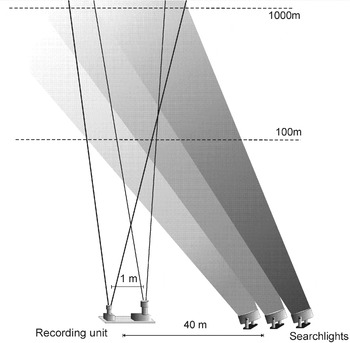
The illumination system is installed 40 m apart from the recording unit (See Figure 2). The system consists of three searchlights of differing luminance and angular size. OSRAM lamps of 250–400 W were used in this project. The parabolic mirrors installed in each searchlight permit the separate focusing of the light beams. The searchlight unit forms one combined beam with an open angle of 5°. Mutual alignment of the beams, their combination (switched on 1 to 3 searchlights simultaneously) and their position relative to the optical axis of the recording unit can be adjusted depending on the altitude of the cloud canopy until the lowest brightest part of the beam and the spot of light on the clouds, appear to be out of field of vision. A zone of intersection of the cone of light and cone of vision then has lower and upper boundaries. Under perfect weather conditions they are of an altitudinal range of 100–1000 m where there is a uniform field of light.
Arrangement of the recording unit and the illumination system.

Adjustment to the searchlights is a critical technique which requires preliminary computer simulation depending on the current weather conditions. To improve this procedure an additional adjusting searchlight was used which forms a reference grid in the night sky using three needle shaped beams. The beam direction is controlled on the screen of the computer of the optical system when the 6° wide angle objective lens is installed.
4. APPROPRIATE SOFTWARE
For a successful operation of the system it was necessary to write dedicated software (Matlab 6.5). This provides complete multistep data processing, as follows:-
• A program package records and controls available crude data (the total volume per season of migration may exceed 1000 Gb). The time sweep for the whole season of observation can be presented in an easy graphical form where any data set could be extracted directly.
• Visual examination of the frame flow is provided by a two-channel viewer.
• The frames of each channel have different scales. To measure the parallax the images should be matched with an error of not more than 10 angular seconds. The program automatically estimates relative displacement, rotation and coefficient of scale transformation of the images. The interface controls and corrects the spatial synchronization.
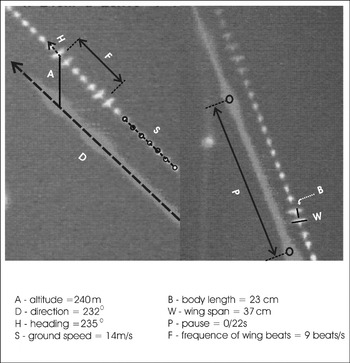
• The selected material is subsequently displayed appropriately for measurements. The images of both channels are superimposed and the measurement of all target parameters is accomplished semi-manually by draft designation of the graphics primitives which mark the control points of the image (see Figure 3). As a result the calculation of the required target parameters is achieved. For the birds we calculate the following parameters:- altitude, linear size (wing span and body length), direction of flight (ground track), orientation of the body axis – heading (the line tail-head), ground speed, wing-beat frequency, number of wing-beats in each series of beats, duration of the pause between series of beats, type of flight trajectory (straight, curved or other).
• The installed image handling controls allow the improvement of the picture of a target and the optimization of viewing parameters (brightness and contrast ratios etc.). It was also possible to identify targets by comparison with a set of the pattern images of the known birds.
• The position of the light spot on the cloud cover (lower than 2 km) allows an estimate of the real altitude of clouds. In some cases by the moving fragments of clouds it is also possible to calculate wind speed and direction at the corresponding altitudes.
• The received data are catalogued in the database including for each recorded target the parameters of synchronization, instrumental parameters of the system (exposure, shutter parameters etc.). The interface enables easy navigation through the database.
• An installed statistics module permits a direct initial summary of results in the form of diagrams and histograms.
Photographs of the tracks of two individual birds (the Song Thrushes) recorded by the Optical Matrix Device illustrating the measurements taken of the linear and dynamic parameters recorded.

5. TESTING THE SYSTEM
In autumn 2006 there was an initial field testing of the equipment. During 22 nights of observation 1537 targets were recorded and identified. Birds were identified for 1284 (84%), insects (6%), bats (4%), satellites and artificial fragments (6%). It was impossible to identify 168 targets. The field testing clarified the reliability of the device under real field conditions and confirmed the scientific validity of the data obtained for the study of bird migration (Vorotkov et al. in prep).
The system advantages are first, the ability to catalogue a representative volume of data throughout a night and throughout a migration season and second, the presentation of a wide range of the important parameters to help with the identification of species (or species group) as well as parameters of target ground track differing from heading showing the influence of wind direction.
The collected data were processed and considered for each parameter. The results were compared with those known in literature and gathered by alternative methods. It was shown that the collected data are largely in agreement with known published results (Vorotkov et al. in prep). We believe the system presented here to be a potential advance in technique for bird migration research. There are also the potential applications for bird-strike, with 80% of migrant species passing overhead at night and consequently a hazard to aircraft, as well as for the remote monitoring of insects, bats and other targets of natural and artificial origin such as space debris.
ACKNOWLEDGEMENTS
This study was supported by the Russian Foundation for Basic Research (grant to Casimir Bolshakov no. 08-04-01658). The authors are grateful to Casimir Bolshakov for the project initiation.