The name of the sage ruler Shun 舜 is found written in two different ways in the Chu 楚 bamboo manuscripts unearthed in Guodian 郭店, Jingmen, Hubei in 1993 and dated to around 300 b.c.e. Here, following Ji Xusheng 季旭昇 and Adam Smith, I label these two forms A (employed in “Qiong da yi shi” 窮達以時) and B (in “Tang Yu zhi dao” 唐虞之道).Footnote 1

Concurring with Ji, Smith argues that “Guodian form A is the more conservative writing for Shun, preserving one crucially informative component intact: the topmost element is 允 [= Guodian 〈 〉, etc.], a phonetic spelling for the name Shun.”Footnote 2 The suggestion is attractive, in part because certain narrative elements (as well as sound) unite illustrious Shun 舜 with the more marginal deity (Di) Jun (帝) 俊, prominent within the received Shanhai jing 山海經. If 〈舜〉 were simply a formal derivative of 〈夋〉 (Ji's terms include fenhuazi 分化字 and bianti 變體), the orthographical dots would be neatly connected as well. The facts are not so straightforward, however. I show below that the Guodian speller 〈允〉 is an innovation, that form B is (relatively speaking) conservative, and more generally that when it comes to questions of “original form,” our attention must remain on the entire range of orthographical variation, not on particular variants’ relative pertinence to philological problems or relative susceptibility to analysis in terms of phonetic components. An adjusted approach leads us closer to the true ancestry of 〈舜〉, though whether it is of any interest depends on one's degree of comfort with the fact that in the study of early language and script, the logic of interpretation of variation can yield implications for a time to which no text bears witness.
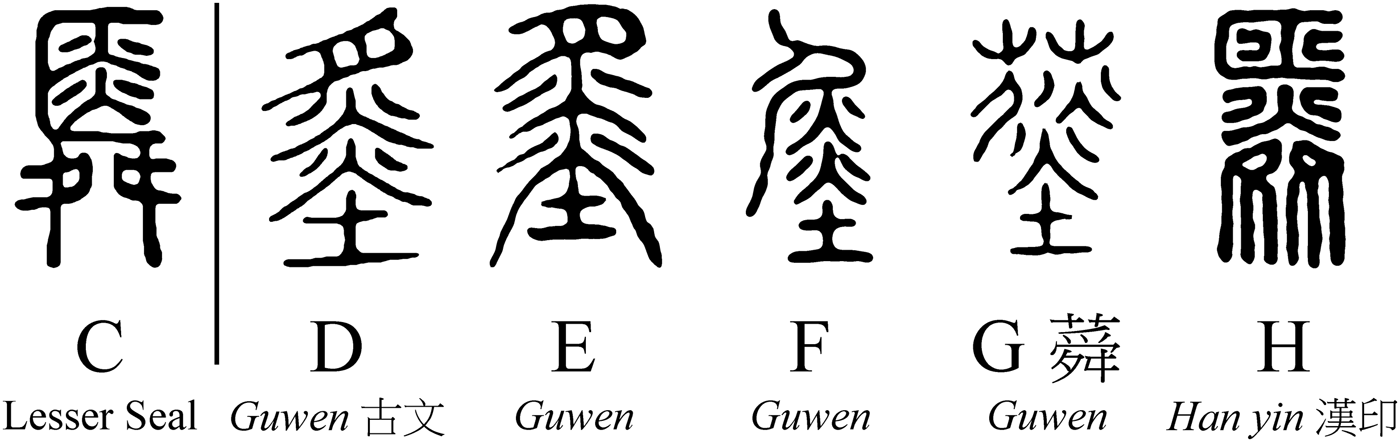
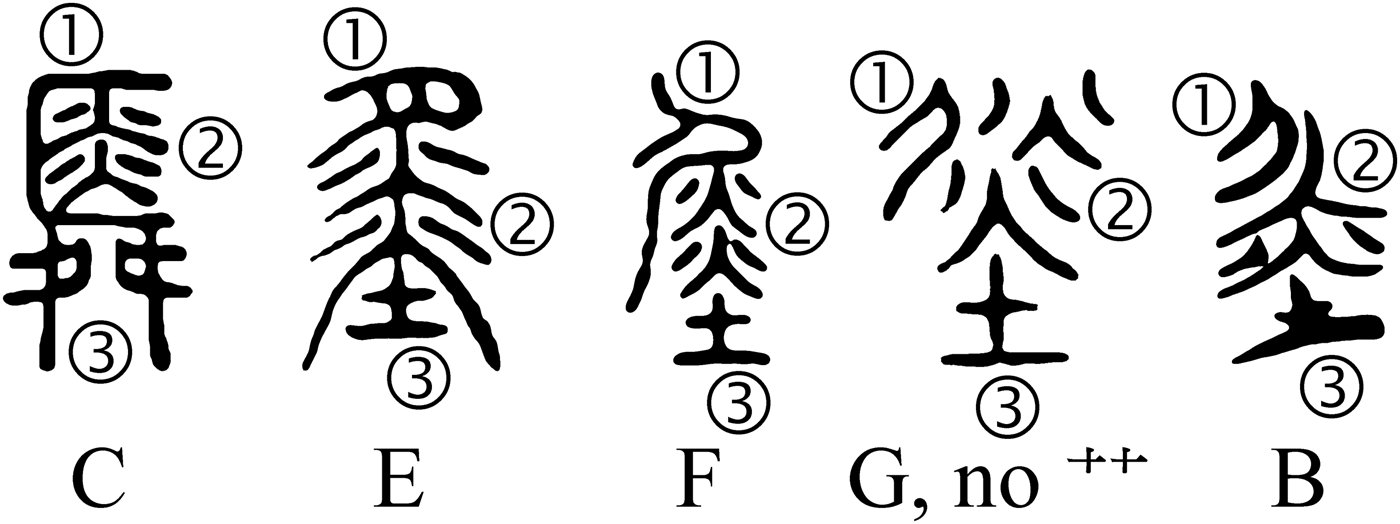
The unifying and thus most significant feature of the character 〈舜〉 in its earliest available attestations is a graphic element at times identical to contemporaneous 〈炎〉 (see Figure 1, C [for which to follow I use regularized 〈䑞〉], D and F), at times somewhat more distantly resembling it (see E, G and H).Footnote 3 This shared feature must reflect an attribute of a common ancestor, not a late innovation as Ji's approach requires.Footnote 4 The “proto-feature” need not have looked exactly like 〈炎〉 in formal terms, and in analytical terms need not have constituted a redeployment of the ancestor of 〈炎〉, but its erstwhile existence is beyond doubt. Also significant is the fuller structural isomorphy observable across C through H and similar forms of 〈舜〉 including B above. This mapping implicates three components which I label ①, ②, and ③ in Figure 2. The same structure is reflected in, among others, regularized (so-called) Guwen 古文 forms presented at the Kangxi Dictionary entry Shun 舜 (see n.3 above): 〈𡐩〉, 〈𡳈〉 and 〈𡳉〉, the last instructive in featuring 〈夊〉, “foot,” at ③.
Figure 1.

Figure 2.

This range is in itself problematic for the idea that A—represented in the excavated Chu slips in particular—preserves a phonetic speller lost elsewhere. More importantly, it is necessary to disagree with Smith that Guwen-type forms (including B) are “essentially unrecognizable as relatives” of the Seal form C and similar.Footnote 5 Rather, all variants of early 〈舜〉 adhere to the same structural template, with delimited alternation at positions ① and ③ and basic agreement at ② 〈炎〉, a regularity which any successful account of the origins of the character will need to address. That the element 〈允〉 of Guodian A is arguably an acceptable speller for the name Shun, while the motivation for 〈炎〉 (and other early constituents) remains mysterious, is immaterial to this methodological point.
This picture is entirely in keeping with Smith's description of the orthography of the Warring States manuscripts as developing largely outside of traditional prescriptions and thus undergoing a “rapid graphic evolution and innovative departure from the earlier script of the Zhou court.”Footnote 6 On the level of the individual glyph, such evolution is frequently visible as formal simplification and (often simultaneously) as reanalysis of marginal or obscure features in terms of components which, from a synchronic view, are more productive and/or phonologically instructive, a process Smith terms “attraction.” What Ji Xusheng has really detected in forms A and B above, then, is a case of such reanalysis in which an already-reduced but fairly direct relative of early 〈䑞〉 (i.e., B) was adjusted to a form whose upper portions resembled 〈夋〉 (i.e., A). Ji's notion of formal change in the opposite direction—from 〈允〉 and then A towards B–H and thus from simple to complex, from productive to idiosyncratic as regards individual components, and from instructive to opaque as regards sound—must be ruled out from principle. Warring States 〈允〉-based writings of the name Shun do appear to have filtered into our received texts, and possible knock-on effects do merit investigation. However, such writings are precisely a function of Warring States-era regional innovation, not windows on earlier form (and note that the innovation is reflected in just the texts one might suspect on independent grounds of being partial heirs to “Chu” traditions.)
In light of the nature of the early adjustment that produced A, it will not be surprising that the more recent history of analysis of the form 〈䑞〉 has in large part been a fruitless search for a plausible phonetic component. Here, Ding Shan 丁山 caught sight of the obvious: the closest formal relative and true core constituent of 〈舜〉 at early periods was 〈粦〉.Footnote 7 Seal Script renderings of these two characters take the (regularized) forms 〈䑞〉 and 〈㷠〉 respectively, sharing 〈㷠〉 and differing only by inclusion in the former of the “classifier” 〈匚〉. Early texts seem not to use 〈粦〉 independently and thus provide no direct indications regarding the word(s) it might first have written. In purely phonological terms, however, this was likely an MC lin. The standard (i.e., Shuowen) suggestion is that the word at issue was MC lin 磷 ~ 燐, naming the marshland or graveyard gui huo 鬼火 “ghost lights” now attributed to spontaneous ignition of byproducts of organic decay (‘ignis fatuus, will-o’-the-wisp’): this direction would account for the inclusion of the component 〈炎〉 in early 〈粦〉 by reference not to sound, in which respect the two are irreconcilable, but to meaning.
Certain implications of this connection are straightforward. Given phonological shape—MC lin (> lin 2) vs. sywinH (> Shun 4)—and an otherwise unexplained near-total sharing of written form, we are obligated to treat the two characters involved as true xiesheng 諧聲 relatives, and to resolve the disparity between the MC onsets l- and sy- at the Old Chinese stage. I refrain from making a specific proposal here, but xiesheng contact of this kind has parallels: MC ljangX 两 ‘pair’ vs. syang 商 “come between, split, etc.” (partly congruent written forms which write cognates involving transitive devoicing), lak 樂 ‘joy’ vs. syak 鑠 ~ 爍 ‘melt’, and lu 𧆨 ‘crucible’ vs. xu 虍 ~ xuX 虎 ‘tiger’ (MC x- rather than sy- in ‘tiger’ being a function of vowel quality.) Baxter and Sagart account for such orthographical contact where they recognize it (‘joy’ vs. ‘melt’; ‘crucible’ vs. ‘tiger’) by reconstructing *r- vs. voiceless *r̥- (> MC x- ~ sy-).Footnote 8 The same contrast must likewise be most of the answer to the OC forms of ‘ghost light’ vs. ‘Shun’.Footnote 9
The early relationship between lin and Shun might of course have been strictly phonological, and not in addition etymological. Nonetheless, in conclusion, we ought to think more deeply about the glyph 〈粦〉, core of early 〈舜〉, and the word it was first designed to represent. Happily, the character appears in Western Zhou bronze inscriptions some five centuries older than the Guodian manuscripts:Footnote 10

By reference to early orthographic conventions, the core of this form has been rightly recognized as a human or human-like figure of which the “feet” are a part. The source of later 〈炎〉 is also perfectly clear, though the notion that 〈炎〉 per se (“fire” + “fire”) was an original constituent of 〈粦〉 (or of 〈舜〉) must be, and has been, dismissed.Footnote 11 As far as the word so written, the Shuowen suggestion that 〈粦〉 first wrote MC lin ‘will-o’-the-wisp’, while a possibility, must be reassessed, not simply accommodated via adjusted paleographical explanations (e.g., that J and K show a person pursued by “ghost lights”; see the remarks of Du Zhonggao referenced just above). The proper methodological course as regards the unaccounted-for marks along the “limbs” of J and K is to continue to seek parallel depictive conventions in the early script. Such investigation suggests that the original illustrative intent here was elements covering the skin: in L below are inked tattoos on face and flesh in 〈黑〉 as it first appears in Zhou-era Bronze Inscriptions (MC xok 黑 ‘black’ probably first meant ‘mark with ink’, causative of MC mok 墨 ‘ink’);Footnote 12 in M we see, according to Xu Zhongshu 徐中舒 and others, plates of armor upon a figure in profile as found in Shang Oracle Bones Inscriptions 〈介〉, writing MC keajH ‘plates (of armor), scales’.Footnote 13

And so the intersection of cautious phonology and paleography marks out a straightforward answer for the word first written by Western Zhou J and K, direct ancestors of 〈粦〉 and in turn of 〈舜〉: not ‘will-o’-the-wisp’, but MC lin (< OC *rin) 鱗 ‘scales [of fish or other animal]; scaled’.Footnote 14 For what it is worth, a likely etymologically equivalent choice—and given present evidence the best choice for the creature actually illustrated by (the ancestors of) J and K—is early Chinese *rin > MC lin ‘pangolin (Manis pentadactyla)’: the word appears in both Hakka and Min and in similar forms in Tai languages, and is found written with the glyph 〈獜〉 (among others) in texts new and old including the Shanhai jing:Footnote 15
又東南三十里,曰依軲之山 … 有獸焉,其狀如犬,虎爪有甲,其名曰獜,善駚𤘝,食者不風。
Another thirty li to the southeast is a mountain called Eika … there is a creature there, its form like a dog, with the claws of a tiger and armored plates: its name is rin; it is capable of standing upright [on its hind legs]. One who consumes [its flesh] will avoid rheumatism.Footnote 16
I stop short at the matter of whether at one point Shun and the scaly pangolin might have had more in common than just pronunciation and written form, a matter implicating the further matters of a half-brother Xiang 象 ‘elephant’, of the role of a meritorious and indeed para-human pangolin in animist belief systems, of the relationship between lin 獜 ~ 鱗 (also *gərin > qilin 麒麟 ~ 麒麐?) and trisyllabic names for the pangolin in, e.g., Malay (whence English) as it relates to the Austronesian/Kra–Dai presence in early southern China, of an epithet *kwrə̂n 鰥 ~ *kwrîn 矜 ‘old unmarried man’, and so forth.Footnote 17 The evidence above renders all of these entirely legitimate directions of inquiry, ones which it would be incurious to scoff at given merely the great chronological distance separating the time period to which such possibilities relate from that of the written record upon which most Sinologists naturally focus, or given merely the arguable irrelevance of the whole question to professional readers of texts.