INTRODUCTION
During the last two decades, the littoral marine molluscs of the Azores were the subject of several studies (see Ávila, Reference Ávila2000, Reference Ávila2005 and references therein). The opisthobranch gastropods have also received significant attention and 141 species were recorded for the archipelago (107 littoral species and the remaining 34 species inhabiting in waters over 50 m deep; Gosliner, Reference Gosliner and Martins1990; Menezes, Reference Menezes1991; Ortea et al., Reference Ortea, Valdés and Espinosa1994, Reference Ortea, Valdés and García-Gómez1996, Reference Ortea, Moro and Espinosa1997, Reference Ortea, Caballer, Moro and Bacallado2002; Jensen, Reference Jensen and Martins1995; Mikkelsen, Reference Mikkelsen and Martins1995; Wirtz, Reference Wirtz1998; Fontes et al., Reference Fontes, Tempera and Wirtz2001; Malaquias, Reference Malaquias2001; Calado, Reference Calado2002; Cervera et al., Reference Cervera, Calado, Gavaia, Malaquias, Templado, Ballesteros, García-Gómez and Megina2006; Malaquias et al., Reference Malaquias, Calado, Padula, Villani and Cervera2009). As a result of recent fieldwork at São Miguel Island, thirteen species of opisthobranchs were collected, one of which, Crimora papillata Alder & Hancock, 1862 is recorded for the first time in the Azores archipelago.
MATERIAL EXAMINED
One specimen collected at Porto de São Vicente (depth = 8 m; maximum length = 12 mm; 17-03-2010; DBUA 1039); one specimen collected at Morro das Capelas (depth = 25 m; maximum length = 10 mm; 09-04-2010; DBUA 1040) (Figure 1). Specimens were obtained by manual collecting through direct observation, and brushing of suitable habitat surfaces (sponges, hydrozoans, bryozoans, algae, etc.). All specimens were deposited in the molluscs' DBUA collection (Department of Biology of the University of the Azores).
Azores archipelago and location of the collecting sites in São Miguel Island (©SGPA—Secção de Gestão e Planeamento Ambiental, University of the Azores).

DESCRIPTION
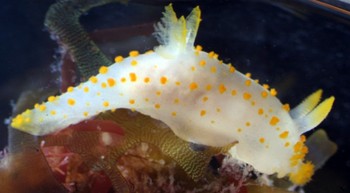
The two specimens found in São Miguel, Azores show the typical morphology and coloration of the species first described by Alder & Hancock (1862). Body ovate–oblong with a pointed posterior tail; several processes like-small papillae spread all over the body including the mantle edge and rachis of tail. Oral veil with branched appendages. Rhinophores are retractile and perfoliate; three tripinnate gills. Body background colour white, with processes tipped with yellow; gills and rhinophores tipped with yellow (see Figure 2).
Crimora papillata (Porto de São Vicente, São Miguel Island, Azores, 8 m deep).

ECOLOGY
According to Picton & Morrow (Reference Picton and Morrow1994), this species is usually found associated with the branching bryozoans Chartella papyracea, Flustra foliacea and Securiflustra securifrons, in a bathymetric range of 0–30 m deep (Rudman, Reference Rudman2002). The Azorean specimens were collected over the alga Cladophora prolifera (Roth) Kützing (Figure 2).
GEOGRAPHICAL DISTRIBUTION
Found in southern Britain, south to Morocco and the western Mediterranean (Rudman, Reference Rudman2002) and the Azores (this work).
DISCUSSION
It is remarkable to realize that despite the efforts during the last years, there is apparently much to be uncovered about the opisthobranch fauna of the Azores; this new record increases the number of opisthobranchs in the Azores to 142 (108 littoral species and 34 deep-water species). As over 90% of the studies were conducted in just two of the nine islands of the Azores (Faial and São Miguel), we believe that new records/new species will probably be found, especially in the most remote islands, Corvo and Flores.
The majority of the shallow-water marine molluscs of the Azores are biogeographically related to the western Mediterranean and the eastern Atlantic European shores (Ávila, Reference Ávila2000, 2005; Ávila et al., 2009) and this new record follows the above mentioned general trend. However, since the last account by Ávila (Reference Ávila, Ávila and Martins2007), the total number of molluscs increased from 299 to 396 species (Ávila, unpublished data), therefore, a new appraisal on the biogeographical relationships of the marine molluscs of the Azores urges to be carried out. This revision is also needed to explain what Ávila (Reference Ávila2000) called ‘the (Azorean) biogeographical paradox’, that is, to provide an explanation for ‘the disparity between the pattern of sea-surface currents and the geographic range of the (Azorean) marine species of molluscs’ (Ávila, Reference Ávila2000).
ACKNOWLEDGEMENTS
We thank Ângelo Gomes and João Brum (University of the Azores) for field assistance. We also thank António Monteiro (SGPA—Secção de Gestão e Planeamento Ambiental, University of the Azores) for providing Figure 1 and Manuela Parente (IMAR/University of the Azores) for the identification of the algae.