Infants are not able to fully self-regulate their emotions. Instead, the reciprocal affective exchange between mother and infant regulates infants’ arousal and emotions (Cohn & Tronick, Reference Cohn and Tronick1987; Feldman, Greenbaum, & Yirmiya, Reference Feldman, Greenbaum and Yirmiya1999; Sroufe, Reference Sroufe2013). According to the mutual regulation model of interaction (Gianino & Tronick, Reference Gianino, Tronick, Field, McCabe and Schneiderman1988), the interaction between mother and infant is mutually regulated by the mother's and infant's behavior: Mothers coordinate their affective behavior with the affective valence and temporal structure of their infant's behavior, and infants respond contingently to their mother's behavior. By adjusting to each other's behavior from moment to moment, infants repeatedly practice regulating their arousal and emotions (Feldman et al., Reference Feldman, Greenbaum and Yirmiya1999; Jaffe, Beebe, Feldstein, Crown, & Jasnow, Reference Jaffe, Beebe, Feldstein, Crown and Jasnow2001) and gradually increase range, control, and flexibility in their behavior (Gianino & Tronick, Reference Gianino, Tronick, Field, McCabe and Schneiderman1988).
From a dynamic systems perspective (Schmidt & Richardson, Reference Schmidt, Richardson, Fuchs and Jirsa2008; Vallacher & Nowak, Reference Vallacher, Nowak, Guastello, Koopmans and Pincus2009), mother and infant constitute an interactive system that is dynamically organized by the behavioral inputs of both interaction partners. One integral feature of this mother–infant system is synchrony. Synchrony reflects the temporal coordination of behavior between mother and infant (Bernieri & Rosenthal, Reference Bernieri, Rosenthal, Feldman and Rime1991). More specifically, a high degree of synchrony of the behavior between mother and infant reflects the strength of the relationship between the mother's and infant's direction of change of their behavior in time. According to this definition of synchrony, a high degree of synchrony does not necessarily mean that the interaction partners simultaneously display the same behavior. For example, an infant might display a low negative facial affect, while the mother is looking at the infant with a neutral face; after 2 s, the infant might shift from a low negative facial affect to a neutral facial expression, and the mother might synchronize her facial affect by responding with a parallel shift from a neutral facial expression to a low positive facial affect. Addressing the direction of change of behavior between interaction partners (rather than the behavior itself), synchrony may address an important aspect of the coregulation between mother and infant: Mothers typically display a more positive facial affect than do their infants (Moore & Calkins, Reference Moore and Calkins2004) but modulate their facial affect in response to their infant's facial affect to provide adequate stimulation and emotion regulation (Cohn & Tronick, Reference Cohn and Tronick1988; Field, Healy, Goldstein, & Guthertz, Reference Field, Healy, Goldstein and Guthertz1990).
According to the “optimal midrange model of self- and interactive regulation” (Jaffe et al., Reference Jaffe, Beebe, Feldstein, Crown and Jasnow2001), a well-organized and flexible interaction between mother and infant is driven by a moderate degree of synchrony, whereas a heightened and lowered degree of facial affect synchrony poses difficulties for infant development. Consistent with this assumption, the degree of mother–infant facial affect synchrony was moderate in low-risk samples, ranging from 0.13 to 0.18 after controlling for the rhythm within each partner's behavior. Heightened (Feldman, Reference Feldman2003; Moore & Calkins, Reference Moore and Calkins2004) and lowered (Feldman, Reference Feldman2007; Feldman et al., Reference Feldman, Greenbaum and Yirmiya1999) mother–infant synchrony predicted unfavorable child outcomes.
Maternal psychopathology, such as depression, has been shown to disrupt the coregulation between mother and infant. Mothers with depressive symptoms were more unresponsive or intrusive, under- or overstimulating their infant (Field, Reference Field2010; Lovejoy, Graczyk, O'Hare, & Neuman, Reference Lovejoy, Graczyk, O'Hare and Neuman2000; Martinez-Torteya et al., Reference Martinez-Torteya, Dayton, Beeghly, Seng, McGinnis and Broderick2014), than mothers without depressive symptoms. Mothers with higher depressive symptoms showed a heightened degree of facial affect synchrony with their infants compared with mothers that reported lower depressive symptoms (Beebe et al., Reference Beebe, Jaffe, Buck, Chen, Cohen and Feldstein2008). Other maternal psychopathologies, such as anxiety (Beebe et al., Reference Beebe, Steele, Jaffe, Buck, Chen and Cohen2011) or dependence (Beebe et al., Reference Beebe, Jaffe, Buck, Chen, Cohen and Blatt2007), also predicted deviant mother–infant facial affect synchrony.
Although we know that maternal psychopathologies disrupt mother–infant facial affect synchrony, it remains unclear what factors cause the association between maternal psychopathology and mother–infant facial affect synchrony.
The mother's emotion regulation might be one pathway by which maternal psychopathology is transmitted to mother–infant facial affect synchrony. According to the three-component model of affective processes in parenting (Dix, Reference Dix1991), the ability to adaptively regulate emotions, rather than the experienced emotions per se, determine the quality of parenting. Emotion regulation is a set of processes that modulate emotions to appropriately respond to environmental demands (Cole, Martin, & Dennis, Reference Cole, Martin and Dennis2004; Gross, Reference Gross1998; Thompson, Reference Thompson1994). These regulatory processes involve recognizing, understanding, accepting and controlling emotions (Gratz & Roemer, Reference Gratz and Roemer2004). Adaptive emotion regulation is associated with positive emotional experience (Gross & John, Reference Gross and John2003), psychological health (Gross & Muñoz, Reference Gross and Muñoz1995; Hopp, Troy, & Mauss, Reference Hopp, Troy and Mauss2011), and interpersonal functioning (Gross & John, Reference Gross and John2003). Conversely, emotion dysregulation is related to psychopathology (Aldao, Nolen-Hoeksema, & Schweizer, Reference Aldao, Nolen-Hoeksema and Schweizer2010; Kring & Bachorowski, Reference Kring and Bachorowski1999; Werner & Gross, Reference Werner, Gross, Kring and Sloan2010), particularly to depression (Aldao et al., Reference Aldao, Nolen-Hoeksema and Schweizer2010). Mothers with high levels of psychopathological symptoms may experience high levels of negative emotions. Whether these emotions disrupt the synchrony between a mother's and infant's facial affect may depend on how the mother is able to regulate these emotions (Dix, Reference Dix1991). However, this assumption has not yet been tested.
The current study addressed this question by investigating the relationships between maternal self-reported emotion dysregulation, maternal psychopathology, and observed mother–infant facial affect synchrony during spontaneous face-to-face play between mothers with mood disorders and their infants. Using the Still-Face paradigm (Tronick, Als, Adamson, Wise, & Brazelton, Reference Tronick, Als, Adamson, Wise and Brazelton1978), we observed mother–infant interaction during an initial play with low regulatory demands and during a reunion play after social stress had been induced.
We tested three hypotheses: (a) maternal emotion dysregulation would be significantly positively related to mother–infant facial affect synchrony, (b) the play condition would moderate the effect of maternal emotion dysregulation on mother–infant facial affect synchrony such that emotion dysregulation would have a greater effect on mother–infant synchrony in the reunion play condition than in the initial play condition, and (c) maternal emotion dysregulation would mediate the effect of maternal psychopathology on mother–infant facial affect synchrony.
Methods
Sample characteristics
The sample consisted of 68 mothers and their infants. We included dyads if (a) the mother was diagnosed with a mood disorder according to DSM-IV, (b) the mother provided informed consent to participate in the study, (c) the mother was a fluent speaker of German, and (d) the infant was aged 4–9 months. We excluded dyads if (a) the mother was diagnosed with a psychosis, primary substance abuse, or intellectual impairments; (b) the mother reported an acute psychiatric crisis; or (c) the infant was diagnosed with a pervasive development disorder. After screening 118 mothers and their infants, we included 68 mothers and their infants in this study. The data of this study were assessed in the context of a larger intervention study (Ramsauer et al., Reference Ramsauer, Lotzin, Mühlhan, Romer, Nolte and Fonagy2014) before participants received any intervention.
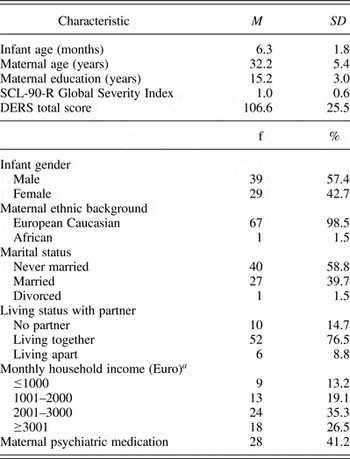
The mothers of our sample were aged between 20 and 44 years. The majority of the mothers were unmarried but lived with their partners in one household (Table 1). The family's socioeconomic status ranged from lower to upper middle class. The infants were aged between 4 and 9 months; approximately half of the infants were male. Most infants were first born.
Characteristics of mothers and their infants (N = 68)

an = 64.
All of the mothers were diagnosed with a DSM-IV Axis I mood disorder (88.2% major depression, 4.4% dysthymia, 4.4% bipolar disorder, 2.9% adjustment disorder with depressed mood). Approximately half of these mothers (55.9%) suffered from at least one comorbid anxiety disorder (14.7% posttraumatic stress disorder, 14.7% social phobia, 10.3% panic disorder with agoraphobia, 8.8% panic disorder without agoraphobia, 4.4% generalized anxiety disorder, 4.4% obsessive-compulsive disorder, and 1.5% specific phobia). The mothers reported clinical levels of depressive symptoms on average, which ranged from 1 to 46 according to the Beck Depression Inventory (Hautzinger, Bailer, Worall, & Keller, Reference Hautzinger, Bailer, Worall and Keller1994). At the time of the behavioral assessment, 25.0% of the patients reported no depressive symptoms, 14.7% reported mild to moderate depressive symptoms, and 60.3% reported severe depressive symptoms.
Most mothers (58.8%) reported not having received medical treatment for their mental disorder. One third of the mothers (35.3%) reported using antidepressants (32.4% selective serotonin reuptake inhibitors or serotonin-norepinephrine reuptake inhibitors, 1.5% tetracyclic antidepressants, and 1.5% other antidepressants), one mother (1.5%) was treated with benzodiazepine, and three mothers (4.4%) were treated with atypical neuroleptics.
Procedure
Mothers and their infants were recruited from a psychiatric mother–infant outpatient unit that offers mother–infant treatment for mentally ill mothers and their infants at the University Medical Center of Hamburg. Mothers participated in the Structured Clinical Interview for DSM-IV I (Wittchen & First, Reference Wittchen and First1997) and filled out questionnaires to assess demographic characteristics, difficulties in emotion regulation, and psychopathological symptoms.
Mothers and their infants eligible for inclusion in the study were contacted, and a behavioral observation in the mother–infant research unit was requested when the infant was approximately 6 months old. For the two spontaneous interaction conditions of the Still-Face procedure (initial play and reunion play), the experimenter instructed the mother to play with her infant as she usually did without a toy or a pacifier. For the Still-Face episode, the experimenter asked the mother to look at her infant with an expressionless face and without any other reaction to the infant's behavior. The experimenter who monitored the video recording in the adjacent room knocked on the one-way mirror to signal the mother the start of the next episode. Four cameras captured mother and infant from four different directions using a hard-disk recording system.
Measures
Observation of mother–infant interaction
We observed mother–infant interaction using the Still-Face paradigm (Tronick et al., Reference Tronick, Als, Adamson, Wise and Brazelton1978). Tronick and his colleagues designed this standardized experiment to observe the face-to-face interaction between a mother and her infant 3–9 months of age. The mother places her infant in an infant chair, and the mother directly faces her infant. The paradigm consists of three consecutive episodes: an initial play condition of a spontaneous interaction between the mother and the infant (3 min); a Still-Face episode, in which the mother is nonresponsive to her infant (1 min); and a reunion play condition, in which the mother and infant reengage in a spontaneous interaction (3 min). The maternal unresponsiveness during the Still-Face episode reliably evokes typical stress reactions in infants, such as reduced positive emotions, increased negative emotions and gaze aversion, and increased cortisol levels (Haley, Reference Haley2011; Mesman, van IJzendoorn, & Bakermans-Kranenburg, Reference Mesman, van IJzendoorn and Bakermans-Kranenburg2009), which can be still observed in the reunion play condition (Mesman et al., Reference Mesman, van IJzendoorn and Bakermans-Kranenburg2009).
Coding of facial affect
The first uninterrupted 3 min of the initial play and the reunion play conditions of the Still-Face paradigm were microcoded 25 times per s, which corresponds to a coding unit of 40 ms. The coding of one 3-min interaction (i.e., initial or reunion play) resulted in a time series of 4,500 data points for each mother and each infant. We used a software system for behavioral coding (The Observer XT 11.0, Noldus Information Technology, Wageningen, The Netherlands). Three-minute microanalytical assessments of mother and infant behaviors are stable and achieve good test–retest reliabilities (Cohn & Tronick, Reference Cohn and Tronick1987; Moore, Cohn, & Campbell, Reference Moore, Cohn and Campbell1997).
Based on an adaption of the approach of Beebe et al. (Reference Beebe, Jaffe, Markese, Buck, Chen and Cohen2010), mothers’ and infants’ facial affect were rated separately with facial affect rating scales, ranging from high negative to high positive. The facial affect rating scales for the mothers and infants are described in Appendices A and B. One researcher and one graduate student conducted the ratings of facial affect. Both raters were trained extensively for 40 hr over a period of 3 months to a reliability level of κ = 0.75. Training included the coding of parent–infant interaction videos from previous studies, according to the scoring rules of the coding manual. The raters coded video frames as uncodable if the face of the mother or infant was not visible on any of the videos made by four cameras. One research assistant, blinded to other data of the study, rated the mothers’ facial affective behavior from the videos on which the infants’ faces were masked. The second rater, unaware of other data of the study, coded the infants’ facial affective behavior from the videos in which the mothers’ face was blinded. In total, raters evaluated 272 time series of facial affect (68 mothers and 68 infants in two play conditions).
To assess interrater reliability, the infants’ and mothers’ behavior of 92 (33.8%) randomly selected time series were independently coded by the other rater. Kappa coefficients (based on coding units of 40 ms) indicated excellent interrater reliability for the ratings of the mothers’ facial affect (initial play κ = 0.81, reunion play κ = 0.84) and the infants’ facial affect (initial play κ = 0.85, reunion play κ = 0.87).
Emotion dysregulation
Emotion dysregulation was assessed with the Difficulties in Emotion Regulation Scale (DERS; Gratz & Roemer, Reference Gratz and Roemer2004). This 36-item self-report questionnaire assesses clinically relevant difficulties in emotion regulation. Participants rate on a 5-point Likert scale (1 = almost never to 5 = almost always) how frequently each statement applies to them. Six subscale scores (nonacceptance of emotional responses, difficulties in engaging in goal-directed behavior, difficulties in controlling impulsive behaviors, lack of emotional awareness, limited access to emotion regulation strategies, lack of emotional identification or clarity) are summarized to a total score representing overall difficulties in emotion regulation (range = 36–180). Higher scores indicate greater emotion dysregulation.
The DERS has been used in clinical populations with mood disorders (Ehring, Fischer, Schnülle, Bösterling, & Tuschen-Caffier, Reference Ehring, Fischer, Schnülle, Bösterling and Tuschen-Caffier2008) and anxiety disorders (McLaughlin, Mennin, & Farach, Reference McLaughlin, Mennin and Farach2007; Tull, Barrett, McMillan, & Roemer, Reference Tull, Barrett, McMillan and Roemer2007; Tull & Roemer, Reference Tull and Roemer2007), substance-related disorders (Fox, Hong, & Sinha, Reference Fox, Hong and Sinha2008; Gratz & Tull, Reference Gratz and Tull2010), and eating disorders (Whiteside et al., Reference Whiteside, Chen, Neighbors, Hunter, Lo and Larimer2007). The DERS demonstrated sound psychometric properties, with good internal consistencies for the subscales and total scale and good retest reliabilities (Ehring et al., Reference Ehring, Fischer, Schnülle, Bösterling and Tuschen-Caffier2008; Gratz & Roemer, Reference Gratz and Roemer2004; Tull & Roemer, Reference Tull and Roemer2007). Studies that tested the convergent validity of the DERS reported sufficient convergent validity with other self-report measures of emotion regulation (Beblo et al., Reference Beblo, Scheulen, Fernando, Griepenstroh, Aschenbrenner and Rodewald2011; Ehring et al., Reference Ehring, Fischer, Schnülle, Bösterling and Tuschen-Caffier2008; Gratz, Rosenthal, Tull, Lejuez, & Gunderson, Reference Gratz, Rosenthal, Tull, Lejuez and Gunderson2006), behavioral assessments (Gratz et al., Reference Gratz, Rosenthal, Tull, Lejuez and Gunderson2006), and physiological measures of emotion regulation (Vasilev, Crowell, Beauchaine, Mead, & Gatzke-Kopp, Reference Vasilev, Crowell, Beauchaine, Mead and Gatzke-Kopp2009).
Clinical characteristics
The Structured Clinical Interview for DSM-IV I (SCID I, Wittchen & First, Reference Wittchen and First1997) is an established method for the assessment of Axis I diagnoses according to the DSM-IV. Validation studies reported sufficient reliability and validity (Lobbestael, Leurgans, & Arntz, Reference Lobbestael, Leurgans and Arntz2011; Basco et al., Reference Basco, Bostic, Davies, Rush, Witte and Hendrickse2000; Skre, Onstad, Torgersen, & Kringlen, Reference Skre, Onstad, Torgersen and Kringlen1991; Zanarini & Frankenburg, Reference Zanarini and Frankenburg2001).
Mothers evaluated their current severity of psychopathology by the Symptom Checklist–90–Revised (SCL-90-R; Franke, Reference Franke2002), which is a widely used self-reported inventory. The respondents rate the experienced psychological distress within the last week on 90 5-point Likert scales ranging from 0 (not at all) to 4 (extremely). Nine symptom dimensions are covered by the SCL-90-R (somatization, obsessive–compulsive symptoms, interpersonal sensitivity, depression, anxiety, hostility, phobic anxiety, paranoid ideation, and psychoticism). The Global Severity Index of the SCL-90-R measures the average overall severity of psychopathology, calculated as the average score of the 90 items. Studies demonstrated that the Global Severity Index reliably measures the global severity of psychopathological symptoms (Franke, Reference Franke2002; Hardt & Brähler, Reference Hardt and Brähler2007). Evidence for convergent, divergent, and criterion validity was also reported (Brophy, Norvell, & Kiluk, Reference Brophy, Norvell and Kiluk1988; Franke, Reference Franke2002; Peveler & Fairburn, Reference Peveler and Fairburn1990; Schmitz et al., Reference Schmitz, Hartkamp, Kiuse, Franke, Reister and Tress2000).
Data preparation and analysis
On the basis of an a priori power analysis (using PASS version 11, Hintze, Reference Hintze2011), we estimated a sample size of 71 dyads to achieve 80% power to detect an R 2 of .10. We used an F test with a 0.05 alpha level of significance, and attributed 80% power to two independent variables (emotion dysregulation and play condition), adjusted for three control variables with an R 2 of .20.
Missing data from the questionnaire assessments were rare (0.11%), as we checked full completion of the questionnaires at every visit. Uncodable behavior of the mothers or infants also rarely occurred (mother's facial affect = 0.58%, infant's facial affect = 1.15%). We imputed missing data by the expectation maximization algorithm of IBM SPSS Statistics Version 21.
In order to enable comparisons to results of previous studies of mother–infant affect synchrony (Beebe et al., Reference Beebe, Steele, Jaffe, Buck, Chen and Cohen2011; Feldman, Reference Feldman2003; Field et al., Reference Field, Healy, Goldstein and Guthertz1990; Kaitz, Maytal, Devor, Bergman, & Mankuta, Reference Kaitz, Maytal, Devor, Bergman and Mankuta2010), we averaged facial affect ratings within each 1-s interval. The averaged ratings resulted in time series of 180 facial affect ratings for each observation of the mother or infant.
The degree of facial affect synchrony between mother and infant was computed for each dyad separately, using time-series analysis (Gottman & Ringland, Reference Gottman and Ringland1981). Before the degree of synchrony between the two time series of the mother and infant were calculated, the mother's and infant's time series of their facial affective behavior were inspected for stationary conditions (consistency of mean and variance across time). If the stationary condition was violated, the time series was differenced. This was the case for 2 out of 272 time series (0.74%). The autocorrelation in each time series (correlation of the time series with itself) was estimated with autoregressive integrated moving average models. The autocorrelation was then statistically partialed out of each time series to control for the rhythm within an individual's behavior (Gottman & Ringland, Reference Gottman and Ringland1981). Cross-correlation functions (CCFs) were computed for each dyad using the two series of residuals from the autoregressive integrated moving average models (prewhitened cross-correlation). A CCF was computed by the correlation between two time series as a function of lag. A lag is the offset of time between one partner's behavior and the corresponding behavior of the partner. In our analysis, a lag corresponded to 1 s. The largest positive cross-correlation between the two time series found at any lag between lag –10 and lag 10 indexed the degree of synchrony between the two time series. This measure of synchrony ranges from 0 (no lagged association between two time series) to 1 (perfect match between two time series). To test whether the degree of synchrony between mothers’ and infants’ facial affect was higher than chance, we tested whether the synchrony between mothers and their infants was significantly higher compared with the synchrony between mothers and randomly assigned infants (other infants of the sample that did not interact with the mothers).
To examine whether mother or infant (or both) drive the change in the partner's affective behavior, we determined lead-lag relationships between mother's and infant's behavior. A significant peak on the CCF plot at a positive lag indicated mother synchrony with infant (the mother responded to changes in the infant's facial affect). A significant peak on the CCF plot at a negative lag indicated infant synchrony with mother (the infant responded to changes in the mother's facial affect). Mutual synchrony (both partners responded to changes in each other's facial affect) was assumed when significant positive and significant negative peaks appeared on the CCF.
To test whether maternal emotion dysregulation, the play condition (initial vs. reunion play), or control variables explained variance of mother–infant facial affect synchrony, we fitted a multilevel random coefficient model (MRCM) using IBM SPSS Statistics Version 21 with a random effect for the intercept to control for the clustering within dyads across the two measurement points. The random effect for the intercept explained more than 10% of the variance in mother–infant facial affect synchrony (intraclass correlation coefficient = 0.17), and was therefore included in the model. The inspection of the relationship between emotion dysregulation and mother–infant facial affect synchrony using residual plots indicated that the relationship between emotion dysregulation and mother–infant facial affect synchrony was linear. Therefore, we used a linear predictive model. We fitted five models, each including a random effect for the intercept. The fixed effects were added stepwise to the model to determine whether the new predictor(s) would be significantly related to mother–infant facial affect synchrony. Control variables included infant gender, infant age, and maternal psychopathology (assessed with the SCL-90-R). Maternal psychiatric medication was not included as a control variable, as most mothers were not medicated, and a preliminary analysis showed that maternal medication was unrelated to mother–infant facial affect synchrony (β = −0.07, SE = −0.18), t (66.0) = −0.37, p = .713.
In Model 0, only the random intercept was included in the model to test whether the random effect explained variance between dyads. In Model 1, the play condition (initial vs. reunion play) was added as a fixed effect. The control variables infant gender, infant age, and maternal psychopathology were entered into Model 2 to examine whether these variables predicted mother–infant facial affect synchrony. Maternal emotion dysregulation was included as an additional predictor in Model 3 to address our hypothesis that maternal emotion dysregulation would be significantly positively related to mother–infant facial affect synchrony, after controlling for infant gender, infant age, and maternal psychopathology. In Model 4, the interaction term of emotion dysregulation and play condition was entered as a fixed cross-level effect in the model to examine whether the play condition would moderate the effect of maternal emotion dysregulation on mother–infant facial affect synchrony.
To test our hypothesis whether maternal emotion dysregulation would mediate the relation between maternal psychopathology and mother–infant facial affect synchrony, we conducted a mediator analysis using MRCM with IBM SPSS Statistics Version 21 (Krull & MacKinnon, Reference Krull and MacKinnon2001). The MRCM included a random intercept to control for the clustering within dyads across the two measurement points. Four conditions confirm a mediation model (Baron & Kenny, Reference Baron and Kenny1986): Condition I: the independent variable (psychopathology) must be significantly related to the mediator (emotion dysregulation); Condition II: the independent variable (psychopathology) must be significantly related to the dependent variable (mother–infant facial affect synchrony); Condition III: the mediator (emotion dysregulation) must be significantly related to the dependent variable (mother–infant synchrony); and Condition IV: the effect of the independent variable (psychopathology) on the dependent variable (mother–infant facial affect synchrony) must significantly decrease when the mediator (emotion dysregulation) has been partialed out.
Results
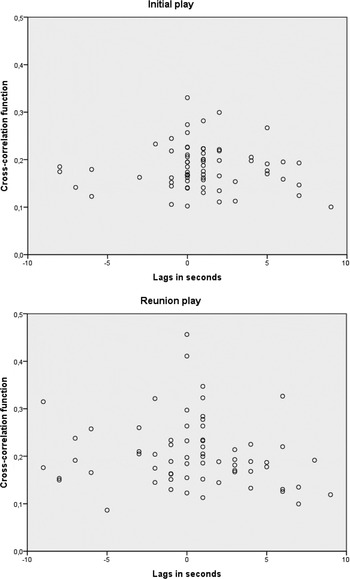
The distribution of the CCFs between the infants’ time series of facial affect and the mothers’ time series of facial affect are plotted in Figure 1. The mean degree of mother–infant facial affect synchrony was 0.18 (SD = 0.05, min = 0.10, max = 0.33) in the initial play and 0.21 (SD = 0.07, min = 0.09, max = 0.46) in the reunion play. The highest CCF was found at a mean lag of 0.36 s (SD = 4.10, min = –9, max = 9) in the initial play and at a mean lag of 0.85 s (SD = 3.26, min = –8, max = 9) in the reunion play. The lags at which the highest CCF occurred did not differ significantly between the initial and reunion play, t (65) = 6.36, d = 0.12, p < .527. The facial affect synchrony between mothers’ and their infants’ facial affect in mothers with mood disorders was significantly higher than the facial affect synchrony between mothers and randomly assigned infants in the initial play, t (134) = 2.20, p < .030, d = 0.38, and in the reunion play, t (134) = 2.96, p < .004, d = 0.30.
Lag and size of the highest cross-correlation function of each mother–infant dyad. Each dot in the scatter plot denotes the lag and size of the highest cross-correlation function between the time series of an infant's facial affect and the corresponding time series of the mother's facial affect. A positive lag indicates mother synchrony with infant; for example, a lag of 1 indicates that the mother responded to changes in the infant's facial affect within 1 s. A negative lag indicates infant synchrony with mother; for example, a lag of –1 indicates that the infant responded to changes in the mother's facial affect within 1 s.

In the initial play interaction, significant peaks on the CCF plots were found in 77.8% of the dyads. In 22.2% of the dyads, no significant peaks on the CCF plots appeared, indicating that a more than 5% chance existed that the observed relationship between the mother's and infant's facial affect happened by chance. In 58.5% of the synchronous interactions, mothers synchronized with their infants (mother responded to changes in the infant's facial affect). In 20.8% of the interactions, mothers dominated the interaction and infants synchronized with their mothers (infants responded to changes in the mother's facial affect). Mutual synchrony was observed in 20.8% of the dyads. In the reunion play interaction, significant peaks on the CCF plots were less often observed than in the initial play interaction (68.2%). In 44.4% of these interactions, mothers synchronized with their infants. In 22.2% of the cases, infants synchronized with their mothers. Mutual synchrony occurred in 33.3% of the interactions.
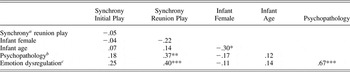
Table 2 shows the intercorrelations between the predictor variables and mother–infant facial affect synchrony in the initial play and reunion play. Maternal psychopathology and emotion dysregulation significantly positively correlated with mother–infant facial affect synchrony in the reunion play condition. Maternal psychopathology significantly positively correlated with maternal emotion dysregulation. The variance inflation factors (Marquardt, Reference Marquardt1970) of psychopathology (1.81) and emotion dysregulation (1.79) were lower than 10, indicating no potential problems with multicollinearity. Infant age correlated with infant gender, indicating that older infants were more often male.
Intercorrelations between the predictor variables and mother–infant facial affect synchrony in the initial play and reunion play condition of the Still-Face paradigm (N = 68)

Note: Pearson correlations were calculated for the association between two continuous variables; point-biserial correlations were calculated for the association between a continuous variable and a dichotomous variable.
a Mother–infant facial affect synchrony as measured by time-series analysis.
b Global Severity Index of the Symptom Checklist–90–R.
c Difficulties in Emotion Regulation Scale.
*p ≤ .05. **p ≤ .01. ***p ≤ .001.
Is maternal emotion dysregulation positively related to mother–infant facial affect synchrony?
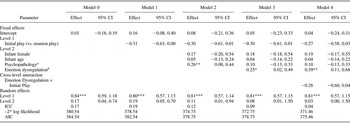
The fixed effects estimates for the prediction of mother–infant facial affect synchrony are displayed in Table 3. Maternal psychopathology was significantly positively associated with mother–infant facial affect synchrony (Model 2). The remaining control variables, infant gender and infant age, were not significantly related to mother–infant facial affect synchrony. When maternal emotion dysregulation was added to the model (Model 3), maternal psychopathology was no longer significantly related to mother–infant facial affect synchrony. Instead, maternal emotion dysregulation was significantly positively related to mother–infant facial affect synchrony. The play condition did not significantly moderate the effect of maternal emotion dysregulation on mother–infant facial affect synchrony (Model 4). However, we found a trend in the expected direction (p = .080), indicating that the effect of maternal emotion dysregulation on mother–infant facial affect synchrony was higher in the reunion play condition than in the initial play condition.
Fixed and random effects estimates of the predictors of mother–infant facial affect synchrony (N = 68)

Note: Multilevel random coefficient model. N = 136 play conditions nested in 68 mother–infant dyads. Level 1 predictor explains variance within dyads. Level 2 predictors explain variance between dyads. Cross-level interaction is the interaction between Level 1 and Level 2. Fixed effects estimates are standardized. AIC, Akaike information criterion.
a Global Severity Index of the Symptom Checklist–90–R.
b Difficulties in Emotion Regulation Scale.
*p ≤ .05. **p ≤ .01. ***p ≤ .001.
Does maternal emotion dysregulation mediate the relation between maternal psychopathology and mother–infant facial affect synchrony?
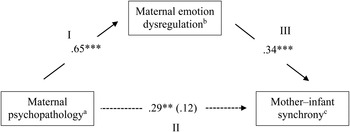
The standardized fixed effects predictors for the tested regression equations of the mediation model are reported in Figure 2. Using maternal emotion dysregulation as the criterion variable and maternal psychopathology as the predictor variable, maternal psychopathology was significantly positively related to maternal emotion dysregulation, Condition I, B = 0.65, 95% confidence interval (CI) = (0.52, 0.77), p < .001. Using mother–infant facial affect synchrony as the criterion variable and maternal psychopathology as the predictor variable, maternal psychopathology was significantly positively related to mother–infant facial affect synchrony, Condition II, B = 0.29, 95% CI = (0.11, 0.46), p = .002. Using mother–infant facial affect synchrony as the criterion variable and emotion dysregulation as predictor variable, emotion dysregulation was significantly related to mother–infant facial affect synchrony, Condition III, B = 0.34, 95% CI = (0.16, 0.51), p < .001. Using mother–infant facial affect synchrony as the criterion variable and maternal psychopathology and emotion dysregulation as predictors, maternal emotion dysregulation was significantly positively related to mother–infant facial affect synchrony, B = 0.26, 95% CI = (0.02, 0.49), p = .032, whereas maternal psychopathology was not significantly related to mother–infant facial affect synchrony, Condition IV, B = 0.12, 95% CI = (–0.11, 0.35), p = .292. Hence, the test of the four conditions to confirm a mediation model (Baron & Kenny, Reference Baron and Kenny1986) indicated that maternal emotion dysregulation fully mediated the effect of maternal psychopathology on mother–infant facial affect synchrony.
Standardized fixed effects estimates for the mediational analyses of the relations between maternal psychopathology and mother–infant facial affect synchrony as mediated by maternal emotion dysregulation (N = 68). The estimated effect of maternal psychopathology on mother–infant facial affect synchrony controlling for maternal emotion dysregulation is reported in parenthesis. aGlobal Severity Index of the Symptom Checklist–90–R. bDifficulties in Emotion Regulation Scale. cMother–infant facial affect synchrony as measured by time-series analysis. **p ≤ .01. ***p ≤ .001.

Discussion
We found that emotion dysregulation in mothers with mood disorders was positively related to mother–infant facial affect synchrony, after controlling for maternal psychopathology, infant gender, and infant age. A heightened degree of mother–infant facial affect synchrony was most often caused by the mothers’ overreactivity. The mother's overreactivity might indicate distress and hypervigilance (Beebe et al., Reference Beebe, Jaffe, Buck, Chen, Cohen and Feldstein2008) that likely interfere with the infant's developing abilities to self-regulate and to explore (Bornstein & Manian, Reference Bornstein and Manian2013).
In earlier studies it was not tested whether emotion dysregulation is related to mother–infant facial affect synchrony; instead, researchers found that maternal psychopathology is associated with mother–infant facial affect synchrony (Beebe et al., Reference Beebe, Jaffe, Buck, Chen, Cohen and Blatt2007; Beebe et al., Reference Beebe, Jaffe, Buck, Chen, Cohen and Feldstein2008, Reference Beebe, Steele, Jaffe, Buck, Chen and Cohen2011). Our results concurred with these findings if we disregarded maternal emotion dysregulation. When we considered maternal psychopathology and emotion dysregulation, maternal emotion dysregulation fully mediated the effect of maternal psychopathology on mother–infant facial affect synchrony in a very high-risk sample of mothers with mood disorders. Thus, psychopathological symptoms may be expected to have a negative effect on mother–infant facial affect synchrony only to the degree that the mothers were impaired in their emotion regulation abilities. Mothers with psychopathological symptoms but with strong emotion regulation abilities may be expected to be unimpaired in their facial affect mother–infant synchrony. These results are consistent with a model of affective processes in parenting (Dix, Reference Dix1991), which assumes that the ability to adaptively regulate emotions, rather than the experienced emotions per se, determine the quality of the parent–infant interaction.
Emotion regulation is a particular challenge for mothers with mental disorders who experience intense aversive mood states (Aldao et al., Reference Aldao, Nolen-Hoeksema and Schweizer2010; Kring & Bachorowski, Reference Kring and Bachorowski1999; Werner & Gross, Reference Werner, Gross, Kring and Sloan2010). Affective disorders are strongly associated with aversive mood states, including sadness, distress, anger, tension, guilt, and anxiety (Lovejoy et al., Reference Lovejoy, Graczyk, O'Hare and Neuman2000). The interaction with a distressed infant may trigger additional negative emotions in mothers. If mothers are incapable of regulating these emotions, it is likely that mothers will experience and express inadequate or badly timed affective behavior that may harm mother–infant facial affect synchrony.
Although the effect of maternal emotion dysregulation on mother–infant facial affect synchrony was not significantly higher in the reunion play condition than the initial play condition, we found a trend in the expected direction. This finding is consistent with the assumption that the interactions of mothers with higher emotion dysregulation may display optimal levels of mother–infant facial affect synchrony when regulatory demands are low, but such mothers may exhibit heightened mother–infant facial affect synchrony under stressful conditions. If future studies confirm this assumption, we should observe mothers and their infants under stress to identify maladaptive mother–infant facial affect synchrony.
It is interesting that we observed a higher average degree of mother–infant facial affect synchrony (range = 0.18–0.21) than was found in previous research (range = 0.13–0.18; Feldman, Reference Feldman2003; Moore & Calkins, Reference Moore and Calkins2004). Researchers of previous studies observed mother–infant synchrony in nonclinical samples; observing extreme values of maternal emotion dysregulation and psychopathology in such a population is unlikely. In our sample of mothers with mood disorders, the mothers reported high levels of psychopathology and emotion dysregulation. Further studies should confirm whether mothers with mood disorders and their infants synchronize their facial affect to a greater degree than do mentally healthy mothers and their infants.
The degree of mother–infant facial affect synchrony seems to be stable across the first year of life because infant age was unrelated to mother–infant facial affect synchrony in our study and in most previous studies (Feldman, Reference Feldman2007; Feldman, Granat, & Gilboa-Schechtman, Reference Feldman, Granat and Gilboa-Schechtman2005). Only one earlier study reported that male (but not female) infants increased the degree of mother–infant facial affect synchrony with age (Tronick & Cohn, Reference Tronick and Cohn1989).
Infant gender was added as a possible confounding factor to our analysis but was unrelated to mother–infant facial affect synchrony. Other studies generated inconsistent results: Infant gender was unrelated to mother–infant affect synchrony (Feldman, Reference Feldman2003, Reference Feldman2007; Moore & Calkins, Reference Moore and Calkins2004), or male gender was associated with higher mother–infant affect synchrony (Tronick & Cohn, Reference Tronick and Cohn1989; Weinberg, Tronick, Cohn, & Olson, Reference Weinberg, Tronick, Cohn and Olson1999). Additional studies may shed light on the role of infant gender in mother–infant facial affect synchrony.
This study has limitations and strengths that one should keep in mind when interpreting our results. A strength of our study is that we examined mothers with mood disorders that varied in their severity of emotion dysregulation and psychopathology.
In contrast, we limited the generalizability of our findings to mothers with mood disorders because we excluded mentally healthy mothers. Further studies should recruit both mentally ill and mentally healthy mothers to examine whether the effect of emotion dysregulation on mother–infant facial affect synchrony differs between these groups.
Keep in mind that our sample consisted of mothers with mood disorders with multiple diagnoses. Multiple diagnoses of mental disorders are the rule rather than the exception in mentally ill individuals (Krueger & Markon, Reference Krueger and Markon2006), which makes it difficult to disentangle the effects of overlapping symptoms. We addressed this problem by measuring general maternal psychopathology instead of maternal depression or anxiety symptoms. Nevertheless, different psychopathologies might lead to different forms of emotion dysregulation. Additional research with more homogenous diagnostic groups, for example patients with a single diagnosis of depression, may clarify the specificity of our findings for different mental disorders.
Finally, a limitation of our study is the variation of the infants’ ages, which might account for differences in the mothers’ and the infants’ facial affect. We addressed this shortcoming by controlling our analyses for infant age and found that infant age was unrelated to mother–infant facial affect synchrony in our study. Our results are consistent with the finding of Striano and Rochat (Reference Striano and Rochat1999) that infant age was unrelated to infant behavior in the Still-Face paradigm in infants aged 7 months versus 10 months.
Our findings suggest further steps to improve subsequent research. Future studies might longitudinally assess emotion dysregulation and mother–infant facial affect synchrony to examine whether maternal emotion dysregulation precedes mother–infant affect synchrony. It might be also valuable to study whether changes in emotion dysregulation, modified by an emotion regulation-focused intervention (Greenberg, Reference Greenberg2004; Mennin, Reference Mennin2006), would correspond with changes in mother–infant facial affect synchrony. Psychophysiological and neurobiological indicators of emotion dysregulation and mother–infant synchrony may illumine the mechanisms that relate emotion dysregulation with mother–infant facial affect synchrony.
Synchrony of behavior is present in almost all aspects of our social lives (Kendon, Harris, & Key, Reference Kendon, Harris and Key1975). In the mother–infant system, behavioral synchrony provides the foundation for the infant's self-regulation, symbol use, and empathy across childhood and adolescence (Feldman, Reference Feldman2007). We should understand and recognize disturbances in mother–infant synchrony because these disturbances adversely affect infant socioemotional development (Beebe et al., Reference Beebe, Jaffe, Buck, Chen, Cohen and Feldstein2007, Reference Beebe, Jaffe, Buck, Chen, Cohen and Blatt2008, Reference Beebe, Steele, Jaffe, Buck, Chen and Cohen2011). The findings of our study provide insight into a pathway that links maternal psychopathology with mother–infant facial affect synchrony: the maternal (in)ability to regulate emotions. Maternal emotion dysregulation rather than maternal psychopathology may drive deficits in the fine-grained synchrony between the mother's and infant's facial affect.
Most of the earlier research on relationships between maternal psychopathological symptoms and mother–infant interaction has been guided by the idea that maternal psychopathological symptoms are directly related to the quality of the mother–infant interaction (Lovejoy et al., Reference Lovejoy, Graczyk, O'Hare and Neuman2000). Others have argued that the effect of maternal psychopathological symptoms on the mother–infant interaction may be mediated by cognitive, affective or behavioral abilities. For example, it has been suggested that a mother’s capacity to understand her child's mind (Fonagy, Gergely, Jurist, & Target, Reference Fonagy, Gergely, Jurist and Target2002; Kelly, Slade, & Grienenberger, 2002) may mediate the relationship between maternal mental illness and parent–infant interaction. Our study identified emotion dysregulation as an additional pathway by which maternal psychopathology may be transmitted to mother–infant facial affect synchrony.
Our findings may have important implications for mother–infant treatment: If mothers report high emotion dysregulation, interventions may focus on maternal emotion regulation capacities to enhance the degree of synchrony between mother and infant. Mothers with high emotion dysregulation might also benefit from video feedback techniques (Beebe, Reference Beebe2005; Rusconi-Serpa, Rossignol, & McDonough, Reference Rusconi-Serpa, Rossignol and McDonough2009) to intervene into the behavioral synchrony between mother and infant. Video feedback based interventions could address the mother's heightened synchrony, for example, helping the mother to slow down and to be less reactive to her infant's facial expression. In cases in which heightened synchrony traces back to the infant, interventions may focus on the mother's ability to notice her infant's response to her and to empathize with the infant's reactivity or vigilance.
Taken together, maternal emotion dysregulation was related to heightened mother–infant facial affect synchrony in a high-risk sample of mothers with mood disorders. Furthermore, maternal emotion dysregulation fully mediated the effect of maternal psychopathology on mother–infant facial affect synchrony. Our results demonstrate that a mother's emotion dysregulation might have higher costs for the mother–infant facial affect synchrony than the mother's psychopathology per se. Interventions for mothers with postpartum mental disorders should target not only maternal psychopathology but also emotion dysregulation.
Appendix A
Facial Affect Rating Scale for Caregivers

Appendix B
Facial Affect Rating Scale for Infants