Introduction
The wave of agrarian populism sweeping through the southern states of the United States in the late nineteenth century helped launch one of the largest social movements, the Farmers’ Alliance, and the most important third party, the People’s Party, the country has ever seen. One of the most notable aspects of agrarian populism was its rapid decline within only a few years of its equally rapid rise around 1890. Unsurprisingly, its fate has been the subject of scholarly inquiry for decades. Some accounts of its decline pivot on the external challenges and obstacles it faced after entering electoral politics in the early 1890s, including the dominant Democratic Party’s violence, election fraud, and appeal to race- over class-based interests (Barnes Reference Barnes1984; Beeby Reference Beeby2008; Goodwyn Reference Goodwyn1976; McMath Reference McMath1993; Woodward Reference Woodward1951). Other accounts put less emphasis on external contingencies of southern politics and more on the internal dynamics of agrarian populism, including divergent organizational and mobilizing forces of social movements and political parties. Such accounts argue, among other things, that the conversion of the Farmers’ Alliance into the People’s Party lead to leadership oligarchization, goal displacement, and mass support disruption by representing the class interests of planters rather than those of common farmers (Barnes Reference Barnes2011; Billings Reference Billings1981; Redding Reference Redding1992, Reference Redding2003; Schwartz Reference Schwartz1976).
This article moves beyond prior research’s focus on political and economic conditions in accounting for the rise and fall of agrarian populism by linking them to the institutional arena second only to partisan politics in its impact on southern society at large, namely organized religion, particularly evangelical Protestantism. While social movement scholars have long recognized the role played by religious organizations in the mobilization of the twentieth-century civil rights and conservative movements in the United States, their role in important nineteenth-century social movements has only recently begun to be appreciated (Young Reference Young2002, Reference Young2006; see also Calhoun Reference Calhoun2012 on the neglected role of religion in nineteenth-century social movements). A number of historical studies suggest a connection between southern religion and agrarian populism (Ali Reference Ali2010; Creech Reference Creech2006; Goode Reference Goode1993; McMath Reference McMath1975, Reference McMath1993; Postel Reference Postel2016). One sociological study (Williams and Alexander Reference Williams and Alexander1994) also makes such a linkage. These studies are, however, limited in two respects. First, they argue for agrarian populism’s connection with organized southern religion based on leadership characteristics and rhetorics. Neither the characteristics of leaders of organizations nor their rhetorics, however, can be reliably used to draw conclusions about broader mobilization. Second, they do not clearly address the possibly differing mobilizing influence of religious organizations in the South on the movement from the party phase of agrarian populism. That is to say, they do not pay sustained attention to the question whether religious organizations may have channeled mobilization differently in the Farmers’ Alliance than in the People’s Party.
This article offers a systematic analysis of that question. It does so theoretically by drawing on leading theoretical perspectives in social movement scholarship, that is, the political process, the cultural framing, and the resource mobilization perspectives. Empirically, it takes a mixed-methods approach combining qualitative information from primary sources, including newspapers and speeches, with quantitative information on local-level membership in evangelical Protestant denominations, membership in the Farmers’ Alliance, and electoral votes for the People’s Party in North Carolina in the 1890s. The article’s results both support and contradict the argument that agrarian populism was rooted in organized southern religion by suggesting that evangelical Protestantism channeled the mobilization of the Farmers’ Alliance to a clearer and greater extent than the People’s Party. We thus conclude that while white southern evangelical religion served as a potent mobilizing structure in the initial movement phase, at the same time it was an important dimension of the disjuncture created within agrarian populism as it moved into party politics, a move from which it never recovered.
Theoretical Considerations
Before moving on to describe and discuss late-nineteenth-century southern agrarian populism and its relation to Protestant evangelicalism, a brief review of the elements of the leading perspectives in social movement theory and research—the political process, the resource mobilization, and the cultural framing perspectives (McAdam et al. Reference McAdam, McCarthy and Zald1996)—informing our argument and analysis is in order. The basic premise of the political process perspective is that conditions and developments in mainstream political systems and institutions, conceptualized as “political opportunities,” may enhance or inhibit the emergence and success of collective protest aiming at influencing institutional politics and policies. Based on this premise, the political process perspective argues for the continuity between conventional activities within mainstream political institutions and protest activities outside such institutions. It also argues that political opportunities affecting the prospects for protest claims and mobilizations may arise along with changes in the alignment of political interests and political power of groups within the polity (Gamson Reference Gamson1975; McAdam Reference McAdam1982; Tilly Reference Tilly1978).
Like the political process perspective, the resource mobilization approach emphasizes the continuity between activities within and collective protest activities outside mainstream political institutions. But unlike the political process perspective, it argues that the collective processes and vehicles that channel the collective protest of aggrieved groups, conceptualized as “mobilizing structures,” should be at the center of analysis rather than the conditions and developments in political systems and institutions. In this perspective, to the extent that conditions and developments in political systems and institutions shape the opportunities and prospects for collective action, their influence is seen as conditioned by the ability of groups to gather and coordinate the collective resources necessary for successful protest mobilization. In other words, in the absence of effective mobilizing structures, incipient protest groups are unlikely to be successful even if afforded the opportunity to engage in collective protest by political changes (Jenkins and Perrow Reference Jenkins and Perrow1977; McCarthy and Zald 1977; Oberschall Reference Oberschall1973).
In its early incarnation, the resource mobilization perspective heavily emphasized the role of external resources and support, above all from elites, in the success or failure of collective protests. The emphasis on external resources has given way to recognition of the importance of resources indigenous to incipient collective protest groups. The canonical example here is the importance of collective resources integral to African American communities in the southern United States embedded within local churches and colleges in the mobilization and success of the civil rights movements (McAdam Reference McAdam1982; Morris Reference Morris1981, Reference Morris1984). The case of the civil rights movements highlights a larger theoretical point, namely the critical role of formal organizations in general, and religious groups in particular, as social contexts for mobilizing and channeling collective resources and protest. What makes formal organizations such powerful mobilizing contexts is that they bring people together in repeated interaction in ways that foster interpersonal ties that allow people to share experiences, beliefs, and values with others beyond what ties established through the routines of everyday life alone can sustain. This, in turn, has the potential to increase the salience and persuasiveness of claims to shared interests among members of aggrieved groups and potential participants in collective protests (Cunningham Reference Cunningham2013; Gould Reference Gould1995; McVeigh Reference McVeigh2009; Redding Reference Redding2003; Smångs Reference Smångs2016).
Neither the political process nor the resource mobilization perspective considers grievances central in explaining the emergence and development of collective protests, but treats them as constant and therefore as incidental to the success or failure of collective protests. In contrast, the cultural “framing” perspective argues that attention to the collectively shared meanings and understandings expressed through collective protest grievances and claims offer analytical leverage in explaining collective protests. It does so because collective protests do not simply arise automatically from the aggregation of individuals’ perceptions, interests, or grievances but also from collective efforts at “diagnostic” framing that establish the nature and cause of the grievances besetting people; “motivational” framing that make people consider themselves part of an aggrieved group with shared interests and purposes justifying and legitimating their coming together to redress their common grievances; and “prognostic” framing that provide strategies, tactics, and targets for solving their grievances (Snow and Benford Reference Snow and Benford1988; Snow et al. Reference Snow, Rochford, Worden and Benford1986). In taking collective protest grievances and claims seriously, the framing perspective appreciates that political opportunities and mobilizing structures should not be understood as more or less static objective conditions but as the result of dynamic and contingent processes. Political opportunities and mobilizing structures may become subjects of “framing contests” between actors representing different factions within the collective protest advocating competing diagnostic, motivational, and prognostic frames, or between actors representing the collective protest and actors representing a collective countermobilization or otherwise opposition to it (Benford Reference Benford1993). The framing perspective, therefore, adds depth to questions pertaining to the origin and fate of collective protests by probing how political opportunities are understood as such by incipient protest groups and what mobilizing structures are available to them in particular places at particular times given the diagnostic, motivational, and prognostic frames they and their opponents develop and deploy (Simmons Reference Simmons2014). We examine how these factors played out in the agrarian revolt, focusing in particular on whether evangelical Protestantism served as a provider of cultural meanings and mobilizing structures in its social movement and political party incarnations.
Historical Background
The origins of agrarian populist protest in the late-nineteenth-century South lay in the structural and institutional transformations of the region after the Civil War. These transformations, continuing for decades and affecting whites as well as blacks, crucially involved the shift toward commercial farming, the rise of farm tenancy and sharecropping, and the development of crop-lien credit. The economic system meant to replace slavery in the immediate postbellum years, based upon the principles of “free labor” (Foner Reference Foner1995), including the rights to choose a livelihood, acquire property, and make contracts, required that different groups accept and learn new roles. While a few former slaves were able and allowed to purchase land, the majority of them were unable to do so and therefore became (formally) free wage laborers mainly in the South’s agricultural economy. Former slave-owning planters, on their part, accustomed to mastering a relatively easily controlled slave labor force, became landholding employers of free agricultural laborers (Ransom and Sutch Reference Ransom and Sutch1977; Smångs Reference Smångs2016; Woodman 1977).
White planters and black freedmen, however, alike lacked the knowledge and experience necessary for stable employer-employee relationships in these new circumstances. Freedmen’s determination to give real meaning to their newfound freedom vitally involved laboring independent from whites’ control and command, which collided with white planters’ determination to reestablish as much as possible of the labor system that had reigned on slavery plantations. The implied notion of equality between the parties to an employer-employee contract bewildered and compounded landowners’ inability to handle a free black labor force. Planters insisted that free African Americans were not disciplined enough but had to be coerced to sign and meet the obligations of wage contracts. Landowners furthermore worked their hired black wage laborers in ganglike fashion similar to how they had worked slaves, something that blacks naturally resented and resisted (Ransom and Sutch Reference Ransom and Sutch1977; Smångs Reference Smångs2016; Woodman 1977).
The outcome of this struggle between former masters and former slaves was a compromise involving the substitution of wage labor contracts with land-rental agreements known as farm tenancy or sharecropping depending upon whether the agreement stipulated that rent payment take the form of monetary compensation or crop share. Although this system turned out to be highly exploitative and oppressive, it signified for a time a substantial concession by landowning whites and a substantial achievement by propertyless blacks by virtue of the latter’s preference for a sharecropping or tenancy arrangement to wage labor because that allowed more independence. The rise of family farming among African American in the postbellum South did thus not simply result from whites leveraging their ownership of agricultural land to force blacks into a new form of servitude but also resulted from freedpeople’s ambitions to escape laboring under whites as they had during slavery (Williamson 1984).
Like former masters and former slaves struggled to redefine their roles in the South’s postbellum economic sector, the largest segment of the white population, that is, small freeholding yeomen who had owned none or at the most only a few slaves, also saw their economic circumstances fundamentally changed after the Civil War. In the wake of the cotton boom immediately following the conclusion of the Civil War and lasting throughout the 1870s, many white yeomen abandoned subsistence family farming for commercial cotton production. Drawn into the cash nexus of commercial farming, formerly self-sufficient white family farmers became dependent on the international cotton market as well as on local commodity markets. Because, while endeavoring to produce more and more cotton, white yeomen no longer grew crop or raised livestock sufficient for household consumption. This shift toward cotton farming in the South was so drastic that by 1880 the region had become a net importer of foodstuff to feed its people (Rabinowitz Reference Rabinowitz1992).
The transformation of white yeomen from subsistence family farmers into commercial cotton farmers, combined with the short supply of cash and credit caused by the badly underdeveloped southern banking system, lead to the rise of the crop-lien system. In this system, farmers used their future crop as lien, that is, collateral, to purchase food and other necessities of life, as well as farming supplies and equipment from local merchants at exorbitant credit prices and interest rates. After the fall harvest, the money from the crop sale went first to repay the crop-lien loan, but as this period, except for the immediate postwar years, saw falling farm commodity prices and an appreciating dollar, many farmers found themselves unable to clear their liens, which typically meant that they had to recontract with the same merchant-creditor the following planting season. Many white farmers found themselves caught in a cycle of increasing indebtedness and had to put up their lands as security for further credit, and if they kept failing to clear their debts, the merchant might foreclose and force them to give up their land and join the ranks of propertyless farm tenants or laborers (Ransom and Sutch Reference Ransom and Sutch1977).
While the absolute majority of black farmers operated under some form of land rental agreement, above all in the form of sharecropping arrangements, it thus also became more and more common for white farmers to till someone else’s land. Steadily increasing landlessness forced white farmers into competition with blacks for economic opportunities in southern agriculture—a painful experience because it not only meant worsened material circumstances but also struck directly at the white ideals of economic and political independence. Whites’ economic interests were thus not separated or separable from but fundamentally interwoven with their political interests (Ayers Reference Ayers1992; Kantrowitz Reference Kantrowitz2000; Smångs Reference Smångs2016).
The abolition of slavery and the passing of the Thirteenth, Fourteenth, and Fifteenth constitutional amendments made freedom, citizenship, and suffrage no longer exclusive white male political privileges. In combination with the deteriorating economic conditions and prospects reviewed previously, postbellum developments left many white southerner farmers with an acute sense of dislocation and dissatisfaction with the political and economic order of things, even after the collapse of Reconstruction restored “home rule,” that is, control of southern state governments by white Democrats, to the region in the late 1870s. The growing discontent among common rural southern whites though found little sympathy with the region’s political leadership, a triumvirate coalition of elite planters, merchants, and industrialists that had effected the end of Reconstruction and that dominated the conservative Democratic Party heading state governments in the South. Envisioning that industrial and commercial developments would cure all the South’s ills, early post-Reconstruction Democratic state governments created incentives for, among other things, northern investment capital by offering tax exemptions to new manufacturers, public state financial aid for railroad construction, and generous sales or grants of public land. Southern Democratic elites had, in other words, scant regard for the plight of ordinary white southerners in general and little patience for their demands that state governments act to alleviate the agricultural crisis in particular. In consequence, the party’s constituency, that is, southern whites at large, most of whom lived in rural areas and made their livelihood in agriculture, increasingly saw southern Democratic elites as subordinating the needs of the region to their own interests and the interests of northern moneyed powers (Ayers Reference Ayers1992; Redding Reference Redding2003; Woodward Reference Woodward1951).
The factionalized conservative southern Democratic elites’ inability and unwillingness to respond to the problems confronting the region in conjunction with the ever-deepening agricultural crisis in the 1880s created opportunities for articulating, mobilizing, and organizing dissent and protest from the embattled and embittered rural white masses. In the initial social movement phase of agrarian populism, the Farmers’ Alliance, which, founded in Texas in the 1870s, found its way to the South in the mid- and late 1880s, channeled this dissent and protest. The Farmers’ Alliance adopted a two-pronged strategy that reflected its federated organizational structure consisting of local-level suballiances and state alliances operating under a national umbrella organization. On the local level, the Farmers’ Alliance promoted economic cooperation typically involving farmers joining together to collectively make trade and marketing arrangements with merchants and wholesalers or starting farmer-owned stores to cut out the “middlemen” and lessen the burdens of crop-lien credit. On the state and national levels, the Farmers’ Alliance worked within the Democratic Party to induce its leaders and officials to embrace and implement its program for economic reform. This program included demands that the federal government underwrite a system of farm credit (the so-called subtreasury plan), increase the money supply, and regulate banks and railroads that the Farmers’ Alliance accused of monopolistic, and thereby undemocratic and immoral, practices (Barnes Reference Barnes2011; Redding Reference Redding2003).
A separate, Colored Farmers’ Alliance emerged in 1886 to address the even more difficult circumstances facing black farmers in the South. While claiming more than a million members by 1890, the Colored Farmers’ Alliance faced extraordinary resource constraints in attempting to mobilize poor and often illiterate sharecroppers, while also receiving only tepid support and sometimes outright opposition from their white Alliance brethren over attempts at cotton-picking strikes and proposals for federal supervision of voter registration and voting procedures (Gaither 2005). The Colored Farmers’ Alliance saw the latter as needed to protect black voters from fraud and exclusion, a growing concern in the late 1880s and early 1890s, while the white Farmers’ Alliance saw it as a potential return to Reconstruction-era federal intrusion in the South.
The white Farmers’ Alliance achieved some success with the economic cooperatives and was able to persuade quite a few Democratic politicians standing for election in 1890 to pledge allegiance to its economic reform program. It proved much more difficult, however, to keep pro-Alliance Democrats to their promises once elected into office, and concrete legislation implementing the Farmers’ Alliance economic reform program was not forthcoming. The “Alliance legislature” in Georgia, for example, failed to pass a bill revoking the charter of a railway company engaged in monopolistic practices as well as failed to block the election of a conservative, non-Alliance affiliated, Democrat to the US Senate. The record was from the point of view of the Farmers’ Alliance similarly disappointing in other states in the sense that reform proposals were defeated in legislatures where Alliance members or otherwise pro-Alliance politicians were in the majority, which to a certain extent can be explained by the fact that the Alliance’s demands were leveled at the federal rather than the state level (Bartley Reference Bartley1990; Holmes Reference Holmes1984; McMath Reference McMath1993; Peal Reference Peal1989).
This manifested the Alliance’s political impotence and prompted many Alliance leaders and members to bolt the Democratic Party and form the People’s Party, which adopted the Alliance’s program for economic reforms described previously, signifying the onset of the later party phase of agrarian populism. After its formation, the People’s Party quickly replaced the Farmers’ Alliance as the main organizational vehicle for articulating and mobilizing agrarian populist protest. In the 1892 elections, the People’s Party ran its own presidential candidate, James B. Weaver, and its own gubernatorial candidates in several southern states, but the election results dealt it a serious blow. The Democratic Party presidential nominee, Grover Cleveland, swept the South and in only one state, Alabama, did Weaver receive more than a third of the votes. Four years later, the People’s Party no longer ran its own presidential candidate, but, after lengthy and complex internal debate and strife, decided to support the Democratic candidate, William Jennings Bryan, for president on a fusion ticket. The People’s Party never recovered from the factionalist split between those who had supported and those who had opposed the fusion with the Democrats on the national level and only a few years after its founding the party, along with agrarian populism as a whole, declined into insignificance (Barnes Reference Barnes1984, Reference Barnes2011; McMath Reference McMath1993; Redding Reference Redding2003).
Southern Evangelicalism and the Two Phases of Agrarian Populism: Qualitative Evidence
While economic and political developments in the quarter century after the Civil War may have generated material grievances and deprivations among southern white farmers and structural opportunities necessary for agrarian populist protest, they did not bring about that protest in and of themselves. The emergence of agrarian populism depended on an ideology articulating and aligning, or “framing” (Snow and Benford Reference Snow and Benford1988), rural southern whites’ expectations and experiences in ways linking them to the changing economic and political conditions and encouraging them to see themselves as forming a collectivity with shared interests that motivated joint action for the sake of that collectivity. Research probing the link between evangelical Protestantism and southern agrarian populism suggests in that regard two things. One, it suggests that evangelical Protestantism provided cultural resources for framing the ideological questions and answers regarding the economy and polity that agrarian populist protest revolved around. Although agrarian populism largely drew on traditional Jeffersonian producerism and Jacksonian republicanism, evangelical Protestant axioms, according to which the economic and political conditions of the late 1880s and early 1890s violated divine principles ordained by God, infused, the argument goes, the agrarian revolt with sacred, transcendent purposes and meanings. “In the Alliance and People’s Party, political and economic goals fused,” Creech argues (2006: xxix), “with evangelical goals of salvation” (also Goode Reference Goode1993; McMath Reference McMath1975; Postel Reference Postel2016; Williams and Alexander Reference Williams and Alexander1994). Two, it suggests that evangelical Protestantism through its leadership and organizations provided mobilizing structures for garnering support for agrarian populist protest: “[T]hroughout the South evangelical ministers, lay leaders, and congregations, in conjunction with local Farmers’ Alliances, were at the fore in local Populist [People’s] Party organization” (Creech Reference Creech2006: xviii; see also Ali Reference Ali2010; McMath Reference McMath1993).
We see no reason to doubt the validity of the argument about the framing function of evangelical Protestantism within agrarian populism, whether in its movement or party phase, and we therefore do not pursue that issue further here. There are, however, reasons to doubt that evangelical Protestantism systematically channeled the mobilization of the Farmers’ Alliance as well as the People’s Party (see McMath Reference McMath1975 for a similar argument). To make this clear, a brief sketch of some aspects of the social, political, and religious life and culture of rural southern communities is needed.
Community life in the nineteenth-century South took place, to a large extent, within and through voluntary membership organizations, for example, religious and fraternal organizations, which provided public associational arenas for generating and maintaining communal relations, beliefs, and values. Such voluntary associations were so commonplace and so central to local communities in nineteenth-century America that they gave people from many different backgrounds a common template of how to understand, organize, and participate in community life. In the late 1880s and early 1890s, the Farmers’ Alliance was thus but one instance of a highly familiar vehicle for community organization and activity. Farmers’ Alliance representatives traveling the southern countryside accordingly typically approached—as their first order of business when arriving in southern rural communities—the leaders of the voluntary associations knitting together those communities. They did so in the hope that persuading community leaders of the necessity and benefit of establishing suballiances and accompanying economic cooperatives would generate broader interest in the Alliance and help recruit members (McMath Reference McMath1993).
Of note for present purposes is that the local-level leaders of countryside evangelical Protestant congregations—the most important voluntary membership organizations in the South at the time—were bivocational. That is to say, rural ministers and pastors did not earn their livelihood mainly by being clergymen but by also being small farmers. This naturally exposed them to the same economic pressures and privations as common rural southerners. Farmers’ Alliance organizers accordingly had little difficulties finding rural pastor-farmers sympathetic to their exhortations about the economic injustices of the day and the need for collective farmer action on the local level and for government action on the state and federal levels to alleviate the hardships for themselves and their congregations’ members (Flynt Reference Flynt1981). In consequence, many local- and state-level leaders in the Farmers’ Alliance in the South were clergymen in rural evangelical Protestant congregations who used the language of evangelicalism to justify and legitimize agrarian populism. That the Farmers’ Alliance on the local level assumed the familiar organization, leadership, and activities as other voluntary associations in general and that of evangelical Protestant congregations in particular meant that suballiances fit seamlessly into the fabric of southern community life and the lives of its members. In the late 1880s, a North Carolina newspaper quoted the secretary of a suballiance in the state as saying: “You cannot imagine what a kindred feeling has sprung among us…. [W]e really seem more like the human being that God made in His own image. Bless the name of the Alliance, long may it continue to grow in strength…it is next to religion to us, as its Constitution partakes so much of the faith, hope, and charity, commended in the Bible” (The Progressive Farmer, July 31, 1888).
Agrarian populism’s connection to evangelicalism in its later party phase in the People’s Party was a different matter. While many black evangelical clergyman had long blended piety with politics and were lending support to the Colored Farmers’ Alliance and its political efforts (Bailey Reference Bailey2005), for whites this was much more problematic. The most important reason for this was the dictate of the separation between state and church, which in the white South, in Creech’s (Reference Creech2006: 142) words, was colloquially conveyed in “the typical assumption that southerners did not mix politics and religion.” It was also articulated in the evangelical religious doctrine of the “spirituality of the church” declaring that the mission of the church was to provide spiritual and moral guidance toward individual salvation and therefore had no commission in politics (Coker Reference Coker2007; Harvey Reference Harvey2005).
While local countryside evangelical Protestant clergymen’s involvement with the Farmers’ Alliance did not seem out of the ordinary, those who got involved with the People’s Party sparked substantial controversy and faced criticism both from inside and outside their denominations and congregations. A Baptist newspaper in Alabama, for example, reproved in 1892 clergymen bringing politics into religious affairs. “You don’t hear of a godly consecrated Christian minister,” the newspaper proclaimed, “‘mixing up’ with dirt and mud of a political campaign. Christ’s kingdom is not of this world” (quoted in Goode Reference Goode1993: 166). The controversy stirred up by mixing religion and politics in the People’s People played itself out on the ground, for example, by congregants, who, while being members of the Farmers’ Alliance, did not support the People’s Party, forcing ministers who participated in or took a strong stand for the third party to resign.
Of course, not only church leaders but also congregants supportive of the People’s Party came under fire from those holding that the church held no place for politics in general and the corrupting influence of politics in particular.
There are plenty of professing Christians in North Carolina [lamented an editorial in the Methodist newspaper Christian Advocate (May 11, 1892)], who just now are more concerned about the “Sub Treasury” or the “Third Party”…than they are about the conversion of the world to Christ. When a member of the church thinks and talks and acts more about politics than he does about religion, it is not hard to tell where his heart is. If we could get a little less politics and a little more religion into the hearts and conversations of our [church members], it would improve things wonderfully.
The matters of politics and religion brought to the fore by the People’s Party rippled throughout rural southern communities. Not long before the 1892 elections, an Alabama Baptist minister reported, “Families have been divided, communities have been rent by contention and churches have been torn by unholy political strife” (quoted in McMath Reference McMath1975: 134). So intense and bitter were the 1892 elections that a pastor in a rural Baptist church the following year recalled that “the dreadful political excitement of last year had almost torn the church to pieces” (quoted in Flynt Reference Flynt1981: 37). After completing a statewide mission tour, a Baptist church leader in Alabama similarly concluded that “[m]any of our churches are torn to pieces on account of last year’s politics” (ibid.).
The religious tensions playing out within agrarian populism came to a head in a highly charged war of words waged for several months in southern newspapers in the summer and fall of 1895. Dr. Cyrus Thompson, a Methodist lay leader who in the 1880s had been elected to multiple public offices as a Democrat and would unsuccessfully run for the US Senate in 1896 for the People’s Party, denounced denominational church leaders for forsaking the true democratic principles of Christ in adhering to the doctrine that the church has no place in politics. The controversy began when Thompson, at a rally in Cary, North Carolina, proclaimed that as soon as leading churchmen come to appreciate the church’s mission they will join the populist cause, but “[t]he church today stands where it has always stood—on the side of human slavery—and not on the side of liberty” (The Caucasian, August 22, 1895). Thompson’s statement provoked commentary from Democrats, Populists, and evangelicals throughout the South. The editor of the Democratic North Carolina newspaper The News and Observer, Josephus Daniels, formerly an Alliance supporter, was one of Thompson’s strongest critics. Daniels charged that “[t]he church-going people of the State and all who believe in the power of Christianity to save, have never been more indignant at the utterance of a public man than they now are with Dr. Cyrus Thompson, the leader of the Populists” (The News and Observer, September 22, 1895). Not only did Daniels vent his own outrage at Thompson, he also invited leading southern clergymen to respond to Thompson in his newspaper. Among them was the Baptist Reverend E. A. Yates, who saw Thompson’s statement as an illegitimate attempt to mix religion and politics in general and to engage southern churches and their regional leadership in the People’s Party in particular. “It is Dr. Thompson’s right as a member of the church to be a Populist if he so elects,” Yates admitted, “But as a church organization or as a Christian minister we dare not imperil the Gospel in soul-saving by working for, organizing or fostering political parties…. A minister of the gospel has no business in politics—Democratic, Populist, Republican or any other. As a citizen, he may vote if he chooses [but]…[n]o soul was ever saved by voting, nor ever will be” (The News and Observer, September 22, 1895).
In conclusion, the initial movement phase of agrarian populism in the Farmers’ Alliance drew on evangelical ideological beliefs and organizational forms more or less universally familiar and accepted, or at least acceptable, among southern whites. The People’s Party’s connection to Protestant evangelicalism, however, added layers of internal and external conflict to its highly contentious emergence on the scene of southern party politics in the early 1890s. The stark tension in mixing politics and religion in the South at the time generally and the forceful internal as well as external pushback provoked by doing so in the People’s Party particularly thus suggest that Protestant evangelicalism served as a vehicle for systematic mobilization of agrarian populism less during its later party than during its earlier movement phase.
Southern Evangelicalism and the Two Phases of Agrarian Populism: Quantitative Evidence
Data and Measures
To evaluate our conjecture that Protestant evangelicalism channeled the mobilization of agrarian populism to a greater extent in its initial movement phase than in its later party phase we use local county-level data on denomination memberships, Farmers’ Alliance memberships, and People’s Party electoral support in North Carolina in the 1890s. The choice of North Carolina was based on data availability in that we only have access to county-level data on memberships in the white Farmers’ Alliance for that state. Unfortunately, no such data is available for the Colored Farmers’ Alliance in the state. Moreover, though black voters constitute a large portion of the state’s electorate prior to the state’s passage of strong disenfranchisement measures, the vast bulk of the black vote in the 1892 presidential election and the 1892 and 1896 gubernatorial elections went to the Republican Party, not the People’s Party (Redding 1993; Redding and James 2001).Footnote 1
It should be noted that while no one state can be seen as representative of the South as a whole, the regional diversity of North Carolina spanned many of the major southern subregions considered key in understanding the economic and political developments at the time (Ayers Reference Ayers1992; Redding Reference Redding2003). What is more, the most sustained argument and analysis of the mobilizing influence of evangelical Protestantism on agrarian populism, Creech’s Righteous Indignation: Religion and the Populist Revolution (2006), is based on a study of North Carolina. Thus, while, of course, only future research can determine whether conditions of concern here in North Carolina differed from those in other states, the present study’s focus on North Carolina makes for a proper and fair evaluation of historical arguments linking Protestant evangelicalism to agrarian populist protest in the South.
Key Variables
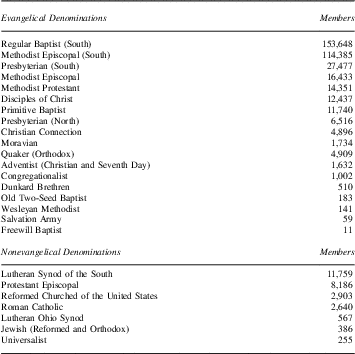
To measure the strength of Protestant evangelicalism among whites across localities in North Carolina we draw on information in the 1890 Census of Religious Bodies providing county-level membership statistics for religious organizations (Haines 2006).Footnote 2 The construction of this measure requires separating white from African American denominations, on the one hand, and evangelical from nonevangelical denominations, on the other hand. The reason for focusing on white denominations is twofold. One, the previous literature on the role of evangelicalism in agrarian populism does so (for an important exception, see Ali Reference Ali2010). Two, as noted, we do not have access to local-level data on memberships in the Colored Alliance. To separate white from African American denominations we rely on Bailey and Snedker’s classification of the leadership and membership of religious organizations in the 1890 Census of Religious Bodies as primarily white or black (Bailey and Snedker Reference Bailey and Snedker2011).
Following Mark Noll (Reference Noll2002; cf. Gahr and Young Reference Gahr and Young2014), by “evangelical” we refer to a multifaceted welter of Protestants with four common characteristics: emphasis on Biblicism; emphasis on personal conversion entailing a “new birth”; emphasis on individual conscience and engagement in religious and social affairs; and a crucicentric emphasis on Christ’s redeeming sacrifice on the cross. Most Protestant denominations in the 1800s qualify as evangelical: “[A]mong the major Protestant denominations in the United States, only the Episcopalians and Lutherans failed to fall within the orbit of evangelical[ism]” (Buenker Reference Buenker1973: 168). In consequence, the measure of the local-level strength of white Protestant evangelicalism include the large main denominations of Baptists, Methodists, and Presbyterians and excludes Episcopalian and Lutheran denominations (for recent quantitative historical sociological studies relying on this definition of evangelicalism, see Andrews and Seguin Reference Andrews and Seguin2015; Lewis Reference Lewis2008). With respect to smaller evangelical denominations, we, following Creech (Reference Creech2006) include, among others, Primitive Baptists, Methodist Protestants, Disciples of Christ, Christian Connection, and Quakers.Footnote 3
We calculate the measure the local-level strength of Protestant evangelicalism among whites in terms of the number of members in primarily white evangelical congregations as percent of the total white population. We also construct a measure calculated as the number of members in white nonevangelical congregations as percent of the total white population. This because it is possible that not only Protestant evangelicalism and its congregations but also congregations of other denominations provided associational settings that brought whites together in repeated interaction fostering ties and affinities conducive to agrarian populist mobilization (cf. Gould Reference Gould1995; Redding Reference Redding2003; Smångs Reference Smångs2016).Footnote 4
Our data on the Farmers’ Alliance draw on information in the archival records of the North Carolina Farmers State Alliance (NCFSA 1887–1902) regarding membership dues paid by county-level local suballiances to the state Alliance. Each quarter Alliance members paid dues of 25 cents to their local suballiances, which, in turn, paid 5 cents of these dues to the state Alliance. To estimate the number of dues-paying members in local suballiances, we accordingly divided the highest quarterly dues amount paid by each county to the state Alliance in the eight quarters of the two-year period 1891 to 1892 by 0.05.Footnote 5 Our measure of local-level collective agrarian populist mobilization in the Farmers’ Alliance was then calculated as the number of dues-paying members as a proportion of the total white population using data from the 1890 Census (Haines 2006).Footnote 6 Using the quarter with the highest dues amount paid to the state Alliance to estimate the number of members in each local suballiance alleviates the potential measurement error of farmers moving in and out of the Alliance because they were not able to afford the membership dues. The records of the NCFSA note and lament the inability of some members to keep paying membership dues and show that those who could not pay their dues were “suspended” from membership and participation in the organization. The records further suggest that paying dues reflected a closer allegiance to and identification with the Alliance’s organizational demands and goals (NCFSA 1892). This suggests, for one thing, that dues payments capture the most active and devoted members of a larger pool of disaffected farmers, and, for another, that the number of dues-paying members as a proportion of the total white population validly measures the extent and strength of Farmers’ Alliance mobilization on the local level (cf. Redding Reference Redding1992, Reference Redding2003).
To measure the political mobilization of agrarian populist protest we use county-level information on election returns in 1892 and 1896 (Interuniversity Consortium for Political and Social Research 1999).Footnote 7 In the 1892 elections, the People’s Party’s fielded its own presidential candidate and gubernatorial candidate. While the People’s Party did not field its own presidential candidate in the 1896 elections but ran a ticket together with the Democratic Party, it did field its own candidate in the North Carolina gubernatorial election that year. In consequence, we estimate three measures of the local-level political populist mobilization as the number of votes received by the People’s Party’s candidate in the 1892 presidential election and the 1892 and 1896 gubernatorial elections, respectively, as a proportion of total votes cast in each election. It should be noted that although the People’s Party ended up fielding its own candidate in the 1896 gubernatorial election in North Carolina, it did at one point or another consider entering into formal cooperation in that election with either the Republican Party or the Democratic Party. Due to these complexities of fusion politics, including not only the People’s Party’s joint ticket with the Democratic Party in the national presidential election but also the real possibility of electoral cooperation across party lines in different directions in state-level elections, some caution is warranted in interpreting the results for the 1896 gubernatorial election in North Carolina.
Control Variables
As described in “Historical Background,” the impetus for agrarian populism was the worsening material conditions among rural white southerners accompanying the postbellum transformation of the region’s agricultural economy.Footnote 8 The multivariate models presented in the following text therefore include a number of variables controlling for county-level economic conditions that may have been associated with the mobilization of agrarian populist protest in the Farmers’ Alliance and the People’s Party. To consider the shift toward commercial farming, the models include a variable indicating the percent of improved farmland devoted to cotton production.Footnote 9 The great fear of losing their farms and becoming landless farm tenants increasingly beset white yeomen as crop-lien debt trapped more and more of them. To assess the inroad of crop-lien credit and farm tenancy into postbellum farming communities, the models include, for one thing, a variable indicating the percent encumbered owned farms, and, for another, a variable indicating the percent tenant farms. As our aim here is to gauge agrarian populist protest among whites, we would ideally like to separate farm encumbrance and tenancy rates by race. The available data do, however, not allow for that. To mitigate, as far as possible with the available data, against this potential measurement error, the models include a control for the natural log of the size of the black population. As diagnostic tests, using variance inflation factors, indicated multicollinearity between the natural log of the size of the black population and other independent and control variables, our models use the mean-centered transformation of this variable, which reduces the multicollinearity among covariates to levels of no concern (Iacobucci et al. Reference Iacobucci, Schneider, Popovich and Bakamitsos2016). To take the fact that agrarian populist protest was rooted in rural areas, the models include a measure of urbanization in terms of the percent of the population living in places of at least 2,500 inhabitants (which follows the US Census definition of urbanized areas). Due to the highly skewed distribution of relative urban population (all but 17 North Carolina counties had no urban population in 1890), the models include cubic-root transformed values of this variable to achieve better model fit. The models, finally, include a dummy variable indicating counties located in the Appalachian mountain region to control for its distinctive economic and political characteristics (Redding Reference Redding1992, Reference Redding2003).
Results
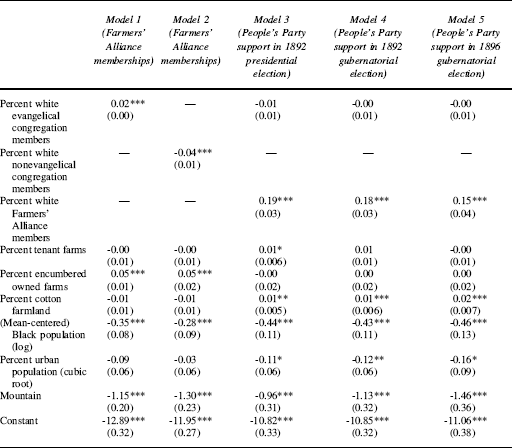
The outcomes of interest here are the county-level proportion of Farmers’ Alliance members of the total white population and the county-level proportion of People’s Party votes of all votes in various elections. Following the strategy proposed by Papke and Wooldridge (Reference Papke and Wooldridge1996) for modeling such proportional dependent variables, table 1 presents a number of models that apply the generalized linear model framework with a binomial family distribution, a logit link function, and robust standard errors.Footnote 10
Generalized linear model estimates of the association between evangelicalism and agrarian populist mobilization in the Farmers’ Alliance and the People’s Party in North Carolina in the 1890s

Note: Numbers in parentheses are standard errors. The number of observations in each model is 96 counties.
* p<0.10; ** p<0.05; *** p<0.01 (two-tailed tests)
Model 1 provides evidence that Protestant evangelicalism was associated with county-level agrarian populist mobilization in the Farmers’ Alliance in that the covariate coefficient for white population percent being members in white Protestant denominations is positive and statistically significant. But before concluding that white Protestant evangelical congregations served as mobilizing structures for the Farmers’ Alliance, we must ascertain to what extent other white religious denominations were similarly associated with it. The results of model 2 suggest, however, that this was not the case—the covariate coefficient for the percent of the white population that was members in other denominations than Protestant evangelical ones is statistically significant negative. The contrasting results of models 1 and 2 thus suggest that the ideological and social milieu of Protestant evangelicalism indeed played a distinct positive role in mobilizing agrarian populist protest in the Farmers’ Alliance.
The results for the control variables in models 1 and 2 show that the level of Farmers’ Alliance mobilization was higher in counties with more encumbered farms and lower in counties with larger African American populations and in counties located in the mountain region. The coefficients for farm tenancy, cotton production, and urbanicity were negatively associated with Farmers’ Alliance mobilization, but do not reach conventional levels of statistical significance. These results suggest that on the county level the Farmers’ Alliance did not respond to southern farmers’ increasing involvement in commercial cotton farming as such. That the Farmers’ Alliance had limited success in mobilizing tenant farmers can be explained by their not benefitting much from the Alliance’s most important activity—the economic cooperatives—as they lacked cash reserves and unlike smallholders could not opt out of the financing and marketing arrangements provided by landlords (Barnes Reference Barnes2011; cf. McMath Reference McMath1975).
Models 3, 4, and 5 assess the association between Protestant evangelicalism and the mobilization of agrarian populism in the People’s Party in the 1892 presidential, the 1892 gubernatorial, and the 1896 gubernatorial elections. In addition to the same control variables as in models 1 and 2, these three models control for the level of Farmers’ Alliance mobilization in terms of the number of Farmers’ Alliance members as percent of the total white population. Unsurprisingly, this variable is statistically significantly positive in all these models, demonstrating a certain level of continuity between the two phases of agrarian populist mobilization. More important for present purposes is that in contrast to models 1 and 2, models 3 to 5 fail to bear out a statistically discernible positive association between the percent whites who were members of white Protestant denominations and the proportion votes received by the People’s Party’s candidate. In fact, although far from conventional levels of statistical significance, the covariate coefficient for white population percent being members in white Protestant denominations is in all models negative. As discussed previously, we recognize a need for caution in interpreting the results for the 1896 gubernatorial election in North Carolina. But because the results for that election (model 5) do not differ from those of the 1892 presidential (model 3) or gubernatorial (model 4) elections, we see no reason to doubt their reliability. In sum, then, the five models in table 1 provide evidence that Protestant evangelicalism systematically channeled the mobilization of agrarian populism more during its initial movement phase in the Farmers’ Alliance than in its later political phase in the People’s Party.
As for the results of the control variable in models 3, 4, and 5, they follow with two important exceptions those of models 1 and 2. One, the prevalence of farm encumbrance does not appear to have generated support for the People’s Party in the way that it did for the Farmers’ Alliance. This is perhaps not too surprising considering that the arguably most important concrete incentive to join the Alliance, an incentive not offered by the People’s Party, was its locally organized economic cooperatives that sought to lessen farmers’ dependency on crop-lien debt. Two, while the prevalence of cotton agriculture, as per the results of the first two models, did not appear to have directly fed into the mobilization of the Farmers’ Alliance, the results of models 3, 4, and 5 suggest that it did generate support for the People’s Party. To make sense of these seemingly contradictory results, we should recall that one reason some Farmers’ Alliance leaders and members decided to found the People’s Party was their conviction that many of the problems facing southern farmers in the region’s predominantly cotton-based agricultural economy, for example, declining farm commodity prices and an appreciating dollar, could not be solved by the local-level economic action promoted by the Alliance but required political action on the state and federal levels. That the People’s Party but not the Farmers’ Alliance performed better in localities more dominated by cotton production is therefore less perplexing than it may appear at first glance.
Conclusions
Scholars have long sought to explain the sudden rise and fall of southern agrarian populism in the late nineteenth century. The dominant line of analysis in this body of research focuses, for the most part, on economic conditions, particularly declining cotton prices, rising indebtedness, and increasing landlessness, in accounting for why and when southern white farmers joined together first in the Farmers’ Alliance and later in the People’s Party. Moreover, while emphasizing the role of economic conditions in explaining the rise of agrarian populism, this line of analysis emphasizes political circumstances, for example, the violence, fraud, and appeal to white supremacy propagated by the Democratic Party, in explaining its fall. While not denying the importance of such conditions, we pursue in this article a line of analysis probing to what extent southern Protestant evangelism provided mobilizing structures for agrarian populism in its initial movement and its later party phase, respectively.
Given the centrality of voluntary membership organizations in local community life in the nineteenth-century South and the region’s religious and political culture at the time, we have argued that southern Protestant evangelism channeled the mobilization of agrarian populist protest in the form of the Farmers’ Alliance to a clearer and greater extent than in the form of the People’s Party. To evaluate our argument, we conducted empirical analyses using local-level statistical data on memberships in evangelical Protestant denominations, memberships in the Farmers’ Alliance, and electoral outcomes for the People’s Party in North Carolina in the 1890s. The empirical analyses revealed systematically higher levels of Farmers’ Alliance mobilization in places where larger proportions of the white population were members of white evangelical Protestant denominations, but failed to bear out a comparable association between white evangelical Protestant denominational memberships and People’s Party’s support in the 1892 presidential and the 1892 and 1896 gubernatorial elections.
By elaborating how and demonstrating that organized evangelical Protestantism served as indigenous local-level mobilizing structures for the Farmers’ Alliance, but not similarly mobilized support for the People’s Party, these findings provide clues into the rapid rise and decline of agrarian populism in the late nineteenth century. They suggest that its rapid rise can be partly accounted for by the fact that by assuming the familiar leadership and organization, as well as drawing on the widely accepted beliefs and values of evangelical Protestantism, the Farmers’ Alliance fit naturally into the fabric and functioning of southern communities. In contrast, attempting to fuse politics and religion in ways conflicting with well-entrenched beliefs and practices about the relation between the two spheres, the People’s Party did not fit readily into the mold of southern communities in general or evangelical Protestantism in particular, contributing to its rapid decline once it entered the arena of electoral party politics. Thus, demonstrating how evangelical Protestantism facilitated the collective agitation and mobilization of agrarian populism in its initial social movement phase, but hampered its later political party phase, this article adds to our understanding of the nature of the movement-party disjuncture that ultimately spelled its demise.
Appendix
Statewide memberships in evangelical and nonevangelical white denominations in North Carolina in 1890

Source: Census of Religious Bodies 1890 (Haines Reference Haines2006).