INTRODUCTION
Laser ion sources are devices delivering ion beams useful for material modification as well as for basic particle emission physics (Dubenkov et al., Reference Dubenkov, Sharkov, Golubev, Shumshurov, Shamaev, Roudskoy, Streltsov, Satov, Makarov, Smakovsky, Hoffmann, Laux, Müller, Spädtke, Stöckl, Wolf and Jacoby1996; Haseroth & Hora, Reference Haseroth and Hora1996). Transport of the extracted ion beam is affected by free expansion of the generated plasma into the vacuum which can be visualized by mapping the positions of ions. In this paper, we propose a method of visualization, which we call mapping of charge density of laser-produced ions. For investigation of laser-produced plasma as a source of ions, the diagnostics based on the time-of-flight (TOF) method is mainly applied. In order to determine space properties of expanding plasma, a number of ion detectors located at various angles ϕ with respect to the target surface normal or to the laser vector are employed.
The general trend in the angular distribution of emitted ions has been determined by an expression of a two-component structure (Thum et al., Reference Thum, Rupp and Rohr1994; Thum-Jäger & Rohr, Reference Thum-Jäger and Rohr1999):
 $$S\lpar {\rm \phi}\rpar =a \, \cos\lpar {\rm \phi}-{\rm \phi}_{\rm o}\rpar -b \, \cos^n\lpar {\rm \phi}-{\rm \phi}_{\rm o}\rpar \comma$$
where S(ϕ) is the density of particles in the zenithal direction, ϕ, and ϕ0 denotes the declination (ejection angle) from the target surface normal direction caused by the laser-plasma interaction (Thum et al., Reference Thum, Rupp and Rohr1994 ); usually ϕ0 differs from the impact angle of the laser beam ϕL.
The proposed technique of angular distribution mapping of the ion emission from laser-produced plasma is based on the analysis and computing signals of TOF ion collectors (IC) positioned at various angles ϕIC. All the ion collectors should be positioned far from the target where the charge states are already stable because the three-body recombination does not significantly affect the evolution of the expanding plasma lowering the charge state of ions any more. On the basis of this model, the plasma charge states can be assumed to be frozen at the distance of several tens of centimeters from the target (L cr) (Roudskoy, Reference Roudskoy1996; Thum-Jäger & Rohr, Reference Thum-Jäger and Rohr1999; Krása et al., Reference Krása, Láska, Rohlena, Pfeifer, Skála, Králiková, Straka, Woryna and Wolowski1999; Lorusso et al., Reference Lorusso, Krása, Rohlena, Nassisi, Belloni and Doria2005).
The creation of an ion map means transforming time-resolved ion currents, i.e., TOF spectra, observed in various directions into both angular and distance dependent distributions of the ion charge density. The aim of our work is to apply the innovated distance-of-flight diagnostic which offers the advantages of mapping the space distribution of ion charge density with the use of data from a number of TOF ion collectors. This mapping reveals more details on the ion emission from laser ion sources than the set of data from the TOF collectors.
THEORY
The signal S x(t) of a TOF ion collector measuring the current of impacted ions in x-direction depends on its response to ions' number and velocity given by a three-dimensional velocity distribution function  $f\lpar \vec{v}\rpar $ (Kelly & Dreyfus, Reference Kelly and Dreyfus1988; Miotello & Kelly, Reference Miotello and Kelly1999):
 $$S_x\lpar L\comma \; t\rpar \propto v_{x}\;f\lpar \vec{v}\rpar \;d{\vec{v}}.$$
To obtain the number of ions hitting the ion detector's area dS = dydz per dt at a distance L from the target, the right side of (2) has to be transformed into laboratory space and time: dv xdv ydv z = (L/t 4)dSdt. Substituting L/t for v and multiplying (2) by the charge eq carried by ions (where e is the elementary charge and q is the ion charge-state), one gets the signal function S x(L,t) of IC induced by the current of ions j IC (Kelly & Dreyfus, Reference Kelly and Dreyfus1988; Miotello & Kelly, Reference Miotello and Kelly1999; Krása, Reference Krása2013), which is represented by a voltage pulse U IC(L,t) = R S j IC(L,t):
 $$U_{\rm IC}\lpar L\comma t\rpar =RS {\rm \kappa}_{0} L^{2}\, t^{-5}f\lpar L/t\rpar \comma$$
where R is the load resistance, S the active IC area, and κ 0 is the normalizing coefficient of the product L 2t −5f(L/t).
If the charge states of expanding ions have been frozen beyond a critical distance from the target, L cr, where the three-body recombination becomes insignificant due to the plasma rarefaction (Roudskoy, Reference Roudskoy1996; Lorusso et al., Reference Lorusso, Krása, Rohlena, Nassisi, Belloni and Doria2005), their total charge Q 0 can be regarded as constant, and we can derive the essential similarity relationship for ion currents detected by identical ion collectors which are placed at two different distances L 1 and L 2 in the same direction. Taking into consideration that the time-of-flight varies with the distance as t = L/v, Eq. (3) takes a form:
 $$\,j\lpar L\comma t\rpar L^3={\rm \kappa}_{0} v^{5} f\lpar v\rpar \comma$$
and the similarity relationship for ion currents with “frozen” charges that are detected at different distances is
 $$\,j\lpar L_{1}\comma \; t_{1}\rpar {L_{1}^{3}}=j\lpar L_{2}\comma \; t_{2}\rpar {L_{2}^{3}}\comma$$
where L 1/t 1 = L 2/t 2.
The similarity relationship (5) enables us to determine the charge density distribution q(x,τ) over a distance-of-flight x at a selected time τ after the laser-matter interaction by the use of equation q = j/v, where the time-resolved current j(L,t) is transformed to q(x,τ) applying the relationship between the flight times t, τ and the flight distances L, x as L/t = x/τ. Consequently, dividing both sides of Eq. (5) by v = L 1/t 1 and substituting x, τ, L, t for L 1, t 1, L 2, t 2, respectively, we obtain the flight-distance dependence of the ion charge density, i.e., the distance-of-flight (DOF) spectrum, which at a time τ takes a form:
 $$q\lpar x\comma \; {\rm \tau}\rpar =j\lpar x\rpar {\rm \tau} L^{3}/x^{4}.$$
The relationship (6) gives the transformation of the ion current density j(L,t) in A/cm2 to the ion charge density q(x,τ) in C/cm3 at an arbitrary chosen instant τ after the laser-target interaction if the flight-time is replaced with the flight-distance making the substitution x = Lτ/t. A set of time-resolved ion currents recorded with the use of a number of ion collectors positioned in various directions with respect to the target surface normal allows us to obtain a set of ion charge densities q n(x,τ) in these directions of observation. This set of DOF spectra q n(x,τ) is the basis for creating ion-charge density maps q n(x, y, τ) for any instant τ after the impact of the laser beam on the target.
When the detector is sensitive only to the charge of ions, relationship (2) takes a form q(L,t) L 3 = κ 0v 4f(v). Then we get another significant relationship
 $$q\lpar L_{1}\comma \; t_{1}\rpar {L_{1}^{3}}=q\lpar L_{2}\comma \; t_{2}\rpar {L_{2}^{3}}\comma$$
where L 1/t 1 = L 2/t 2. For the total charge we get a well-known equation q(L 1)L 12 = q(L 2)L 22. This similarity relationship gives a simple and exact determination of the critical distance L cr indicating that charge states of expanding ions have been “frozen” (Lorusso et al., Reference Lorusso, Krása, Rohlena, Nassisi, Belloni and Doria2005).
EXPERIMENTAL ARRANGEMENT
The reported measurements were performed with iodine photo-dissociation laser systems at the PALS facility, Prague delivering onto a target a focused intensity of up to 3 × 10¹⁶ W/cm2 in 300-ps pulses with λ = 1.315 µm and with a Compex 205 KrF excimer laser (λ = 248 nm, τFWHM = 23 ns) at LEAS, Lecce which works at laser irradiances between 108 and 1010 W/cm2. In these experiments, the TOF spectra of ions were measured at PALS by eight ion collectors and at LEAS by nine ion collectors positioned in a horizontal plane at various angles to the laser beam axis, as Figure 1 shows.
(Color online) Schematic diagram of the experimental set-up of the iodine laser system PLAS (a) and of the KrF excimer laser at LEAS laboratory (b).

EXPERIMENTAL RESULTS AND DISCUSSION
The plasma produced at low irradiances of about 109 W cm−2 emits reproducible and smooth peak-shaped ion currents nearly free of shot-to-shot irregularities contrary to the plasma generated at higher intensities (1016 W cm−2) (Krása et al., Reference Krása, Velyhan, Jungwirth, Krouský, Láska, Rohlena, Pfeifer and Ullschmied2009; Reference Krása, Lorusso, Nassisi, Velardi and Velyhan2011). Figure 2 shows such a reproducible emission of ions produced with a KrF excimer laser delivering 8-J/cm2 fluence onto a Cu target. These nine time-resolved ion currents were observed at angles ranging from −19.5° to 19.5° with respect to the target surface normal at 0° in a clockwise direction. The laser pulse struck the target at 70°. The angular distribution is affected by the narrow angular distribution of ions having the highest charge states (Thum-Jäger & Rohr, Reference Thum-Jäger and Rohr1999; Krása et al., Reference Krása, Velyhan, Jungwirth, Krouský, Láska, Rohlena, Pfeifer and Ullschmied2009). The width of the stream of ions, in fact, increases with decreasing ion charge-state.
(Color online) Time-of-flight spectra of Cu ions generated with the KrF excimer laser fluence of 8 J/cm2. The laser beam struck the target at an angle of 70° with respect to the target surface normal.

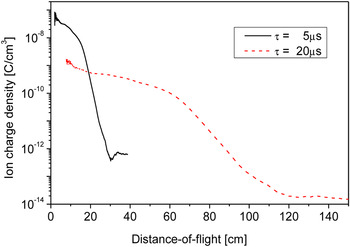
If the charge of freely expanding ions is frozen, then the ion charge densities derived from TOF spectrum show variations over the axis of observation, as Figure 3 shows for different times τ = 5 μs and 20 µs. Remarkable is the fast decrease in the ion charge density over a short distance of 20 cm from the target at 5 µs after the laser shot. The highest charge density at about 3 cm from the target belongs to the slowest ions while the fastest ions, i.e., protons and carbon ions, constituting the peak at 1.3 µs in Figure 2 became very rarefied up to a value of about 5 × 10⁻¹³ C/cm3 at DOF = 33 cm, as the solid line in Figure 3 shows. The dash line in Figure 3 shows that the rarefaction caused by the ion expansion decreases the charge density significantly.

Unlike commonly presented angular distributions of the total number of emitted particles, total charge of ions, as well as a peak current, the transformation based on the relationship (6) makes it possible to map the charge density of ions over a plane of ion-current observation at selected instants, as Figure 4 shows. In this case, nine TOF spectra were transformed into DOF spectra and the map of ion charge density was created. Unfortunately, the space limitations inside the target chamber do not make it possible to put more ion collectors to obtain a fuller angular distribution of expanding ions. Figure 4 gives clear evidence that the space-distribution of ion charge density depends on the velocity of ions, i.e., on their acceleration mechanisms — the fastest ions (protons and carbon ions) carry the charge into the direction of an ion collector labeled with 9, i.e., angle of 19° (or higher), other local maxima of fast ions move in directions of −15° and 5° (see the dark-blue area in the map for τ = 5 µs). The angle of expansion of slower Cu ions is well observable at later time of 30 μs as Figure 4 shows for x < 30 cm: ϕ ≈ 8° (between ion collectors labeled 6 and 7).
(Color online) Charge density maps of ions emitted by Cu plasma at times of 5 µs, 10 μs and 30 μs after the laser-target interaction. These distributions were derived from TOF spectra shown in Figure 2. The labels indicate the directions of observation of ion currents with the use of the individual ion collectors positioned at the distance of 13 cm from the target surface. The KrF laser beam struck the target at an angle of 70° with respect to the target surface normal.

A target irradiated by a medium laser-intensity can emit a high current of ions as Figure 5 shows for a polyethylene target exposed to intensity of 3 × 10¹⁶ W/cm2. The ion current density reached a peak value of 37 A/cm2 at a 40-cm distance from the target.
Time-of-flight dependence of current density (a) and distance-of-flight dependence of charge density (b) of ions emitted from polyethylene plasma produced by intensity of 3 × 10¹⁶ W/cm2. The iodine photo-dissociation laser beam struck the target at an angle of 30°. The ion collector was located at a distance of 40 cm from the target at an angle of −3° with respect to the target surface normal (label 3 in Fig. 6).

The velocity of fastest ions was higher than 2 × 109 cm/s, as can be determined from the DOF spectrum at the time of 400 ns in Figure 5b. This DOF spectrum shows that at the time τ = 400 ns the rarefaction of ions transforms nearly all local peaks in the time-resolved current into inflection points on the DOF spectrum due to the term x 4 in (6). Owing to the high spread in velocity of ions the difference between the highest charge density and the lowest one is more than 7 orders of magnitude.
Figure 6 shows two maps of charge density at times of 400 and 820 ns after the laser pulse irradiation with the (CH2)n target. It is obvious that the choice of the visualization time τ of the ion charge density allows us to highlight the variation in partial ejection angles of ion emission. The ion charge density map formed at τ = 400 ns shows that the fastest ions are ejected in directions at −3° and 30° with respect to the target normal, while the map formed later at τ = 820 ns shows that the slower ions expand at four ejection angles at −19°, 3°, 19°, and 30°. Thus, one can conclude that ions are emitted into various particular directions which are not fixed for all ion groups generated by the same laser pulse. Since the slower ions expand wider than the fast ones, it is possible to deduce that ions are accelerated by various mechanisms. Moreover, we can presume that the plasma expands in a form of a multi-jet fountain where the central jet is declined from the target surface normal and the others exhibit a high declination from this normal. Therefore, the simple angular distribution of emitted ions stated by the expression (1) for a two-component structure is not sufficient due to its time-integral conception that obliterates partial effects related to the minority groups of ionized species.
(Color online) Charge density maps of protons and carbon ions at instants of 400 ns and 820 ns after the interaction of a PALS-laser beam with a (CH2)n target. The labels indicate the directions of observation of ion currents with the use of eight ion collectors positioned at the distance of 40 cm from the target. The iodine photodissociation laser beam struck the target at the angle of 30°; target irradiation of 3 × 10¹⁶ W/cm2.

The ion charge density map, as a two-dimensional graph of the intensities, enables to display profiles of the charge density along a selected line parallel to the y-axis at various distances x from the target surface. Figure 7 shows line-profiles of the ion charge density at distances of 30, 50, and 80 cm from the Cu target surface at 20 μs after the laser-plasma interaction. Figure 8 shows the profiles of the ion charge density at 30, 50, and 70 cm far from the (CH2)n target surface at time of 800 ns. These profiles also prove significant variations in the charge density of ions with increasing distance from the target at a selected time τ. In fact, these profiles match ions moving with different velocities given by the ratio x/τ. A similar state was described above for the CH2 plasma produced by much higher laser intensity. Figure 8 also shows that the partial charge density profiles do not give a complete picture of the ion expansion because these profiles selected for flight-distances of 30, 50, and 70 cm at τ = 800 ns show only four streams: 3 visible maxima and 1 assumed at  ${ {{\rm \phi}}}_{0}=30^\circ$, while the total number of declinations ϕn is n = 5. Nevertheless, the line profiles shown in Figures 7 and 8 enable us to compare the densities of expanding ions which were produced under different conditions.
(Color online) Line-profiles of the ion charge density along selected lines parallel to the y-axis at distances of 30, 50, and 80 cm from the Cu target surface at 20 μs after the laser-plasma interaction which were obtained from the charge density map shown in Figure 4.

(Color online) Line-profiles of the ion charge density along selected lines parallel to the y-axis at distances of 30, 50, and 70 cm from the (CH2)n target surface at 800 ns after the laser-plasma interaction which were obtained from the charge density map shown in Figure 6.

CONCLUSIONS
In conclusion, these results confirm the usefulness of the concept of using the transformation of time-resolved ion currents (TOF spectra) to ion charge density profiles of ions (DOF spectra) over the direction of observation at a selected time τ after the laser-target interaction. The simultaneous measurement of TOF spectra of ions in various directions allows us to determine the map of the ion charge density at selected times. A set of these maps for various τ makes the visualization of the time development in the emission of ions possible if the charge of ions is frozen.
The observed ion charge density maps show that the simple scenario of the plasma expansion, which is based on the idea that all groups of ionized species have the same declination ϕ0 from the target surface normal, should be replaced by a new one reflecting the fact that ions are ejected into various angles ϕn in the dependence on their velocities. This multi-directionality in the ion emission appears even at low laser intensities which remains commonly undetected due to the averaging of the charge density over the ion velocity.
ACKNOWLEDGEMENTS
The authors gratefully acknowledge the support of the staff of the PALS laser facility which is a joint research laboratory of the Institute of Physics and the Institute of Plasma Physics of the Academy of Sciences of the Czech Republic without whose assistance this work would not have been possible. The research leading to these results has received funding from the Czech Science Foundation (Grant Nos. P205/12/0454), the Czech Republic's Ministry of Education, Youth and Sports (grant for the PALS RI - Project IC: LM2010014, and for the OPVK 3: CZ.1.07/2.3.00/20.0279), and from the LASERLAB-EUROPE (grant agreement n° 284464, EC's Seventh Framework Programme).