





1. Introduction
Theories of language embodiment typically propose that language and action are inter-related, and that processing language is grounded upon the actions, objects or events to which the language refers (Barsalou, Reference Barsalou1999; Boulenger et al., Reference Boulenger, Roy, Paulignan, Deprez, Jeannerod and Nazir2006; Buccino et al., Reference Buccino, Dalla Volta, Arabia, Morelli, Chiriaco, Lupo, Silipo and Quattrone2018; Gallese, Reference Gallese2008; Gianelli et al., Reference Gianelli, Kühne, Presti, Mencaraglia and Dalla Volta2020; Glenberg & Gallese, Reference Glenberg and Gallese2012; Gough et al., Reference Gough, Campione and Buccino2013; Marino et al., Reference Marino, Gough, Gallese, Riggio and Buccino2013; Pulvermüller, Reference Pulvermüller2005; Zarr et al., Reference Zarr, Ferguson and Glenberg2013; Zhang et al., Reference Zhang, Sun and Humphreys2016). Support for embodiment theories has come from neuroimaging, behavioural and brain stimulation studies, which have tested the effect of processing motor-related language on motor activity. For example, neuroimaging studies have shown that processing words (e.g., Hauk et al., Reference Hauk, Johnsrude and Pulvermüller2004) and sentences (e.g., Tettamanti et al., Reference Tettamanti, Buccino, Saccuman, Gallese, Danna, Scifo, Fazio, Rizzolatti, Cappa and Perani2005) describing hand (e.g., washed) and foot (e.g., kicked) actions activates the premotor and primary motor cortical regions that are active during actual hand and foot actions. Similar findings from studies of hand-related nouns (e.g., Buccino et al., Reference Buccino, Dalla Volta, Arabia, Morelli, Chiriaco, Lupo, Silipo and Quattrone2018; Dreyer et al., Reference Dreyer, Picht, Frey, Vajkoczy and Pulvermueller2020; Kuhnke et al., Reference Kuhnke, Kiefer and Hartwigsen2020; Marino et al., Reference Marino, Gough, Gallese, Riggio and Buccino2013, Reference Marino, Sirianni, Dalla Volta, Magliocco, Silipo, Quattrone and Buccino2014) suggest that word representation is grounded in the real-world experience of the action/object that the word/s describe – hence, the similar neural activations while processing language and performing actions or viewing actions/objects.
Behavioural findings from studies of verbs (e.g., Gianelli et al., Reference Gianelli, Kühne, Presti, Mencaraglia and Dalla Volta2020; Klepp et al., Reference Klepp, Van Dijk, Niccolai, Schnitzler and Biermann-Ruben2019; Sato et al., Reference Sato, Mengarelli, Riggio, Gallese and Buccino2008) and nouns (e.g., Buccino et al., Reference Buccino, Dalla Volta, Arabia, Morelli, Chiriaco, Lupo, Silipo and Quattrone2018; Glover et al., Reference Glover, Rosenbaum, Graham and Dixon2004; Marino et al., Reference Marino, Gough, Gallese, Riggio and Buccino2013, Reference Marino, Sirianni, Dalla Volta, Magliocco, Silipo, Quattrone and Buccino2014) have shown that processing effector-related stimuli can modify subsequent effector responses. Motor activations can either inhibit an early effector response or facilitate a later effector response – depending upon when the participant is required to respond (Marino et al., Reference Marino, Gough, Gallese, Riggio and Buccino2013). These findings are said to occur as processing effector-related verbs and nouns representing objects that can be acted upon provides the motor system with the potential to perform the described acts or to act upon the described objects. Embodiment theories are further supported by brain stimulation evidence (see Buccino et al., Reference Buccino, Riggio, Melli, Binkofski, Gallese and Rizzolatti2005; Gough et al., Reference Gough, Campione and Buccino2013; Repetto et al., Reference Repetto, Colombo, Cipresso and Riva2013). For example, Repetto et al. (Reference Repetto, Colombo, Cipresso and Riva2013) used repetitive transcranial magnetic stimulation (rTMS) to disrupt activity in the left-hemisphere hand area of the primary motor cortex. The study found impaired subsequent processing of hand-related language, suggesting that the left-hemisphere primary motor hand area is involved in processing words referring to hand-related actions.
Taken together, there is a variety of evidence aligning with the idea that language and action are interrelated and that processing language is an embodied process – though this is disputed by some (e.g., de Zubicaray et al., Reference de Zubicaray, Arciuli and McMahon2013, Reference de Zubicaray, McMahon and Arciuli2021; Papeo et al., Reference Papeo, Vallesi, Isaja and Rumiati2009; Solana & Santiago, Reference Solana and Santiago2022). However, other factors beyond motor relatedness affect word processing and could be influencing embodiment findings. For instance, frequency, which refers to how regularly a word is encountered, can influence responses across various experimental tasks (Brysbaert et al., Reference Brysbaert, Mandera and Keuleers2018; Ellis, Reference Ellis2002). Typically, high-frequency words elicit quicker responses than low-frequency words as they tend to be better known and processed more quickly (Monsell et al., Reference Monsell, Doyle and Haggard1989). Brysbaert and Biemiller (Reference Brysbaert and Biemiller2017) further found that frequency was the greatest predictor of reaction time (RT) speed in lexical decision tasks (LDTs) – further highlighting its importance as a variable. However, word frequency is generally controlled for by language researchers broadly, and more specifically, by those supporting the embodiment view (e.g., Buccino et al., Reference Buccino, Riggio, Melli, Binkofski, Gallese and Rizzolatti2005; Marino et al., Reference Marino, Gough, Gallese, Riggio and Buccino2013, Reference Marino, Sirianni, Dalla Volta, Magliocco, Silipo, Quattrone and Buccino2014), and it is therefore unlikely to upset previous findings.
What has been less considered in embodiment literature is Age of Acquisition (AoA) – the period within which a word, phrase or concept has been learned. Though there is no specific agreement, early AoA is generally categorised as acquisition before 6/7 years old and late AoA as acquisition after 6/7 years old (Brysbaert et al., Reference Brysbaert, Van Wijnendaele and De Deyne2000). The effect of early AoA can be observed across numerous tasks (see Arnon et al., Reference Arnon, McCauley and Christiansen2017; Brysbaert et al., Reference Brysbaert, Van Wijnendaele and De Deyne2000; Ellis et al., Reference Ellis, Holmes and Wright2010; Morrison & Ellis, Reference Morrison and Ellis1995; Stadthagen-Gonzalez et al., Reference Stadthagen-Gonzalez, Bowers and Damian2004). For instance, Stadthagen-Gonzalez et al. (Reference Stadthagen-Gonzalez, Bowers and Damian2004) found significantly quicker RTs to early acquired words than to late acquired words. Later, Smith-Spark et al. (Reference Smith-Spark, Moore and Valentine2012) found significantly quicker hand RTs to celebrities` names learned early in life compared to later learned celebrities’ names, which persisted when frequency of exposure, facial distinctiveness and familiarity were controlled. In addition, Arnon et al. (Reference Arnon, McCauley and Christiansen2017) found that participants were quicker to categorise the plausibility of early learned (e.g., have a cookie) versus late learned (e.g., have a photo) phrases.
AoA effects have also been shown to persist across the lifespan. Catling et al. (Reference Catling, South and Dent2013) compared object naming in younger controls (M age = 22.4), healthy older controls (M age = 80.8) and older adults with cognitive impairments (M age = 82.5). Across all groups, early learned items elicited quicker responses, though RTs did increase with age and with impairment. Navarrete et al. (Reference Navarrete, Pastore, Valentini and Peressotti2015) found a similar early AoA advantage in relation to speech production. Additionally, in two separate studies, Cuetos et al. (Reference Cuetos, Herrera and Ellis2010, Reference Cuetos, Arce, Martínez and Ellis2017) found that Alzheimer’s disease (AD) patients better remembered and pointed to early learned than late learned words, though the AD group was significantly more impaired than controls. Overall, these findings highlight the influence that AoA effects have across the lifespan.
Despite the influence that AoA can have on experimental outcomes, it is often not controlled for in embodiment-related experiments (e.g., Buccino et al., Reference Buccino, Dalla Volta, Arabia, Morelli, Chiriaco, Lupo, Silipo and Quattrone2018; Gough et al., Reference Gough, Riggio, Chersi, Sato, Fogassi and Buccino2012; Repetto et al., Reference Repetto, Colombo, Cipresso and Riva2013; Willems et al., Reference Willems, Hagoort and Casasanto2010); however, there are some exceptions to this (e.g., García-Marco et al., Reference García-Marco, Morera, Beltrán, de Vega, Herrera, Sedeño, Ibáñez and García2019; Sokoliuk et al., Reference Sokoliuk, Calzolari and Cruse2019). As such, it is not entirely clear if many existing embodiment findings are being influenced by stimuli that have not been balanced for AoA. The present experiments sought to test this possibility by directly examining the effect of AoA on hand responses to language.
Specifically, we tested the effect of AoA, hand relatedness, frequency and word imageability on hand RTs to language (our measure of embodiment). Word imageability is typically described as the ease at which a word can evoke a mental image (Paivio et al., Reference Paivio, Yuille and Madigan1968). This variable was included as highly imageable words have been found to elicit quicker responses to language (Cortese et al., Reference Cortese, McCarty and Schock2015), though Dymarska et al. (Reference Dymarska, Connell and Banks2023) did find that imageability effects were small and typically varying.
In our study, a LDT was presented to a younger sample (aged 18–44 years old – Experiment 1) and to an older sample (aged 50–65 years old – Experiment 2). Of particular interest in both experiments was whether the expected main effect for hand relatedness (i.e., different hand RTs to words with higher ratings of hand/arm relatedness) would be evident, and if present, whether it would be influenced by AoA. The inclusion of the older adult sample in Experiment 2 allowed us to further test the effect of AoA on hand-related language across the lifespan. Typically, ageing is associated with many physical and cognitive changes, which can include a reduction in bodily movement and deficits in processing speed (Costello et al., Reference Costello, MacCormack, Paek, Jalloh and Borghi2025; Wingfield & Grossman, Reference Wingfield and Grossman2006). However, language processing including AoA effects (see above) have generally found to be preserved with ageing (Shafto & Tyler, Reference Shafto and Tyler2014), but whether this extends to hand-related language is a little less clear. As with Experiment 1, we expected an early AoA advantage with our older adult sample in Experiment 2, and our analysis also tested whether this AoA effect interacts with hand relatedness.
2. Experiment 1: Lexical decision task – Younger adults
2.1. Method
2.1.1. Participants
Forty participants were recruited for the younger adult experiment (20 females and 20 males) – all aged between 18 and 44 years (M = 22.3, SD = 6.2). Participants were recruited via poster advertisement at Maynooth University and via a research participant pool at Maynooth University. Those recruited from the participant pool received course credit for their participation. All participants were right-handed according to the Edinburgh Handedness Inventory (M = 73.9, SD = 14.9) (Oldfield, Reference Oldfield1971) and spoke English as a first language. No participant self-reported psychological/neurological impairment, history of epilepsy or memory issues or history of language-related disorders (e.g., dyslexia and aphasia). No financial incentives were offered for participation, and the experiment was conducted in accordance with MU’s research policy and received approval from the Maynooth University Social Research Ethics Sub-Committee (SRESC-2018-144).
2.1.2. Stimuli
The stimuli consisted of 120 English words and 60 pseudowords (https://doi.org/10.17605/OSF.IO/84B2C). The 120 English words comprised of verbs and nouns (similar but not exactly equal in number per category) that were classified as early acquired (i.e., learned before the age of 7 years old – see Brysbaert & Ghyselinck, Reference Brysbaert and Ghyselinck2006; Kogan et al., Reference Kogan, Muñoz, Ibáñez and García2020) and late acquired (i.e., learned after 7 years old). Early acquired words were drawn from the Jolly Phonics series of workbooks and activity books – designed to be taught to school children who are approximately 4–6/7 years old (Lloyd et al., Reference Lloyd, Wernham and Stephen2018). Late acquired words were taken from the Less Stress More Success English book (Kelly, Reference Kelly2018) and from the English Extra revision book (Behan, Reference Behan2019) – both of which apply to older students in Ireland (i.e., 16–18/19 years old). A specific AoA score for each word was also established via the Kuperman et al. (Reference Kuperman, Stadthagen-Gonzalez and Brysbaert2012) AoA norms.
Half the verbs and nouns in the early and late acquired conditions were classified as hand related (e.g., coat and strike), and the other half were classified as non-hand related (e.g., garage and vary). A specific hand-related score for each word was also established via the Lancaster sensorimotor norms (Lynott et al., Reference Lynott, Connell, Brysbaert, Brand and Carney2020), which provide ratings of the degree to which words are experienced by different bodily modalities (i.e., the hand/arms). Additionally, half the words in both the early and late acquired conditions were high in frequency, while the other half were low in frequency. High in frequency was defined as having a combined total of 150 + from the Thorndike–Lorge written frequency (Thorndike & Lorge, Reference Thorndike and Lorge1944) and Kucera–Francis written frequency scales, as per the MRC Psycholinguistic Database (Coltheart, Reference Coltheart1981). Low in frequency was defined as scoring a total of <150 on the same two psycholinguistic scales. A specific frequency value (Zipf scale) for each word was also established via a large language model (LLM) database containing familiarity estimates and frequency norms for over 400,000 English words (Brysbaert et al., Reference Brysbaert, Martínez and Reviriego2025). An imageability norm for each word was established using a combination of MRC (Coltheart, Reference Coltheart1981), Bristol (Stadthagen-Gonzalez & Davis, Reference Stadthagen-Gonzalez and Davis2006), Glasgow (Scott et al., Reference Scott, Keitel, Becirspahic, Yao and Sereno2019) and Cortese (Cortese & Fugett, Reference Cortese and Fugett2004; Schock et al., Reference Schock, Cortese and Khanna2012) databases. Here, the MRC imageability norms were divided by 100 to fit the scoring ranges from the other databases. Thus, overall, each presented word was comprised within the categories of AoA, hand relatedness, frequency and imageability.
The 60 pseudowords were created using Microsoft Excel, version 16.0, by randomly ordering the letters that comprised the real English words in the experiment and constructing new pseudowords (not necessarily pronounceable). The pseudowords and real words were also matched for number of letters.
2.1.3. Procedure
All participants were individually tested at Maynooth University. Upon arrival, each participant was provided with an information sheet outlining the general nature of the experiment. They were required to complete a consent form before being taken to a dimly lit testing cubicle. Here, the participant sat on a chair approximately 55 cm from a 15-inch standard 4:3 ratio computer screen. The computer screen and keyboard were placed on a small table just in front of the participant’s chair. The participant was informed that the experiment would consist of a number of onscreen trials, and that each trial would present a string of letters in the centre of the screen. They were instructed to read the letter strings carefully and respond as quickly and accurately as possible – by pressing the keyboard spacebar with the right hand only – whenever the letter string was a real word (i.e., a go/no-go LDT). Participants were also instructed to refrain from responding when the letter string was not a real word. The instructions for the experiment were then presented onscreen, and the experimenter ascertained if each participant understood the task. The experiment began when the participant pressed the keyboard spacebar.
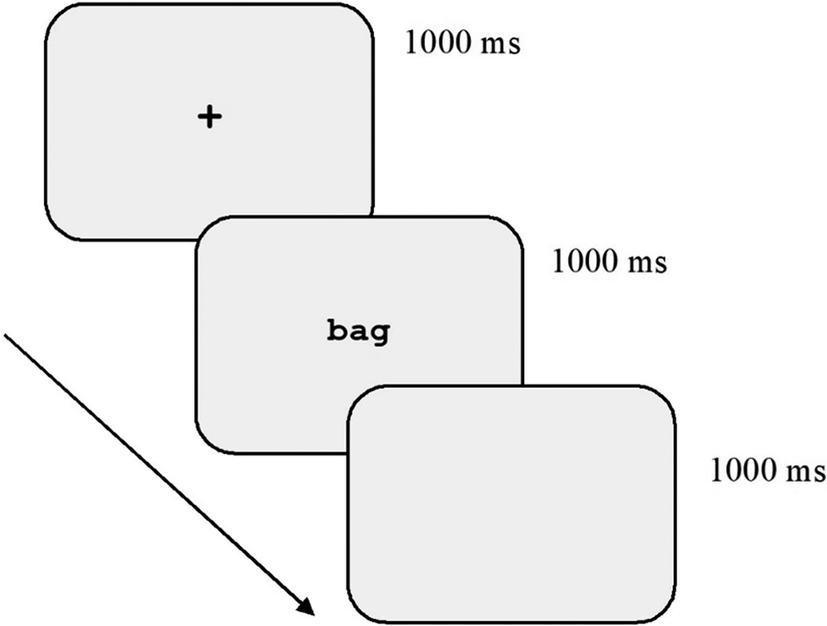
The experiment was presented via EPrime Psychology Software Tools, version 2.0, (2018). All stimuli were presented in the centre of the screen in black Courier New size 32 font on a silver background. Overall, the experiment consisted of 360 trials (block of 180 stimuli presented twice). Each trial began with a fixation cross that was presented for 1000 ms. A letter string (i.e., a real word or a pseudoword) was then presented for 1000 ms. The participant was required to respond when the letter string was a real word, whereas a pseudoword required no response. The letter string remained on the screen for 1000 ms, independent of the response time. A blank screen was then presented for 1000 ms before the experiment moved to the next trial (see Figure 1). Each trial lasted 3000 ms, and completion of the task took approximately 20–25 minutes. After every 90 trials, participants were allowed to take a break. After each break, the experiment continued when the participant pressed the spacebar. Trials were presented in a randomised order within the two blocks.
Example of an experimental trial. Fixation cross appeared for 1000 ms. A letter string was then presented for 1000 ms (e.g., a real word – bag – requiring a response; or a pseudoword – smoh – not requiring a response). A blank screen appeared for 1000 ms before the experiment moved to the next trial.

2.1.4. Design
The experiment used a repeated-measures design consisting of five continuous independent variables and one continuous dependent variable. The independent variables were AoA, hand relatedness, frequency, imageability and word length. The dependent variable was participants’ hand RTs to real words.
2.1.5. Statistical analyses
A total response accuracy score was calculated for each participant for the 360 trials. This was computed by subtracting the number of incorrect responses during the 240 real word trials and the number of incorrect responses during the 120 pseudoword trials from the total number of trials. Participants had a mean accuracy rate of 98% (Standard Deviation (SD) = 1.3) across all trials. No participant’s response accuracy score was below the set threshold of 85% (see Gough et al., Reference Gough, Riggio, Chersi, Sato, Fogassi and Buccino2012), and no participant was excluded from the final analyses. A mean response time (RT) across all trials was then calculated for each of the 40 participants individually, and all individual responses that were 2 SDs above or below this mean were excluded from the analyses. On average, 97% of the participants’ responses were within 2 SDs of their individual mean times. All preliminary analyses were conducted using Microsoft Excel, version 16.0. Data were then transferred into jamovi version 2.6.44, where linear mixed models analyses were performed. P < 0.05 was taken as significance for all tests.
Data are available at: https://doi.org/10.17605/OSF.IO/84B2C
2.2. Results
A linear mixed model tested the effects of AoA, hand relatedness, frequency, word length and imageability on hand RTs to language. AoA, hand relatedness, frequency, word length and imageability were included as fixed effects, with subjects and words as random intercepts. A significant main effect was found for AoA (F (1, 100) = 10.7, p = 0.002) – later AoA scores were associated with slower RTs (b = 3.6, SE = 1.1 (see Figure 2). A significant main effect was found for frequency (F (1, 101) = 19.4, p < 0.001) – higher frequency scores were associated with quicker RTs (b = −14.9, SE = 3.4) (see Figure 3). No significant main effect was found for hand relatedness (F (1, 101) = 0.22, p = 0.64), imageability (F (1, 101) = 0.002, p = 0.97) or word length (F (1,101) =0.16, p = 0.7). No significant interaction effect was found between AoA and hand relatedness (F (1, 101) = 1.63, p = 0.2), AoA and frequency (F (1, 107) = 0.003, p = 0.96) or hand relatedness and frequency (F (1, 100) = 0.62, p = 0.43).
Later AoA words were associated with significantly slower response times (RTs) (p = 0.002). Shaded area represents confidence intervals.

Figure 2. Long description
The horizontal X axis is labeled Age of Acquisition with numerical markers at 5 and 10. The vertical Y axis is labeled Response times m s with numerical markers at 400, 600, 800, and 1000.
Data points are represented as a dense cloud of semi-transparent black dots distributed across the entire plot area. The dots are clustered in vertical columns corresponding to specific ages.
A solid black regression line starts at approximately 500 m s on the left and shows a slight linear increase as it moves to the right, ending just above 500 m s. A light gray shaded area surrounds the regression line, representing the confidence interval, which remains relatively narrow and consistent in width across the horizontal span of the graph.
Higher frequency words (Zipf) were associated with significantly quicker response times (RTs) (p < 0.001). Shaded area represents confidence intervals. Zipf scale is log10 frequency per billion words.

Figure 3. Long description
The horizontal X axis is labeled Multilex word frequency Zipf with a scale from 2 to 5. The vertical Y axis is labeled Response times m s with a scale from 400 to 1000. The data is presented as a dense scatter plot of individual black dots. The dots are concentrated between 400 and 600 m s across the entire frequency range, with vertical clusters appearing at specific Zipf intervals. A solid black regression line starts at approximately 550 m s at Zipf 2 and shows a slight negative linear slope, ending near 500 m s at Zipf 5.5. A light gray shaded area representing the confidence interval surrounds the regression line, maintaining a consistent width throughout the frequency range.
As participants in Experiment 2 only completed block 1 (i.e., 180 trials – see below), a separate linear mixed model was performed for block 1 from Experiment 1. Here, a significant main effect was found for AoA (F (1, 102) = 11.9, p < 0.001) – later AoA scores were associated with slower RTs (b = 5.18, SE = 1.5). A significant main effect was found for frequency (F (1, 103) = 17.7, p < 0.001) – higher frequency scores were associated with quicker RTs (b = −19.3, SE = 4.6). No significant main effect was found for hand relatedness (F (1, 103) = 0.7, p = 0.4), imageability (F (1, 102) = 0.02, p = 0.86) or word length (F (1,102) =1.3, p = 0.26). No significant interaction effect was found between AoA and hand relatedness (F (1, 102) = 0.18, p = 0.67), AoA and frequency (F (1, 106) = 0.1, p = 0.32) or hand relatedness and frequency (F (1, 102) = 0.17, p = 0.68).
3. Experiment 2: Age of acquisition in older adults
3.1. Method
3.1.1. Participants
Forty older participants aged between 50 and 65 years (M = 56.2, SD = 4.7) were recruited for Experiment 2 (12 females and 28 males). All were recruited via a poster advertisement in Maynooth University, via LinkedIn and psychology subpages on Reddit. As per self-reports, all participants were right-handed and spoke English as a first language. No participant had psychological/neurological impairment, history of epilepsy or memory issues, history of language-related disorders (e.g., dyslexia and aphasia) or motor-related issues. No financial incentives were offered for participation. The experiment was conducted in accordance with Maynooth University research policy and approved by the Maynooth University Social Research Ethics Sub-Committee (SRESC2021–2450172). Due to Covid-19 in-person restrictions at the time of testing, this experiment was run online.
3.1.2. Stimuli
The stimuli consisted of the same 120 words and 60 pseudowords used in Experiment 1.
3.1.3. Procedure
Participants who contacted the researcher through the poster advertisement were emailed a link to the experiment. Separately, the same experimental link was posted on LinkedIn and the psychology subpages on Reddit. Once the participant clicked on the link, they were brought to an information page on Qualtrics (https://www.qualtrics.com/). The information page provided basic details about the experiment and collected demographic information such as age, gender, handedness, as well as each participant’s consent. Participants were also asked to tick a box indicating whether they had motor-related issues; no participant reported any issues here. If the participant consented, via clicking a link, they were brought to the experiment on Pavlovia (https://pavlovia.org/). They were informed that the experiment would consist of a number of onscreen trials, and that each trial would present a blue/lilac letter string in the centre of the screen. Further, they were instructed to read the letter strings carefully and respond as quickly and accurately as possible – by pressing the spacebar on the keyboard with the right hand only – whenever the blue/lilac letter string was a real word. They were instructed to refrain from responding when the blue/lilac letter string was not a real word. Once the participant pressed the spacebar on the computer keyboard, the experiment began.
As with Experiment 1, all stimuli were presented in the centre of the screen on a silver background. However, the older adult LDT was constructed on PsychoPy builder (version 2021.2.3) and run online via Pavlovia. As font colourings differ between PsychoPy and EPrime, the letter string presented here was in blue/lilac Courier New font. The letter height was 0.05, which means that all stimuli appeared as 1/20th the size of participants’ screens. As this experiment was being run online with older adults, it was decided to only run one block. Thus, in total, Experiment 2 contained 180 trials. All other details were as per Experiment 1.
3.1.4. Design and statistical analyses
Experiment 2 used the same repeated-measures linear mixed model design as used in Experiment 1. Data were analysed using the same processes. Participants had a mean accuracy rate of 99% (Standard Deviation (SD) = 1.6) across all trials. No participant’s response accuracy was below the set threshold of 85% (see Gough et al., Reference Gough, Riggio, Chersi, Sato, Fogassi and Buccino2012), and no participant was excluded from the analyses. On average, 96% of the older participants’ responses were within 2 SDs of their individual mean times.
Data are available at https://doi.org/10.17605/OSF.IO/84B2C
3.2. Results
A linear mixed model tested the effects of AoA, hand relatedness, frequency, word length and imageability on hand RTs to language. AoA, hand relatedness, frequency, word length and imageability were included as fixed effects, with subjects and words as random intercepts. A significant main effect was found for AoA (F (1, 103) = 12.1, p < 0.001) – later AoA scores were associated with slower RTs (b = 3.27, SE = 0.9) (see Figure 4). A significant main effect was found for frequency (F (1, 103) = 14.5, p < 0.001) – higher frequency scores were associated with quicker RTs (b = −12.6, SE = 3.3) (see Figure 5). No significant main effect was found for hand relatedness (F (1, 103) = 0.14, p = 0.71), imageability (F (1, 102) = 2.2, p = 0.14) or word length (F (1,104) = 0.68, p = 0.41). No significant interaction effect was found between AoA and hand relatedness (F (1, 104 = 0.09, p = 0.77), between AoA and frequency (F (1, 105) = 0.31, p = 0.58) or hand relatedness and frequency (F (1, 104) = 1.9, p = 0.17).
Later AoA words were associated with significantly slower response times (RTs) (p < 0.001). Shaded area represents confidence intervals.

Figure 4. Long description
The horizontal X axis is labeled Age of Acquisition with numerical markers at 5 and 10. The vertical Y axis is labeled Response times m s with numerical markers from 400 to 1000 in increments of 200. The data is presented as a dense scatter plot of semi-transparent black dots clustered in vertical columns corresponding to specific ages. A solid black regression line starts at approximately 560 m s on the left and shows a slight positive linear increase as it moves to the right. A light gray shaded area surrounds the regression line representing the confidence interval. The majority of data points are concentrated between 400 and 800 m s, with a few outliers reaching up toward 1000 m s.
Higher frequency words (Zipf) were associated with significantly quicker response times (RTs) (p < 0.001). Shaded area represents confidence intervals. Zipf scale is log10 frequency per billion words.

Figure 5. Long description
The horizontal X axis is labeled Multilex word frequency Zipf with a scale from 2 to 5. The vertical Y axis is labeled Response times m s with a scale from 400 to 1000.
Data points are represented as a dense cloud of semi-transparent black dots clustered primarily between 3 and 5 on the X axis and 400 and 800 on the Y axis. The dots are organized in vertical columns, suggesting discrete frequency values.
A solid black regression line starts at approximately 600 m s at Zipf 2 and follows a slight downward linear trend, ending at approximately 550 m s at Zipf 5.5. A light gray shaded area surrounds the regression line, representing the confidence interval, which remains relatively narrow and consistent in width across the entire frequency range.
4. Discussion
The current study tested the effect of multiple factors on RTs in a go/no-go LDT, with younger and older participants, where participants responded with the right hand. Potential explanatory word-related factors included were AoA, hand relatedness, frequency, imageability and word length. The main motivation for the work was to test for an embodiment effect (effect of hand relatedness), and whether that effect might be tempered by AoA effects.
For both younger and older adults, no embodiment effect was found but a main effect of both AoA and frequency was revealed. No main effects of imageability or word length were shown. There were no significant interactions between AoA and hand relatedness, AoA and frequency or between hand relatedness and frequency.
As mentioned previously, AoA effects are consistently found in the literature (e.g., Arnon et al., Reference Arnon, McCauley and Christiansen2017; Brysbaert et al., Reference Brysbaert, Van Wijnendaele and De Deyne2000; Ellis et al., Reference Ellis, Holmes and Wright2010; Morrison & Ellis, Reference Morrison and Ellis1995; Stadthagen-Gonzalez et al., Reference Stadthagen-Gonzalez, Bowers and Damian2004). They can be made sense of in terms of a hypothesis by Ellis and Lambon Ralph (Reference Ellis and Lambon Ralph2000) – the neural network account (See Brysbaert & Ghyselinck, Reference Brysbaert and Ghyselinck2006 for a discussion). Under this account, there is allowance for gradual loss of plasticity in the learning system. This means that early learned words could lead to large weight shifts in connections, but later words will show reduced weight shifts due to the prior experience of the system. Early acquired words, therefore, will always retain an advantage.
We had considered it possible that AoA might interact with hand relatedness because in early language learning, one learns through the sensory experience of words’ referents (i.e., vision, touch, smell, etc.) (Borghi et al., Reference Borghi, Barca, Binkofski, Castelfranchi, Pezzulo and Tummolini2019; Hernandez, Reference Hernandez2013). In contrast, late language learning is often facilitated via linguistic means and not through direct perceptual experience (Borghi et al., Reference Borghi, Barca, Binkofski, Castelfranchi, Pezzulo and Tummolini2019). These differences could result in differences in neural representation, which could plausibly result in late learned hand-related words having no motor advantage (embodiment effect) in an LDT. We, however, found no evidence of this as we found no effects of hand relatedness or an interaction of that factor with AoA.
We suggest that one of the main reasons we did not see an overall effect of embodiment here is due to the fact that our stimuli were purposely selected to reflect earlier and later AoA. As mentioned above, many previous embodiment-related studies have not balanced stimuli in terms of AoA (Buccino et al., Reference Buccino, Dalla Volta, Arabia, Morelli, Chiriaco, Lupo, Silipo and Quattrone2018; Gough et al., Reference Gough, Riggio, Chersi, Sato, Fogassi and Buccino2012; Repetto et al., Reference Repetto, Colombo, Cipresso and Riva2013; Willems et al., Reference Willems, Hagoort and Casasanto2010), with some exceptions (e.g., García-Marco et al., Reference García-Marco, Morera, Beltrán, de Vega, Herrera, Sedeño, Ibáñez and García2019; Sokoliuk et al., Reference Sokoliuk, Calzolari and Cruse2019).
To be clear, our argument is not that embodiment effects do not exist, but rather that embodiment-like effects can be demonstrated and erroneously presented as embodiment when AoA is not considered. There are examples of studies where the factor of AoA has been controlled and where a pattern of results supporting embodiment has been shown (e.g. Boulenger et al., Reference Boulenger, Roy, Paulignan, Deprez, Jeannerod and Nazir2006, Reference Boulenger, Mechtouff, Thobois, Broussolle, Jeannerod and Nazir2008; García-Marco et al., Reference García-Marco, Morera, Beltrán, de Vega, Herrera, Sedeño, Ibáñez and García2019; Rodriguez-Ferreiro et al., Reference Rodríguez-Ferreiro, Menéndez, Ribacoba and Cuetos2009). Boulenger and colleagues used AoA ratings from 20 (2006) to 15 (2008) volunteers. García-Marco et al. (Reference García-Marco, Morera, Beltrán, de Vega, Herrera, Sedeño, Ibáñez and García2019) used AoA ratings based on normative data from the EsPal database (Duchon et al., Reference Duchon, Perea, Sebastián-Gallés, Martí and Carreiras2013). Rodriguez-Ferreiro et al. (Reference Rodríguez-Ferreiro, Menéndez, Ribacoba and Cuetos2009) used values from Cuetos and Alija (Reference Cuetos and Alija2003) and missing values were gathered in two normative studies following the same methods using two new groups of 50 students. It should be noted that AoA measures used can vary considerably in terms of the minimum ratings per word, for example, 15 (Boulenger et al., Reference Boulenger, Mechtouff, Thobois, Broussolle, Jeannerod and Nazir2008) to 50 (Cuetos & Alija, Reference Cuetos and Alija2003). This, in itself, is cause for future consideration. The values used in the current study (from Kuperman et al., Reference Kuperman, Stadthagen-Gonzalez and Brysbaert2012) relied on a minimum of 18 ratings per word.
A brief look at even just this subset of studies (Boulenger et al., Reference Boulenger, Roy, Paulignan, Deprez, Jeannerod and Nazir2006, Reference Boulenger, Mechtouff, Thobois, Broussolle, Jeannerod and Nazir2008; García-Marco et al., Reference García-Marco, Morera, Beltrán, de Vega, Herrera, Sedeño, Ibáñez and García2019; Rodriguez-Ferreiro et al., Reference Rodríguez-Ferreiro, Menéndez, Ribacoba and Cuetos2009) highlights the complexity of understanding all the relevant factors leading to conflicting findings, even where AoA has been considered.
Participants may be typical controls, as in the current study (and e.g., Boulenger et al., Reference Boulenger, Roy, Paulignan, Deprez, Jeannerod and Nazir2006; García-Marco et al., Reference García-Marco, Morera, Beltrán, de Vega, Herrera, Sedeño, Ibáñez and García2019), or patients (e.g., Boulenger et al., Reference Boulenger, Mechtouff, Thobois, Broussolle, Jeannerod and Nazir2008; Rodriguez-Ferreiro et al., Reference Rodríguez-Ferreiro, Menéndez, Ribacoba and Cuetos2009). Task type and dependent variables can vary widely, from LDTs measuring priming (e.g., Boulenger et al., Reference Boulenger, Mechtouff, Thobois, Broussolle, Jeannerod and Nazir2008) to kinematic measures of reaching movements during word processing (Boulenger et al., Reference Boulenger, Roy, Paulignan, Deprez, Jeannerod and Nazir2006) or effects of negation on motor execution in a typing task (García-Marco et al., Reference García-Marco, Morera, Beltrán, de Vega, Herrera, Sedeño, Ibáñez and García2019) to naming accuracy for pictures of actions and objects (Rodriguez-Ferreiro et al., Reference Rodríguez-Ferreiro, Menéndez, Ribacoba and Cuetos2009). Whether a study is looking at effector-specific effects, as in the current study, is also relevant. For example, a patient study (e.g., Rodriguez-Ferreiro et al., Reference Rodríguez-Ferreiro, Menéndez, Ribacoba and Cuetos2009) might look at general motor effects on the processing of motor-related material but effector specificity becomes extremely relevant in any study where typical controls are processing motor-related material and responding in some way; for example, García-Marco et al., Reference García-Marco, Morera, Beltrán, de Vega, Herrera, Sedeño, Ibáñez and García2019 compare the effect of negation on typing of statements related to manual, non-manual and non-action verb sentences. The issue of timing is also relevant. As noted by Boulenger et al. (Reference Boulenger, Roy, Paulignan, Deprez, Jeannerod and Nazir2006), and discussed earlier (Marino et al., Reference Marino, Gough, Gallese, Riggio and Buccino2013), the relative timing of a stimulus and a required response can lead to varying effects. Another complicating feature for manual responses is whether the task requires unimanual dominant (Boulenger et al., Reference Boulenger, Roy, Paulignan, Deprez, Jeannerod and Nazir2006), unimanual dominant or nondominant (Boulenger et al., Reference Boulenger, Mechtouff, Thobois, Broussolle, Jeannerod and Nazir2008), or bimanual (García-Marco et al., Reference García-Marco, Morera, Beltrán, de Vega, Herrera, Sedeño, Ibáñez and García2019) responses. Variations across these factors make direct comparisons very difficult. Specific confounds can also add complexity; for example, Rodriguez-Ferreiro et al. (Reference Rodríguez-Ferreiro, Menéndez, Ribacoba and Cuetos2009) note that the visual complexity for their verb pictures was higher than that for their noun pictures.
While we suggest that taking AoA into account may be one of the main reasons we did not see an embodiment effect in the current study, there are other potential reasons for this. One of the most obvious is our choice of task. We selected an LDT as an automatic measure of embodiment; however, some might argue that a deeper level of processing in the form of a semantic task might be required to elicit these effects (Papeo et al., Reference Papeo, Vallesi, Isaja and Rumiati2009). Note, however, that shallower processing tasks such as responding to go signals (Marino et al., Reference Marino, Gough, Gallese, Riggio and Buccino2013) or LDTs (Miklashevsky et al., Reference Miklashevsky, Reifegerste, García, Pulvermüller, Balota, Veríssimo and Ullman2024) have been used previously.
It should also be noted that within our LDT, we used a randomly created set of pseudowords matched with real words for letter length. This resulted in a list of pseudowords, some of which were pronounceable and some not. It might be argued that including non-pronounceable pseudowords may have lessened the difficulty of the task, to a point where participants processed the stimuli at an even shallower level than for a typical LDT. (See e.g., Martínez-Tomás et al., Reference Martínez-Tomás, Baciero, Lázaro and Hinojosa2025).
As mentioned earlier, embodiment effects have been shown for both nouns (e.g., Marino et al., Reference Marino, Gough, Gallese, Riggio and Buccino2013) and verbs (e.g., Boulenger et al., Reference Boulenger, Roy, Paulignan, Deprez, Jeannerod and Nazir2006). Our aim was to have an equivalent proportion of nouns and verbs within categories; however, these were not exactly equal, and in hindsight, a small number were ambiguous (https://doi.org/10.17605/OSF.IO/84B2C). While we would expect an embodiment effect regardless of category (noun/verb), the strength of that effect is likely to be stronger for verbs. Within the hand-related category, overall there were 31 nouns, 4 ambiguous (i.e., noun/verb) and 25 verbs, while in the non-hand-related category there were 36 nouns, 1 ambiguous and 23 verbs.
We found the same pattern of results for older and younger adults; that is, each group showed an effect of AoA and frequency, but not an effect of hand relatedness.
One obvious, and expected, difference between Experiments 1 and 2 is that older participants show slower RTs (579 v 509 ms). This, in itself, was not of particular interest to us. Older participants likely showed slower responses due to the generally accepted finding (e.g., Forstmann et al., Reference Forstmann, Tittgemeyer, Wagenmakers, Derrfuss, Imperati and Brown2011) that older participants prioritise accuracy over speed. Secondly, the testing environment of Experiment 2 may also have supported or encouraged this shift as it took place online rather than in person (see e.g., Semmelmann & Weigelt, Reference Semmelmann and Weigelt2017).
The issue of the potential changing effect of motor relatedness, or embodiment, with age has been addressed recently in two publications. In an initial work, Reifegerste et al. (Reference Reifegerste, Meyer, Zwitserlood and Ullman2021) showed a potential sparing of motor-related language with age. In three experiments, two lexical decisions and one object naming, it was demonstrated that RTs to both word categories increased with age, but age had a stronger effect on the non-motor-related category. Younger participants showed a difference in RTs to motor- and non-motor-related language, but older participants did not. For naming, accuracy remained stable with age for action-related items but reduced for non-action-related items.
As the authors noted, the lexical decision experiments reported by Reifegerste et al. (Reference Reifegerste, Meyer, Zwitserlood and Ullman2021) were not originally designed to examine motor relatedness, and as a result included an imbalance in the number of items in each category. A second more robust look at the question comes from Miklashevsky et al. (Reference Miklashevsky, Reifegerste, García, Pulvermüller, Balota, Veríssimo and Ullman2024) and is based on data from Balota et al., (Reference Balota, Cortese, Sergent-Marshall, Spieler and Yap2004) and The Lancaster sensorimotor norms (Lynott et al., Reference Lynott, Connell, Brysbaert, Brand and Carney2020). In this study, lexical decision RTs to items with differing degrees of motor relatedness were compared for younger and older adults. The study also examined accuracy and RT for reading items from these categories. Findings show that for lexical decisions, younger adults were faster for words with higher motor relatedness, whereas older adults showed no motor relatedness effect. Neither age group showed a motor relatedness effect for reading.
A separate factor raised by Miklashevsky et al. (Reference Miklashevsky, Reifegerste, García, Pulvermüller, Balota, Veríssimo and Ullman2024) is the effect of task. As mentioned above, within embodiment literature, the discussion about task and the importance of semantic access is fairly common (e.g., Papeo et al., Reference Papeo, Vallesi, Isaja and Rumiati2009; Sato et al., Reference Sato, Mengarelli, Riggio, Gallese and Buccino2008). Under these discussions, there is a view that the requirement for semantic access varies across tasks, and in line with that so will embodiment effects. What is more novel here is the suggestion by Miklashevsky and colleagues that a change in semantic access requirement across tasks will have a differential effect for younger and older participants, the hypothesis being that for tasks heavily reliant on semantic access (e.g., a semantic judgement), both groups of adults are more likely to show an embodiment effect. For tasks with little requirement for semantic access (e.g., reading aloud), neither group is expected to show an effect, and finally for a task with moderate requirement for semantic access (e.g., LDT), an effect for the younger but not the older group is expected. Our LDT results do not align with this as neither of our groups showed an effect with an LDT. However, if we consider, as discussed above, that our pseudoword stimuli meant that our task was in fact more shallow, akin to the reading task in Miklashevsky et al. (Reference Miklashevsky, Reifegerste, García, Pulvermüller, Balota, Veríssimo and Ullman2024), then one could argue that the results do align. As we only used one type of task, we cannot comment further on the hypothesis. It should be noted that our older group is younger than that in the work by Miklashevsky and colleagues, and this could also lead to differing results.
An alternative view on the ageing question is that with senescence comes reduced embodiment effects (see Costello et al., Reference Costello, MacCormack, Paek, Jalloh and Borghi2025). Costello et al. (Reference Costello, MacCormack, Paek, Jalloh and Borghi2025) suggest that with biological ageing our language remains embodied but that we shift our reliance away from sensorimotor representations and interoception to become more reliant on visual and abstract representations, referred to as Embodiment-Based Reweighting (EBR). The authors suggest that the work by Miklashevsky et al. (Reference Miklashevsky, Reifegerste, García, Pulvermüller, Balota, Veríssimo and Ullman2024) is in line with this, as older participants did not show an embodiment effect for the LDT. Support for this EBR view comes indirectly from older participants’ difficulty with motor imagery (Saimpont et al., Reference Saimpont, Malouin, Tousignant and Jackson2013) and their lower body–object interaction (BOI) ratings compared to that of younger participants for a set of words (Miceli et al., Reference Miceli, Wauthia, Lefebvre, Vallet, Ris and Loureiro2022). Costello et al. (Reference Costello, MacCormack, Paek, Jalloh and Borghi2025) also point to reviews showing an apparent reduction or reversal of the concreteness effect with age (Borghi & Setti, Reference Borghi and Setti2017; Pezzuti et al., Reference Pezzuti, Dawe and Borghi2021). Additional supporting evidence suggests that the Mirror Neuron System (Rizzolatti & Craighero, Reference Rizzolatti and Craighero2004), thought to provide a neural substrate for motor-related language embodiment, may be more active, and potentially less efficient, in older adults (Di Tella et al., Reference Di Tella, Blasi, Cabinio, Bergsland, Buccino and Baglio2021). Further primary work addressing the roles of task, AoA, concreteness and neural underpinnings in language embodiment with age will be required to further test the EBR hypothesis.
One further point of difference between Experiment 1 and Experiment 2 in our study was that only one block of stimuli (i.e., 180 trials) was run in Experiment 2, while Experiment 1 presented the same block twice. A separate analysis of block 1 for the younger participants showed the same pattern of results. Future work could run the double-block LDT, or preferably an increased set of stimuli, varying on all continuums, with in-person adults using age as a continuous factor.
Although not central to our aims, our experiments also demonstrated an expected role for frequency. Both Experiments 1 and 2 found that high-frequency words elicited significantly quicker hand RTs than low-frequency words. These results mirror previous findings (e.g., Arnon & Snider, Reference Arnon and Snider2010; Brysbaert et al., Reference Brysbaert, Mandera and Keuleers2018; Ellis, Reference Ellis2002), and thus add to the large body of literature which has highlighted the importance of controlling for word frequency in language-related experiments. As an aside, we should note that we cannot rule out the possibility that frequency trajectory might play a role in our findings as this measure was not taken into account (see Juhasz et al., Reference Juhasz, Yap, Raoul and Kaye2019).
Much previous discussion in the literature has surrounded the relationship between AoA and frequency and whether they can be explained simply by cumulative frequency (Brysbaert & Ghyselinck, Reference Brysbaert and Ghyselinck2006; Ghyselinck et al., Reference Ghyselinck, Lewis and Brysbaert2004; Lewis et al., Reference Lewis, Gerhand and Ellis2001). A cumulative frequency explanation could in part explain our results, but we did not see a significant interaction of the AoA and frequency factors. This point is not central to our discussion because we are advocating the balancing of both frequency and AoA in embodiment-related work.
Taken together, the current findings raise important issues for language embodiment theories and research, as they question claims derived from experiments which found that hand-related words modified hand motor activity during language processing tasks (see Buccino et al., Reference Buccino, Riggio, Melli, Binkofski, Gallese and Rizzolatti2005; Gough et al., Reference Gough, Campione and Buccino2013; Marino et al., Reference Marino, Gough, Gallese, Riggio and Buccino2013, Reference Marino, Sirianni, Dalla Volta, Magliocco, Silipo, Quattrone and Buccino2014) when AoA was not controlled. Generally, researchers concluded that effects occurred as processing language is an embodied phenomenon grounded upon experiences of actions/objects/events that language describes (Buccino et al., Reference Buccino, Riggio, Melli, Binkofski, Gallese and Rizzolatti2005; Gough et al., Reference Gough, Campione and Buccino2013). However, neither Experiment 1 nor Experiment 2 in the present study found an overall significant main effect of hand relatedness (our measure of embodiment) when AoA (among other factors) was considered.
At a minimum, this suggests that researchers should control for AoA – to eliminate its potential as a confound. Future work will need to show that motor-related word effects can still be observed with a variety of tasks when AoA is controlled. Moreover, to further test whether, or to what degree, embodiment persists across the lifespan, future work will need to be extended to a broader range of age groups.
Data availability statement
Data reported on in this article are available at https://doi.org/10.17605/OSF.IO/84B2C under a CC-By Attribution 4.0 International licence.
Acknowledgements
We thank all the participants who gave their time taking part in either the in-person or online experiment. We thank Prof. M. Brysbaert, and a second anonymous reviewer, for valuable feedback on earlier drafts of the manuscript.
Author contributions
Conceptualisation: K.O., S.C., P.M.G.; Formal analysis: K.O.; Investigation: K.O.; Methodology: K.O., S.C., P.M.G.; Project Administration: S.C., P.M.G.; Supervision: S.C., P.M.G.; Writing – Original Draft: K.O.; Writing – Review and Editing: K.O., S.C., P.M.G.
Funding statement
This research did not receive any specific grant from funding agencies in the public, commercial or not-for-profit sectors.


 Open access

