Introduction Footnote 1
This essay analyzes the legal agency and economic roles of women in Brava, a small port city on Somalia’s Indian Ocean coast (south of Mogadishu) in the period 1893–1900. It largely bases itself on a very specific set of sources, namely the sijill or daftar (record book) containing the civil case records of Brava’s Islamic court for this seven-year period. Footnote 2
Brava takes up a distinctive position on this Indian Ocean coast. With its own town language – Chimiini or Chimbalazi, a language related to Swahili with about thirty percent Somali vocabulary – it has historically formed part of the wider Swahili coast. Yet, with an urban population that consists of Somali Tunni and Arabian immigrants who have for generations intermarried with these local Tunni, Brava is also part of Somalia and Somali history. This multi-faceted connectedness makes the findings of this study about Brava relevant to our understanding of the wider region.
As a study based on Islamic court records, this essay enters in conversation with a range of studies about Ottoman qāḍī’s courts and scholarship using Islamic court records for East African (Swahili) history. In the case of the Ottoman studies, the legal agency and socio-economic roles of women in Brava confirm many aspects of their findings, but with interesting exceptions. Footnote 3 As for the studies of the Swahili coast, their focus lies on women’s use of qāḍī’s courts after the transformation of the judicial system by British colonial rule; Footnote 4 by contrast, the analysis of women and the qāḍī’s court of Brava in this essay allows glimpses of a period in which colonial (in this case Italian) impact on social relations and the administration of Islamic law was still minimal. As such its insights are relevant to the very early-colonial history of Swahili women.
As a study of women, this essay also speaks to Somali women’s history, scholarly studies of which have had to rely for this very early colonial period on Somali-language orature and insights from ethnographic studies conducted much later. Footnote 5 The urban women of Brava fit the picture that has emerged from this scholarship, namely that of competent, astute, resilient, and hard-working contributors to the economic life and social cohesion of their families and communities. However, Brava’s women, notably those who were married and not enslaved, give evidence of female legal agency and financial autonomy that has neither been documented for the other towns on the Benadir coast nor for rural Somali contexts of this period. The new data on the women of Brava presented in this essay therefore adds a new dimension to Somali women’s history.
The structure of this essay is as follows. We will first introduce the town of Brava in this time-period (1893–1900), its neighborhoods, the composition of its population, and its recent political and economic history, especially the decline of the political overlordship of the Busaidi sultans of Zanzibar and beginning of Italian rule. Then we will introduce the qāḍī’s records on which this study is largely based, including their strengths and blind spots, and their rewards and challenges for the historian. The main body of this essay is a detailed study of what the qāḍī’s records tell us about women and property: how women acquired property and what kinds of property they owned. The financial transactions by women that gave rise to the legal records under study are woven into the narrative throughout.
In the conclusion, we will evaluate both the nature of Brava’s qāḍī’s court and women’s impressive, even if qualified, legal personhood and their economic and financial agency and place it in the context of the different historiographies outlined above. While the court records give evidence of free, married women’s autonomy in dealings with unrelated business men and financial agents, even more striking are women’s roles as economic partners in family business endeavors, as financial sponsors and supporters of male relatives, including husbands and brothers, and as benefactors of younger female and male relatives who would not have received a share of their estates in intestate succession. Women also emerge as major property owners, especially of real estate, which they leveraged financially to create more wealth and appear to have valued as “a place of their own” and security against the vagaries of life.
Brava in Regional Context
The last decade of the nineteenth century witnessed the beginnings of the formal establishment of European colonial rule in East Africa and the Horn – Britain, France, Germany and Italy all claiming a share. However, European exploration and political and economic interventions dated from much earlier in the century and had intersected with regional developments that in themselves too contributed to the expanding scale and scope of local events and actions. Thus nineteenth-century Zanzibar, seat of the Busaidi sultans of Oman since the 1830s, developed (clove) plantation agriculture and, supported by a network of Indian and Swahili financiers and traders, became a center of global trade with Europe, Asia, and the United States. At the same time it established its political hegemony over a large part of the East African coast. It was in this context that the East African slave trade and the institution of slavery first reached unprecedented heights and then, under European pressure, were forcefully suppressed and gradually abolished. Nevertheless, the middle of the century marked for Brava a moment of relative peace and political stability. By 1837, the Sultan of Zanzibar had firmly established himself as overlord of the Benadir coastal towns, and in 1843 Sultan Yusuf Mahmud of the inland sultanate of Geledi had defeated the competing city-state of Baardheere, which had imposed its power and reformist Islamic ideology on Brava. As the Geledi Sultanate itself gradually declined, Brava’s autonomy received a further boost.
The sultans of Zanzibar were interested in the Benadir chiefly for commercial reasons. Each of the Benadir towns had a Zanzibari governor (wali), who, supported by a military garrison that had grown to one hundred and fifty soldiers by the 1890s, was responsible for maintaining law and order and supervising the collection of import-export taxes that represented Zanzibar’s main revenue from Brava. Nevertheless, led by a council of local elders representing the main sections of the urban community, Brava retained a high degree of administrative autonomy. This meant that the many sultanic decrees promulgated at Zanzibar under pressure of the British, including the momentous ones concerning the abolition of the slave trade and slavery and the changes in the administration of Islamic law, were not implemented in Brava itself. On the contrary, as, from the late 1870s onwards, constraints on the slave trade increased in the Sultan’s dominions further south, the illegal slave trade to the Benadir coast – both by land and by sea – continued and intensified for several decades.
Developments in the second half of the nineteenth-century affected Brava negatively. Even after Baardheere had been defeated, its former allies, the Bimaal of the Merka area, remained hostile. This caused overland travel between Brava and Mogadishu to almost cease. Moreover, in the mid-1870s, Bimaal obstruction of the Webi Goofka destroyed the irrigation crucial to Bravanese fields, negatively impacting exports of sesame and maize. The rinderpest of the late 1880s decimated herds of cattle and goats in Brava and its hinterland. International demand for orchella Footnote 6 dwindled and its price fell by half when the U.S. and European textile industry turned to chemical dyes. Meanwhile, Brava’s economic lifeline, the caravan routes to Baardheere and Luuq, was disrupted as a result of, on the one hand, extended conflict between Somali and Oromo nomadic groups in the area around the Juba River (with Somali pushing Oromo as far south as the Tana) and, on the other hand, the relentless Abyssinian raids on Somali-inhabited areas from the west.
The decline of Zanzibar as a regional power under the successors of Sultan Barghash bin Said (died 1888) opened the way for the expansion of European colonialism to southern Somalia. Barghash himself had granted the administration of the Benadir ports to the Imperial British East Africa Company (IBEAC) and in 1889 Great Britain transferred this right to Italy. Footnote 7 In the short term, these treaties and agreements had no practical impact, since the IBEAC had no immediate interest in the Benadir and Italy lacked the financial and organizational means to establish a colonial administration in the region. Eventually, the Italian government opted for a temporary solution that would not involve any major financial burden to its treasury. In May 1893, it signed a three-year contract with Vincenzo Filonardi, an Italian who had opened a trading house in Zanzibar and was acting as the Italian Consul there. Thus Filonardi came to administer the Benadir ports of Warsheikh, Mogadishu, Merka, and Brava. In return for the right to collect all customs duties, he was expected to make an annual payment of 160,000 rupees to the Sultan of Zanzibar, while receiving a subsidy from the Italian government. Formally the Benadir ports continued to be part of the Zanzibar dominions; Zanzibari walis and customs masters remained in office and the local qāḍīs continued to administer justice according to the Shari`a. This put limits on the changes the embryonic Italian administration might have wanted to introduce.
In 1896, when the contract of the Filonardi Company expired, Italy’s colonial future in the Horn looked very bleak. Abyssinian forces resoundingly defeated Italy at Adowa in March, while, in November, Somalis massacred Antonio Cecchi, Filonardi’s successor, together with other Italians, at Lafoole, in the Benadir. The Italian government was in the process of transferring the administration of the southern Somali coast to another commercial company, the Società Anonima Commerciale, which maintained the administrative structure of the Filonardi years and even kept on some of the local Italian personnel. It was not until 1905 that the Benadir coast came directly under the Italian government, which combined all its Somali territories into a colony called Somalia Italiana in 1908.
Given all this, it is remarkable that only the faintest echoes of this enormous turmoil can be discerned in the qāḍī’s records of Brava. This may be in part because no major incidents of violence or episodes of unrest occurred in the town of Brava itself, which in this period remained the only town in the Benadir where the lives of Europeans were not at risk. However, a more compelling explanation has to do with the nature of the qāḍī’s records as a source, for these records, as we will see below, are most pertinent to the inner workings of the town and the routine legal and financial interactions individual residents had with each other.
The Town of Brava
Nineteenth-century European travel accounts give a good picture of what the town of Brava looked like in the period under study. Footnote 8 Brava had developed along the seashore from north to south, expanding from its more ancient core built on slightly higher rocky ground (the Mpaayi quarter) to a larger and lower area along the sandy beach (Biruni). A town wall surrounded these two moieties, enclosing the town on three sides but leaving it open to access from the sea. Some parts of the main quarters had particular names, notably the “Hatimi area” in Mpaayi and Madransani in Biruni. A large cemetery and a market for the sale of cattle were located outside the city walls, as were workshops for the curing and tanning of hides. Most houses of Mpaayi and a good number of those of Biruni were built of coral rag. The second common type of dwelling in Brava was the ‘arīsh, built of wattle-and-daub and with a sloping reed-covered roof. An ‘arīsh consisted of one or more rooms that opened onto a fenced courtyard and could serve both as living areas and commercial spaces (such as shops or oil mills). Women living in ‘arīsh – many of whom were not part of the elite and included freed slaves – were much less tied by rules of seclusion and thus much more visible, both at home and in public places such as the market, from which women of higher social status were excluded. Local custom barred all women from attending prayers or other functions in the mosques. Footnote 9 In fact, the qāḍī’s court of law was the only public place to which law and custom sanctioned women’s full access.
The People of Brava
At the turn of the twentieth century, the town of Brava had approximately 5,000 residents, including some 400 slaves, mostly brought from the Swahili lands farther south, with only a few individuals – mainly women – of Oromo extraction. Footnote 10 The freeborn population formed different named social groups. First, there were groups claiming to have originated in different regions of the Arabian peninsula (the Hatimi and the Bida/Barawi). Together these identified themselves as “Waantu wa Miini” (“People of Brava”), thus stressing their common residence in the town. Footnote 11 Second, there were the “Somalis of Brava,” Footnote 12 mainly the urban Tunni, a confederation of five groups (shan gamas) historically constituted from different Somali as well as Oromo, Bajuni, and possibly other Bantu-speaking elements. Footnote 13 These gamas were the Dafaradhi, Goigali, Dakhtira, Wirile, and Hajuwa. The fact that these two largest groups – the Bida/Barawi and the Tunni – had come into being as confederations means that, unlike the Somali clans, they made no reference to common ancestors; lineages became important only at a sub-segmental level (the reer) within each gamas or as sub-divisions of the Bida/Barawi sections. Third, some families of Ashrāf – people who claimed descent from Prophet Muḥammad through his grandson Ḥusayn – had settled in the town since the seventeenth and eighteenth century, and in the last twenty years of the nineteenth century new waves of migrations from southern Arabia (the Hadramawt) – both of individuals and of groups – added to the town population. All these town-dwellers shared the use of the local Bantu vernacular, Chimiini, as their first or second language.
In Brava, as in other East African coastal towns, the named social groups articulated their identities and laid claim to social and cultural prestige on the basis of geographical provenance and ethnicity. This was of special importance in the context of marriage alliances. Since all groups were strictly patrilineal, a person’s social identity and standing was formally linked to that of his or her father, irrespective of the female line.
An aspect of social hierarchy that Brava shared with the other East African coastal towns was the distinction between the free and the enslaved. Members of the elite were called waungwana (Chimiini walungaana). Footnote 14 They formed the backbone of the mercantile class and also included the town’s qāḍīs and religious scholars (ulama). On the Swahili coast the concept of waungwana referred to people who were seen as the quintessential expression of the urban way of life, which combined birth, learning, and good upbringing. Its translation as “patricians” and “upper class” is for Brava perhaps misleading, as this implies political and economic dominance, which, as a group, the waungwana of Brava did not have. Footnote 15 Here individual waungwana could be poor without losing their place in this social hierarchy, while the urban Tunni included individuals (and families) who were very wealthy and politically influential without being included in the waungwana. In Brava, unlike the Swahili coastal towns further south, it was the Somali element (the Tunni), not the waungwana, who were politically the most important. Of the seven members of the town’s ruling council five represented the five gamas of the Tunni and most of the population of the surrounding region belonged to the same confederation. Because of the commonalities between the Tunni of Brava and those in the surrounding countryside, town-country relations that were so disruptive for other Benadir port towns such as Merka and Mogadishu were overall excellent in Brava and contributed to its security and prosperity.
As a port city, Brava had an ever-changing, diverse, and partly transient population. This included the ethnically diverse crews of sailing ships, their nakhodas (captains), and some Arab and Indian traders. From the immediate countryside men and women daily brought farm and other products (fodder, firewood, milk) to the town market. From farther inland caravans brought valuable commodities for export by the traders of Brava, mainly to the Zanzibar market. While contacts with the Indian merchants of Zanzibar were very important for the economy of Brava, the town, unlike other centers of the Swahili coast, hosted very few Indian residents. Footnote 16 These latter were not representatives of Zanzibar firms (which appointed Bravanese men as their commercial agents) and did not play a central role as either financers or competitors of the local mercantile class.
The Qāḍī’s Register (Sijill)
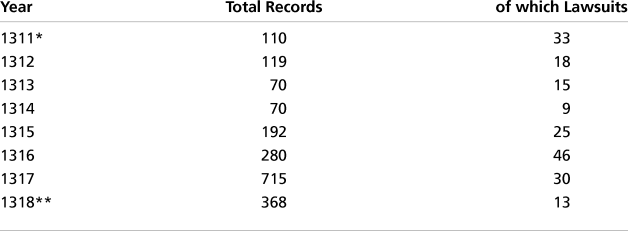
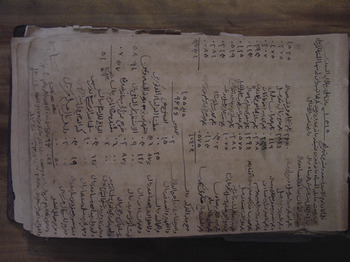
This essay is based on the sijill or register in which the qāḍīs of Brava on a day-to-day basis recorded all legal acts pertaining to the administration of civil law individuals brought before them in the period 20 November 1893 – 28 July 1900 (11 Jumāda I 1311 – 30 Rabī` I 1318). Footnote 17 Civil suits and disputes occupy only a small part of the extant 989 pages of this register and are only a fraction of its 1,924 records. The bulk of the records deal with financial transactions (such as sales and donations) and the financial debts and obligations the parties wanted to have officially recorded, that is to say, in legal form and in writing (see Table 1).
Legal Records and Lawsuits per Year

* The records concern only the last seven months of the Islamic year.
** The records concern only the first three months of the Islamic year.
The sharp increase in the frequency with which individuals chose to create such legal records in the last two years of the period under study points at a gradual shift in what constituted authoritative evidence in Brava. Footnote 18 This suggests that, instead of oral testimony, townspeople increasingly began to depend on written records as “textual memory” of kinship and property relations. Footnote 19 This emphasis on the written document is in line with what Bishara has documented for developments in Indian Ocean transactions more generally. Footnote 20 It can also be related to the pressures historically exercised by modernizing states. Both the Ottoman state and East African colonial administrations pressured qāḍīs of this period to give priority to written evidence at the expense of the oral testimony of witnesses so fundamental in Islamic law. Footnote 21 In Brava’s court records the impact of such pressure appears to have been gradual but real. The frequency with which the qāḍī’s court of Brava recorded notarial acts increased (probably in part as a response to Italian influence), but the rules of evidence they applied strictly followed the legal texts of the Shāfi`ī school and, with very few exceptions, Footnote 22 were based on the oral testimony and legal oaths of upstanding Muslims. Footnote 23
As a physical object, the register under study is a record book Vincenzo Filonardi, the first Italian administrator of the Benadir, handed over to the Zanzibari wali of Brava on 21 October 1893. It is, therefore, in this sense, one of the earliest legal documents initiated by Italian colonial rule on the Benadir coast. However, this type of legal document was not a colonial innovation. We know that it was used in Brava before the Italian administrative presence, because our source (QR979.2) makes reference to an earlier register (daftar) kept by the qāḍīs in 1302 AH (1884–1885). A similar large bound notebook with the same type of records and covering the period February 1900 to June 1903 has been preserved in the Zanzibar National Archives. Footnote 24 So far no legal documents produced by the Shari`a courts of the other Benadir towns have come to light.
As a source, the record book of the qāḍīs of Brava presents the same challenges as the sijills that have survived in different parts of the Ottoman area. It consists of short summaries of legal cases that reduce complex cases and contexts to a limited set of legal formulae and only present a bare outline of the issues at stake, without giving details of the arguments presented by the parties and their witnesses to support their positions. This produces “blind spots” that limit our knowledge of the social context of the cases (and of any possible collusions between judge and local power-holders). Footnote 25 Moreover, although the qāḍī recorded the précis of a case after he had given his verdict, these summaries usually make no mention of the reasons or legal principles underlying the legal decision, which the qāḍī, under Shari`a rules, was under no obligation to justify. Footnote 26
However, it would not be fair or accurate to brand the sijill records simply as too cryptic or biased to help us gain any understanding of what happened Footnote 27 or, even more drastically, to depict them as records of “orchestrated performances” in which “the outcome of the majority of lawsuits was decided prior to the appearances of the litigants before the judge.” Footnote 28 Instead, while acknowledging that this kind of source has serious drawbacks and limitations, we agree with scholars such as Agmon, Ergene, Peirce, and Stockreiter, Footnote 29 that it also has unique strengths and that an interpretation of the records in the cultural, socio-economic, and political contexts in which they were created allows us important insights into the local histories to which they speak.
The formal distinction between civil and criminal law was not part of Islamic law and was elsewhere in East Africa too imposed by the colonial authorities. Footnote 30 In Brava the above-mentioned Italian administrator Filonardi had provided the qāḍīs, together with the civil record-book, a register for criminal cases, which was partly preserved in Brava’s court house until the 1980s.
The Qāḍīs of Brava
Until the arrival of Filonardi in 1893, the Sultan of Zanzibar had appointed the qāḍīs of Brava. Usually two qāḍīs served together. There were no muftis in either Brava or the Benadir coast as a whole. Despite a heavy workload that occupied the qāḍīs in their capacity as judges and registrars, there was no court personnel that assisted the qāḍīs of Brava. In particular, they did not command the services of any kātibs or scribes, who were a permanent fixture of the entourage of qāḍīs elsewhere in the Islamic world, relieving qāḍīs of lesser tasks such as copying the records into the court registers, Footnote 31 summoning defendants to court, Footnote 32 and acting as a liaison between the local community (to which such court personnel usually belonged) and the qāḍīs themselves, who were often outsiders, appointed to serve in unfamiliar communities for rather short periods. Footnote 33
Instead, for Brava the qāḍī’s centrality and the absence of a court hierarchy are well documented. The qāḍī wrote all records “in his own hand;” Footnote 34 can be seen to go to a defendant’s house to take her statement in person (QR206.1), and did not need any assistance in liaising with the local community, since he was an integral part of its elite stratum. Footnote 35 If this, on the one hand, gave the qāḍīs a unique insight into the workings of the local community and the extra-judicial aspects of the cases brought to their attention, it could, on the other hand, prejudice their attitude in favor of the elite, whose social biases they very likely shared. Some qāḍīs, moreover, held office for very long periods of time. Thus Mohamed bin Haji Maie Omar had not only been qāḍī for more than three years when Filonardi confirmed him in his office in 1893, but, with the exception of the period February 1895 to November 1897, continued to serve for another twenty-three years, until at least 1916. Footnote 36 His colleague Wali bin Sheikh Abdurahman was qāḍī for ten years, serving without interruption from October 1897 until his (probable) death in 1907. Footnote 37
However, if qāḍīs as members of the town’s establishment were likely to be pillars of the social status quo, as servants of the Shari`a they were charged with preserving and restoring social harmony. Applying the law was both about establishing the truth and, as Stockreiter put it so aptly for the qāḍīs of Zanzibar, about “bringing people back into working relationships.” Footnote 38 Even though she spoke of a very different time and place (sixteenth-century Ottoman Aintab), Peirce’s words too ring true for Brava: “The overarching concern of this community – and the aim of its dispute-resolving mechanisms – is to preserve social order. It sees itself as safe when the individual is safe, and the well-being of the smallest is therefore the concern of the greatest.” Footnote 39 The analysis of the qāḍī’s records of Brava below, including specific examples of ṣulḥ or iṣlāḥ (mediation), bears this out.
The court of Brava was an enclosed space. It had first been attached to the house of the wali and was later moved to its own space referred to as maḥkama (Arabic for court of law). Footnote 40 It was open to all, except to slaves and minors of both sexes. Footnote 41 People presented their cases to the qāḍīs in their own language – whether the local Chimiini vernacular, the widely spoken Somali dialects, and occasionally also Arabic – and in their own words. Footnote 42 It was the qāḍī’s task to fit their testimony into a relevant legal mold, capture it in legal formulae, and record the final summary and decision in Arabic in the register.
The qāḍīs of Brava mostly interacted with the town’s urban population, which almost gives the court the feel of a family court. However, they occasionally also dealt with temporary residents, such as foreign merchants and ship captains, and also had authority to hear cases presented by people living in the countryside, which did not have its own qāḍī’s courts. They also interacted and corresponded with other qāḍīs in the region, both those in the other coastal towns under Italian administration and those in the still independent interior. Footnote 43
Both before and during this early colonial period, the qāḍīs of Brava applied no other law than the Shari`a as interpreted and developed by the Shāfi`ī juridical school. Footnote 44 The ordinances promulgated by the Zanzibar Sultans had not applied to the relatively distant Benadir coastal towns, while the edicts of the Italian administration were still embryonic. Somali customary law (xeer) appears to have been formally acknowledged in the towns’ qāḍī’s court only in matters related to diya or blood money payments. Footnote 45 In East Africa, both British and Italian colonial authorities had a strong bias against the Shari`a, which they considered irrational and “confused and contradictory.” Footnote 46 However, they were extremely weary of local resistance that might be provoked by immediate drastic changes in the administration of Islamic law. Footnote 47 Italy had in its convention with the Sultan of Zanzibar agreed to leave the qāḍīs of the Benadir in place and have them decide all matters according to Islamic law. There was, moreover, no pressing need to establish alternative, non-Islamic jurisdictions, since there were still very few Europeans and no Indian Hindu residents. At the same time, the number of Italian administrators was in any case so small that, at that stage, no such change could have been implemented. Therefore, until the general reform of the judiciary of 1911, the qāḍīs officially continued to have full competence to hear and decide on all civil and criminal matters. Footnote 48
In reality, however, the Italian “Residente” (like his counterpart the District Officer in British East Africa) was often a disruptive element in local society and the local balance of power. Although Italian Residents, inexperienced young officers who were only loosely supervised and mostly left to themselves, did not have any formal judicial authority, some occasionally interfered with the qāḍīs’ decisions. The qāḍīs of Brava deeply resented this and in 1904, when the Italian administration gave them the opportunity to register their complaints, they explained why:
Matters that are dealt with in the barza [court] are reported to the Resident, but generally the Residents do not take any part in the decisions we make. However, sometimes they to some extent interfere. In Brava, the one who interfered most was Mr. Cappello [the Resident from November 1898], who sometimes changed our decisions saying that they were not just. And this happened at the instigation of Sheikh Faqi [the shaykh al-balad], who did so for money or because he had received some presents. However, the whole town population was and still is talking about that. If not for this, he would not have had any interest in constantly meddling in judicial matters. Mr. Cappello trusted him [Sheikh Faqi] completely and blindly accepted whatever he said. Many decisions were taken directly by Mr. Cappello, without any communication with us, and there is consequently no trace of these in our registers. Footnote 49
During the overlordship of the sultans of Zanzibar, the walis had always had a formal judicial role, since they heard appeals from the decisions of the qāḍīs. Footnote 50 The latter nevertheless largely maintained their judicial independence, in part perhaps because their salary came from the court fees and not the coffers of the Sultan. Certainly there is no evidence or memory in Brava of any wali, who was a fellow Muslim, flouting a central and incontrovertible aspect of Islamic law. However, Italian Residents occasionally interfered in flagrant violation of Islamic law. One such incident occurred when Resident Cappello upset the status quo by lending an ear to complaints by free, married women.
As the qāḍīs put it, perhaps using some hyperbole:
Many women used to go to Mr. Cappello with their claims, and not to the barza. No woman came to us any more (…) but, because Mr. Cappello always took their side, directly went to see him after the evening prayer. Of course this gave rise to many rumors in town and people said that these claims were often a pretext [for women] to enter the Resident’s premises, where some went to look for unlawful things and receive money in exchange for their favors. Footnote 51
The qāḍīs supported their complaint by referring to a specific instance in which the Resident had granted a woman a divorce. A certain Fatima Imanke had gone to Cappello directly, lodging a claim against her husband and accusing him of beating her. The husband acknowledged this but argued that he loved his wife and did not want a divorce. Cappello, however, immediately granted Fatima a divorce and ordered the husband to pay her 30 qirsh within one month. Footnote 52 This violated not only the authority of the qāḍī but also Islamic law, which does not necessarily consider a “corrective” beating a ground for divorce and, when a wife-initiated divorce is accepted by the husband, puts the burden of a payment on the woman. Footnote 53
Although the sources do not provide enough details for us to fully judge this incident, there is no doubt that Fatima Imanke’s maneuver to bypass the qāḍī and the Shari`a met with absolute local disapproval and resistance. In their statement before the Italian Consul-General the qāḍīs noted that Fatima Imanke had been unable to contract a new marriage, since nobody in Brava believed that a dissolution of marriage pronounced by the Resident legally enabled her to do so. Furthermore, our analysis of the court records as a whole suggests that the qāḍīs of Brava, within the limits imposed by the Shari`a and evaluated in that light, did not treat women in court unfairly. This is, for example, evident in the cases in which women applied for the dissolution of their marriage to an absentee husband who had failed to provide for their maintenance (nafaqa). In all such cases in the register (fourteen), the qāḍīs gave the women their divorce. Footnote 54
Women in Court
In Brava, women of all social strata presented their cases and transacted business in the court, either personally or through their representatives, and local custom did not prevent elite women from appearing before the qāḍīs in person. In this Brava differed from other Muslim contexts such as sixteenth-century Ottoman Aintab, where secluded women (muhaddere) did not appear before the qāḍīs at all. Footnote 55 Only married women feature in Brava’s qāḍī’s court records as fully empowered legal actors. Physical and mental maturity alone – the criteria for legal majority in the Shari`a – was in Brava apparently not a sufficient condition for women to appear in court. Footnote 56 In the qāḍī’s court records married women constituted 24.34% of all plaintiffs and 11.11% of defendants. Footnote 57 They appeared in court even more often in yet another capacity, namely to officially register their transactions.
Brava’s qāḍī’s court records show that, in the area of property matters, the court treated women largely the same as men. This historical reality is by now very familiar from the scholarship about the qāḍī’s courts in Ottoman areas and is increasingly recognized in such scholarship of the Swahili coast. Footnote 58 All these studies also emphasize that this nearly equal legal treatment of women did not negate the fact that local society, in our case, the city of Brava, was nevertheless deeply patriarchal, that is to say, represented a community in which a person’s social identity and status was transmitted in the male line and where men monopolized formal positions of leadership and power.
In Brava, the formal complete identification of an individual consisted of his/her personal name, father’s name, and grandfather’s name, followed by his/her named group affiliation. Footnote 59 Brava’s patrilineality and emphasis on the male lineage is of course reflected in the qāḍī’s court’s “vocabulary of identity;” Footnote 60 as a consequence, an individual’s family relationships through the mother and wife often do not come into view. However, even beyond this, the qāḍī’s court records often identify women less completely than they do men. Footnote 61 Agmon’s conclusion in her study of late Ottoman Greater Syria rings true for Brava as well: “These sources clearly emphasize the male lineage of the respective families, so the wives are mentioned without names, daughters are not mentioned at all, and sons are mentioned without specifying the mother.” Footnote 62
Similarly, the qāḍīs of Brava at times omitted in their recordkeeping a woman’s grandfather’s name and group affiliation and sometimes even more basic information. As a result, there are a number of records in which a woman remains unnamed, has only her first name recorded, or is identified only in relation to others, as a man’s mother, daughter, or (divorced) wife. Footnote 63 Such indirect or incomplete identification was not necessarily a sign of disrespect and may rather speak to the centrality of a woman’s family (and her position in its hierarchy) to her social identity. By cross-referencing the records, a historian can often get to know a woman as well as a man. However, the patrilineal bias reflected in the records nevertheless limits how the latter identify women in comparison to men.
The qāḍī’s records of Brava offer insight into two aspects of legal practice and court procedure that are of direct relevance to this study of women, that of witnessing, an area in which women’s participation in court was restricted, and oath taking, in which Bravanese women participated on equal footing with men.
Women as Witnesses
In Islamic law, women’s legal capacity and suitability as witnesses is a complex, even fraught, issue. Footnote 64 In the qāḍī’s court in Brava, as elsewhere in the Islamic world, there were two types of witnesses. The first kind witnessed that a legal act had taken place. The presence of these case witnesses Footnote 65 and their identification by name at the end of each written record was essential to the validity of the case and, as Peirce put it, a “structural element of the court procedure.” Footnote 66 Although they might include people who knew or were related to the parties involved in the legal case, case witnesses were not involved in what was being adjudicated. They witnessed the act and could be called upon at a later date to corroborate that the matter had come to court and the judge had given his verdict. The case witnesses were always free, adult, Muslim men, whose social background and economic status might otherwise vary widely. Footnote 67 In Brava they included relatives of one of the parties, neighbors, ulama, merchants, military men of the Zanzibari garrison, and Ashrāf (especially for cases involving marriage), with some men appearing to be regulars.
Potentially more consequential for how women fared in court were the legal rules determining who could serve as witnesses of the second kind, that is to say those individuals who were called to court to provide testimony in support of the claim of one of the parties to a court case. Given the centrality of oral testimony to Islamic law and court procedure, such witnesses were very important, even crucial, to the outcome of a case. They testified in court to the fact that some action (usually outside the court) had or had not taken place at some point in the past and supported one party’s assertions about the content, context, and legal implications of this action. Although in the qāḍī’s court of Brava, as we will see below, women were prominent as plaintiffs, defendants, and parties to contracts, and were routinely personally present in court, they did not serve as witnesses of this second kind and did not give third-person testimony. They did not even serve as witnesses in the ratio of two women to one man, as was officially allowed in property cases according to both the Shari`a generally and the Shāfi’ī legal school in particular. By contrast, the records indicate that even a low-status man such as a freedman could and did serve as a witness (QR359.1).
In restricting women’s testimony, Brava was in line with (and went beyond) Islamic legal practice elsewhere in the Islamic world. In Women, Family, and Gender in Islamic Law, Judith Tucker discussed this “female disability in the area of legal testimony” Footnote 68 as a far from clear-cut but nevertheless significant aspect of Islamic legal thought in all its historical variations across legal schools and individual jurists. She notes that the issue of women’s testimony was “in the hands of most jurists tinted with the notion of female disability,” whether they saw women as defective in nature (innate weakness) or because of a “social order that limited the presence and the experience of women in the public space.” Footnote 69 She concludes, and this is of immediate relevance to Brava as well, that, while women’s roles as legal actors in matters pertaining to themselves were widely accepted, “most jurists were less comfortable with the notion that women could have an equally authoritative legal voice in the affairs of others as witnesses.” Footnote 70
The qāḍī’s court records of Brava show that women did indeed not act as witnesses giving testimony in the disputes or other legal issues of other people than themselves. The only mention of a woman serving as a witness together with a man concerned a marriage that was found invalid because it lacked two male witnesses (QR309.1). Footnote 71 The qāḍī’s records do not allow us to evaluate whether or to what extent this legal restriction on women’s witnessing had a negative impact on how women fared in court, as suggested by Tucker and asserted by Peirce. Footnote 72 Brava’s small size and its character as a close-knit community in which people, including the qāḍīs, were quite familiar with each other’s affairs, may have served as a counterweight against women’s legal inequality in this respect.
Women and Oaths
In the scholarship about women and Islamic law, the legal practice of oath taking does not get much attention. Footnote 73 However, the qāḍī’s records of Brava show that it was an important practice that was especially significant for women, because their oath had the same weight and was administered to them by the qāḍīs in the same circumstances as in the case of men; the two-to-one ratio, a common rule governing women’s testimony, did not operate here.
In general, Islamic law does not require parties to a legal case to take an oath when the evidence is complete. However, in special circumstances a judge may ask one of the parties to take an oath before reaching a ruling. In Brava, the qāḍīs administered oaths almost always because of the absence of the defendant and did so only rarely to supplement incomplete evidence. The most common oath that occurs in the records is the yamīn al-istiẓhār, translated by Bechor as “the oath of clarification.” Footnote 74 The qāḍī administered it to the plaintiff in addition to the testimony of two male witnesses, when the defendant was either absent or deceased. When a plaintiff took this oath in these circumstances, swearing that his/her claim against the absent or deceased person was truthful (and that the right (s)he claimed had not already been satisfied or been transferred to someone else), the qāḍīs in all cases ruled in favor of the plaintiff. Footnote 75 It is striking that in Brava male and female plaintiffs were invited to take this oath in exactly the same legal circumstances and that the weight of a woman’s oath was exactly the same as that of a man. Moreover, even when a plaintiff, man or woman, had filed a suit through an agent, s/he took the oath in front of the qāḍī in person, Footnote 76 that is to say, the oath was taken by the principal, not the agent. Footnote 77 Finally, the social background of the women who were given and used this legal option ranged from Sharīfa (QR25.1) to freedwoman (QR387.2). There was no question of any legal disability for women in this regard.
Although Islamic jurisprudence recognizes a range of oaths, Footnote 78 apart from the yamīn al-istiẓhār, the qāḍīs of Brava only exceptionally mentioned other oaths by name. Footnote 79 This is the case with oaths taken when both parties were present in court. The qāḍīs might ask one of the parties (male or female) to take the oath if that party had failed to produce a sufficient number of witnesses in support of his/her legal position (whether this was a plaintiff’s claim or a defendant’s denial). The party invited to take the oath had the option to “re-render” it, that is to say, to refuse to take the oath and ask the other party to do so instead. Footnote 80 Brava’s qāḍī’s court records show that women took and re-rendered such oaths in perfect equality with men. Footnote 81
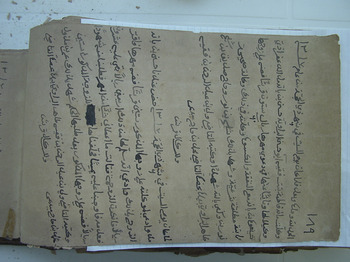
However, in Brava oaths were not always decisive in producing a positive outcome for the party taking the oath and the qāḍīs apparently had wide discretionary powers, including the option of bringing about a compromise solution acceptable to both parties (ṣulḥ or reconciliation). Footnote 82 Striking in this context are the two following cases in both of which the qāḍī appears to have been partial to the female party. In the first case, the qāḍī did not rule in favor of a male plaintiff who had taken the oath but gave his verdict in favor of the female defendant (QR257.1). In the second (QR827.2), the qāḍī again ruled in favor of a woman (in this case the plaintiff) and against her husband, even after the latter had taken the oath at the qāḍī’s invitation (see Figure 1). Whether the qāḍī’s decision meant that he favored the women in these two cases or whether he had knowledge of the situation beyond what was presented in court cannot be surmised.
In QR827, of 6 Dhū’l Ḥijja 1317 (7 April 1900), Qāḍī Mohamed bin Haji Maie Omar registers two entries about Mana Fatima bint Faqi Abu Hassan’s claim for mahr from her husband. The first records Mana Fatima’s conferral of power of attorney to someone to pursue her claim. In the second, this representative presents her claim and the Qāḍī rules in her favor after her husband fails to provide witnesses for his counter claim. Photograph by Mohamed Kassim.

Sources of Women’s Wealth
The six major sources of women’s wealth and property that appear in the qāḍī’s records of Brava are: (1) mahr or dower husbands had to pledge at marriage; (2) inheritance; (3) pious gift (nadhiri); (4) waqf or Islamic trust; (5) commercial enterprise; (6) labor. Footnote 83
Five of these six areas of property acquisition and income generation gave rise to women legal actions in court. Women become visible in the qāḍī’s court records as plaintiffs and defendants; to acknowledge debts; to pledge security for their own or other people’s debts and loans; to confer powers of attorney; as testators and heirs; as givers and beneficiaries of pious gifts (nadhiri), as establishers and beneficiaries of family trusts (waqf), and to initiate the legal certification of particular acts and transactions.
1. Mahr
One source of women’s property, income, and empowerment was the mahr or dower. In Brava, as elsewhere in the Islamic world, the stipulation of a mahr, which specified the husband’s obligation to pay his wife a certain amount of money or to give her goods of equivalent value, was an essential clause of the marriage contract. Footnote 84 Every woman who entered into a marriage therefore had the right to receive a mahr (also called ṣadāq in the qāḍī’s records), which would become her personal property. In Brava, the mahr was not normally paid when the marriage contract was concluded and the distinction between the muqaddam part of the mahr, which was to be paid immediately, and the mu’akhkhar or deferred part, due on divorce or at the death of the husband, so common in other parts of the Islamic world, did not exist in Brava. Footnote 85 Questions to be asked in this context are what constituted the mahr in Brava, how and when women actually received the mahr due to them, and how they leveraged the mahr owed to them before they received it.
In Brava, the mahr was generally stipulated as a sum of money, of which the amount did not depend so much on the wealth of individual families as on what was the customary range for the different sections and social strata of the community. In contrast to the findings of Moors in Palestine, Footnote 86 in Brava gold was not central to the mahr. In the few (four) cases in which the mahr was stipulated in kind, it consisted of cattle. Footnote 87 The amounts of mahr recorded in Brava’s qāḍī’s court records range from the high amount of 100 qirsh to the exceptionally low one of 3 qirsh, with most mahrs ranging from 30 to 60 qirsh. The qāḍī’s court records mention only five cases of 100-qirsh mahrs. In three of these cases both spouses belonged to prominent Ashrāf families, which, representing the most prestigious layer of society, may have wanted to give public expression to their status and wealth in this way. Footnote 88 Another case may reflect some reluctance on the part of the wife’s family, as it involved a local Bravanese family marrying a daughter off to a foreign Arab. This reluctance appears to have triggered the demand for an exceptionally high amount of mahr, forty percent of which was moreover immediately due at marriage (QR334.1).
Most common in Brava was the mahr of the middle range: 60 qirsh for women of the Bida and Hatimi sections and the wealthy families of the Tunni, and 30 to 50 qirsh for middle-level Tunni families. Footnote 89 The lowest amount of mahr mentioned in the qāḍī’s records, that of 3 qirsh, was stipulated as part of a marriage of an Oromo (Wardai) freedwoman called Hawa to a Somali (Isaaq) man (QR350.2). Footnote 90 More commonly freedwomen received a mahr of 10 qirsh, Footnote 91 although freedwomen marrying their former owners or former owners’ sons obtained mahrs as high as 30 qirsh and as low as 5. Footnote 92
Women obtained access to their mahrs in different ways. In principle, the mahr was payable to a woman on demand. This indeed occurred and, when it did, women often chose to receive it in the form of productive “capital:” cattle (twelve cases), ‘arīsh (five cases), and slaves (three cases). Footnote 93 On one occasion a woman was able to buy part of her husband’s stone house with the mahr money he owed her (QR326.2). Women of the lower strata appear to have opted for a place of their own in the form of an ‘arīsh, whose average value (of 10 qirsh or lower) corresponded exactly to that of their mahr (e.g. QR634.2). That women chose not to receive their mahr in money or gold is evident from the fact that several case records note that they “purchased” the cows or ‘arīsh from their husbands with the mahr money owed to them (e.g. QR40.2–41.1 and QR377.1).
However, often the full amount of the mahr was still outstanding at the time a marriage ended in divorce or with the death of one of the spouses. Footnote 94 If the husband died first, the wife was entitled to be paid her mahr out of his estate before the heirs received their shares of the inheritance. If the family was relatively well off, the mahr amount paid to the widow might be as significant as her share of her husband’s estate. For example, in a case of 11 November 1899, a wife was awarded the 60 qirsh of her mahr and an almost equal share of inheritance for a total of 127½ riyāl (QR697.1–698.1). Another way of assessing the significance of the mahr as a source of wealth for women is comparing it to what they left at death.
Although the number of records specifying women’s estates are limited and thus not statistically significant, they suggest that, measured this way, mahr could represent a high percentage of a woman’s estate and thus, by implication, probably a significant source of wealth during her life. For women of moderate wealth (QR167.1, QR228.1, and QR330.1), whose mahr was most likely 60 qirsh, the mahr represented respectively 27, 33, and 42 percent of their estates of 220, 180, and 142 qirsh. In the case of a woman whose mahr had been stipulated at the lower amount of 19 qirsh, the mahr represented 51 percent of her much smaller 37 qirsh estate (QR371.1), while for the woman who left the largest estate recorded, her 60 qirsh mahr would have represented only 5.45 percent of her 1,100 qirsh estate (QR186.1). This confirms Tucker’s statement that for poorer women the mahr as measured by the wealth they owned at death represented a more important source of property than for wealthier ones. Footnote 95
In case of divorce, the wife had an immediate right to the full amount of the mahr, but in reality she sometimes received it from her ex-husband in small installments (QR452.2 and QR476.1). The same appears to have occurred when couples were poor or of low status. Footnote 96 In such cases the mahr served for a while as a small source of income for the former wife and a contribution to her basic daily needs. When a marriage ended without the mahr having been paid, women sometimes chose to take their case to court. If need be, especially if the former husband or the late husband’s estate was not in Brava, women conferred powers of attorney to obtain the mahr owed to them. The records indicate that in such cases they sometimes chose relatives (especially a brother) as formal legal representatives, but even more often engaged non-related men, perhaps because these latter had more familiarity with court procedure or had the required connections to the place in question. Footnote 97
One special use women made of their mahr was not to claim it and use relinquishing their right to mahr as a source of empowerment. By formally releasing a husband from the mahr debt, women could obtain a divorce. At issue here are the two wife-initiated forms of divorce called mubāra’a and khul`. According to Welchman, writing about Egypt, mubāra’a took the form of a ṭalāq (repudiation) by the husband in exchange for a general renunciation of any remaining financial rights by the wife. Footnote 98 In khul`, the spouses agreed on a divorce settlement effected by the husband’s pronunciation of a single, irrevocable ṭalāq in return for “a consideration,” that is to say, a payment by the wife whose amount could be specified by either party. Footnote 99 Most cases in the qāḍī’s records of Brava follow the pattern of mubāra’a, in which the wife released the husband from the obligation of paying her mahr in return for an irrevocable divorce. Footnote 100 In the two cases of khul` (QR141.1 and QR220.1), the wife obtained an irrevocable divorce by releasing her husband from the outstanding mahr debt plus a further consideration, which took the form of an acknowledgement of a debt in one case and a payment of an extra 10 qirsh in the other. A third case appears to be a khul` but took the form of a nadhiri by which the wife released her husband from a debt of 70 qirsh (probably representing her mahr of 60 qirsh and another 10 qirsh he owed her), immediately followed by his divorcing her (QR91.1). In none of the cases of wife-initiated divorce is there any mention of custody rights and child support; these were probably handled out of court. Footnote 101 The custody of children never comes up in the qāḍī’’s records of Brava. Footnote 102
In the cases of mubāra’a, the records do not refer to this noun itself but use a legal terminology that uses the verb (abra’a) and verbal noun (barā’a). For example, in a case of 24 July 1899 (QR586.2), a husband divorced his wife, Asha bint Abdinur, “after she released him from her dower of the amount of 7 riyāl through a valid, legal release (ba`damā abra’athu min ṣadāqahā mablagh riyāl 7 barā’a şaḥīḥa shar`iyya).” These records also show that the wife sometimes released her husband from outstanding debts only after the latter had formally pronounced the irrevocable divorce before the judge (QR425.1 and QR514.1).
The two khul` cases, like those of mubāra’a, do not use the noun form of the root but the verbal forms. Thus in a case of 1 November 1894, Kusey bint Osman rejected her husband’s demand for mu`āshara (intimate relations) with the words (note the root khl`): “‘urīd al-’ikhtilā` min zawji” (“I want to be divorced from my husband”). The record notes: “And the above-mentioned husband performed the khul` (khāla`a), saying ‘I divorced my wife (ṭalaqta zawjatī), the above-mentioned Kusey, with three repudiations, for 30 silver qirsh’” (QR141.1).
In both cases of khul`, the wife’s initiative in bringing about the divorce is explicitly expressed through the record’s use of direct speech. Thus, in the case referred to above, the qāḍī reported Kusey’s words as follows: “I want to be divorced from my husband.” The second record, dated 3 November 1895, states:
“(…) after the marital relations between Sayyid Ahmed bin Abasheikh bin Haji Talha and his wife Halima bint Abanur bin Sheikh, both Hatimis, had deteriorated and the dissension and the ruin of family harmony had become apparent, the wife divorced herself from her husband [ikhtala`at nafsahā min zawjihā] by stating clearly and addressing him directly: “I divorced myself from you (ikhtala`ta nafsī minnak) for 70 silver riyāl. And the husband accepted this from her” (QR220.1).
The two khul` cases discussed above suggest that in Brava the amount to be paid for a khul` divorce could be established by either the husband or the wife. Footnote 103 However, we cannot surmise from the records whether the amount to be paid was agreed upon before the divorce was registered in court, possibly in negotiations facilitated by family members or the qāḍī.
It is worth noting that in Brava, unlike Zanzibar, divorce by mutual consent did not result in a wife repaying sums of money she had already actually received from her husband as dower. In this context, Stockreiter’s suggestion for Zanzibar that qāḍīs might support women’s requests for khul` “in order to help men raise the dower for another wife” makes no sense for Brava, where a man did not need to pay mahr at the time of marriage but only incurred the legal obligation to pay it at a later time. Footnote 104
It is in the nature of the court records that they only document the bare transaction and leave us guessing at the circumstances of the divorce. For example, in another case of 27 August 1898, one wonders whether the woman who proved in court, to the qāḍī’s satisfaction, that her husband had repudiated her but who nevertheless released him from the mahr debt of 60 qirsh, acted out of love for him, out of desperation to be free from him, or because of family pressure (QR425.1)? That kind of texture the qāḍī’s record book cannot provide. However, it is clear that in Brava the mahr was both a source of women’s income and property and a real factor in their empowerment.
2. Inheritance
According to the qāḍī’s records, most of the estates left at death consisted of a range of property items, including real estate, slaves, gold and silver jewelry, money in cash, commercial goods and agricultural produce, livestock, and household and personal effects. Footnote 105 When somebody died leaving a number of male and female heirs, the qāḍī had the duty to give each heir his or her legitimate share. His first task was to determine which properties were part of the estate and which might not be because the deceased had dealt with them by will, nadhiri, or waqf. After the qāḍī had assessed the total value of the estate, he and the heirs usually proceeded in one of three ways. First, the qāḍī sold the estate (sometimes through auction) to pay the deceased’s debts and divide the rest of the money among the heirs (e.g., QR389.1–390.1 and QR391.1). The second way was for the heirs to sell the estate to one or more individuals amongst them (QR214.1) or to a third party (QR231.1, QR249.1, and QR376.2), after which the qāḍī would give each his or her share (one half, one-sixth, one eighth, and so forth) of the money. Third, heirs sometimes chose to remain co-owners of particular parts of an estate such as a house or slaves (e.g. QR386.1).
Shāfi`ī legal texts recognize seven categories of legitimate female heirs of a deceased individual: the daughter; the daughter and other female descendants of the son provided they are agnates; the mother; the grandmother and other female ancestors; the sister; the surviving wife (if not divorced or repudiated), and the female patron (former owner of a freed slave). Footnote 106 The qāḍī’s records include sixty-seven cases in which women obtained property through inheritance. It is not surprising that women inherited most often from (in this order) fathers and husbands, mothers, and brothers, with women inheriting from a grandmother or sister in only one single case each. Footnote 107 In five cases women inherited from daughters and sons who had died before them. Footnote 108 Only in very few cases was a woman the sole heir of her deceased parents: usually the families were large, as evident also from the number of children listed as heirs in the qāḍī’s records (e.g. QR159.1, QR186.1, and QR338.1).
We have no legal record of widows acting as executors, distributing shares of inheritance to other heirs. However, the records do include cases in which the qāḍī describes children’s portions of an estate as being “in the possession (bi-yad)” (QR390.1) of their widowed mother, handed over to her “to be kept in trust for them” (QR395.1). That such shares could represent a substantial amount of property is evident from the estate of Moallim Omar Aboke (Barawi). After all outstanding debts had been paid, the qāḍī left in the possession of the pregnant widow: 17 riyāl and 39 dokra, one male and three female slaves, gold jewelry valued at 130 riyāl, and a plot of land in Biruni valued at 30 riyāl. Of this, the qāḍī noted, “one-eighth is her own share and the rest she holds in trust (wadī`a) for her children, a male getting double the share of a female” (QR389.1–390.1). The records do not tell us how the widow managed her children’s wealth and whether the absence of the formal title of “guardian” indeed prevented her from spending it on her children’s maintenance or investing it productively.
Women regularly conferred power of attorney to a third party to obtain their share of a particular estate. This appears to have occurred most commonly when the estate was held outside of Brava, and the men women chose as their legal representatives were in this context most often not relatives. Footnote 109
Everything in the qāḍī’s records suggests that women received their shares of estates in accordance with the Shari`a. Footnote 110 However, women’s rights to their shares of estates were occasionally challenged in court by a fellow heir or an individual whose claim to the inherited property was based on a transaction with a fellow heir. The records include two inheritance disputes in which the parties were brother and sister. The first case is one in which a brother accused his sister of having usurped their mother’s estate, allegedly consisting of real estate, some pieces of gold, broken silver, and clothes (QR206.1). The sister refused to come to court and two important men, Sheikh Faqi bin Haji Awisa, the shaykh al-balad, and one of the qāḍīs (later listed in the record as case witnesses) went to her home and brought back her reply as well as a piece of golden jewelry weighing 1¼ waqiyyas (35 grams). Footnote 111 The qāḍī recorded the sister’s words in direct speech (as reported by Sheikh Faqi):
“This is what I have in my possession of my mother’s estate and, except for this, I have nothing else. If my brother, Mohamed bin Maie Bakar accepts, divide this between us; let him keep two-thirds and send me back one-third, on the condition that this will put an end to the lawsuit between us concerning my mother’s inheritance. If he does not accept, return the piece of gold jewelry to me. I do not answer to this lawsuit because this has gone beyond the limits of the law (jāwiz ḥadd al-qānūn). However, I give my brother this as a gift (atabarra`u li-akhī) to have him stop his demands.”
The brother accepted and was given his share of the gold right there and then in the courtroom; his formal declaration before the witnesses that there was no further dispute between him and his sister became part of the case record. As is often the case, the court record does not tell us exactly what happened here. Had the sister actually seized the whole estate and did she get away with paying her brother a trifle? Did she lose two-thirds of a piece of golden jewelry just to put an end to her brother’s false claims? Or did both get a fair share? The record does not give us a conclusive answer about this. However, it is striking that the qāḍī – perhaps in endorsement of the sister – included in the written record something he did not commonly do, namely the sister’s direct speech, laden with emotion and indignation. All we can say with certainty is that the qāḍī and the two prominent men who represented the sister in court went out of their way and managed to solve the case and restore peace.
A second example of the court supporting a sister in an inheritance dispute with her brother (perhaps a brother by a different mother) is that of Sharīfa Mana Nafisa bint Sayyid Habib Makka (QR67.1). She sent a legal representative to court to claim that her brother Sharif Abrar had passed on to another Sharīf (then deceased) her share of the estate of their father and another deceased brother. This share was substantial and consisted of “134 silver qirsh and a slave (ra’s khādim] called Sālimīn, valued at 66 silver qirsh.” In his reasoning the qāḍī cited the original record of the division of the estate, which had been handled by the former wali of Brava (Sālim bin ‘Alī al-Ya’qūbī), in his barza and during his lifetime. He then ruled for Mana Nafisa and against the dead defendant, whose acquisition of Mana Nafisa’s property from her brother he judged illegal. The qāḍī did not rule against the brother and the record does not reveal whether the brother’s behavior was blameworthy.
In her work on Palestine, Annelies Moors found that “urban women refrain from claiming their shares in the estate if their contending heirs are their brothers.” Footnote 112 The case of Mana Nafisa and her brother appears to belie this for Brava. Women had close relations with their natal family and depended on them in many ways. However, there is no evidence that women refrained from taking on a brother and pursuing their inheritance rights in court.
The cases cited above show that women often won disputes about their rights to property acquired through inheritance. Another such case is that of Mana Lulu bint Sharif Abdalla. Mana Lulu sent a legal representative to court to question the legality of the sale of a dilapidated house by a Sharīf to a Barawi man, on the basis that she had inherited this house from her father. She was able to bring only one witness, who testified to the fact that she had received it from her father as a gift (hiba), but the qāḍī rejected this testimony because it did not pertain to the question at hand, that concerning inheritance. Then Mana’s agent revealed that the Barawi man who bought the house from the Sharīf had initially tried to buy it from Mana Lulu herself! The man hemmed and hawed, but the qāḍī, after making Mana Lulu take an oath, gave a verdict in her favor (QR248.1). The records reveal that Mana Lulu then sold the dilapidated house to a buyer of her choice (another Sharīf), who in turn sold it to the son of the very same Barawi man who had originally tried to buy it (QR370.1).
The court also upheld the rights of Khasuf bint Tahir (Hatimi). In this case, the qāḍī recognized that the heirs of the late Funzi bin Bakar – his widow Khasuf, sister, and paternal relatives – should share the proceeds of the late Funzi’s house, which was sold by auction (QR355.1 and QR356.1). However, the qāḍī excluded from this division that part of the stone house Khasuf had bought from her husband during his lifetime with the money of her mahr. The record that confirmed Khasuf’s ownership reads as follows and also provides an interesting description of the layout of a Bravanese stone house:
I ascertained with just and legally acceptable evidence that Khasuf bint Ṭahir bin Abu al-Hatimiyya purchased from her husband, the late Funzi bin Bakar, during his lifetime, two stone rooms of his house, one located on the eastern side and the second on the northern side, with an entrance hall that is situated in front of the two rooms, and with three small walls adjoining the entrance on the eastern side near the front door, with their appurtenances of land, buildings, doors, and timber. The right of way and the main door are jointly owned by her and the other heirs (QR326.2).
The records also show women of a wide range of backgrounds leaving property at death, from large estates, such as that of Asha bint Haji Awisa, who left real estate, money, commercial goods, and miscellaneous items totaling 1,100 qirsh (QR186.1), to smaller ones of 30 qirsh (QR236.2 and QR301.1). Below we will examine the wide range of property items women inherited and bequeathed in more detail. That inheritance was an important source of women’s property ownership is something the qāḍī’s records make abundantly clear.
3. Nadhiri
The pledge of a nadhiri (Arabic: nadhr) was in Brava a common legal frame for multi-purpose financial transactions. Although it is not documented in this form in studies of Ottoman and East African qāḍī’s courts, it features prominently in the qāḍī’s court records of Brava. In its core meaning, nadhiri is a solemn vow to do something or make a gift of something in return for God’s granting of a wish. In the qāḍī’s court records nadhiri takes the form of a formally pledged, legally binding, and irreversible pious donation by which the donor transfers the ownership of something in his or her possession to someone else. The terminology often explicitly asserts the pious nature of the gift: Such and so nadhara wa tabarrara (“made this nadhiri as a pious act”) “as a sacrifice to be nearer to God,” “while in good health and of his/her free will, knowing the meaning of nadhiri, a gift that cancels the right of property (i` ṭā’ yuzīl al-mulk).” Footnote 113
The contexts in which donors made nadhiris varied widely. Occasionally, as we will see below, they appear to stretch the limits of the concept and take the form of a plain financial transaction in which the element of piety is not obvious to the observer. Women took full advantage of this important legal and social practice in Bravanese society acting as givers and receivers alike. Out of the seventy nadhiris that occur in the qāḍī’s records, fifty-eight have women as either donors or beneficiaries.
Nadhiris feature in the records most often as gifts by a donor to his or her relatives. In nadhiris by male donors to one or more male relatives, we find fathers donating items of property (cattle, land, a slave) to sons, as well as an uncle giving a gift to the sons of a brother. Footnote 114 In the case of nadhiris by men to one or more female recipients, almost all (fifteen) represent gifts, especially of slaves and livestock, from husband to wife. Footnote 115 The records give no information about the circumstances in which wives received such gifts, but probable reasons would include affection for the wife (as in QR171.1, which features a wife who is pregnant), and masayrtir, a gift to “erase a wife’s jealousy” on the occasion of the husband’s marriage to an additional wife.
The instances of nadhiris from husband to wife contain two special cases. The first one (QR285.1) is a reciprocal nadhiri between husband and wife, whereby the husband released his wife from all her debts while she released him from paying the mahr. Here one may wonder why this settling of debts took the form of a nadhiri and hypothesize that giving up established rights while avoiding an adversarial situation in court might have been seen as a pious act. The second nadhiri is one for which we are able to surmise the circumstances. It is the only nadhiri of our limited set that involves an important amount of gold (12 waqiyyas or 336 grams) donated to his wife by the wealthy businessman Jabir bin Rufai. The latter was the Bravanese agent of the Indian trader Kanji Rajpar, soon to be disgraced and bankrupted. Footnote 116 It is very possible that he made the pious gift to his wife to protect this gold from his creditors and perhaps assure her future maintenance (QR64.1).
Although marginal to the wealth that accrued to women by way of nadhiri, some other cases that occur in the qāḍī’s records are significant because the nadhiri functions differently in them. Footnote 117 Here it takes the form of a small monthly or annual amount paid to the beneficiaries (male and female) by a non-related man in return for (and for the period of) his keeping in his possession (and presumably using) money they had inherited. Given that both the amount of capital and the time it would be at the disposal of the donor were significant while the monthly and annual amounts donated as nadhiri were small, Footnote 118 it is tempting to interpret these nadhiris simply as a hidden form of interest. If this were correct, then we might conclude that the nadhiri of Brava occasionally functioned somewhat like the Hadrami transaction called ʻuhda documented by Boxberger in “Avoiding Ribā” and the bay’ khiyār documented for Oman and East Africa by Bishara. The ‘uhda was a revocable sale of custody of property (usually land or a house) by which the seller received the sale price but retained the right, within a specific period of time, to revoke the sale and recover the property upon repayment of the sale price, while the buyer gained the usufruct of the property, often renting it back to the seller. Footnote 119 In its usual form (as an irreversible pious gift) the nadhiri has no similarities to the Hadrami ‘uhda, but in the cases described here, it resembles this “revocable sale,” even though the cases here do not involve real estate but custody of money. This use of nadhiri also brings to mind the bay’ khiyār or “conditional sale” Bishara documented for Oman and East Africa, which also involved hidden interest and sidestepped the legal prohibition against it. Footnote 120
If there was a pious or charitable dimension of these nadhiris-by-installment, it might be related to the fact that all four cases deal with inherited money, which suggests that those transferring its usufruct were all bereaved, with one case clearly involving underage orphan boys in care of the Italian administration and a second one featuring a fatherless orphan who had just come of age. It is possible that administering the property of such vulnerable individuals and guaranteeing their basic sustenance may have been seen as a pious act.
Women were not only the beneficiaries of nadhiris but also givers of such pious gifts (thirty-three cases). They made nadhiris most often in favor of male relatives (fathers, brothers, sons, grandsons, nephews, and husbands), but also to unrelated men. Their female beneficiaries were daughters, granddaughters, and nieces. The kinds of property they donated in this way included land, stone houses and rooms, ‘arīsh, slaves, livestock (cows and goats), and gold and silver jewelry.
Women’s nadhiris bring into view how multi-purpose a financial instrument the nadhiri was, for they fall into three broad categories, nadhiris of mahr, nadhiris as bequest, and nadhiris as means of terminating a dispute. Women made nadhiris of mahr most often to husbands or former husbands, but the contexts in which they did so varied. One such nadhiri is a clear case of khul`, as the wife released her husband from his debts to her (her mahr of 60 and a further debt of 10 qirsh) in return for his agreement to divorce her (QR91.1), but in two other nadhiris a woman donated to the husband or former husband his mahr debt without any explanation of the circumstances (QR611.2 and QR512.3). Women also exchanged the husband’s mahr debt for a specific property item Footnote 121 and used nadhiris of mahr to settle a debt to a third person. Footnote 122 In several cases women donated the mahr their husbands still owed them to their fathers, perhaps in the hope that the latter might more easily obtain it for them or to repay them for earlier disbursements in their favor (QR291.2, QR326.1, and QR338.1).
The cases in which women made nadhiris in the form of bequests are of special interest, for it appears that they used the instrument of the nadhiri to bequeath property to particular individuals at the exclusion of heirs who would have inherited this property in case of intestate succession. This particular aim seems clear in the case of the childless Ado bint Dera, who chose to donate one slave each to three female relatives and whose decisions were in part only ascertained after her death (QR221.1, QR629.1, and QR629.2).
Women and men also made nadhiris as means of dispute resolution and the final stage of the procedure of iṣlāḥ, or formal reconciliation and compromise in court. It appears that, when the qāḍīs succeeded in reconciling the contestants, they settled the dispute by having the “losing party” make a nadhiri of at least part of what she or he had originally claimed. Here the nadhiri functioned as a way to reach a compromise about the amount of the claim (QR261.1 and QR257.1), in order to put a definitive end to the dispute and perhaps to avoid explicitly putting the losing party in the wrong (QR257.1). Thus the qāḍī confirmed Aisha bint Ahmed, of the Tunni Dakhtira, as owner of a house in her possession but disputed by her nephews, who eventually agreed to settle the matter by donating it to her by nadhiri (QR259.2). The issue of who was right and who wrong did not come up and the nephews may have been able to gain in moral stature or simply save face by committing a pious act. In another case it was the woman who had to compromise: Sudo bint Menye was faced in court by a male claimant who demanded 23 qirsh from her. Although she refused to acknowledge this debt, arguing that she had already repaid him, she made a nadhiri of 14 qirsh and paid him an additional 3 qirsh in the form of honey (QR261.1). Footnote 123 A third case of compromise is that of Asha bint Wali, who lived in a house that was claimed by Madho bin Mohamed Nur as inheritance from his father. Asha had to make a nadhiri of the house but got to keep two rooms, allocated to her as part of this compromise solution (QR257.1).
If we take the cases of nadhiri in Brava’s qāḍī’s court records as a whole, it is clear that the nadhiri was an important instrument by which women received and donated substantial amounts and different forms of wealth. Its uses, moreover, appear to have been unique to Brava.
4. Waqf
Waqf or Islamic trust is an institution known all over the Islamic world. By establishing something as a waqf, an individual allocated in perpetuity the use of, or income from, this trust to either a pious foundation such as a mosque (waqf khayrī) or particular individuals such as the founder’s children and their descendants (waqf ahlī or family trust). Footnote 124 By establishing a waqf the founder withdrew the property or its income from the possibility of it being bought and sold, claimed by creditors, fragmented through inheritance, or taxed. The qāḍī’s court records of Brava mention only family trusts.
The records suggest that individuals who founded waqfs might accomplish three things that other means of disposing and transferring property could not. First, the founder of a waqf could designate beneficiaries of his or her choice to receive the income from (or use of) the waqf after his or her death without regard to the Islamic laws of inheritance. The latter not only stipulated in great detail who would inherit but also allocated to women half of the share of men in the same relation of kinship to the deceased. On the contrary, in a family waqf all beneficiaries – at least potentially and often actually – received equal shares irrespective of their sex. Second, while Islamic law allowed individuals to allocate only one-third of their estate by will to individuals of their choice, a waqf could be applied to the whole estate. Footnote 125 Third, if someone established a waqf before death, this person could continue to use or benefit from it during his or her lifetime.
In Brava, only real estate (mostly stone houses) was turned into waqf property. Footnote 126 While the number of family trusts mentioned in our source is too small to be statistically meaningful, it is noteworthy that the records feature more women than men as founders and beneficiaries of waqfs. Footnote 127 The women who founded waqf houses included Ado bint Dera, who at her death turned her house in the Biruni quarter into a waqf (QR667.1), Abay bint Alinkey, who did so during her life-time with a house in the prestigious neighborhood of Mpaayi (QR930.1 and QR.II.8.1), Footnote 128 and Mana Aisha bint Abu Banali, whose name is associated with two waqf houses, which she probably established herself. Footnote 129 Women were also beneficiaries of waqf houses, as in the case of the house in Biruni that Funzi bin Baghasho Ahmed established as a trust in favor of his wife and children, five of whom were girls (QR303.1). The fact that the qāḍī, in the act recording the founding of this waqf, did not specify that the son was to receive twice the share of the daughters (as qāḍīs always did in cases of intestate succession), suggests that male and female beneficiaries had equal shares in its benefits.
Another waqf house that had female beneficiaries was established at her death by a woman already referred to above, namely Ado (or Adoy) bint Dera, who had no (surviving) children and at the time was most probably widowed or divorced (QR667.1). Ado, a regular presence at court, did not dispose of her whole estate as waqf, but did so with just her house, valued at 120 qirsh, for which she designated as beneficiaries two nieces, daughters of two of her brothers, with their offspring. Footnote 130 She also made a will, in favor of her grandnephew, to whom she left a female slave (QR628.3,), and, as we saw above, made three nadhiris (all donations of slaves) to female relatives of a younger generation (QR221.1, QR629.1, and QR629.2). None of these relatives would have inherited from her in case of intestate succession. In other words, the female relatives who benefited from the house Ado established as waqf (or, for that matter, from her nadhiris) benefited from an estate that, in the absence of the legal provisions Ado made during her lifetime, would have gone to other heirs, most likely male agnates.
Someone’s motivations for establishing a family waqf might have included the desire to ensure that the beneficiaries and their descendants, whatever their future financial position might be (they could well become very poor), would have a roof over their heads and have no reason or possibility to quarrel about inheritance shares amongst themselves. This was important for widowed, divorced, or unmarried women, who might find themselves without support and a place of their own, and whose share in the estate of parents might be disputed or withheld by brothers. Women’s preoccupation with having their own dwelling is evident from cases in which married women tried to secure even one room or an ‘arīsh by forfeiting their mahr. Footnote 131
The qāḍī’s records show that women were active participants in the institution of waqf in Brava and the family trust was a distinct and significant way by which women acquired and transmitted property.
5. Commercial Enterprise
Women also obtained wealth by engaging in commercial transactions. For example, women gained income from renting out real estate, whether living or industrial space. Footnote 132 Thus widow Aisha bint Adaw sent a legal representative to court to claim nineteen-and-half qirsh “due as rent of the house in which orchella (a lichen used as a dye to produce violet) is spread out to dry” (QR58.1). Women were also among the owners of oil mills: Amina bint Mohamed Said included in the nadhiri to her brother “a sesame oil mill with its implements” (QR40.2), while Amina bint Shego pledged as security for a four-month loan of 15 qirsh “her ‘arīsh in which she lives and the oil mill that is installed near the aforesaid house, together with its implements” (QR836.2). In another case, a Tunni Dakhtira woman called Fadhumo bint Moallim, pledged as security for a debt of 26½ silver qirsh and 12 pesa, due on demand, a workshop for the preparation of ḥalwa (a sweet traditionally made of ghee, sugar, rose water, and spices). This is how the record described the security she put up: “her ‘arīsh house that has one room, with its courtyard and hall, and a space for the preparation of ḥalwa, with a bathroom, as well as a large copper vessel called zena ḥalwa, three copper pots, a ladle and all other utensils for [preparing] ḥalwa, and eight silver bangles” (QR47.1).
The glimpses the qāḍī’s court records give of women’s trading activities are not many but show that women were routinely involved in large- and small-scale commercial enterprise in and outside of Brava. We see women trade in foreign vinegar worth 30 riyāl (QR372.1); in imported cloth (QR771.1), worth in one case as much as 2 waqiyyas of gold (QR7.1); in large and small quantities of maize (QR3.1 and QR445.2); in ivory worth 60 riyāl (QR262.1); in timber, of which a quantity worth 14 qirsh was part of a woman’s estate (QR859.3), and in honey (QR261.1). The large estate of Asha bint Haji Awisa, wife of the most important elder of the Tunni Dafaradhi, included 200 qirsh of (unspecified) commercial goods (QR186.1). Women also formed partnerships with other women (QR855.3) and with (unrelated) men (QR867.1 and QR870.4).
Although women, like men, often used authorized agents in court, as we will see below, the qāḍī’s court records refer to women’s officially authorized commercial agents in only a few cases. Footnote 133 In one such case, a woman, through her agent in court, gave her father formal power of attorney to buy from her husband commercial goods worth 24 riyāl (QR202.1). This case shows both how close family members often did business together and how the court formalized woman’s autonomous legal personhood. The same is true for a second case, in which a husband, represented in court by his own agent, demanded from his wife, through her agent, the large amount of 3,147.75 kilograms of maize. Footnote 134 The wife’s agent acknowledged the debt and was granted twenty more days to repay it (QR3.1). In the cases involving the smaller amounts of maize, as well as the foreign vinegar, ivory, and cloth, women represented themselves. When Sudo bint Menye was confronted in court with a claim for 60 qirsh worth of ivory allegedly entrusted to her by the plaintiff’s late father, she not only represented herself but showed full knowledge of her late husband’s affairs and answered with great authority. The qāḍī reported:
She replied that her husband, the late Abrar bin Ahmed, had sold this ivory during his lifetime, for 60 silver qirsh, and that the plaintiff’s legator, Edhan Dawaken, had acknowledged, in his lifetime, that he received from the late Abrar 40 silver qirsh of the price of the ivory. Therefore [only] 20 silver qirsh were still due to him.
The widow produced two witnesses, and won the case (QR262.1).
That women saw marriage as a real partnership and tried hard to help their families (of birth and by marriage) survive and thrive is evident from the financial support they gave to their close male relations. Women often helped their husbands (and sometimes a brother or son) obtain loans by putting up their own property as security for those loans. Footnote 135 The security they pledged consisted especially of houses, land, livestock, and money. And in some cases they lost the property so pledged. The wealthy Ado bint Dera lost most of her gold when her nephew could not repay the sums advanced to him by the Zanzibari Indian trader Kanji Rajpar (QR321.1). Similarly, Mana Aisha bint Bana Omar lost a piece of land when her husband was unable to repay 20 silver qirsh of a 29-qirsh loan (QR26.1 and QR82.1). The qāḍī sold the land to the lender, making Mana Aisha’s displeasure part of the record: I did so, he wrote, “after advising her that the sale was obligatory and after she refused to give permission for it.” That wives occasionally made loans of money in cash to their husbands is evident from the case of Fatima Mustafa, who lent her husband funds to repair his house (QR.II.77.2).
Women also raised money and took out loans of their own. The evidence we have for this consists largely of women’s acknowledgements of debts. These show us to whom women owed money, and how much and what property they pledged as security, but there is usually no mention of the purposes for which women borrowed or whether the amount of the debt to be repaid included any hidden interest. Footnote 136 However, reading between the lines of the qāḍī’s court records and drawing on other sources, we can postulate the following. It appears that women, when short of cash, rarely sold their capital assets but instead leveraged these to borrow money they hoped to repay from the income a newly acquired asset might yield. This also ensured that their initial capital (pledged as security but usually remaining in their possession) would not remain idle and allow them to produce more wealth.
Examples of added capital acquired with borrowed money might include a house or ‘arīsh to be rented out to a third party (as we saw above); a cow that would provide milk for sale and have calves; a slave who would reproduce Footnote 137 or autonomously generate an income from which the owner claimed a share, and so forth. The borrowed money could be also used to complete some project, such as building or repairing a house (QR795.1 and QR.II.77.2). Finally, some of women’s debts appear to be loans from local male merchants for various trade goods such as grain and vinegar, as we saw above, or money borrowed from third parties to repay such merchants. It is striking that, according to the records, women helped husbands (and other male family members) obtain loans but did usually not borrow from them. Footnote 138 The data suggests that women not only borrowed from outside their families but often even from outside their own or their husband’s named social groups.
The names of a few resident rich merchants, with substantial real estate property and documented business deals with Zanzibar and Brava’s interior, feature in a large number of acknowledgements of debts by men and women. These are ‘Abd Ḥusayn bin Shams al-Dīn, called “al-Hindī al-Bohrī” (Indian of the Bohra Muslim community), and Sharif Abrar bin Sharīf Habib Mudhir. It is possible that these men more or less functioned as professional moneylenders and women certainly were among their customers, borrowing amounts ranging between 6 and 52 qirsh. Footnote 139
An example of a female entrepreneur who comes across as a real wheeler-dealer is the colorful personage of the Barawi woman Fatima Mustafa. The fact that the qāḍīs always identify her without her third (grandfather’s) name – as “Fatima Mustafa” tout court – suggests that she was well known to them and unmistakable to anyone in Brava. Fatima’s first husband had been the Indian Ya`qũb bin Ismā`īl, by whom she had a daughter. In the period covered by the records, she was married to the Hatimi elder Mohamed bin Sheikh Abba, by whom she had three children. Between 23 July 1899 and 15 December 1900, Fatima figured in the qāḍī’s court records as a borrower of money seven times. Footnote 140 The first four loans she took out, all from the above-mentioned habitual moneylenders ‘Abd Ḥusayn and Sharif Abrar, involved amounts ranging from 6⅛ qirsh to 30 qirsh. For these she pledged the following items as security: first, some silver jewelry and gold beads (QR585.2); then, a stone room referred to as “the house she had built” (QR795.1); then, golden earrings (QR801.1); and eventually (QR969.2) all of the aforementioned items, namely the same golden earrings, silver pectoral, and house, plus an unexpected item, a dagger! For the fifth and largest loan of 30 qirsh on 19 August 1900 (QR.II.31.2), Fatima pledged as security sixteen silver and sixteen golden bangles – the silver bangles, it turns out, borrowed from her daughter (QR.II.99.2). In addition, although Fatima had loaned her second husband funds to repair his house, in the same six week period (3 November – 15 December 1900), she also borrowed money from him, once for the high amount of 85 qirsh – a debt whose largest part she transferred to her brother (45 qirsh) and sister (11 qirsh) and that was repaid promptly – and once for 15 qirsh. Footnote 141 The legal records do not say whether Fatima simply enlisted the help of her siblings to repay her husband or whether the former already owed her these amounts in connection to transactions not known to us; nor do they give us a full picture of the debt-credit relationship between husband and wife. Nevertheless, although the details of Fatima Mustafa’s transactions remain hazy, the picture that emerges is clearly one of an eminently enterprising woman.
6. Labor
The qāḍī’s records are silent about a last important way by which women obtained economic resources: their own labor. According to Islamic law, the basic needs of a married woman – accommodation, food and clothing – were to be satisfied by the husband, whom the law saw as the family provider. Footnote 142 However, the wife’s right to maintenance (nafaqa) became an issue in court only if a husband failed to provide it, for example during a long absence from Brava or because of willful neglect. Footnote 143 When a husband was present in a household and had resources, he was expected to supply much of the family’s food; provide small amounts of money for items such as tea, sugar, and oil, and occasionally buy his wife and children clothes. Many women therefore supplemented the husband’s contributions by way of their own labor, whether to help the family budget, to buy some luxury items such as jewelry, or perhaps to generate their first capital for further ventures.
Sources other than the qāḍī’s records indicate that the women of Brava engaged in a number of income-generating activities carried out from their homes. Women supplied local coffee shops with cooked food or had these items sold in the market. Urban women who kept cows derived a small daily income from selling milk, from their homes, to regular customers. Other home-based economic activities involved producing items such as straw mats and kofias (men’s skullcaps). Footnote 144 Women also wove taranzi, multi-colored strips sewn onto the edges of fabrics to prevent the fraying of the cloth, although otherwise weaving in Brava was work done outside of the house by men, in this period especially slaves. Footnote 145
Also resident in Brava were the female slaves and freedwomen of the Bravanese. The qāḍī’s records are silent about what female slaves and freedwomen may have earned from the sweat of their brow. Footnote 146 As mentioned above, slaves feature in the qāḍī’s records as property and gained legal personhood and autonomous agency under the law only when they obtained their freedom. From the field report about slavery in Brava Robecchi Bricchetti compiled in 1903 we know that some slaves were allowed to work autonomously in return for paying to their owners a substantial percentage of their daily or monthly income, while they kept only a part for themselves. Footnote 147 For example, a slave woman called Mana Ascia (Asha) paid 4 pesa a day to her owner, the Hatimi woman Alima (Halima), and the fourteen years-old male slave called Shekurria paid his owner, the Tunni Dakhtira woman Ascia Abdu (Asha Abdow), 3 pesa a day. Footnote 148 These sums, though amounting to less than 1 qirsh a month, could well have been enough to cover the basic expenses of the female owners.
The qāḍī’s records include several cases of freedwomen who succeeded in accumulating some wealth. Footnote 149 The best example of an independent freedwoman who did well for herself is a woman called Rahma, whose patroness was Bay Asha bint Wali. No husband or children are recorded for Rahma. She first appeared in court claiming some money that the deceased slave Nasib owed her (QR387.2). At a later time the court confirmed her as the owner of an ‘arīsh, a donkey, and some silver jewelry (QR584.2). Indirectly we find out that her ‘arīsh was located very close to the house of her former owner and this suggests that the two women may have continued to have social connections (QR257.1 and QR584.2). Given their legal nature, it is not surprising that the qāḍī’s records do not comment on how Rahma obtained these possessions. This is generally true for income-generating activities that mostly depended on women’s labor and did not involve (or barely involved) capital investment – a feature of our source base we must keep in mind.
Women’s Property
Brava’s qāḍī’s court records are an especially rich source for documenting Bravanese women’s property, including (1) real estate (that is to say, stone houses, ‘arīsh, and urban land), (2) slaves, (3) livestock, (4) money in cash, and (5) personal items such as jewelry, clothing, furniture, and household utensils.
1. Real estate
Women’s ownership of immovable assets in Brava was both widespread and of long standing. The records show that women owned or co-owned over fifty stone houses or parts of such houses, over twenty ‘arīsh, and about twenty pieces of urban land. In one case, a woman built her own house (QR795.1). Women also regularly pledged stone houses and rooms of such houses, as well as ‘arīsh, as security for loans. Footnote 150 As we saw above, some of the ‘arīsh women owned included space for business activities such as making ḥalwa or processing sesame oil. With the value of stone houses ranging in value from c. 90 to 650 qirsh and that of ‘arīsh dwellings normally from 6 to 11 qirsh, this represents a considerable amount of wealth in women’s hands. Indeed, women owned (or had owned at some point in time) more than one half of all the houses mentioned in the records. Footnote 151 The records indicate that women attached great importance to owning a home, also as a way of planning ahead for having some autonomy during their old age. This is perhaps why women obtained dwellings in return for their mahr (referred to above) and why a brother gave his widowed sister (by nadhiri) an ‘arīsh of her own (QR686.3 and QR826.1). The records contain two examples of women renting living space for themselves in houses that had once belonged to them or their family. Footnote 152
Moreover, women’s ownership of real estate (and the application of the Shari`a rules governing it) must by the late nineteenth and early twentieth century have been in force in Brava for at least three generations, for the records mention individuals inheriting immovable property from their grandmothers and include references to women of previous generations who were already owners of real estate. For example in one case two men contested the ownership of some land, with one claiming it had belonged to his two maternal aunts and the other that it had belonged to his mother, who had inherited it from her mother (QR276.1). Footnote 153
The qāḍī’s court records therefore disprove oral sources recorded by Reese that women did not inherit real estate from their fathers’ estates and that Sheikh Nureni, when he served as qāḍī before the Italian administration, had alienated some Bravanese merchants because he insisted on applying the Shari`a in this area. Footnote 154 That Asha bint Haji Awisa, the wife of the most prominent chief of all the Tunni and a Tunni Dafaradhi herself, owned a stone house valued at 500 qirsh (QR186.1), later inherited by her sons and daughters, further proves that women’s house ownership in all sections of the Bravanese population was of long standing.
The records give no examples of urban women owning agricultural land. Because free women of the higher and middle strata did not usually go out during the day, it is possible that such fields would have been hard to reach for them, especially after the Webi Goofka, which had allowed for irrigated fields close to Brava, had been purposefully filled in and obstructed during regional conflict in 1876. Footnote 155 That the Bravanese owned a significant number of male and female slaves who worked fields and plantations at some distance from Brava was established and documented in great detail by the Italian traveler Robecchi Bricchetti. However, there are no women among the owners of agricultural slaves the latter lists by name. Footnote 156
2. Slaves
In Brava, in the period 1893–1900, slaves were still considered “speaking things” or “chattel” and as such were sold, hired out, pledged as security, or donated by their owners at will. Footnote 157 However, slaves were at the same time not “just property” and had limited legal capacity, as is evident from records documenting their marriage. Footnote 158 It is evident from the qāḍī’s court records that urban women routinely owned slaves, often transferred or acquired ownership of them by nadhiri or inheritance, and used them as security for loans. Footnote 159 Women’s estates at death sometimes consisted to a substantial extent or entirely of slaves. Footnote 160 For example, the estate of Mana Fatima bint Sharif Alawi also included eight slaves, inherited by her two sons (QR490.1). The estate of Hijawo bint Mohamed Mote, who died on 21 July 1896, leaving a husband, mother, and seven children (of whom two girls), consisted of six slaves, valued at 250 qirsh (QR559.1). Of this amount, the husband received one-fourth, the mother one-sixth, and the children the rest, with the daughters receiving one half of the share of the sons (and paying only half of the court fee!). Footnote 161 One of the sons must have provided some of the money to pay the others’ shares, for he ended up with four of the six slaves, namely Mariam Jahab, her two daughters Fadhuma and Kadisha, and her son Hinda, all children, the record specifies, of the slave Awregha (QR561.3). Footnote 162 This last record suggests that Bravanese owners avoided separating slave children from their mothers. Heirs to an estate sometimes officially recorded their consent to have slaves pass into the ownership of one heir only, so that slave families were not split. Even when slaves were auctioned, it appears that mothers and children were not separated (QR405.1), a practice that, according to the Italian colonial administrator and scholar Cerulli, was not observed in Somalia’s northeastern region. Footnote 163
Other evidence of women’s ownership of slaves is provided by what the qāḍī’s court records tell us about Ado bint Dera, mentioned above in the discussion of nadhiris and waqf. Already on 7 November 1895, Ado had donated a slave (shay’an mu’ayyinan) to a niece (QR221.1), who apparently received a document describing the slave. When Ado died on 5 September 1899, the qāḍī recorded further donations of slaves to another niece (QR629.1) and to a woman or girl who was possibly her grandniece (QR629.2). Footnote 164 By will Ado also left a female slave called Zafaran to her grandnephew Abdallah, who was to take care of her funeral expenses of 30 qirsh in return (QR628.3). Ado must therefore have owned at least six slaves during her lifetime.
In using the legal option of the nadhiri to benefit particular members of her family, Ado also ensured that at her death her slaves would not be sold to outsiders (as might well have happened as she had no living children of her own) but become part of the households of relatives of her choice. Another example of a female owner’s concern about the fate of her slave is Bariso bint Mohamed bin Maie. Bariso defaulted on a loan for which she had pledged her female slave Sudi bint Maftah as security. In transferring the ownership of Sudi to her creditor, Bariso added a restrictive clause: “Abu Bana Ware is not allowed to sell her or transfer her elsewhere. The aforesaid slave woman should stay with her mother Suriya, slave of Bariso, in the town of Brava” (QR458.2). When transferred by sale or nadhiri, domestic slaves often stayed within the same family and this may have mitigated the negative impact of transfers of this kind, as such slaves would probably have continued to live in the same household performing the same tasks. Footnote 165
An analysis of the named and unnamed slaves mentioned in Brava’s qāḍī’s court records leaves many questions unanswered. The records do not allow us to know the total number of slaves present in Brava, because they mention only slaves that feature in the transactions recorded in the seven-year period of 1893–1900. The overall list, while too small to produce statistically meaningful information, nevertheless suggests that free urban women owned fewer slaves than men. The qāḍī’s records mention a total of one hundred and six slaves by name (thirty-eight males, sixty-one females, seven of uncertain gender). Of these women owned twenty-one. For the more than hundred-and-one unnamed slaves, we identified sixteen female owners with a total of thirty-three slaves, including children. Moreover, from the list of slaves whose names are mentioned in the records, we see that women owned more female than male slaves. Footnote 166 It is worth noting that female slaves are more often mentioned by name than male slaves (sixty-one women compared to thirty-eight men). This might indicate that female slaves had more individuality in the eyes of their owners, perhaps because they were part of the household.
Given that the price of male slaves ranged from 46 to 66 qirsh and that of women from seventeen to sixty, with a woman-with-baby valued at 100 qirsh (QR405.1), slaves represented a substantial amount of women’s wealth. Of course, slaves were people and, as people, they provided (were forced to provide) their owners with much more than wealth calculated in cold cash. The qāḍī’s court records give us very few glimpses of affect in the relations between owners and slaves. Some free urban men had concubines or surias, and we know from Robecchi Bricchetti and Brenner that some of these surias had a special status and supervised other slaves’ work in the fields outside of Brava. Footnote 167 For free urban women, slaves represented domestic labor, including chores outside of the house such as fetching water. However, at times slaves may have also provided human company, for example to an elderly woman without a husband or surviving children such as Ado bint Dera. One gets a strong sense of the emotional bonds slave women might forge with the families of their owners from Naila Barwani’s fictionalized but reality-based memoir about Zanzibar titled Gone is yesterday (Imepita jana). Footnote 168 However, Brava’s legal records do not allow insight into such an emotional dimension.
Female owners, like male owners, appear to have regularly manumitted their slaves. The records routinely identify a freedwoman by adding the name of her manumitter, whether male or female. Footnote 169 One such record (QR391.1) shows that a Hatimi woman, Mana Ado bint Bakar, had freed her female slave, whom she had named after herself (Mana Ado). Former owners and their freed slaves continued to be bound by close ties of mutual social and economic obligations. We learn, for example, that one freedwoman (perhaps a concubine) was apparently so trusted by her patron (and perhaps the qāḍī and community as well) that, at her patron’s death, she had a large amount of gold and silver in her possession, which was then handed over to the guardian of the deceased’s minority-age heirs (QR312.1). A freed person also remained legally tied to his or her patron, who at the former’s death would inherit his or her estate (QR316.1). Even when a freedman died leaving a wife and children of his own, the former owner would share the estate with them (QR537.2). Footnote 170
In QR391, of 19 Dhū’l Ḥijja 1315 (11 May 1898), Qāḍī Wali bin Abdurahman documents how he disposed of the estate `Alī bin Allāy al-Sa`dī left to his pregnant wife, the freedwoman Mana Ado, and their son. Photograph by Mohamed Kassim.

3. Livestock
The people of Brava – especially women, the qāḍī’s court records indicate – kept a number of milch cows that provided milk for local consumption. Women of all social backgrounds and named groups, including those of the Ashrāf, owned cows, and often also goats, donkeys, and camels. Footnote 171 Apart from a source of nutrition, livestock was also productive capital and a store of wealth. However, because of the rinderpest of 1888, which predated the qāḍī’s court records under study here by about five years, cattle herds were largely destroyed. Footnote 172 This is visible both in the limited presence of cattle in the records before 1899–1900 and the high prices of cattle that do get mention. Although women’s ownership of cattle is recorded for the whole period covered by the records, most cases date from 1899 onwards, when, about eleven years after the epidemic, the herds appear to have reconstituted themselves.
An example of women’s livestock ownership is that of Bay bint Abdallah, also known as Bay Burasi, who, when she died on 12 March 1899, left to her son and daughter an estate valued at 165 qirsh. Apart from gold, money in cash, and an ‘arīsh, she left a bull worth 15 qirsh and a milch cow with its calf worth 40 qirsh (QR521.2). Compared to the average price of a male slave (46 to 66 qirsh), these are very high prices. Similarly, when on 17 June 1899 Fato bint Mohamed Manyo died, leaving her brother’s son as sole heir, the cow-with-calf that constituted her estate was also valued at 40 qirsh (QR551.1). A third estate, which Mana Aba bint Haji Jinkismalleh, when she died on 30 April 1900, left to her two daughters and sister, included a cow worth 20 and a bull worth 14 riyāl (QR859.3). Women’s ownership of cattle is also evident from the approximately twenty cases in which they pledged from one to six cows as security for debts. Footnote 173 The records include cases in which women obtained cows in exchange for their mahr. Footnote 174 In most of these cases women “bought” a cow with calf from their husbands with a mahr of 60 qirsh, i.e. at a price higher than the usual market value of 40 qirsh.
The same type of record (that of women pledging property as security for debts) gives us an occasional glimpse of women owning goats, donkeys, and burden camels. The donkeys and camels suggest that women may have been engaged in the local transport business, perhaps hiring out donkeys and camels to carry (or pull carts carrying) water, building materials, and so forth. Footnote 175 Livestock was clearly an important dimension of women’s wealth.
4. Money in cash
The qāḍī’s court records clearly show that Brava’s economy was highly monetized and that money in cash was part of everyone’s life, whether male or female, rich or poor, free or slave. The records specify the monetary value of every item being transacted and the qāḍīs evaluated all estates left at death in monetary terms. Money in cash was therefore part of urban women’s property. Not only was the mahr fixed and usually paid in cash, but women, like men, engaged in monetary transactions of many kinds; the records show them routinely borrowing and lending money, as well as acknowledging and claiming money debts. Here a few examples of what women might own in cash money must suffice. The estate Aisha bint Haji Awisa left to her husband, sons, daughters and mother on 20 May 1895 – valued at 1,100 qirsh, the second-largest estate featuring in the records and the largest left by a woman – included 270 qirsh in cash (QR186.1). The smaller but still impressive estate Bay Burasi left to her son and daughter on 12 March 1899 valued at hundred and 65 riyāl total, did not only include an ‘arīsh and cattle, as we saw above, but also 60 riyāl in cash (QR521.2). An example of a widow inheriting (rather than bequeathing) money in cash is Asha bint Adaw, who received one-eighth of her husband’s estate, consisting of 178¾ riyāl. Footnote 176 This estate, valued at 2,332 riyāl is the largest one mentioned in the qāḍī’s court records. That freedwomen too might own substantial amounts of cash is evident from a case of debt acknowledgment in favor of Khadija, who was owed 90 qirsh (QR16.1).
The records do not often show women in possession of substantial amounts of money in cash. Where they do, it appears that women either inherited cash money or received the monetary value of their share of an estate. Since women did not receive their mahr at the time of marriage, they often borrowed money when they needed cash.
5. Jewelry, clothing, and household items
Although this was not their objective, the qāḍī’s court records at times allow us to visualize the material dimension of everyday life in Brava. This is somewhat true when it comes to women’s gold and silver jewelry, articles of clothing, and household items, which feature in court records primarily as items of property donated, bequeathed, and pledged as security. Gold and silver ornaments fulfilled many functions, as they were dependable stores of value, potential investment capital, indicators of their owners’ social rank, and complements to feminine beauty. Footnote 177
Gifts of gold also marked particular relationships and lifecycle events. It was custom that a mother, at her daughter’s marriage and if circumstances allowed, would give her daughter golden jewelry, either passing some of her own on to the daughter or selling some of her own gold to exchange it for more fashionable pieces for the bride. Footnote 178 It is not surprising that such familial gifts are usually not officially documented in the qāḍī’s court records, with their focus on property transactions and disputes. However, we do get glimpses of what jewelry (gold and silver) women owned and how they acquired it and passed it on. Occasionally financial transactions such as bequests and nadhiris bring the relationships women fostered and favored clearly into focus.
Fashions in jewelry have changed (and continue to change) very rapidly in the whole Benadir and therefore many names of particular items are now not recognizable. This is the case of the golden necklace called makka, which in one case is said to have weighed 31½ grams (1⅛ waqiyyas). Footnote 179 Only a few gold ornaments like the shkoya necklace–which in one case weighed 1½ waqiyyas (42 grams) and thus may have been worth between 27 and 40 qirsh (QR321.1)–remained a favorite of the women of Brava throughout the twentieth century. It is a golden necklace of hollow golden (and sometimes also coral) beads, together with round coin-shaped golden pieces and a porte-Koran pendant in the center.
By piercing not only the earlobe but also the auricle, Bravanese women could wear a larger pairs of golden earrings together with many smaller ones. In the qāḍī’s court records the matenge, large bow-shaped earrings to be worn in the earlobe, are usually mentioned together with the smaller rings called ambali. The pair of matenge mentioned in QR428.1 weighed 17½ grams and was sold for 12½ riyāl, again representing a substantial amount of wealth.
The best indication of the staggering amount of gold a high-status Bravanese woman might own is the case of the already often-mentioned Ado bint Dera. The occasion for her detailed description of her gold before the qāḍī was an unfortunate one for Ado, for she had lent it to her nephew, who died leaving many debts. As a result, Ado lost almost all the gold she described in such detail to the qāḍī on 29 November 1897 (QR321.1). Footnote 180 Ado was allowed to pick out two earrings weighing ½ waqiyya (14 grams) from the estate but, although she was added to the long list of hopeful creditors, she lost the remaining gold, weighing 19½ waqiyyas (546 grams) and worth between c. 350 and 519 qirsh.
Ado bint Dera’s case was exceptional. Other women belonging to “notable” families, such as the daughter of the Barawi elder Abu bin Maie Maioke, owned very modest amounts of gold (only 28 grams), Footnote 181 and the wealthiest Tunni woman, Asha bint Haji Awisa, wife of the most important Dafaradhi elder, left at death gold and clothes worth together only 100 qirsh (QR186.1). However, given that Asha’s large 1,100-qirsh-estate also included a house worth 500 qirsh, 270 silver qirsh in cash, and 200 qirsh in commercial goods, Asha bint Haji Awisa may have followed a different investment strategy than Ado bint Dera. Footnote 182
In contrast to the Palestinian context analyzed by Moors, gold was not the most significant source of wealth for Bravanese women and they did not obtain most of their gold through inheritance or marriage (mahr). Footnote 183 The qāḍī’s court records include only two cases in which the mahr was paid in gold (and silver), but even then the mahr’s value was recorded in qirsh. Footnote 184 When an inheritance consisted of different items including gold, a woman did not usually or necessarily inherit the gold. For example, when a Tunni Goigali woman died leaving an ‘arīsh, chest, bed, clothing, and gold, neither her daughter nor the three granddaughters received (and perhaps chose to receive) any gold. Instead they were given the monetary value of their shares, after a grandson had bought everything in the estate (QR428.1). As in Palestine, however, women often received gold as “premortem gifts,” Footnote 185 which in Brava, as we saw above, took the form of a nadhiri, often from a husband, mother, aunt or grandmother.
The qāḍī’s court records show that silver bangles were popular with women of all social classes, from high to low. Women often owned bangles in sets of eight or ten and may have accumulated such a number in the course of their lives; in the records we see small numbers of both bangles and anklets passing as gifts from mother to daughter. Footnote 186 While women wore jewelry as body ornaments, given that bangles may have weighed between 45½ and 46 grams, they also represented a small but versatile store of wealth and capital to be put to work! This is particularly evident in the case of the dynamic Fatima Mustafa. Although in the qāḍī’s court records, bangles are often pledged as security for loans (in some cases in the ratio of one bangle per qirsh borrowed), Footnote 187 in Fatima Mustafa’s case, we can follow how she used bangles and other jewelry to obtain loans, which helped her to accumulate property, which she then leveraged to obtain larger loans. Footnote 188 In the period for which we have records, Fatima took out four loans from well-known moneylenders. We also learn that the sixteen bangles that were part of what she pledged as security for a sixty-day loan of 30 qirsh on 20 August 1900 (QR.II.31.2) had been borrowed from her daughter (QR.II.99.2). Footnote 189 Clearly Fatima leveraged family connections as well as turning to non-related moneylenders.
For lower-status women, silver jewelry was both a significant store of value and, because the designs replicated the more expensive gold jewelry, a source of prestigious adornment. This is suggested by the case of the freedwoman Rahma, who came to court to register with the qāḍī her ownership of, among other things, twelve silver bangles and an idafu necklace that was a silver version of the golden ones owned by women such Ado bint Dera mentioned above. Footnote 190
Of women’s dress, the qāḍī’s court records give just a few glimpses. One garment mentioned is the ishogga (or shogga, Somali shukka), a black outergarment urban women wore outside of the house. The ishogga features twice in the records, once in the estate left at her death by the Tunni Goigali woman Aisha Abdi, who left an ishogga of 1 riyāl and 2 riyāl worth of expensive, imported subahiya striped silk (QR428.1) and once in the estate of a man called Abu Nuri al-Baysari, who may have traded in cloth and jewelry. The estate was complex and Abu Nuri’s wife and six children (three boys and three girls) received their shares partly in kind. The share put in trust for Abu Nuri’s young daughter Mana Nana took the form of “a chest containing a shadar [a white fabric with colored edges], two bangles, and coral beads, for a total of 6¾ riyāl.” Most of the cloth and jewelry of the estate, however, came to make up the shares of two of Abu Nuri’s sons. The cloth included a locally made ishogga as well as, imported from India, msuwanis (in Somali called shaash), headkerchiefs of red-and-black patterned silk worn exclusively by married women, and several pieces of banaghari, light fabric used for scarves (QR431.1). That clothing could be a substantial part of women’s property is evident from the estate of Fāṭima bint Yisir bin ‘Abūd of the ‘Umar Bã ‘Umar, who, among other things, left 9¼ qirsh worth of clothing (not itemized). This represented almost a quarter of her estate of 37⅓ qirsh (QR371.1).
In general, houses in Brava were not lavishly furnished. Rooms in stone houses were multi-purpose, and even the barza, a space in which guests could be entertained and meetings held, was used for such purposes only occasionally. Footnote 191 However, we learn from the qāḍī’s court records that women owned certain items of furniture. Among these was the shabriye, the cloth bed canopy (QR330.1, QR336.2, and QR428.1). Four-post canopied beds, imported from Zanzibar, where they are now collector’s items, were common in the houses of Brava’s better off families. Of massive hard wood, with head- and footboards that were intricately carved and decorated with panes of painted glass, they could be more than two meters high. By placing the bed’s four feet on wooden blocks, the space underneath was turned into storage space where bundles of clothes, containers for dry food, and so forth were hidden from sight by the overhanging bedclothes. Canopies of two such beds were left as part of the estates of two women. That left by the Hatimi woman Bay Asha bint Sadali fetched, when auctioned, 1 riyāl and 62 dokra (QR330.1), while that left by the Tunni Goigali woman Aisha Abdi fetched, when sold, 1 riyāl (QR428.1).
Bravanese house furniture also included wooden chests of different sizes. The largest chests were often huge and served as storage for items needed only occasionally (such as food trays and serving bowls used for large ceremonies) or sacks of silver coin. The qāḍī’s court records mention the mandusi, a middle-sized chest that could be used to store clothes, and the boweta, a portable box, with inside compartments, in which women kept jewelry, incense, perfumes, and documents. Many of the chests mentioned in the records belonged to women. Mana Fatima bint Abanur sent her agent to court to claim a large chest from the estate of Qullatten bin Haji Abba (QR737.2). Of the mandusi chests mentioned, a poor quality one featured as part of a woman’s estate (QR336.2), but the one Nur bin Ali Nur borrowed from his wife and her sister was valuable enough to be part of the security he pledged for a loan from the professional money lender ‘Abd Ḥusayn (QR478.2). Small boweta chests also receive mention in the qāḍī’s court records as part of women’s estates. Footnote 192
In general the qāḍī’s court records do not attach much importance to household goods among women’s possessions. The qāḍīs never itemized them, except when they were sold individually at auction. Often the records lump them together with other things, describing them as “broken silver and house implements valued together at 30 qirsh” (QR186.1). We can therefore say with some confidence that in Brava, at the time of study, valuable household goods and furniture were not part of a woman’s “trousseau,” as was often the case in Ottoman lands. Ottoman ladies appear to have had a much larger range of possessions, including vessels of precious metal, carpets, china, and furs, which they could sell at high prices when they needed money in cash. Footnote 193 In Brava chairs and a carpet (zulia) only feature in the estate of Kanji Rajpar’s local agent Jabir bin Rufai (QR320.1), and the household goods of even a wealthy man such as Moallim Omar Aboke consisted only of mats, dishes, metal trays, cups, some chests and containers, together with a few garments and a skullcap (QR389.1).
In some cases the material value of items donated or bequeathed is so small that we may consider them keepsakes. Thus in the nadhiri the Barawi woman Asha bint Maie made in favor of her three children, the latter received, apart from real estate, personal items such as a special dress, a one-hundred-bead rosary made of fishbone, and some gold (QR223.1).
Conclusions
The source base that allows us a view of late nineteenth-century Brava through its women also qualifies and limits that view. The qāḍī’s court records show us free, Muslim, married urban women, widely varying in social status, wealth, and named group affiliation, as they appeared in court to claim, defend, or create a formal record of their rights in the area of property. They provide insight into what women owned (from houses, slaves and livestock to money, jewelry and cloth) and how they obtained economic resources and wealth, venues that, apart from dower at marriage, were the same as men’s. However, what the 1,924 records of mostly small-scale legal transactions between private individuals allow us to see goes beyond this rather prosaic cataloging of property rights and items. They extend our understanding of many aspects of the town of Brava in this time-period, including its local economy, social stratification, and justice system; and they show us that Bravanese women, who often remain invisible in other sources, were an intimate and dynamic part of the social fabric.
The qāḍī’s court of this period not only mediates what we learn about Brava in this essay but also was itself a major player in shaping the social relations of late-nineteenth-century Brava. Although 1893–1900 falls within the period of Italian colonial rule, we argue that Italian influence on the qāḍī’s court was still limited in this period, in contrast to, for example, Zanzibar, where the British interfered with the justice system and the qāḍī’s courts from even before the formal declaration of the protectorate in 1890 and dramatically transformed it in the years that followed. Similarly, although the abolition of slavery was “in the air” in Brava in this period, in contrast to Zanzibar and the Sultan’s coastal dominions, where the British started the process of the abolition of slavery in 1897, Footnote 194 the Italian administration did not introduce such legislation until 1903, just beyond the period under study here, and began to implement it even later. This means that, in the context of the East African coast, the urban Islamic justice that comes into view in the qāḍī’s court records of Brava gives us a glimpse of earlier social realities. Footnote 195
The records indicate that the qāḍīs of Brava of this period took their role as servants of the Shari`a very seriously and were well versed in Islamic law and familiar with the core Shāfi`ī legal texts. At the same time, they were an intrinsic part of the community and intimately familiar with the people who came to their court. In this context, Peirce’s insight into pre-modern Ottoman justice, that the individual was not “a notional entity,” a pea like other peas in the pod of society, is fully relevant to Brava. Footnote 196 This meant that the qāḍī often knew the individual in his court room personally and as a member of a particular family and network, that is to say, as Peirce put it, as “a particular combination of social and civil attributes to be scrutinized and entered into the calculus of judgment.” Footnote 197 This context-specific “intimate” character was precisely what the Ottoman state’s efforts at modernization of the justice system from the sixteenth century onwards, as described by Peirce and Tucker, and British colonial transformations of the qāḍī’s courts on Zanzibar and the East African coast from the mid-nineteenth-century onwards, as analyzed by Stockreiter and McMahon, were meant to change. Footnote 198 In both cases, establishing state authority over Islamic law meant making it less responsive to its local context and making it more predictable and verifiable by centralizing, systematizing, and bureaucratizing both the law and the training and functioning of the qāḍīs who administered it. Brava’s qāḍī’s court gives us a view of Islamic law in a small town just as such transformation was getting underway and before it had a great impact.
In Brava, apart from an individual’s personal character and reputation, often well known to the qāḍī, and the fact that he or she was a Muslim, which in Brava was a given, a number of other aspects of identity carried great social meaning. To have legal agency at all, an individual could not be a slave. As mentioned above, in accordance with Islamic law and social practice of the time, slaves feature in the qāḍī’s records only as objects of transactions, while by the same token men and women who obtained their freedom could and did exercise legal agency in the court. Being free was therefore a foundational social attribute of individuals coming to Brava’s qāḍī’s court. The social status of a person’s family and named social group, ranging from the high-ranking Ashrāf to the low-ranking former slaves, was another important aspect of identity, and this status intersected with the individual’s (or family’s) economic wealth. Moreover, while male outsiders freely used the court, whether one was a resident of Brava or not was undoubtedly significant as well.
Gender was a fundamental aspect of the bundle of “social and civil attributes” that made up people’s identities and one that affected many aspects of women’s social existence and legal personhood. As mentioned above, there were clear constraints on women’s physical presence outside of their homes. However, as is evident from this essay, under Islamic law, the women of Brava had explicit rights, especially well established in the area of property, and were entitled to assert these rights in court. In both Ottoman and East African contexts, scholars of qāḍī’s court records have noted women’s impressive legal and economic agency in societies that were in many other aspects definitely patriarchal. Thus Stockreiter writes about early twentieth-century Zanzibar:
[The] kadhi’s court records demonstrate that the supposedly dominant patriarchal ideology did not thoroughly inhibit women’s engagement in economic transactions and pursuance of their legal rights as wives and kin in the kadhi’s courts. Footnote 199 (…) [G]iven the ease with which women from all social backgrounds addressed the kadhi’s courts, it is difficult to see that women actually imperiled their respectability in seeking legal redress. Footnote 200
The intersection between local context and Islamic law shaped women’s legal agency in Brava as it did in other Muslim societies. In Brava three aspects of this intersection, of Islamic law dispensed in a local context, help account for women’s dynamic presence and agency in court.
First, the qāḍī’s court of 1893–1900 was socially embedded in a small community where most people knew each other and many were related. This familiarity may have facilitated women’s access to the court, as it did in Zanzibar, where, in Stockreiter’s words, the “social embeddedness of the Islamic court system implied the easy accessibility of kadhis and their flexibility.” Footnote 201 McMahon’s suggestion that qāḍīs on British-ruled Pemba often asked women to hire a licensed agent to represent them in court because “speaking to unrelated women was not appropriate for them” makes no sense for Brava. Footnote 202
Second, the sources for Brava confirm what other studies of Islamic law courts have also found, namely, that qāḍīs were not biased against women beyond the social and legal norms of their day. In this respect Brava was similar to nearby early twentieth-century Zanzibar, where Stockreiter found that qāḍīs “enforced women’s rights as articulated in the legal doctrines,” Footnote 203 as well as to Islamic courts in Ottoman lands across time. There, Tucker concludes from her survey of the historiography, men and women flocked to the Islamic courts in the belief “that the courts were likely to hear them out and provide redress.” She adds:
And, at least for the periods for which we have some systematic information, their trust was not misplaced: if they could demonstrate that their rights had indeed been violated, the judge was likely to find in their favor. The apparent ideological commitment of the court and its personnel to upholding rights thought to be inscribed in the shari`a, regardless of the social power of the plaintiff, made sure that those rights remained part of the collective memory of the community. Footnote 204
In other words, although women did not have full equality with men under the law, in Brava, as in the Zanzibari and Ottoman courts referred to above, qāḍīs appear to have upheld women’s rights in accordance with the provisions of the law.
Moreover, in the area of property rights, Brava’s qāḍīs’ rulings in cases involving women as plaintiffs or defendants did not appreciably differ from when the parties were male. Peirce drew the same conclusion from the courts records of sixteenth-century Ottoman Aintab: “Procedurally, the court of Aintab treated women and men equally in property cases, once their cases came to court.” While she notes that the court records cannot help us establish what happened to such cases before and after they came to court, or when they did not reach the court at all, her statement about the procedure at court is unambiguous: at court, she writes, “property provided its own script: women and men at court talked about property in the same language.” Footnote 205 In fact, occasionally, the qāḍīs of Brava may have even favored women, for the court records include a favorable ruling in a small number of cases in which the evidence presented would suggest a different outcome (QR827.2). This may reflect their embeddedness in the community and knowledge of the individuals and their circumstances.
Third, Bravanese women were gendered female in a man’s world as part of often tightly knit and interconnected families. While someone’s gender influenced how he or she functioned in society and was treated under the law, the interests of individual men and women were closely intertwined with those of their families and other social networks. Peirce powerfully articulated this qualification of the impact of gender on women in her study of sixteenth-century Ottoman Aintab:
Finally, because the lives of all women and men were embedded in family relationships, the separate interests of the sexes were offset by the web of concerns and ideals that family generated. In other words, women’s interests were protected in part by a view of society as an intricately woven fabric in which individual rights could not be unraveled from mutual responsibilities, especially those of the family. Footnote 206
In Brava too, women’s embeddedness in the family blunted the sharp edges of gender differentiation and may have facilitated the ease with which they appear to have accessed the qāḍī’s court. Footnote 207
A comparison between Brava and the East African and Ottoman contexts referred to above yields differences as well as similarities. As we saw above, Brava’s qāḍī’s court also had a number of unique features, ranging from fundamental difference to minor variation, some of which can be summarized as follows. In Brava only married women appeared in court as independent agents capable of managing and disposing of their property. This in spite of the fact that most legal texts link a woman’s legal capacity to her legal majority as signaled by sexual (and, in the views of some jurists, mental) maturity. Footnote 208 Moreover, in Brava women never appeared as witnesses, even though the Shari`a, especially the Shāfi`ī school, admitted their testimony in all matters of property as long as it went together with that of a man at a ratio of two to one. Footnote 209 In other words, in Brava, women routinely appeared in court as plaintiffs and defendants addressing their own rights and obligations, but did not give testimony in other people’s cases. Footnote 210 In Brava, however, women were given the opportunity to take the oath in precisely the same circumstances as men, and always took oaths by appearing before the qāḍī in person, even when they had filed their suit through an agent. This was different from, for example, the court of sixteenth-century Ottoman Aintab, where women were rarely invited to take oaths. Footnote 211
Another difference from the situation noted for some of the Ottoman courts is that in Brava even women of the highest status groups appeared in court to uphold their rights or record their transactions, including women of the Ashrāf group (QR67.1 and QR275.2), wives of prominent ulama (QR228.2) and qāḍī’s relatives (QR302.3). Footnote 212 Furthermore, although the gender norms of Bravanese society were in many aspects socially conservative, for example with regard to women’s seclusion, the qāḍī’s court records clearly show that women had legal and commercial dealings with men who were not part of their families or even of their own named groups. Women traded and formed business partnerships with such unrelated men – always freeborn and usually of the same social class – and also conferred powers of attorney to them, so that these male agents could represent them in court or otherwise pursue their legal rights on their behalf. This is, for example, quite different from the situation noted by Peirce in Ottoman Aintab, where women used their slaves, servants and clients to conduct their public business. Footnote 213
As for women and real estate, it is evident that in Brava women were not subject to any restriction in their ownership and disposal of immovable property. Women’s real estate transactions followed the same legal venues men used: they bought and sold it, used it as security, and received and transferred it by way of pious donation, family trust, and inheritance. Moreover, in contrast to men, who did not use this legal tool even once in the seven years covered by the qāḍī’s court records, women also bequeathed real estate by will (QR490.1). In Brava, as in Ottoman Aintab, women feature in the qāḍī’s court records more often as sellers than as buyers of real estate. In Brava, however, this was not because women preferred cash money and material goods to houses or land, as Peirce suggests for Aintab, but because they most commonly acquired real property by way of inheritance or pious donation – the latter a uniquely common and multi-faceted financial instrument in Brava. Footnote 214
Finally, Bravanese women were not only legally acknowledged as heirs but also received the shares of real property to which they were entitled under Islamic law. Footnote 215 This is different from other Islamic contexts, in which fathers sometimes donated houses to their oldest sons or women acquiesced when brothers usurped their inheritance rights to real estate. Footnote 216
This study of Brava confirms a crucial finding of the historiography about women and Islamic courts in East Africa and the Ottoman Middle East, namely, that women’s legal personhood and financial and economic agency, while qualified by gender, were well established and fully acknowledged under the law. However, the question whether or to what extent our findings about the women of Brava may apply to Somali women more broadly, including those belonging to inland communities that derived their livelihood from farming and (nomadic) livestock husbandry, can, given the limited source base for the latter, not currently be answered.
Lidwien Kapteijns is Kendall/Hodder Professor of History and teaches African and Middle Eastern history at Wellesley College. Educated in The Netherlands, she studied Somali Language and Literature under B.W. Andrzejewski at SOAS (School of Oriental and African Studies, London). Before turning to Somali studies in c. 1986, she lived and worked in the Sudan and published about late pre-colonial Sudanese history. Her Women’s Voices in a Man’s World: Women and the Pastoral Tradition in Northern Somali Orature, c. 1899-1980 (with Maryan Omar Ali) (Portsmouth NH: Heinemann, 1999) deals with notions of proper womanhood in Somali folklore texts and in the Somali popular songs of the 1960s-1980s. Clan Cleansing in Somalia: The Ruinous Legacy of 1991, an analysis of Somali civil war violence in text and context, came out with the University of Pennsylvania Press in 2013. E-mail: lkapteij@wellesley.edu
Alessandra Vianello is an independent scholar and researcher, affiliated with the Department of Languages and Cultures of Africa at SOAS. She lived and worked in Somalia from 1970 to 1990 and has specialized in the history and culture of Brava, on the Benadir coast of Somalia, especially also Brava’s Bantu language called Chimiini or Chimbalazi. She edited (with Mohamed Kassim) Servants of the Sharia: The Civil Register of the Qadis’ Court of Brava, 1893–1900 (Leiden: Brill, 2006) and is currently working on an anthology of the religious poetry of Brava in Chimiini in collaboration with Lidwien Kapteijns and Mohamed Kassim. E-mail: abudsandra@googlemail.com