Introduction
The early diagnosis of dementia is critically important, particularly as symptomatic treatment of Alzheimer's disease (AD) is available. Further benefits of early detection include the opportunity to plan ahead with regard to legal and other personal priorities, and to provide adequate information to patients and families regarding changes in affect, behaviour and cognition (Shulman et al., Reference Shulman2006). However, individuals in an early stage of AD rarely contact neuropsychiatrists. This might be because of a denial of cognitive decline (Derouesne et al., Reference Derouesné, Thibault, Lagha-Pierucci, Baudouin-Madec, Ancri and Lacomblez1999), or because of a belief that cognitive decline is part of the normal aging process (Kotler-Cope and Camp, Reference Kotler-Cope and Camp1995). Even if individuals report symptoms and despite the tendency for elderly people to visit their general practitioner frequently, early AD often remains undetected (Chodosh et al., Reference Chodosh2004), and consequently often remains untreated in primary care settings. A lack of suitable screening instruments might contribute to low rates of detection.
Typically, screening tests such as questionnaires, physical findings, laboratory tests or cognitive tests are applied to a sample of individuals, often those at increased risk of having a particular disorder. A screening test should identify patients who may have a disease but it is not intended to establish a diagnosis (Fletcher and Fletcher, Reference Fletcher and Fletcher1996). In contrast, a diagnostic test is used to establish or to confirm a diagnosis and is usually applied to individuals who have a positive screening test.
A screening test should be used as a first stage in disease identification and should detect most cases. It should have a high sensitivity and a high positive predictive value. Specificity and negative predictive value are less important in this context (Philpot, Reference Philpot2004). To be effective, a screening test also should be simple, inexpensive, easily available and accurate (Reid et al., Reference Reid, Lachs and Feinstein1995). It should be easy and quick to perform and to interpret.
Various psychometric tests and batteries of tests with various sensitivities and specificities have been proposed for screening of AD in the general population and in subjects at risk, but no single test or battery of tests has become an established “gold” standard (Heun et al., Reference Heun, Papassotiropoulos and Jennssen1998; Sager et al., Reference Sager, Hermann, Rue and Woodard2006). Recently an International Psychogeriatric Association (IPA) survey was conducted to determine which cognitive screening instruments were used most frequently by clinicians specializing in the neuropsychiatric aspects of old age. Only six instruments were rated by respondents as being used “routinely” or “often”. In declining order, these were: the Mini-mental State Examination, the Clock Drawing Test, Delayed Word Recall, the Verbal Fluency Test, Similarities, and the Trail Making Test. The respondents also concluded that no single test was adequate and that combinations of the above mentioned tests were used frequently in clinical practice (Shulman et al., Reference Shulman2006).
This study investigated short instruments, including four of the six mentioned above, and tried to identify a combination of instruments which was highly sensitive for the detection of AD among individuals aged 77–78 years in a population-based study.
Methods
VITA study
This study is based on data collected in the Vienna TransDanube Aging (VITA) study, which started in May 2000. The VITA study is an interdisciplinary community-based cohort study of 75-year old inhabitants (at baseline) living in the 21st and 22nd districts of Vienna (Austria). All residents of these two districts of Vienna (resident as of 1 March 2000) who were born between 1 May 1925 and 20 June 1926 were invited to participate in the VITA study by written invitation. The main scientific question in the VITA study concerns the prediction and early detection of dementia in the elderly. Since age is the best predictor of cognitive decline in the elderly, the VITA age stratification design attempts to minimize its variance (variance of age: 0.2 years, mean: 75.8 years at baseline). The VITA study involved extensive neurological, psychiatric and neuropsychological assessments by an experienced neurologist, psychiatrist and two clinical psychologists, respectively. For further detail on methods and recruitment strategies see Fischer et al. (Reference Fischer2002).
Sample
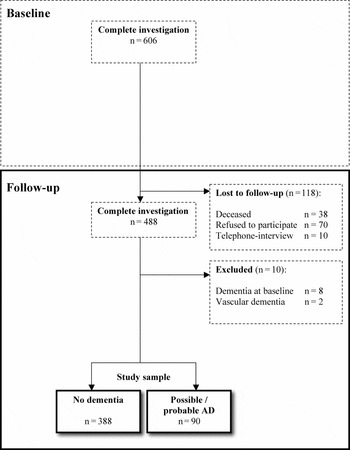
At the outset, the VITA study involved 606 individuals who were born between May 1925 and June 1926 and who took part in the complete baseline investigation by experienced clinicians after having given informed consent (Figure 1). After 30 months a complete follow-up was conducted on 488 of the 606 baseline-subjects. Of the 488 subjects, 10 were excluded from analyses: eight because of dementia at baseline, and two because of incident vascular dementia (VaD). Therefore, the final sample of the current study comprised 478 subjects for whom longitudinal information for diagnosing late onset AD according to common clinical criteria was available. Of these 478 subjects, 388 had no dementia diagnosis and 90 had a diagnosis of possible (n = 72) / probable (n = 18) AD at the VITA-follow-up. Of those 90 subjects, 70 cases had a diagnosis of AD, 10 cases had a diagnosis of mixed AD/ VaD, nine cases had a diagnosis of mixed AD/dementia with Lewy bodies (DLB), and one case a diagnosis of mixed AD/VaD/DLB. Subjects excluded from the follow-up are described in Figure 1.
Study sample.

Diagnosis of dementia
Whether a subject suffered from AD at follow-up was determined by applying the NINCDS-ADRDA criteria (McKhann et al., Reference McKhann, Drachman, Folstein, Katzmann, Price and Stadlan1984). VaD was diagnosed strictly according to the NINDS-AIREN criteria (Román et al., Reference Román1993). DLB was diagnosed according to the Newcastle criteria (McKeith et al., Reference McKeith1996). The availability of longitudinal data allowed a high quality diagnosis, particularly with respect to clinical aspects of the diagnoses. In order for a diagnosis of possible or probable AD to be reached, a panel of experts had to reach a consensus based on longitudinal information from psychometric results in combination with information from the Clinical Dementia Rating (Hughes et al., Reference Hughes, Berg, Danziger, Coben and Martin1982), instrumental activities of daily living (Lawton and Brody, Reference Lawton and Brody1969), and the Mini-mental State Examination (CERAD; Morris et al., Reference Morris1989; Berres et al., Reference Berres, Monsch, Bernasconi, Thalmann and Stähelin2000). Additional information was obtained from cerebral magnetic resonance imaging (at baseline and at follow-up) which was available for 408 cases; from fluorodeoxyglucose positron emission tomography (FDG-PET) which was available for 48 cases; from the diagnosis of depression (DSM-IV criteria; Saß et al., Reference Saß, Wittchen and Zaudig1996); and, for all cases, from relevant blood-parameters (e.g. calcium, vitamin B12, folic acid, thyroid-parameters). Information given by relatives was available for most subjects. In this study the diagnosis of AD included pure AD as well as mixed dementias (AD, VaD and DLB). The final diagnoses were made by an experienced geronto-psychiatrist (PF).
At follow-up, none of the psychometric instruments listed below was used to determine the diagnosis of AD.
Psychometric instruments
The Ten-point Clock Test (Manos, Reference Manos1999). This is administered using a circle (11.4 cm diameter) printed on a sheet of paper. The subject is asked to “write the numbers of a clock face” and to “make the clock say 10 minutes past 11”. The spacing of the numbers and the positions of the hands are used to score the test. The possible total score ranges from 0 to10. The test takes approximately five minutes.
The Human Figure Drawing Test (Ericsson et al., Reference Ericsson, Forsell, Amberla, Holmen, Viitanen and Winblad1991). The subject is asked to draw a man or a woman. An 8-point scale is used to rate the quality of the free-hand Human Figure Drawing. The test takes approximately five minutes.
The Intra-categorical Delayed Selective Reminding Test (IDSR-7). This is a test for measuring episodic memory. A list of seven animals is read to the individual who has to repeat the words aloud. After distracting the subject she or he is asked to recall the animals. Subjects are reminded about omitted items after each recall attempt. Following the reminder they were distracted a second time before attempting to recall the animals. A total of five trials are administered in this way. The test score is the sum of correctly recalled items from five trials. Potential scores range from 0 to 35 (Fischer et al., Reference Fischer1990). The test takes approximately five minutes.
Naming (nomina composita) (a subtest of the Aachener Aphasie Test; Huber et al., Reference Huber, Poeck, Weninger and Willmes1983). This subtest consists of line drawings of ten objects. The subject is asked to name the objects. Responses to each item are scored on a three-point scale with a total score ranging from 0 to 30. The test takes approximately three minutes.
The Trail Making Test B (TMT-B; Reitan, Reference Reitan1956). The TMT–B is a measure of visual tracking, mental flexibility and attention. The subject has to trace a trail which alternates between circles containing numbers and letters variously spread over an A4 page. Performance is assessed by the time (in seconds) taken to complete the trial correctly. The test takes between one and ten minutes.
Verbal Fluency (according to CERAD, Morris et al., Reference Morris1989; standardized German translation, Berres et al., Reference Berres, Monsch, Bernasconi, Thalmann and Stähelin2000). Subjects are asked to name as many animals as they can in 60 seconds. A one-minute category fluency score is given.
The Pocket Smell Test (PST; American Version). This 3-item test provides a very brief screen of gross olfactory dysfunction. The subjects have to correctly identify three odors from four options. The total score ranges from zero to three and the test takes about two minutes.
Subjective memory complaints (SMC). Respondents’ perceptions of deterioration in their memory are assessed before the testing procedure. Subjects are asked four questions about any changes in specific areas of everyday memory, according to the method described by Jorm et al. (Reference Jorm, Christensen, Henderson, Korten, Mackinnon and Scott1994). Responses to all questions are rated on a three-point scale as follows: 0 = “No, not much worse”; 1 = “A bit worse”; 2 = “Yes, a lot worse”. The ratings from the four items are summed to give a score ranging from 0 to 8. The test takes approximately three minutes.
Covariates
Sex and education: subjects’ education was rated on a five-point scale: (1) illiterate or elementary school, (2) secondary school, (3) vocational school, (4) grammar school, and (5) final degree at a university.
Depression: this was assessed using the Short Geriatric Depression Scale (SGDS; Sheik and Yesavage, Reference Sheikh and Yesavage1986). The SGDS is a self-report scale comprising 15 questions. Potential total scores range from 0 to 15, with higher scores indicating greater severity of depression.
All psychometric instruments were performed at the 30-month follow-up in the same order. They were administered by an experienced clinical geronto-psychologist. The administration occurred a few days before the diagnostic procedure of dementia. The psychometric instruments were conducted in German.
Analysis
Means and standard deviations are reported for continuous data. Frequencies are reported for categorical data. Univariate logistic regression analyses are calculated to investigate the influence of the screening tests on the diagnosis (AD versus no AD). For simplification the probability of having no AD is modelled. Odds ratios (OR), corresponding 95% confidence interval (95% CI), p-values and the area under the ROC-curve (aROC) are reported.
All variables with p < 0.05 in the univariate analyses were used in the stepwise multiple logistic regression analysis. Here, a cut point for the p-value to enter or to stay in the model was set to the conventional value of 0.05.
To avoid over-fitting and to check the stability of the model, additional methods of modeling were applied. In a first approach we set the critical limit of the p-values of the probability to enter or to stay in the model 0.005 (Bonferroni adjustment for multiplicity for 10 candidate variables). In addition, we cross-validated the model using a method recommended by Hastie et al. (Reference Hastie, Tibshirani and Friedman2001). The database was divided into five roughly equal sized parts to allow the model-building procedure to be run five times, each time taking four parts of the sample as a development set and the remaining one as the validation set. Stepwise logistic regressions were then repeated, with the probability to enter or to stay in the model set at 0.05, and the significant variables in the five procedures were listed.
Additionally, bootstrapping was used to develop five random data sets. Each data set was drawn from the original data set with replacement until it had the same size as the original data set. A stepwise procedure was applied and the significant variables in the five analyses were listed. Finally, the model was checked using the least Bayesian information criterion (least BIC).
A receiver operating characteristics curve (ROC) was plotted for the resulting model and corresponding score. ROC curves serve as a graphic tool to explore the relationship between sensitivity and specificity of a clinical test for all possible cut points, thus allowing the determination of an optimal cut point.
Box and whisker plots (minimum, maximum, quartiles and outliers) are given for the resulting main model.
Analyses were performed using SAS 9.1 and R 2.6.
Results
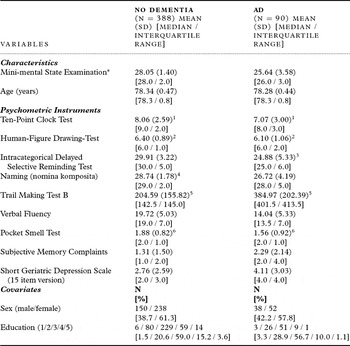
The characteristics of subjects without dementia and those with AD are shown in Table 1. Of the 90 subjects with AD, two had an MMSE score lower than 10, two had an MMSE-score higher than 10 and lower than 20, and the remaining 86 cases had an MMSE score of 20 and higher.
Characteristics of individuals without dementia and individuals with Alzheimer's dementia (AD)

1Missing values: no dementia: n = 7, AD: n = 1 (visual impairment).
2Missing values: no dementia: n = 19, AD: n = 3 (tremor, blindness, visual impairment, lack of motivation).
3Missing values: AD: n = 1 (drowsiness).
4Missing values: no dementia: n = 6 (blindness).
5Missing values: no dementia: n = 10, AD: n = 2 (tremor, blindness, visual impairment).
6Missing values: no dementia: n = 4, AD: n = 2 (loss of scent, test not available).
*According to Morris et al., Reference Morris1989; Berres et al., Reference Berres, Monsch, Bernasconi, Thalmann and Stähelin2000.
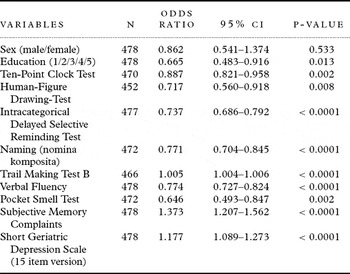
Univariate logistic regression analyses showed that subjects without dementia and those with AD differed significantly on all screening parameters except sex (see Table 2). All significant parameters of the univariate logistic regression analyses were therefore included in the multiple analyses.
Results of the univariate logistic regression analyses

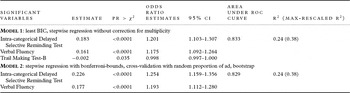
The multiple selection procedures described above resulted in two models for the logistic regression analyses. Applying the least BIC and the simple stepwise logistic regression without adjustment for multiplicity, the “Intra-categorical Delayed Selective Reminding Test”, the “Verbal Fluency”, and the “Trail Making Test-B” (Model 1) were found to be associated with the detection of AD. All other selection procedures only showed the “Intra-categorical Delayed Selective Reminding Test” and “Verbal Fluency” to be significant (Model 2).
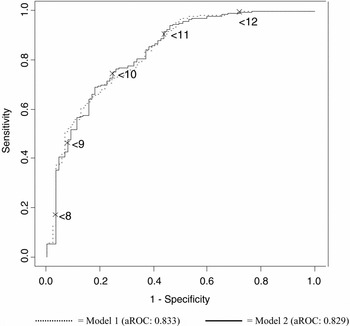
Table 3 presents the results of the multiple regression analyses. The models differed little in the aROC (Model 1: 0.833; Model 2: 0.829). R2 and max-rescaled R2 were nearly identical (Model 1: 0.238; 0.385, Model 2: 0.236, 0.382). Regression scores (RS) for Model 2 were calculated from the estimates of the two regression coefficients (see Table 3) according to the following formula:

Results of the multiple analyses: Model 1 and Model 2

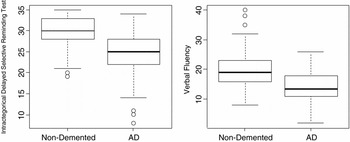
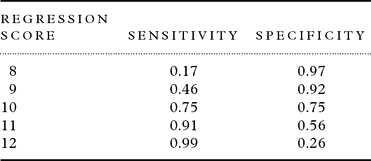
The minimum value of the RS was 0.0 (IDSR-7 score = 0; Verbal Fluency score = 0), and the maximum value was 14.989 (IDSR-7 score = 35, Verbal Fluency score = 40). A sensitivity of 99% was found at a RS ≥ 12, and a specificity of 97% was found at a RS ≤ 8. Figure 2 shows the RS: 8, 9, 10, 11, and 12 directly plotted on the ROC curve of Model 2. Figure 3 shows box and whisker plots for Model 2. The corresponding values of sensitivity and specificity can be seen in Table 4.
ROC curves for Model 1 and Model 2.

Box and whisker plots (minimum, maximum, quartiles and outliers) for Model 2.

Regression scores of Model 2 and their corresponding values

In a subsequent analysis the MMSE was included in the stepwise multiple models. There was no difference in the resultant models (data not shown).
Discussion
Screening is a “first step” in detecting AD, and therefore, an important public health and clinical initiative (Shulman et al., Reference Shulman2006). A main finding of this study was the identification of a combination of two psychometric instruments effective at screening incident AD: an episodic memory test based on the delayed selective reminding procedure (IDSR-7) together with a test of categorical verbal fluency, which is a simple test of semantic memory and executive function.
The analyses resulted in two models for screening AD. The main model (Model 2) consisted of the IDSR-7 and Verbal Fluency and had high sensitivity (0.91) and moderate specificity (0.56). These two instruments can be executed and interpreted easily and quickly and are not expensive. The combination of these instruments appears to be suitable for routine use. Screening tests are supposed to be highly sensitive at detecting a disorder. Therefore, the lower specificity of the screening tests identified in the model are acceptable given the higher sensitivity. The other model (Model 1) comprised three instruments: the IDSR-7, Verbal Fluency and the TMT-B. Both resulting models included impaired episodic memory as well as impaired semantic memory and executive function. This is in line with blurring of boundaries between different dementia syndromes and the knowledge that executive dysfunction appears early and prominently in AD.
Despite the marginal statistical advantages of Model 1 the combination of measures took longer to administer and some elderly individuals cannot perform the TMT-B because of physical handicaps (e.g. blindness, visual impairment, and tremor). This invalidates Model 1.
Impairment of episodic memory is considered to be one of the most prominent features in dementia of the Alzheimer type and is therefore an essential criterion in the diagnosis of AD (McKhann et al., Reference McKhann, Drachman, Folstein, Katzmann, Price and Stadlan1984). Verbal memory tests such as the IDSR-7, which are based on the selective reminding procedure, are described by Buschke and Fuld (Reference Buschke and Fuld1974). This procedure has gained considerable popularity as a clinical measure of verbal learning and memory. Previous studies showed that such memory tests are useful in distinguishing between patients with and without AD. Masur et al. (Reference Masur, Fuld, Blau, Thal, Levin and Aronson1989) reported a lower sensitivity (85.7%) but a higher specificity (98.5%) in differentiating elderly people without AD from individuals with AD using a selective reminding test, than the combination of two of the psychometric tests used in this study.
Deficiencies in categorical fluency seem to reflect impaired structures of semantic memory occurring early in the course of Alzheimer's disease (Fischer et al., Reference Fischer1990; Monsch et al., Reference Monsch, Seifritz, Taylor, Ermini-Funfschilling, Stahelin and Spiegel1997). The results of the current study are consistent with this. Heun et al. (Reference Heun, Papassotiropoulos and Jennssen1998) compared the validity of seven instruments for screening AD. Within the performance of individual tests, the Verbal Fluency Test (animal category) had the largest aROC and the highest discriminative power between dementia and normal cognition. Sager et al. (Reference Sager, Hermann, Rue and Woodard2006) examined the utility of three brief screening tests (MMSE, Clock Drawing, and Animal Naming) in detecting dementia and mild cognitive impairment. The Animal Naming test was best at distinguishing AD from normal cognitive aging (sensitivity: 85%,; specificity: 88%). Monsch et al. (Reference Monsch, Seifritz, Taylor, Ermini-Funfschilling, Stahelin and Spiegel1997) also showed that category fluency correctly classified AD patients (84%) compared with non-AD control subjects.
The TMT-B, a test of divided attention, measures visual search and cognitive alternation of operations (Crowe, Reference Crowe1998). Current evidence suggests that after an initial amnesic stage in AD, attention is the first non-memory domain to be affected. It appears that divided attention is particularly vulnerable in the early stages of AD (Perry and Hodges, Reference Perry and Hodges1999). Thus, it is unsurprising that the TMT-B was identified in one of the two models in this study.
The remaining psychometric variables and instruments that differentiated AD cases from non-AD cases in univariate analyses, but which did not reach significance in either of the two models, were the Ten-Point Clock Test, the Human-Figure Drawing Test, Naming, the Pocket Smell Test, Subjective Memory Complaints, and the Short Geriatric Depression Scale.
The Ten-Point Clock Test (Manos, Reference Manos1999) did not distinguish AD cases from non-AD cases. This is consistent with several studies which have demonstrated that the clock drawing test is only modestly successful in identifying cases of mild dementia (e.g. Seigerschmidt et al., Reference Seigerschmidt, Mösch, Siemen, Förstl and Bickel2002). Lee et al. (Reference Lee, Swanwick, Coen and Lawlor1996) showed that the Clock Drawing Test (CDT) as a screening test was insensitive in early stage cases, but sensitivity improved with increasing severity of dementia. The CDT is unlikely to be useful in screening for AD in its early stages. In the present study, the vast majority of AD cases were diagnosed as possible AD cases (80% of the AD cases). This could be why this test was not identified by multiple analysis.
The free hand Human Figure Drawing Test has been used as a non-verbal technique primarily to measure children's intelligence and cognitive maturation (Goodenough, Reference Goodenough1926). Because of this and because of the concept of retrogenesis in AD (Reisberg et al., Reference Reisberg1999) it has been concluded that the Human Figure Drawing Test might have some potential for assessing early symptoms of dementia (Wang et al., Reference Wang, Ericsson, Winblad and Fratiglioni1998) if focusing on the hierarchical level of the drawings. The current study included the hierarchical level of the drawn figure but it did not reach significance in the multiple models. Furthermore, this test is known to be susceptible to high drop-out rates (Wang et al., Reference Wang, Ericsson, Winblad and Fratiglioni1998). This was confirmed in the current study in which the drop-outs in the non-demented group (4.9%) might have been caused by the feeling that the task was too easy to perform.
Speech disorders within AD (e.g. anomia) have long been known to represent an integral part of the clinical picture of AD. Anomia occurs in the early stages of AD at confrontation naming of pictured or real objects. Anomia also occurs later on within spontaneous speech and is probably caused by a dysfunction of the semantic memory. However, pronounced dysfunctions of anomia do not occur until an advanced stage of AD (Benke et al., Reference Benke, Andree, Hittmair and Gerstenbrand1990). This may be why naming within the great number of possible AD cases in this study did not differ significantly between AD cases and subjects without dementia in both multiple procedures.
AD has been shown to be associated with impaired olfactory function early in the course of the disease (Davies et al., Reference Davies, Brooks and Lewis1993). The earliest neuropathological changes in AD are found in the entorhinal cortex, and comprise the sense of smell. The physiological processes of the pathology start in the olfactory bulb and can limit severely the abilities of that sense (Elsner, Reference Elsner2001). Based on this, there is a growing interest in the use of olfaction as a diagnostic aid in AD, but the diagnostic value of olfactory deficits concerning AD is still not clear (Elsner, Reference Elsner2001). It should be considered that chronological age is strongly associated with impairment of the sense of smell. Olfaction in older adults is influenced by a multiplicity of parameters like disease, dementia, nutritional deficiencies, environment, medication use, as well as insults and injuries of the olfactory system (Arnold et al., Reference Arnold, Smutzer, Trojanowski and Moberg1998). This could be why the Pocket Smell Test was not included in the multiple models of screening AD in this study.
Most studies concerning subjective memory complaints (SMCs) have investigated SMC as a predictor of AD, as an expression of memory decline or its relationship with affective disturbances or personality traits (Reid and MacLullich, Reference Reid and MacLullich2006). SMCs as a potential screening-instrument for AD have been disregarded. There are two possible reasons why SMCs did not reach significance in multiple analysis in the present study. First, it was found that people with early AD often lacked insight into their cognitive impairment. Thus, they did not complain about cognitive decline (Vogel et al., Reference Vogel, Stokholm, Gade, Andersen, Hejl and Waldemar2004). Some individuals with mild AD were aware of their cognitive impairment, but misjudged the severity of impairment and the consequences for everyday life (Derouesné et al., Reference Derouesné, Thibault, Lagha-Pierucci, Baudouin-Madec, Ancri and Lacomblez1999). Second, the utility of SMCs as a valid indicator of current cognitive impairment is debatable as both positive and negative associations between SMCs and cognitive function have been found in cross-sectional studies (Reid and MacLullich, Reference Reid and MacLullich2006).
Depression and dementia are among the most prevalent disorders of older people. Their frequent coexistence has stimulated speculation about complex associations between these two conditions (Wilson et al., Reference Wilson, Schneider, Bienias, Arnold, Evans and Bennett2003; Holtzer et al., Reference Holtzer2005). Attention should be paid to the results of Burke et al. (Reference Burke, Houston, Boust and Roccaforte1989) who showed that while the GDS (30-item version) was an accurate screening test for depression in cognitively intact geriatric samples (CDR = 0), it did not necessarily maintain its validity in samples with mild dementia of the Alzheimer type (CDR = 1). This might be one reason for its not being included in multiple analyses of the GDS within this study.
Some limitations to this study should be noted. First, it has to be mentioned that one of the most prominent screening procedures, the Mini-mental State Examination (CERAD; Morris et al., Reference Morris1989; Berres et al., Reference Berres, Monsch, Bernasconi, Thalmann and Stähelin2000) was not included in the analyses of the present study because it has been used in the process of making the consensus diagnoses of AD. Nevertheless, when the MMSE was included in the stepwise multiple models in a subsequent analysis it made no difference to the resultant models. Second, possible order effects of the screening tests were not controlled. The third limitation relates to the diagnoses of AD-enfolded cases with possible as well as with probable AD. This implies some variability in the severity of AD within the AD group. However, no difference on cognitive measures was found between patients with probable/possible AD in a large group of patients up to 11 years later (Villareal et al., Reference Villareal, Grant, Miller, Storrandt, McKeel and Morris2003). Therefore, patients with possible AD should be considered for inclusion in investigations of AD to improve the generalizability of findings. Fourth, the TMT-B was included in the analyses despite several missing values (n = 12). It was included because of the relevance of impaired divided attention in the clinical picture of AD. The fifth limitation concerns sample selection and generalizability of results as the participation rate in our community-based study was only 40% at baseline (Fischer et al., Reference Fischer2007). We gathered medical information about refusers at baseline and there was no indication that cognitive problems were more frequent in non-participants. As expected, we identified differences in survival between participants and non-participants. Although the number of neuropathological diagnoses was small, trends towards differing degenerative pathology or vascular pathology between participants and non-participants were not observed. There were few drop-outs between baseline and follow-up. Nevertheless, we cannot exclude the possibility that at least some incident AD cases refused to participate in the follow-up. Furthermore the participants belonged to a restricted age cohort. Some studies have found differences in frontal/executive functions (Reid et al., Reference Reid1996) and language performance (Bayles, Reference Bayles1991) with respect to the age at onset of AD. Consequently, caution should be exercised when generalizing the results of this study to other age-cohorts because this is a study about screening 78 year olds. Therefore the study is dealing with late onset AD (not early-onset AD). Additional studies are needed to clarify whether these results are replicated in different age cohorts.
The study has a number of strengths. First, all subjects underwent neuropsychological and psychiatric investigations, including a complete assessment of depression, performed by experienced specialists. Nearly all subjects underwent extensive blood analyses and a cerebral magnetic resonance imaging. Second, the diagnostic-process concerning AD was based on comprehensive longitudinal information (2.5 years). Third, all Alzheimer-type dementias have developed between baseline and follow-up so no single AD diagnosis was older than 30 months which means the results are valid for newly diagnosed “incident” cases of AD.
In conclusion we found that cognitive ability assessment alone might suffice for screening AD. Our findings suggest a combination of a short memory test and a test of verbal fluency to screen for Alzheimer dementia effectively. This combination of a test of episodic memory and of a test of semantic memory and executive function has high sensitivity, moderate specificity and is quick and easy to administer.
Conflict of interest
None.
Description of authors’ roles
S. Jungwirth wrote the article and made a substantial contribution to the interpretation of the data. S. Zehetmayer analyzed the data, wrote the section on statistical methods, revised the manuscript critically for important intellectual content, and gave final approval of the version to be published. P. Bauer co-designed the study, revised the manuscript critically for important intellectual content, and gave final approval of the version to be published. S. Weissgram collected the data, and gave final approval of the version to be published. K. H. Tragl made a substantial contribution to conception and design, revised the manuscript critically for important intellectual content, and gave final approval of the version to be published. P. Fischer designed the study, formulated the research question, made a substantial contribution to the interpretation of the data, revised the manuscript critically for important intellectual content, and gave final approval of the version to be published.
Acknowledgments
The authors gratefully acknowledge the assistance of the following individuals in providing neuropathological analyses: H. Budka, E. Gelpi, S. Hoenigschnabl and A. Reiner-Concin. The VITA study is supported by and took place at the Ludwig Boltzmann Institute of Aging Research. Neuropathological analyses were supported by the Lord Mayor's Medicoscientific Fund of the City of Vienna.