





Introduction
Larkspurs (Delphinium spp.) are typically organized into three basic categories: plains, low, and tall larkspur (Green et al. Reference Green, Gardner, Pfister and Cook2009). Geyer larkspur is classified as plains larkspur and is a native perennial forb in the Ranunculaceae family found in semiarid rangelands primarily in the High Plains of Colorado, Nebraska, Utah, and Wyoming (Burrows and Tyrl Reference Burrows and Tyrl2013; Green et al. Reference Green, Gardner, Pfister and Cook2009). Stems are erect and can vary from 20 to 80 cm. They are topped with terminal raceme inflorescences consisting of many flowers (Burrows and Tyrl Reference Burrows and Tyrl2013). Roots are thick, woody-fibrous with tuberous short vertical rootstock branching downward from a crown (Barr Reference Barr1983; Whitson and Burrill Reference Whitson and Burrill2002). Foliage emerges each year from rootstock buds (Hyder and Sabatka Reference Hyder and Sabatka1972), and the plant reproduces from seed.
Geyer larkspur growth typically begins early in the spring, before perennial cool-season grasses and other forbs, and can often be the only green forage available to cattle (Green et al. Reference Green, Gardner, Pfister and Cook2009; Pfister et al. Reference Pfister, Gardner, Stegelmeier, Knight, Waggoner and Hall2002). Delphinium species contain alkaloids that occur in two types: the N-(methylsuccinimido) anthranoyllycoctonine (MSAL) type and the non-MSAL type (Panter et al. Reference Panter, Manners, Stegelmeier, Lee, Gardner, Ralphs, Pfister and James2002; Pfister et al. Reference Pfister, Gardner, Panter, Manners, Ralphs, Stegelmeier and Schoch1999). The MSAL-type alkaloids are highly toxic, whereas the non-MSAL-type alkaloids are much less toxic (Welch et al., Reference Welch, Panter, Gardner, Green, Pfister, Cook and Stegelmeier2008, Reference Welch, Green, Gardner, Cook, Pfister, Stegelmeier, Panter and Davis2010, Reference Welch, Green, Gardner, Cook, Pfister and Panter2012). The principal toxins in Geyer larkspur are methyllycaconitine, nudicauline, and geyerline (Gardner and Pfister Reference Gardner and Pfister2007; Manners et al. Reference Manners, Panter and Pelletier1995).
Research on herbicide control of larkspur has mainly focused on the tall larkspur species (Mickelsen et al. Reference Mickelsen, Ralphs, Turner, Evans and Dewey1990; Ralphs et al. Reference Ralphs, Turner, Mickelsen, Evans and Dewey1990, Reference Ralphs, Whitson and Ueckert1991, Reference Ralphs, Evans and Dewey1992) with limited research having occurred on plains larkspur. Picloram + 2,4-D has been a commonly recommended herbicide for Geyer larkspur control (Ralphs et al. Reference Ralphs, Whitson and Ueckert1991), but its efficacy varies depending on the timing of application and growing conditions (Hyder Reference Hyder1971; Hyder and Sabatka Reference Hyder and Sabatka1972). Therefore, more research is needed to understand herbicide efficacy before and after flowering. Contemporary herbicide options for Geyer larkspur control are limited. The aminopyralid product label lists several plants from the Ranunculaceae family that it is able to control. Several herbicides developed for rangeland use contain aminopyralid in combination with other active ingredients and were selected for evaluation in this study: aminopyralid +florpyrauxifen-benzyl, aminopyrlid + 2,4-D, and aminopyralid + metsulfuron-methyl. The herbicide triclopyr has recently been shown to control another poisonous plant, death camas [Zigadenus paniculatus (Nutt.) S. Watson] (Stonecipher et al. Reference Stonecipher, Ransom, Thacker, Welch, Gardner and Palmer2021), but its ability to control Geyer larkspur remains unknown.
Land managers often use herbicides to decrease Geyer larkspur density (Green et al. Reference Green, Gardner, Pfister and Cook2009), thereby lowering the potential for livestock poisoning, but the palatability and toxicity of remaining plants can be altered through changes in alkaloid content due to herbicide applications (Green et al. Reference Green, Gardner, Pfister and Cook2009; Stonecipher et al. Reference Stonecipher, Ransom, Thacker, Welch, Gardner and Palmer2021). For example, Ralphs et al. (Reference Ralphs, Manners and Gardner1998) showed that toxic alkaloid concentrations in tall larkspur [Delphinium barbeyi (Huth) Huth] plants treated with metsulfuron-methyl increased; however, applications of glyphosate and picloram did not alter alkaloid concentrations. How alkaloid concentrations in Geyer larkspur are affected by herbicide applications has not been evaluated, but it could be valuable information to livestock producers to help reduce the risk of toxicity.
The objectives of this study were to 1) evaluate aminopyralid, aminopyralid + florpyrauxifen-benzyl, aminopyralid + 2,4-D, aminopyralid + metsulfuron-methyl, metsulfuron-methyl, triclopyr, and triclopyr + 2,4-D for their efficacy in controlling Geyer larkspur; 2) determine whether plant growth stage at the time of herbicide application influences herbicide effectiveness; and 3) determine whether herbicide treatment alters the alkaloid content of Geyer larkspur when applied at either the vegetative or flowering stage.
Materials and Methods
Study Site
Plots were established at sites in eastern Wyoming and northern Colorado. The Wyoming site was located just west of Cheyenne (41.1732°N, 104.8855°W) at an elevation of 1,893 m. The soil is fine-loamy over sandy or sandy-skeletal, mixed, mesic Aridic Argiustolls (Loamy). The ecological site is an upland site characterized by perennial cool-season mid-height bunchgrasses and rhizomatous grasses, and the perennial warm-season shortgrass blue grama [Bouteloua gracilis (Willd. Ex Kunth) Lag. Ex Griffiths] (USDA-NRCS 2024). The 50-yr mean (1974–2024) annual precipitation for the site is 381 mm (PRISM Climate Group 2024). The site is managed by the Resources and Systems Research Unit, a division of the U.S. Department of Agriculture–Agricultural Research Services, and was chosen for its ease of accessibility and because grazing during the trial period could be prevented in the pasture where the plots were established. A voucher specimen was collected and deposited in the Poisonous Plant Research Laboratory Herbarium (No. 4979).
The Colorado site was located 8 km east of Virginia Dale (40.9416°N, 105.2609°W) at an elevation of 2,203 m. The soil is loamy-skeletal, mixed, shallow Aridic Argiborolls (Rocky loam). The ecological site is classified as mountain big sagebrush [Artemisia tridentata Nutt. ssp. vaseyana (Rydb.) Beetle] (USDA-NRCS 2024). The 50-yr mean (1974–2024) annual precipitation for the site is 435 mm (PRISM Climate Group 2024). The site is located on the Colorado State University Maxwell Ranch and was chosen for its ease of accessibility, and because grazing could be prevented during the trial period in the pasture where the plots were established. A voucher specimen was collected and deposited in the Poisonous Plant Research Laboratory Herbarium (No. 4982).
Experimental Design
Treatments were arranged factorially in a randomized, complete block design with four blocks at each site. Each block consisted of 15 plots (3 by 9 m) with seven herbicide treatments (Table 1) applied at two timings, vegetative and flowering growth stages, and one nontreated control plot. Herbicide rates were chosen based on manufacturer recommendations for closely related plant species. A nonionic surfactant (2.5 mL L− 1) was included with each herbicide treatment.
Herbicides and application rates used to treat Geyer larkspur. a
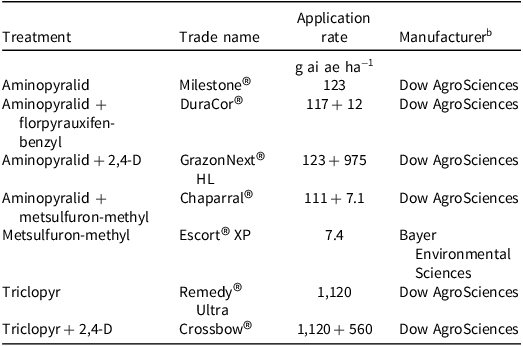
a Studies were carried out at siters near Cheyenne, Wyoming, and Virginia Dale, Colorado, in 2021 and 2022.
b Manufacturer locations: Bayer Environmental Sciences, Research Triangle Park, NC; Dow Agrosciences LLC, Indianapolis, IN.
At the Wyoming site, herbicides were applied at the vegetative growth stage of Geyer larkspur on May 26, 2021. The height of Geyer larkspur was 25 ± 3 cm at application. Herbicide application at the flowering growth stage occurred on June 23, 2021, when Geyer larkspur plants were 40 ± 5 cm tall. At the Colorado site, herbicide application at the vegetative growth stage of Geyer larkspur occurred the following year on June 8, 2022. Larkspur plants were much shorter at 11 ± 2 cm than at the Wyoming site. Herbicide application at the flowering growth stage occurred on June 28, 2022, again with much shorter plant heights of 28 ± 4 cm compared to the Wyoming site. Herbicides were applied using a CO2-pressurized backpack sprayer at a rate of 168 L ha−1 at 207 kPa at 4.0 km h−1. The spray boom consisted of six XR8002 flat-fan nozzles (TeeJet Technologies, Glendale Heights, IL) spaced 51 cm apart.
Plant Measurements
The total number of Geyer larkspur plants in each plot was counted before herbicide application and again 1 and 2 yr after treatment (YAT). Aboveground biomass production was measured at 2 YAT for both sites by clipping all the vegetation in a 0.25-m × 0.5-m frame to a 3-cm stubble height. Plots at the Wyoming site were clipped on June 12, 2023, and plots at the Colorado site on June 24, 2024. Two frames were clipped in each plot at random locations approximately 3 m and 6 m within the plot. Clipped biomass was separated into plant functional groups: perennial grass, annual grass, perennial forb, annual forb, and Geyer larkspur. Biomass was dried in a forced-air oven at 60 C for 96 h and weighed.
Six individual Geyer larkspur plants were collected per plot, harvested at ground level, 15 to 28 d after herbicide application, at both vegetative and flowering growth stages, and dried at 60 C for 96 h and ground in a Wiley mill to pass through a 1-mm screen. Two of the six plants collected from each plot were randomly selected for alkaloid analysis, and the two plants from each plot were analyzed individually. The concentration of MSAL alkaloids and total alkaloids were determined as previously described using flow injection electrospray mass spectrometry (Gardner et al. Reference Gardner, Lee and Cook2021).
Data Analyses
Geyer larkspur plant density, biomass, and alkaloid concentration were analyzed using a generalized linear mixed model (GLIMMIX procedure) method in a mixed model analysis of variance with repeated measures using SAS software (v. 9.4; SAS Institute, Cary, NC). Geyer larkspur density, biomass, and alkaloid concentration values were averaged for each plot, and the means used for analysis. Plots were the experimental units, and the four blocks were replicates. Herbicide treatment, application timing, and year were the fixed effects factors, and block and repeated measures were incorporated as random effects factors. Biomass and Geyer larkspur density were square-root transformed, and alkaloid concentration was log-transformed to meet assumptions of normality and homogeneity of variance. Treatment means are reported as original, nontransformed data with standard errors (x̄ ± SEM). Treatment means were separated using the LSMEANS method, and main effects were adjusted for Type I error inflation using the Tukey method. Geyer larkspur control was evaluated at two different growth stages, vegetative and flowering. The two sites were analyzed separately. Geyer larkspur plant counts were converted to the number of plants per square meter.
Results and Discussion
Precipitation at the Wyoming site was below the 50-yr mean (381 mm) the year herbicides were applied (339 mm). However, precipitation for the months immediately preceding herbicide applications (February to June) was at or above average (Table 2). At the Colorado site, precipitation the year that herbicides were applied was 364 mm, well below the 50-yr mean (435 mm). Precipitation was below the 50-yr average for March through June, the year that herbicides were applied (Table 2).
Monthly precipitation for the year that herbicides were applied, the 2 yr of data collection, and the 50-year average. a , b , c
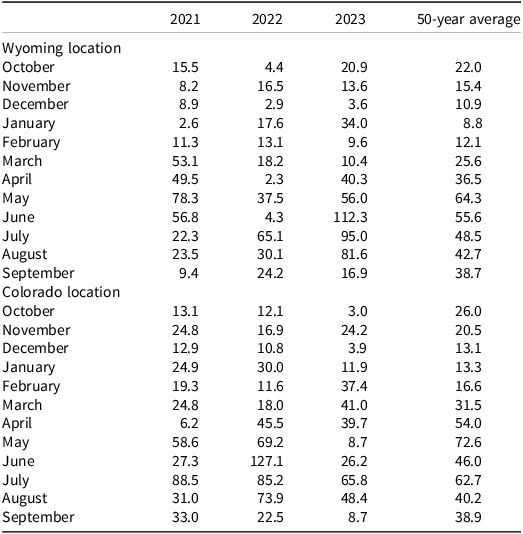
a Experiments were carried out at sites near Cheyenne, Wyoming, from 2021to 2023; and Virginia Dale, Colorado, from 2022 to 2024.
b All precipitation data are reported in millimeters.
c Fifty-year average data include 1974 to 2024. Source: PRISM Climate Group (2024).
Geyer larkspur density prior to herbicide application was 2.5 ± 0.16 and 3.7 ± 0.26 plants m−2 at the Wyoming and Colorado sites, respectively. Geyer larkspur density in the nontreated control plots at the Wyoming site was similar prior to herbicide treatment and 1 YAT, but decreased by 40% at 2 YAT (P = 0.0001; data not shown). The density of Geyer larkspur did not change in the nontreated plots at the Colorado site (P = 0.0651; data not shown).
Herbicide application at the different phenological stages did not have an effect on Geyer larkspur density at the Wyoming site (P = 0.1065; data not shown). Geyer larkspur density at the Wyoming site was reduced by all herbicide treatments applied at the vegetative stage 1 YAT and all herbicides except triclopyr 2 YAT (P = 0.0249; Table 3). When applied at the flowering stage, Geyer larkspur density was reduced by all herbicides except metsulfuron-methyl, triclopyr, and triclopyr + 2,4-D at 1 YAT and triclopyr and triclopyr + 2,4-D at 2 YAT (Table 3).
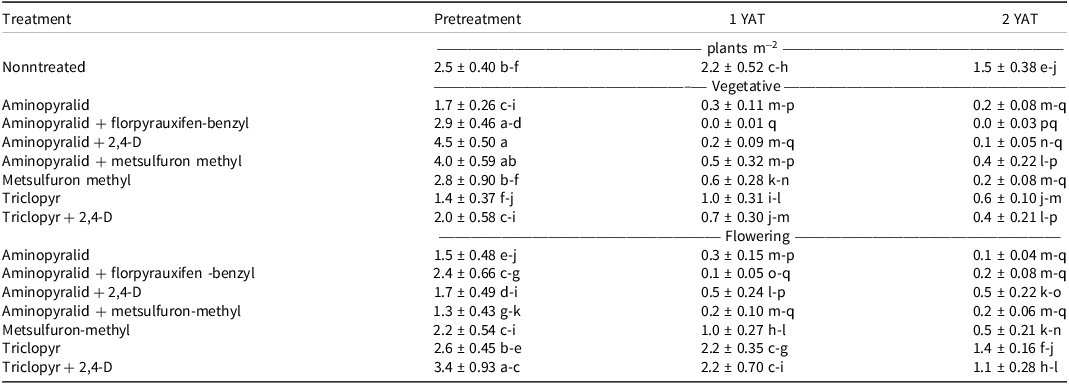
a Abbreviation: YAT, years after treatment.
b Geyer larkspur density is reported as plants per square meter (plants m−2, mean ± SE, n = 4).
c Means followed by the same letter are not significantly different between treatment and phenological stage and data collection time (pretreatment, 1 YAT, 2 YAT) (P < 0.05).
d Studies were carried out at sites near Cheyenne, Wyoming, between 2021 and 2023. Herbicides were applied to vegetative stage Geyer larkspur plants on May 26, 2021, and to flowering stage plants on June 23, 2021.
In contrast to the Wyoming site (P = 0.0249), there were no differences in Geyer larkspur density across treatments at the Colorado site (P = 0.9621; data not shown). There were no differences in Geyer larkspur density between herbicide applications at the different phenological stages (P = 0.9875). We suspect that the efficacy of the herbicides was significantly reduced at the Colorado site compared to the Wyoming site due to low precipitation in Colorado. Drought can cause water stress and affect plant responses to herbicides, principally reducing efficacy. Water stress has been shown to reduce herbicide efficacy on both monocots and dicots (Benedetti et al. Reference Benedetti, Rangani, Viana, Carvalho-Moore, Camargo, de Avila and Roma-Burgos2020; Miller and Norsworthy Reference Miller and Norsworthy2018), and translocation of herbicides can be reduced during times of moisture stress (Reynolds et al. Reference Reynolds, Wheless, Basler and Murray1988).
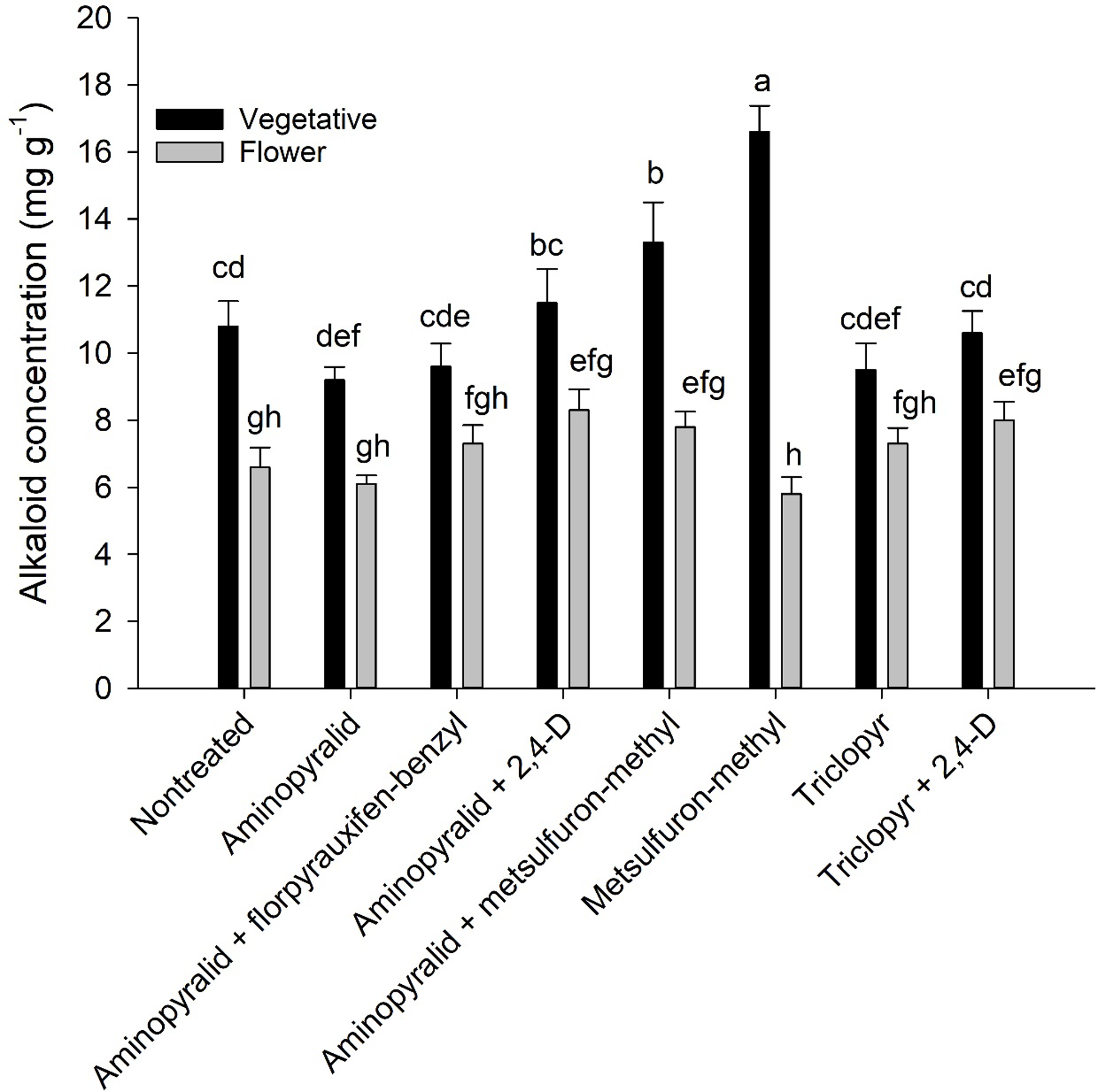
At the Wyoming site, there was a difference in MSAL and total alkaloid concentration between nontreated Geyer larkspur plants collected at the vegetative and flowering stages (P < 0.0490). MSAL concentrations of nontreated Geyer larkspur were 1.4 times greater at the vegetative (4.4 ± 0.40 mg g−1) than the flowering (3.2 ± 0.13 mg g−1) stage. Total alkaloid concentrations of nontreated larkspur plants were 1.6 times greater at the vegetative (10.8 ± 0.75 mg g−1) than the flowering (6.6 ± 0.58 mg g−1) stage (P < 0.001; Figure 1). Total alkaloid concentrations of all samples analyzed were 1.6 times greater at the vegetative (11.4 ± 0.25 mg g−1) phenological stage than the flowering (7.2 ± 0.26 mg g−1) stage (P < 0.001), and MSAL alkaloids were 1.5 times greater at the vegetative (4.3 ± 0.15 mg g−1) stage than the flowering (2.8 ± 0.16 mg g−1) stage (P < 0.001). Plants treated with metsulfuron-methyl had at least 2.9 times greater total alkaloid concentrations when treated at the vegetative growth stage than the flowering stage (P < 0.001; Figure 1). Conversely, plants treated with this herbicide at the flowering stage contained 30% lower total alkaloids than those treated with a herbicide containing 2,4-D; there were no differences in total alkaloid concentrations of Geyer larkspur plants receiving any herbicide treatment or the nontreated controls at the flowering stage. Total alkaloid concentrations were 1.2 times greater from the aminopyralid + metsulfuron-methyl treatment than the nontreated controls when the herbicide combination was applied at the vegetative phenological stage with all other herbicide treatments, except for metsulfuron-methyl, which produced total alkaloid concentrations similar to that of the nontreated controls.
Total alkaloid concentration of Geyer larkspur plants treated with herbicides at vegetative and flowering stages of phenological development near Cheyenne, WY, 2021–2023.
No differences in MSAL or total alkaloid concentrations of nontreated Geyer larkspur plants were collected between vegetative and flowering stages at the Colorado site (P > 0.1182; data not shown). Total alkaloid concentrations for nontreated larkspur plants were 1.4 times greater at the vegetative (10.9 ± 0.53 mg g−1) than the flowering (7.8 ± 0.54 mg g−1) phenological stage (P = 0.001). There were no differences in MSAL alkaloid concentrations of nontreated larkspur plants between phenological stages (P = 0.0624; data not shown). There was no difference in MSAL concentrations across herbicide treatments (P = 0.1699), but there was a difference in total alkaloid concentrations (P = 0.0357; Figure 2). Total alkaloid concentrations were increased in the metsulfuron-methyl treatment applied at the vegetative stage, which was similar to what was observed at the Wyoming site. Total alkaloids in the plants treated with aminopyralid + metsulfuron-methyl were also high but were not statistically different from those collected from the nontreated controls.
Total and N-(methylsuccinimido) anthranoyllycoctonine (MSAL) alkaloid concentrations of Geyer larkspur plants treated with herbicides near Virginia Dale, CO, 2022–2024.
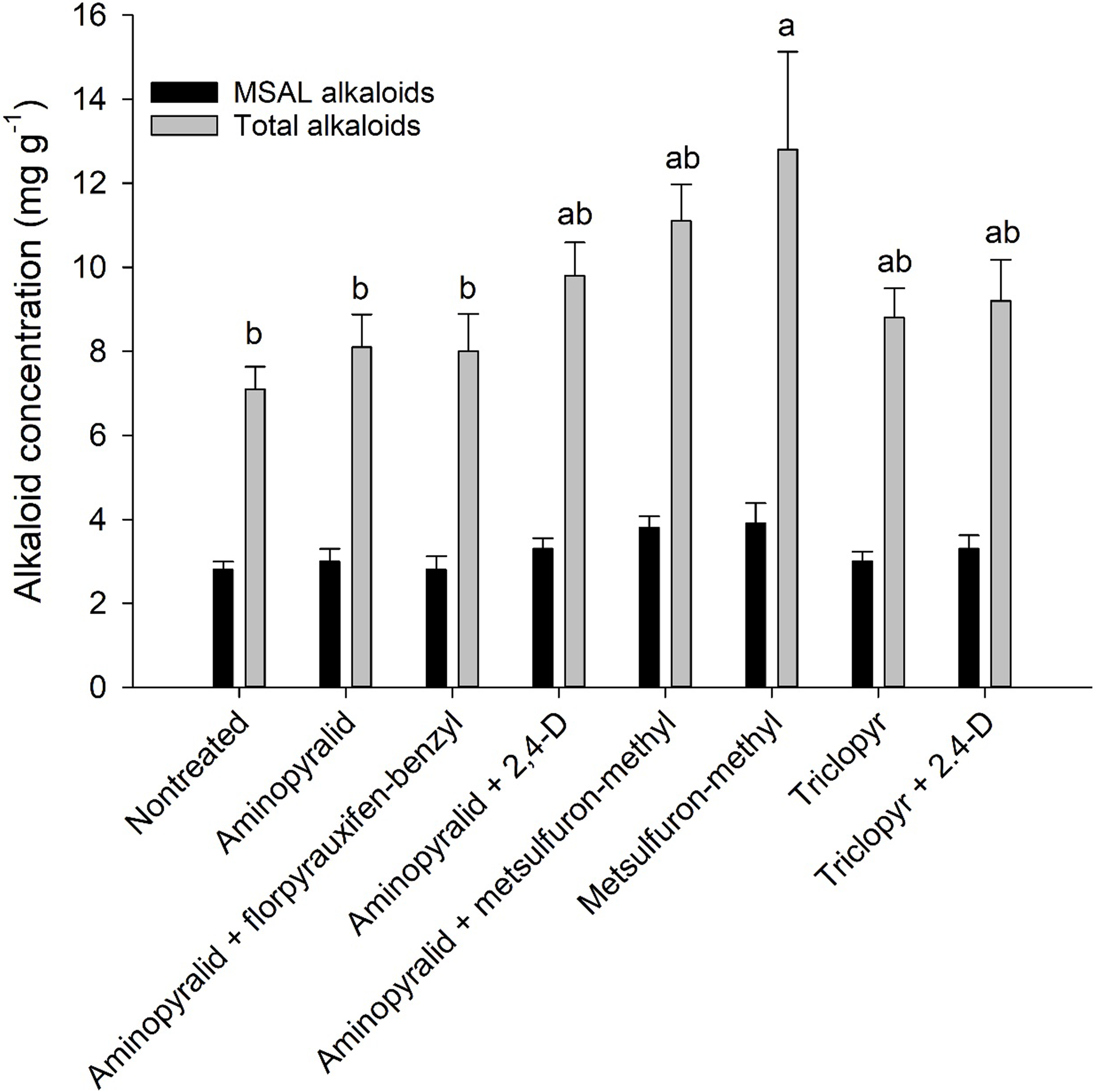
In greenhouse studies with tall larkspur, total alkaloid concentrations increased 2-fold in plants treated with metsulfuron-methyl compared with nontreated controls 7 d after herbicide treatment (Ralphs et al. Reference Ralphs, Manners and Gardner1998). In the same study, the total alkaloid concentration of Geyer larkspur plants treated with picloram was similar to that of nontreated plants. In field trials, total alkaloid concentrations were greater in Geyer larkspur plants treated with metsulfuron-methyl than in plants treated with picloram or nontreated plants (Ralphs et al. Reference Ralphs, Manners and Gardner1998). Herbicides can increase, decrease, or not affect the concentration of toxic compounds in plants (Williams and James Reference Williams and James1983). Stonecipher et al. (Reference Stonecipher, Ransom, Thacker, Welch, Gardner and Palmer2021) observed no change in the alkaloid concentration of death camas plants treated with various herbicides. In the current study, most of the tested herbicides did not affect alkaloid concentrations of treated plants; the exception was an increase in alkaloid concentration in plants that received metsulfuron-methyl and aminopyralid + metsulfuron-methyl.
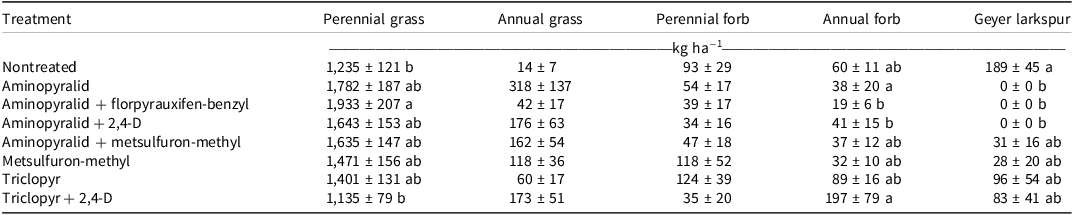
Vegetation was clipped 2 YAT at both sites to determine whether herbicide treatment altered vegetation biomass. Biomass production of Geyer larkspur at the Wyoming site differed at herbicide application, with a 1.9 times greater larkspur biomass produced at the flowering than the vegetative stage (P = 0.0126; data not shown). There was an interaction in the treatment by herbicide application timing for Geyer larkspur biomass (P = 0.0381) with triclopyr + 2,4-D producing less Geyer larkspur biomass at the vegetative stage than the flowering stage (data not shown). Applications of aminopyralid, aminopyralid + florpyrauxifen-benzyl, and aminopyralid + 2,4-D resulted in a reduction in Geyer larkspur biomass to a level below that of the nontreated plots (P = 0.0128; Table 4). Perennial grasses produced the most biomass of all vegetation groups at both sites (P < 0.0001; Tables 4 and 5). At the Wyoming site, perennial grass biomass production was greater in plots treated with aminopyralid + florpyrauxifen-benzyl than biomass production from the nontreated controls (P = 0.0147; Table 4). The increase in perennial grass production could be due to a competitive release that occurred after Geyer larkspur had been controlled. Similar results have been observed with an increase in biomass production of high seral perennial grass species following treatment with aminopyralid to control Canada thistle (Cirsium arvense (L.) Scop.; Almquist and Lym Reference Almquist and Lym2010). Grass cover increased after duncecap larkspur (Delphinium occidentale) (Mickelsen et al. Reference Mickelsen, Ralphs, Turner, Evans and Dewey1990) and tall larkspur (Ralphs et al. Reference Ralphs, Turner, Mickelsen, Evans and Dewey1990) had been treated with metsulfuron-methyl. However, treatments with metsulfuron-methyl in combination with aminocyclopyrachlor did not affect grass production when the herbicides were applied to control duncecap larkspur (Greet et al. Reference Greet, Mealor and Kniss2016).
Dry matter biomass of rangeland components 2 yr after herbicide treatment of Geyer larkspur. a , b , c
a Data are combined over both vegetative and flowering application timings.
b Study was carried out at a site near Cheyenne, Wyoming, from 2021 to 2023.
c Means followed by the same letter are not significantly different within a plant functional group (P < 0.05).
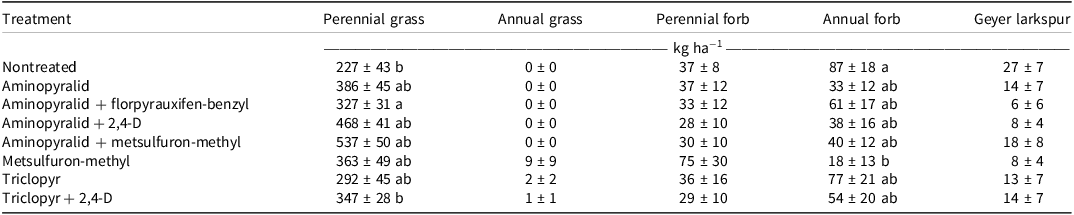
Dry matter biomass of rangeland components 2 yr after herbicide treatment of Geyer larkspur a, b, c .
a Data are combined over both the vegetative and flowering application timings.
b Study was carried out at a site near Virginia Dale, Colorado, from 2022 to 2024.
c Means followed by the same letter are not significantly different within a plant functional group (P < 0.05).
There was a tendency for annual grass biomass production to be lower in the nontreated control plots than the herbicide-treated plots at the Wyoming site (P = 0.0463; Table 4). There was a treatment by herbicide application time interaction for perennial forb biomass production, in that plots treated with metsulfuron-methyl produced more biomass at the flowering stage than both the nontreated control plots and those treated at the vegetative stage (P = 0.0383; data not shown).
At the Colorado site, there was a treatment by herbicide application timing interaction (P = 0.0084) for biomass of Geyer larkspur, with lower biomass at the vegetative stage from plants treated with triclopyr than the nontreated controls, and plants that received all other treatments exhibited similar biomass results to those of the nontreated controls. At the flowering stage, biomass production of Geyer larkspur from plots treated with aminopyralid + metsulfuron-methyl and triclopyr was similar to that from the nontreated control plots and those treated with aminopyralid, aminopyralid + florpyrauxifen-benzyl, aminopyralid + 2,4-D, metsulfuron-methyl, and triclopyr + 2,4-D (data not shown). Perennial grass biomass production was greater in plots that received the aminopyralid + florpyrauxifen-benzyl treatment than the nontreated controls, and all other treatments were similar to that of the nontreated controls (P = 0.0147; Table 5). Although herbicides did not completely control Geyer larkspur at the Colorado site, the herbicides could have reduced the density of Geyer larkspur to a level that competition with perennial grasses was reduced, which allowed perennial grass production to increase. There was little or no annual grass biomass production at the Colorado site, which resulted in no differences between treatments. There were also no differences between herbicide treatments in perennial forb biomass production (P = 0.4953). Annual forb biomass was greatest from the nontreated control and lowest from plots that received metsulfuron-methyl treatments (P = 0.0438; Table 5).
Overall, aminopyralid, aminopyralid + florpyrauxifen-benzyl, aminopyralid + 2,4-D, aminopyralid + metsulfuron-methyl, and metsulfuron-methyl demonstrated good control of Geyer larkspur when they were applied at both phenological growth stages at the Wyoming site. However, annual grass production increased in all plots that were treated with herbicides at the Wyoming site. If annual grasses are present, applying the herbicides used in this study may increase annual grasses in treated areas. It may then be necessary to add an additional herbicide to control annual grasses or apply a herbicide in the fall or following spring to reduce annual grasses. Palatability and toxicity of Geyer larkspur plants treated with herbicides can be altered. Alkaloid content can increase or decrease as we observed with the mestulfuron-methyl treatment. Palatability of herbicide-treated plants can increase even if the alkaloid concentration is not changed, and result in increased preference and consumption by livestock. Livestock must not have access to Geyer larkspur plants that have been treated with herbicides the year of treatment. If herbicide-treated plants remain, they may be poisonous to livestock. Results differed at the Colorado site, where all herbicide treatments had limited efficacy due to lower precipitation in the months prior to and shortly after herbicide application, resulting in limited soil water and causing Geyer larkspur to become drought stressed. We suggest delaying the use of a herbicide to control Geyer larkspur when environmental conditions are unfavorable, such as those that occurred at the Colorado site.
Practical Implications
Control of Geyer larkspur in semiarid rangelands can be effectively accomplished with aminopyralid herbicides and metsulfuron-methyl applied at both vegetative and flowering growth stages, provided environmental conditions prior to herbicide application are sufficient for plant growth and uptake of the herbicide. When environmental conditions are unfavorable, herbicide treatment of Geyer larkspur should be delayed. Perennial grass biomass increased when Geyer larkspur was controlled with herbicides. Do not let livestock graze on Geyer larkspur that has been treated with herbicides. If herbicide-treated plants are present, they could be poisonous to livestock.
Acknowledgments
We thank Kermit Price and Scott Larsen for their technical assistance, Joel Vaad and the Maxwell Ranch at Colorado State University, and Matt Mortenson, USDA-ARS Agricultural Science Research Technician. USDA-ARS is an equal opportunity provider and employer.
Funding Statement
Research was funded by the U.S. Department of Agriculture–Agricultural Research Service.
Competing interests
The authors declare they have no conflicts of interest.


 Open access

