

Introduction
Biological relationships among cattle breeds are studied for a variety of reasons (Kidd and Pirchner, Reference Kidd and Pirchner1971). For example, the relationships may reflect breed histories and thereby illuminate human migrations, they may identify breeds potentially useful in breeding programmes and they may aid in understanding domestication (Simon et al., 2008). Historically, morphological studies, especially of the skull, were the major source of data used to characterize breeds (Kidd and Pirchner, Reference Kidd and Pirchner1971), but molecular genetics were recognized soon after their discovery to be another valuable source of data (Viana et al., Reference Viana, Fernández, Iglesias Blanco and Sánchez1998; Pariset et al., Reference Pariset, Mariotti, Nardone, Soysal, Ozkan, Williams, Dunner, Leveziel, Maróti-Agóts, Bodò and Valentini2010; Martín-Burriel et al., Reference Martín-Burriel, Rodellar, Cañón, Cortés, Dunner, Landi, Martínez-Martínez, Gama, Ginja, Penedo, Sanz, Zaragoza and Delgado2011). Evolution of mammalian skeletal structure can be rapid and the changes profound, as illustrated by the morphological diversity of the cattle. There are several ways of trying to group the European cattle breeds: by role, geographically, by obvious external characteristics such as colour and horns, by genetic distance or by any of several hypotheses suggesting how the breeds might have evolved an diversified and in which general directions their ancestors migrated with the invaders and settlers of their country of origin (Porter, Reference Porter1991; Čítek et al., Reference Čítek, Panicke, Řehout and Procházkovál2006; Achilli et al., Reference Achilli, Bonfiglio, Olivieri, Malusà, Pala, Kashani, Perego, Ajmone-Marsan, Liotta, Semino, Bandelt, Ferretti and Torroni2009). There is certain arbitrariness in such groupings and it depends, to some extent, on why the connections between the breeds are being sought (Porter, Reference Porter1991). It has been traditionally stated that cattle breeds were distinguishable on the basis of suites of head measurements and considered that skull and face lengths and widths were most useful for their identification.
The objective of principal component analysis (PCA) is to account for the maximum portion of the variance present in the original set of variables with a minimum number of composite variables. It assumes that the unique variance represents a small portion of the total variance. The present investigation therefore explores the relationships among some cephalic dimensions in some bovine breeds using PCA with a view to reduce the number of body measurements required for genetic and breeding purposes. Rotation of principal components was through the transformation of the components to approximate a simple structure. PCA can be used with success when morphological characteristics are interdependent. This is to find the loadings that can explain the highest variation in the data set over the dependent variable. The resulting PC or loadings may decrease the dimension of the explanatory variables and break the possible dependence among explanatory variables (Yakubu and Ayoade, Reference Yakubu and Ayoade2009).
To the present, skull morphometric studies within and among cattle breeds based on a relatively large number of specimens and employing multivariate analysis techniques have been limited. In addition, most of the craniological studies were based on measurements of very few skulls (Kidd and Pirchner, Reference Kidd and Pirchner1971) and from the studies of this type, no comparative one has been performed between the Pyrenean breeds. Therefore, the aim of the present study is to examine the skull differences between some Pyrenean breeds based on large samples as well as their intraspecific variability by means of multivariate analyses. This study therefore also considers the “Pyrenean bovine patchwork”, with the special interest of conserving those breeds which are highly endangered, such as Blanca del Pallars.
Material and methods
Three hundred adult cows of known breeds were included in the study. Studied animals belonged to the following seven French and Spanish breeds: Avileña (AVI, N = 9), Blanca del Pallars (BLP, N = 36), Bruna dels Pirineus (BRU, N = 193), Gascon (GAS, N = 7), Pardo Alpina (PAL, N = 19), Parda de Montaña (PMU, N = 19) and Pyrenean (PIR, N = 17). Only adult specimens (at least M3 erupted) were included in this study, because the developing skeleton undergoes large changes in size and proportions, which might limit the distinction between breeds. The Avileña is a black, long-horned draught-and-meat breed that belongs to the black Iberian group and it has many similarities with the so-called Celtic breeds, such as Welsh, Longhorn, Kerry, Camargue and Tortona while the Gascon is a wheaten or grey meat-and-draught breed and is long horned, a trait that is shared with the Podolian types in Italy and the Pyrenean is a blond breed that is straw coloured with pale shading on the underside and lower parts of extremities (Porter, Reference Porter1991). The muzzle and the mucosae are pink (Sambraus, Reference Sambraus1992). Its breed history could be traced back to Celtic cattle. The Bruna dels Pirineus, Pardo Alpina and Parda de Montaña belong to the so-called Alpine Swiss brown group having Swiss strains as their ancestor and are closely related to each other because of their same origin. They are mostly medium to dark brown with a pale back line and almost white around the muzzle. Muzzle and hooves are dark. Finally, the Blanca del Pallars is a fairly primitive pure white breed, the mucosae and hooves being dark. It is classified as a relic breed on the brink of extinction by the Food and Agriculture Organization of the United Nations, as only 33 breeding animals remain alive (2 bulls and 31 cows) and could represent the last vestiges of an ancient Podolian population introduced from France many years ago (unpublished data, 2011) which has been blanketed out of existence by successful alpine Swiss invaders. It is well managed and well adapted to the local Pyrenean hard terrain and climate.
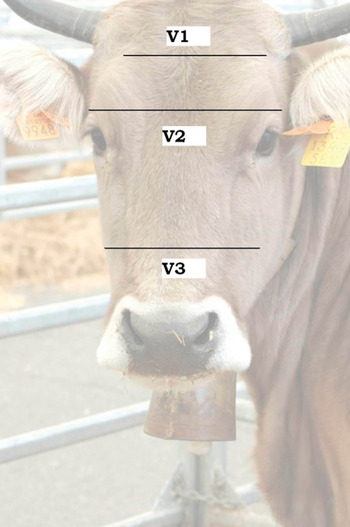
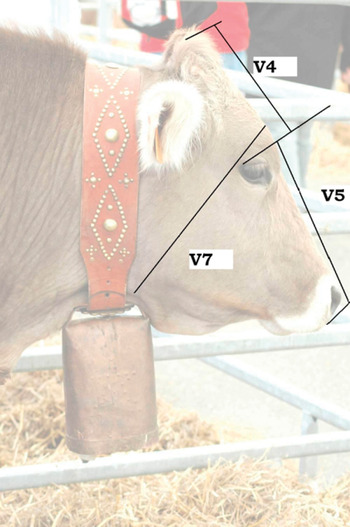
In the present study, following the criteria described in the classical literature (Sánchez, Reference Sánchez1984; Porter, Reference Porter1991), cows were classified as belonging to the Alpine (BRU, PAL and PMU), Blonde (PIR), Iberian (AVI) and Podolian trunks (BLP and GAS). Seven basic measurements were taken following standard procedure and anatomical reference points described (Herrera and Luque, Reference Herrera, Luque and Sañudo2009) (Figures 1 and 2):
(1) Skull width.
(2) Head width.
(3) Face width.
(4) Skull length.
(5) Face length.
(6) Head length (V3 + V4).
(7) Head depth.
Only traditional measurements were included. Mandibular measurements were excluded. The cephalic measurements were taken with a slide gauge equipped with a scale. The measurements are in millimetres to the nearest 0.5 mm. All bones were measured by one of the authors (Pere-Miquel Parés) except for 28 Blanca del Pallars cows, which were measured by Ignasi Sinfreu, but since the measurements are defined anatomically, authors do not believe that this fact involved any systematic differences. No specimens had missing measurements. Ethical approval was considered not necessary as the study involved simple manipulations.
Anatomical reference points described (frontal view). V1, skull width; V2, head width; V3, face width.

Anatomical reference points described (lateral view). V4, skull length; V5, ace length; V6, head length (V3 + V4); V7, head depth.

Standard statistics comprised mean, standard deviation and coefficient of variation (CV). Also, one-way analysis of variance (ANOVA) on each character was used to ascertain whether or not significant differences existed among breeds. Pearson's correlations were determined and those variables showing all absolute r < 0.3 were excluded from subsequent multivariate analysis. The Kaiser − Meyer − Olkin rule criterion was used to determine the number of components, i.e. relating only the components that have eigenvalue greater than 1. For further analysis, a varimax rotation was performed. The next method used in this study was principal components analysis using the correlation matrix. Finally, the standardized canonical coefficients, which represent the contribution of each variable to the discriminative function, were inspected in order to investigate the breed differences.
Statistical analyses were performed using the standard methods of Factor v. 7.00 software package (Lorenzo-Seva and Ferrando, Reference Lorenzo-Seva and Ferrando2006) and PAST (Hammer, Harper and Ryan, Reference Hammer, Harper and Ryan2001). Data are available at the following address: peremiquelp@prodan.udl.cat.
Results and discussion
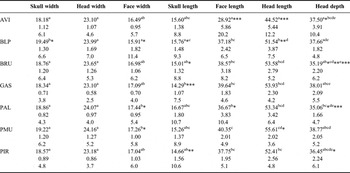
The analysed breeds differ differently in terms of all the studied parameters (Table 1). Breed variation, expressed by the CVs, is relatively high for some variables in some breeds. Although high CVs have been also reported in previous morphometric studies (Parés and Jordana, Reference Parés and Jordana2008) this general variability may be a feature of cattle and it should be taken into account when variables are selected for analysis. On average, the face of Avileña is shorter than those of the other breeds, being a clear brachyprosopic breed, and Blanca del Pallars has the widest skull but in general all measurements show an overlap in ranges. The tests reveal significant differences between breeds in all variables (p ≤ 0.05), with the exception of head width (p > 0.05).
Descriptive statistics of features and significance differences.

Rows: (1) mean; (2) standard deviation; (3) CV.
Different letters in the same column differ significantly *p ≤ 0.05, **p ≤ 0.01, ***p ≤ 0.001.
V4 (skull length) is excluded from subsequent analysis as it presents a Pearson's correlation coefficient lower than absolute 0.3. In the component analysis for the six remnant variables, the estimate of sampling adequacy Kaiser − Meyer − Olkin reveals the proposition of the use in different biometric traits by underlying components (0.66888) and indicates a mediocre sampling adequacy. The determinant of the matrix is 0.05501523013747.
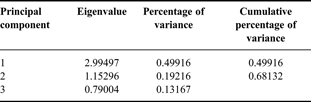
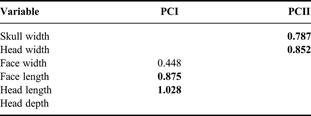
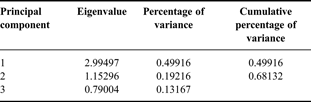
The PCA reveals that the percentage of total variance that best explained the data was summarized in the first two components (Table 2). The two analysed components of the PCA analysis reveal two components, the eigenvalues of which are bigger than 1.0. Eigenvalues for components I and II are 2.99 and 1.15, respectively. These components jointly explain 68.1 percent of the total variance formed by the six metric traits. After the varimax rotation is performed, each variable is given a load, reflecting the linkage of a variable with a given component. The highest loads (>0.7) in Table 3 are marked in bold and loadings lower than absolute 0.300 omitted. PCI is especially linked mostly with two traits out of six (Table 3) reflecting lengths: face and head lengths. PCI accounts for 49.9 percent of the total variation and is interpreted as a size component as suggested by the positive coefficients for almost all measurements. It indicates a proportional increase in the face length in relation to head length in all the breeds. PCI may be called the component of the viscerocranium length. PCII defines traits of width: skull and head widths. PCII may be called the component of the neurocranium width.
Extraction of the three first principal components.
Component loading matrix after varimax rotation.
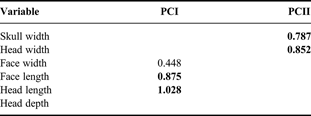
The highest loads ( > 0.7) are marked in bold and loadings lower than absolute 0.300 omitted.
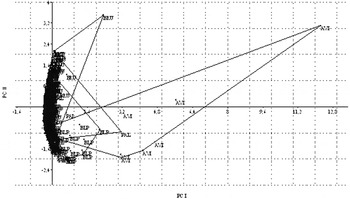
The polygons of the plot (Figure 3) show a lack of distinct breed difference of skulls. The only apparent tendency is the slight shift to the right of the graph in case of the skulls of Avileña which shows an increasingly shorter built face and head. Due to the marked dispersion of points representing the skulls of the breeds, it may be stated that in terms of the structure of the skull the studied breeds do not constitute uniform groups. On the other hand, the second principal component does not contrast differences between skulls of cows of studied breeds. These observations are confirmed by ANOVA which shows that Avileña differs in terms of face (F = 76.33, p < 0.0001) and head length (F = 69.99, p < 0.0001). ANOVA conducted for PCI did show significant differences between Avileña and the others (F = 283.9, p ≤ 0.0001) but as PCI – just connected with two parameters – explains less of half of the total variance, it is difficult to draw final conclusions.
Principal component plot (PCI and PCII). Polygons enclose the breeds. Abbreviations are explained in the text.

ANOVA conducted for PCII shows highly significant differences in some breeds: between Avileña and Bruna dels Pirineus (p ≤ 0.05), between Blanca del Pallars and Bruna dels Pirineus (p ≤ 0.0001) and between Blanca del Pallars and Pardo Alpina (p ≤ 0.01). Of special interest is the position of Blanca del Pallars, which appears clearly separated from alpine breeds such Bruna dels Pirineus and Pardo Alpina but closely related to Gascon. The relationship between Blanca del Pallars and Gascon, as revealed in this investigation, makes possible the claim that the former breed is very distinct from the alpine breeds, differing from the idea of Avellanet, Aranguren-Méndez and Jordana (Reference Avellanet, Aranguren-Méndez and Jordana2002), Jordana et al. (Reference Jordana, Ferrando, Marmi, Avellanet, Aranguren-Méndez and Goyache2010), and Marmi, Casas and Jordana (Reference Marmi, Casas and Jordana2005), although the Blanca del Pallars and the Bruna dels Pirineus are in the same area. One can attempt to identify Blanca del Pallars as a sphere of influence of what we call a “provincialism” in the “Podolian occupation”. The Blanca del Pallars breed could have a certain relation with an ancient variety of a grey breed, similar to the extant “Gascon areole” or Mirandais (not studied here), as suggested by general morphological traits of both breeds (authors, 2011, in press). Historical, intense relationships have been demonstrated along both sides of Pyrenees (in the Middle Ages, Gascony was a principality in the southwest of France, linked to the ancient county of Pallars Sobirà, in the northeast of Spain). Considerable commerce and traffic must have existed between French and Spanish Pyrenees and this, with intermingling on common or adjacent mountain pastures (a current phenomenon in Pyrenees), must have led to some exchange of breeding stock. Thus, for these historical and geographical reasons, a transpyrenean relationship between Podolian breeds seems quite reasonable.
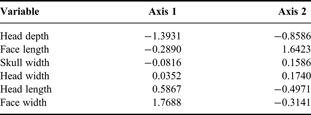
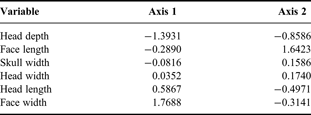
Finally, the discriminative function analysis indicates no significant differences among breeds (F = 0.070; d.f. = 503.14, 68; P = 1). Examination of the standardized canonical coefficients revealed that the variables that most contributed to the discrimination between breeds, in decreasing order, were face width and head depth (Table 4).
CCA scores for the canonical correspondence analysis.
Our results contrast with the classification of the old zootechnical schools which based breed classification mostly on cranial measurements (Kidd and Pirchner, Reference Kidd and Pirchner1971). Nevertheless, our obtained tree appears to represent a more reasonable picture of the phylogenetic relationships, at least among Pyrenean cattle breeds. Now it would be of some interest to compare results of multivariate analyses of skull measurements from other relict Pyrenean breeds, such as Betizu, Lourdaise and Casta with the present results. But this will be only done if effective sampling is facilitated and collaborative transboundary scientific links are established.
Acknowledgements
This research could not have succeeded without the help and support of many farmers who allowed the measurements of their animals. Authors wish to express their special gratitude to Ignasi Sinfreu Canturri, Fernando Blasi and Mercè Casals (Pallars Sobirà), and “Cal Puxica” (Berguedà) too, who all own the last cows of the near extinct Blanca del Pallars breed.