Staphylococcus aureus is a major causative agent of bovine mastitis, one of the main diseases affecting dairy cattle. The use of antibiotics is highly relevant for the control of mastitis cases, and beta-lactam antibiotics and tetracycline are commonly used in animal and human health. The use of antimicrobials in food-producing animals is a matter of concern because of the potential selection of antimicrobial resistance and the potential transmission of resistance determinants to the human microbiota (Wendlandt et al. Reference Wendlandt, Feßler, Monecke, Ehricht, Schwarz and Kadlec2013).
Penicillin resistance is probably the most well-known antimicrobial resistance of S. aureus. The production of beta-lactamase is one of the mechanisms responsible for generating beta-lactam resistance in S. aureus, and is mediated by the blaZ gene. Tetracyclines are broad-spectrum antimicrobials that have been widely used in human and veterinary medicine. Two known mechanisms of tetracycline resistance have been identified among staphylococci: the active efflux, that is a result of the acquisition of the genes tet(K) or tet(L), and the ribosomal protection, that is conferred by the tet(M) and tet(O) genes (Wendlandt et al. Reference Wendlandt, Feßler, Monecke, Ehricht, Schwarz and Kadlec2013).
There are several veterinary products based on ampicillin, penicillin and tetracycline in the Brazilian market, including formulations for intramammary use. Although there is increased consciousness in Brazil about the judicious use of antimicrobials to treat mastitis, a prescription is not mandatory to purchase antimicrobials for animal treatment. In addition, many producers do not have veterinary assistance or any professional guidance in the treatment of mastitis. These conditions may aggravate the antimicrobial resistance problem. There are some studies on antimicrobial resistance in S. aureus from bovine mastitis in Brazil, but few have dealt with the determinants of resistance. For that reason, the aim of this study was to determine phenotypic and genotypic characteristics of resistance to ampicillin, penicillin and tetracycline in S. aureus isolated from bovine mastitis and previously selected for its resistance to the cited antimicrobials.
Material and methods
A detailed methods account is provided in the online Supplementary File.
Bacterial isolates
The study was conducted using 90 S. aureus samples selected from among 266 S. aureus isolates obtained from composite milk samples collected from milking cows from 10 dairy farms located in six different municipalities of the Zona da Mata of Minas Gerais State. The 266 isolates were previously submitted to susceptibility testing of different antimicrobials by the disk diffusion method according to the recommendations of the CLSI (2013). These isolates showed resistance to ampicillin (66·5%), penicillin (70·7%) and tetracycline (27·4%). All 266 isolates were susceptible to oxacillin. From the total 266 isolates, 90 isolates were selected for this study based on their origin (animal/farm) and their resistance to ampicillin, penicillin and/or tetracycline (online Supplementary Table S1). Species confirmation of the 90 S. aureus isolates was performed using PCR amplification of the femA gene according to Lange et al. (Reference Lange, Brito, Reis, Machado, Guimarães, Azevedo, Sales, Alvim, Silva and Meurer2015).
Minimum inhibitory concentrations
The minimum inhibitory concentrations (MICs) of ampicillin, penicillin and tetracycline were determined for the 90 S. aureus isolates using Etest® (Biomérieux, Hazelwood, MO, USA) according to the manufacturer's guidelines.
Beta-lactamase production
The 90 isolates were tested for beta-lactamase production using a cefinase disk method (BBL™ Cefinase™ Discs, Franklin Lates, New Jersey, USA) according to the manufacturer's instructions.
Amplification of the resistance genes
Whole cell DNA was extracted from the isolates according to Lange et al. (Reference Lange, Brito, Reis, Machado, Guimarães, Azevedo, Sales, Alvim, Silva and Meurer2015). PCR amplification of a 518 bp fragment of the blaZ gene was performed using the primers and PCR conditions described by Vesterholm-Nielsen et al. (Reference Vesterholm-Nielsen, Larsen, Olsen and Aarestrup1999). For the amplification of the fragments of the tet(K), tet(L), tet(M) and tet(O) genes, the primers and conditions described by Trzcinski et al. (Reference Trzcinski, Cooper, Hryniewicz and Dowson2000) were used.
Sequence analysis of the amplicons
One amplicon from each resistance gene was sequenced by a commercial sequencing facility (GenOne Biotechnologies, Rio de Janeiro, Brazil) using the ABI 3730XL System in order to confirm their identity. Sequence comparisons were made using the DNA Baser Sequence Assembler v3.5.4 (Heracle BioSoft SRL, www.DnaBaser.com). Contigs were blasted against the nucleotide database of the National Center for Biotechnology Information (NCBI) (http://www.ncbi.nlm.nih.gov/BLAST).
Results and discussion
The MIC values obtained with the control strain were within the expected ranges for the three antimicrobial agents tested. Of the 90 isolates tested, 69 (76·7%) were resistant to ampicillin, 75 (83·3%) were resistant to penicillin, and 64 (71·1%) were resistant to tetracycline. The MIC50 and MIC90 were, respectively, 1 and 2 µg/ml for ampicillin, 0·5 and 1 µg/ml for penicillin and 32 and 64 µg/ml for tetracycline. The MIC values for ampicillin ranged from 0·06 to 4 µg/ml, for penicillin, the range was 0·03–8 µg/ml, and for tetracycline, the range was 0·25–256 µg/ml (Table 1).
Minimum inhibitory concentrations of ampicillin, penicillin and tetracycline as determined by Etest® against Staphylococcus aureus (n = 90) isolated from bovine mastitis

The MIC50 and MIC90 values for ampicillin, penicillin and tetracycline observed in this study were higher than those reported in other studies (Pitkälä et al. Reference Pitkälä, Haveri, Pyörälä, Myllys and Honkanen-Buzalski2004; Russi et al. Reference Russi, Maito, Dieser, Renna, Signorini, Camussone, Neder, Pol, Tirante, Odierno and Calvinho2015), probably because our isolates were pre-selected for ampicillin, penicillin and/or tetracycline resistance.
Seventy-eight isolates (86·7%) produced beta-lactamase, including seven isolates (7·8%) that produced beta-lactamase only after induction with oxacillin. The 12 isolates from this study that did not produce beta-lactamase showed a MIC ≤ 0·125 µg/ml for penicillin. The majority of beta-lactamase producing isolates showed a MIC ≥ 0·125 µg/ml; however one of the isolates exhibited a MIC of 0·06 µg/ml for penicillin. Russi et al. (Reference Russi, Maito, Dieser, Renna, Signorini, Camussone, Neder, Pol, Tirante, Odierno and Calvinho2015) also reported a low number of S. aureus isolates producing beta-lactamase with MIC values ranging from 0·03 to 0·12 µg/ml for penicillin. Haveri et al. (Reference Haveri, Suominen, Rantala, Honkanen-Buzalski and Pyörälä2005) suggested that the resistance breakpoint used in the agar dilution method might be too high for prediction of penicillin resistance in S. aureus isolates with borderline MICs.
Eighty-eight isolates (97·7%) were positive for the blaZ gene, exhibiting an amplification product with the expected size. Eighty-one isolates (90%) had at least one of the four tet genes, with PCR amplicons corresponding to the expected sizes. The DNA sequencing of the fragments obtained from the five isolates carrying blaZ, tet(K), tet(L), tet(M) or tet(O) confirmed that the fragments were part of these genes. The sequences obtained for blaZ, tet(K), tet(L) and tet(M) showed 100% similarity with sequences deposited in GenBank, whereas the sequence of the tet(O) gene showed 99% similarity with a sequence deposited in this database.
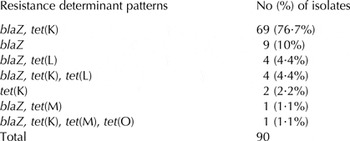
Ninety per cent of the isolates from this study harbour at least one of the tet genes. The most prevalent tet gene was tet(K), which was present in 76 (84·4%) isolates. The tet(L), tet(M) and tet(O) genes were found in 8 (8·8%), 2 (2·2%) and 1 (1·1%) isolate, respectively. Four isolates harboured tet(K) and tet(L) and one isolate harboured tet(K), tet(M) and tet(O). The gene tet(O) was observed in only one isolate in this study and was concomitant with tet(K) and tet(M). This gene was not found in the S. aureus isolates from human infections and bovine mastitis in previous studies (Trzcinski et al. Reference Trzcinski, Cooper, Hryniewicz and Dowson2000; Wendlandt et al. Reference Wendlandt, Feßler, Monecke, Ehricht, Schwarz and Kadlec2013). The tet(O) gene has so far only been detected in a single Staphylococcus intermedius isolate and in combination with a tet(L) gene in a single Staphylococcus xylosus isolate (Wendlandt et al. Reference Wendlandt, Feßler, Monecke, Ehricht, Schwarz and Kadlec2013).
The isolates showed seven different resistance determinant patterns (Table 2): 76·7% carried blaZ and tet(K) genes; 10% carried only the blaZ gene; 4·4% carried blaZ and tet(L); 4·4% carried blaZ, tet(K) and tet(L); two of the isolates (2·2%) carried only the tet(K) gene; one isolate (1·1%) carried blaZ and tet(M); and one isolate (1·1%) carried blaZ, tet(K), tet(M) and tet(O) genes. The blaZ gene was found in the S. aureus isolates from all the herds studied, and the tet gene was found in all but one of the herds.
Distribution of the resistance genes blaZ, tet(K), tet(L), tet(M) and tet(O) in Staphylococcus aureus (n = 90) isolated from bovine mastitis

Of the 88 blaZ-positive isolates, 75 were phenotypically resistant to penicillin and/or ampicillin and produced beta-lactamase. These isolates presented MIC values ranging from 0·25 to 8 µg/ml for this antimicrobial. Thirteen isolates amplified the blaZ gene but were phenotypically susceptible to ampicillin and penicillin by the E-test® (online Supplementary Table S2). The presence of the blaZ gene in S. aureus phenotypically susceptible to penicillin has been reported previously (Pitkälä et al. Reference Pitkälä, Haveri, Pyörälä, Myllys and Honkanen-Buzalski2004; Tasara et al. Reference Tasara, Cernela and Stephan2013; Russi et al. Reference Russi, Maito, Dieser, Renna, Signorini, Camussone, Neder, Pol, Tirante, Odierno and Calvinho2015). Tasara et al. (Reference Tasara, Cernela and Stephan2013) detected genetic mutations in the blaZ and blaR genes of bovine mastitis S. aureus strains that lead to a penicillin susceptible phenotype despite the penicillin resistant genotypes.
Of the 90 isolates included in this study, nine did not harbour tet genes and were phenotypically susceptible to tetracycline. Fifteen isolates harbouring tet(K), one isolate harbouring tet(L) and one isolate harbouring tet(K)(L) were phenotypically susceptible to tetracycline. The MIC values for tetracycline of the phenotypically resistant isolates ranged from 16 to 256 µg/ml and the MIC values for tetracycline of the susceptible isolates ranged from 0·25 to 8 µg/ml (online Supplementary Table S3).
In this study, 87·7% of the isolates harboured both penicillin and tetracycline resistance determinants. Concomitant resistance to penicillin and tetracycline has been reported in previous studies (Waage et al. Reference Waage, Bjorland, Caugant, Oppegaard, Tollersrud, Mork and Aarestrup2002; Gao et al. Reference Gao, Ferreri, Yu, Liu, Chen, Su and Han2012), probably due to the spread of a particular strain. It may be possible that the isolates of the present study have a common origin because the farms were located in the same region within a radius of 120 Km from the Research Center.
The S. aureus isolates investigated in this study showed high MIC50 and MIC90 values for ampicillin, penicillin and tetracycline. Most of the isolates produced beta-lactamase. The blaZ and tet(K) genes were widespread in the herds studied, usually together in the same isolate. These results demonstrate a high resistance level for the three antimicrobials in the S. aureus isolates. Lower levels of antibiotic resistance in pathogens of bovine mastitis in our country will only be achieved with the implementation of mastitis control programs, monitoring of antimicrobial resistance and appropriate policies of antibiotics use, similar to what already happens in other countries. In Brazil, efforts are needed to improve access of producers to veterinary assistance and thereby to diagnostic laboratories. Preventive measures to control mastitis and the correct identification of infectious agents are essential for the proper and prudent use of antibiotics.
Supplementary material
The supplementary material for this article can be found at https://doi.org/10.1017/S0022029917000061.
This work was supported through funding from the Brazilian Agricultural Research Corporation (Embrapa, 01.09.01.003.05.00 and 03.13.14.006.00.00) and the Conselho Nacional de Desenvolvimento Científico e Tecnológico (CNPq) (grant 578430/2008-8 to M.A.V.P. Brito). C.L. Martini received a scholarship from Coordenação de Aperfeiçoamento de Pessoal de Nível Superior (Capes). The authors express their appreciation to Marcos Aurélio Souto Silva for technical assistance.