Introduction
Terrorist attacks are those which deliberately use violence to bring fear and wide terror to a community and cause injuries and deaths of civilians, to serve political, religious, or ideological agendas. Bombings are the most common form of terrorist acts. 1 Such incidents can cause a spectrum of injury patterns to humans, ranging from barotrauma to a wide variety of blunt or penetrating traumas, burns, crush injuries, and inhalational injuries. Reference Singh, Ditkofsky and York2 Terrorist attacks not only pose threats to the lives of others and their physical and mental wellbeing, but they also threaten the community and the healthcare system as a whole. Managing disasters includes mitigation, preparedness, response, recovery, and rehabilitation, Reference Gupta3 and preparedness is crucial for effective disaster management. Health systems are essential to enhance disaster resilience, and therefore planning should include health care facilities at all levels, Reference Kaji, Koenig and Lewis4 such as tertiary hospitals, primary health care facilities, public health departments, and emergency medical services.
Lebanon is a Middle-Eastern country located on the eastern coast of the Mediterranean Sea. This region has witnessed countless terrorist and mass-casualty events increasingly over the last few decades, disrupting health sector programmes and essential services. Lebanon alone has seen 38 bombing incidents between 2004 and July 2020, injuring and killing more than 2000 persons. The exact number cannot be determined as the number for some attacks are withheld for political purposes.
On August 4, 2020, thousands of tons of ammonium nitrate that had been stored at the Beirut port exploded, leading to severe destruction of population-dense residential, commercial, and industrial areas nearby. The massive explosion killed more than 200, injured more than 6,000 and led to the relocation or homelessness of 300,000 residents. 5 Several major hospitals were destroyed by the blast. Among those, two large University Medical Centers had to cease operation. With residents of the affected neighborhoods flooding to those facilities for aid, chaos filled the area as transport vehicles were overwhelmed and unable to enter rubble-filled streets to reach the casualties. Many healthcare workers and patients were killed or injured by the massive explosion.
The Lebanese health system serves approximately 8,000,000 persons, including more than 2,000,000 refugees and includes 120 hospitals ranging in size from 20 to more than 600 beds. The majority of Lebanese hospitals are privately owned (82%) and are inequitably distributed, mostly aggregated in urban areas like Beirut housing 17 private and 2 governmental (public) hospitals. 6 Public hospitals are owned by the state, but they are not governed by the state, instead, they are managed separately. A rare unifier of Lebanese hospitals is their accreditation standards; set by the MOPH in 2003 and last surveyed in 2011. With regard to disaster management, all hospitals that have passed their audits have implemented the requirement of an institutional ‘contingency plan for emergency response.’ This plan is sometimes in the mere form of a policy document. The MOPH also funds private hospitals by setting a monthly lump sum for each hospital to cover Lebanese nationals.
The national response plan, on the other hand, has been deemed “fragmented, with no clear agency in charge.” Reference El Sayed7 It is largely reliant on the armed forces as well as other involved agencies and international organizations, suggesting a quick overwhelming of supplies. Reference El Sayed7 Lebanese authorities can no longer neglect the potentially grave threat, and some Lebanese hospitals have gained invaluable experience that can be used to improve the national response plan. In case of a terrorist attack, all casualties are treated in the nearest operating hospital at the expense of the government.
Limited research is available on the preparedness of Middle Eastern hospitals to respond to mass-casualty incidents, and it shows that preparedness is low, Reference Alruwaili, Islam and Usher8 but very little has been done to explore specific Lebanese past experiences, assessing strengths and weaknesses, as well as sharing practices and learnt lessons. This contextual knowledge would be of significant importance in improving the national response plan and mitigating future risks. In this study, the researchers aimed to explore the experiences of Lebanese hospitals in responding to terrorist bombings and assessed their disaster preparedness level from the perspectives of multiple stakeholders. Semi-structured interviews were used to assess and compare the experience of different hospitals on a national level and as a function of their rurality, size, type of ownership (private/public), and geographical proximity to high-risk areas.
Method
This study used the descriptive qualitative method. Data was collected through semi-structured interviews with respondents of different health-system stakeholders. Data collection took place during July and August 2019, and thus does not include the experiences of hospitals affected by the August 4, 2020 explosion.
Participants
Inclusion criteria were: holding current positions and/or having past experiences with disaster management in a healthcare setting in Lebanon and willingness to participate in the study. An exclusion criterion was: not being involved with disaster management in a Lebanese healthcare setting. Participants were either responsible for the disaster management plan of their hospital (having experienced the plan’s implementation as an executive), were volunteers in relevant agencies, or held positions as decision makers in the Lebanese disaster management national response.
The aim was to collect the experiences of various stakeholders in that response system. So, respondents from the following institutions were selected: the MOPH, the Syndicate of Private Hospitals, private and governmental hospitals, and 2 transfer agencies (the Lebanese Red Cross and the Lebanese Civil Defence). Participant consent was ensured, as they were informed of their liberty to refrain from participation at any point during the study.
Data Collection
Participants were informed of the aims of the study prior to the interview, and consent for voice-recording was obtained. The researchers conducted a total of 26 in-depth, semi-structured interviews with participants from various organisations and agencies. The interviews were recorded, and notes were taken. Each interview spanned between 40 and 65 minutes, median time was 50 minutes. The interview was guided by 9 themes, including: considerations made while planning; command and control during execution; communication, safety and security procedures; supply management; personnel training programs; triage procedures; dealing with patients’ families; relationship with transfer agencies; and post-disaster recovery procedures.
Data Analysis
All interviews were transcribed verbatim using the recorded files and the notes taken during the interviews. Thematic analysis was conducted and after the researchers were familiarized with the data, codes were generated, and themes were created—themes and subthemes were reviewed and analysed.
Rigor
Multiple considerations were taken in an attempt to remain objective and try to minimize bias throughout the entire research process. The study was neither funded nor sponsored. To prevent the participants from simply agreeing or disagreeing and to guide them to provide a truthful and honest answer, 9 open-ended themes were used, these themes were ordered from general to specific or sensitive. The themes were neutral to prevent the participant from responding in favor of a particular assumption, thus minimizing all participant bias.
Ethical Considerations
The Institutional Review Board’s (IRB) approval was attained. Individual participant consent was obtained for data collection and utilization, and for voice-recording. Respondents from hospitals were assured that the names of their hospitals would be kept confidential. They reserved the right to end the interview or refrain from answering any question.
Results
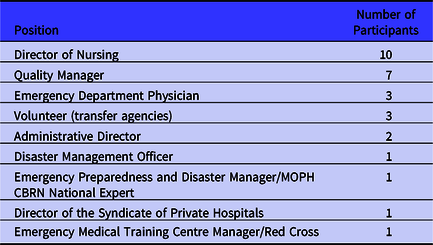
Twenty-six interviews were conducted, with participants from Lebanese hospitals and other institutions concerned with disaster management. Of the 50 contacted hospitals, 19 took part in this study (38% response rate). Of these, 6 hospitals were located in rural areas. The participants were almost equally distributed by gender (53% men, 47% women). The positions filled by the study population are shown in Table 1. The number of participants shown in the table amount to 29 because a few of them held 2 positions and were thus counted twice to illustrate diversity in educational & institutional background.
Positions filled by participants

The results show that Lebanese hospitals vary greatly in their levels of preparedness. Of the 19 hospitals surveyed, 13 were considered ‘experienced’ and 6 were not. Most of the surveyed hospitals were ‘experienced.’ However, that does not reflect that the majority of Lebanese hospitals are well-versed in responding to terrorist attacks. In reality, most of the participants were so because ‘non-experienced’ hospitals showed very poor willingness to participate in the study.
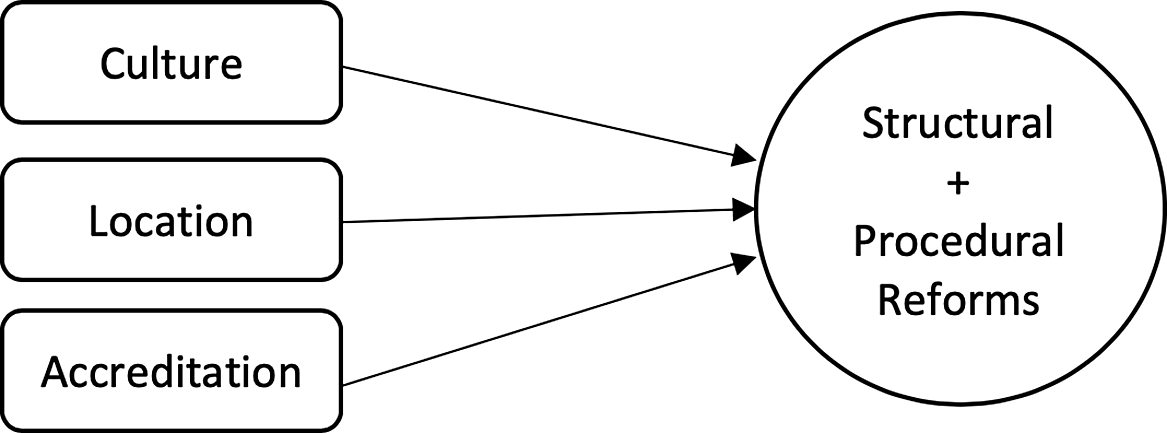
The differences between an experienced and an unexperienced hospital lie in the hospital’s structures and procedures, which have been adapted by some of the hospitals to become more responsive to such threats. After analysing the hospitals’ differences, the researchers found that 3 key factors—culture, location, and accreditation—are responsible for the 2 main differences between those hospitals’ structures and procedures. Figure 1 shows a depiction of the finding.
Depiction of the findings.

Structural Differences
Lebanese hospitals located in close proximity to areas prone to, or with a history of, terrorist attacks have different structures and appearances than others. In order to cope with the imminent threat, these hospitals have altered their spaces by creating underground tunnels between departments, building larger emergency departments with movable beds, installed metallic shields over windows, barbed wires around the facility, and in some cases, mobile intensive-care units that can be swiftly moved to lower floors. An administrative director in an ‘experienced’ hospital said: “We created a way for cars to enter and exit without causing much traffic. We learned that after an incident where the traffic jam caused by the families of the victims blocked the road, and the Red Cross could not reach us; the Lebanese Army had to shoot in the air in order to clear the road!”
Those hospitals located in relatively safer areas—less susceptible to acts of terrorism—have given far less considerations to the structural readiness of their facilities.
Procedural (Systemic) Differences
Hospitals that had previous experience with terrorist attacks have created, tested, and improved their procedures with time. They have elaborate disaster plans and designated response teams with highly trained team members. They train frequently and hold large quantities of emergency supplies. They coordinate with internal and external parties and have planned triage systems, clear control and command authorities, and awareness of staff and patient safety and security. They train and coordinate with security guards and rely on them. A quality manager of a hospital said: “We believe that there must be an ICU specialist performing the triage outside the door of the hospital; this leaves space for the ER physicians to be with their patients inside, and the ICU doctor can triage just fine! A triage-trained nurse must be outside as well to help. We find this the best way to go.” Whereas a director of nursing of a less-experienced hospital said: “We do not have a specific stock for the ER, we generally always have 15% more than we need. […] nothing really serious ever happens here. […] when the event happens, we act upon the problems that we face at the moment.”
Lebanese hospitals have 2 main concerns for the improvement of disaster response practices: The first is the lack of financial resources, and it was expressed by all participants. The second is the shortage of physical space for expanding some departments. This was particularly a major concern for hospitals found in urban areas. The main concerns of transfer agencies are the lack of effective modes of communication with hospitals and an impactful approach to real-time occupancy data, whereas the main concern of officials is the lack of collaboration and coordination between hospitals.
Finally, in all the interviewed hospitals and agencies, there was a significant lack of awareness and work on the psychological effects in the aftermath of a terrorist attack. None of the hospitals had considered or implemented mental health into their plans, whether for victims, children, or other members of the community.
Limitations
This study had limitations. Almost half of the respondents initially contacted refused to partake in the study causing the researchers to interview much fewer personnel than planned. This hints to a lack of openness and transparency in Lebanese hospitals. Sharing knowledge is the first step towards creating a unified and resilient system. Another reason is the control of several hospitals by political parties, which restricts information-sharing and dialogue with other hospitals. All of this was reflected in the poor willingness to participate in the study.
Discussion
The study found that Lebanese hospitals vary greatly in terms of structure and procedures when it comes to emergency preparedness. After recognizing those disparities, the researchers suggest 3 main contextual factors to be the forces causing the uneven adaptation and the variation in preparedness levels.
The first is the cultural factor. The ‘experienced’ hospitals have performed cultural analyses of Lebanese families, and that has influenced their structures and procedures. They consider the Lebanese political parties prevailing in their region when constructing their plans. Some have implemented physical measures to ensure patients’ families don’t meet within hospital premises, as those might be on opposing sides of the bombing or feud. Some have integrated into their processes a step of nominating a ‘family influencer’ (usually an elder, a respected family member that they can contact and rely on to influence the behavior of the other family members). They have selected certain personnel whose task during a disaster is to deal with the families of the patients.
The second factor is the hospital’s location. The proximity of the hospital to areas that are prone to terrorist acts cause the hospital to be more aware and more experienced in mass casualty events. The recurrent application of their plans lead to their amendment and improvement. The results do not suggest that rurality is a factor contributing to the level of preparedness.
The third factor is accreditation. The Lebanese MOPH standards require the hospitals to have disaster response plans. The implementation of those standards is indirectly obligatory as it is tied to governmental reimbursements (covering patients who are members of the National Social Security Fund and the monthly lumpsum set for each private hospitals). This has forced hospitals in safer areas to create plans that they would have otherwise not created. However, those plans have remained undeveloped and theoretical, with minimal experience leading to their improvement. The MOPH accreditation program has not surveyed hospitals for a decade.
Conclusion
Published research on the Lebanese hospitals’ experiences is limited. The disparity among Lebanese hospitals is wide and causes the healthcare system to be fragmented and fragile, with results from similar countries showing low preparedness for such incidents as well. Reference Alruwaili, Islam and Usher8 However, the experiences culminated by some of the interviewed hospitals show an opportunity for strengthening the system by sharing those experiences with other Lebanese and even regional hospitals beyond Lebanese borders. Government efforts must be made to create a platform for Lebanese hospitals to share experiences and make consulting visits and knowledge-sharing assemblies among them. This would strengthen the Lebanese healthcare system and increase readiness of less-experienced hospitals.
Lebanese hospitals also require a cultural shift into: (1) increased considerations for mental health and the needs of the community following a terrorist attack and (2) recognizing that the threat is not localized in a few areas of the country where bombings are most frequent. The Lebanese healthcare decision makers must realize the ubiquity of terrorist threats and act upon improving the readiness of all hospitals equitably. This would not only strengthen the system but will also improve the response rate for future studies.
The August 4 explosion at the Port of Beirut gave yet another example of a fragmented approach, as relief services relied in their majority on the funds and efforts of international organizations and civil society initiatives. This suggests the pressing need for a long-term strategy for reform in the Lebanese healthcare authorities, attempting to improve governance of disaster response and management.
In a region marked with instability, peace and security are the exception, and violence is the norm. Hospitals should never feel safe and secure; they should always be prepared for the worst. This study suggests further research investigates the possibility of reform, looking for ways to achieve the appropriate level of preparedness, and better communication and collaboration between Lebanese hospitals and transfer agencies. The researchers also suggest that the authorities focus more resources on the improvement of hospital preparedness to terrorist attacks. Finally, this study suggests a comprehensive health-system reform that strategically plans for a broad, resilient and multidisciplinary approach to the issue. This can become a model disaster-response system that can be used in neighbouring countries in the face of similar terrorism threats.