Introduction
Major depression is a common, often disabling disorder. In 2004, unipolar depression was rated third in the leading causes of burden of disease (WHO, 2004). Major depression is typically difficult to treat, with only one-third of patients responding to initial treatment with antidepressant medication (Rush et al. Reference Rush, Warden, Wisniewski, Fava, Trivedi, Gaynes and Nierenberg2009). In addition, intolerance of antidepressant medications is a frequent cause of treatment failure (Fava, Reference Fava2000).
Repetitive transcranial magnetic stimulation (rTMS) is a relatively new treatment for depression. Recent meta-analyses suggest that rTMS is effective, compared with sham rTMS (Schutter, Reference Schutter2009; Slotema et al. Reference Slotema, Blom, Hoek and Sommer2010). Repetitive TMS has been shown to be feasible and effective in naturalistic, unselected patient populations (Cohen et al. Reference Cohen, Boggio and Fregni2009; Frank et al. Reference Frank, Eichhammer, Burger, Zowe, Landgrebe, Hajak and Langguth2011). The US Food and Drug Administration (FDA) has approved the marketing of the NeuroStar device (Neuronetics, USA) for the treatment of adults with major depression who have failed to achieve satisfactory improvement from one prior antidepressant medication (FDA, 2008).
Repetitive TMS requires a time commitment from both the patient and the staff administering the treatment. Service considerations such as the number of rTMS machines purchased, the availability of trained staff and the duration and number of treatment sessions prescribed in a course of rTMS directly influence the number of patients who can be provided with treatment.
It is therefore important to determine optimal treatment parameters for rTMS. There are a range of factors to be considered, including the frequency of rTMS (various high- and low-frequency regimes have been described), the total number of pulses delivered, the anatomical location where treatment is given (usually the left or right dorsolateral prefrontal cortex, DLPFC), the number of treatments in a course, and the spacing of treatments. The present study was designed to address some of these issues.
Electroconvulsive therapy (ECT) also relies on electrical stimulation of the brain. Kendell (Reference Kendell1981) notes that few formal comparisons of different temporal sequences of ECT have been carried out, but over time it was found that ECT given two or three times a week was effective and relatively well tolerated. The number of treatments needed for response in each individual patient usually varied from four to about 12 (Kendell, Reference Kendell1981). Early studies suggested that more frequent administration of ECT may be associated with a more rapid response, but at the cost of greater cognitive impairment (Shapira et al. Reference Shapira, Calev and Lerer1991). A recent review (Charlson et al. Reference Charlson, Siskind, Doi, McCallum, Broome and Lie2011) found that ECT given twice weekly had similar efficacy to ECT given three times a week, and twice weekly ECT could result in fewer treatments being required. ECT given only once a week was less effective than ECT given three times a week.
Chen et al. (Reference Chen, Madsen, Wegener and Nyengaard2009) have shown that daily electroconvulsive seizures (ECS) in rats induce neurogenesis, synaptogenesis and remodelling of synapses in the rat hippocampus. These mechanisms may explain the therapeutic effects of ECT in humans. Further animal studies have shown that, like ECT, rTMS is associated with hippocampal neurogenesis (Ueyama et al. Reference Ueyama, Ukai, Ogawa, Yamamoto, Kawaguchi, Ishii and Shinosaki2011). Lisanby & Belmaker (Reference Lisanby and Belmaker2000) have described the neurophysiological similarities between ECS and rTMS, suggesting that both treatments may regulate gene expression and improve neuronal viability and synaptic plasticity. Repetitive TMS is generally well tolerated (O'Reardon et al. Reference O'Reardon, Solvason, Janicak, Sampson, Isenberg, Nahas, McDonald, Avery, Fitzgerald, Loo, Demitrack, George and Sackeim2007) and does not cause cognitive impairment (Guse et al. Reference Guse, Falkai and Wobrock2010), so it is generally given daily, 5 days/week (Cohen et al. Reference Cohen, Boggio and Fregni2009; Fitzgerald et al. Reference Fitzgerald, Hoy, Gunewardene, Slack, Ibrahim, Bailey and Daskalakis2010; George et al. Reference George, Lisanby, Avery, McDonald, Durkalski, Pavlicova, Anderson, Nahas, Bulow, Zarkowski, Holtzheimer, Schwartz and Sackeim2010; Ray et al. Reference Ray, Nizamie, Akhtar, Praharaj, Mishra and Zia-Ul-Haq2011). Given that modifications in genetic expression and neurogenesis would take time, it is possible that spaced rTMS treatment (given two or three times a week) would be as effective but with fewer treatments required than with daily rTMS. There has only been one previous study comparing spaced (3 days in the first week, 2 days in the second week) and daily (five treatments on 5 successive days) rTMS (Turnier-Shea et al. Reference Turnier-Shea, Bruno and Pridmore2006). There was significant improvement in both groups, with no differences between groups. However, the numbers were very small with only eight subjects in each group.
The total number of rTMS treatments comprising a complete course varies considerably. A recent meta-analysis (Slotema et al. Reference Slotema, Blom, Hoek and Sommer2010) reported a range of five to 25 treatments. In some studies, the number of treatments depends on clinical response: Fitzgerald et al. (Reference Fitzgerald, Benitez, de Castella, Daskalakis, Brown and Kulkarni2006) gave 10 treatments with a further five treatments if the patient showed some initial response, followed by further extension periods of a week depending on response, up to a maximum of 30 treatments; other protocols include 10 to 20 treatments depending on clinical response (Frank et al. Reference Frank, Eichhammer, Burger, Zowe, Landgrebe, Hajak and Langguth2011); 15 treatments with an extension phase of a further 15 treatments for those who improved (George et al. Reference George, Lisanby, Avery, McDonald, Durkalski, Pavlicova, Anderson, Nahas, Bulow, Zarkowski, Holtzheimer, Schwartz and Sackeim2010); 20 treatments (sham or actual rTMS) with an extension phase of a further 10 treatments in subjects with a poor response (O'Reardon et al. Reference O'Reardon, Solvason, Janicak, Sampson, Isenberg, Nahas, McDonald, Avery, Fitzgerald, Loo, Demitrack, George and Sackeim2007); and 10 to 30 treatments depending on clinical response (Cohen et al. Reference Cohen, Boggio and Fregni2009).
The aim of the present study was to inform the development of clinical rTMS services. This requires the ability to plan when patients will start and finish treatment. Based on a review of the previous literature, we considered that 18 to 20 treatments should generally be adequate for clinical response. We therefore randomly allocated patients to rTMS 3 days/week for 6 weeks (spaced treatment) or to rTMS 5 days/week for 4 weeks (daily treatment). We used sequential bilateral rTMS, with high-frequency stimulation of the left DLPFC followed by low-frequency stimulation of the right DLPFC. The combination of these two types of treatment has been shown to be effective in a sham-controlled study of 50 patients with treatment-resistant depression (Fitzgerald et al. Reference Fitzgerald, Benitez, de Castella, Daskalakis, Brown and Kulkarni2006). At the time when this study was designed, this treatment protocol was selected as most likely to deliver optimal treatment. Subsequently, it has been shown that low-frequency rTMS to the right DLPFC is as effective as bilateral treatment (Fitzgerald et al. Reference Fitzgerald, Hoy, Gunewardene, Slack, Ibrahim, Bailey and Daskalakis2010).
To test the hypothesis that the beneficial effects of rTMS are due to mechanisms such as neuroplastic changes or modifications of gene expression, and that passage of time along with brain stimulation is required for these changes, we compared antidepressant response at week 4 for both groups of patients. At this point, the spaced treatment group had received 12 treatments and the daily treatment group had received 20 treatments.
Method
Study design
The study compared two groups of participants, allocated randomly to either spaced treatment (Monday, Wednesday and Friday) or daily treatment (Monday to Friday). Participants were randomized sequentially using a computer-generated random number sequence. The duration of the trial was 6 weeks for the spaced treatment group and 4 weeks for the daily treatment group. Data collection occurred between August 2008 and February 2011.
Participants
Seventy-seven patients [51 females and 26 males, mean age 48.6 years (s.d.=13.42, range 18–82] participated in the study. They were out-patients at a private mental health service, referred by their treating psychiatrists for rTMS treatment.
The inclusion criteria included a diagnosis of major depression and sufficient fluency in English to participate in the research study. Patients were excluded if they had neurological disorders, metal plates or other implants in the skull, a history of epilepsy, or were withdrawing from drugs or alcohol.
A total of 137 patients were assessed for the study. Twenty-three participants chose not to have the treatment, 24 did not meet the inclusion criteria, eight patients started ECT while waiting to start rTMS, and one participant's referral was cancelled by their psychiatrist. Four participants dropped out of the study before completing their treatment. The diagnosis of major depression was confirmed by a study psychiatrist. In addition, all participants were assessed using the Mini International Neuropsychiatric Interview (MINI; Sheehan et al. Reference Sheehan, Lecrubier, Sheehan, Amorim, Janavs, Weiller, Hergueta, Baker and Dunbar1998) administered by a trained research officer. All participants met criteria for a major depressive episode. The mean duration of the current episode was 31.2 (s.d.=62.3) months. Twelve patients (15.6%) met criteria for bipolar disorder. Eleven (14.3%) met criteria for a co-morbid alcohol and/or substance abuse disorder and 31 (40.3%) met criteria for a co-morbid anxiety disorder, most commonly panic disorder with agoraphobia or generalized anxiety disorder.
Our patients were referred by private psychiatrists so we did not have access to case records detailing previous treatment. Information about past treatment was therefore obtained by interviewing the patients. Sixty patients (77.9%) had been prescribed at least five antidepressant medications and 47 patients (61.0%) had been treated with ECT during the lifetime course of their illness. The mean number of ECT courses was 2.11 (s.d.=1.74, range 1–10). All patients had failed treatment with at least one antidepressant during the current episode.
Participants continued taking their usual medications during the study. They were required not to change the type or dosage of the medication prior to or during treatment. Sixty-nine participants (89.6%) were taking medication during rTMS treatment. Sixty-six (85.7%) were taking antidepressant medications: serotonin-noradrenaline reuptake inhibitors (n=28); tricyclic antidepressants (n=12); selective serotonin uptake inhibitors (n=15); noradrenaline reuptake inhibitors (n=6); and monoamine oxidase inhibitors (n=5). Twenty-one participants (27.3%) were taking benzodiazepines, 47 (61.0%) were taking atypical antipsychotic drugs and 26 (33.8%) were taking a mood stabilizer. Medication doses were held constant during the study.
Written informed consent was obtained from all participants. The study was approved by the Ramsay Health Care (SA) Mental Health Services Research and Ethics Committee.
Repetitive TMS treatment
Repetitive TMS was administered using a MagPro R30 stimulator and MCF B65 figure-of-eight coils (MagVenture A/S, Denmark), which were interchanged to allow cooling. The resting motor threshold was measured using standard visual methods (Pridmore et al. Reference Pridmore, Fernandes Filho, Naha, Liberatos and George1998). The site of stimulation was located 6 cm anterior to the point at which maximum stimulation of the abductor pollicis brevis muscle was achieved. A template was prepared for each participant to ensure that the coils were positioned correctly at each treatment session.
Participants sat in a reclining chair during treatment. They were provided with disposable earplugs. The coils were fixed in position throughout treatment using a flexible stand attached to the machine trolley.
All participants were treated with sequential bilateral rTMS at 110% of the resting motor threshold. Fifteen minutes of high-frequency rTMS (10 Hz), delivered in 5-s trains with a 25-s intertrain interval (1500 pulses), were applied to the left DLPFC, followed by 15 min of continuous low-frequency (1 Hz) rTMS (900 pulses) to the right DLPFC.
Measures
All participants were assessed at baseline and after 4 weeks of treatment by a trained research officer. In addition, participants in the spaced treatment group were assessed after 6 weeks of treatment. The primary outcome measure for the study was the 21-item Hamilton Depression Rating Scale (HAMD; Hedlund & Vieweg, Reference Hedlund and Vieweg1979). Participants were also assessed using the Montgomery–Åsberg Depression Rating Scale (MADRS; Montgomery & Åsberg, Reference Montgomery and Åsberg1979), the Zung Self-Rating Depression Scale (Zung SDS; Zung, Reference Zung1965) and the 14-item Hamilton Anxiety Rating Scale (HAMA; Hamilton, Reference Hamilton1959).
Based on the Sequenced Treatment Alternatives to Relieve Depression (STAR*D) trial (Rush et al. Reference Rush, Fava, Wisniewski, Lavori, Trivedi, Sackeim, Thase, Nierenberg, Quitkin, Kashner, Kupfer, Rosenbaum, Alpert, Stewart, McGrath, Biggs, Shores-Wilson, Lebowitz, Ritz and Niederehe2004), clinical response was defined as a decrease of ⩾50% in the HAMD score. Partial response was defined as a decrease of ⩾25% in the HAMD score. Remission was defined as a score of ⩽7 on the HAMD.
Data analysis
Statistical analyses were performed with SPSS version 17.0 (SPSS Inc., USA). Independent-samples t tests and χ2 tests were used to investigate differences between the two study groups on baseline and demographic variables. Paired-samples t tests were used to examine change in scores between baseline and post-treatment for all participants. Group differences in the change in scores over time were evaluated using mixed between–within analyses of variance models for each outcome variable. Post-hoc t tests were used to further explore group differences in change in scores over time. χ2 tests were used to analyse differences in response and remission rates between the two study groups. All procedures were two-tailed, with significance set at an α level of 0.05.
Results
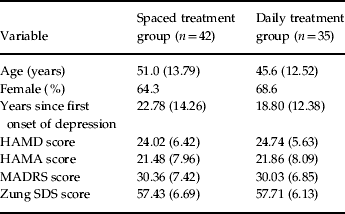
There were no significant differences between groups in terms of age, gender, years since onset of depression, and baseline measures (Table 1).
Demographic and baseline clinical characteristics

HAMD, Hamilton Depression Rating Scale; HAMA, Hamilton Anxiety Rating Scale; MADRS, Montgomery–Åsberg Depression Rating Scale; Zung SDS, Zung Self-Rating Depression Scale.
Values given as mean (standard deviation).
Four participants dropped out of the study before completing treatment. One participant in the daily treatment group dropped out after 10 treatments, reporting lack of efficacy. Three participants in the spaced treatment group dropped out due to a lack of efficacy, one after 6 treatments (2 weeks), one after 12 treatments (4 weeks) and one after 16 treatments (5 weeks). Given the nature of the study design, their results are not included in the analyses reported here.
Efficacy of rTMS: all participants
Paired-samples t tests revealed a significant reduction in HAMD [t(76)=11.93, p<0.001], HAMA [t(76)=9.45, p<0.001], MADRS [t(76)=9.85, p<0.001] and Zung SDS scores [t(76)=9.08, p<0.001] from baseline to post-treatment for all participants.
Thirty-three participants (42.9%) met criteria for a clinical response to treatment, and 25 of these (32.5% of the total) were in remission at treatment completion. A further 22 (28.6%) met criteria for a partial response.
There were no significant differences between responders and non-responders in age [t(75)=1.47, p=0.15], gender (χ2=0.03, p=0.86), years since first onset of depression [t(74)=1.72, p=0.09], history of previous treatment with ECT (χ2=0.60, p=0.44) or overall presence of a co-morbid disorder (χ2=0.05, p=0.81). Patients with bipolar disorder had a lower response rate (25%, n=3) than those with major depressive disorder (46.2%, n=30), but this difference did not reach significance (χ2=1.09, p=0.30). A lower proportion of people with a co-morbid alcohol and/or substance abuse disorder responded (27.3%, n=3) than those without the disorder (45.5%, n=30), but again this difference did not reach significance (χ2=0.64, p=0.42).
Comparison of spaced treatment and daily treatment
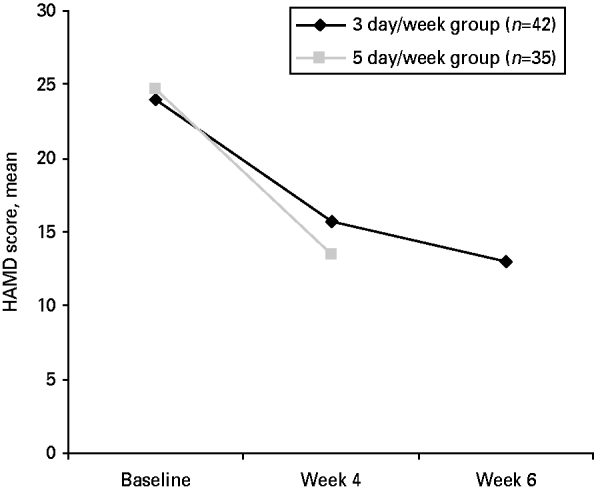
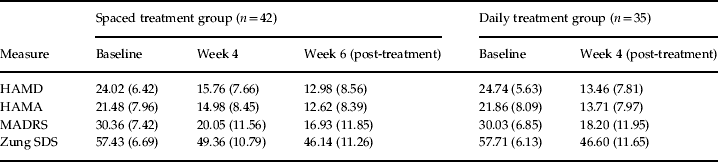
There was a significant group-by-time interaction for the HAMD (F=4.74, p=0.01, partial η2=0.11) and Zung SDS (F=3.33, p=0.04, partial η2=0.08) measures, indicating that improvement in scores over time differed significantly between treatment conditions (Table 2 and Fig. 1). The group-by-time interaction approached significance for the MADRS (F=2.56, p=0.08, partial η2=0.07) and the HAMA (F=3.02, p=0.06, partial η2=0.08) measures. Participants in the daily treatment group (after 20 treatments) demonstrated more improvement between baseline and week 4 than the spaced treatment group (after 12 treatments) (Fig. 1). There was no difference between groups at treatment completion. These results indicate that 4 weeks of spaced treatment were inferior to 4 weeks of daily treatment.
Mean Hamilton Depression Rating Scale (HAMD) scores for group across time.

Baseline and follow-up scores on each outcome measure by group

HAMD, Hamilton Depression Rating Scale; HAMA, Hamilton Anxiety Rating Scale; MADRS, Montgomery–Åsberg Depression Rating Scale; Zung SDS, Zung Self-Rating Depression Scale.
Values given as mean (standard deviation).
Paired-samples t tests revealed that the spaced treatment group improved significantly between weeks 4 and 6 on the HAMD [t(41)=3.08, p=0.004], HAMA [t(41)=2.63, p=0.012], MADRS [t(41)=2.50, p=0.017] and Zung SDS [t(41)=2.68, p=0.011]. There were no significant differences between groups in the scores at the completion of treatment on the HAMD [t(75)=−0.256, p=0.799], HAMA [t(75)=−0.584, p=0.561], MADRS [t(75)=−0.467, p=0.642] or Zung SDS [t(75)=−0.175, p=0.862] measures.
At week 4, a larger proportion of participants in the daily treatment group (n=11) were in remission compared to the spaced treatment group (n=7), but this difference did not reach significance.
At treatment completion (week 4 for the daily treatment group and week 6 for the spaced treatment group), 18 participants in the spaced treatment group met criteria for response; 14 of these also met remission criteria. Fifteen participants in the daily treatment group met criteria for response and 11 of these were also in remission. Eleven participants in each group had a partial response to treatment. There were no significant differences between groups in rates of response or remission.
Safety and tolerability
Mild temporary headaches and increase in tiredness post-treatment were the most commonly reported side-effects. There were no serious adverse events, including seizures or induction of a manic episode. The rTMS treatment was well tolerated by all participants.
Discussion
Our participants were a relatively unselected clinical population. More than a third of participants had co-morbid Axis 1 conditions, predominantly anxiety and substance abuse disorders. Previous treatment resistance was evidenced by the high proportion of patients who had been treated with more than five antidepressant medications and/or ECT, and all patients had failed to respond to treatment with at least one antidepressant medication in the current episode. Continuation of usual medications was permitted and a substantial number of participants were taking adjunctive atypical antipsychotics, mood stabilizers and benzodiazepines, in addition to antidepressants. The co-morbidity and medications may have been potential confounding factors, but as our focus was on informing clinical services, we considered that broad inclusion criteria reflected the realities of clinical practice. This approach is consistent with the STAR*D study (Gaynes et al. Reference Gaynes, Warden, Trivedi, Wisniewski, Fava and Rush2009), which used broadly defined, inclusive entry criteria.
Our study was designed to inform the development of efficient rTMS services. Taking ECT as a starting point, we investigated the possibility that spacing treatment over time might enable good efficacy to be achieved with a smaller number of treatments. Charlson et al. (Reference Charlson, Siskind, Doi, McCallum, Broome and Lie2011) found that patients having ECT twice a week achieved equivalent efficacy with fewer treatments, compared to patients having ECT three times a week. This model would be congruent with evidence from animal studies that neurostimulation treatments (ECT and rTMS) act by mechanisms involving changes in gene expression and neurogenesis (Lisanby & Belmaker, Reference Lisanby and Belmaker2000; Ueyama et al. Reference Ueyama, Ukai, Ogawa, Yamamoto, Kawaguchi, Ishii and Shinosaki2011), which might take time to evolve.
We found that this was not the case and that the number of treatments, rather than the period of time over which treatment had been administered, was the important factor. Our findings can be considered in light of the notion that more frequent rTMS may be associated with cumulative plastic changes in intrinsic motor cortex excitability (Bäumer et al. Reference Bäumer, Lange, Liepert, Weiller, Siebner, Rothwell and Münchau2003); in other words there may be a specific benefit from more frequent treatment. However, we did not find evidence that spacing treatments, at least to 3 days/week, was associated with reduced efficacy. It can be concluded that the total number of treatments, rather than the timing of these treatments, is the crucial factor.
It is worth noting, however, that drop-out rates due to lack of efficacy were (non-significantly) higher in the spaced rTMS condition. Three people (7%) in the spaced condition dropped out due to lack of efficacy compared with one (3%) in the daily condition.
The number of rTMS treatments given to each patient varies considerably in previous studies, but there is some suggestion of further improvement in remission rates in patients receiving more than 20 treatments, the maximum given in our study. Cohen et al. (Reference Cohen, Boggio and Fregni2009) found that additional rTMS treatments (up to a maximum of 60 treatments) were associated with a better rate of remission. An early meta-analysis found that 5 days of rTMS treatment was associated with a small non-significant effect size whereas 10 days of stimulation was associated with a significant effect size (Martin et al. Reference Martin, Barbanoj, Schlaepfer, Thompson, Pérez and Kulisevsky2003). Frank et al. (Reference Frank, Eichhammer, Burger, Zowe, Landgrebe, Hajak and Langguth2011) described a naturalistic, retrospective study in which patients received an average of 13 (range 10–20) rTMS treatments. They reported a 22% response rate, considerably less than our 37% response rate. O'Reardon et al. (Reference O'Reardon, Solvason, Janicak, Sampson, Isenberg, Nahas, McDonald, Avery, Fitzgerald, Loo, Demitrack, George and Sackeim2007) reported that, in patients given daily (5 days/week) rTMS, response rates doubled between week 4 (20 treatments) and week 6 (30 treatments). It may therefore be necessary to extend beyond 20 treatments to achieve maximum efficacy. Further research, with random allocation to courses of either 20 or 30 treatments, would be helpful in clarifying this question. Alternatively, it may be useful to prescribe a further 10 treatments for non-responders or partial responders.
Since our study was designed, subsequent research has shown no difference between the sequential protocol used in our study and low-frequency rTMS to the right DLPFC (Fitzgerald et al. Reference Fitzgerald, Hoy, Gunewardene, Slack, Ibrahim, Bailey and Daskalakis2010). Adoption of a unilateral rTMS protocol would reduce the time needed to treat individual patients and would therefore enable more patients to be treated. We used a system of measuring forward from the motor cortex, rather than magnetic resonance imaging (MRI) localization, to locate the DLPFC. This is a cheaper, more practical method suitable for use in clinical services and does seem to be sufficient to achieve good efficacy.
The study had several limitations. Blinding of subjects, treating clinicians and raters was not possible. Information about prior treatment was obtained by patient interview. Larger numbers may be helpful although we considered that the study was adequately powered to detect differences between treatment protocols, as indicated by the differences in response rates at the 4-week assessment time. The lack of a placebo group is a limitation of our study and it is possible that our response rate includes some placebo responders. However, our response and remission rates are similar to those reported in Fitzgerald et al.'s (Reference Fitzgerald, Benitez, de Castella, Daskalakis, Brown and Kulkarni2006) double-blind, randomized, placebo-controlled trial of rTMS for treatment-resistant depression. Perhaps the most problematic limitation is in our capacity to generalize our results to more commonly applied rTMS protocols. Since implementing this study, rTMS has been approved in the USA, resulting in the stimulation parameters (75 trains of 10 Hz applied to the left DLPFC) used in the device registration trial becoming the de facto standard method of rTMS administration. It is not clear whether administration of this type of rTMS three times a week would result in a similar pattern of clinical response as we saw in our trial.
However, given that recent studies have consistently failed to identify substantive differences between different rTMS protocols, there is no reason to necessarily assume that the type of rTMS used in this study specifically influenced response rates in relationship to the frequency of treatment sessions in a way that would be different from unilateral left-sided rTMS. However, before a reduction in frequency of rTMS treatment is adopted clinically, it would be prudent that this be assessed in adequately powered studies of unilateral high-frequency left-sided stimulation.
Depression is a common and disabling disorder, and many people either do not respond to antidepressant medication or cannot tolerate the side-effects. Psychological treatments are not always available, and are not effective for all patients. Given that there is convincing evidence of the efficacy of rTMS (O'Reardon et al. Reference O'Reardon, Solvason, Janicak, Sampson, Isenberg, Nahas, McDonald, Avery, Fitzgerald, Loo, Demitrack, George and Sackeim2007; Slotema et al. Reference Slotema, Blom, Hoek and Sommer2010), and it is generally well tolerated with few adverse effects, it can be anticipated that clinical services will be developed to increase access to this treatment. It is essential that there is strong evidence to inform the establishment of rTMS services, to ensure that the best possible results are obtained for individual patients and the most efficient use is made of available resources.
Declaration of Interest
P.B.F. is supported by a NHMRC Practitioner fellowship and has received equipment for research from MagVenture A/S, Medtronic Ltd and Brainsway Ltd.