Introduction
Policy is most conventionally understood as a rational prescription for actions, opportunities, sanctions and other acts of policy in the public sphere in order to achieve desired outcomes. One of the most common notions of policymaking views it as a rational process involving the “creative process of designing solutions to public policy problems” (Linder and Peters Reference Linder and Peters1984, 237). A related description is a set of goal-oriented purposive rules and instruments (Schneider and Ingram Reference Schneider and Ingram1988) or rules, norms and other shared prescriptions (Ostrom Reference Ostrom and Sabatier1999). So being, policy conforms to an ethic of rationality (in a weak sense) insofar as it is understood as prescription, guided by reason and knowledge, for pursuing desired ends. By rationality, we mean something weaker than the positivist interpretation of it as the maximisation of efficiency (or other measure) but its more general sense of using practical reason and debate to tailor decisions toward valued outcomes (Dryzek Reference Dryzek, Fischer and Forester1993).
Policy is most commonly understood in this rational, prescriptive sense. Even a purely ethical/deontological approach to policy prescription assumes a weak notion of rationality, in this case, maximising the degree to which a decision conforms to a (nonutilitarian) value criterion (Stewart Reference Stewart2009). But there are often policy situations that seem to consistently deviate from the rational matching of rules/actions to goals, and the analyst may simply label these situations as anomalous. In this article, we discuss a different criterion for analysis that can help us better describe and understand policy situations that may sometimes deviate from even these weak notions of rationality. This concept, which we refer to as relationality, complements the rational approach to analysing and describing policy. The relational model, moreover, should prove useful in better understanding policy regimes that do not seem to fit the conventional. This article is not a critique of the idea of rationality in policy life, nor an attempt to simplify what rationality means in thought and in practice. As will be seen, relationality is not simply a departure from dualistic notions of policy (e.g. formal/informal; design/implementation) but a different mode of description altogether.
Scholars have long recognised situations when policies and institutions seem to deviate from their formal intents and designs. This is reflected in the early literature on implementation, which problematised the lack of fit between policy as practiced and policy as designed (Pressman and Wildavsky Reference Pressman and Wildavsky1984; Sabatier Reference Sabatier1986). This literature posits different reasons for deviation from policies as practiced from codified policy – e.g. problems in communication and interpretation of policy intent (Frank et al. Reference Frank, Xu and Penuel2018), mismatches in goals between policy designers and implementers (Van Meter and Van Horn Reference Van Meter and Van Horn1975) or lack of fit between inflexible policies and the demands of the local context (Maynard-Moody et al. Reference Maynard-Moody, Musheno and Palumbo1990). But why the deviation? It is often recognised, but not formally modelled, that policies as designed are modified according to the interactions, negotiations and relationships among the policy actors. In this discussion, we examine policy not as prescription-and-implementation but as the workings of relationships among policy actors. It cannot simply be attributed to informality, as relational arrangements can also exhibit structure (albeit in complex ways).
While the implementation literature sees lack of fit between rules-as-specified and rules-as-practiced, other scholars are increasingly opening up to the idea that these policies and institutions might not be determined by the rational prescriptions themselves. In regulatory systems, there is increasing attention paid to situations when patterns of behaviour do not closely conform to regulations per se but, instead, determined by transactions, understood as everyday interactions between different policy actors (e.g. Huising and Silbey Reference Huising and Silbey2011; Braithwaite Reference Braithwaite2013; Warne Peters and Mulligan Reference Warne Peters and Mulligan2019). An important literature has arisen that speaks to the intentional variability in rules-as-practiced, to allow the governed to tailor rule compliance to the particular conditions of a context (Ayres and Braithwaite Reference Ayres and Braithwaite1995; Gunningham et al. Reference Gunningham, Grabosky and Sinclair1998). What process or logic then substitutes for rule-governed behaviour, in these situations? Using the term “relational regulation” to refer to this phenomenon, Huising and Silbey (Reference Huising and Silbey2011) describe how agents “govern the gap between regulatory expectations and performances with an appreciation of the ongoing production of organizational and material life through human transactions”. In other words, policy actors are to be understood not just as rule-setting and rule-following beings but relational agents who work out the substance of policy through interpersonal relationships and everyday transactions. Writing about policy practice, Stewart and Ayres describe how sometimes the output of policymaking is procedural rather than substantive, a relational program within which policy is worked out processually within general directives (Stewart and Ayres Reference Stewart and Ayres2001; Braithwaite Reference Braithwaite2013).
Similarly, there has been increasing attention to what some scholars refer to as “relational contracting” (Bertelli and Smith Reference Bertelli and Smith2009). For example, the decentralisation of governance has increasingly led to the contracting out of many public services. However, there remains the difficulty of completely specifying what and how contractors perform and overseeing the many complex arrangements. Bertelli and Smith (Reference Bertelli and Smith2009, 22) see the relational model as a response to this difficulty, proposing that “relationships enhance and expand the arrangements specified in a formal contract” such that “relationships have become the conduit for governance”. In many cases, contracting arrangements are a mix of the contractual and relational (Warsenet al. Reference Warsen, Klijn and Koppenjan2019). Summarising the critique of new public management, with its emphasis on targets and market prescriptions, Cooke and Muir (Reference Cooke and Muir2012) describe how a rethinking of the state involves imagining new relationships evolving between states and citizens, and example of this being Mulgan’s locating different situations along a continuum spanning different degrees of individual choice versus state control and degree of engagement (Mulgan Reference Mulgan, Cooke and Muir2012).
Most relevant to this discussion is the considerable literature around the role of networks in policy and governance (see Klijn and Koppenjan Reference Klijn and Koppenjan2000; Koliba et al. Reference Koliba, Meek, Zia and Mills2017 for useful accounts). In this literature, policy outcomes are generated by policy processes that revolve around interactions of actors in a network. These networks can be heterogeneous, involving not just government and the governed but other actors (corporations, nonprofits, etc.), hence the use of the term network governance (Rhodes Reference Rhodes1997; Provan and Kenis Reference Provan and Kenis2008). This is, in part, a relational concept, and descriptions of network governance resemble the idea of relationality as a process: “Interaction patterns between actors emerge around policy problems and resource clusters, and these patterns acquire a degree of sustainability because of the limited substitutability of resources. Rules develop which regulate the behaviour of actors and resource distribution in the network, and this also influences interactions within networks. Resource distribution and rules are gradually shaped in interactions, but they are also solidified and altered in these interactions” (Klijn and Koppenjan, Reference Klijn and Koppenjan2000, 139, citing Giddens Reference Giddens1984). Power, within the policy process, is likewise inherently a relational entity (Clegg Reference Clegg1989; Arts and Van Tatenhove Reference Arts and Van Tatenhove2004). In other words, policy emerges from the interactions of actors within the policy network.
While the network governance literature foregrounds the relational, it does not sufficiently recognise how policy decisions and outcomes might conform to a logic of relationality. Indeed, much of the network governance literature emphasises on the one hand, network structure and, on the other, individual agency. What logic guides the action of the network? Scholars point to either an overarching structure or authority that provides an overall rationality to the network, or a more decentralised structure wherein each rational actor pursues its own interests within the rules and structure of the network (Provan and Kenis Reference Provan and Kenis2008). Importantly, network scholars have recognised how the relational networks have an emergent quality, such that these relationships may drive the network toward unforeseen outcomes that deviate from prior goals (e.g. Kooiman Reference Kooiman2003; Koliba and Koppenjan Reference Koliba, Koppenjan, Bovaird and Loeffler2016). The network theorists get closer to a relational theory when they evoke trust as a necessary element in the effective functioning of policy networks (Edelenbos and Klijn Reference Edelenbos and Klijn2007). Some point to the role of reciprocity in relational ties among street-level bureaucrats (Nisar and Maroulis Reference Nisar and Maroulis2017). However, trust and reciprocity are only one of an infinitude of possible relationships forged among policy actors. What is needed is closer, undivided attention to the workings, and the richness, of the relationships themselves.
Nevertheless, despite characterising these networks as a “third way” operating outside markets and hierarchies (Powell Reference Powell2003), the literature has recognised how these networks work in parallel and within overarching formal policy systems. It is evident that these networks perform work that is complementary to formalised administrative rules. One way of understanding this intertwining of models is that policy networks work to collectively craft policy, which can ostensibly take the form of a system of rules. However, some scholars also recognise that, even beyond the policy outcomes, these networks can continue working to refine the outcomes of policy and fill in the substance of policy that the rules do not provide for. For example, Poppo and Zenger (Reference Poppo and Zenger2002) find that, more often than not, relational exchange works alongside formalised contracts in complementary fashion, ensuring timely, reliable delivery on contractual requirements.
Attention to the relational has also been a feature of a long-standing and varied literature on negotiation and deliberation in policymaking. Practitioners and scholars of the deliberative model emphasise the role of relationships in crafting policy agreements (Susskind Reference Susskind2006; Fisher et al. Reference Fisher, Ury and Patton2011; Stout and Love Reference Stout and Love2017). For example, Forester et al. (Reference Forester, Kuitenbrouwer and Laws2019) describe a deliberative process that involves participants’ reconstructing shared histories and engaging each other with a “relationality” that goes beyond the simply agonistic notion of negotiation.
Public administration scholars have maintained an interest in the relationality of governance arrangements for some time. Bartels and Turnbull (Reference Bartels and Turnbull2019) provide a useful review of these developments, tracing the interest in the relational from the earlier implementation scholarship to the more recent literature on networks and new public governance. Relational models, they suggest, should be characterised by three elements: (i) a relational ontology that attempts to overcome the structure-agent dichotomy, (ii) a focus on emergent properties wherein interactions between actors can change the system and (iii) a methodological focus on social networks (Bartels and Turnbull Reference Bartels and Turnbull2019, 7–8). Proposals for a “process ontology” of the relational see actors interrelating and overall systems as co-constitutive (e.g. Stout and Love Reference Stout and Love2015). We will refer to these notions in developing our relational framework below.
The “relational turn” draws, in part, from developments in the area of relational sociology (see Mische Reference Mische, Scott and Carrington2011, for a summary). This movement was a reaction to the substantialist focus on the individual and the system, calling instead for a focus on a transactional approach that transcended the individual unit or the aggregate (see Emirbayer Reference Emirbayer1997). Harrison White (1992) critiqued the structuralism of early social network analysis, choosing to describe the social ties that underpin the network as stories that were multiple, emergent and complex. The cultural sociologist, Charles Tilly (2004, 72), described what he termed relational realism as the realisation that “transactions, interactions, social ties and conversations constitute the central stuff of social life”. These developments influenced thinking around social networks, with a growing sense of how networks and culture were co-constitutive (della Porta Reference della Porta, Klanderman, Kriesi and Tarrow1988; Melucci Reference Melucci1989). The relational stuff of the network, furthermore, was grounded in the evolving identities of its actors (Friedman and McAdam Reference Friedman, McAdam, Morris and Mueller1992). As will be discussed below, each of these ideas contributes to the relational framework, described below, that we will use to illustrate the relational perspective on policy. Each of the above scholars was influenced by the work of Bourdieu, who sought to transcend the multiple dualisms of sociological theory – e.g. subject/object, micro/macro. Accordingly, we will begin our discussion of the logic of relationality with a digression into Bourdieu’s work on practice.
Renewed recognition of the complexity of the policy process has reoriented the scholarship to better appreciate policymaking as interaction and relationships among a heterogeneous network of actors. While scholars have begun to investigate how a more relational type of governance can address coordination issues in these networks (Muir and Parker Reference Muir and Parker2014; Simmons Reference Simmons2016), a coherent model of relationality has yet to be put forward. In this article, we take this notion of the relational as a model in its own right and conceptualise how it presents an alternative lens to understanding policy as designed and practiced. In this model, policy emerges through the working and reworking of relationships within a web of policy actors. To the extent that this relational logic can, in some situations, even dominate formal rulemaking, we might find that rules and institutionalised roles begin to be epiphenomenal to the dynamic of relationships (Lejano Reference Lejano2008). We will refer to this alternative model as, simply, relationality, contrasting this against the rational model of purposive rule-governed systems. Later in the article, we weaken this contrast and discuss how relationality and rationality are to be found working side-by-side as complementary logics in many policy situations.
But first, we need to work out the logic of relationality. In the discussion to follow, we contrast the relational frame from a more conventional rational template – but we do this not to set the rational model as a “strawman” but to elucidate more clearly some distinct features of the relational view. To be sure, the literature has long recognised policies as more-than-rational, performative as well as designed, emergent as well as determined. But, as in much of the literature on the relational perspective, types are idealised to delineate ends of a spectrum – e.g. take the opposing poles of instrumental-strategic and critical-reflexive in Bartels and Turnbull’s analytical heuristic (Reference Bartels and Turnbull2019). Contrast is used as a pedagogic device, and it is in this spirit that we may sometimes refer to one policy system being “more relational” than another – this is simply shorthand for saying that one situation appears to be less rule-governed and more dependent on the everyday workings of relationships than another.
In what follows, we discuss how a relational framework allows us to better describe innovative, emergent or hybrid policy situations. Thus, our primary focus is on relationality as a descriptive tool. We leave, for future discussion, the equally important normative question (but briefly return to it in the conclusion).
In this article, the relational lens is presented as a tool for the “thick description” of policy and institutions. The question of whether or not a program that exhibits greater relationality is more effective or just is not the subject of this discussion, which focuses on relationality in its descriptive, not normative, dimensions. As an example, the practice of what is referred to as guanxi in China, which pertains to the practice of citizens negotiating with an administrator for better terms (e.g. code restrictions on home renovations), is something that exhibits relationality and can be described as such (instead of merely deviations from set rules). The question of whether guanxi is acceptable, corrupted, inefficient, etc. is another question altogether.
The logic of relationality
Thinking relationally, said Pierre Bourdieu, entails examining the spaces between the traditional objects of analysis (Bourdieu and Wacquant Reference Bourdieu and Wacquant1992). The approach we will be taking up attempts to better account for the gray area that lies between the strongly objectivist notion of policy systems characterised by rule-bound behaviour and subjectivist notions of purely entrepreneurial policy agents. In this, we take a cue from the social theory of Bourdieu who, in eschewing the fallacy of objective rules and subjective agency, sought to better describe the “generation and structuring of practices and representations which can be objectively ‘regulated’ and ‘regular’ without in any way being the product of obedience to rules… collectively orchestrated without being the product of the orchestrating action of a conductor” (Bourdieu and Nice Reference Bourdieu and Nice1977, 72).
What is the logic of such a system? Bourdieu provides an interesting example of gift exchange among the Kabyle. Rather than an objectively fixed obedience to social rules, the gift exchange has to operate as if it were spontaneous and improvised. “…If it is not to constitute an insult, the counter-gift must be deferred and different …opposed on the one hand to swapping, which… telescopes gift and counter-gift to the same instant, and on the other hand, to lending, in which the return of the loan is explicitly guaranteed by a juridical act is thus already accomplished at the very moment of the drawing up of a contract” (Bourdieu and Nice Reference Bourdieu and Nice1977, 5). In other words, to understand the institution of gift exchange, one must study it in transactional terms, as a sequence of actions and reactions that express and reinforce the relationship between two actors. It cannot, if it is to appear as a spontaneous exchange, simply follow a sequence of prescribed actions. To try and capture it as a system of rules or juridical arrangements would defeat its purpose.
The analogy with the world of policy is readily apparent. What, after all, is public policy if not (very often though not always) a high-stakes game of collective gift exchange? This is all the more unmistakable if we understand policy as establishing and coordinating patterns of actions involving multiple actors that, through such coordination, work for the collective good. The turn of logic, however, is to see these actions as not being predetermined by prescription but arising from the actions and reactions of policy actors in response to their relative positions (i.e. the interrelationships) with others in a network of policy actors. Policy emerges from these transactions and, even when these patterns are described as rules-in-place, such rules can be seen to be outcomes of these transactions instead of their prior. Rules, in this case, are epiphenomenal to relationship.
As an example, consider the policy of land expropriation and compensation in rural China. There are definitive regulations, as found in the Land Administrative Law, that prescribe nominal compensation rates (in terms of yuan per square meter of land expropriated). However, real terms of compensation are seen to vary widely, from case to case. What determines the actual amount? Various things, but an important one is the fact that, often, the rural landowner will pay a visit to the local town manager and plead better terms and, should this not suffice, seek out other authorities to bargain with (Wong and Zhao Reference Wong and Zhao1999; Lian and Lejano Reference Lian and Lejano2014). Such a system, where relationships with policy actors such as the manager are an important part of governance, is ubiquitous enough such that social scientists recognise it as an institution in itself (e.g. guanxi). Such a policy, however, works in a way that is difficult to capture as a system of rules, which we see in the wide variation of levels of compensation (and other terms of the exchange). The transactions that determine the policy, moreover, do so inside the formal structure of the administrative law but in a way that is accepted and understood by all as being a necessary part of the system. The transactional nature of this policy cannot be formally codified, however, because it will make the policy seem arbitrary (just as specifying the rules of gift exchange would make it seem perfunctory). And, so, the rule system serves as a backdrop for the working dynamic of relational interaction.
Much of this article describes situations and justifications for using a relational framework. Indeed, there is a widely varying range of approaches that can be described as relational, as evident in the above-mentioned literature. For purposes of illustration, we offer one possible relational model below. The building blocks of such a model include, first, a definition (even an ontological one) of what a relationship is. Second, one should want to operationalise what a relationship is, especially in terms amenable to analytical description. And, third, one should be able to describe how the relationships manifest themselves through everyday and repeated transactions that constitute the institution. Underlying this is the idea that the rules and roles of a policy can, in some instances, even be considered epiphenomenal to the working of relationships. The foregrounding of relationship, and the (even if temporary) bracketing of the rational-purposive elements of a policy, can be a useful conceptual lens even when the real-world object still conforms to the rational template.
At this point, we should formalise the model of relationality and more carefully describe its underlying logic. Provisionally, let us define relationality as the institutional logic by which established patterns of action in the public sphere emerge from the working and reworking of relationships among policy actors.
We have associated the relational with patterns that emerge from transactions and relative positioning between policy actors, but what governs these transactions? What is their logic? In a word, relationship, and this brings up the need to more carefully define what we mean by the term. Relationship has something to do with one’s identity and how one is positioned in comparison to others in a network of interrelating actors. Most fundamentally, relationality departs from the notion of the autonomous Cartesian subject and, instead, employs the phenomenological notion of intentionality, where self is always realised through tending outwards (e.g. Husserl Reference Husserl1901) in response to the other (Levinas Reference Levinas1969). Similarly, Gilligan (Reference Gilligan1993) has characterised this as an ethic of care, which has to do with feeling connected to and empathising with the other.
The first element of a working model is an (ontological) definition of relationship. It will help to have at least an initial definition of relationship, especially one that is amenable to analysis. There are several relevant dimensions to a relationship. As proposed in previous work (Lejano Reference Lejano2008), relationship might be understood as the constitution of identity along three different axes:
-
constitution of one’s self-identity,
-
constitution of identity vis-à-vis the other and
-
constitution of identity of self-and-other,
and we propose that an adequate definition of relationship requires recognition of these different aspects of identity. Relationship with another, in other words, is defined by who I am, who I am in contrast or with regard to the other and who I am conjoint with the other. Of course, there are other ways of understanding relationship, but the concept as defined above will suit our purpose of illustrating the merits of the relational view. The next question is how can we operationalise this definition of a relationship so that it is amenable to analysis? In this, we are open to multiple modes of analysis. But, as an example, consider White’s original notion of ties as a network of narratives. We can use narrative descriptions, solicited from actors in the network, of their autobiographical accounts of who they are and what actions they perform, their interactions vis-à-vis others and the identity and actions of the aggregate group. The last piece of the analysis is to depict the institution as the patterned actions, rules and roles that emerge from the working and reworking of relationships. Later in this article, we use a case study to illustrate the model.
There are good reasons to define relationship in terms of constitution of identity, as we have done above. Relationships between entities can be manifested through transactions (e.g. exchanges of resources, text/words, actions) between them but not only consisting in this. Identities as constituted can manifest as transactions sporadically, sometimes coming to the fore but not always. Regardless of their taking material form as exchange, these identities maintain. This is why narratives can be an important part of evaluating the relational, as how an actor describes who she is (vis-à-vis another) provides insights not always discernible through the actor’s transactions. Describing relationships (e.g. one’s role or identity vis-à-vis another) also includes shared (or differing) values, frames of understanding, experiences, etc. This is an important qualification to make because, even when we observe a material exchange between two actors, we do not observe what these transactions mean unless we probe these actors’ perspectives and expressed identity. Unless we expand the notion of a relationship to include the dimension of meaning and value, we can never be certain whether, to use an analogy from Geertz (Reference Geertz1973), we saw someone wink or blink.
The above formulation exhibits the three characteristics that Bartels and Turnbull (Reference Bartels and Turnbull2019) claim are common to many relational theories, especially in the context of public administration. The multi-axial definition of relationship we presented above attempts to go beyond the limiting interpretations of the actor as an individual and the system. It allows for the emergent properties of the system as the “working and reworking of relationships” constitutes (and is affected by) the institution. And, lastly, the above notion of relationship can and should be applied to the analysis of social networks.
The logic of relationality is that policy actions reflect, reinforce and develop the configuration of relationships across the network of policy actors. It is a logic of appropriateness (March and Olsen Reference March and Olsen2004), specifically a seeking out of harmony between action and relationship. We see how policies can tend towards outcomes that can deviate from the rational-purposive, as actions can be taken that are aimed more at preserving relationships than towards formal policy goals.
We will illustrate the relational framework outlined above later in the article. But for now, a brief example can suggest what it offers in addition to extant approaches like social network analysis. Laird-Benner and Ingram (2010) studied the longevity of a network of ecologists working to preserve the continuity of the Sonoran desert habitat across the Mexico-United States (US) border. They depicted one of the crossborder networks through a conventional social network diagram and commented that, while the network analysis was instructive, its emphasis on system structure and streamlined analysis of social ties only partially captured what kept the network alive. What completed the analysis were the numerous interviews they gathered in which the actors spoke about their own stories about who they are and what the other network members meant to them. In these narratives, too, were reflected their relationships with the desert itself, expressed in the language of love (Laird-Benner and Ingram Reference Laird-Benner and Ingram2010, 13–14). It was in the narrative accounts of these identities and relationships that the researchers understood what sustained the network despite decades of growing political acrimony over the border.
The notion of relationality has implications for extant policy models. Ingram et al. (Reference Ingram, Schneider and DeLeon2007), for example, discuss how policy emerges from the social construction of identity of different policy actors. The idea of relationality suggests that such identity is not simply a meaning accorded to a policy actor on her own (or classes of policy actors taken on their own), but the meaning of who the actor is in comparison with others and the meaning of the different actors taken as a whole. No one is an island, one might say, and this pertains to one’s identity. In fact, reading into Ingram et al.’s work, it is all about not just constructing actors’ identities but their relative positions within, or relationship to, the network of actors. Relationality pertains to how policy emerges from the interaction of different constructed identities. Perhaps a good analogy for this dynamic comes from Paul Ricoeur’s notion of emplotment as, first, a linking of different objects, events and narratives into one framework and, second, the fusion of horizons between two actors such as reader and author (Ricoeur Reference Ricoeur1988).
As some scholars point out, policy is performative (e.g. Hajer and Versteeg Reference Hajer and Versteeg2005; Voß Reference Voß2014). Policy emerges not just from the complex constitution of identities but through their expression and reinforcement – i.e. the working and reworking of relationships among a constellation of policy actors. In some cases, the idea of policy as a rule system recedes into the background, taking a back seat to the everyday transactions that define relationships among policy actors.
Taking an example from the field of ecological conservation, some scholars describe a case study of an ecological habitat where the rules prohibiting harvesting of turtle eggs are routinely bent as a network of government officials, local islanders and fishers dance around each other in a finely détente that allows each party to fulfill their objectives (including egg harvesting) while co-existing (Lejano et al. Reference Lejano, Ingram and Ingram2013, 125). In such cases, rules and formalised roles may begin to be epiphenomenal to the working and reworking of relationships. Such rules are either underspecified, leaving much room for interpretation, or misspecified, disguising formally questionable practices with formally acceptable policy text. The former is part of what Brugnach and Ingram (Reference Brugnach and Ingram2012) refer to as policy ambiguity, which can be the result of differing frames of understanding a policy in a heterogeneous network of actors or what Clarke et al. (Reference Clarke, Smith and Vidler2006) refer to as underspecification, where policy is not able to fully specify policy as to meet the differing, complex demands of context. The latter is part of what Lejano and Shankar (Reference Lejano and Shankar2013) refer to as policy double-talk, where the text of policy represents a frontstage while real decisions are made backstage (Goffman Reference Goffman1959). In any case, in these cases, the language of policy sets a backdrop, within which policy actors negotiate and work out policy through multiple transactions that obey the logic of their mutual interrelationship.
We have made the case that relational systems can deviate substantially from formal codified rules and roles, but there is also the possibility that systems of informal tacit rules evolve in a situation. In this latter case, one might still describe the system as a rule-governed one, except the rules are informal, uncodified, perhaps never even acknowledged. Argyris and Schön’s (Reference Argyris and Schön1974) notion of theories-in-use is an example of this. The idea of tacit rule systems can undoubtedly be used to describe many policy situations more deeply, but it does not fully encompass the relational. The working and reworking of relationships might never coalesce into patterned actions that can be described as a rule. Bourdieu’s example of gift exchange never evolves into a recognisable tit-for-tat (or other describable rule) because once it can be recognised as an implicit rule, it violates the ethic of gift exchange as not being rule-driven and automatic. In the previous example of turtle egg harvesting, the dynamic working out of relationships never sedimented into identifiable rules as it was always a dynamic exchange worked out in real time. And, lastly, relationship is something that goes beyond what can be discerned in material transactions (and, through such observations, be summarised as a rule) but something that includes how actors identify themselves. Identity often manifests as action but not always, sometimes bubbling to the surface and sometimes not. Lastly, relationships can be expressed in a multitude and complexity of ways not amenable to description through systems of rules.
Relationality emphasises connectedness. Contrast this with a rationalised, Weberian formalism where clear boundaries are drawn between different spheres of governance – e.g. public versus private, or state versus corporation versus civil society. The relational view is open to the ubiquity of connection and, in fact, one sector exists by virtue of its connection to others. There are policy regimes that an analyst might describe as underdeveloped, as sectors are not independent from another. Lines between public and private are blurred, and rules are bent as often as they are followed. But the relational perspective allows us to better describe these are legitimate policy designs in themselves, instead of relegating them to subordinate status as inchoate systems.
Relationality also shines a light on the kind of rootedness that some of the path dependency literature discusses (Pierson Reference Pierson2000; Ingram and Fraser Reference Ingram and Fraser2006). A new policy does not simply reconfigure the policy landscape and immediately alter ways of acting and thinking that have long settled in place. Policies enter into a web of relationships, and policymakers should not assume that new relationships can be forged in an instant. Instead, to be successful, a new policy may need to cohere with the existing constellation of relationships. As an example, in 2006, George W. Bush began making overtures to Iran to start dialogue over the latter’s nuclear program. Then Iranian President Mahmoud Ahmadinejad responded by sending President Bush an 18 page letter that, after a brief mention of the nuclear issue, spoke at length about philosophy, history and religion.Footnote 1 What Ahmadinejad was saying, in other words, is that relationships are a sedimentation of a history of interaction; they cannot simply change overnight. For this same reason, a relational mode of governance does not imply a system where rules are eschewed and “anything goes”. Rather, the established relationships govern the operating of the system, these relationships often working in the background similar to how Bourdieu describes the habitus as operating like an invisible conductor (Bourdieu and Nice Reference Bourdieu and Nice1977).
The rootedness of relationship also helps us understand participation in policy process in a deeper way. There is, though nuanced, in the literature on policy deliberation a presumption of Habermas’ ideal speech situation and discourse revolving around it and the goal of establishing sensible policy through an agonistic process. But this tends to lose sight of embeddedness, that these policy processes are enacted in an already structured field of relationships and exchange of multiple forms of capital (Bourdieu Reference Bourdieu and Richardson1986). In this field, many actors who do not possess the same cultural and social capital as the dominant groups often experience alienation. But a relational perspective can bring this to the fore by attempting to access an actor’s understanding of who she/he is relative to others. Otherwise, it is hard to interpret what we hear or do not hear in a participatory forum – e.g. one’s silence may be an inhibition structured by the actor’s relative subordinate position or a magnanimous gesture to allow others voice.
In the following sections, we will turn often to policy situations in China to illustrate our points. Perhaps this is easy to do, especially given the temptation to view China as an entirely alternative (e.g. Confucian) system.Footnote 2 But, towards the end, we will discuss how relationality is not only a characteristic of policy in China but also a lens that can be applied everywhere.
Relationality as a complementary system
One prevalent sentiment is to view relational systems as an alternative to the conventional. In this case, relationality can be contrasted with the model of the rational-purposive. Of course, this may simply be due to scholars’ penchant for emphasising differences between models so as to best elucidate the features of the new one. But there are undoubtedly cases when one mode of governance competes with the other.
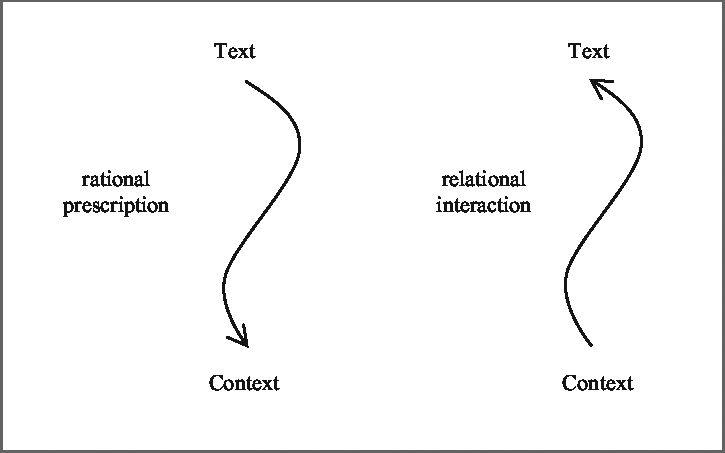
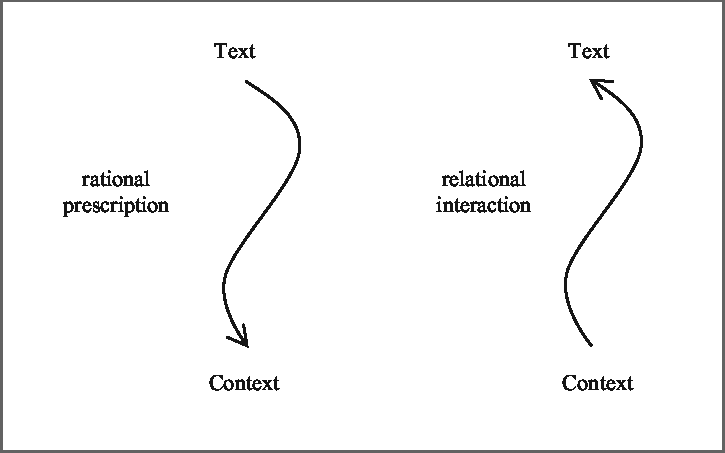
One can paint this contrast (at least for the moment) as diametrically opposed logics. One of the earlier formulations of relationality stems from a contrast between the idea of policy-as-prescription as the imposition of a text – i.e. a policy design, rule or other prescription constructed by decisionmakers, upon a context, versus the possibility of policy working in the opposite direction, where policy actors work out policy through their everyday interaction in context, the overall “design” of which emerges epiphenomenally (Lejano Reference Lejano2006). Contextual action can exhibit a logic of relationality, as illustrated in Figure 1 (adapted from Lejano Reference Lejano2006).
Two depictions of the policy process.
The ethic of relationality is distinct from an ethic of rationality. While the rational model is characterised by a goal-imposing logic (as exhibited in utility maximising behaviour of individuals or the rational-purposive ethic of the state), the relational involves actors conforming their actions to their mutual relationships – a logic of appropriateness (March and Olsen Reference March and Olsen2004). In some policy situations, the relational dynamic may even subvert the rational-purposive system.
Why might a relational system crowd out a formal, rule-based regime? In some instances, these may pose two mutually exclusive alternatives. One example of this is found in the area of governance of interorganisational transactions (e.g. purchasing of supplies or services). There has arisen a literature around so-called relational governance where relationships, supported by mutual trust, govern these exchanges rather than formal contracts. Poppo and Zenger (Reference Poppo and Zenger2002, 710) describe the system in these terms: “For such relationally-governed exchanges, the enforcement of obligations, promises, and expectations occurs through social processes that promote norms of flexibility, solidarity, and information exchange”. Relationships can pose an advantage over formal contracts due to lowered transaction costs or inherent flexibility and adaptability to changing circumstances (Heide and John Reference Heide and John1992; Dyer and Singh Reference Dyer and Singh1998). In these cases, formal contracts can actually detract from the dimension of trust that governs interorganisational arrangements.
In other situations, the organisational or political culture may make some policy regimes as more inherently relational than others. In some cases, this can translate to framing different systems in contrasting terms. China is a case in point. Scholars have long recognised how social relations are an inextricable part of governance, at every level of society. Qiao and Upham, writing about the modernisation of property law, contend that the dynamic interplay of social relations governs transactions of rural property even when there is absent a more definitive policy on property rights. Qin extends this logic to political institutions in China, in general, arguing that, while Weberian notions of rationalisation fit contexts where society is understood as individuals bound by social contracts and norms, an ethic of relationality better fits China, where persons are not understood as simply being individuals but always part of a collective (Qin Reference Qin2009). This contrast between a “western” Weberian frame and an “eastern” Confucian frame is useful for analysis, even though it reifies categories (e.g. east versus west) that do not hold in reality (Lejano et al. Reference Lejano, Guo, Lian and Yin2018).
While being careful to avoid an institutional “orientalism” of sorts, the model of relationality is useful for describing, more deeply, policy regimes that do not resemble those that Western scholars are used to studying. At least, it is an attempt to go beyond the outright orientalist claim that these other systems are not sufficiently modernised. Rather, one can understand these distinctions are differences in the relative importance of rational processes and relational ones. The notion of relationality allows us to more completely describe nonconventional systems without taking overtly ideological frames of analysis. Take for example, Weber’s vivid depiction of an authority based on charisma rather than the legal-rational (Weber Reference Weber1922). What is charisma, though, if not the surface appearance of a configuration of relationships that endows a leader with undue sway over the governed? Rather than assuming charisma to part of the essence of the leader, we might better analyse it as the outcome of the establishment and working of a particular system of relationships.
The provisionality and adaptability of policy in China is often understood this way. Rather than having fixed, definitive rules in place, there exists in China a penchant for adaptive trial-and-error adjustments of policy, what Deng Xiaoping referred to as “crossing the river by feeling the stones”.Footnote 2 Adaptability and flexibility also inheres in the expression of relationships among policy actors (e.g. the idea of guanxi). Without invoking the idea of relationality, Weber expressed this as differing degrees of rationalisation (Weber 1904/Reference Weber1930). At the extreme, one can draw a sharp contrast between what we might call a Weberian system of governance, characterised by rules and clear lines of authority, and the Confucian, which functions more like an idealised family and public affairs are conducted to maintain harmony and social cohesiveness (e.g. Lejano et al. Reference Lejano, Guo, Lian and Yin2018). For example, Deva proposes that China’s constitution is not the ultimate or definitive source of legal authority (in contrast to, say, the US constitution) but shares this with other authorities – e.g. its leadership, the National People’s Congress, the Communist Party, etc. (Deva Reference Deva2010).
Some literature builds on the ostensible contrast between systems of varying degrees of rationalisation (with degrees of relationality presumed to vary in converse fashion). In the area of interorganisational exchange, Li contends that emphasis on relational governance has been a factor in the so-called East Asian miracle (Li Reference Li2003) but concluded that these economies were transitioning to stronger rule-based regimes. Distinguishing the two models is a useful exercise in categorising, so long as writers recognise that actual cases differ in the degree to which a system tends toward one pole versus the other.
As is often the case, one cannot describe the policy situation very adequately by referring to the codified rules. Take the case of the Chinese government’s policy toward the special administrative region of Hong Kong. What is formally codified is the policy of “one country, two systems” which evokes autonomous governance of Hong Kong by the Hong Kong residents themselves. The real policy, however, is found in the way the relationship between the two parties, and the people and organisations involved, works out in the everyday. It has evolved into a kind of détente that is not officially codified anywhere, where the Chinese government attempts greater sway over Hong Kong’s governance, and Hong Kong residents react in resistance. While the people of Hong Kong work for the cause of free elections and self-determination, the periodic incursions establish the perpetual presence of the mainland in everyday life in the city. So, while a mass demonstration of free speech and assembly, such as the so-called yellow umbrella protest against China in 2014 or the anti-extradition protests that begun in 2019, can occur in Hong Kong, interventions by China such as the temporary arrest of the leaders of the movement serve to create an unsettled kind of stable arrangement. This coexistence is, in a sense, maintained by these everyday practices which is a manifestation of the evolving relationship between the city and the state (Yeung Reference Yeung2019). The policy is not a static rule-defined state but something dynamic, wrought through the working and reworking of relationships between contending parties. In terms of the dimensions of relationality outlined above, the relationship can be understood to be the working out of three aspects of Hong Kong’s identity. First, there is the city’s self-identification as a free, autonomous people. But there is, at the same time, a dynamic tension between Hong Kong and Beijing that pits against each other their contrasting cultures and institutions. Lastly, there is the conjoint identity of Hong Kong and China as one nation. As this complex relationship evolves, so does the ritual dance of protest, censure and rapprochement that constitutes policy around this city region.
Perhaps a more realistic way of understanding relational systems is as a mode of governance that works side-by-side with the conventional, rule-based system. This hybridity is perhaps, not surprisingly, found in abundance in policy systems in China, which exhibits what scholars refer to as institutional bricolage (de Jong Reference De Jong2013). However, it is possible, at times, for the relational model to come to the fore when the administrative state or other conventional institutions is not dominant in a particular setting (e.g. Xin and Pearce Reference Xin and Pearce1996; Raiser Reference Raiser1997).
Employing the relational model
Having outlined what relationality is and how it is manifested in the world of policy, we now turn to its potential use for policy researchers and practitioners. In the following discussion, we offer some possibilities, first in the area of policy analysis and, then, policy design.
Analysing policy anomalies
Policy anomalies are deviations from paradigmatic policy ideas. These can be persistent discrepancies between policy intents and their realities, sometimes serious enough to force practitioners to reconsider policy paradigms (Béland Reference Béland2005; Wilder and Howlett Reference Wilder, Howlett, Hogan and Howlett2015, 101–102).
Take, for example, the use of vouchers as a type of incentive-based policy instrument (Lascoumes and Le Galés Reference Lascoumes and Le Galés2007), as it is presently being tested at several sites in China (e.g. Lou and Ci Reference Lou and Ci2014; Kan Reference Kan2018). Its concept draws from the paradigm of demand-side reasoning: consumers know their needs and wants best and, so, can self-optimise the services they avail of so long as they are provided sufficient choice and subsidy. For example, vouchers have been used in elder and child care, where clients and their family members are provided vouchers that can be applied to any mix of services from a list of providers. But, time and again, researchers have found that people often refuse them even when there are clear benefits to their doing so and no downside (e.g. Hardin et al. Reference Hardin, Ragan and Khan2018; Lai et al. Reference Lai, Kuang, Yam, Ayub and Yeoh2018). Viewed from the lens of the rational paradigm, inquiries into this anomaly would search for hidden transaction costs, a lack of information, or thin markets (e.g. Shimberg 2001; Sard and Fischer Reference Sard and Fischer2002). But the logic behind this may be a relational one, and employing this alternative lens may help make sense of the policy situation. In this case, the analyst might understand the voucher program as a new entrant into an already existing network of relationships among multiple policy actors. The question would revolve around the fit of this new instrument into this relational domain – i.e. whether the assumptions made by the program proponents about how the voucher would be used conforms or conflicts with existing relationships. This phenomenon has been seen in the introduction of vouchers in China. For example, a study of the under-utilisation of a new voucher program in Hong Kong showed that some elderly clients felt use of the voucher conflicted with the practice of being cared for by one’s family (Kan Reference Kan2018). Another study of a voucher program for elder care in Hong Kong suggested that residents relied on the state for care and mistrusted the private sector (Lai et al. Reference Lai, Kuang, Yam, Ayub and Yeoh2018).
The other type of anomaly is the policy situation that defies conventional typologies (Kooiman Reference Kooiman and Kooiman1993). One example of this is that of the role of civil society and environmental advocacy groups revolving around the new Environmental Protection Law in China (Johnson Reference Johnson2011). The conventional assumption is that environmental NGOs would act as advocates and fiscalizers in the environmental review of large capital improvement projects. However, the inconsistent way in which NGOs operate, at times challenging a project and other times acceding to it, is difficult to explain within the frame of a pluralist model. But understood from the lens of relationality, other insights emerge. For example, Guo studied the membership of some of the NGOs and discovered that they included prominent government officials and military personnel. Inquiring further, she concluded that these NGOs act not separately from the state as its fiscalizer but in a different relationship to it, being part of the state yet different from it (Guo Reference Guo, Lejano, Guo, Lian and Yin2019). She concluded that strict divisions between sectors (civil society, state and industry) did not well capture institutional life in China (Guo Reference Guo, Lejano, Guo, Lian and Yin2019, 91).
Similarly, some policy situations are underspecified, where exactly the rules and process by which policy outcomes are achieved are never completely spelled out. Where there is considerable policy ambiguity, the relational perspective can explain how the system functions and how decisions are crafted when formal rules do not specify exactly how outcomes come about. In describing the evolving urban property market in China, Wong and Zhao (Reference Wong and Zhao1999) discuss how social relationships constitute an informal land allocation process that works behind the formal rules, in fact overriding the latter. Rather than simply designating the system as a poorly established system of rules (or as corruption), scholars might analyse the situation more deeply by studying how the web of social relationships function to create a system that works more or less efficiently. As the above authors discuss, the property market system cannot be understood in conventional terms, where buyer and seller negotiate a price, but one where a host of public and private (and quasi-public) actors act in concert to work out the terms of the transaction. The system works according to this relational logic in a way that cannot be captured in terms of codified administrative rules.
A brief example
In the brief overview of related literature and illustrative examples above, we have pointed out the merits of a relational perspective in more deeply describing innovative or emergent policy designs. In this section, we examine one case more closely to illustrate the merits of the particular relational model described earlier.
We illustrate the relational model using a case study from Chengdu sub-province in China. The case is particularly suited for our purposes because it involved a unique, unconventional policy design that suggests a relational mode of description.
At the Third Plenum (or general assembly) of the ruling Communist Party of China, a significant move toward the creation of private markets around land was taken, resolving to “promote market-oriented reform… promote resources allocation according to market rules, market prices and market competition, so as to maximize the benefits and optimize the efficiency”.Footnote 3 The movement began with the creation of marketable long-term lease rights to urban land, which essentially operated like private land ownership. Beginning in the early 2000s, policymakers began to free up rural land to market forces.
Rural land was, historically, collectively owned and used. Starting in the 1980s, however, families were assigned individual plots of (nontransferable) land and leasehold use rights from the same. Families managed their land as their private holdings, including the right to lease them out for revenue. This included homestead land that rural families resided in, a process that was furthered by extensive efforts at land titling (Li Reference Li2012). In 2007, an important policy experiment was launched in two areas, Chengdu and Chongqing. It created a transferable development right (TDR), referred to as the dipiao or quota, wherein rural landowners could move out of their homestead land and move into higher-density urban-type housing. Their former landholdings would be converted to agricultural land, and agricultural land closer to the edge of the urban area would be converted into urban land use, for which the developer would pay the former rural owners something approaching the urban price for their land. The auction was conducted at the rural property rights exchange centre. This essentially allowed individual rural landowners to sell their land to urban developers, often earning more than the capitalised earnings from tilling their land.
This, along with other related land reforms, was thought by some to be the beginning of a path toward a conventional private property regime with individual actors engaging in market transactions (e.g. Nee and Opper Reference Nee and Opper2012). However, the system evolved into something altogether unique, exhibiting characteristics of both private and public goods. We will give a brief illustration of how the relational model presented herein can be used to describe the other nondescript policy design.
In previous research, we conducted field research and interviews on the Chengdu program (authors’ names associated with policy report withheld). With changes in property regime came changes in the network of relationships. The relational model first entails describing the roles, actions and self-identities of the individual, which we can assume in this case to be the individual rural property owner. Unlike what might be presumed to be the transition to the utility maximising market actor, residents associated their rural land with culture and way of life. The move to leave their homestead and transfer to urban living was driven by the loss of the rural traditions as many of their children were choosing to leave rural farm life in favour of the city.
Instead of transfer of decisionmaking from the rural or village collective to the individual, rural land owners developed an even more active relationship with the collective. They began participating in joint decisionmaking, meeting with other families to deputise village officials to represent them and participating in joint decisionmaking. Families deciding to leave their homesteads bundled their land and depended on the collective to arrange for sale. While decisions used to be made by the village council director, now individual families participated in deliberation and decisionmaking. Prior experience with land expropriation left a sense that individuals had too little power or information to bargain individually. Interviewed residents did not describe themselves in terms of the market actor, seeking to increase individual utility, but as still part of a village, choosing to move only because of a diminishing rural lifestyle.
Another dimension in our analysis concerns the identity and action of self-and-other – i.e. the union of the individual families making up the collective. The communities maintained the role of the village unit, with the latter standing in for the families in market transactions. The important insight gained is that the renewed relationship, and everyday transactions, between individual homesteaders and the village is what constitutes the new policy regime. These relationships and transactions are not codified, and it is in the way these are worked and reworked over time that we see the institution taking shape. The relational view includes, but is more than, the realm of practice. Identities (of self, self vis-à-vis other and self-and-other) evolve as well and, in the case of Chengdu’s new policy regime, individual rural homesteaders are taking on new roles and new relational positions in relation to other collective bodies.
This analysis could be extended to encompass relationships between the village and the Chengdu municipal government. Rather than the conventional auction process, where individual buyers and sellers transact through the exchange, the government would connect the two parties and arrange for terms of the agreement, sometimes bundling properties to meet developers’ requirements. The village unit would form closer relationships with the municipality, obtaining guidance through the process. We are only able to offer this brief illustration of a relational approach, but it suffices to show that it helps us analyse unique aspects of the new policy design. It helps us understand that the policy did not result in a classic private property regime, but one where the network of relationships between individual and collective and state was preserved and even enhanced. That the new quota system did not function like a conventional TDR was most evident in 2011, when speculators attempted to hoard quotas and drive the price up, and the municipal government stepped in to set a ceiling on the quota. Descriptions of the relationship of the municipal government to the stakeholders, from interviews, suggested a still paternal relationship, as the government did not see it possible for sellers and buyers to act autonomously from the government. Interviews suggested that this extended to the relationship of the municipal government with developers, being more paternal and clientelist in Chengdu than in Chongqing, which explains some of the differences in how the quota system is implemented in the two areas.
What are the merits of the particular approach used above (especially relative other extant approaches that at least partially employ relational concepts)? One is its explicit formulation for how a relationship between two (or more) actors might be described and analysed. This would be a useful complement to social network analysis, which more often than not (but not always) emphasises the pattern of ties across a network without intensive exploration of what those ties consist. When there is an attempt to work out what the ties amount to, analysis will often express this in terms of exchange, which encompasses a rather limited set of material and other transactions. What the model above emphasises is that a relationship (or a tie) is a complex made up of transactions, meanings shared and unshared, stories and other interconnections. Moreover, the expansion of relationship to include constituted identities allows one to explore relationships as told by the actor even when it is not manifest as transaction. Additionally, it can provide explanations for actions that are hard to explain when merely observed or measured. For example, in the Chengdu case, the increased encounters between individual owners and the village council can be understood in a better light when individuals describe themselves as still belonging to the collective even after they have left the rural community for urban living.
Conclusion
The article’s main goal is to underscore the need to explicitly account for the relational dimension of institutional life and to describe how the relational can be seen in varied situations. To illustrate the relational framework, a number of examples were taken from the Chinese context. There are important institutional experiments occurring in China today, some leading to new or unconventional institutional designs, for which the relational concept would seem to be most appropriate. But the more important point is that the relational condition is a general one that should be applicable to other regions, as well.
Throughout the article, we have been drawing examples from China, ostensibly because of the nonconventional nature of policy life in this country. But this is, if anything, an illusory scholarly bias. What is unconventional depends mainly on the scholar’s particular vantage point. More to the point, as the literature on relational sociology suggests, the notion of relationality should be applicable to any other policy milieu.
Returning to the point that relational processes function along with rational-purposive rule systems in complementary fashion, we should expect to find the relational to be operative everywhere, even in programs that conform strictly to set rules and formal guidelines. The challenge, moving forward, is to first find more powerful modes of describing the workings of relationships and, second, describing how these intertwine with formal rules to determine the institution as practiced.
Describing the relational will require methodological openness. The relational model proposed earlier presents relationship as consisting in the multiple ontological dimensions of the policy actor as she is as an individual agent or entity, the actor vis-à-vis the other (person, state, etc.) and the joint identity of person-and-other. How do we analyse the identity of an actor vis-à-vis another? The most immediate and most observable manifestation is in the transactions that occur between the actor and the other. These can be empirically observed as material or other exchanges between them. In many cases, these transactions can be operationalised and analysed (whether quantitatively or qualitatively) as is done in social network analysis (e.g. Scott and Carrington Reference Scott and Carrington2011; Hollstein Reference Hollstein2011). But there is also the element of meaning, which does not always exhibit themselves in material transactions. Take, for example, the evolving identity of the Hong Konger as the resident of the city but also citizen of the state. In part, this evolving identity can be seen in the protests and other action taken by the Hong Konger to establish who they are vis-à-vis the state, but there is always an aspect that lies beyond or behind observable actions. More ethnographic methods, employing interviews and narrative analysis, can allow other ways to access the less observable aspects of relative identity (e.g. Lejano Reference Lejano2008).
To this point, our discussion has focused on the relational framework as a descriptive tool. We have left out discussion of the normative dimension as our primary goal was the faithful description of policy life. (To the thing itself, Husserl might say.) But it is important to note that to describe a policy regime as dependent on the workings of everyday relationships is not to valorise the relational. Indeed, departure from formalised rules is often seen as aberrant, or the relationships that underpin the situation may be unjust or unethical. The normative question should be taken up in future work. While our focus in this article has been descriptive, there should be a parallel effort to begin evaluating whether the relational aspects of a program help or hinder its just and effective performance. We merely suggest that the task of describing a program requires an openness on the part of the analyst. That is, one can first bracket aside the tendency to predetermine a phenomenon like guanxi as anomalous or corrupt practice and, instead, analyse it by first describing it closely and shedding insight on how it comes about. Then the normative questions can be introduced.
Increased attention to the relational dimensions of institutional life, however, can attune policymakers to possibly helpful strategies to pursue in program and policy development. From a relational perspective, reform should revolve around attempts to reconfigure relationships among policy actors in ways that encourage interaction, exchange of knowledge and trust. Closer relationships with the citizenry can be a goal for the relational state (Mulgan Reference Mulgan, Cooke and Muir2012). Each of the examples described above can be understood in these terms. Reforms in environmental law in China aim, in part, at having civil society link the state to the people (Schwartz Reference Schwartz2004, 45). Voucher programs in Hong Kong seek to empower the client so that she is no longer a recipient of state aid but a partner in program implementation (Kan Reference Kan2018). In a sense, the reform of property law in China represents a desire to foster joint ventures that involve the concerted action of an entire set of actors, including corporations, local and national state agencies and villagers (Qiao and Upham Reference Qiao and Upham2015). In each of these cases, reforms involve reconfiguring relationships among diverse actors. Hope for the “one country, two systems” idea lies in the willingness of the central government to affirm and build upon the uniqueness and freedoms of the Hong Kong people, instead of imposing rigidity. Beyond the formation of new linkages among policy actors, allowing greater inclusion of the governed, there is the goal of relationships becoming more active, rich and productive.
Employing the concept of relationality does not mean eschewing conventional policy frameworks. The relational view is meant to complement extant analyses, not supplant them. Given what we already know about how policies are crafted and put into action, what additional insights do we gain when we add the formative effects of the working and reworking of relationships? How might we evaluate a highly relational system, if it is not enough to assess them against formal policy objectives? The hope is to engage a community of policy scholars in deepening our understanding of relationality in policy life.
Acknowledgements
Gratitude is expressed for the numerous helpful suggestions received from the three anonymous reviewers and the editor, Dr. Madalina Busuioc, which helped improve the manuscript considerably. The author thanks the China Program, Lincoln Institute of Land Policy, for grant funding that supported part of the research on China, particularly Kate Austermiller and Zhi Liu of the institute.
Data Availability Statement
This study does not employ statistical methods and no replication materials are available.