Introduction
The feed industry is faced with a number of challenges, not only regarding the availability of feed ingredients but also the ability to produce high quality products in a cost-effective manner. There is a need to exploit cheaper energy sources in order, and to replace expensive cereals for livestock production, to relieve the food-feed competition in the future. In the coming years, poultry producers will definitely have to look beyond maize and other cereal grains because of their low availability; cost and inability to keep pace with ever-increasing poultry production. Further, as a result of increasing use of maize for producing ethanol and biofuel, maize prices in the US increased from $2.60 a bushel in 2006 to near $4 a bushel in 2007 (USDA, Reference USDA2007). Substantial efforts have been made in the past to replace cereals with cassava in poultry feeding but the response, in terms of productive performance of chickens fed cassava products, has been widely variable.
Cassava, manioc, tapioca, or yuca (Manihot esculenta) is a woody shrub of the Euphorbiaceae (spurge) family, native to South America. Cassava is the third largest source of carbohydrates for human food in the world and has been grown extensively as an important economic root crop in Southeast Asia, tropical Africa and Central America (Fauquet and Fargette, Reference FAUQUET and FARGETTE1990). Cassava has the ability to withstand poor soil and drought, and the plant can yield 25 to 60 tons/ha, depending on variety and cultivation practice. Almost 70 percent of world's cassava production comes from five countries, namely Nigeria, Brazil, Thailand, Indonesia and the Congo Democratic Republic. The world cassava production was 228 million tonnes in 2007, which represents a steady increase in production over previous years (FAO, Reference FAO2008). There are two types of cassava; the sweet type, which is used for human consumption, which is either tough or tender texture, with no bitterness and low hydrocyanic acid content. Large amounts of this type are planted throughout the world. The second type is bitter cassava with high hydrocyanic acid (HCN) content and is not suitable for human consumption, but is only suitable for the processed tapioca industries, such as tapioca tablets, tapioca flour, and alcohol. Broadly, roots and leaves are the two main products from cassava but several different products can be obtained from these through further processing (Figure 1).
Processes and end-use of different products from the cassava plant.
Source: Howeler (Reference HOWELER2003).

whole roots
Normally, whole roots or fresh cassava tubers are often fed to cattle and pigs, either raw or in the boiled form. However, feeding of fresh tubers may cause cyanide toxicity, depending on the cyanide content in the tubers (Mathur et al., Reference MATHUR, SAMPATH and GHOSH1969). For storage, as well as feeding to poultry, it is advisable to dry it and bring down the moisture level to about 10% level.
chips
Cassava chips are the most common products used in animal feeding and are produced extensively in Thailand, Malaysia, Indonesia, and some parts of Africa. Chips are produced by a machine, which slices the fresh roots into small pieces. The fresh chips are sun-dried on a concrete floor over about 2-3 days, depending on the weather conditions, until the moisture content is reduced to about 14%. Most cassava chips are directly sent to the factories for the manufacture of feed pellets. The general specifications for export cassava chips are 65% (minimum) starch, 5% (maximum) fibre, 3% (maximum) soil contaminant and 14% (maximum) moisture (Balagopalan, Reference BALAGOPALAN2002).
pellets
Pellets are obtained from dried cassava chips by grinding and hardening them into a cylindrical shape. The standard specifications for hard pellets are similar to those of chips from which pellets are produced (Balagopalan, Reference BALAGOPALAN2002). According to reports, the expansion in animal production in Europe has resulted in increased demand for cassava pellets in the European market. The advantage of using cassava pellets in animal feed is the enhancement in animal performance, less pollution, and the pellets are less bulky, so transportation cost is lower (Philips, Reference PHILIPS1974).
meal
Cassava meal is the powdered residue of the chips and roots after processing to extract edible starch. The quality of cassava meal is inferior to that of chips, pellets and broken roots. It has lower starch content, and usually contains more soil contaminants. The use of cassava meal in the European Union has declined with a shift to the other cassava products. In other producing areas, particularly Africa, cassava meal is produced from the whole root, which may be peeled or unpeeled. This meal is higher in starch compared to meals produced in Thailand and other parts of Asia where cassava is mainly used for starch production.
leaves
Cassava leaves are a by-product of cassava root after harvest, and are highly nutritious. Like other dark green leaves, they are an extremely valuable source of protein (140–400 g/kg DM), minerals, vitamins B1, B2, C and carotenes (Eggum, Reference EGGUM1970; Adewusi and Bradbury, Reference ADEWUSI and BRADBURY1993). However, the leaf contains cyanogenic glucosides, six times higher than in the roots. Moreover, tannin and phytin may also limit the nutritional value of cassava leaves (Reeds et al., Reference REEDS, SATHE and SALUNKHE1982). The leaf blade accounts for 10 to 40% by weight of the plant's aerial part, depending upon the age and ecological condition of the plant. Leaves can be harvested within 4 to 5 months of planting, without adversely affecting root production, yielding up to 10 tonnes of dry foliage per hectare (Khajarern and Khajarern, Reference KHAJARERN and KHAJARERN1992).
Residual pulp
During the processing of cassava starch, the solid residual pulp separated in the screening process is also used as an animal feed. This product is considered as a by-product of the cassava starch industry. The moisture content of cassava pulp is about 60-70%. Cassava pulp contains a large amount of carbohydrate, which is up to 50% on dry weight basis. The pulp also has a high fibre content and contains minerals such as Cu, Zn, Mn, Fe and Mg. At the University of New England, there is on-going research aimed at evaluating the potential of cassava pulp for poultry feeding. Initial analyses show that four different pulps, from three sources, have lysine levels varying between 43 and 64 g/kg of protein. The highest levels of methionine, alanine, leucine, isoleucine and threonine are 7.0, 106, 82, 57 and 70 g/kg of protein, respectively. Calcium content varies from 3.15 to 6.5 mg/kg DM, while P, Na and K were 0.27-0.63, 0.21-1.20 and 2.28-3.86 mg/kg DM, respectively.
Nutrient composition of cassava
The nutrient composition of various cassava products as reported by different researchers is presented in Table 1. The metabolisable energy value of cassava root meals for poultry varies from 12.0 to 14.6 MJ ME/kg of dry matter (Olson et al., Reference OLSON, SUNDE and BIRD1969, Maust et al., Reference MAUST, SCOTT and POND1972; Hutagalung et al., Reference HUTAGALUNG, JAYALUDIN and CHANG1974; Muller et al., Reference MULLER, CHOU and NAH1975; Fetuga and Oluyemi, Reference FETUGA and OLUYEMI1976; Khajarern et al., Reference KHAJARERN, HUTANUWATR, KHAJARERN, KITPANIT, PHALARAKSH and TERAPUNTUWAT1982). However, Agwunobi and Okeke (Reference AGWUNOBI and OKEKE2000) studied the AME and chemical composition of 19 cultivars of cassava and observed no significant differences between the cultivars. Silva et al. (Reference SILVA, DA FONSECA and GUEDES2000) obtained values of AME and AMEn of 7.10 and 7.08 MJ/kg DM for cassava leaf meal, respectively. It also contained very low levels of protein (25 g/kg DM) and was deficient in essential amino acids, fat, minerals and vitamins. Cassava is very low in fat or lipids. The extractable lipids are mainly polar, galactosyl diglycerides, and the fatty acids in cassava are mainly saturated (Hudson and Ogunsua, Reference HUDSON and OGUNSUA1974). As cassava contains low amounts of lipids, it is a poor source of fat-soluble vitamins (Hudson and Ogunsua, Reference HUDSON and OGUNSUA1974). Onwueme (Reference ONWUEME1978) reported cassava to contain low levels of vitamins such as vitamin A, B1, B2 and niacin but higher levels of vitamin C was well as the mineral, calcium. Cassava root products are deficient in carotene and other carotenoids, making it necessary for supplementation of these pigments for the maintenance of normal egg yolk and broiler skin pigmentation (Kanto and Juttupornpong, Reference KANTO and JUTTUPORNPONG2005).
Nutrient composition of different cassava products.

Source: Muller et al., Reference MULLER, CHOU and NAH1974; Hutagalung et al., Reference HUTAGALUNG, JAYALUDIN and CHANG1974; Devendra, Reference DEVENDRA1977; Khajarern et al. Reference KHAJARERN, HUTANUWATR, KHAJARERN, KIPANIT, PHALARAKSH and TERAPUNTUWAT1979; Khajarern and Khajarern, Reference KHAJARERN and KHAJARERN1992; Ravindran, Reference RAVINDRAN1992; Akinfala et al., Reference AKINFALA, ADERIBIGBE and MATANMI2002; Kanto and Juttupornpong Reference KANTO and JUTTUPORNPONG2005; Nwokoro and Ekhosuehi, Reference NWOKORO and EKHOSUEHI2005
carbohydrate (starch)
Cassava starch has been reported to contain 17% amylose and 83% amylopectin, compared to maize starch, which consists of 28% amylose and 72% amylopectin (Gomes et al., Reference GOMES, SOUZA, GRANDI and SILVA2005). The amylose content of barley, rice and maize is higher than that of tapioca starch. Promthong et al. (Reference PROMTHONG, KANTO, TIRAWATTANAWANICH, TONGYAI, ISARIYODOM, MARKVICHITR and ENGKAGUL2005) reported that rapidly digestible starch was higher in cassava than in maize due to a higher content of amylopectin in cassava.
protein
The major limitation for using cassava root meal in poultry feed is its low protein content and deficiency of essential amino acids. Cassava flour and peels contain about 36 and 55g protein/kg, respectively, although cassava leaves are richer in protein, as observed in eight Brazilian varieties to be 178 to 348 g/kg (Rogers and Milner, Reference ROGERS and MILNER1963) and in Nigerian varieties, 298 to 337 g/kg (Tewe et al., 1976). The protein in cassava has a higher arginine content while methionine, threonine, cystine, phenylalanine, isoleucine and proline are low (Muller et al. Reference MULLER, CHOU and NAH1975; Onwueme, Reference ONWUEME1978).
anti-nutritional factors
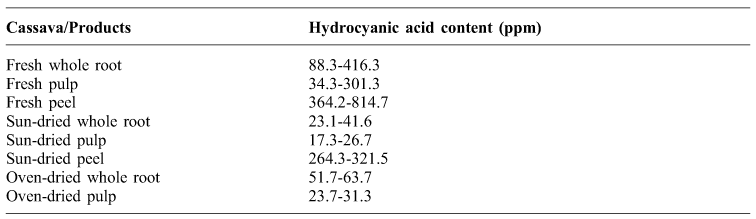
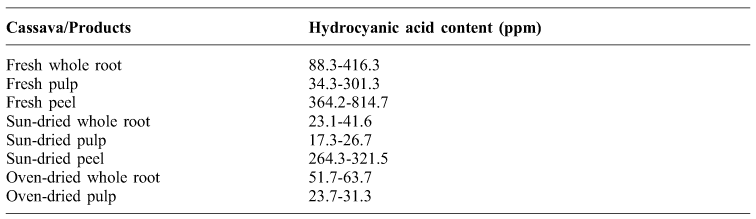
Cassava contains the anti-nutritional factors cyanogenic glycosides of two types, primarily linamarin (93%) and some lotaustralin or ethyl linamarin (7%). Linamarin is chemically similar to glucose but is conjugated to cyanide (ion). Yeoh and Yruong (Reference YEOH and YRUONG1993) reported that linamarin in cassava can vary from 2 to 395 mg/100 kg of fresh cassava tuber, depending on the variety. In the whole plant, linamarin is synthesised from the amino acid, valine, while lotaustralin is synthesised from isoleucine. Both cyanogenic glycosides are not harmful to the plant but serve as sources of aspartic and glutamic acids and glutamine. The HCN concentration, resulting from the action of hydrolytic enzymes found in the plant, is influenced by the nutritional status and age of the plant (Ravindran and Ravindran, Reference RAVINDRAN and RAVINDRAN1988), and higher HCN levels were found in leaves from bitter than those from sweeter varieties (Tewe and Iyayi, Reference TEWE and IYAYI1989). The hydrocyanic acid content of Nigerian cassava and some products used for animal feeding is presented in Table 2. Udedibie et al. (Reference UDEDIBIE, ANYAEGBU, ONYECHEKWA and EGBUOKPORO2004) reported that fresh cassava tubers contain 0.44 mg HCN/g, whereas unfermented and fermented meals contain 0.15 and 0.08 mg HCN/g, respectively. The study by Panigrahi et al. (Reference PANIGRAHI, RICKARD, OBRIEN and GAY1992) showed that cassava root meal with a total cyanide content less than 40 mg/kg, can be fed to broiler chicks at 500 g/kg without any adverse effects. A later study by Panigrahi (Reference PANIGRAHI1996) suggested that low-cyanide cassava root meals may be incorporated in nutritionally-balanced poultry diets between 500 and 600 g/kg without any reduction in weight gain or egg production. However, an excess of cyanide content at 100 mg/kg diet appears to adversely affect broiler performance, and laying hens may be affected by levels as low as 25 mg total cyanide/kg diet (Panigrahi, Reference PANIGRAHI1996). Chronic cassava toxicity in layers has been reported to lower egg production, egg quality, and hatchability of eggs (Omole, Reference OMOLE1977; Ngoka et al., Reference NGOKA, CHIKE, AWONIYI, ENYINNIA and ODURUKWE1982).
Hydrocyanic acid content of Nigerian cassava products (air dry basis).
Source: Tewe and Iyayi (Reference TEWE and IYAYI1989)
Improving the nutritive value of cassava products
physical processing
High moisture level is one of the major reasons for the spoilage of cassava products during storage and feeding, therefore, the products benefit from drying. Different physical processing methods have been tried for cassava, including sun-drying, boiling, mashing and pelleting, to improve the nutritive value and reduce cyanide content. Sun-drying is probably the cheapest method in the tropics and is also the most effective. Khajarern et al. (Reference KHAJARERN, HUTANUWATR, KHAJARERN, KITPANIT, PHALARAKSH and TERAPUNTUWAT1982) observed a reduction of HCN content from 111.83 ppm to 22.97 ppm on sun drying of cassava roots for 6 days and the reduction was appreciable from within three days of sun drying. Gomez et al. (Reference GOMEZ, VALDIVIESO, DE LA CUESTA and SALCEDO1984) reported that on sun-drying, more than 86% of HCN present in cassava was lost probably due to the evaporation of free cyanide at about 28°C. Eruvbetine et al. (Reference ERUVBETINE, TAJUDEEN, ADEOSUN and OLOJEDE2003) observed that the grinding together of cassava roots and leaves in the proportion of 50:50 before sun-drying improved the texture and crude protein content of the material when included in broiler diets. The cyanide content was also reduced. Eruvbetine and Adejobi (Reference ERUVBETINE and ADEJOBI2000) reported that when cassava was boiled and sun-dried, the nutritive value was improved and the physical texture became flaky. However, pelleting of diets generated high temperatures, but did not significantly alter the HCN concentration (Pangrahi et al., 1992).
fermentation
There are reports that fermentation can effectively reduce HCN content of cassava. Generally, the total cyanide content in fresh root is up to 400 mg HCN/kg and in the study of Muzanila et al. (Reference MUZANILA, BRENNAN and KING2000), it was reduced to 5.84 mg HCN/kg on wet fermentation in comparison to 14.0 mg HCN/kg by solid-state fermentation. Manilal et al. (Reference MANILAL, NARAYANAN and BALAGOPALAN1987) conducted a study on the use of Aspergillus niger to improve the quality of cassava waste products through solid state fermentation, and observed that the initial biomass protein in the material was increased from 1.60% (w/w) to 7.0% after three days of fermentation. Similar studies have been reported by Padmaja and Balagopalan (Reference PADMAJA and BALAGOPALAN1990) who included Trichoderma pseudokoningii-enriched cassava waste in diets for broiler chickens at up to 600 g/kg in the feed without any adverse effect on growth performance and percentage of carcass yields. Aderemi (Reference ADEREMI2006) also indicated that layers fed on biodegraded diet (cassava root fermented by Aspergillus niger) were similar in performance to a maize fed group.
There is a possibility that cassava products can be incorporated at a higher level after processing, and proper sun drying is one of easiest and most economical means of processing. For storage, care should be taken to keep the moisture level to below 10%, to avoid mould growth.
studies on broiler chickens
Cassava products have long being used for animal feeding under subsistent agriculture in its major areas of production. In the earlier years when it was compared to cereals, the inclusion of cassava in poultry diets was reported to depress performance (Tobayayong, Reference TOBAYAYONG1935; McMillan and Dudley, Reference MCMILLAN and DUDLEY1941; Vogt, Reference VOGT1966) probably due to the presence of HCN and high levels at which it was incorporated. Some of the later studies (Tejada and Brambila, 1969; Job et al., Reference JOB, OLUYEMI, AWOPEJU and ODEYEMI T.O.1980) observed satisfactory growth performance in broiler chicks on replacement of maize by cassava at up to 50 -100 g/kg in the diet. However, there are several reports on the use of cassava meal in poultry diets in the past few decades with encouraging results probably due to the balancing of nutrients to meet requirements (Ravindran et al., Reference RAVINDRAN, KORNEGAY, RAJAGURU, POTTER and CHERRY1986; Tewe and Egbunike, Reference TEWE and EGBUNIKE1992; Khajarern and Khajarern, Reference KHAJARERN and KHAJARERN1986; Khajarern and Khajarern, Reference KHAJARERN and KHAJARERN1992; Aderemi et al., Reference ADEREMI, TEWE and ADESEHINWA2000; Akinfala et al., Reference AKINFALA, ADERIBIGBE and MATANMI2002).
Feeding sun-dried cassava root meal at 0, 150, 300 or 450 g/kg in broiler diets yielded no significant changes in growth performance (Eshiett and Ademosun, Reference ESHIETT and ADEMOSUN1980). Male broiler chicks were given a diet from the age of 7 days with wheat replaced by 0, 100, 200, 300, 400, 500 g/kg of dried cassava root meal, which did not significantly reduce body weight and food intake (Stevenson and Jackson, Reference STEVENSON and JACKSON1983). In a study by Gomez et al. (Reference GOMEZ, VALDIVIESO, SANTOS and HOYOS1983), the performance of chickens on control diets was similar to that of chickens fed up to 200 g/kg cassava root meal of cultivars low or high in cyanide content. Replacement of one-third of the maize with cassava had no adverse effects on body weight gains of broilers but there was a reduction in weight gain at higher levels (Waldroup et al., Reference WALDROUP, RITCHIE, REESE and RAMSEY1984). Ravindran et al. (Reference RAVINDRAN, KORNEGAY, RAJAGURU, POTTER and CHERRY1986) recommended that up to 15% cassava meal could substitute for coconut meal in broiler diets without affecting the growth performance. When broiler chicks were given diets with cassava root meal at 375 or 500 g/kg without or with zinc (50 or 100 mg/kg) for 56 days; body weight gain did not differ between the groups except that chickens given 500 g/kg cassava with 50 mg Zn/kg weighed significantly more than the others (Ekpenyong and Obi, Reference EKPENYONG and OBI1986). The study by Brum et al. (Reference BRUM, GUIDONI, ALBINO and CESAR1990) indicated that up to 66.7% of maize in broiler diets can be replaced by cassava meal without adversely affecting growth performance.
Banday and Gowdh (Reference BANDAY and GOWDH1992) reported that broilers fed on boiled cassava meal showed higher body weight than with raw or autoclaved cassava. The addition of sun-dried cassava peel meal at 50, 100 and 150 g/kg diet had no significant influence on feed consumption, live weight gain and the efficiency of feed utilization, but feed intake tended to increase with increasing levels (Osei, Reference OSEI1992). Ogbonna et al. (Reference OGBONNA, MCCRACKEN, LILLEY and MCALLISTER1996) studied the effects of processing cassava by mashing, cold-pelleting, heat-pelleting and extrusion on broiler performance and observed that pellet feed gave a better weight gain and feed to gain ratio than mash. When maize was replaced with fermented whole cassava meal at 0, 20, 40, 60, 80 and 100%, lower weight gains were observed only on total replacement of maize (Onjoro et al., Reference ONJORO, BHATTACHARJEE and OTTARO1998). Diets containing >5% cassava peel meal reduced the feed conversion efficiency of the broilers whereas feed consumption was reduced in broilers fed >75 g/kg cassava peel meal (Elanchezhian et al., Reference ELANCHEZHIAN, RAVI and PURUSHOTHAMAN1999). The birds fed ensiled cassava peel meal diet had similar feed intake and body weight gain as the control group whereas the FCR of birds on sun-dried cassava peel meal was poor (Obikaonu and Udedibie, Reference OBIKAONU and UDEDIBIE2006). In a study by Oyebimpe et al. (Reference OYEBIMPE, FANIMO, ODUGUWA and BIOBAKU2006), 200 g/kg cassava peel meal could replace maize in broiler diets with no reduction in growth performance.
There are few studies with respect to performance and utilization of cassava leaf meal (CLM) in poultry. Available studies suggest a range of 100-400 g/kg of CLM inclusion without any adverse effect on performance. Montilla (Reference MONTILLA1977) reported that CLM could be included at up to 200 g/kg in pelleted broiler diets, while Ravindran et al. (Reference RAVINDRAN, KORNEGAY, RAJAGURU, POTTER and CHERRY1986) observed that the performance of broilers can be sustained with up to 150 g/kg CLM in diet without negative effects on their growth. The inclusion of 100 g/kg cassava product (50:50 of cassava root and leaf meal) in the broiler diet had no effect on growth, feed conversion, and carcass characteristics (Eruvbetine et al., Reference ERUVBETINE, TAJUDEEN, ADEOSUN and OLOJEDE2003). The weight of the small intestine, caeca, gizzard and pancreas increased with increase in CLM in the diet (Borin et al., Reference BORIN, LINDBERG and OGLE2006).
There are wide variations in the inclusion levels of cassava products in broiler diets and productivity appears to be adequate at seemingly high levels. It can be assumed that as long as nutrient (ME, amino acids, minerals, vitamins etc) requirements are met, the maximum inclusion level can be manipulated to achieve a positive response, including low feed costs. Table 3 is a summary of the response of broiler chickens to cassava-containing diets and what various researchers currently recommend as the maximum level of inclusion in the diet.
Suggested maximum inclusion levels of cassava products in the diet of broiler chickens.

studies on laying hens
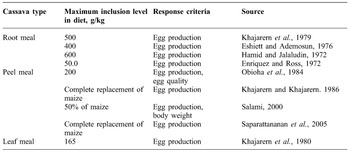
Comparatively fewer studies have been undertaken with cassava products on layer chickens (Table 4). In most of the studies, 40-60% of dietary maize has been satisfactorily replaced by cassava root meal, without adverse effects on egg production (Enriquez and Ross, Reference ENRIQUEZ and ROSS1972; Hamid and Jalaludin, Reference HAMID and JALALUDIN1972). Cassava peel meal at 100 and 200 g/kg inclusion level was comparable to a maize diet in terms of egg production, egg weight and feed conversion ratio in layer chickens but 300 and 400 g/kg cassava peel meal inclusion gave inferior performance compared to maize (Obioha, 1984). Khajarern and Khajarern (Reference KHAJARERN and KHAJARERN1986) reported that cassava could be used as an energy source in layer diets at both pullet and laying stages with comparable production performances as those of maize. Hen-day egg production was decreased by cassava meal, whereas egg weight, feed intake, shell thickness, Haugh unit and feed efficiency were not affected (Aina and Fanimo, Reference AINA and FANIMO1997). On feeding graded levels of cassava peel meal up to 200 g/kg, the highest live weight gain and feed consumption were recorded in the layer strain male chicks fed 50 g/kg cassava peel meal. Inclusion of cassava peel meal did not affect blood composition and dressing percentage (Elanchezhian et al., Reference ELANCHEZHIAN, RAVI and PURUSHOTHAMAN1999). Parboiled cassava peel meal at 50% replacement of maize in layer diets resulted in optimum production with good economic returns (Salami, Reference SALAMI2000). Saparattananan et al. (Reference SAPARATTANANAN, KANTO, JUTTUPORNPONG and ENGKAGUL2005) observed that diets with maize or cassava had similar effects on laying rate and egg quality, but egg yolk colour score was lower in layers on the cassava diet. Idowu et al. (Reference IDOWU, ODUWEFO and ERUVBETINE2005) reported that the replacement of wheat up to 10% by cassava could reduce the cholesterol content of the plasma and egg. More studies on layers would be ideal, as results do not have a bearing on egg yield only but egg quality may be altered, and this has a strong repercussions for consumer acceptability.
Suggested maximum inclusion levels of cassava products in the diet of layer chickens.

dietary cassava and gut health
The interaction between cassava factors and intestinal function is one area that has not been adequately researched. Promthong et al. (Reference PROMTHONG, KANTO, TIRAWATTANAWANICH, TONGYAI, ISARIYODOM, MARKVICHITR and ENGKAGUL2005) demonstrated that feeding broilers on cassava chips and pellet diets reduced the counts of E. coli population in the jejunum, ileum and caecum compared to counts in birds on a maize diet. Broilers fed on cassava diets exhibited better health status and required less or no antibiotic treatment compared to birds fed on maize diets (Saentaweesuk et al., Reference SAENTAWEESUK, KANTO, JUTTUPORNPONG and HARINSUT2000; Tathawan et al., Reference TATHAWAN, MOONCHAISUK, TANASRISUTARAT, KANTO and JUTTAPORNPONG2002). Stevenson and Jackson (Reference STEVENSON and JACKSON1983) reported that the inclusion of dried cassava root meal increased the proportion of acetic acid in the caeca, which may be at the expense of propionic and valeric acids. In a study on broiler chickens raised on diets containing cassava chips and pellets, Promthong et al. (Reference PROMTHONG, KANTO, TIRAWATTANAWANICH, TONGYAI, ISARIYODOM, MARKVICHITR and ENGKAGUL2006) observed an increase in villus surface area and the number of absorptive cells in the jejunum, more rapid cell proliferation and higher numbers of goblet cells than those on control diets. The inclusion of cassava at 150 g/kg in diets for layers had no adverse effect on gut morphology and the weight of lungs and gizzard was higher than those fed on maize diets (Aderemi et al., Reference ADEREMI, LAWAL, ALABI, LADOKUN and ADEYEMO2006).
Conclusions
A lot of research has been conducted on cassava products for feeding poultry, however, as with other alternative feed resources, these products have not been fully exploited for commercial poultry feeding. This may be partly due to the scattered nature of such research, and this review attempts to bring some of the research together in one place, to aid in the comparison of different results. There is no doubt that cassava and other roots and tubers will play a stronger role in the near future as grain prices soar. Contemporary research should aim at improving the nutritive value of cassava products, similar to what has been achieved with temperate cereals that contain high levels of non-starch polysaccharides.