Early reports of the use of 24-hour ambulatory blood pressure monitoring in paediatrics were published nearly two decades ago.Reference Hornsby, Mongan, Taylor and Treiber1 Over the years, it is widely accepted that there are several benefits of ambulatory blood pressure monitoring over clinic blood pressure measurements. These include the ability to perform multiple measurements in the patient's own environment and thus to obtain a better representation of the blood pressure. Ambulatory monitoring also allows assessment of the circadian rhythm of blood pressure. Ambulatory as opposed to clinic blood pressure measurements have been shown in both adults and children to be more positively correlated with end organ damageReference Sorof, Cardwell, Franco and Portman2–Reference White, Dey and Schulman4, and in adults to be a better predictor of future cardiovascular and cerebrovascular events.Reference Dolan, Stanton and Thijs5–Reference Clement, De Buyzere and De Bacquer7
Normative data sets are available for ambulatory blood pressure monitoring in children and most authorities use the normative values from a multi-centre European study.Reference Soergel, Kirschstein and Busch8, Reference Wuhl, Witte and Soergel9 The routine use of ambulatory blood pressure monitoring in paediatric clinical practice, however, remains limited. The lack of widespread clinical utilisation of ambulatory blood pressure monitoring in paediatrics is at least partly related to a lack of understanding of blood pressure data elements during a 24-hour study and scarcity of data about its reliability, tolerability, and reproducibility.Reference Graves and Althaf10
Physical activity is shown to be an important factor influencing the success of measurements during ambulatory monitoring.Reference Jacoby, Fixler and Torres11–Reference Portman and Yetman13 Children during a 24-hour ambulatory blood pressure study are typically advised unrestricted physical activity during the day. At night, it is feasible that blood pressure measurements may cause sleep disturbance and thereby adversely affect the quality and accuracy of monitoring. This is shown to be a significant issue in adults.Reference Verdecchia, Angeli, Borgioni, Gattobigio and Reboldi14 Frequency of measurements during ambulatory monitoring is another factor that could influence the patient's tolerance of the study. Less frequent measurements might improve patient tolerance, but could lead to an inadequate number of blood pressure measurements on which to base meaningful clinical decisions.
Improved knowledge of these factors and their influence on the success of measurement during ambulatory monitoring is essential as this may improve wider acceptance of this technique in clinical practice. There are few data describing these and other factors that influence the quality of a 24-hour ambulatory blood pressure profile in healthy children.Reference Jacoby, Fixler and Torres11–Reference Portman and Yetman13, Reference Lurbe, Cremades, Rodriguez, Torro, Alvarez and Redon15
This study aims to describe the blood pressure characteristics during a 24-hour ambulatory blood pressure profile in children with renal disease and to analyse the factors that influence its success over 24 hours, and during patient-recorded awake (DAY) and sleep (NIGHT) periods.
Patients and methods
This is a single-centre study that includes all 24-hour ambulatory blood pressure studies performed consecutively over a 30-month period. All data were collected prospectively. All studies were conducted using either Spacelabs 90207, or Spacelabs 90217 oscillometric devices (Spacelabs Inc., Redmond, Wash, United States of America).
All studies performed for clinical reasons during the study period were considered for inclusion in the analysis. The decision to perform ambulatory blood pressure monitoring was made by the clinician managing the patient on clinical grounds. The included patients were analysed together and in two sub-groups: normal renal function group: paediatric patients with renal disease but normal renal function; abnormal renal function group: patients with chronic kidney disease defined as estimated glomerular function rate less than 70 millilitres per minute per 1.73 square metre for at least 6 months. This was calculated using the Schwartz formula.Reference Schwartz, Haycock, Edelmann and Spitzer16 The following ambulatory studies were excluded: studies performed on patients on haemodialysis, as these are performed over 48–72 hours continuously during the inter-dialytic period at our institution; if there were more than 2 hours of interrupted recordings at any time during the 24-hour period; or if the duration of ambulatory recording was inadequate. These were classified in two further sub-groups: “short duration”, if the duration of ambulatory monitoring was less than 20 hours continuously or did not include nighttime measurements and “failure to tolerate”, if the duration of ambulatory monitoring was in total less than 12 hours of measurements.
Two different frequencies of blood pressure measurements were performed. Less frequent measurement group: Once every 30 minutes from 7 am to 11 pm and hourly from 11 pm to 7 am. More frequent measurement group: Measurements once every 20 minutes during the daytime from 7 am to 11 pm and hourly from 11 pm to 7 am. At the start of the study, all patients had their cuff fitted in hospital by an experienced member of the team. The monitor was switched on and blood pressure measurement performed for the first time observed. Questions by the patient/family regarding the study and expected events over the period of monitoring were answered. Written information about the same was provided to all patients.
Ambulatory blood pressure study data were downloaded using the manufacturer's software “Spacelabs report manager system”. All ambulatory recordings were analysed and reported by a single investigator (author M.D.S.). The daytime and nighttime periods during each study were defined by the information provided by the patient-held “diary card”. If this was not completed or was unclear, this was verbally confirmed with the patient/family. To assess the degree of blood pressure control, all ambulatory blood pressure parameters were analysed as “indexed blood pressure measurements” derived by “indexed blood pressure = measured blood pressure value/95th percentile for ambulatory blood pressure monitoring”. Blood pressure load was measured as the percentage of readings that were above the 95th percentile for ambulatory blood pressure monitoring.
Automatic error settings were used so that if the monitor was unable to perform a recording, an automatic re-attempt was performed 5 minutes later. We used the following automatic editing of readings: if systolic blood pressure was greater than 240 or less than 20 millimetres of mercury, diastolic blood pressure was greater than 150 or less than 20 millimetres of mercury, mean arterial pressure was greater than 200 or less than 20 millimetres of mercury, pulse pressure was greater than 150 or less than 16 millimetres of mercury and pulse rate was greater than 200 or less than 20 beats per minute. Ambulatory blood pressure monitoring instruments were serviced regularly and checked annually for accuracy of blood pressure measurements against mercury sphygmomanometer instruments.
To assess the characteristics during each ambulatory study, the following were measured: total number of hours of monitoring from the first measurement to the last measurement; total number of attempted measurements as all the measurements recorded, including both successful and unsuccessful measurements during monitoring; successful measurements following first attempt (S-initial) as the total number of measurements that the monitor automatically estimated successfully without editing; unsuccessful measurements at first attempt as the numbers that were automatically rejected by the monitor and assigned error codes “EE” and “AE”; number of repeat attempted measurements; overall successful measurements (S-final) as the total number of measurements that the monitor estimated successfully following an automatic repeat measurement if an initial attempt had failed; unsuccessful measurements following repeat attempt. To assess the quality of each ambulatory blood pressure study, the following parameters were calculated in the manner previously described by Lurbe et alReference Lurbe, Cremades, Rodriguez, Torro, Alvarez and Redon15: percentage of successful measurements following first attempts (S-initial%), as 100 times the ratio (S-initial/T) between successful measurements following the first attempt (S-initial) and total number of measurement (T) attempts; percentage of successful measurements after second attempt (S-final%) as 100 times the ratio (S-final/T) between overall successful measurements (S-final) and total number of measurement (T) attempts. All parameters were measured for the entire duration of ambulatory monitoring, for patient-reported awake and sleep periods and also for patient groups who had less and more frequent measurements during the daytime.
Statistical analysis
The mean, median, and standard deviation were calculated. Groups were compared for differences using the two-tailed unpaired t-test method (Mann–Whitney) for two group comparisons with the Bonferroni correction for multiple comparisons. Differences were considered significant when p was less than 0.05. Simple linear regression was used to assess association. Stepwise multiple linear regression analysis was calculated with successful measurements over the 24-hour, DAY, and NIGHT periods as the dependent variable.
Results
A total of 169 ambulatory blood pressure studies were conducted in 154 patients during the study period. Of these, 24 studies in 24 patients (16 males) were excluded (13 in patients with normal renal function) for the following reasons: 18 studies as they had interruptions for continuous periods greater than 2 hours duration, two studies for short duration of monitoring and four studies as they were not tolerated by patients. Their median (range) age was 15.2 years (8.0–18.3), height was 155.5 centimetres (118.7–186), and body mass index was 21.2 kilograms (15.7–31.6).
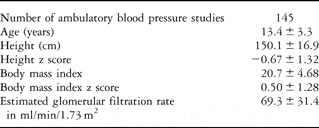
In all, 145 ambulatory studies performed in 130 (68 females) patients were included in the final study analysis: 111 studies in the less frequent measurement group (41 in patients with normal renal function) and 34 studies in the more frequent measurement group (16 in patients with normal renal function). Of the 145 studies, 82 (56.6%) were conducted while the patient was on anti-hypertensive medications. Patient demographics are shown in Table 1. There was no significant difference for any demographic characteristics when studies with less or more frequent measurements were analysed. Patient groups with normal and abnormal kidney function also did not demonstrate any significant differences. Data are therefore shown together for all 145 patients.
Patient demographics shown as mean ± SD.

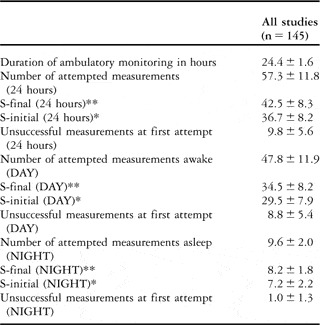
Table 2 shows the results of attempted measurements during an average ambulatory blood pressure monitoring study over the 24-hour, DAY, and NIGHT periods. The proportion of measurements both successful and unsuccessful during the 24-hour and DAY periods between the two measured frequencies was comparable and not statistically different.
Results of attempted measurements during an average ambulatory blood pressure monitoring study over the 24-hour, awake (DAY), and asleep (NIGHT) periods.

Figures shown are as mean ± SD
*S-initial = successful measurements following first attempt; **S-final = number of measurements that the monitor estimated successfully following an automatic repeat measurement if an initial attempt had failed
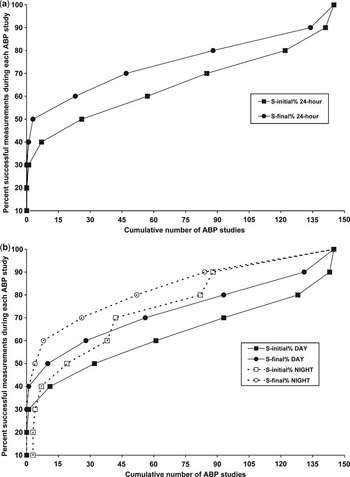
In the cohort of 145 ambulatory blood pressure studies, 68% were of good quality, defined as at least 70% successful blood pressure measurements during each study. Figure 1 shows the percentage of successful blood pressure measurements in each ambulatory blood pressure study over the 24-hour, DAY, and NIGHT periods. There is an increase in the percentage of successful measurements in each ambulatory study following a second attempt (S-final% 24-hour, DAY, and NIGHT). The proportion of successful blood pressure measurements attempted both initially (S-initial% NIGHT) and finally when the patient was asleep (S-final% NIGHT) was significantly greater than that of successful measurements obtained initially (S-initial% DAY; p = 0.02) and finally (S-final% DAY; p = 0.03) when awake.
(a) Percentage of successful blood pressure measurements in each ambulatory blood pressure monitoring study (n = 145) over the 24-hour period (b) percentage of successful blood pressure measurements in each ambulatory blood pressure monitoring study (n = 145) over the DAY and NIGHT periods. S-initial: successful measurements following first attempt; S-final: number of measurements that the monitor estimated successfully following an automatic repeat measurement if an initial attempt had failed.

Analysis of blood pressure measurements that were assigned “EE” error codes showed that three-tenths or more of the ambulatory studies had EE codes 10, 11, 18, 70, and 90. All “EE” error codes except “EE” error code 11 were primarily as a result of patient movement at the time of the measurement. Code 11 denotes failure to pump above mean arterial pressure. Other “EE” error codes that were recorded in at least a tenth of the ambulatory studies were often secondary to patient movement (“EE” error codes 20, 40, 48, 50, 58, 78, and 80) but also included some other causes including error codes 3 (attempt aborted by patient), 38 (pulse pressure less than 16 millimetres of mercury), 42 (no cuff attached), 52, and 72 (kinked tube). Failed attempts during the daytime were predominantly movement errors. Re-attempts following an initial unsuccessful blood pressure measurement were more likely to be successful at nighttime.
Overall, on simple regression analysis, significant association was found between several ambulatory blood pressure monitoring criteria including indexed mean arterial pressure, indexed average systolic blood pressure and indexed average diastolic blood pressure (24-hour, DAY, and blood pressure load) and the proportion of successful measurements during the 24-hour (“S-final% 24-hour”) and DAY (“S-final% DAY”) periods but not during the NIGHT (“S-final% NIGHT”) period. There was no significant association between age (years), gender, height, weight, body mass index, and renal function on any of these (“S-final% 24-hour”, “S-final% DAY”, and “S-final% NIGHT”). Stepwise multiple regression analysis identified indexed mean systolic blood pressure over 24 hours as the only factor having a significant influence over final success at measurements (“S-final%”) during the 24-hour and DAY periods. A standard deviation score change of +1.0 in indexed mean 24-hour systolic blood pressure will result in a +0.3 standard deviation score change in the proportion of successful measurements during the 24-hour (“S-final% 24-hour”) and DAY (“S-final% DAY”) periods. Additional factors added no more value in improving the overall success in measurements during the 24-hour and DAY periods.
Discussion
This study presents data from a typical paediatric age range and confirms that ambulatory blood pressure monitoring is feasible in children, with 68% of the cohort producing an ambulatory recording of good quality, defined as having 70% or more of successful blood pressure measurements.
The higher rate of successful blood pressure measurements as reported by Lurbe et al previously could be partially explained by the increased frequency of measurements: every 20 minutes from 6 am to midnight and every 30 minutes from midnight to 6 am.Reference Lurbe, Cremades, Rodriguez, Torro, Alvarez and Redon15
The proportion of successful measurements overall (S-final%) during ambulatory blood pressure monitoring was significantly better than the proportion of successful measurements following an initial attempt (S-initial%). This improved success rate of measurements is primarily because of the monitor's ability to repeat a blood pressure measurement if the initial attempt is unsuccessful. This observation was previously reported for the 24-hour duration of ambulatory monitoring.Reference Lurbe, Cremades, Rodriguez, Torro, Alvarez and Redon15 We observed that although this remains true for both patient reported awake and sleep periods, there are some interesting differences. As shown in Figure 1, the number of studies with an increased proportion of successful blood pressure measurements improves from the initial to the final attempted measurement. Overall, the blood pressure measurements performed at night in children were more successful than the measurements attempted during the day.
These observations provide insight into the likely sequence of events during ambulatory monitoring. In a child who is allowed unrestricted physical activity during ambulatory monitoring, when a measurement is attempted (S-initial) during the DAY, it has a higher chance of being unsuccessful. This is primarily because of movement-related errors in measurement as revealed by the predominance of movement-related “EE” error codes in our data. A second attempt at measuring blood pressure 5 minutes following an initial failed measurement is therefore more likely to capture the child's attention and co-operation. As a consequence, there is a significantly higher success rate on second attempts at measurement of blood pressure. This sequence of events is unlikely to be at work at NIGHT when the child is sleeping. An additional reason for the higher success of second measurement may be because the monitor tends to pump up to higher pressures than previously and thus be a disincentive to continued movement. We did not collect any specific information regarding this.
In agreement with previous reports in children, we found that patient activityReference Jacoby, Fixler and Torres11–Reference Portman and Yetman13 (indirectly assessed by error codes in our study) and increased 24-hour mean systolic blood pressureReference Lurbe, Cremades, Rodriguez, Torro, Alvarez and Redon15 influenced the success of measurements over a 24-hour period. In addition, we also observed a positive correlation of indexed mean arterial pressure, and indexed mean systolic and diastolic blood pressure both during the DAY and at NIGHT with improved success of measurements over the 24-hour period. As opposed to previous reports, we did not observe an effect of patient age on the success rate of measurements over a 24-hour period.Reference Lurbe, Cremades, Rodriguez, Torro, Alvarez and Redon15 This may be due to the relatively narrow age range of 8- to 18-year-olds in our study, as opposed to a previous report that included younger children between 3–8 years of age. We did not observe any positive correlation of increased success in measurements over a 24-hour period with height, body size,Reference Lurbe, Alvarez and Liao17 or gender. The success of measurements when the patient was awake was positively influenced by similar blood pressure criteria except indexed mean 24-hour diastolic blood pressure. None of the factors studied showed any positive correlation on success of measurements when the patient was asleep. An obvious cause for lack of association of success during ambulatory monitoring with body mass index may be the relatively small sample size.Reference Fravel, Ernst, Weber, Dawson, Carter and Bergus18 Patients with renal dysfunction are reported to have sleep disturbances and therefore have at least a theoretical chance of having unsuccessful ambulatory monitoring at NIGHT.Reference Davis, Baron, O'Riordan and Rosen19, Reference Applebee, Guillot, Schuman, Teddy and Attarian20 We found no significant association of mild renal dysfunction on success during ambulatory monitoring.
Stepwise multiple regression analysis identified indexed mean systolic blood pressure over 24 hours as the only factor having a significant influence over final success at measurements (S-final%) during the 24-hour and DAY periods. Even then, it only accounted for 30% of the variance, suggesting that other factors not studied here have a more important effect. Anecdotally, we have often observed that acceptance and tolerability of an ambulatory study by the child exceeded our expectations when the monitoring process was explained in detail to the child and their family. This has also been evident to us from improved study quality on subsequent studies following an initially failed ambulatory study. It is likely that an understanding of the process and acceptance of the study by the child are likely to play a major role in its success.
We recognise that there are limitations to the conclusions from this study. The results in this study do not add to the understanding of the tolerance of ambulatory monitoring in children. There is also no information regarding sleep disturbance in children as a result of an ambulatory study. Feedback through a patient-held “diary card” was not provided by all patients and its absence was presumed to suggest that the study was well tolerated. This process is likely to underreport tolerability of the process. A structured questionnaire about tolerability both during the day and at night would have perhaps provided more reliable and helpful information. Further, our study does not provide evidence for the optimum frequency of measurements during ambulatory monitoring in children. The increased frequency of attempted blood pressure measurements improves the overall number of successful measurements. This does not necessarily mean that the probable improved accuracy of the measured blood pressure is clinically more useful. Therefore, the increased frequency of measurements must be always balanced against patient tolerability.
Despite these limitations, from the patient's perspective, this study provides some answers to questions they often voice: “How often will blood pressure measurements be attempted during the period of monitoring?” and “What happens during a 24-hour ambulatory blood pressure monitoring study?”
In conclusion, this study presents new data in an unselected series of children confirming higher success of measurements during ambulatory monitoring at NIGHT as opposed to DAY periods. Furthermore, it adds to the little evidence in children describing the blood pressure characteristics during an ambulatory blood pressure monitoring study and factors that may influence its success.
Acknowledgement
The author M.D.S. acknowledges financial support from the Department of Health through the National Institute for Health Research (NIHR) comprehensive Biomedical Research Centre award to Guy's and St Thomas’ NHS Foundation Trust in partnership with King's College London and King's College Hospital NHS Foundation Trust. Disclaimers: None.