Introduction
This paper explores findings relevant to Child and Adolescent Mental Health Services (CAMHS) and clinical practice more generally. The aim of this stakeholder voice study was to explore stress and coping with parents and Children and Young People (C/YP) affected by attention-deficit hyperactivity disorder (ADHD) in an Irish context, in order to contribute to knowledge about what works and what needs to change in practice from a service user perspective. We begin with a brief review of ADHD and CAMHS in Ireland and international research into stakeholders’ experiences in their pathways through care.
ADHD and stakeholders’ voice
Early intervention is often correlated with more positive outcomes for C/YP with ADHD (Young et al. Reference Stake2013). In Ireland, diagnosis and treatment are provided by CAMHS, which is reportedly under-resourced and inconsistent, resulting in long waiting lists (Kilkelly, Reference Kilkelly2007; Health Service Executive, 2014), these issues may exist across Europe for ADHD (Clark et al. Reference Clark, Carr-Fanning and Norris2011).
Involving stakeholders in the planning and delivery of mental health services is supported by a range of national and international policy and legislation. A children’s voice/participation framework is supported by international (United Nations Convention on the Rights of the Child, Reference Vaughn and Fuchs1989) and national (Government of Ireland, 2000; Department for Children and Youth Affairs, 2015) policy, as well as Irish legislation (Government of Ireland, 2012). Accordingly, C/YP should be consulted and involved in decision-making on matters affecting them. Parents are stakeholders within ADHD services, sometimes adopting advocacy/mediator roles (Buckley et al. Reference Buckley, Devitt, Gavin, Guerin and Noctor2012) and their perceptions may predict service access (Sayal et al. Reference Sayal, Ford and Goodman2010). Stakeholder’s voice is associated with other benefits, such as consumerism and service evaluation/development (Melvin, Reference Melvin2003; Kildea et al. Reference Kildea, Wright and Davies2011). According to policies, such as Ireland’s A Vision for Change (Government of Ireland, 2006) and prior research (Buckley et al. Reference Buckley, Devitt, Gavin, Guerin and Noctor2012), service users should be involved at every level of service development. However, specific populations are likely to have different experiences, given that they receive specialised services and have different needs, and so exploring the voices of service users is useful.
A range of personal and socio-cultural factors represent barriers and facilitators to accessing ADHD services (Wright et al. Reference Young, Fitzgerald and Postma2015). There is limited qualitative research into stakeholders’ experiences internationally [National Institute for Health and Clinical Excellence (NICE), 2008]. Existing research explored stakeholder’s experiences of stimulant medication (Singh, Reference Singh2007, Reference Singh2012, 2013 Reference Singha , 2013 Reference Singhb ), diagnosis, and treatment (Kildea et al. Reference Kildea, Wright and Davies2011). In Ireland, parents reportedly struggled to come to terms with diagnosis (McIntyre, Reference McIntyre2012), whereas, UK parents welcomed a diagnosis, which provided a sense of control, lessened guilt, and provided access to help (Klasen, Reference Klasen2000). Bringewatt’s (Reference Bringewatt2011) retrospective interviews with young adults found that children may experience both stigma and empowerment as a result of diagnoses. Studies have also considered bio-ethical questions, such as parental decision-making, fears about labelling, and/or the consequences of medication on children’s sense-of-self and moral decision-making (Singh, Reference Singh2004, Reference Singh2005, Reference Singh2007, Reference Singh2012; Travell & Visser, 2006). Singh (Reference Singh2012) explored the voices of 151 families (parents and children) in the United States and the United Kingdom. Their findings suggest fears around medication’s impact on child development may be unfounded, but parents may struggle with the decision. Conversely, Leggett & Hotham (Reference Leggett and Hotham2011) found parents may be more positive about medication when compared with adolescents.
Among the factors identified as contributing to stakeholders’ willingness to engage with ADHD services include adults’ perspectives, such as knowledge of treatment and its availability (Bussing et al. Reference Bussing, Zima, Mason, Porter and Garvan2011), and stigma (Wright et al. Reference Young, Fitzgerald and Postma2015). Similarly, in Ireland, Buckley et al. (Reference Buckley, Devitt, Gavin, Guerin and Noctor2012) identified stigma as a barrier to accessing mental health services. Feelings of being ‘out of control’ reported by C/YP with ADHD (Gallichan & Curle, Reference Gallichan and Curle2008) may be linked with experiences within services (Buckley et al. Reference Buckley, Devitt, Gavin, Guerin and Noctor2012). Once engaged in services, professionals’ failure to include service users in the decision-making process was identified as a barrier in the United Kingdom and the United States (Singh, Reference Singh2012).
To date, stakeholder’s experiences have not been explored in Ireland. However, studies suggest that culture plays a role within access to care for ADHD (Gidwani et al. Reference Gidwani, Opitz and Perrin2006), and so consider Irish experiences can provide valuable insights. However, participatory research, especially exploring the voices of C/YP with ADHD, is challenging because research methods can obscure children’s voice (Carr-Fanning & Mc Guckin, Reference Carr-Fanning and Mc Guckin2017). To avoid being prescriptive, this study adopted Lazarus’ (Reference Lazarus1999) theory of stress and coping as a more patient-led framework, which states that stress arises when one appraises events as personally significant and beyond coping resources. So, stress is inherently subjective. A second model was added to explore the socio-environmental context and the need for ADHD to be understood within a bio-psychosocial approach (Hughes, Reference Hughes2007). Bronfenbrenner’s (Reference Bronfenbrenner2005) bio-ecological Model views C/YP as located within the micro-system (e.g. home and school), but influenced by forces at increasingly more complex systems, such as the macro-system (wider socio-cultural context) and chrono-system (socio-historical and life history).
Methods
This multi-case study (Stake, Reference Timimi and Taylor2006) explored stakeholders’ experiences of ADHD services.
Research sample
The target sample included C/YP (7–18 years) diagnosed with ADHD in the Republic of Ireland. To produce a homogenous sample, placement in special school was an exclusion criterion. Due to prevalence (Cuffe et al. Reference Cuffe, Visser, Holbrook, Danielson, Geryk, Wolraich and McKeown2015) and their inclusion in prior research (McIntyre, Reference McIntyre2012), C/YP with co-morbid diagnoses were included.
Purposive sampling was used because it provides insights into service users’ (parent and C/YP with ADHD) experience by selecting ‘information-rich’ cases (Devers & Frankel, Reference Devers and Frankel2000). In total, 32 participants (C/YP and parent), which formed a case study (n=15), were recruited through several sources: ADHD support groups, ADHD parent training course, and online (e.g. websites and social media). Thus, participants were self-selecting and voluntary (Coolican, Reference Coolican2004).
Participants included nine males and six females, aged from 7 to 17 years (mean=12.8; s.d.=3.09) and 17 parents (including two fathers). C/YP were from a range of socio-economic backgrounds and were living in both rural and urban communities in the country. A demographic survey collected information about the diagnosis from parents, which asked whether they had received a diagnosis from a psychologist or psychiatrist, the age of diagnosis, sub-type of ADHD, and any co-morbid diagnoses. It also collected information about age, gender, academic stage, diagnosis, and living situation. The survey collected information about ADHD sub-type, socio-economic status, co-morbid diagnoses, and parental or sibling diagnoses, which have been associated with greater dysfunction/distress. Information about the parents’ education was collected as an indicator of socio-economic status. Based on parental reports, participants had been diagnosed with a range of ADHD subtypes (DSM-IV): one predominantly hyperactive–impulsive, six predominantly inattentive, and eight combined. In total, 12 participating C/YP had at least one co-morbid diagnosis: dyspraxia (n=4), oppositional defiant disorder (n=4), asperger’s syndrome (n=2), depression (n=2), dyslexia (n=1), dyscalculia (n=1), and cerebral palsy (n=1). All case studies contained one (or more) parent.
Materials and procedure
Parents, as gatekeepers, made contact and were sent two age-appropriate information packs. Consent was sought in writing from parents and verbally from C/YP. Participants were assured anonymity within the limits of confidentiality (discussed with participants) as per Children First Act (Government of Ireland, 1999) and child protection guidelines.
With a parent present in another room, the majority of C/YP (n=10) chose to be interviewed at home and five chose the researchers’ host university. Parent interviews occurred after C/YPs’ interviews. All participants took part in an individual semi-structured interview, which provides detailed descriptions about lived experiences, sensitively, due to the nature of the topic and participants’ marginalised status. Parent interviews explored their own personal experiences of problems/solution and their perceptions of their son/daughter’s experiences. Interviews with C/YP focussed only on their personal experiences.
The study of stress and coping (Lazarus, Reference Lazarus1999) and child-centred research (Prosser & Burke, Reference Prosser and Burke2008) should be non-prescriptive and participant-led. Thus, interviews adopted a more conversational style (Kvale, Reference Kvale1996) and no presuppositions were formed about the experience of stress, save that everyone experiences stress (Lazarus, Reference Lazarus1999). For each self-identified stress, participants were asked how they ‘dealt with’ or coped. Participants were asked to evaluate current practices and (where appropriate) make recommendations about what needed to change.
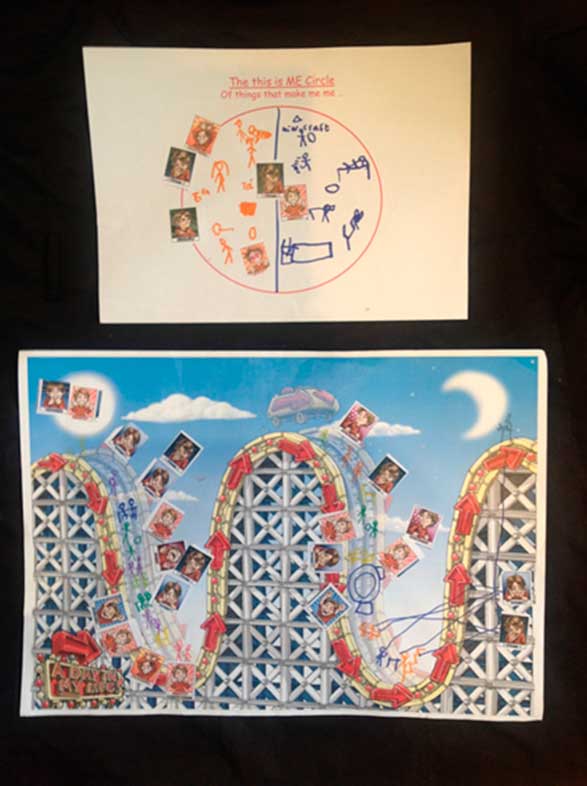
A novel methodological approach developed by the authors (Carr-Fanning & Mc Guckin, Reference Carr-Fanning and Mc Guckin2017) was utilised. Consultation with C/YP began with ‘icebreakers’. Once the participant appeared relaxed, the draw–label–dialogue task (see Fig. 1 for a completed version) was introduced. First, participants’ created a timeline of a typical day in their lives (rollercoaster task). Second, participants constructed a pie chart representing their self-concept (circle task). Third, the emoticon-labelling task was introduced. Participants were shown an A3 page with 16 emotion faces (positive and negative emoticons). Two gender-specific sets of emoticons were developed for research purposes. Next, pre-made emoticon-labels (stickers) were provided, and participants attached one or more of the emoticon label(s) to each item on the previous two tasks.
Draw–label–dialogue completed (male version).

Combined, these tasks explored the whole child (circle task) in the context of everyday activities (rollercoaster task), and the relationship between the two (i.e. positive/negative person–environment relationships: emoticon-labelling task). All tasks were followed-up with dialogue. The C/YP self-identified the important situations and relationships, which were explored further including (current or potential) solutions. The triangulation afforded by the mixed-method (visual and verbal data) multi-voice (parent and child) approach adopted recognised and accommodated multiple subjectivities and situational contexts.
Additional triangulation was achieved using a demographic survey, which was completed by parents while the researcher interviewed the C/YP.
All data were stored securely and anonymously under password protected software or locked filing cabinet, with consent forms kept separately (Government of Ireland, 2003).
Data analysis
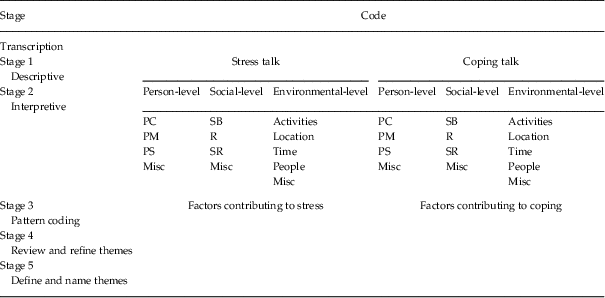
All interviews (range 59–86 minutes) were recorded, transcribed, and then coded using the principles of Thematic Analysis (TA; Braun & Clarke, Reference Braun and Clarke2006). TA was selected due to the flexibility provided by the approach and the complexities involved in multi-case research (Stake, Reference Timimi and Taylor2006). A staged approach to data analysis was adopted (see Table 1). Initially, broad themes of stress (stress talk) and coping (coping talk) were identified. Prior to data collection, in line with Miles & Huberman’s (Reference Miles and Huberman1994) guidelines, a codebook was developed informed by stress and coping theory (Lazarus, Reference Lazarus1999) and the bio-ecological model (Bronfenbrenner, Reference Bronfenbrenner2005). During the second stage, codes were attached to variables identified as being at personal, social, and/or environmental levels. Another level of analysis coded variables within each level for a more refined focus. Next, these codes were reviewed and patterns identified and explored, and the relationships between them informed the themes, which were then reviewed, and subsequently refined and named.
Coding structure and analytic stages

PC, Personal characteristics; PM, personal meaning; PS, personal significance; SB, shared beliefs; R, relationships; SR, status and role.
Results
In all 15 case studies, participants identified experiences within their pathways through care, which were stressful or contributed to coping. This section presents findings from this sub-set of data, beginning with the referral and diagnostic process, before considering stakeholder’s experiences of treatment and ongoing services.
Understanding the journey to and through diagnosis
Participants’ experiences of referral and diagnosis, which includes the challenges they had to overcome and a sense of empowerment that followed, are explored here.
‘Looking back now the poor child she’d no one looking after her’
Parents reported that their child’s problems were often apparent from an early age. However, only one was diagnosed at this stage. The more commonly reported experience was that their child’s teachers identified problems during the first few years of school, but either did not suggest, or advised against, getting a formal assessment/diagnosis. Parents reported that challenging behaviours were attributed to parenting (e.g. lack of discipline) and/or their child’s lack of effort (e.g. ‘lazy’), or wilful disobedience (e.g. ‘bold brat’):
… the first time there would ever have been a question mark about behaviour … he started school … But she never ever said to me like about going to a psychologist or getting an assessment … So I really never knew what to do with him. I just thought he was being bold. And he was killed for being bold … He was five and then I went to my doctor … [and] he was going ‘maybe you need to be more strict’ … (mother, son 10 years).
Young People (YP) who had not been diagnosed until adolescence described the frustration and repeated experiences of failure and distress prior to receiving a diagnosis, which was often a source of anger and resentment:
… this is what happened [my doctor] said I had it when I was six and then we went to another person … and she was like no no she’s just emotionally has an emotional disorder. I duno what that means … and then when I got into secondary school coz I didn’t know anything … they were like … ‘what is going on?’ My Mam was like, ‘I knew that but the schools just said that she was just lazy’ … So then I got assessed by this lady for Dyscalculia nothing to do with ADHD and she was like ‘she has ADHD’ … (female 16 years).
Parents described how delayed diagnosis resulted in significant consequences and secondary problems, which led to the diagnosis. For example, a mother described her daughter’s (17 years) overdose at the age of 13 years as a cry for help:
… looking back now the poor child she’d no one looking after her … it was always HER she was the problem so she was constantly being told she was no good … that was a symptom of it all the ADHD … it was a cry for help …
This was a source of frustration for parents, as one mother of a 14-year-old female said, ‘… it should never have got to THIS stage … she’s just so at-risk …’. A female (16 years) explained that she received her diagnosis, because ‘… I was gone a bit mad …’
Parents said that the most significant school-based barrier to diagnosis was teachers’ fear of ‘labelling’:
… they [the teachers] had filled out the Connor’s rating scale so that she wouldn’t be hyper … they said, ‘we sat down and made sure we didn’t mark her down on anything that made her look like she was hyperactive’. And I said ‘why did you do that?’ and they said, ‘you don’t want your child labelled’ … (mother, daughter 14 years).
Support for this was found among the YP’s experiences, who thought that teachers did not believe in the validity of ADHD:
… some of the teachers I think they’re like ADHD doesn’t really exist they’re just like you’re just being bold looking for attention it’s not really anything. I’m annoyed by that coz it’s not true (female 17 years).
Parents very frequently said that barriers to diagnosis occurred at clinical levels; including long waiting lists and a lack of co-ordination between services, which could result in misdiagnosis or conflicting diagnosis:
… it took am two years of linking in with the services the HSE and with CAMHS who are an absolute disaster … I was told with CAMHS would deal with the ADHD and CAMHS had a waiting list of two years … [when] we got an appointment with CAMHS … [the psychiatrist] went on to tell me that he believed that there was an attachment disorder and … it wasn’t ADHD … So then we were moved from CAMHS back into the children’s services to meet psychologists … (mother, son 10 years).
As a result, this mother disengaged from public services and received a diagnosis privately. With one exception, these service-level issues were not raised by the C/YP.
‘Labels are like signposts’
Almost unanimously, parents were adamant that diagnosis was essential. They identified benefits in understanding ADHD in term of helping to support their child and becoming self-empowered. As one parent explained:
… It’s just like signposts … labels are like signposts … Life is like a map and these are just the signposts about who you are and where you are, should be going … If you don’t know then that’s bad … (mother, son 15 years).
In a similar manner, parents often described elation or relief when they received a diagnosis. Mothers’ typical response, and most commonly reported coping strategy was information gathering:
… I was delighted to get a diagnosis … because I couldn’t understand what was wrong with my son … I just threw myself into it tried to find out everything … the empowerment of understanding the condition … you start to see your child in a completely different light. Instead of the bold child that’s ALWAYS getting given out to that their name is ‘always’ worn out. And you are basically bashing them up … you start to see why … You start to understand …you start do things differently … (mother, son 10 years).
Parent support groups were the most commonly reported coping resources; providing (emotional and practical) information and support:
… I found that ADHD group a great help … it was the first time I’d gotten a bit of positive feedback from somebody … they were just SO nice and so honest and they were talking about their kids and I was telling them about [my son] … they were just people like me … I wasn’t making excuses. I think when you meet people who are in similar situation as yourself you don’t feel as crazy or as ‘isolated’ … I didn’t feel like the odd one with the odd kid (mother, son 13 years).
Albeit to a lesser extent, participating adolescents’ reports also suggested that they benefit from diagnosis, in terms of knowledge and understanding contributing to acceptance, as one male (14 years) said, ‘… I just want them [teachers] to understand …’. Indeed, C/YP often reported wanting to be understood and recommending disclosure to teachers and other people.
Experiences of treatment
This section explores the perceptions and experiences of treatment, in particular, beliefs around medication and the relative controllability of symptoms, along with frustration and a sense of powerlessness at a lack of alternative treatments and child- and family-centred practice.
Medication and control
This section considers findings regarding participants’ perceptions and experiences of medication and their perceived control over symptoms. Medication was the most commonly reported type of treatment for ADHD; indeed, the majority were unaware of and had not received any other type of treatment.
Parents
Parents reported positive perceptions and experiences with medication. For example, one mother (son 13 years) said ‘… it was like a puzzle falling into place … it was like great we found something that works …’. In particular, parents said medication helped with social problems, externalising behaviour, and emotional-regulation. The impact of medication on academic learning/inattentive symptoms was rarely mentioned by parents:
… with the meds he can kinda control it more … it’s been like night and day’ and … the difference in him emotional wise … I just notice a difference he’s not as fiery now … (mother, son 7 years).
Even among those who were very positive, none believed it was the whole solution, as one mother (son 7 years) stated, ‘… it’s definitely not a miracle worker …’.
Overwhelmingly, those who had opted for medication described initial aversion and conflicting emotions prior to making the decision to use drug treatment:
… There’s always concern about taking the medication that’s another thing people would say ‘oh don’t put your daughter on medication she might get addicted to it’ which is an awful concern. But then if you don’t I really think they mightn’t get an education … (mother, daughter 13 years).
A few parents did not use medication. However, they were often still conflicted about their decision, which is summed up in the words of one parent (daughter 17 years):
… I kind of felt like it wasn’t my choice. Like I felt like if she wanted to go onto medication, you know, when she was older then it was her decision … I didn’t want to change her character … [but] maybe socially it would have been better for her …
C/YP
C/YP were usually positive about medication, but less so than their parents, and some were more positive than others. For example, when one female (17 years) talked about what advice she would give to someone younger:
… take your medicine because I didn’t really take mine at all in 2nd or 3rd year … I thought I was gonna change … so it wasn’t till like 6th year and I have to take them because of the study … [but] I probably wouldn’t have gotten into as much trouble if I’d taken them back then … I’d say I would have done a lot better in school …
Participants were much more inclined to report that they needed medication in order to study. However, this was sometimes a source of frustration that they could not concentrate without medication:
… you can’t really concentrate for long periods of time or you can’t really study really hard things without medicine am you get distracted really easily … it’s really annoying at times … I only take them when I have to study … hopefully I won’t need them next year … (female 17 years).
YP’s reports were conflicting. Some attributed behavioural improvements to maturity and greater knowledge and understanding (their own and other stakeholders), and less to medication. Parents typically believed behavioural improvements were due to medication. However, parents said their son/daughter did not recognise their behaviour and/or the impact of the medication:
He doesn’t see it himself but there’s SUCH a difference with him on his medication, his behaviour, his moods, he’s a totally different person … (mother, son 13 years).
Reports of medication were not all positive. For example, one participant said she stopped taking medication because they made her feel ‘agitated’, ‘anxious’, and said, ‘… I just didn’t feel like me’ (female 17 years). Another female (17 years) believed that medication inhibited the positive sides to ADHD:
… I feel it’s makes me more quieter so I’d always be sure not to take them when I’m going out … my friends notice they say I’m less chatty and stuff …
However, this was not universal, because another participant, when discussing social difficulties described how medication helped:
… I would get on peoples’ nerves people … [but] when I’m on my medication I would feel different like I would actual feel quiet I’d feel like normal like other people … (female 16 years).
Thus, experiences and effects varied across C/YP.
Over-reliance on medication
Universally, parents reported dissatisfaction with treatment. Parents were critical about an over-reliance on medication; usually, the first and only type of treatment offered:
… I feel he’s being given the medication. But that’s all. And I feel he needs something else around that and we need something else around that. And that’s not very forthcoming. BUT … I don’t even know where to go looking for the help … I’m really really struggling … (mother, son 15 years).
Indeed, two parents said that once they decided against medication CAMHS discharged them:
… It was sorta the case that since I didn’t want her on medication so they just cut me off … (mother, female 17 years).
Parents were frustrated about the lack of psychological treatments, family services, and resources:
… the psychologist in there said he’d more than 200 kids on his books so he didn’t have the resources to give [my son] what he needed … (mother, son 13 years).
Parents were also critical of CAMHS for not providing them with enough information or community/family support. As one mother (daughter 17 years) described, ‘… CAMHS were very bad they told us nothing. They gave us no information …’:
I mean all you’re getting from CAMHS is a sheet on medication and then websites. And your head is all over the place. It wasn’t till years later that I heard about other things … I never sort of asked ‘well what are you going to do for my son’ and it might have been better if I had have … But you don’t think to ask questions. Or at least I didn’t think to. Coz I was just so bogged down with everything … (mother, son 13 years).
These issues around alternative treatments were not discussed by the C/YP, however, none of them were aware of treatments beyond medication.
Powerlessness
Parents and YP reported feeling ‘powerless’ and distressed before, during, and after appointments with CAMHS. In particular, participants did not believe psychiatrists and psychologists were working ‘with’ them, seeing them as human beings with a voice who required support, compassion, and to be heard.
Similarly, attending CAMHS was often a source of considerable distress for the YP. As one mother reported, ‘… we’d have a child who was traumatised for three days before and three days afterwards …’. Her daughter (17 years) said, ‘I hate going. I don’t really like going. Sometimes I won’t go’, which she attributed to doctors ‘lecturing ya’, ‘not listening’, and ‘thinking they know best coz their doctors’. However, she said she would often go, but only to get her medication. Several parents said their son/daughter ‘dreads’ psychologists and/or ‘refuses’ to attend appointments:
… some of them [psychologists] are only there for three months they’re not going to build a relationship with ya … it wasn’t a huge help to her coz the doctors was all horrible [and] she didn’t get what they were saying … the people who are face-to-face with the children with ADHD that they build a relationship, that they make eye contact that they’d be trained in forming a relationship. Because without a relationship there’s no communication and helping a child with ADHD is all about communication … (mother, daughter 17 years).
These problems were also reported by the YP themselves. One female (14 years) said ‘… I HATE [the psychiatrist] … I’m not going there anymore they don’t listen … it makes ya feel different going there’. The adolescents described a range of problems and frustration with psychiatrists and attending CAMHS; including not being listening to, talking to their parents instead of them, lecturing them about alcohol, constantly changing and having to re-tell their story, and forgetting their names:
… I hate going … they think they know what’s best … [just] because they’re doctors they know and they don’t really … they’re always like you should go back on the Ritalin but I’m like I’ve already tried that and it doesn’t work … and then they just put you on it for another six weeks and you go back and you say the exact same thing but they are just not listening … (female 17 years).
Ultimately, participants felt like psychiatrists and psychologists did not care and did not understand. As a result, a few YP refused to attend, or the necessity of attendance to receive a prescription kept them engaged.
Discussion
This study explored service users’ experiences. The fact that all 15 case studies identified difficulties in their pathways to and through care are itself significant.
CAMHS aims to provide ‘timely’ access to assessment/diagnosis. However, the majority of cases experienced (Vaughn & Fuchs, Reference Watson and Maître2003) ‘wait to fail’ approach, where problems emerged early, but diagnosis did not occur for years, for some until adolescence. So, stakeholders experienced distress and failure, before help was forthcoming, which was a source of anger and frustration. McIntyre (Reference McIntyre2012) found that parents were distressed to receive a diagnosis of ADHD. Conversely, this study suggests delays in diagnosis was more distressing, with parents reporting relief following diagnosis. Accordingly, removing barriers to diagnosis should be a priority.
School-based barriers to diagnosis were identified, including reports of teachers’ concerns with labelling and accepting a diagnosis. Thus, findings could suggest fears about stigma (Watson & Maître, Reference Wright, Moldavsky, Schneider, Chakrabarti, Coates, Daley, Kochhar, Mills, Sorour and Sayal2014) and/or teachers’ failure to accept ADHD as a valid diagnosis (Timimi & Taylor, Reference Travell and Visser2004). These problems may be attributed to a lack of education/training (Shevlin et al. Reference Shevlin, Kearns, Ranaghan, Twomey, Smith and Winter2009). Therefore, as NICE (2008) recommends, training around ADHD (including its identification) for teachers and others who work with children and families (e.g. GPs, social workers) is required to increase knowledge and understanding, and also decrease stigma, so as to enable timely diagnosis, but also to support treatment.
Miscommunication and misperception may be widespread, because, across different health and social services, parents and C/YP reported barriers; such as misdiagnosis, conflicting diagnosis, and also professionals’ lack of knowledge and mother-blame. Therefore, better communication and education within services may be required, along with a multi-disciplinary approach (Government of Ireland, 2006), especially communication between CAMHS and schools, which was reportedly poor.
Participants (especially parents) often reported positive experiences of medication; citing benefits with externalising behaviour, emotional-regulation, socialising, and school work. However, parents were concerned about an over-reliance on medication; which was often the first and only treatment offered. Similarly, young people were often unaware that there were other treatment options available. Accordingly, one can conclude that services may be over-reliant on medical management, to the neglect of other psychosocial treatments and community-based supports. According to best practice guidelines, medication should not be used as frontline treatment, except in very severe cases of ADHD (NICE, 2008). Furthermore, when it is used, it should only be used as part of a multi-modal treatment plan, which should include education, social support, and psychological interventions. Indeed, parents emphasised a holistic approach and the role of self-empowerment and gaining access to resources (especially information gathering, self-education, and support groups) in the management of ADHD.
Parents’ reports highlighted the challenges involved in deciding to use medical management, and the associated tensions within themselves and with others (e.g. teachers, family). The C/YP’s perceptions and experiences of medication often did not reflect the reports of their parents. Stakeholders may not understand the effects of medication on inattention and/or hyperactivity-impulsivity, possibly related to perceptions of control. Thus, education about ADHD and medication may contribute to its acceptance and use. C/YP’s reports about the effects of medication varied, and so when used they should be discussed with them with an emphasis on empowerment, rather than reliance.
At present, there are no best-practice guidelines for the diagnosis and treatment of ADHD in Ireland (Kavanagh et al. Reference Kavanagh, O’Hanrahan, Hughes and McNicholas2015). Findings from this study advocate a need to focus on the development of family- and child-centred practice. Participating stakeholders did not report being partners in the decision-making process, nor were they provided with adequate information; a prerequisite to meaningful participation. For example, adolescents spoke about the frustration of not being listened to by clinical professionals. Irish policy and legislation assert the rights of C/YP to be consulted and involved in the decision-making process on matters affecting them. Therefore, clinicians must endeavour to ‘meaningfully’ include C/YP with ADHD in the decision-making process regarding their diagnosis and treatment. Therefore, best-practice guidelines may benefit from the inclusion of a participatory approach within services.
This study is limited by the inclusion of a small, somewhat homogeneous sample of C/YP with ADHD; as is the nature of case study research. Furthermore, the sample included a range of co-morbid conditions. Therefore, conclusions must be understood within these limitations. The objective was to explore the lived experiences of stakeholder’s affected by ADHD. Findings reported here surround diagnosis and treatment, which was not the expressed focus of the study; however, findings suggest they clearly played a significant role within experiences. This area requires further research. Findings about the relationship between beliefs about ADHD and medication, and how they contribute (positively or negatively) to treatment also requires further research.
Conclusion
Despite the professionals and the systematic supports available, stakeholders did not feel that they were fully understood, listened to, or participants in accessing diagnosis and care planning.
Financial Support
This research received no specific grant from any funding agency, commercial or not-for-profit sectors.
Conflicts of Interest
K.C.-F. reports personal fees from Shire Pharmaceutical, outside the submitted work. C.M. has no conflicts of interest to declare.
Ethical Standards
The authors assert that all procedures contributing to this work comply with the ethical standards of the relevant national and institutional committee on human experimentation with the Helsinki Declaration of 1975, as revised in 2008. The study protocol was approved by the ethics committee of each participating institution.