Background
Electronic cigarettes (e-cigarettes) have grown in popularity in the UK since 2010, with approximately 21.6% of smokers trying it in 2012 compared to 60% in 2017 (Action on Smoking and Health (ASH), 2017). It is estimated that there are currently 2.9 million e-cigarettes users in Briton (ASH, 2017) with 19.4% of smokers and ex-smokers currently vaping (West, Beard, & Brown, Reference West, Beard and Brown2018). As e-cigarette use (vaping) has grown, the UK Stop Smoking Services (SSS) are encouraged to support smokers who want to quit smoking by using the e-cigarette (McEwan & McRobbie, Reference McEwan and McRobbie2016).
The SSS uses a combination of pharmacotherapy and psychological support to help smokers quit. It reports high abstinence rates in the short-term but has low participation rates (West, May, West, Croghan, & McEwen, Reference West, May, West, Croghan and McEwen2013). The support provided by the SSS is based on evidence that has been shown to be effective such as goal setting, use of nicotine replacement therapies like patches, etc (PHE, 2017). However, given the relative newness of e-cigarettes, there is limited and mixed evidence on its effectiveness to help smokers quit (Bullen et al., Reference Bullen, Howe, Laugesen, McRobbie, Parag and Williman2013; Kalkhoran & Glantz, Reference Kalkhoran and Glanrz2016), and thus limited information is available on the best way to intervene or support e-cigarette users.
Research on the health effects of e-cigarettes is also limited, though most studies suggest that e-cigarettes are safer than traditional cigarettes (Wagener, Siegel, & Borrelli, Reference Wagener, Siegel and Borrelli2012). However smokers have reported many adverse effects of using e-cigarettes (Chen, 2013), and a recent study has shown that short-term use may cause a reduction in lung function (Flouris et al., Reference Flouris, Chorti, Poulianiti, Jamurtas, Kostikas and Tzatzarakis2013). In addition, approximately 26% of the UK adult population perceive e-cigarettes to be as or more harmful than cigarettes (ASH, 2017). It is therefore not surprising that smokers may discontinue use and revert to smoking cigarettes.
In addition to concern about the health impact of these products, previous studies investigating smokers’ reasons for discontinuing use of the e-cigarette have mostly been quantitative (e.g. Simonavicius, McNeill, Arnott, & Brose, Reference Simonavicius, McNeill, Arnott and Brose2017). These studies found that participants stopped using the e-cigarettes because they felt e-cigarettes did not feel or taste the same as cigarettes, were used just to experiment, or were expensive and less satisfying than cigarettes (Kong, Morean, Cavallo, Camenga, & Krishnan-Sarin, Reference Kong, Morean, Cavallo, Camenga and Krishnan-Sarin2015; Pepper, Ribisl, Emery, & Brewer, Reference Pepper, Ribisl, Emery and Brewer2014). Although these studies have provided much needed information on reasons for use and discontinuation of the e-cigarettes, they do not provide the in-depth information needed that would help us understand smokers’ experiences of vaping.
There are some published qualitative studies on smokers’ experiences, perceptions and understanding of e-cigarettes (e.g. Coleman et al., Reference Coleman, Johnson, Tessman, Tworek, Alexander and Dickinson2016; Lucherini, Rooke, & Amos, Reference Lucherini, Rooke and Amos2017; Rooke, Cunningham-Burley, & Amos, Reference Rooke, Cunningham-Burley and Amos2016; Sherratt, Newson, Marcus, Field, & Robinson, Reference Sherratt, Newson, Marcus, Field and Robinson2016). These studies point towards vapers’ view of e-cigarettes as ‘healthier’ than cigarette smoking but also highlight the lack of information on the ingredients in e-cigarettes and the long-term health impact of the product. However, none of these studies took an indepth view of e-cigarette users lived experiences of vaping. Those that have (Luck & Beagan, Reference Luck and Beagan2014; Orton, Coleman, Lewis, Cooper, & Jones, Reference Orton, Coleman, Lewis, Cooper and Jones2016 and Vangeli & West, Reference Vangeli and West2012) are not focused on e-cigarette users but rather presents an insight into cigarette smokers’ experiences using interpretative phenomenological analysis (IPA).
Given the rapid growth in e-cigarette use, it is important to understand smokers’ motivation and barriers to using the e-cigarette, so this study takes an indepth view, using IPA, of e-cigarettes users lived experiences of vaping, and factors that contributed to their return to cigarette smoking. Understanding why e-cigarette users relapse can help develop more tailored support to those who wish to quit smoking cigarettes by using the e-cigarette.
Methods
Design
A qualitative study with smokers who have tried and stopped using the e-cigarette. This study was approved by the Psychology Ethics Committee at a North London University.
Participants
A purposive sample of six participants provided a retrospective view of their experiences of exclusive use of the e-cigarette for at least seven days, and their reasons for returning to smoking. Those who smoked cigars, pipes and cannabis were excluded from the study.
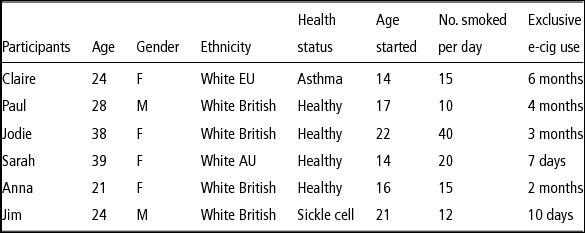
Participants at time of interview were on an average 29 years old (ranging from 21 to 39), mainly White British (n = 4) and female (n = 4) (Table 1). The majority of participants (n = 5) only smoked cigarettes in the last seven days, whereas one participant used various nicotine products including cigarettes, e-cigarettes, nicotine gum and snus. While most participants started using the e-cigarette to help them quit (n = 5), one participant tried the e-cigarette to experiment with the product. All participants used and preferred the tobacco flavour in the e-cigarette, though most (n = 5) tried other flavours, such as mint, vanilla, watermelon, summer fruits, strawberry, cherry, coffee and chocolate.
Demographic information for participants recruited to the study

Procedures
Participants were recruited through snowball sampling and the University's online research study platform, SONA. Those interested contacted the researcher to register an interest in the study, (n = 10) of which six met the inclusion criteria outlined above. First year students (n = 2) were offered 1.5 credits for participating in the study. All participants gave informed signed consent to be interviewed.
Interviews
Participant interviews lasted for approximately 1 h and 15 min. A semi-structured interview guide explored participants’ views of smoking, use of the e-cigarette, experiences of ‘vaping’, and reasons for discontinued use of the e-cigarette. Examples of interview questions include ‘Can you tell me about your e-cigarette use? Can you tell me why you stopped using the e-cigarette? How did you view yourself when you smoked an e-cigarette? Do you see yourself differently now?’
Data Analysis
Interpretive Phenomenological Analysis (IPA) was conducted to explore each participants’ sense of their own experiences of using the e-cigarette before looking across the corpus (Pietkiewicz & Smith, Reference Pietkiewicz and Smith2012). Previous research has suggested that conducting IPA on 6–8 participants is optimal, as this allows for a detailed and in-depth analysis of each participant's account (Smith, Flowers, & Osborn, Reference Smith, Flowers, Osborn and Yardley1997; Smith & Osborn, Reference Smith, Osborn and Smith2003). Interviews were transcribed verbatim, and transcripts were analysed according to guidelines outlined by Smith and Osborn (Reference Smith, Osborn and Smith2003). First, each transcript was read and re-read multiple times; independently by all authors, and initial notes, thoughts and comments were made. Themes were then identified for each transcript, and connections between these initial themes were grouped together to form subordinate and superordinate themes before moving on to the next transcript. In the final stage, this process was repeated for each transcript and a final list of superordinate themes was constructed. Any disagreements were resolved via discussion, and a final rereading of the transcripts was conducted to ensure all identified themes were grounded in the data.
Results
Analysis of the accounts suggested participants held conflicting attitudes about using e-cigarettes, which undermined attempts to quit smoking, and led to the discontinuation of the e-cigarette. These conflicts were around issues relating to (1) discomfort with the e-cigarette identity; (2) lack of abstinence self-efficacy and (3) navigating the barriers to e-cigarette use.
1. Discomfort with the e-cigarette identity
Previous research has shown that the way smokers view themselves and the self-labels they use (e.g. I am a smoker or I am an ex-smoker), can affect quitting success (Tombor, Shahab, Brown, Notley, & West, Reference Tombor, Shahab, Brown, Notley and West2015). In all accounts, even though all participants were regular smokers, smoking more than 10 per day, they chose to apply various other labels or definitions to their smoking besides ‘I am a smoker’. This discrepancy between their smoking identity and their behaviour led all participants to create their own definitions of what it means to be a smoker. Sarah's explanation of her smoking behaviour captures the feelings of all in the study, and shows the internal struggles these smokers face with their smoking identity:
No, [Laughs] not really (I don't see myself as a smoker). That's paradoxical isn't it? No, I smoke these really super, super mild cigarettes that don't actually smell disgusting so I, I don't think I smell like a smoker. . . . Umm [sighs] but I suppose I am really [Sarah]
However most participants identified more as a smoker once they started using the e-cigarette and so they did not ascribe new self-labels such as ‘non-smoker’ or ‘vaper’. Instead, participants’ identity became more reinforced as a ‘smoker’ as shown in Claire's quote:
I felt a bit like one of those fake smokers who's a bit like, yeah my e-cigarette, coming out with those smokers and stuff. I think I felt more like a smoker when I had my e-cigarette. .[Claire]
Given participants reluctance to endorse the ‘smoker’ identity, it is not surprising that Claire rejected feeling like a smoker when using her e-cigarette in public as that was in direct conflict with how she saw herself and her own self-label. Though participants identified more as smokers when using the e-cigarette, they also welcomed the ‘non-smoker’ outward appearance that using e-cigarettes provided. Most participants wanted to distance themselves from identifying as a ‘smoker’ to maintain a ‘non-smoker’ identity for family members. The e-cigarette therefore helped Anna, Jodie, Claire, Paul and Jim to project the perfect ‘non-smoking self’ to other family members and shown in the quotes:
I did keep it hidden from like family members that I knew would be angry that I smoked, like my grandma for instance [Claire]
Family have no idea [laughs]. I think if my family knew they would have carted me off to the equivalent of alcoholics anonymous for smokers. Umm I think they would be very disappointed if they found out. . .I think my parent's disappointment in me would be quite huge and I would never, I would never want to put them through that and I don't, I am selfishly, I don't want to hear them tell me how disappointed they are [Jodie]
Anna acknowledged that the e-cigarette ‘vapour just disappears and doesn't leave a smell in my bedroom’ so she was able to hide her use from her Mother. Similarly, the extracts above show that participants projected a different identity to protect their loved ones from knowing about their cigarette smoking, and themselves from ‘disappointing’ family members. In Jodie's case, it also demonstrates what she perceived her family's view of herself would be, an addict, and the embarrassment she would feel being ‘carted off to the equivalent of alcoholics anonymous’, i.e. the UK NHS SSS.
Three participants, Claire, Sarah and Anna, were also concerned about their public image while using the e-cigarette. They felt judged and stigmatised by the public and addressed this in various ways. Sarah was very particular with her choice of e-cigarette and ensured she purchased the one that most closely looked like a cigarette. It seemed she was determined to reinforce her smoking identity with her choice of e-cigarette:
I tried a couple from corner stores but they were [sighs] (a) they tasted weird and (b) the size of them was ridiculous. You know like a giant thing that made my hands look tiny. Yeah, and umm I couldn't stand that. I used to laugh at my poor ex smoking those ones that look like tampons. The plain white ones that look like a tampax, you know [laughs] but umm so yeah, I didn't, I didn't want to be using anything that didn't look as much like a cigarette as possible. [Sarah]
However, Anna and Claire were both concerned with the attention they received from using an e-cigarette. They did not expect or want the comments they received from members of the public about their e-cigarette use as demonstrated in Anna's talk of her ‘stigmatised self’ in the quote below.
. . .So it was, it's hard to be the first one to do something and then to walk down the street and you're trying, you're like using it and people are looking at it like it's, it's something from Mars or something, do you see what I mean? Sometimes it's like ‘oh I would be so much more discrete right now if I had a cigarette’. But the smoke that comes off them is so much more. There is a lot more smoke from what, if you exhale out a cigarette. Like coming out of your mouth it looks the same, but when it's in the air or when it blows down the street it's so, there is so much more. Quite a lot of people noticed that. Yeah I found it really odd that people were looking at me. And wanting to know, and I'd much rather they come and ask and it kind of put me off and I thought I'd much rather just be having a normal cigarette, then people wouldn't be looking at me and strangers looking at me. . .to put up with that kind of like stigma attached to it and its only because people don't know about it, it's uncertain. [Anna]
Anna's view of her stigmatised self while using the e-cigarette also highlights the importance of social acceptance and her view of her cigarette smoking as more ‘discrete’ and thus more acceptable than the e-cigarette. The internal conflict Anna felt while using the e-cigarette in public led to her reinforcing positive feelings towards smoking cigarettes and developing negative images towards the e-cigarette.
The tension between participants cigarette and vaping identities as well as the positive feelings towards smoking cigarettes seemed to undermine attempts to quit using the e-cigarette, and as such, none of the participants were able to embrace new self-labels like ‘vaper’ or ‘ex-smoker’.
2. Lack of Abstinence Self-Efficacy
Abstinence self-efficacy is related to participants’ confidence in their ability to abstain from smoking (Gwaltney, Metrik, Kahler, & Shiffman, Reference Gwaltney, Metrik, Kahler and Shiffman2009). In this study, participants seemed to have low quitting self-efficacy as demonstrated by Sarah's talk:
Well that I feel that I should quit the cigarettes. Yes there is a slight, yeah schism there [laughs]. . . I think I have to quit. I think the ecigs are the only way I'll manage to do it but I don't have a lot of confidence actually that I'll stay off cigarettes. I think I can do it for a while but I think I'll probably slip back. But I guess it gives my system a break for a little bit of time, at least. . . .I need to want to stop though, you know, that's probably the part that's missing. I'm sort of not, you know, not quite committed enough to that yet [Sarah]
Sarah's insight into her thought processes on quitting smoking, and the internal struggles she describes points towards a decrease in self-efficacy in her quitting ability ‘I think I can do it for a while but I think I'll probably slip back’. Many models, especially relapse prevention models (e.g. Marlatt and Donovan, Reference Marlatt and Donovan2005) outline the importance of self-efficacy in maintaining abstinence. None of the participants in this study had confidence to remain abstinent. This coupled with participants’ enjoyment of cigarette smoking undermined attempts to quit using the e-cigarette, as shown in Claire's quote:
I'm kind of aware that I love, that I really like smoking and that probably means I will always go back to it, but the periods that I stop may become longer. [Claire]
Other factors that contributed to low levels of quitting self-efficacy included participants’ initial motivation to use the e-cigarette and their lack of preparation to continue vaping in high-risk situations. Participants’ initial motivations for using the e-cigarette was centred on the need to try to quit for their significant others, rather than for themselves, as most participants described the negative impact that cigarette smoking was having on their relationships and the pressure they felt to quit, as shown in Claire and Jodie's accounts:
I noticed when I got together with my boyfriend cos obviously he didn't like smoking umm so he said that it smelt weird and stuff when I was laying down next to him or something. Yeah, he was very anti-smoking. So yeah I got a sense that it was frowned upon and that maybe we wouldn't be together for a long time if I continued it. [Claire]
In as much as my husband absolutely abhors smoking, it affects my relationship. . . .the only arguments we ever have these days is about my smoking really, so [laughs] to be perfectly honest. [Jodie]
Though participants wanted to quit for their significant others, this reason was not a sufficient motivating factor for them to continue using the e-cigarette. In particular, none of the participants considered using the e-cigarette in social situations, and the importance of these social interactions was so great, that they undermined any attempt to continue vaping as shown in Paul's account:
Usually, I actually, this holiday in Devon recently it was ridiculous. I knew I would want to smoke when I was there. And I knew if I started smoking when I was there that I'd probably feel really, really bad umm for a bit because I wasn't used to smoking so like 3 days before, I actually went and bought some tobacco and started smoking so that I was ready for the weekend. It was literally like getting match fit for a football game, like you train. . .It is absolutely ridiculous to think that I did it but I did. . ., [Paul]
Instead of participants considering how to remain abstinent in high-risk situations and thus developing coping strategies when in social situations, they were more likely to lapse and in most cases this then lead to a relapse. In the above quote, Paul was clearly able to identify the challenge he would face of not smoking during his holiday in Devon. However, his confidence in his ability to remain smokefree during this period was so low, that he made a conscious decision to get ‘match fit’ for the weekend by buying and smoking cigarettes before the weekend, rather than considering buying extra e-liquid or carrying his second e-cigarette.
The combination of participants’ lack of preparedness in high-risk situations, together with their lack of commitment to quit contributed to relapse. In fact, for Paul and for all other participants, the value placed on social interactions was so great that it outweighed any previous smoking cessation decisions.
3. Navigating the barriers to e-cigarette use
Though participants outlined some facilitators to e-cigarette use such as ‘e-cigarettes are new and exciting’, ‘are safe and healthy’ and ‘mimics smoking behaviour’, they held more perceived barriers to using them. These barriers undermined participants’ attempt to quit cigarettes with the e-cigarette. In particular, Paul, Jodie, Claire and Jim were concerned about the limited information available on them and as such they talked about a lack of trust/confidence in the product as shown in Paul and Claire's quotes:
You don't really know what's in cigarettes cos it's treated with so many chemicals but you know that it's heavily regulated. Well, maybe not, but you kind of put some kind of faith into the manufacturers and the urr gatekeepers of that industry, whereas e-cigarettes are a very new industry so you don't really know what's going on with them and what chemicals are being used in them. [Paul]
. .that's another reason why I kind of stopped cos I don't know the effects of it [e-cigarettes], like it's a bit uncertain. . .I've read a bit of papers trying to find out if it's actually harmful, but there's not actually much out there. [Claire]
As shown in the excerpts above, participants were concerned about the unknown risk they were taking using the e-cigarettes. Paul and Claire both compared information they had on both products and weighed the unknown risk of the e-cigarette as a potential greater threat than that of cigarettes.
In addition to this, four participants Claire, Paul, Jodie and Sarah talked about how the negative side effects they experienced contributed to a greater perception of personal risk while using the e-cigarette. These side effects varied from nausea, jaw pain, tightness in the lungs, headaches, body aches to sleeplessness and palpitations:
I mean, the first couple of days I'd made the mistake of ordering ones that were too strong and they gave me palpitations and I couldn't sleep, and I thought I was going to have a heart attack. I felt a bit nauseous as well, almost like the first time I had a cigarette so really not very pleasant at all. I mean obviously I was getting the nicotine hit, umm, but it was way too much nicotine for me, you know. . .Umm they hurt your throat a little bit, the umm vapour stuff. Funnily enough cigarettes don't but I guess my body is used to those. But I lost my voice a couple of times on the ecigs. [Sarah]
The health impact outlined in Sarah's excerpt above may have undermined use of the e-cigarette as though smokers are generally aware of the health risks attributed to cigarette smoking, young smokers in particular view these as future risks (Slovic, Reference Slovic2000). However, the personal experience of a potential serious health effect, ‘I thought I was going to have a heart attack’, could have reoriented this risk to the present and not towards cigarette smoking, but towards use of the e-cigarette.
All participants, except Jim, described overusing the e-cigarette. Participants enjoyed the freedom that the e-cigarettes gave them as they could smoke ‘anywhere’ but were concerned about the level of dependence they seemed to have on the e-cigarette as shown in the quotes:
I was chain smoking e-cigarettes and I was smoking a lot more than urr than if I was just smoking straight cigarettes. I had two main urr e-cigarette bodies which I would have to charge in rotation. I was working in a studio with 7 other people and I was just constantly smoking these things because I could now. . . .I would go to the toilet and I'd be washing my hands and I'd take out my. . .yeah. And I could smoke indoors for the first time in how ever many years since the smoking ban. I'd yeah, I'd go to the bathroom in the middle of the night and, you know, grab my e-cigarette from the nightstand before I went and umm occasionally Amy had rolled over I might reach over and have some then as well. It's just absolutely ridiculous [Paul]
However this freedom encouraged a change in smoking patterns with participants developing a more automatic habit with the e-cigarettes. Jodie talks about the struggles associated with regulating use of the e-cigarette:
I made a pact that I would go outside still to smoke, this e-cigarette, even though you don't have to but then you know it would be raining and you'd be in the pub and you'd smoke it. And you don't really realise how often, when it's there and you don't have to light it up and it doesn't go dead, you don't realise how often you pick it up. . . .it's so hard to put the damn things down because you, you then get into the habit of sitting at a pub table, as long as you are with the right people, and just, you know, chuffing away on your e-cigarette and you don't really notice. . . [Jodie]
The change in smoking pattern described above may suggest a shift from a more controlled behaviour to a loss of self-control while using the e-cigarette. While smoking cigarettes, participants were able to exert control by deciding when and how much to smoke but with the e-cigarette, there was no ‘off switch’ so participants’ vaped automatically as shown in Jodie's account above. This loss of control was of concern to all participants as they did not want to become addicted to the e-cigarette and so this contributed to the decision to return to smoking cigarettes.
Coupled with this, participants were disappointed with their ‘vaping’ experience. All expected that the e-cigarette would provide the same ‘hit’ as a cigarette and as such all held unrealistic expectations of the product. Sarah and Jim's quotes below demonstrate the disappointment participants felt with the lack of ‘hit’ from using the e-cigarette:
Well, it's a substitute, it's like umm like taking [exhales] I don't know food pills or having an IV drip instead of being able to eat, you know, or umm the analogy I mentioned to Sue which is like being told yes you can have sex again but you will never ever have an orgasm, it kind if it kind if, it's not the same, you know if did, it wasn't, it didn't hit the spot. Umm, I'd be a little bit miserable if I kept it up [Sarah]
. . . there is no alternative out there that is better than having an actual cigarette. . .I will say that it doesn't feel like there was any nicotine in it whatsoever, so you could pull on that thing for like half an hour and it still doesn't give you the same effect as a cigarette I don't think, even though it says it has the same amount of nicotine. [Jim]
Participants’ expectations of the product was not met as demonstrated in both quotes above, with Sarah realising that she would be ‘miserable’ if she continued using the e-cigarette and Jim's realisation that his search for a ‘better’ product had not been realised. Participants may have therefore underestimated the individual effort required to continue vaping.
The three themes above outlines the difficulties participants’ experience with using the e-cigarette while trying to quit. These struggles all seemed to reinforce participants’ perception of the e-cigarette being an inferior product to the cigarette.
Discussion
This study explored the experiences of smokers who relapsed to cigarette smoking after exclusive use of the e-cigarette. Findings suggest that a complex interplay of factors contributed to discontinuation of the e-cigarette. In particular, e-cigarette users struggled with many issues including their smoking and vaping identity, confidence in their quitting ability, feelings of loss of control while vaping and unrealistic expectations of the e-cigarette. These findings are consistent with a recent qualitative study on young Scottish adult e-cigarette users (Lucherini, Rooke, & Amos, Reference Lucherini, Rooke and Amos2017) that found vaping to be in conflict with users’ cigarette smoking identity; but contradictory to other research (e.g. Farrimond, Reference Farrimond2017) that showed a positive vaping identity, with users highlighting the ‘pleasure’ and ‘satisfaction’ they got from it.
This suggestion that identity may play a key role in (dis)continuation of e-cigarette use builds on previous research that suggests smoking identity may be important for quitting success (Tombor, Shahab, Brown, & West, Reference Tombor, Shahab, Brown and West2013; Tombor, Shahab, Herbec, Neale, & West, Reference Tombor, Shahab, Herbec, Neale and West2015). In this study once participants started exclusive use of the e-cigarette, their vaping identity was in conflict with their smoking identity, which meant participants were unable to embrace new self-labels such as ‘vaper’ and instead reinforced positive feelings towards smoking cigarettes and developed negative images towards the e-cigarette.
Previous research has theorised that identity is important for motives and that a ‘deeply entrenched’ identity towards the new behaviour can provide stability towards that new behaviour (West, Reference West2006). Also, qualitative investigations into identity and cigarette smoking have shown smoking identity to be a complex construct, (Tombor et al. Reference Tombor, Shahab, Brown, Notley and West2015) and identity conflict to precede relapse (Vangeli, Reference Vangeli2010, unpublished thesis). The results of this study suggest that there may also be conflict with e-cigarette or vaping identity, and as is reported in the cigarette smoking literature, this conflict resulted in a rejection of the new behaviour, vaping. In rejecting the e-cigarette, participants’ focused on their perception of cigarettes as something that was controllable, non-stigmatised and with known risks.
In addition to this, participants also demonstrated low self-efficacy in their quitting ability. Participants’ reasons for using the e-cigarette (e.g. for significant others), as well as the importance of socialisation, together with a lack of preparation to be in high-risk situations, undermined efforts to quit. The characteristics outlined above are similar to those identified in a subgroup of smokers in a recent qualitative study on smoking cessation progression labelled as ‘Forced attempters’ (Tombar, Vangeli, West, & Shahab, Reference Tombor, Vangeli, West and Shahab2018). Forced attempters hold positive feelings towards smoking and are extrinsically motivated to quit smoking. Similarly to forced attempters, the e-cigarette users in this study did not show internal motivation to vape and as such may have underestimated the personal effort needed to continue vaping.
Participants were also unable to maintain e-cigarette use while socialising with friends and consuming alcohol, so it may be that ways to increase vaping self-efficacy in these particular situations is needed. Previous research on the role of self-efficacy for smoking cessation shows a modest relationship (Gwaltney, Metrik, Kahler, & Shiffman, Reference Gwaltney, Metrik, Kahler and Shiffman2009; Perkins, Parzynski, Mercincavage, Conklin, & Fonte, Reference Perkins, Parzynski, Mercincavage, Conklin and Fonte2012); and suggests that targeting situation-specific self-efficacy may be more useful. The situations outlined here are a good starting point for NHS SSS to discuss with e-cigarette users, who may be using their services to quit. However, high-risk situations may be individualised and previous research has shown that a focus on within-person variation in self-efficacy is important (Gwaltney, Shiffman, Balabanis, & Paty, Reference Gwaltney, Shiffman, Balabanis and Paty2005), and thus assessing vapers’ individual relapse risk in high-risk situations is needed. Though situation-specific high-risk relapse situations have been identified for smokers, e.g. negative affect, positive affect, restrictive situations, low arousal, social-food situations and craving (Gwaltney et al., Reference Gwaltney, Shiffman, Norman, Paty, Kassel and Gnys2001); these have not yet been identified for vapers, and this information would help to provide a more tailored intervention to support those using the e-cigarette to quit smoking.
In addition to the factors discussed above that undermined vaping, the combined effect of little information, and therefore trust in e-cigarettes, potential personal risks of vaping together with loss of control leading to feelings of greater dependence and overuse of the e-cigarette contributed to participants more positive views of smoking and negative views of vaping. Participants also had high expectations of the e-cigarette, and were not prepared for the differences in taste and ‘hit’ between vaping and cigarette smoking. The variables identified here that undermined e-cigarette use are similar to that found in previous research (Lucherini, Rooke, & Amos, Reference Lucherini, Rooke and Amos2017; Pepper, Ribisl, Emery, & Brewer, Reference Pepper, Ribisl, Emery and Brewer2014; Simonavicius et al., Reference Simonavicius, McNeill, Arnott and Brose2017). In order to help prepare participants for quitting with using the e-cigarette, clear guidance is needed on how to select the right product, the dosage required, possible side effects and the expected ‘hit’ and satisfaction levels. Further research on the most effective way to convey this information to smokers is needed.
This study has a few limitations. First, though only six participants were interviewed, this sample size was appropriate as a detailed account of participants’ experience of using and stopping e-cigarette use was obtained. Second, it is possible that the findings may not be applicable to an older or more culturally diverse sample, so the qualitative data presented here is not generalizable to the wider UK e-cigarette community. Participants also provided a retrospective view of their experiences of stopping the e-cigarette, so the information provided was dependent on their memory of the experience. However, this study is unique as it highlights potential barriers to vaping that may provide some insight into why the evidence on the effectiveness of e-cigarettes as a smoking cessation tool is mixed (Brown, Beard, Kotz, Michie, & West, Reference Brown, Beard, Kotz, Michie and West2014; Bullen et al., Reference Bullen, Howe, Laugesen, McRobbie, Parag and Williman2013; Hartmann-Boyce et al., Reference Hartmann-Boyce, McRobbie, Bullen, Begh, Stead and Hajek2016; Heydari, Ahmady, Masjedi, & Fadaizadeh, Reference Heydari, Ahmady, Masjedi and Fadaizadeh2017).
These findings gave further insight into the struggles smokers may have when using the e-cigarette and outlines factors that may contribute to relapse, so these are important considerations for NHS SSS when supporting users in their quit attempt. Further research should focus on the role of identity, self-efficacy and on ways to manage e-cigarette users’ expectations in a quit attempt.
Acknowledgements
We would like to thank the participants who volunteered to participate in this study and shared their experiences.
Financial Support
None.
Conflict of Interest
None.
Ethical Standards
The authors assert that all procedures contributing to this work comply with the ethical standards of the relevant national and institutional committees on human experimentation and with the Helsinki Declaration of 1975, as revised in 2008.