1. Introduction
With the rapid growth of non-English text documents, the cross-language information retrieval (CLIR) research field has attracted much attention. CLIR deals with retrieving documents in a language different from the language of the query. Because of the difference between the query language and the documents language, translation is a part of many CLIR systems. Three common translation-based approaches could be used in CLIR (Ren and Bracewell Reference Ren and Bracewell2009): (1) translating documents from target language to source language, (2) translating queries from source language to target language, and (3) translating both the documents and queries to an intermediate language. Document translation has not been widely used because of high cost and complexity of machine translators for translating all documents (Ren and Bracewell Reference Ren and Bracewell2009; Nie Reference Nie2010). Therefore, in this research, we focus on query translation. Usually, query translation is done using linguistic resources such as parallel corpora, comparable corpora, dictionaries, or machine translators (Pirkola et al. Reference Pirkola, Hedlund, Keskustalo and Järvelin2001; Nie Reference Nie2010).
Supervised IR methods have shown to have better performance compared to traditional IR methods (Li Reference Li2011). These methods use IR heuristics such as term frequency (TF), inverse document frequency (IDF), and their combination, along with common traditional IR methods such as BM25 as features to learn a scoring function. In this paper, we use LTR methods for CLIR. To pass the language barrier, we use translation resources to map monolingual features to their cross-lingual equivalents employed for constructing a cross-lingual ranking model. Our feature set contains the common IR heuristics mapped to their cross-lingual equivalents (such as TF and IDF), common CLIR methods (such as cross-lingual language modeling), and named-entity-based features.
Although for some language pairs such as English–French and English–Arabic, the performance of CLIR is almost the same as the performance of monolingual IR (Nie, Isabelle, Plamondon, and Foster Reference Nie, Isabelle, Plamondon and Foster1998), for low-resource language pairs there is a gap between the performance of CLIR and monolingual IR methods (Gollins and Sanderson Reference Gollins and Sanderson2001). For low-resource language pairs, such as English–Persian, it is very important to efficiently exploit available bilingual resources. To take advantage of all available resources, we use multiple translation resources for query translation. Translations that are extracted from parallel corpora are usually more accurate compared to those extracted from comparable corpora. On the other hand, since comparable corpora are composed of aligned documents that are not exact translations of each other, translations mined from comparable corpora may contain translation candidates that are related to query terms, which leads to query expansion effect. By considering the translations extracted from a comparable corpus and the ones extracted from a parallel corpus at the same time, we would be able to take advantage of the benefits of both.
To combine translation resources, we extract various features from query–document pairs using multiple translation resources, and then employ LTR methods for learning a ranking model based on the extracted features. LTR methods automatically learn the weights of the features extracted from different resources and construct the ranking models.
To evaluate the proposed approach, we perform the CLIR task of CLEF-2008 (Agirre et al. Reference Agirre, Di Nunzio, Ferro, Mandl and Peters2009) and CLEF-2009 (Ferro and Peters Reference Ferro and Peters2010), retrieving Persian documents from queries in English. We use a parallel corpus, a comparable corpus, a dictionary, and a machine translator for translating English queries to Persian and also estimating the cross-lingual features. Our results indicate that LTR approach outperforms traditional CLIR methods which first translate queries using dictionaries, comparable corpora, parallel corpora, and machine translators, and then use the translated queries to retrieve documents in the target language. Also, we show experimentally that the proposed combination method based on LTR approach significantly outperforms single-resource-based CLIR methods in the English–Persian CLIR task.
The main contributions of this paper are as follows:
Using an extensive set of cross-lingual features for LTR-based CLIR: We use four different translation resources (parallel and comparable corpora, dictionary, and machine translator) for defining cross-lingual features and evaluate their effectiveness in CLIR. Moreover, we define and use new features based on named entities mentioned in queries and documents.
Using LTR approach for combining translation resources: Our study on the performance of different resources for CLIR shows that we can improve the performance of CLIR by combining different translation resources in an LTR setting.
This paper is an extension of our previous work presented in Azarbonyad, Shakery, and Faili (Reference Azarbonyad, Shakery and Faili2012). In previous work, parallel corpora are employed for mapping monolingual features to cross-lingual ones. Then LTR methods are used for learning a ranking model and scoring documents. In this paper, we extend the previous work through (1) exploiting other translation resources for mapping features and showing the usefulness of LTR approach for CLIR based on different translation resources, (2) defining and using new features based on named entities, (3) adapting LTR approach for combining different translation resources for CLIR and evaluating its effectiveness in different scenarios, and (4) expanding the experiments and showing the effectiveness of LTR for CLIR with careful analysis and experiments.
The remainder of the paper is organized as follows. In Section 2, we review previous work on using parallel and comparable corpora and LTR approaches for CLIR. Section 3 describes the design of features used in this research. Various CLIR methods using dictionaries, parallel corpora, comparable corpora, and a combination of resources are described in Section 4. Section 5 explains the experiments and results. Finally, Section 6 concludes the paper with a brief discussion on the impact of using multiple translation resources for CLIR.
2. Previous work
We review the related studies from three perspectives: cross-language IR, combining resources for CLIR, and LTR.
2.1 Cross-language information retrieval
Regarding translation resources for query translation, CLIR methods could be classified into four categories (Pirkola et al. Reference Pirkola, Hedlund, Keskustalo and Järvelin2001; Nie Reference Nie2010): methods that use either (1) bilingual dictionaries or (2) machine translators, or (3) comparable corpora, or (4) parallel corpora.
Among different methods for query translation that use parallel corpora, the methods that employ machine translation models are more popular and among different translation models, IBM model-1 (Brown et al. Reference Brown, Pietra, Pietra and Mercer1993) is more commonly used in CLIR (Nie Reference Nie2010). This model extracts p(f|e) from a parallel corpus. p(f|e) is the probability of translating a word e in the source language to a word f in the target language. Using this translation model, Nie et al. (Reference Nie, Isabelle, Plamondon and Foster1998) select the top N translation candidates for a given query and use these translations for building the query in the target language. This method first translates the query (translation step) and then uses the translated query for retrieving the related documents (retrieval step). The translation and retrieval steps can be also integrated within a unified framework (Berger and Lafferty Reference Berger and Lafferty1999). Lavrenko, Choquette, and Croft (Lavrenko et al. Reference Lavrenko, Choquette and Croft2002) use a parallel corpus for estimating the probability of relevance of each word in the target language with respect to a given query in the source language. Using these probabilities, they estimate the language model of a query in the target language.
Comparable-corpora-based methods use the association between words in aligned documents for estimating the relatedness of words in two different languages. The effectiveness of comparable-corpus-based methods for CLIR is investigated in two main studies which use comparable corpora for query translation (Tao and Zhai Reference Tao and Zhai2005; Talvensaari et al. Reference Talvensaari, Pirkola, Järvelin, Juhola and Laurikkala2008). Tao and Zhai (Reference Tao and Zhai2005) use comparable corpora for calculating an association score between words in two different languages. Talvensaari et al. (Reference Talvensaari, Pirkola, Järvelin, Juhola and Laurikkala2008) use the similarity score of documents in two different languages in addition to co-occurrence of words in the aligned documents to calculate the similarity score between the words in two different languages. In addition to these two most popular translation acquisition methods, there are other methods which try to extract and use translations achieved from comparable corpora in the language modeling framework (Rahimi and Shakery Reference Rahimi and Shakery2013; Shakery and Zhai Reference Shakery and Zhai2013).
Machine translators have also been exploited for translating queries and/or documents to the target language and finding related documents in the target language. Some of these research studies use machine translators for simply translating queries to the target language (Aljlayl and Frieder Reference Aljlayl and Frieder2001). The effectiveness of machine translation for Chinese–English CLIR has also been studied (Wu and He Reference Wu and He2012). The findings of this research show that translations derived from machine translation systems have high quality and accuracy in CLIR. Moreover, they utilize techniques such as relevance feedback methods to expand the translations achieved from a machine translator. This approach also has been exploited in other research studies such as Chen and Gey (Reference Chen and Gey2004). Jones and Lam-Adesina (2002) employ data fusion methods to merge the ranked lists achieved from two machine-translation-based CLIR systems.
2.2 Combining translation resources for CLIR
In order to achieve higher performance in CLIR, a number of studies have been carried out for employing multiple translation resources simultaneously. These methods could be categorized into two general categories: methods that assign weights to different resources and use a weighted combination of the resources for query translation (Lu, Chien, and Lee Reference Lu, Chien and Lee2004; Kadri and Nie Reference Kadri and Nie2007; Türe, Lin, and Oard Reference Türe, Lin and Oard2012; Azarbonyad, Shakery, and Faili Reference Azarbonyad, Shakery and Faili2013) and methods that use multiple resources for disambiguating translations of one another (Chen, Jiang, and Gey (Chen et al. Reference Chen, Jiang and Gey2000); McNamee and Mayfield Reference McNamee and Mayfield2002). The main issue with the methods of the first category is the cost of tuning the weights of different resources. The most simple weighting approach is fixing the weights of the resources based on some heuristics (Lu et al. Reference Lu, Chien and Lee2004). A more sophisticated approach (Kadri and Nie Reference Kadri and Nie2007) is learning the weights of different resources. The methods in the second category extract a number of translations from different resources and merge them to come up with a translation for the query in the target language.
2.3 Learning to rank for CLIR
Learning to rank (LTR) methods have been widely used in IR applications (Li Reference Li2011), and specifically in multilingual information retrieval (MLIR). Although MLIR and CLIR are very similar tasks, they have some differences. The main difference between MLIR and CLIR is that CLIR deals with the problem of retrieving documents in a language different from that of a query, but MLIR deals with the problem of retrieving documents in several languages different from the query language. Some studies use LTR in the merging step of MLIR (Tsai, Wang, and Chen Reference Tsai, Wang and Chen2008). After translating queries with a bilingual dictionary, they use an LTR method for merging retrieved document lists in each language and constructing a single list of documents. The main difference between this approach and our proposed method is that the former uses LTR to learn a merging method, not a ranking model. Gao et al. (Reference Gao, Niu, Zhou and Wong2009) employ machine learning methods for query translation. They extract features from translated query and document pairs and use these features for learning a ranking function. Effectiveness of using a multilingual parallel corpus for learning a scoring function in each language has also been studied by Usunier, Amini, and Goutte (Reference Usunier, Amini and Goutte2011). This approach uses a multilingual parallel corpus for predicting the paired labels of documents and then employs a bipartite ranking method for aggregating results as a ranked list. The main contribution of this method is using LTR for aggregating the bipartite rankings. However, our method directly uses LTR methods for learning a scoring function that can be used for ranking documents. Recently, Ghanbari and Shakery (Reference Ghanbari and Shakery2018) used LTR for training a ranking model for CLIR. They define various features for creating a model. Their main focus is on training local models for different query types which have similar characteristics, rather than creating a global model for all queries. Although, their defined feature set is similar to ours, they only use a parallel corpus for extracting cross-lingual features while we use different translation resources to perform CLIR. Moreover, our main focus (e.g., combining translation resources for CLIR) is different than theirs.
LTR has also been used in a few other cross-lingual settings such as cross-language question re-ranking and cross-language microblog retrieval. In an LTR-based cross-language re-ranking approach (Da San Martino et al. Reference Da San Martino, Romeo, Barroón-Cedeño, Joty, Maàrquez, Moschitti and Nakov2017), syntactic trees are constructed for both aligned source and target language questions and different features are extracted based on the similarity of syntactic trees of the questions and are used for ranking questions. Another study (Godavarthy and Fang Reference Godavarthy and Fang2016) tackles the task of cross-language microblog retrieval by mapping microblog messages in both source and target languages to a same semantic space and measuring the similarity of messages on the constructed space. Comparable corpora are also used for learning a cross-lingual word embedding (Vulić and Mones Reference Vulić and Moens2015). The learned word embeddings are used for constructing embedding of queries and documents. The created embeddings are then employed for estimating the similarity of queries and documents. Recently, online LTR has been also used for CLIR (Rahimi and Shakery Reference Rahimi and Shakery2017). Online LTR is different than offline LTR as the former is based on using implicit frequent user feedback to train a ranking model, while the latter creates a model based on the whole training set and does not update the model frequently.
3. Cross-lingual features
In IR tasks, features for constructing an LTR model are extracted from query–document pairs. The features could be categorized into two categories (Li Reference Li2011): (1) Query-dependent features such as frequency of query terms in the document, IDF of query terms, and Okapi BM25 score of the query and the document and (2) query-independent features such as PageRank of the document and length of the document. Since in CLIR, queries and documents are in different languages, we cannot use query-dependent features in LTR methods directly. To overcome this problem, we map monolingual query-dependent features to cross-lingual features and employ them in CLIR. Unlike query-dependent features, query-independent features can be used directly for CLIR.
The mapping approach employs translation techniques to map monolingual features to cross-lingual ones. Also, in this section, we introduce new features estimated based on the named entities in the query and the documents.
3.1 Adapting monolingual LTR features for CLIR
One of the important features used in many LTR methods is frequency of query terms in documents. For estimating this feature in a cross-language setting, we should estimate the frequency of source language query terms in the target language documents. In this paper, Probabilistic Structured Queries (PSQ) approach (Darwish and Oard Reference Darwish and Oard2003) is used for mapping TFs from source language to target language. The PSQ approach uses the translation probabilities between source and target language terms to estimate the frequency of a source language term in a target language document. In this approach, the TF of word e in a source language S in document DF in a target language F is calculated as:
 $$ CLTF(e,{D_F}) = \sum\limits_{{f_i} \in {V_F}} p({\kern 1pt} {f_i}|e).TF({\kern 1pt} {f_i},{D_F}), $$(1)
where VF is the target language vocabulary, fi is a word in document DF, p(fi|e) is the translation probability estimated from translation resources, and TF(fi,DF) is the frequency of term fi in document DF.
Another important feature used in LTR methods is IDF of query terms. Similarly, the PSQ approach could be used for estimating IDF of word e in the target document collection as follows:
 $$ CLIDF(e) = \sum\limits_{{f_i} \in {V_F}} p({\kern 1pt} {f_i}|e).IDF({\kern 1pt} {f_i}), $$(2)
where IDF(fi) is the inverse document frequency of term fi. Many IR methods use TF and IDF when calculating similarity of the query and documents. Thus, using the features extracted using Equations (1) and (2), many retrieval methods such as Okapi BM25 (Robertson, Walker, and Beaulieu Reference Robertson, Walker and Beaulieu2000) or language modeling approach in the target language could be used for retrieving relevant documents.
Okapi BM25 score is one of the most frequently used features in LTR. For estimating the cross-lingual Okapi BM25 feature, we use the method proposed in Nie et al. (Reference Nie, Isabelle, Plamondon and Foster1998). Using the translation model, this method selects the top N translation candidates with the highest translation probabilities for the whole query, QS, which is:
 $$ p({\kern 1pt} f|{Q_S}) = \sum\limits_{e \in {Q_S}} p({\kern 1pt} f|e)P(e|{Q_S}), $$(3)
where e is a query term and f is a target language word. It is further assumed that p(e|QS) is the same for every query word and therefore Equation (3) is simplified to:
 $$ p({\kern 1pt} f|{Q_S}) \propto \sum\limits_{e \in {Q_S}} p({\kern 1pt} f|e). $$(4)
The language modeling score of documents given the query is another important feature in LTR methods. In this paper, the method proposed in Berger and Lafferty (Reference Berger and Lafferty1999) is used for calculating the language model score of documents for a given query. The score of a document D to a query Q could be estimated using cross-entropy as follows:
 $$ Sc(Q,D) = \sum\limits_{t \in V} p(t|{\theta _Q})\log p(t|{\theta _D}), $$(5)
where θQ and θD are the language models of query Q and document D, respectively, and V is the vocabulary. The language models for Q and D are probability distributions over all terms in the collection given the terms in the query and document, respectively. The maximum likelihood estimation with a smoothing method is typically used for estimating these probability distributions. Using translation probabilities, the query language model is estimated as follows:
 $$ p(t|{\theta _{{Q_S}}}) = \sum\limits_{s \in {V_S}} p(t|s,{\theta _{{Q_S}}})p(s|{\theta _{{Q_S}}}) \approx \sum\limits_{s \in {V_S}} p(t|s)P(s|{\theta _{{Q_S}}}), $$
(6)
where  $ {\theta _{{Q_S}}}$ is the language model of query in the source language, Vs is the source language vocabulary, and p(t|s) could be estimated from translation resources. After estimating the query language model, the similarity of a document to the query could be determined as:
 $$ Sc(Q,D) = \sum\limits_{t \in V} p(t|{\theta _Q})\log p(t|{\theta _D}) = \sum\limits_{t \in {V_F}} \sum\limits_{s \in {V_S}} p(t|s){p_{ML}}(s|{\theta _{{Q_S}}})\log p(t|{\theta _{{D_F}}}), $$(7)
where  $ {p_{ML}}(s|{\theta _{{Q_S}}})$ is the maximum likelihood estimation of probability of a word s in QS. The document language model
 $ {\theta _{{D_F}}}$ in the target language should be smoothed by means of smoothing methods.
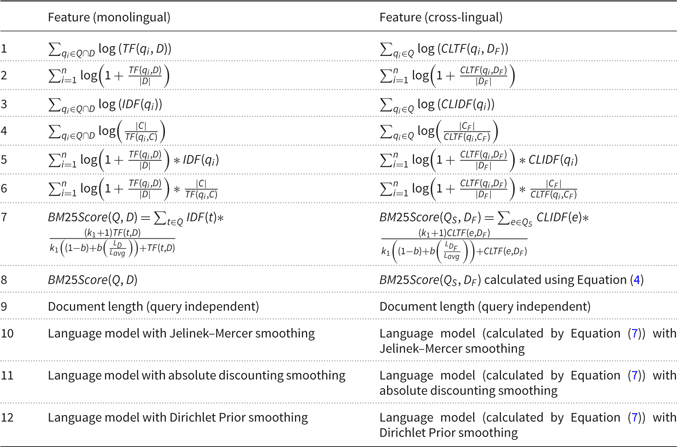
We adapt the standard features used in document retrieval (Nallapati Reference Nallapati2004) and also five other features which are common in LTR approach: document length, Okapi BM25 score, language model score with Jelinek–Mercer smoothing, absolute discounting smoothing, and Dirichlet prior smoothing. Using methods described in this section, we map these monolingual features to cross-lingual features. In Table 1, monolingual features and their mapped equivalents in CLIR are shown. In order to estimate the translation model, which is used in mapping the features, multiple translation resources are examined in Section 4.
Features used for learning the ranking function (In each column, the best result is bolded)

TF(q, D): frequency of term q in document D, |.|: size-of function, n: number of query terms, C: collection, CF: target language collection, DF: target language document, IDF(q): inverse document frequency of term q, and TF(q, C): frequency of term q in collection C.
3.2 Named-entity-based features
Named entities could be useful for estimating the similarity between queries and documents. The weights of different query terms are not equal in expressing the intent of the query. For example, if a query contains a general term and a specific name, usually the specific name is more informative for finding relevant documents. Named entities are usually very specific. Detecting named entities in queries and using them in CLIR can be very effective in improving the performance. Specific named entities may not be present in translation resources. In order to make use of named entities in CLIR, we detect and translate named entities by means of some external resources. We define four named-entity-based features and use them beside the mapped features described in Section 3.1 for learning a ranking model.
For finding named entities in queries, we use Stanford Named Entity Recognizer (Finkel, Grenager, and Manning Reference Finkel, Grenager and Manning2005) which is trained on the CoNLL data set with four entity types (Organization, Location, Person, and Misc). After recognizing each type of named entities in the source language, we use Google TranslatorFootnote a for translating them to the target language. We use the frequency of each named entity type, which is contained in the query, in documents as a feature. In order to prevent biasing this feature toward long documents, we normalize the frequency of named entities by the length of the documents:
 $$ NETF(Q,D) = {{\sum\limits_{nm \in Q} F({T_{nm}},D)} \over {|D|}}, $$(8)
where nm is a named entity, Tnm is the translation of nm, F(Tnm,D) is the frequency of Tnm in document D, and |D| is the length of D. This feature is computed for the four kinds of named entities the Stanford NER toolkit can identify. Based on the four different entity types we extract four named-entity-based features. We estimate these features once for all query–document pairs and then use them in different LTR methods for CLIR.
Overall, we have 16 features: 12 of mapped features and 4 named-entity-based features. We estimate the 12 mapped features using different translation resources and use them for training the ranking models of LTR methods.
4. CLIR using various translation resources
We use dictionaries, machine translators, comparable, and parallel corpora for translating queries. To extract translations using dictionaries, for each word we select its top-N translation candidates from the dictionary and form the query in the target language. To translate queries using machine translators, we simply give the query as an input to the machine translation system and consider its output as the query in the target language. To extract translation knowledge from parallel and comparable corpora, we use more complicated methods. In this section, we first explain how the translation knowledge is extracted from comparable and parallel corpora. Then, we introduce an LTR-based method for combining translation resources in CLIR.
4.1 Parallel- and comparable-corpora-based CLIR
For performing CLIR based on parallel corpora, we employ Equation (4) which is described in Section 3.1 for query translation. We use the translated queries for calculating the BM25 score of documents. We employ IBM model-1 for estimating the translation model. Moreover, after estimating the translation probabilities between source and target language words, we use the translation probabilities for estimating the cross-lingual features.
We use the method proposed in Hashemi (Reference Hashemi2011) for extracting word associations from aligned documents in comparable corpora. This method uses similarity scores of aligned documents for extracting word associations. The output of this method is a dictionary that suggests a relatedness score for each pair of source–target language words. The basic intuition of this approach is that words co-occurring frequently in a lot of aligned documents are related to each other. The relatedness of words is captured using mutual information of words in aligned documents. This method extracts translation probabilities of target language words, p(f|e), with regard to all source language words. After extracting translations from comparable corpora using the described method, we use the translated query to implement BM25 IR method. Moreover, having the translation probabilities, it is straightforward to use them for mapping features and using them in an LTR setting for creating a ranking model.
4.2 Combining translation resources
Dictionaries, comparable corpora, parallel corpora, and machine translators have been widely used for query translation in CLIR. Each of these translation resources have some advantages compared to other resources. The main benefit of parallel corpora is their high accuracy for estimating the translation probabilities needed for query translation. Comparable corpora do not have the accuracy of parallel corpora, but they have query expansion effect in query translation process. Also, dictionaries have other benefits like their availability for many languages. The main issue with using dictionaries for query translation is their limited coverage. Machine translators are usually accurate in translating a complete sentence, but do not provide translation probabilities. Since each resource has its own advantages, combining translations extracted from different resources may lead to more accurate results.
Different approaches have been proposed for combining translation resources (Chen et al. Reference Chen, Jiang and Gey2000; McNamee and Mayfield Reference McNamee and Mayfield2002; Lu et al. Reference Lu, Chien and Lee2004; Kadri and Nie Reference Kadri and Nie2007) but most of them only use simple techniques for combining translation resources. One of the basic methods of resource combination is the linear combination method. This approach calculates the final translation probability of a source language word, e, to a target language word, f, as follows:
 $$ p({\kern 1pt} f|e) = \sum\limits_{{R_i}} {\lambda _i}*{p_{{R_i}}}({\kern 1pt} f|e),\sum\limits_{{R_i}} {\lambda _i} = 1, $$(9)
where Ri is a translation resource, λi is the weight of the resource, and  $ {p_{{R_i}}}({\kern 1pt} f|e)$ is the translation probability between e and f extracted from resource Ri. The probabilities are calculated using Equation (9), and then used for estimating the similarity of the query and documents.
Finding optimal weights of different resources is hard, especially when there are many translation resources available. In this case, simple methods for adjusting weights such as grid search are not efficient. To overcome this problem, we employ the LTR approach. We use features extracted from multiple resources together in order to construct the ranking model. In the ranking model, each feature gets a weight with regard to its importance in ranking the documents. The final score of a document regarding the query in this method is calculated as follows:
 $$ Score({Q_s},{D_t}) = \sum\limits_{{R_i}} \sum\limits_{i = 1}^{\# {f_i}} {\lambda _{ij}}{f_{ij}}, $$(10)
where Ri is a translation resource, #fi is the number of features extracted using Ri as the translation resource, fij is a feature, and λij is the weight of fij. λij’s are adjusted by means of LTR approaches. Using features extracted from multiple resources together, we can analyze the importance of each feature in ranking and by analyzing features we can determine the importance of each resource in the ranking. In this paper, a number of LTR methods such as AdaRank (Xu and Li Reference Xu and Li2007), IR-SVM (Cao et al. Reference Cao, Xu, Liu, Li, Huang and Hon2006), and Coordinate Ascent (Metzler and Croft Reference Metzler and Croft2007) are used for combining features.
5. Data sets and experimental results
In this section, we report the experimental results and analyze the effectiveness of different CLIR approaches. For evaluating our methods, we perform the CLIR task of CLEF-2008 and CLEF-2009: Retrieval of Persian documents in response to queries in English. We conduct a set of experiments to test the performance of our methods on Hamshahri data set (AleAhmad et al. Reference AleAhmad, Amiri, Darrudi, Rahgozar and Oroumchian2009). We first describe the test collections and then report and analyze the experimental results.
5.1 Data sets
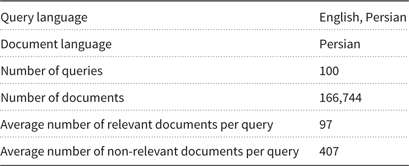
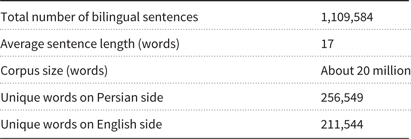
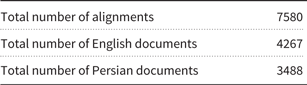
In this paper, Hamshahri collection is used for evaluating the proposed methods. 20M parallel corpus and University of Tehran Persian-English Comparable Corpus (UTPECC) comparable corpus (Hashemi, Shakery, and Faili Reference Hashemi, Shakery and Faili2010) are used for training the translation model of parallel-corpora-based methods and implementing comparable-corpora-based methods, respectively. Hamshahri collection consists of about 160,000 text documents in Persian and 100 queries in Persian and English. We use the title field of each English query. Table 2 shows the statistics of Hamshahri corpus. The 20M parallel corpus is constructed from four different parallel corpora: Roman parallel corpus (Mansouri and Faili Reference Mansouri and Faili2012), Iran Telecommunication Research Center parallel corpus (Jabbari et al. Reference Jabbari, Bakhshaei, Mohammadzadeh Ziabary and Khadivi2012), European Language Resources Association English–Persian parallel corpus (Mosavi Miangah Reference Mosavi Miangah2009), and a part of Mizan parallel corpus.Footnote b This corpus consists of 1,109,584 aligned sentences, which have about 20,000,000 words on each side. Table 3 shows the statistics of this corpus. UTPECC corpus is constructed from aligned news articles in Persian and English. In this corpus, BBC articles are aligned to Hamshahri articles. Table 4 shows the statistics of this corpus.
Hamshahri test collection statistics

20M parallel corpus statistics

UTPECC comparable corpus statistics

5.2 Evaluation metrics
In this section, we introduce evaluation metrics used in this paper for evaluating the proposed methods. We use Mean Average Precision (MAP), which is a common measure in IR, for evaluating our methods. Given k documents retrieved for query q, the Average Precision (AP) is calculated as follows:
 $$ {\rm{AP}} = {{\sum\limits_{i = 1}^k Prec(i)*Rel(i)} \over {\rm{Number}\,\rm{of}\,\rm{relevant}\,\rm{documents}}}, $$(11)
where Rel(i) is an indicator function equal to one if the document at rank i is a relevant document, zero otherwise, and Prec(i) is precision at rank point i which is defined as:
 $$ Prec(i) = {{RR(i)} \over i} $$(12)
where RR(i) is the number of relevant retrieved documents at rank point i. MAP is the mean of AP’s over all queries. Another measure that has been widely used in IR is P@n which is equal to Prec(n) described above. In this paper, we use P@5 and P@10 metrics for evaluating different methods.
5.3 Experimental results
In this work, the features described in Section 3 are extracted from judged documents for each query and are used for training LTR models. In addition to the judged documents, for each query, 10,000 unjudged documents are randomly selected from Hamshahri collection and the features extracted based on these documents are also used for constructing train and test sets. Unjudged documents are considered to be non-relevant to each query. Since the trained model will be tested on the whole collection containing judged and unjudged documents, unjudged documents should be considered in the training process. Since there are many more unjudged documents in the test set compared to the judged documents (relevant and non-relevant), the number of unjudged documents in training process is considered to be higher than the number of documents in other categories.
We use fivefold cross-validation for evaluating the proposed methods. The whole data set is partitioned into five folds. Each fold contains extracted features from 20 queries and their associated documents (judged documents and selected unjudged documents). We train LTR methods on four folds and use the fifth fold to evaluate the trained model.
We set up different experiments based on different translation resources. Also, we set up one monolingual experiment for evaluating the performance of LTR methods on monolingual IR. We have tested three different LTR methods [AdaRank (Xu and Li Reference Xu and Li2007), IR-SVM (Cao et al. Reference Cao, Xu, Liu, Li, Huang and Hon2006), and Coordinate Ascent (Metzler and Croft Reference Metzler and Croft2007)] for monolingual IR and CLIR methods. Our results indicated that all of LTR methods outperform traditional methods in both monolingual and cross-lingual IR cases. Among different LTR methods, AdaRank had the best performance and significantly outperformed other methods. Therefore, in this section, we only present the results of AdaRank method as the results of LTR methods.
5.3.1 Monolingual IR experiments
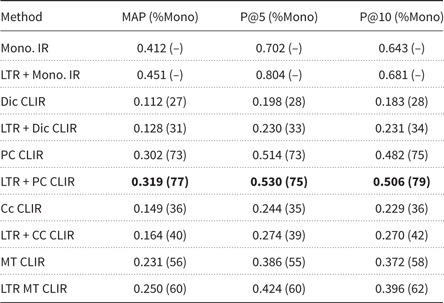
In these set of experiments, Persian queries are used for retrieving Persian documents. We implement BM25 and LTR methods using Persian queries. For training the models of LTR methods we use monolingual features listed in Table 1. In Table 5, the results of the first set of experiments are shown. As can be seen from this table, the LTR method outperforms Okapi BM25 for monolingual IR. Okapi BM25 is one of the features used for training the ranking model of AdaRank method. The performance of AdaRank in terms of MAP is 0.4531, which is 10% better than the performance of Okapi BM25.
Results of CLIR methods on Hamshahri collection (In each column, the best result is bolded)

Mono., Dic, PC, CC, and MT are monolingual, dictionary, parallel corpus, comparable corpus, and machine translator.
We have conducted statistical significance test (t-test) on the improvement of LTR method over the Okapi BM25. The results indicate that improvement of this method over Okapi BM25 in terms of MAP is statistically significant (p-value < 0.05).
5.3.2 Dictionary-based CLIR experiments
In these set of experiments, we use a dictionary for translating English queries to Persian. We implement Okapi BM25 model on the translated queries. Also, we implement the proposed feature mapping method using a dictionary and employ the mapped features alongside named-entity-based features for learning the ranking model of LTR methods. For translating English queries to Persian, we use Aryanpour English–Persian dictionary.Footnote c
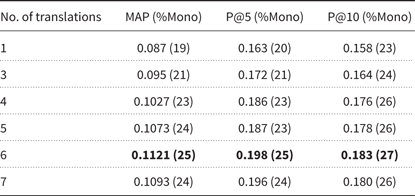
The results of dictionary-based CLIR method are shown in Table 6. In this experiment, the queries are translated using the dictionary such that the first N translations for each English word are selected as its translation. As can be seen from Table 6, the best result of this method is achieved when N = 6. The translated queries are used for calculating the Okapi BM25 score of documents. The results of dictionary-based CLIR with N = 6 are selected as the baseline of dictionary-based method to be compared to other methods.
CLIR results on Hamshahri collection using dictionary (In each column, the best result is bolded)

%Mono shows the relative performance of the CLIR system compared to the performance of the monolingual system.
In order to increase the performance of dictionary-based CLIR, we use the dictionary for estimating the features expressed in Section 3. We consider the probability of translation of each English word e to its associated Persian words in the dictionary to be uniform, that is, 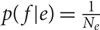 $p({\kern 1pt} f|e) = {1 \over {{N_e}}}$, where Ne is the number of Persian words associated to the English word e. After estimating the features, we use them as training data for learning the ranking model of LTR methods. In Table 5, the results of this experiment in terms of MAP and P@n are shown. In this experiment, we considered N to be 6, which is the optimal value for N.
As the results show, LTR methods for dictionary-based CLIR outperform Okapi BM25 method. We have conducted statistical significance test (t-test) on the improvements of AdaRank method over Okapi BM25 method. The results show that the improvement of AdaRank over Okapi BM25 method is not significant in terms of MAP, P@5, and P@10. We believe that since the accuracy of dictionary for query translation is very low, combining different features estimated using the low accurate dictionary does not add any useful information to the Okapi BM25 feature.
5.3.3 Parallel-corpora-based CLIR experiments
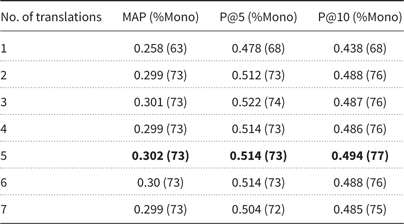
In these set of experiments, we do CLIR based on parallel corpora. For each query word, we select its N most probable translation candidates and construct the query in the target language. We use IBM model-1 to extract a probabilistic dictionary from 20M parallel corpus. After translating queries, we implement Okapi BM25 method for calculating the similarity of queries and documents. Table 7 shows the results of these set of experiments for different values of N. As the results show, the best performance in terms of MAP and P@5 is achieved with N = 5. The performance of this method in terms of MAP is 0.302, which is 73% of the MAP of monolingual method.
CLIR results on Hamshahri collection using parallel corpus (In each column, the best result is bolded)

In order to improve the performance of parallel-corpora-based CLIR, we implement the method described in Section 4.1, which uses parallel corpora for extracting translations and employs the extracted translations for estimating the cross-lingual features. After estimating the features, we use the mapped features and named-entity-based features for constructing the ranking model of LTR methods. In Table 5, the results of this experiment are shown. The LTR method using parallel corpus outperforms using the parallel corpus for translating the queries and then performing monolingual retrieval. The performance of AdaRank in terms of MAP is 0.319, which is 6% better than using parallel corpus for CLIR. Conducted statistical significance test (t-test) shows that the improvements of AdaRank for CLIR over the basic method in terms of MAP are statistically significant (p-value < 0.05).
5.3.4 Comparable-corpora-based CLIR experiments
In these set of experiments, we employ UTPECC corpus to translate the queries. The performance of Okapi BM25 in terms of MAP using translations extracted from UTPECC corpus is 0.149, which is 36% of the MAP of monolingual method. Also, in these experiments, we exploit comparable corpora for mapping monolingual features to cross-lingual ones and constructing the training data of LTR methods. In Table 5, the result of these set of experiments are shown. The results show that LTR approach could be very useful for comparable-corpora-based CLIR. The performance of AdaRank is 0.164 in terms of MAP, which is 10% better than the basic method described in Section 4.1. We have conducted statistical significance test (t-test) on the improvements of AdaRank method over the basic method. The results show that, this improvement is significant in terms of MAP (p-value < 0.05).
5.3.5 Machine-translation-based CLIR experiments
In this research, we employ Farazin machine translatorFootnote d for translating English queries to Persian. Farazin is one of the high-quality machine translators for the English–Persian language pair. We submit each query to this system and the system returns the translation of the whole query. We consider the machine translator as a black box in which the input is a query and the output is the translated version of the query. The translated query is used to implement Okapi BM25 method. The performance of this method in terms of MAP is 0.231, which is 56% of MAP of monolingual method. This result shows that using a machine translator as the translation resource results in better performance compared to using a dictionary or a comparable corpus. However, using a machine translator as a black box is not more effective than using a parallel corpus in CLIR.
Moreover, we use the translated queries achieved from the machine translator for estimating the cross-lingual features. Since the machine translator does not provide translation probabilities, we use the translated query as a monolingual query and estimate the monolingual features listed in Table 1 using the translated queries. The results of using LTR for machine-translation-based CLIR are shown in Table 5. Using LTR for machine-translation-based CLIR outperforms the Okapi BM25 method. The performance of LTR-based CLIR method in terms of MAP is 0.250, which is 8% better than the Okapi BM25 method. The improvement of the LTR method over the Okapi BM25 is statistically significant in terms of MAP (p-value < 0.05).
5.3.6 Multi-resource-based CLIR experiments
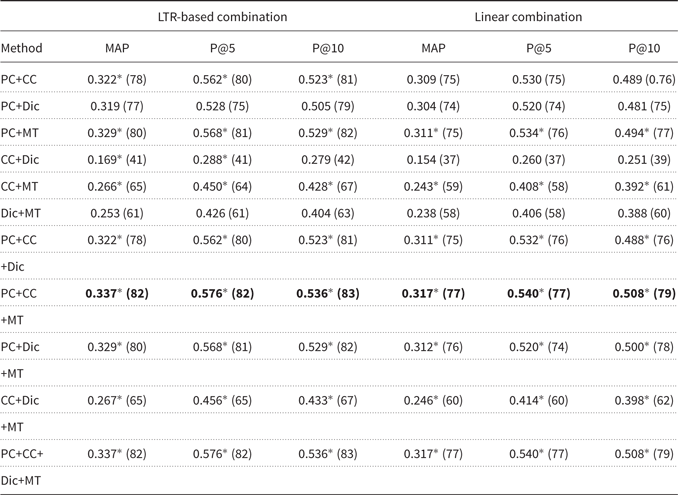
In these set of experiments, we implement the combination method described in Section 4.2 and study the effectiveness of different resources in CLIR. The results of different combinations of these resources are shown in Table 8. The performance of the LTR approach using a combination of resources is better than the performance of this method using each single resource. Moreover, the results show that the LTR-based combination method outperforms the linear combination method which is one of the most widely used combination methods.
LTR for combining parallel corpus (PC), comparable corpus (CC), machine translator (MT), and dictionary (Dic) results (the numbers in parentheses are %Mono) (In each column, the best result is bolded)

* The improvement achieved in that metric is statistically significant compared to the corresponding single-resource-based CLIR method.
Among different combinations, combination of parallel corpus, comparable corpus, and machine translator has the best performance. This shows that these resources are providing complementary signals for query translation. Parallel corpus and machine translator suggest the exact translations of the query and comparable corpus expands the query by related words and combining these translations improves the performance of CLIR. The results show that adding the features extracted using dictionary to the features extracted using parallel corpus does not have any effect on the performance of the LTR method. The features extracted using dictionary are very inaccurate as the translation probabilities are estimated naively in dictionary-based feature mapping. In contrast, the translation probabilities obtained from parallel corpus are more accurate. Therefore, adding low-quality features estimated from the dictionary cannot improve the ranking model constructed based on the features extracted from the parallel corpus. Moreover, the results show that adding dictionary-based features to the comparable-corpus-based features increases the performance of both dictionary and comparable corpus for CLIR. This result shows that unlike parallel-corpus-based LTR for CLIR, dictionary adds useful information to the ranking model of comparable-corpus-based LTR. Dictionaries are usually human made. Thus, by using the dictionaries, we can extract the exact translations of query words. Also, as the aligned sentences in parallel corpus are exact translations of each other, translations that are extracted from parallel corpus for queries are usually exact translations of query words. Therefore, dictionary and parallel corpus tend to translate queries accurately. However, dictionary has the shortcoming of ambiguity compared to parallel corpus, which results in its poor performance in CLIR. Unlike parallel corpus and dictionary, comparable corpus tends to expand the query and extract related words to the query words. Therefore, combining each of parallel corpus and dictionary with comparable corpus adds new information to the comparable corpus and improves the performance of comparable corpus in CLIR.
The results show that LTR-based combination approach outperforms the linear combination method. The grid search method is used for adjusting the weights of translation resources in the linear combination method. We have conducted statistical significance tests on the improvements of the LTR-based combination method over the linear combination method. Experiment results show that the improvements are statistically significant in all combinations.
As an additional baseline, we use the method proposed by Azarbonyad, Shakery, and Faili (Reference Azarbonyad, Shakery and Faili2014) which exploits LTR for translating queries from English to Persian and then performs CLIR. The main intuition of this approach is exploiting multiple translation resources for disambiguation, de-noising, and aggregating translations extracted from the resources. This method considers query translation as a ranking task in which given a word in the source language, the goal is to rank its translation candidates in the target language and select the top-N candidates as the translation of the source language word. To build the ranking model, they extract different features which reflect the relatedness of source and target language words. Then, using these features, an LTR method is employed to learn a translation model for CLIR. We use the same translation resources used for building our proposed combination model to create the translation model proposed in Azarbonyad et al. (2014). This method achieves MAP of 0.3217, P@5 of 0.562, and P@10 of 0.518 using all translation resources. The results indicate that our used LTR approach (PC+CC+MT in Table 8) outperforms this baseline in terms of all evaluation metrics. This indicates that it is more effective to first estimate query–document relevance signals using different translation resources and then combine them using an LTR approach. LTR for query translation (Azarbonyad et al. Reference Azarbonyad, Shakery and Faili2014) has a reasonable performance and it outperforms the linear combination method, but it cannot take full advantage of the different translation resources.
5.4 Discussion
In this section, in order to gain additional insights into the proposed approach, we try to further analyze the factors that can affect the performance of LTR-based CLIR. We first do an analysis on the impact of the effectiveness of different translation resources on query translation. We compare the performance of different CLIR methods based on different resources. The second analysis is performed on the impact of different features introduced in this paper on constructing the ranking model of AdaRank.
5.4.1 Comparing the effectiveness of translation resources for CLIR
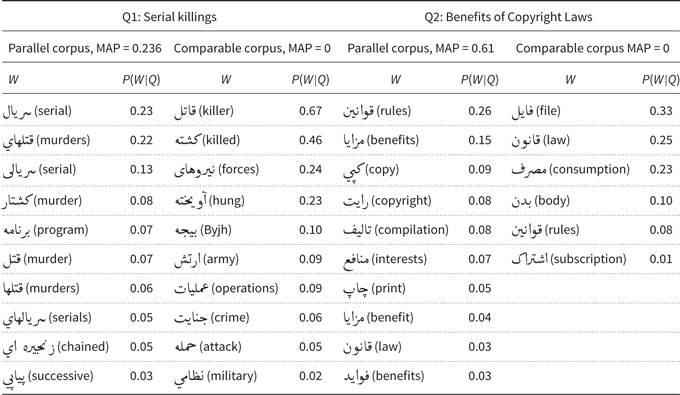
In this section, we study the effectiveness of different translation resources for CLIR. Among different translation resources, parallel corpus has the best performance in CLIR and dictionary has the worst performance. The performance of dictionary-based CLIR (without LTR) in terms of MAP is 0.112, which is very low compared to the performance of other resources. A possible explanation for the poor performance of dictionary in query translation is its limited coverage and ambiguity. Experiment results show that there are a total number of 64 out of vocabulary (OOV) words when we use dictionary for query translation, while the number of OOV words for comparable-corpus-based CLIR is 24, for machine-translation-based CLIR is 12, and for parallel-corpus-based CLIR is 4. Although an average parallel corpus has a better performance compared to the comparable corpus, for some queries it can be seen that the comparable corpus can perform better. In Table 9, some queries on which the parallel corpus has better performance compared to the comparable corpus are shown. We can see the effect of noisiness of the comparable corpus on the performance achieved for queries in Table 9. For example, in Table 9, the Persian word “بيجه /Byjh” has a high probability of relatedness to the query Q1. This word is the name of a predator in Iran. Since in the comparable corpus, this word has occurred with terms of the query, it has high translation probability to the query terms. In this example, we can see that the effect of query expansion and noisiness of comparable corpus sometimes could lead to a low performance of CLIR systems. Also, in Table 9, it can be seen that the translations extracted from comparable corpus for Q2 are very noisy. The low performance of comparable corpus in extracting translations of some words for CLIR also could be due to the effect of the method used for extracting translations.
Two sample queries for which parallel corpus has better performance compared to comparable corpus (The Persian words and their English equivalents achieved from Google Translator are shown)

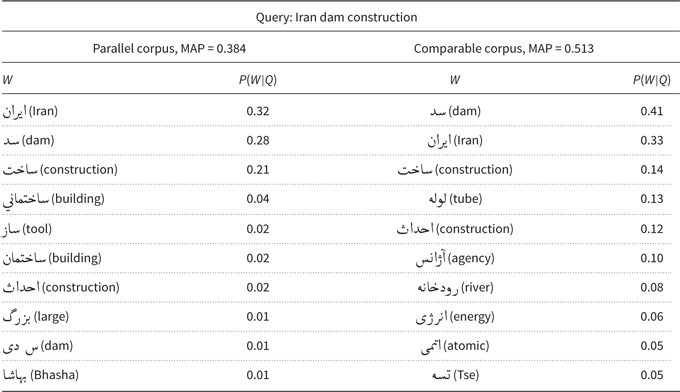
In Table 10, a query for which comparable corpus has better performance compared to parallel corpus is shown. This example shows that query expansion could also be very useful in query translation. In this example, we can see that parallel corpus does well in translation and the top three translations extracted from parallel corpus are exact translations of query terms; nevertheless the performance of parallel-corpus-based CLIR is lower than the performance of comparable-corpus-based CLIR for this query. The good performance of comparable corpus on this query is due to the effect of query expansion. For example, the words “لوله /tube,” “احداث/construction,” and “رودخانه /river” are relevant terms to the query which are extracted from comparable corpus and affect the performance of the CLIR system on this query in a good way.
A sample query for which comparable corpus can result a better translation compared to parallel corpus

The Persian words and their English equivalents achieved from Google Translator are shown.
5.4.2 Impact of features on LTR-based CLIR
In this paper, we use a method for mapping standard monolingual features to cross-lingual features. Also, we define a set of new named-entity-based features for CLIR. The results of different LTR methods for CLIR show that only a subset of these features contribute to the ranking models of LTR methods. Our results show that the features extracted using parallel corpus as the translation resource are more useful than those extracted using other translation resources. Among other features, machine-translation-based features, comparable-corpus-based features, and dictionary-based features are the next best features.
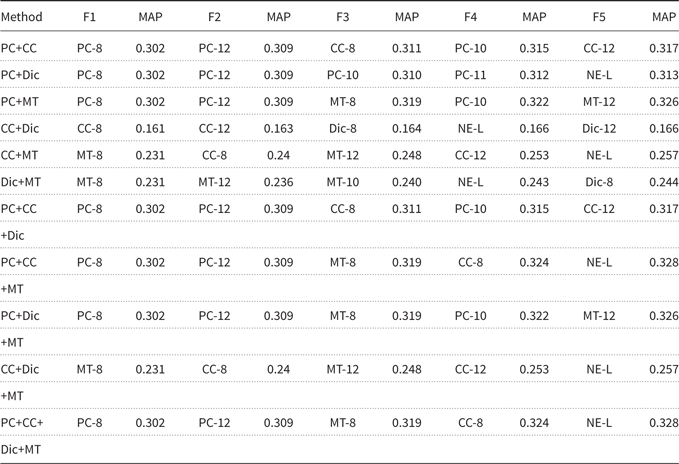
Table 11 shows the top five most effective features in the trained model of different combination methods. From this table we can make two general conclusions:
Among different features, generally, the cross-language BM25 feature (feature number 8 in Table 1) is the most important feature for CLIR. This feature is the best performing feature in different LTR methods. Language modeling features are the next best features. Among different language modeling features, the language modeling feature using Dirichlet prior smoothing has the highest impact. Also, the language modeling feature based on Absolute Discounting smoothing has a high contribution in constructing the ranking model. BM25 and language models are standard IR methods that are shown to have very good performance in IR, so the high performance of these features in CLIR was expected. Another important feature in different CLIR methods is the “location” named entity feature. This feature has a high contribution in different CLIR methods. Using the named entity recognizer, we find 35 “location,” 10 “person,” and 12 “misc” entity types in the whole 100 queries. The main reason that the “location” named entity has higher weight in the constructed models compared to the other entity types is the high frequency of this entity type in the queries. This result shows that named entities could be very useful in CLIR and by employing them in CLIR we can improve the performance of CLIR systems. Also, TF-IDF features (features number 5 and 6 in Table 1) are contributing to the ranking model of LTR methods.
As we expected, parallel-corpora-based features have higher contribution on the constructed model of different combination methods and in all combination scenarios which include a parallel corpus, the most dominant feature is a parallel-corpus-based feature. The features estimated using the machine translator are the next high impact features followed by the comparable-corpus-based features. Based on our analysis, the dictionary-based features have the lowest impact.
Top five features of models trained using multiple resources and their additive performance (e.g., The performance reported for F5 is the performance achieved by adding F5 to four selected features)

PC is parallel corpus, CC is comparable corpus, Dic is dictionary, MT is machine translator, NE-L is the named-entity-based feature with Location type. Features are numbered based on the resource used for extracting them and their ID in Table 1.
5.4.3 The reasons for the low performance of English–Persian CLIR
The most important factor that affects the performance of CLIR is availability of resources between source–target language pairs and their quality. These cross-lingual resources could be in the forms of bilingual corpora, dictionaries, or machine translators. Language pairs that have high-quality cross-lingual resources usually have better performance in CLIR. For language pairs such as English–French and English–Arabic, it has been shown that the CLIR performance can be as good as monolingual IR (Lavrenko et al. Reference Lavrenko, Choquette and Croft2002). For the English–Persian language pair, such high-quality bilingual resources do not exist. The size of parallel corpora for rich-resource languages is tens of millions of aligned sentences. However, for English–Persian language pair the biggest parallel corpus is 20M corpus which contains about one million aligned sentences. The lack of appropriate bilingual resources is one of the main reasons for the low performance of English–Persian CLIR. That is why in this paper, we tried to exploit all available resources to improve the performance of English–Persian CLIR.
Another factor that affects the performance of CLIR is availability of language-specific resources such as tokenizer and stemmer for source and target languages. Although, for English these resources are available with a high quality, for Persian, a tokenizer and a stemmer with reasonable quality do not exist. We employed available stemmers and tokenizers for pre-processing of documents in Persian. However, our results show that using low-quality stemmers and tokenizers has a bad effect on the performance of CLIR, and by employing them the performance of CLIR degrades. According to our observations, the problems related to stemming have a high impact on the performance of English–Persian CLIR. For example, for the word “film,” three top translations extracted from 20M corpus are “فيلم/film,” “فيلمها /films,” and “فيلمهای /films.” All these words are derivations of “فيلم /film.” However due to lack of a stemmer they have been treated as separate words. The translation probability of the word “film” is divided between these words and it can have a negative effect on the translation performance.
6. Conclusions and future works
In this paper, we employed LTR approach in CLIR. We mapped the widely used monolingual features to CLIR features using different translation resources. Also, we defined and extracted a set of new features using named entity recognition technique. We used these features for training LTR models. We designed different experiments to evaluate the proposed LTR approach for CLIR. Experiment results showed that LTR is very useful for CLIR and the LTR-based CLIR method significantly outperformed traditional and common CLIR methods.
Moreover, in this paper, we studied the effect of exploiting multiple translation resources in CLIR. We employed different translation resources for translating queries. We used a combination method based on the LTR approach to combine translations mined from different resources. We examined the proposed method by combining multiple translation resources. Experiment results showed that the combination method outperforms all single-resource-based translation methods. The best results of the combination method were achieved when we estimated features using parallel corpus, comparable corpus, and machine translator and used them for training the ranking model of LTR methods. Our results showed that this method improves comparable-corpus-based method by 126%, parallel-corpus-based method by 12%, and machine-translation-based method by 46%. This result shows that LTR can be very helpful for combining translation resources.
In this paper, we adapted common LTR features to be used in cross-language environment. An interesting future direction could be using contextual information such as phrases contained in translation resources for defining other useful features. Neural-network-based combination methods could also be very helpful for combining the translations extracted from different resources. Another interesting research direction is using LTR methods for re-ranking the translation candidates extracted from different resources. To do this, more specific features for this task can be defined and then LTR methods can be employed for learning a re-ranking model that re-ranks the translation candidates for queries. In this work, we evaluated our approaches on a publicly and commonly used CLEF data set for CLIR. It would be very interesting to apply the proposed approaches on other language pairs and data sets and analyze the generalizability of the proposed approaches to other languages.
Acknowledgements
We would like to thank the reviewers for their valuable and constructive comments.
Financial support
This work was supported in part by two grants from the School of Computer Science, Institute for research in fundamental sciences (No. CS1397-4-55 and No. CS1397-4-192).