




No CrossRef data available.
THE STELA AS A CULTURAL SYMBOL IN CLASSIC AND CONTEMPORARY MAYA SOCIETIES
Published online by Cambridge University Press: 28 March 2006
Abstract
In Classic Maya society, the stela was an important medium through which historical information was conveyed. Stelae are free-standing stone slabs carved in low relief that usually depict portraits of rulers, which are accompanied by hieroglyphic texts recording the rulers' identity and actions. Recent research has focused on the stela not only as a carrier of information but also as an important cultural symbol in its own right. In 1985, Linda Schele and David Stuart proposed that the Classic Maya called the stela a te'-tun, or stone-tree. This identification led to the recognition of cultural continuities among the Highland Maya in Chiapas who, on occasion, substitute trees for individual crosses on their cross shrines. In 1996, Stuart suggested that the ancient Maya word for stela was lakamtun, or big stone, emphasizing that the stela was an embodiment of the royal self in the sense that it shared some of the divine essence of the ruler. Drawing on epigraphic research, anthropological theory, the ethnographic literature, as well as personal field observations, I propose that certain spiritual and symbolic concepts of the stela continue to live in the crosses among the Maya today and that these concepts should be considered when we evaluate ancient contexts of meaning for the Maya stela.
Information
- Type
- Research Article
- Information
- Copyright
- © 2005 Cambridge University Press
The purpose of this essay is to analyze conceptual continuities that exist between the Classic Maya sculptured stone slabs called stelae and the wooden crosses used by contemporary Maya groups in the highlands of Chiapas. The point of connection between these seemingly different—at least with regard to materials—groups of objects is the symbol of the tree. Natural trees grow roots that penetrate deep into the earth or underworld; their trunks exist in the same realm as man; and their branches reach into the upperworld. In a Maya myth of cosmogenesis written down in The Book of Chilam Balam of Chumayel after the Conquest of Mexico, the gods raised symbolic trees of abundance in the four quarters of the world. These trees support the sky on their branches. In multiple ways, trees appear to establish connections between the vertical divisions of the universe, and so do the stela and the wooden cross. This study will draw on lines of evidence derived from epigraphy, iconography, and ethnography showing that the Maya understood and continue to understand stelae and crosses as manifestations of the tree symbol. The second part of the essay will examine the proposed continuities in the light of anthropological theory. Such an approach will clarify that the conceptual connections between the stone stela and the wooden cross are not esoteric and speculative interpretations on the part of the author but can be rationalized in the context of human psychology and behavior. The study will begin with a brief historical overview of the development of the stela cult, followed by a review of previous research on stelae.
HISTORY OF THE STELA CULT
Stelae are three-dimensional monuments in the format of carved stone slabs depicting human figures; often the depictions are accompanied by hieroglyphic texts. They were commissioned by the ruling elite to visualize and legitimize their claims to religious and political power. This type of sculpture was used by many Mesoamerican people but became most popular among the Maya. The stone materials, size of the stelae, and craftsmanship and carving styles varied from region to region, but stelae were generally displayed in public space, usually in the plazas.
The tradition of stela carving began in the Formative Period (1500 b.c.–a.d. 250) among the Olmec. Several carved stone slabs portraying high-status individuals are known from La Venta. For example, Stela 2 depicts a protagonist with a tall headdress surrounded by floating, supernatural figures. In Kent Reilly's view, Olmec protagonists such as the one on Stela 2 acted as “institutional shamans” who validated their power by publicly exhibiting their shamanic journeys in which they contacted the supernatural world (Reilly 1996). In the Late Formative period (350 b.c.–a.d. 250), stelae representing narrative scenes surrounded by Olmec-derived cosmological symbols were erected in the city of Izapa on the southern Pacific coast. Julia Guernsey Kappelman has shown that the iconography of most of the monuments in Group A alludes to the shamanic transformation of the Izapa ruler into his animal spirit companion, the Principal Bird Deity. Often such transformations are couched within the narrative context of stories written down in the Popol Vuh much later in the Colonial period—for example, Stela 2 (Guernsey Kappelman 2001:88–99, 104). Stelae with depictions of elite figures framed by Olmec symbols were found at the Highland Maya site of Kaminaljuyu. Most scholars believe that from Kaminaljuyu and other southern sites, the practice of stela carving may have spread to the Lowland Maya.
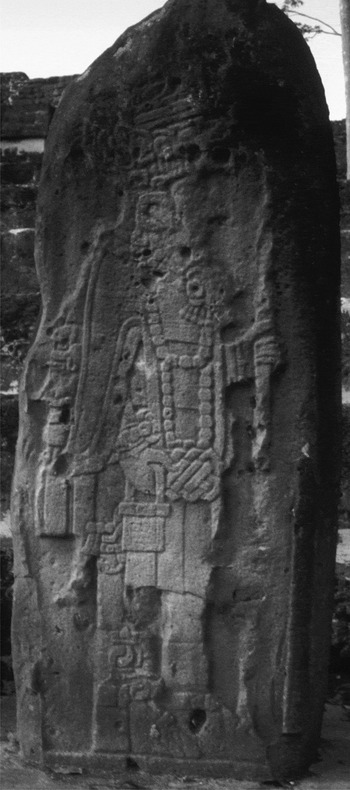
In the lowland area, the first stelae with ruler portraits were erected in the Early Classic period at cities such as Tikal and Uaxactun. At Tikal, the earliest monument is Stela 29 dated to a.d. 292 (Grube and Martin 2000; Harrison 1999:65). During the Classic period (a.d. 250–900), stelae became the most common medium of Maya stone sculpture. They vary considerably in size and the degree of relief carving. For example, the Early Classic staff stelae at Tikal are slightly taller than a human being and are carefully carved in a consistent low relief (Figure 1). However, Waxaklajun Ub'ah K'awil is portrayed in very high relief on his stelae in the Great Plaza of Copan, and the Late Classic monuments at Quirigua take on the form of towering pillars exceeding the height of an ordinary human being. At a few Maya cities, the erection of stelae was not common practice, but such exceptions may be due to the lack of stone types conducive to the format of stela carving, as at Palenque (although one stela was discovered and is on display at the museum on site), or to the function of minor sites as craft-producing locales, such as the chert-production site Colha. Some of the last stelae were set in place surrounding Structure A-3 at Seibal in the middle of the ninth century, and the custom of erecting stelae was discontinued as their patrons, the rulers of Maya cities, lost power.

Tikal, Stela 13. Photograph by the author.
HISTORY OF RESEARCH ON STELAE
It was only in the second half of the nineteenth century and in the early 1900s that stelae and their carvings began to receive scholarly attention (Bowditch 1910; Brasseur de Bourbourg 1868). Interestingly, most researchers turned their eyes to the inscriptions, the calendrical notations, and the reconstruction of the calendar rather than to the images (Brinton 1895; Morley 1915; Thomas 1882). The consensus among these scholars, with the exception of Sylvanus Morley, was that the content of Maya inscriptions was mathematical, calendrical, and astronomical. The most extreme view of this numerical interpretation was expressed by J. T. Goodman. He believed that the glyphs, ornaments, idols, stelae, and altars were built up of numerical symbols and dedicated to number worship. He asserted that all the pictorial elements, such as eyes, ears, and animal features, resolved themselves into number signs; that numbers were deified and uplifted as objects of adoration; and that the priests shown on the stelae wore “appropriately numerated regalia” (Goodman 1889–1902:79).
Our understanding of the Classic Maya stela changed profoundly in the 1960s when Tatiana Proskouriakoff published her study of the Piedras Negras monuments in which she demonstrated that Maya stelae recorded historical information (Proskouriakoff 1960). Since Proskouriakoff's breakthrough, epigraphy has focused on the reconstruction of dynastic histories of individual Maya cities—a research direction that has been remarkably successful (Martin and Grube 2003; Schele and Freidel 1990; Schele et al. 1980–2000). The carved images and iconography are now recognized as illustrations of the written texts and are used as an aid in the identification of individuals and in the reconstruction of history. Thus, most scholars understand the stela as a carrier of information.
However, few studies have concentrated on the format and medium of the stela itself. In 1985, Schele and Stuart presented an epigraphic approach and proposed that the Classic Maya word for stela was te'-tun, or “stone-tree.” Their argument was one of the earliest studies to connect the stela with the tree symbol and was based on Bishop Diego de Landa's description of New Year's ceremonies in Yucatan and the possible illustrations of these ceremonies in the New Year's pages of the Dresden Codex. The most thorough recent analysis of the New Year's pages in the Dresden, Madrid, and Paris codices has been provided by Karl Taube (1988:218–268).
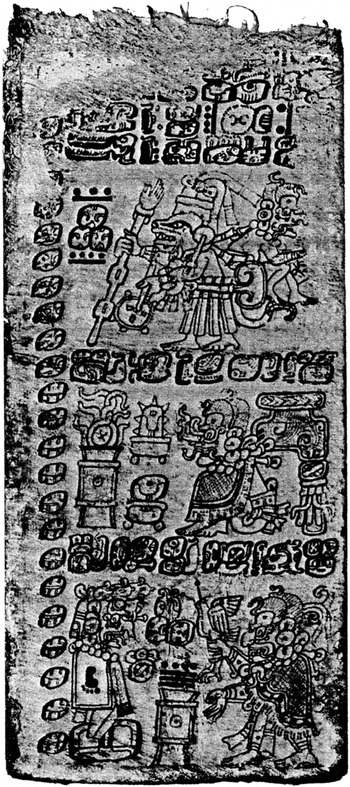
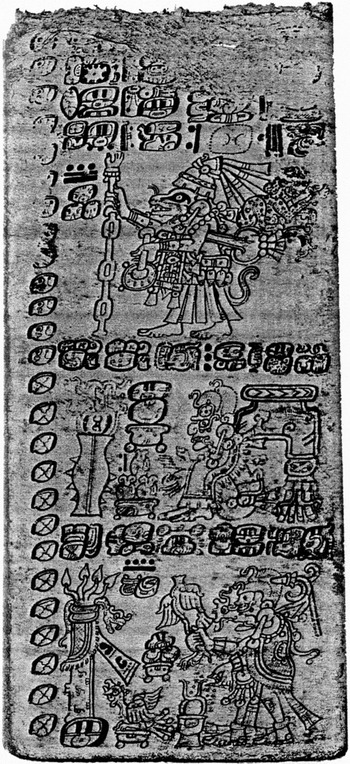
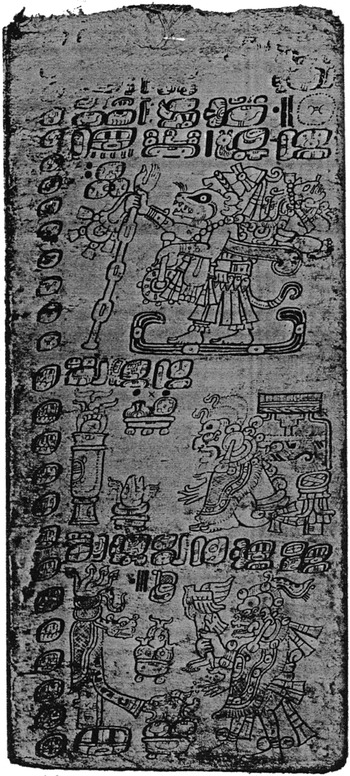
In the bottom register of pages 25–28 of the Dresden Codex, a human-like figure is shown making offerings to a draped pillar placed upon a haab' glyph. On page 25, this pillar is personified as the god Chac, while on pages 26–28, a snake is coiled around the top of the pillar and branches with single leaves sprout from it (Figures 2, 3, 4, and 5). The shaft of three pillars shows te' and cauac signs, with the meaning of wood or tree and stone, respectively. A reference to stone is repeated in the haab' glyph upon which the pillars are standing. This haab' glyph embodies a period of time that the Yucatec Maya called tun, or “stone,” because they set up stone markers at the end of certain periods, suggesting that they may have understood the adorned pillars as “stone trees” and as such stone markers. The scene of offering is reminiscent of Landa's description of the New Year's ceremonies. He reports that at the beginning of the short month Uayeb, the Yucatan Maya created a figure of the Yearbearer of the preceding year and called this figure Uayeyab. It received clothes, food, and gifts and was considered a ruler of the Uayeb rites. Landa mentions specifically that a priest perfumed the idol with incense, and a hen was sacrificed and offered to the image. The figure was carried in procession between the town entrances associated with the Yearbearer and the house of a chief where the year's ending was celebrated (paraphrased from Tozzer 1941:135–167). The offerings of incense and a beheaded hen are rendered in the bottom register of the New Year's pages, reinforcing the correspondences between Landa's account of the Year Ending celebrations and the illustrations in the Dresden Codex.

Dresden Codex (Kumatzim Wuj Jun 2001:25).

Dresden Codex, (Kumatzim Wuj Jun 2001:26).

Dresden Codex, (Kumatzim Wuj Jun 2001:27).

Dresden Codex (Kumatzim Wuj Jun 2001:28).
Schele and Stuart (1985) related the “stone trees” in the Dresden Codex to Landa's Acantun, which may be one aspect of the Uayeyab statue. Landa himself never made clear the exact identity of the Acantun. Acantun was interpreted as “set-up stone pillar” by John Eric Thompson (cited in Schele and Stuart 1985). Taube clearly sorts out the terminology and interpretations in reference to the “tree” symbols in the Dresden New Year's pages, which have been presented in the literature. Cyrus Thomas (1882:74, 81) first suggested that they represent the Uayeyab idols. Taube concludes that “the Acantun and the Dresden trees are conceptually related; both are identified with the four directions, the new year ceremonies and probably, the cosmogonic act of creation. However, at this point there is no reason to assume that the two are entirely equivalent” (Taube 1988:242).
Schele and Stuart (1985) found representations of trees similar to those in the Dresden Codex in Classic Maya iconography—for example, on the sides of Pakal's sarcophagus at Palenque. In Classic-period inscriptions, this general sign for “tree” consisting of a single large leaf attached to the end of a thick branch was combined with the T528:116 cauac glyph for tun, or “stone.” Together these signs read te'-tun, or “stone tree” (Figure 6). The te'-tun glyph occurs exclusively on stelae and in most cases in association with Period Ending dates on which the stela was erected. Hence, Schele and Stuart proposed a reading of te'-tun, or “stone tree,” for the stela. The word tetunte continues to be used as an expression for “stone” in the Copan region as well as in Guatemala (Schele and Stuart 1985:5).

(a) Te'-Tun Glyph from Copan Stela C; (b) Te'-Tun Glyph from Tonina M30 (from Schele and Stuart 1985). Drawings by Kerri Henrickson.
Taube essentially concurs with Schele and Stuart's understanding of the trees in the Dresden New Year's pages. In his view, the bottom sections depict the four gods of the new year placing offerings to their corresponding directional trees. He relates the trees to the four Imix trees of creation set up at the beginning of K'atun 11 Ajaw after a flood episode, as described in the Books of Chilam Balam of Chumayel, Tizimin, and Mani (Taube 1988:214, 239). It should be emphasized that the tree symbolism outlined here is not strictly Maya but very much Mesoamerican; see, for example, the analysis of Mesoamerican creation mythology by Lopez Austin and Lopez Lujan (2002:34–39).
In addition, Taube mentions that Stephen Houston first pointed out that the initial glyph in the horizontal texts corresponding to the lower section of the Dresden New Year's pages is strikingly similar to the Classic verb tz'ap, which Nikolai Grube has read as “to stack, to erect, to drive into the ground” (Martin et al. 2002:87). In Classic Maya stelae texts, tz'ap usually records the erection of the monument. If this verb is indeed present in the New Year's pages, it would suggest that the Dresden trees were set up like the Classic stone stelae, thus documenting in writing the cultural continuities carried over from the Classic to the Early Postclassic period (a.d. 900–1250), when the Dresden Codex was likely fashioned (Taube 1988:203–204, 239).
Schele and Mary Ellen Miller strengthened the argument that stelae were symbolic stone trees by adding evidence from the iconography. They noticed the similarities between a loincloth design that rulers wear in many stela compositions and the imagery of the tree symbol on the Sarcophagus Lid and the Tablet of the Foliated Cross at Palenque (Schele and Miller 1986:77). The edges of the loincloth display fret-like designs that terminate in serpent heads with squared-off, curling noses. These serpent-frets are related to the square-nosed serpent heads that transform the ends of the branches of the trees on the Lid and the Tablet. The central design on the loincloths is a deity mask identified by its large, squinting eyes and a sign for mirror infixed in its forehead. Again, the same deity appears on the trunk of the trees on the Palenque panels. This being is God C.
Studies in texts and iconography by Schele and Stuart (cited by Tate 1992:56) have demonstrated that the God C loincloth symbolizes the blood the ruler has let in autosacrifice as well as his blood or descent line. Carolyn Tate addresses the multivocality of the God C symbol and how its contexts of blood and tree might be connected. She refers to a collection of papers from Yucatan dating to the time of the Conquest that includes a genealogy of the Xiu family. One illustration shows the reclining figure of the paterfamilias, Tutul Xiu, with a tree emerging from his loin. The fruits of this tree are the names of his descendants. Tate argues that the blood context of God C can be understood as bloodline of descent and that the tree symbols on the Tablets and the Sarcophagus Lid at Palenque connect the ruler to his ancestors like the tree of Tutul Xiu links him to his progeny (Tate 1992:56–59, Figure 21a). At the same time, the style of the Tutul Xiu drawing shows strong European influences, and it may primarily depict a European-inspired family tree. Grube (1989) has suggested that God C also personifies the spirit of the world tree. It follows that the loincloth becomes a condensed image of the tree with the deity mask in the center and two branches folded down its sides in the form of serpent-frets. Dressed in this loincloth, the ruler became identical with the world tree and its range of symbolic functions, such as that of a communication channel between the world of man and the ancestors and supernaturals above and below. However, it remains ambiguous whether the identification of the world tree is with the ruler alone or with the ruler and the stela. It would seem that this line of evidence primarily associates the ruler with the world tree, because, for example, Yaxchilan rulers wear the same God C apron on several lintels that clearly do not share the tree symbolism of the stelae (Matthew Looper, personal communication 2005).
In 1996, Stuart distanced himself from the 1985 reading of the stela as te'-tun. He now states that “the pictorial qualities of a hieroglyphic sign are seldom a firm basis upon which to propose a new reading” (Stuart 1996:153). His research for a phonetic and therefore more objective reading of the plant-like element that often precedes the tun glyph in texts on stelae produced the spelling la-ka-ma. Combined with the tun glyph, the Classic Maya word for stela would thus be lakam-tun, or “lakam stone.” The word lakam may mean “flag, banner, and large stone.” Therefore, the ancient Maya word for stela may simply translate as “big stone” (Stuart 1996:154).
Stuart's argument rests on phonetic signs that are often attached to the plant-like element and on one example, on Copan Stela A, in which the same phonetic signs accompany a readable glyph followed by tun. This sequence is read la-ka-ma-tun-ni (Stuart 1996:153–154). It is his primary evidence for substituting the lakam-tun for the te'-tun reading of stela. Perhaps it is too early to draw the conclusion that, based on the evidence on Copan Stela A, the reading of the plant-like element is indeed lakam. It would help to see other examples supporting this reading, which have been found but are not mentioned in Stuart's 1996 article (Looper, personal communication 2005). Further, Stuart seems to dismiss the data from the Dresden Codex too quickly. The Acantuns (tree-like forms) in the lower register of the New Year's pages not only display branches ending in single leaves, but their trunks show the double bumps characteristic of the glyph te', which means “tree,” as well as cauac markings that identify the glyph for “stone.” The New Year's pages in the Dresden Codex appear to present a strong case that the Yucatec Maya understood these tree-like forms as “stone trees,” and the same glyphic elements appear in the Classic-period inscriptions referring to the stela. More recently, Elizabeth Newsome has built another strong case in favor of the association of stelae with trees and pillars of the world. Her study focuses on the stelae of Waxaklajun Ub'ah K'awil in the Great Plaza of Copan and demonstrates that the stela/tree symbolism is still sound, even though the te'-tun reading may be outdated (Newsome 2001:xvii). This suggests that our understanding of the meaning of monuments should not be determined solely by hieroglyphic labels and that such monuments most likely had symbolic connotations that were never captured by their historical Maya names.
Stuart further explores the relationship between the portraits on stelae and the actual individuals who were depicted. He concludes that stelae were in fact extensions of the royal self, meaning that they not only displayed an image of a person but manifested the body and essence of that person in a very literal sense. This interpretation is supported by hieroglyphic terms used in portrait captions, such as bah, which Stuart translates as “the body/person/self of” (Houston and Stuart 1998). “Such captions do not simply label an image or identify the person acting out some episode or event but may convey the understanding that the image embodies that figure” (Stuart 1996:164). If a stela portrait renders a ruler present, he would be shown in a perpetual state of ritual action, and portrait stelae would function as rituals in stone. Altars that were placed in front of many stelae could then be seen as actual objects on which the ruler literally presented his offerings. In Stuart's view, stela and altar groups were something like “performance” pieces.
This line of thinking leads us back to the earlier discussion of the loincloth iconography. If the stela truly embodies the ruler, then the two become identical; when the loincloth identifies the ruler as the personification of the world tree, the same applies to the stela. Simon Martin (2005) has presented an intriguing iconographic argument suggesting that the ruler could become the Maize God, who in turn is often labeled in hieroglyphic captions the ixim-te', or Maize Tree. On a number of vases (K4331, K6547, K631), the Maize God is depicted as a tree from which, at times, cacao sprouts. One could extend this reasoning and build a case that all these roles and identities of the ruler also apply to the stela if the two share the royal essence and substance. Yet exploring this direction further would digress too far from the topic of this essay, the stela, which is not explicitly marked as a Maize Tree. Bishop Landa's description of the production of wooden images in sixteenth-century Yucatan makes clear that the artistic process was understood as a manipulation of spiritual forces in the sense that the souls of the ancestors to be depicted had to be induced to enter their images, and that this process was approached with great awe. Tate (2001:125) has argued that similar spiritual forces were likely present in Classic Maya stelae.
Stuart continues his discussion by identifying one of the most common events associated with stelae on Period Endings. He deciphers the “tun-over-hand” glyph as k'altun, which may mean “stone-binding” (Stuart 1996:155). This reasoning is based on other occurrences of the “hand” verb with a “mirror” element. Stuart likens this “mirror” to oblong stone celts similar to those portrayed on stelae hanging from the belts of rulers. Several of these celts bear figural portraits and hieroglyphic texts and resemble miniature stelae, such as the Leyden Plaque. He shows that, “in the inscriptions of Chichen Itza and northern Campeche, the hand-mirror verb is replaced by the syllabic sequence k'a-la, suggesting the logographic value k'al” (Stuart 1996:155). By means of substitution evidence, he arrives at the reading k'al-tun for the “tun-over-hand” verb. In Cholan and Yucatecan languages, k'al is the word for “score,” but it can also be a verb meaning “to fasten, enclose.” Stuart (1996:156) translates the term k'altun as “stone-binding” and suggests that the similar term k'atun for a period of 7,200 days (or 20 Maya tuns) was derived from this ritual event.
It is most fascinating that the Maya illustrated this same ritual event on the peccary skull unearthed in Tomb 1 of Copan (Figure 7). In the central cartouche incised on the peccary skull, two seated figures flank an upright object marked with “stone” or cauac elements that identify the glyph for “stone.” The shape and size of the central object suggest that it is a stela, and it appears to be wrapped with bands of tied cloth. In front of the upright stone stands a possible zoomorphic altar similar to those visible in Copan's main plaza. A short hieroglyphic caption above the scene uses the k'altun verb. Stuart's translation is “1 Ahaw 8 Ch'en 8.17.0.0.0. (is) the stone-binding (of) (ROYAL NAME)” (Stuart 1996:156). While the carving on the peccary skull is very persuasive in support of the k'altun reading of the “tun-over-hand” verb and its translation as “stone-binding,” one may again caution against the scarcity of examples. To my knowledge, the peccary skull is the only example in which the Classic Maya portrayed the act of stone-binding so explicitly. Another example is K718, which shows a painted stela wrapped with what may be cloth and a bound jaguar on top. Some of the Copan altars display knots and ropelike elements along their sides, and the diagonally oriented text on Copan Stela J has been interpreted as a wrapping pattern. We have seen that the “stone trees” on the New Year's pages of the Dresden Codex are dressed with skirts and loincloths. Landa also mentions that the newly carved images of ancestors were fed with incense and wrapped in cloth (Tate 2001:125). These could be practices at least similar to Stuart's “stone-binding.”

Peccary Skull from Copan, Tomb 1. Drawing by Kerri Henrickson after Barbara Fash.
The evidence thus supports the conclusion that the Classic Maya fastened cloth around some of their stelae, perhaps primarily around plain stelae. This activity could be related to the contemporary Maya practice of “dressing up” wooden crosses and statues of saints, which will be discussed shortly. However, it does not seem logical to cover up the carved images and texts—especially if they embodied the royal person—at least as long as the stela fulfilled its role in public space.
The view of stelae as performance pieces, where rituals were acted out and offerings were placed, and not simply as the material background for recorded history has now been supported by a number of scholars. In her analysis of the design of Yaxchilan as a ceremonial city, Tate has focused on the aesthetic power the stelae held not only in their form but also in their spatial relationships to the architectural and natural environments (Tate 1992:31–34, 116–137). Matthew Looper has shown that Platform 1A-1 at Quirigua commissioned by the Late Classic ruler K'ak Tiliw functioned as an open performance space for world-renewal rites and acts of cosmogenesis conducted on Period Endings. Emulating the sculpture program of Waxaklajun Ub'ah K'awil at Copan (Newsome 2001), K'ak Tiliw had his stelae set up as independent sculptures in the open space of the platform, where they likely served as focal points of processions and as loci for sacrifice and prayer. Looper's interpretation is substantiated by quantities of modeled effigy censer fragments found often in association with the monuments (Looper 2001:128).
Ethnography offers another fruitful avenue from which to investigate the stela/tree symbolism. Tree symbols have been observed in contemporary Maya practices in the highlands of Chiapas (Newsome 2001:212–213; Vogt 1969:388, 1981). Here, tree branches or small trees often substitute for individual crosses in cross shrines. Crosses are erected in many highland villages in Chiapas as well as in Guatemala. In 1990–1991 and 2004–2005, I documented crosses in Zinacantan, Chamula, San Pedro Chenalho, Tenejapa, and in 1995–1996, 1999–2000, 2002–2003 at the popular shrine Pascual Abaj in Chichicastenango and at Utatlan. Crosses may be a ritual device concentrated in the highlands because, as we will see, one of their aspects is to provide access to the mountain gods. However, references to crosses also come from Yucatan. For example, in the Books of Chilam Balam, the Priest of Mani predicts that at the conclusion of K'atun 13 Ajaw, the Itza will see the symbol of the God Hunab Ku as an erect tree. The editors add that a cross with four arms of equal length was also the symbol of Quetzalcoatl-Kukulcan (Craine and Reindorp 1979:74). Taube recorded stone piles with wooden crosses at the entrance of a number of Yucatec communities. He associates them with the locus of the Uayeyab figure during the Uayeb festival, which Landa describes as heaps of stone (Taube 1988:279, Figure 89). He cites additional examples documented by Robert Redfield and Alfonso Villa Rojas and by John Sosa. Redfield and Villa Rojas discuss a ceremony called loh cah, during which the h-men buries certain objects at the four entrances of the village, “where stand the crosses and the balams” (Redfield and Villa Rojas 1934:175). Sosa mentions another loh cah ceremony performed at a town called Yalcoba. He talks about offerings made to specific deities and Yalcoba's guardians, which have to be “placed on the stone altars of the saantoh de ce crosses” marking the four corners of the town (Sosa 1985:343–344). Based on my observations, crosses are probably most abundant at Zinacantan (Figure 8) and best represented in the literature through the anthropological fieldwork of Evon Z. Vogt, who has provided an understanding of Zinacanteco customs and traditions to a wide audience (Vogt 1969, 1981, 1993 [1976]). Therefore, the following data are from Zinacantan, but I feel confident in stating that similar practices exist in most contemporary Maya communities. I remember noticing numerous wooden crosses along the roadside when driving on the small roads that connect highland villages and towns in Chiapas. Most of these crosses marked water sources, and they demonstrate that the practice of erecting crosses is well known and widespread throughout the region.

Cross Shrine in the Mountains of Zinacantan. Photograph by the author.
Vogt lists the following contexts in which wooden structures in the form of Christian crosses may be erected: on top of the roof of a house; perpendicular to the main door in the patio outside a house; on top of maize stored in a granary; on top of a church; in a churchyard; around the edges of the heart of the ceremonial center, frequently, but not always, at street intersections; beside a waterhole; in a cave or limestone sink; at the foot and summit of the mountain residences of the ancestral gods; at the “meeting places of TOTIL ME'ILETIK” that are called KALVARYO; and at the head of a grave in the cemetery (Vogt 1993 [1976]:44). On one level, these crosses are Catholic Christian symbols—primarily those on and around churches and those that seem to function like tombstones. The Zinacantecos, however, describe them as “doorways” or “entryways” to the houses of the ancestral gods. They are means of communication with deities and with the ancestors. Further, the term “doorway” evokes images of corresponding walls or boundaries of some kind. Thus, the crosses function as gateways to, as well as boundary markers for, the sacred houses of the ancestral gods, and in a general sense they delineate significant units of sacred and social spaces (Vogt 1993 [1976]:6, 44).
To be effective in any ritual activity, a cross shrine must consist of three crosses. If only one or two wooden crosses are present on a shrine, pine trees are added next to the standing crosses. If there are no wooden crosses at a place where a ritual must be performed, the triple crosses can be symbolically created by placing three pine trees in the ground. During the Year Renewal festivities in late December 2004 and early January 2005, I noticed such ad hoc cross shrines in the street in front of the houses of two high-level cofradia members. To activate a cross shrine for any kind of ceremony, three small pine trees have to be present, either attached to the wooden crosses or substituting for them, and the base of the crosses and the ground in front must be covered with pine needles. Pine trees grow wild in the Chiapas mountains and are symbols of the forest and nature. By extension, the crosses themselves become a symbol of the uncivilized and uncontrolled forces of nature. Further, the three pine-tree tops symbolize the three pines that surround the supernatural corrals located in the mountain homes of the gods where the wild animal companions of the Zinacantecos are kept (Vogt 1993 [1976]:6).
Before any ritual begins, bundles of red geraniums are tied to the three pine trees. Geraniums are cultivated in the gardens of the Zinacantecos and symbolize the domain of “culture.” Consequently, the placement of the pine trees is always outward, toward the world of nature, while the red geraniums always face inward, toward the world of culture—that is, the ceremonial center with the house patios, the churches, and the seat of community government (Vogt 1993 [1976]:6).
Vogt's consultants described the flowers as the “clothing” for the crosses. Could this be a conceptual parallel to the “binding” of Classic Maya stelae with cloth as reconstructed by Stuart? Though nobody could give a definite answer, I think the underlying ideas of activating and making certain objects sacred by attaching secondary materials are the same. The red geraniums symbolize a man's kerchief with bright red tassels, which in turn are called SNIC POK', “flower of the kerchief.” Cross shrines are said to resemble three ancestral gods, “dressed and waiting for candles for their food” (Vogt 1993 [1976]:49). Crosses are often referred to as SANTOETIK and are classified with the saints' images.
These observations indicate that Zinacanteco crosses have multiple symbolic associations. The practice of substituting pine trees for crosses implies that the crosses themselves are understood as a type of tree and share the connection of the tree to nature and uncivilized forces. The concept of “dressing” and “feeding” the crosses reveals that, on one level, they are personified and take on individual characters, like the stone stelae according to Stuart. Further, the relationship between crosses and people is reinforced in one particular kind of cross shrine, the “cross at the entrance to the house,” erected just outside the principal house of a Zinacanteco domestic group. A domestic group typically consists of a patrilocally extended family occupying two or more adjacent single-room houses. The house cross represents the smallest unit in the patriline within the patrilineage and is the symbolic focus for the domestic group. It signifies the unity of the group, and a simple count of all of these crosses in Zinacantan provides an approximate total number of domestic groups living in the municipio (Vogt 1993 [1976]:24).
It thus appears that a strong argument can be made for a correlation between the Classic Maya stela and the Zinacanteco cross based on the concept of tree symbolism. The primary evidence for associating stelae with trees came from the Dresden Codex, loincloth iconography, and tree icons on several monuments from Palenque. Today, when the Zinacantecos replace wooden crosses with pine trees, they repeat these ideas. Further, the stelae display rulers' portraits, while the “dressed” crosses are treated like ancestral gods who feed on the candle offerings. Both seem to embody powerful ancestors.
Patricia McAnany (1995) has analyzed ancestor worship among the Maya in a way that challenges traditional views about social organization and state formation. She presents evidence that ritual practices venerating ancestors were commonly performed from the Late Formative through the Classic into the Colonial period. Her primary data are burials and images of the ancestors. This assumed pervasiveness of ancestor worship in Maya culture is corroborated by Tate (1992:59–62), who describes the ancestor cartouches at Yaxchilan, and by Newsome (2001:215), who concurs that the Classic Maya may have placed offerings to the ancestors at the bases of all stelae. The Zinacanteco cross shrines extend the tradition of creating icons of important ancestors into the present. McAnany (1995:39–40, 125–144) further argues that, while ancestor worship developed initially during the Late Formative as a kinship ritual linked to land entitlements, it was appropriated and transformed by Classic-period rulers into a ritual legitimizing kingly authority. I would add that Zinacanteco wooden crosses take the cult of the ancestors back into the realm of the kin group. For example, some crosses designate water holes as belonging to specific social units.
PERSPECTIVES FROM ANTHROPOLOGICAL THEORY
The abundance and complexity of information about Classic Maya stelae and contemporary wooden crosses raise the question of whether the ideas outlined here are disparate and mutually exclusive or whether they highlight different aspects of a very complex symbol. Does the reader have to subscribe to one or the other reading and subsequent interpretation, or, perhaps, do both views help us to better understand the levels of meaning the stelae and the wooden crosses hold in Classic Maya and contemporary Maya societies? I think the latter can be demonstrated by drawing on models offered by anthropological theory. The remainder of this essay will focus on applying some of the thought processes proposed by respected theorists to the questions raised by the stela and the wooden cross.
Victor Turner (1967, 1969, 1973) has written extensively about the Ndembu people in Africa, but his theoretical approach to the analysis of symbols and rituals in particular can be applied to other cultural contexts as well. Turner emphasizes the interrelatedness of symbol and ritual. “By ‘ritual’ I mean prescribed formal behavior for occasions not given over to technological routine, having reference to beliefs in mystical beings or powers. The symbol is the smallest unit of ritual that still retains the specific properties of ritual behavior” (Turner 1967:19). He assigns symbols to the categories of dominant and instrumental:
Dominant symbols appear in many different ritual contexts, sometimes presiding over the whole procedure and sometimes over particular phases. The meaning content of certain dominant symbols possesses a high degree of constancy and consistency throughout the total symbolic system…. Such symbols also possess considerable autonomy with regard to the aims of the rituals in which they appear. Precisely because of these properties, dominant symbols are readily analyzable in a cultural framework of reference…. They are relatively fixed points in both the social and cultural structures, and indeed constitute points of junction between these two kinds of structures [Turner 1967:31–32].
According to Turner, instrumental symbols must be seen in terms of their wider contexts—that is, in terms of the total system of symbols that makes up a ritual. The analysis of an instrumental symbol must focus on how it relates to other symbols in a given ritual and how it contributes to obtaining the goals and purposes of the whole ritual process (Turner 1967:32). I suggest that the Maya stela and wooden cross fit Turner's definition of dominant symbols because of the constancy of meaning proposed earlier and because they enjoy a certain autonomy with regard to the aims of the rituals conducted in front of them. By this I do not deny in any way the importance of analyzing stelae in their cultural context—that is, the rituals during or for which they were erected and the open or architectural spaces in which they were set up, as well as relationships to other monuments. I simply see the stela/wooden cross as very consistent symbols that “preside” over a number of different ceremonies.
Turner discusses three properties of ritual symbols that may help to clarify our understanding of the Maya stela and wooden cross. The first property is that of condensation. “Many things and actions are represented in a single formation” (Turner 1967:28). Looking at the symbols in question from this perspective, it becomes conceivable that they represent various things. I suggest that the Classic Maya understood the stela as “stone tree” and as “big stone,” and the Highland Maya see in their wooden crosses a form of the Catholic cross as well as “doorways” to the houses of the ancestral gods. One context may have been dominant over the other in certain rituals, but they were not mutually exclusive. While the contexts and associations may vary, the fundamental function of the symbols remained unchanged: the stela and the wooden cross acted and act as axes or channels of communication with the supernaturals who populate the vertical divisions of the world. From this perspective, the precise epigraphic reading of the Maya word for “stela” becomes secondary because, whether it was te-tun or lakam-tun, it does not alter the overall ritual process in which the stela was a dominant symbol. For the epigrapher and linguist, the identification of phonetic values in Maya hieroglyphs is essential, and the reading of the tree-like element as te or la-ka-ma brings two entirely different conclusions. The point I am trying to make here is that the symbolic function of the stela would have stayed the same regardless of whether the Maya referred to it as “stone tree” or simply as “big stone.”
The second property Turner attributes to ritual symbols is unification of disparate significata (Turner 1967:28). The disparate significata can be very general and encompass diverse areas, but they remain connected because they possess analogous qualities or by association in fact or thought. I think this second property assigned by Turner may confirm—as explained earlier—that the stela and the wooden cross have different meanings and associations depending on the ceremonies that are being performed. The stela first of all highlights and possibly embodies Classic Maya rulership; later generations venerated these rulers and their stelae as ancestors, and among the contemporary Maya, wooden crosses are related to ancestral gods. Thus, the themes of rulership and ancestor worship (McAnany 1995) become the disparate significata interwoven in the symbol of the stela/cross that maintain their function as communication channels with the supernatural world of the ancestors.
According to Turner, the third important property of dominant ritual symbols is polarization of meaning (Turner 1967:28). At one pole, which Turner calls “ideological,” is found an arrangement of norms and values that guide and control people as members of social groups and categories. At the other—“sensory”—pole are concentrated meanings that are natural and physiological phenomena and processes and those that can be expected to arouse desires and feelings. I think that with regard to the stela as an example of a dominant ritual symbol, the carved ruler portrait and the accompanying inscriptions would certainly have reinforced the norms, values, and political system in Maya society. At the sensory pole lay perhaps the tree symbolism, most obviously indicated by the fact that the stela sat in the ground like a tree. Desires and feelings would have been intensified by the ritual activities conducted around the monument. The wooden crosses of today mark sacred locations where the ancestral gods can be contacted, and they are visited on prescribed ritual pilgrimages. As mentioned earlier, they can be set up spontaneously in the street where an important ritual, such as the bull game, is about to take place. Thus, they manifest and reinforce the Zinacanteco belief system. The offerings made and ceremonies conducted in front of the crosses engage the emotions of any spectator. While watching the ritual killing of the bull late on the night of January 6, 2005, in Zinacantan, it became clear to me that the emotions aroused by traditional rituals and symbols—of which the fake bull constitutes another one—play a fundamental role in strengthening community identity and cohesion. Nights like January 6 remain the rare occasions during which most Zinacantecos, from babies to the elderly, spend the night among themselves (my son and I were the only outsiders), watching, talking, joking, socializing, laughing, eating, and drinking, and seemingly oblivious of any work or school schedule that awaits them the following morning. Vogt describes how, in similar ceremonies, clouds of smoke from burning copal fill the air; the shaman recites his prayers; a black chicken is sacrificed; and candles are lit. As they burn down, Zinacantecos believe that the gods consume them like food (Vogt 1993 [1976]). It is most likely that similar offerings were placed on Classic Maya altars as part of a similar ceremonial context. For example, Landa describes the following as places where blood and food offerings were made in the courtyards of temples: they had erected tall logs and near the stairway to the temple, they had a round and broad pedestal—a description that fits the Classic Maya altar—and half way up there was a slender upright stone; on top of the temple stairway they had another such pedestal (Rivera 1985 [1566]:90).
Edward Sapir also stresses that ritual symbols are stimuli of emotion. Sapir distinguishes between two principal classes of symbols. “Referential” symbols are agreed on as economical devices for purposes of reference, such as speech, writing, or national flags; “condensation” symbols are “highly condensed forms of substitutive behavior for direct expression, allowing for the ready release of emotional tension in conscious or unconscious form” (Sapir, as quoted in Turner 1967:29). A major difference in development between these types of symbols is that, “while referential symbolism grows with formal elaboration in the conscious, condensation symbolism strikes deeper and deeper roots in the unconscious, and diffuses its emotional quality to types of behavior and situations apparently far removed from the original meaning of the symbol” (Sapir, as quoted in Turner 1967:29). Recent studies in consciousness have shown that the categories of “conscious” and “unconscious” are not to be treated as oppositions. Human consciousness is understood as the product of social factors and therefore exists in a constant process of evolving (Pickering and Skinner 1990). As early as Sigmund Freud in the 1920s, scientists recognized that the conscious and unconscious are not two separate identities; instead, they consist of layers—Freud uses the terms “topographical” and “mental province”—which always interact in dynamic relations (Freud, as quoted in Pickering and Skinner 1990:268–274). George Herbert Mead was one of the first scholars to stress the use of symbols as an identifying element of human consciousness as opposed to sentience of animals. In fact, Mead narrowed human social interaction to an exchange of symbols, which has often been referred to as “symbolic interactionism” (Mead, as quoted in Pickering and Skinner 1990:190–197, 210).
This is not the time and place to explore the literature on consciousness studies any further, but I can at least suggest that, if the stela and the cross are “condensation” symbols according to Sapir's definition, the emotional quality of these symbols rested in the conscious (ritual acts described earlier) and unconscious provinces of the Maya mind. Freud and his daughter Anna characterized the id of the unconscious as the level where “the so-called ‘primary process’ prevails; there is no synthesis of ideas, affects are liable to displacement, opposites are not mutually exclusive and may even coincide, and condensation occurs as a matter of course” (Anna Freud in Pickering and Skinner 1990:277). This establishes very well the realm where cultural concepts may be passed on, and such an argument would at least help to resolve the problem that, on the one hand, there is strong iconographic and structural evidence that the wooden cross replaced the stela, but on the other, the Zinacantecos themselves seem to be unaware of any connection between the two. I think Sapir's definition of “condensation” symbols may offer one explanation for many disturbing and confusing field observations. For example, Freidel and colleagues (1993) built a strong case that the pole in the Palo de Voladores ritual at Chichicastenango is a modern version of the ancient World Tree. However, most of the people at Chichicastenango who watch the event do not recognize such profound symbolism. To them, it is primarily entertainment, an event “muy alegre.” The possibility that the ancient symbolism could survive somewhere in the unconscious might explain the discrepancy between research and real-life observations. This discrepancy has been brought into focus by postcolonial theorists who have argued that anthropology oftentimes degrades native peoples to commodities for research; that they are valued as leftovers from the past but not respected as active living and changing cultures (Chow 1996). It seems to me that Sapir's “condensation” symbol might offer a perspective that would contribute to validating both views.
Turner believes that ritual symbols are at one and the same time referential and condensation symbols, which he sees as a binary opposition that is structurally equivalent to his “ideological” and “sensory” poles. The essential quality of symbols “consists in their juxtaposition of the grossly physical and the structurally normative, of the organic and the social. Such symbols are coincidences of opposite qualities, unions of ‘high’ and ‘low’” (Turner 1967:29–30). He reasons that rituals are mechanisms that convert the obligatory into the desirable. The dominant symbol as a basic unit of ritual is instrumental in this transmutation process because it brings the ethical and jural norms of society into close contact with strong emotional stimuli. In the ritual process, which includes the physiological stimuli of music, dancing, copal incense, alcohol, feasting, and specialized modes of dress, the ritual symbol may bring together the qualities of meanings of its opposing poles. Thus norms and values become saturated with emotion, while the gross and basic emotions become ennobled through contact with social values (Turner 1967:30).
Looking at the stela and wooden cross from this perspective can prove very useful. Both played and play the role of a powerful symbol in their societies, and this power is well explained by their capability to reconcile fundamental human opposites. Every society struggles with the problem of how to enforce norms and rules but, at the same time, maintain some degree of loyalty and social cohesion. Ritual symbols that can do this are without question very powerful as well as useful. I think it is not unreasonable to suggest that it is this very ability to balance and harmonize such universal binary oppositions as rules and desires, intellect and emotions, society and individual—in general, the “high” and the “low”—that bestowed longevity on the stela and motivated its transformation into the wooden cross. According to Sapir's view, the conviction that the stela and wooden cross have the power to reconcile opposites has remained in the subconscious mind of the Maya people from Classic times to the present. Only the outward material manifestation of the ritual symbol has changed from the carved stone stela to the assembled wooden cross, bending and adjusting to changes in ritual content and performances as well as in social structure. Or, to put it in Turner's words, “we can see how the same dominant symbol, … in its aggregate of meanings stands for unity and continuity of the widest Ndembu [or Maya] society, embracing its contradictions” (Turner 1967:46).
Clifford Geertz (1973, 1983) also understands symbols as integral elements of religion and culture. Systems of symbols are culture patterns. Symbols give objective conceptual form to social and psychological reality both by shaping themselves to it and by shaping it to themselves (Geertz 1973:87–123). Such reasoning offers another way to explain the cultural continuities between the Classic Maya stela and the contemporary wooden cross. Responding to social and political changes, the stone stela was gradually transformed into the wooden cross, but not without imprinting its structural concept into the minds of the Maya people. Thus, they now materialize ideas related to the stela through the cross.
Geertz (1973:90) explains the power of symbols by the way they act to establish pervasive and long-lasting moods and motivations in men by formulating conceptions of a general order of existence and clothing these conceptions with such an aura of factuality that the moods and motivations seem uniquely realistic. I suspect that such moods and motivations were particularly aroused and fed during ritual performances conducted in front of the stela and the cross. As described earlier, modern practices probably provide a faint reflection of what Classic performances would have been like. As Stuart has argued, the ruler portraits in the stone would have come to life in a very real sense; in a similar way, the crosses resemble and possibly become ancestral gods when they are dressed with red geraniums and are waiting for their food in the form of candles.
Geertz agrees with Turner's and Sapir's view that symbols reconcile opposites but states his point in slightly different terminology. He emphasizes that the function of sacred symbols lies in their ability to identify fact with value and world view, which describes how things in sheer actuality are, with ethos, which are the evaluative elements of a given culture. By fusing world view and ethos, symbols give to a set of social values an appearance of objectivity and make them more believable. Geertz emphasizes that sacred symbols point not only toward the existence of opposites but also toward the conflict between them (Geertz 1973:126–128). I think he restates Turner's and Sapir's point that the ultimate power of ritual symbols rests in their capability to balance and harmonize universal human oppositions and in their effectiveness in accomplishing it.
In his more recent work, Turner has practiced a postmodern approach to anthropology. He emphasizes that “there is occurring a major move towards the study of processes … as performances” (Turner 1986:80). In the modernist way of thinking, Western and native cultures were two distinct, opposite, and stable entities that could be subjected to rational analysis. In the postmodern turn, Western and native cultures are understood as changing, interacting, and overlapping. While in the modernist colonial view, Western culture always exported its superior knowledge and commodities to the “inferior” native cultures, postmodern thinkers emphasize a give-and-take relationship in which nobody is inherently superior (see, for example, Chow 1996; Schevill, Berlo, and Dwyer 1996). This reasoning reflects Turner's view of process and performance, of which the units or actors are total human beings in full psychological concreteness, not abstract, generalized, and timeless sociocultural entities, as the modern colonial perspective defined them (Turner 1986:80). I think the stela and cross as ritual symbols exemplify the postmodern definition of culture as process and performance as opposed to stable bodies untouched by change. The Maya people are living, feeling, and changing individuals. Their ceremonies and symbols are multireferential, and they adopt and adjust to innovations they select—including Christianity—but at the same time remain rooted in their Classic heritage. One such intriguing innovation I observed in Chichicastenango in 1999 and again in 2002 are American cartoon figures. At the last night of the festivities for Santo Tomas in December 1999, a dance was performed in which the participants wore Barney, Mighty Duck, red-nosed snowman and other costumes. Some of the local people said that this dance has been held for five or six years, and it provides “mucha alegria” (also Rhonda Taube, personal communication 2005). The transformation of the carved stone stela into the contemporary wooden cross can be seen as the material manifestation of such processes.
CONCLUSIONS
The foregoing discussion demonstrated that the Classic Maya stone stela and the contemporary Maya wooden cross express very similar ideas. While different in material and form, they act as the same symbol linked by the conceptual properties of the tree. I think the Maya were indeed ingenious in the way they altered the form of the stela in relation to the profound changes in social and political organization brought on by the Colonial period. The emotional and physiological stimuli of the stela and wooden cross seem to have remained very similar.
Applied anthropological theory has shown that the transformation of the symbol can be explained and rationalized through the study of human behavior and psychology. Following Turner, Sapir, and Geertz, the most powerful potential of symbols is their capability to reconcile binary oppositions, which bestows on them a timeless attraction even though their material form may change.
I think this approach can be used as a model or framework for similar investigations of Maya as well as other indigenous cultures in the future. Modernist studies of culture change tended to look primarily for visual and formal differences between pre-Contact and post-Contact American cultures and portrayed pre-Columbian societies as a fundamental other. For example, George Kubler made what I think are some rather superficial comparisons between examples of pre-Columbian and Colonial art and likened the search for pre-Columbian themes in the art of contemporary Latin American peoples to performing an autopsy and to eschatology, or the science of the end of things (Kubler 1961:14).
By contrast, postmodern studies in anthropology treat the Maya people as human actors equal to all other human actors. As such, they show principles of human behavior that are shared by the human species as a whole. I think that, from this perspective, the study of culture change becomes more objective and less political than casting it in modernist binary categories. The understanding of symbols as outlined earlier may contribute to bridging the modernist gap between us and the other. Finally, and perhaps most important, this approach respects the human dignity of the Maya people who, after all, are forced into the role of research subjects in the context of any study about them.
RESUMEN
En la cultura Maya Clasica, l'estela era un medio importante que comunicaba informacion historica. Estelae son losas de piedra independentes talladas en relieve bajo que representan a gobernantes acompanados por textos jeroglificos que documentan l'identidad y las actividades de los gobernantes. Investigaciones recientes han explorado l'estela no solo como una escultura exponiendo informacion pero tambien como un importante simbolo cultural propio. En el ano 1985, Linda Schele y David Stuart propusieron que los Mayas antiguos llamaran l'estela te'-tun o arbol de piedra. Esta identificacion resulto en la realizacion de continuidades culturales con los Mayas contemporaneos que viven en las montanas de Chiapas y que, a veces o cuando parece conveniente, sustituen arboles por cruces individuales en sus santuarios de cruces. Las estelas antiguas y las cruces contemporaneas funcionan como simbolos culturales y expresan ideas parecidas relacionadas al concepto del arbol. En el ano 1996, Stuart cambio su opinion sugeriendo que la palabra Maya antigua para l'estela era lakamtun o piedra grande (y no te'-tun); tambien enfatizo que l'estela contenia parte del cuerpo propio del gobernante en el sentido que compartia algo de l'esencia divina o del espiritu del gobernante o soberano.
Citando trabajos epigraficos, teorias antropologicas, la literatura etnografica, y tambien observaciones personales y conversaciones de campo, propongo que particulares conceptos spirituales y simbolicos de l'estela continuen a sobrevivir en las cruces de los Mayas de hoy y que debamos considerar esos conceptos cuando estudiemos contextos antiguos del significado de l'estela Maya. En este estudio, los argumentos mas importantes vienen de los autores Victor Turner, Edward Sapir, and Clifford Geertz razonando que el poder mas formidable de simbolos culturales sea su capacidad de reconciliar oposiciones binarias, lo que les da una atraccion permanente mientras su material pueda cambiar—en este caso de la piedra de l'estela a la madera de la cruz. Esta capacidad de harmonizar oposiciones binarias podria ayudarnos a comprender los cambios en material y forma del simbolo estela/cruz/arbol y, al mismo tiempo, las continuidades de ideas y creencias. Ademas, la metodologia de entender a los Mayas a traves de teorias antropologicas y psicologicas tiene la intencion post-moderna de tratarles como seres humanos iguales a todos los otros y no como seres fundamentalmente diferentes de Europeos o Norte Americanos como lo hicieron previos estudios modernos.
References
REFERENCES
Bowditch, Charles P.
1910
The Numeration, Calendar Systems, and Astronomical Knowledge of the
Mayas.
Cambridge University Press,
Cambridge.Google Scholar
Brinton, Daniel G.
1895
A Primer of Mayan Hieroglyphs.
Series in Philology Literature and Archaeology, vol. 3, no.
2.
University of Pennsylvania,
Philadelphia.Google Scholar
Chow, Rey
1996
Where Have All the Natives Gone? In
Contemporary Postcolonial Theory: A Reader, edited by
P. Mongia, pp.
122–146.
Arnold,
London.Google Scholar
Craine, Eugene, and
Reginald Reindorp (translators and
editors)
1979
The Codex Perez and the Book of Chilam Balam of Mani.
University of Oklahoma Press,
Norman.Google Scholar
Goodman, Joseph T.
1889–1902
The Archaic Maya Inscriptions. In
Biologia Centrali-Americana,
vol. 1, edited by
Alfred Maudslay.
London.Google Scholar
Grube, Nikolai
1989
The World Trees of Copan. Paper presented at the Fifth Texas
Symposium on Maya Art and Architecture, Austin, March.Google Scholar
Grube, Nikolai, and
Simon Martin
2000
Tikal and Its Neighbors.
Notebook for the 24th Maya Hieroglyphic Forum at Texas,
University of Texas, Austin.Google Scholar
Guernsey Kappelman, Julia
2001
Sacred Geography at Izapa and the Performance of Rulership.
In
Landscape and Power in Ancient Mesoamerica, edited by
Rex Koontz,
Kathryn Reese-Taylor, and
Annabeth Headrick, pp.
81–111.
Westview Press,
Boulder, CO.Google Scholar
Houston, Steven, and
David Stuart
1998
The Ancient Maya Self: Personhood and Portraiture in the Classic
Period.
RES
33:73–101.Google Scholar
Kubler, George
1961
On the Colonial Extinction of the Motifs of Pre-Columbian
Art. In
Essays in Pre-Columbian Art and Archaeology, edited by
Samuel K. Lothrop et al., pp.
14–34.
Harvard University Press,
Cambridge, MA.Google Scholar
Looper, Matthew
2001
Dance Performances at Quirigua. In
Landscape and Power in Ancient Mesoamerica, edited by
Rex Koontz,
Kathryn Reese-Taylor, and
Annabeth Headrick, pp.
113–135.
Westview Press,
Boulder, CO.Google Scholar
Lopez Austin, Alfredo, and
Leonardo Lopez Lujan
2002
The Myth and Reality of Zuyua: The Feathered Serpent and
Mesoamerican Transformations from the Classic to the Postclassic.
In
Mesoamerica's Classic Heritage: From Teotihuacan to the
Aztecs, edited by
David Carrasco,
Lindsay Jones, and
Scott Sessions, pp.
21–84.
University Press of Colorado,
Boulder.Google Scholar
Martin, Simon
2005
Metamorphosis in the Underworld: The Maize God and the Mythology of
Cacao. In
Sourcebook for the 29th Maya Hieroglyphic Forum, edited by
David Stuart, pp.
175–190.
Department of Art and Art History,
University of Texas, Austin.Google Scholar
Martin, Simon, and
Nikolai Grube
2003
Chronicle of the Maya Kings and Queens.
Thames and Hudson,
London.Google Scholar
Martin, Simon,
Marc Zender, and
Nikolai Grube
2002
Palenque and Its Neighbors.
Notebook for the 26th Maya Hieroglyphic Forum at Texas,
University of Texas, Austin.Google Scholar
Morley, Sylvanus G.
1915
An Introduction to the Study of the Maya Hieroglyphs.
Bureau of American Ethnology Bulletin No. 57.
Smithsonian Institution,
Washington, DC.Google Scholar
Newsome, Elizabeth A.
2001
Trees of Paradise and Pillars of the World.
University of Texas Press,
Austin.Google Scholar
Pickering, John, and
Martin Skinner (editors)
1990
From Sentience to Symbols: Readings on Consciousness.
University of Toronto Press,
Toronto.Google Scholar
Proskouriakoff, Tatiana
1960
Historical Implications of a Pattern of Dates at Piedras Negras,
Guatemala.
American Antiquity
25:454–475.CrossRefGoogle Scholar
Redfield, Robert, and
Alfonso Villa Rojas
1934
Chan Kom: A Maya Village.
Carnegie Institution of Washington Publication 448.
Carnegie Institution of Washington,
Washington, DC.Google Scholar
Reilly, F. Kent
1996
Art, Ritual, and Rulership in the Olmec World. In
The Olmec World. Ritual and Rulership, pp.
27–46.
Art Museum,
Princeton University, Princeton, NJ.Google Scholar
Rivera, Miguel (editor)
1985 [1566]
Diego de Landa. Relacion de las cosas de Yucatan.
Historia 16,
Madrid.Google Scholar
Schele, Linda, and
David Freidel
1990
A Forest of Kings: The Untold Story of the Ancient Maya.
Morrow,
New York.Google Scholar
Schele, Linda, and
Mary E. Miller
1986
The Blood of Kings: Dynasty and Ritual in Maya Art.
Kimbell Art Museum,
Fort Worth, TX.Google Scholar
Schele, Linda, and
David Stuart
1985
Te-Tun as the Glyph for “Stela.”
Copan Notes no. 1.
University of Texas,
Austin.Google Scholar
Schele, Linda, and
et al.
1980–2000
Notebooks for the Maya Hieroglyphic Forum at Texas.
University of Texas,
Austin.Google Scholar
Schevill, Margot Blum,
Janet C. Berlo, and
Edward B. Dwyer
1996
Textile Traditions of Mesoamerica and the Andes: An
Anthology.
University of Texas Press,
Austin.CrossRefGoogle Scholar
Sosa, John R.
1985
The Maya Sky, the Maya World: A Symbolic Analysis of Yucatec Maya
Cosmology.
Ph.D. dissertation,
Department of Anthropology, State University of New York,
Albany.Google Scholar
Stuart, David
1996
Kings of Stone: A Consideration of Stelae in Ancient Maya Ritual and
Representation.
RES
29–30:148–171.Google Scholar
Tate, Carolyn E.
1992
Yaxchilan: The Design of a Maya Ceremonial City.
University of Texas Press,
Austin.Google Scholar
Tate, Carolyn E.
2001
Sculpture. In
The Oxford Encyclopedia of Mesoamerican Cultures,
vol. 3, edited by
David Carrasco, pp.
125–130.
Oxford University Press.Google Scholar
Taube, Karl
1988
The Ancient Yucatec New Year Festival: The Liminal Period in Maya
Ritual and Cosmology.
Ph.D. dissertation,
Yale University,
New Haven, CT.
University Microfilms,
Ann Arbor, MI.Google Scholar
Thomas, Cyrus
1882
A Study of the Manuscript Troano.
Contributions to North American Ethnology, Vol. 5, No. 1-237.
U.S.
Department of the Interior,
Washington, DC.Google Scholar
Tozzer, Alfred M.
1941
Landa's Relacion de las Cosas de Yucatan.
Papers of the Peabody Museum of Archaeology and
Ethnology.
Harvard University,
Cambridge, MA.Google Scholar
Turner, Victor
1967
The Forest of Symbols: Aspects of Ndembu Ritual.
Cornell University Press,
Ithaca, NY.Google Scholar
Turner, Victor
1969
The Ritual Process: Structure and Anti-Structure.
Aldine,
Chicago.Google Scholar
Vogt, Evon Z.
1969
Zinacantan: A Maya Community in the Highlands of Chiapas.
Belknap Press of Harvard University,
Cambridge, MA.CrossRefGoogle Scholar
Vogt, Evon Z.
1981
Some Aspects of the Sacred Geography of Highland Chiapas.
In
Mesoamerican Sites and World-Views, edited by
Elizabeth Benson, pp.
119–138.
Dumbarton Oaks Research Library and Collections,
Washington, DC.Google Scholar
Vogt, Evon Z.
1993 (1976)
Tortillas for the Gods.
University of Oklahoma Press,
Norman.Google Scholar
Tikal, Stela 13. Photograph by the author.
Dresden Codex (Kumatzim Wuj Jun 2001:25).
Dresden Codex, (Kumatzim Wuj Jun 2001:26).
Dresden Codex, (Kumatzim Wuj Jun 2001:27).
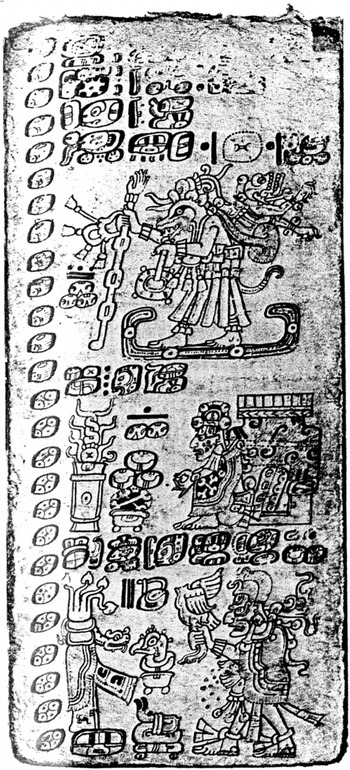
Dresden Codex (Kumatzim Wuj Jun 2001:28).
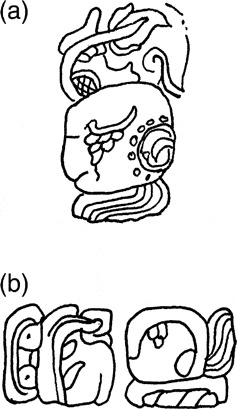
(a) Te'-Tun Glyph from Copan Stela C; (b) Te'-Tun Glyph from Tonina M30 (from Schele and Stuart 1985). Drawings by Kerri Henrickson.
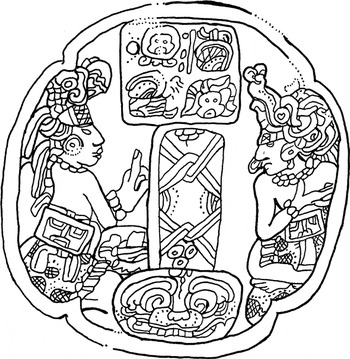
Peccary Skull from Copan, Tomb 1. Drawing by Kerri Henrickson after Barbara Fash.
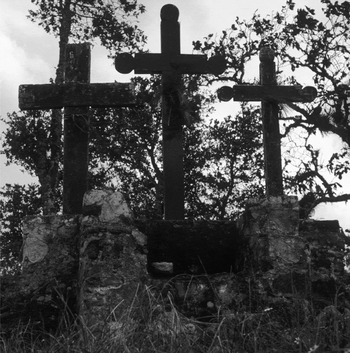
Cross Shrine in the Mountains of Zinacantan. Photograph by the author.
 You have
Access