



Intracranial haemorrhage (ICH) in neonates and infants is a serious neurological condition with long-term complications, including cerebral palsy, epilepsy and developmental delays. Reference Hanigan, Powell, Miller and Wright1 Key risk factors for ICH include traumatic brain injury, preterm birth, vascular abnormalities, infections, haematologic disorders, metabolic conditions and substance use during pregnancy. Reference Tan, Svrckova, Cowan, Chong and Mankad2 Among these, prenatal exposure to central nervous system (CNS) stimulants such as cocaine, methamphetamine and 3,4-methylenedioxymethamphetamine (MDMA) is a significant yet understudied contributor. Reference Evans, Wu, Mamas, Irwin, Kang and Perlow3 Although the cerebrovascular risks of prenatal cocaine exposure have been well documented, particularly for mothers during pregnancy Reference Rendon, Malta, Leung, Badenes, Nozari and Bilotta4 and neonates, Reference Singer, Yamashita, Hawkins, Cairns, Baley and Kliegman5,Reference Volpe6 the effects of other CNS stimulants, such as methamphetamine and MDMA, remain significantly understudied. Despite the increasing global prevalence of methamphetamine use, Reference Hedegaard, Bastian, Trinidad, Spencer and Warner7–Reference Stoneberg, Shukla and Magness9 research on its effects – particularly regarding prenatal exposure and its impact on cerebrovascular health in children – is limited. Reference Sankaran, Lakshminrusimha and Manja10 Although methamphetamine is known to elevate ICH risk in adults, Reference Huang, Yang, Lin, Chen, Chen and Kuo11,Reference Hemphill, Tierney, Tirschwell and Davis12 its implications for pregnant women and their offspring are still poorly understood.
Further complicating this issue is the real-world challenge of polysubstance use, making it difficult to isolate the effects of individual substances on ICH risk. Reference Tran, England, Park, Denny and Kim13 The concurrent use of multiple substances, such as methamphetamine and opioids, raises the question of whether the observed risks are attributable to individual substances or their combined effects. This is particularly relevant for opioids, where research has struggled to establish clear conclusions regarding their independent role in increasing ICH risk. Reference Sordo, Barrio, Bravo, Indave, Degenhardt and Wiessing14 Additionally, studies have shown that prenatal exposure to both cocaine and methamphetamine is associated with higher risks of hypoxic-ischaemic encephalopathy and intraventricular haemorrhage (IVH), but the specific contribution of each substance remains difficult to distinguish. Reference Dixon and Bejar15
Taiwan provides a unique setting to investigate the potential roles of methamphetamine and MDMA in ICH risk, given the predominance of methamphetamine use over the past two decades Reference Yu, Cottler and Li16 compared with the higher prevalence of cocaine in Western countries. Taiwan’s National Health Insurance Research Database (NHIRD) and maternal–child health registries offer a comprehensive, population-wide resource for studying the long-term effects of prenatal substance exposure. These databases address limitations found in previous studies, such as small sample sizes and insufficient control for confounders. By leveraging these data-sets, this study aims to clarify the association between prenatal exposure to methamphetamine, MDMA and opioids, and the risk of ICH, accounting for key factors such as socioeconomic status and preterm birth.
Method
Data source
This nationwide, population-based cohort study utilised data from multiple interconnected sources: the Taiwan NHIRD, the Birth Reporting Database (BRD), the Maternal and Child Health Database (MCHD) and the Integrated Illegal Drug Database (IIDD). The NHIRD, established under Taiwan’s National Health Insurance programme, has been active since 1 March 1995, and covers approximately 99.9% of the country’s 23.7 million residents. Reference Chou, Chiou, Liang, Chen, Lu and Li17 These comprehensive databases provided data on maternal and neonatal demographics, gestational age at birth, birth outcomes and drug-related criminal records.
The IIDD offered crucial information on prenatal illicit drug exposure, including drug use, possession and distribution records, whereas the BRD and MCHD were used to track maternal and infant health outcomes. The NHIRD provided anonymised medical claims for visits, procedures and prescriptions, capturing a nearly complete record of healthcare utilisation for both mothers and offspring.
All databases were linked using encrypted, unique identification numbers assigned to each mother to ensure data privacy. Reference Hsing and Ioannidis18–Reference Mohsin, Khan, Baki, Zabeen and Azad20 The Institutional Review Board of the National Health Research Institutes in Taiwan approved the study (approval number: EC1130806-E), and all data were de-identified before analysis, exempting the requirement for written informed consent.
Study population
We identified all pregnancies among females aged 15–50 years who gave birth between 1 January 2004 and 31 December 2018. Only the first live-born child for each woman during this period was included in the analysis, resulting in a total of 1 856 625 individuals. Pregnancies that resulted in stillbirths or had invalid data were excluded. For multiple births, only the first-born child was included in the analysis. Additionally, pregnancies were excluded if the mother had a history of ICH before delivery, as detailed in Fig. 1.
Flowchart of cohort selection for pregnant women with illicit drug exposure and matched unexposed controls.

The exposure group comprised 10 691 individuals whose mothers had used illicit drugs during pregnancy. A comparison group of 42 764 individuals, unexposed to illicit drugs, was created by using 1:4 matching based on maternal age, year of childbirth and socioeconomic status. This ratio was selected to improve statistical precision, and matching was performed without replacement. For the primary outcome, offspring were followed from birth until the occurrence of ICH, death, 6 years of age or 31 December 2019, whichever came first. Depending on year of birth, offspring contributed between 1 and 6 years of follow-up. Exposures and offspring outcomes were further stratified based on gestational age. The primary outcome was the occurrence of ICH in the offspring, whereas maternal ICH was examined separately as a secondary long-term outcome.
Prenatal exposure to illicit drugs
Prenatal exposure to illicit drugs was defined as any use of illicit opioids, methamphetamines, MDMA, cannabis, ketamine or other substances before or during pregnancy. Pregnant women involved in the possession, manufacturing, trafficking or distribution of these substances were excluded. However, those who tested positive during urine screenings and had a substance-related criminal record documented by the police were included. The timing of substance exposure was determined based on urine test results from the day the pregnant woman was apprehended, making the recorded date reflect apprehension rather than the verdict. This provides a closer approximation to the actual time of substance use, as the urine test indicates recent exposure.
To clarify the specific impact of each substance, a stratified analysis was conducted comparing women who used a single substance to those engaged in polysubstance use. Polysubstance use, defined as the use of two or more substances, accounted for 25.9% of the cohort (Supplementary Fig. 1). This distinction was crucial for determining the specific risk associated with each substance, as polysubstance use can confound the relationship between any single substance and the risk of ICH. Therefore, in our analysis, we employed two definitions of substance use: (a) exclusive use of a single substance and (b) use of that substance in combination with others (polysubstance use) to perform a sensitivity analysis and better assess each substance’s role in increasing ICH risk.
Supplementary Fig. 1 illustrates the distribution of substance use among pregnant women in this cohort. Methamphetamine was the most commonly used substance (27.0%), followed by illicit opioids (15.7%) and MDMA (13.7%), making it the second most prevalent stimulant. Polysubstance use was observed in 25.9% of cases, with nearly all women in this group (99.1%) having used either methamphetamines or illicit opioids. Furthermore, it is worth noting that among pregnant women who used two or more illicit substances, 98.3% of those whose substances included illicit opioids also used methamphetamines, and 70.5% of those whose substances included methamphetamines also used illicit opioids.
Outcome measures
The primary outcome of this study was the occurrence of ICH in offspring following prenatal illicit drug exposure. We used ICD-9-CM codes 430-432, 767.0, 767.6, 772.1 and 772.2, and ICD-10-CM codes I60-I62, I69.0, I69.1, I69.2 and P52, extracted from NHIRD. Offspring with three or more out-patient visits or at least one hospital admission were defined as having ICH. Incident offspring ICH was defined by the first date on which these criteria were met during follow-up. As a secondary outcome, we also tracked the subsequent incidence of ICH in mothers. For this, we extracted ICD-9-CM codes 431 and 432.0, and ICD-10-CM codes I60-I62, I69.0, I69.1 and I69.2, excluding any trauma-related brain haemorrhage diagnoses. For offspring, follow-up spanned from birth until the occurrence of ICH, death, 6 years of age or the administrative end of follow-up on 31 December 2019, whichever came first. In the offspring analyses, death before ICH was treated as a censoring event. For mothers, follow-up spanned from delivery until the occurrence of ICH, death, 15 years after delivery or 31 December 2019, whichever came first. Thus, later diagnoses after infancy were counted only if they represented the first qualifying ICH event during follow-up.
Covariates
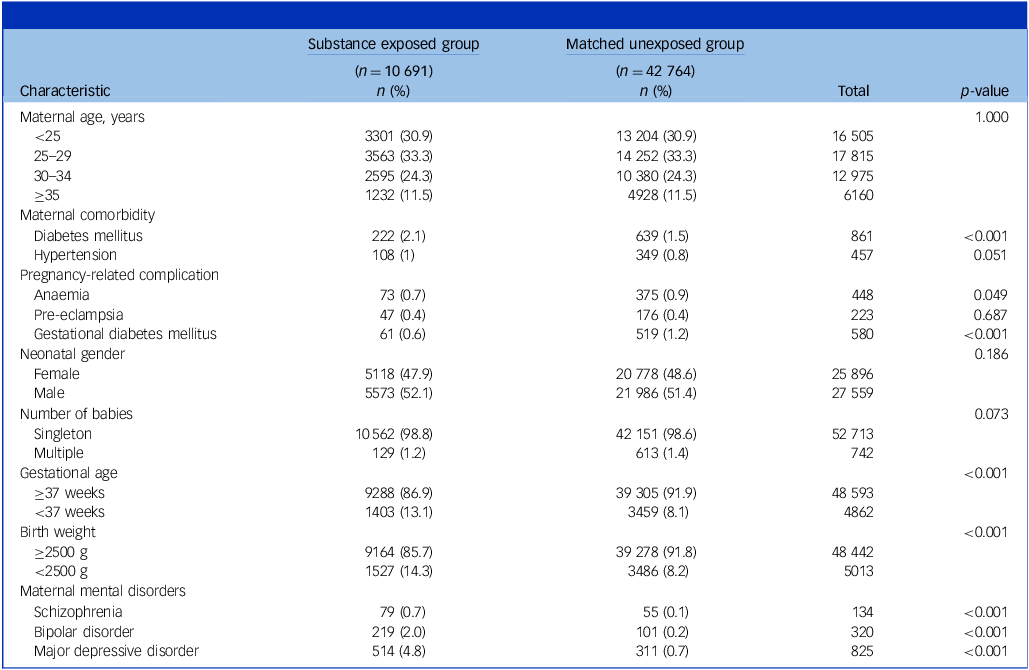
We gathered information on confounding factors from the NHIRD. Maternal age, year of childbirth and socioeconomic status were matched between exposed and unexposed groups (Table 1). Maternal comorbidities were identified through ICD-9-CM and ICD-10-CM codes found in out-patient medical records at least three times or in-patient medical records at least once before pregnancy. These comorbidities included diabetes mellitus and hypertension. Pregnancy-related complications, such as anaemia, pre-eclampsia and gestational diabetes mellitus, were identified when the patient received either in-patient or out-patient care. We categorised income into two levels based on the payroll bracket table released by the National Health Insurance Administration of the Ministry of Health and Welfare, expressed in New Taiwan Dollars. Reference Hon, Chan, Ng, Ho, Tsang and Tam21 Details on gestational age, birth weight, neonatal sex and number of babies were obtained from the BRD. Neonatal sex was included in the adjusted analyses, and number of babies was evaluated as a potential covariate. Maternal mental disorders, including schizophrenia, bipolar disorder and major depressive disorder, are summarised descriptively in Table 1. These psychiatric conditions were not included in the primary adjusted models because direct evidence linking non–substance-related maternal mental disorders to offspring ICH is limited, and their relationship with illicit substance use is heterogeneous and conceptually complex.
Demographic and clinical characteristics of pregnant women exposed to illicit drugs and unexposed control group

Statistical analysis
For the primary outcome, we utilised Cox proportional hazards regression models to estimate the association between maternal illicit drug use and the risk of ICH in offspring, adjusting for potential confounders including gestational age, maternal age, maternal comorbidities, pregnancy-related complications and neonatal sex. Children who died before developing ICH were censored at the time of death. Number of babies was also examined in supplementary analyses; given the small proportion of multiple births and limited outcome events, formal assessment of effect modification by plurality was not performed. Separate sex-stratified analyses were also not performed. Adjusted hazard ratios (aHRs) with corresponding 95% confidence intervals were reported to quantify the association between substance use and ICH risk. The models also accounted for polysubstance use, and additional stratified analyses were conducted to assess risks in both preterm (<37 weeks) and full-term births.
Given the established association between gestational age and neonatal ICH risk, gestational age was included as a covariate in multivariable models. We further conducted sensitivity analyses to examine the robustness of the findings, particularly focusing on cases of exclusive substance use (methamphetamines, MDMA or illicit opioids). For the secondary maternal outcome, we performed similar Cox proportional hazards modelling to assess long-term ICH risk among mothers over up to 15 years of follow-up.
All statistical analyses were performed using SAS software version 9.4 for Windows (SAS Institute, Cary, North Carolina, USA; https://www.sas.com/), and a two-sided p-value of <0.05 was considered statistically significant.
Results
Figure 2 illustrates the cumulative incidence of ICH among children exposed to methamphetamines, illicit opioids and MDMA compared with the unexposed group. Notably, the majority of ICH cases occurred within the first year of life, with a median time to ICH occurrence of 36 days. Although offspring were followed for up to 6 years, most incident ICH events occurred early in life. Figure 3 demonstrates that children born to mothers who used methamphetamines during pregnancy were associated with a higher risk of ICH compared with the control group (0.4 v. 0.2%; aHR = 1.72, 95% CI 1.06–2.79; p = 0.028). In contrast, no statistically significant association was observed for MDMA (0.2 v. 0.2%; aHR = 1.58, 95% CI 0.64–3.93; p = 0.324) or illicit opioids (0.4 v. 0.2%; aHR = 1.43, 95% CI 0.81–2.53; p = 0.214).
Cumulative incidence of intracranial haemorrhage in children exposed to illicit drugs during pregnancy compared with children of unexposed mothers. MDMA, 3,4-methylenedioxymethamphetamine.

Intracranial haemorrhage in children with prenatal exposure to illicit drugs compared to those with no exposure, stratified by preterm status and substance exposure definitions. Hazard ratios were obtained from adjusted models controlling for the following covariates: maternal age, maternal comorbidities (diabetes mellitus), pregnancy-related complications (pre-eclampsia, gestational diabetes mellitus), child’s gestational age at birth and sex. *NA indicates that, according to the regulations of Taiwan’s National Health Insurance Research Database, the number of cases was too small to disclose because of concerns about patient privacy. As a result, further stratification of the number of intracranial haemorrhage cases within the full-term and preterm cohorts could not be presented in these categories. MDMA, 3,4-methylenedioxymethamphetamine; aHR, adjusted hazard ratio.

Fig. 3 Long description
Panel A: A line graph showing the adjusted hazard ratios for intracranial haemorrhage in children with prenatal exposure to methamphetamine (including polysubstance use). The horizontal axis represents the adjusted hazard ratios with 95% confidence intervals, ranging from 0.00 to 10.00. The vertical axis lists different cohorts: Full cohort, Full-term cohort (gestational age ≥ 37 weeks), and Preterm cohort (gestational age < 37 weeks). Each cohort has a corresponding data point with a hazard ratio and confidence interval. Panel B: A line graph showing the adjusted hazard ratios for intracranial haemorrhage in children with prenatal exposure to methamphetamine (exclusive use). The horizontal axis represents the adjusted hazard ratios with 95% confidence intervals, ranging from 0.00 to 10.00. The vertical axis lists different cohorts: Full cohort, Full-term cohort (gestational age ≥ 37 weeks), and Preterm cohort (gestational age < 37 weeks). Each cohort has a corresponding data point with a hazard ratio and confidence interval. Panel C: A line graph showing the adjusted hazard ratios for intracranial haemorrhage in children with prenatal exposure to MDMA (including polysubstance use). The horizontal axis represents the adjusted hazard ratios with 95% confidence intervals, ranging from 0.00 to 10.00. The vertical axis lists different cohorts: Full cohort, Full-term cohort (gestational age ≥ 37 weeks), and Preterm cohort (gestational age < 37 weeks). Each cohort has a corresponding data point with a hazard ratio and confidence interval. Panel D: A line graph showing the adjusted hazard ratios for intracranial haemorrhage in children with prenatal exposure to MDMA (exclusive use). The horizontal axis represents the adjusted hazard ratios with 95% confidence intervals, ranging from 0.00 to 10.00. The vertical axis lists different cohorts: Full cohort, Full-term cohort (gestational age ≥ 37 weeks), and Preterm cohort (gestational age < 37 weeks). Each cohort has a corresponding data point with a hazard ratio and confidence interval. Panel E: A line graph showing the adjusted hazard ratios for intracranial haemorrhage in children with prenatal exposure to opioids (including polysubstance use). The horizontal axis represents the adjusted hazard ratios with 95% confidence intervals, ranging from 0.00 to 10.00. The vertical axis lists different cohorts: Full cohort, Full-term cohort (gestational age ≥ 37 weeks), and Preterm cohort (gestational age < 37 weeks). Each cohort has a corresponding data point with a hazard ratio and confidence interval. Panel F: A line graph showing the adjusted hazard ratios for intracranial haemorrhage in children with prenatal exposure to opioids (exclusive use). The horizontal axis represents the adjusted hazard ratios with 95% confidence intervals, ranging from 0.00 to 10.00. The vertical axis lists different cohorts: Full cohort, Full-term cohort (gestational age ≥ 37 weeks), and Preterm cohort (gestational age < 37 weeks). Each cohort has a corresponding data point with a hazard ratio and confidence interval.
To account for polysubstance use, we analysed cases where mothers exclusively used methamphetamines or illicit opioids (Fig. 3). The risk of ICH remained significantly elevated in children born to mothers who used only methamphetamines (aHR = 1.82, 95% CI 1.00–3.29; p = 0.049), whereas no significant risk was observed in children of mothers who used only MDMA (aHR = 1.45, 95% CI 0.53–3.97; p = 0.476) or only illicit opioids (aHR = 1.43, 95% CI 0.65–3.12; p = 0.375).
To better understand the relationship between maternal illicit drug use and ICH, we examined the prevalence of preterm birth among exposed children, as it is a significant contributor to ICH risk. Table 1 shows that 13.1% of children born to mothers using illicit drugs were preterm, a rate significantly higher than the 8.1% observed in the control group. Among infants who developed ICH, preterm births accounted for 50.0% in the methamphetamine-exposed group, 46.7% in the opioid-exposed group and 68.8% in the unexposed group. Additionally, preterm birth (aHR = 6.33, 95% CI 3.80–10.54) and birth weight under 2500 g (aHR = 4.28, 95% CI 2.59–7.08) were identified as the two most significant risk factors for ICH in the supplementary analyses (Supplementary Table 1). Multiple births were uncommon in both groups (1.2% in the exposed group and 1.4% in the unexposed group; Table 1), and number of babies was not significantly associated with offspring ICH in the supplementary analyses (aHR = 1.19, p = 0.598; Supplementary Table 1).
To account for these risk factors, our aHR models (Fig. 3) controlled for gestational age, maternal age, maternal comorbidities and pregnancy-related complications in the full cohort. These adjustments revealed a significantly higher risk of ICH in children exposed to maternal illicit drug use (aHR = 1.72, 95% CI 1.06–2.79; p = 0.028). We further conducted stratified analyses to separately examine full-term and preterm cohorts, addressing the differing contributions of preterm birth to ICH risk across these groups. The stratified analysis showed a statistically significant increase in ICH risk among full-term infants exposed to methamphetamines (aHR = 4.30, 95% CI 2.08–8.88). In contrast, no statistically significant association was observed among preterm infants (aHR = 1.00, 95% CI 0.52–1.93). These findings should be interpreted in the context of the substantially higher baseline risk of ICH in preterm infants, whereas absolute event rates remained low across gestational age strata.
As a secondary outcome, we tracked ICH risk in mothers over 15 years of follow-up (Supplementary Fig. 2, Supplementary Table 2). Mothers who used methamphetamines, alone or with other substances, had a significantly higher risk of developing ICH during follow-up. In contrast, MDMA use did not increase maternal ICH risk, and illicit opioid use only significantly elevated maternal ICH risk when combined with other substances.
Discussion
Our study found that methamphetamine exposure was the illicit drug exposure most consistently associated with an increased risk of ICH in offspring, the primary outcome of this study, and was also associated with long-term maternal ICH in secondary analyses. Infants born to mothers who used methamphetamines during pregnancy had a significantly elevated risk of ICH, particularly within the first year of life, even after adjusting for key confounders such as preterm birth and polysubstance use. Importantly, this association persisted even among children whose mothers exclusively used methamphetamines, suggesting that the observed association was not fully explained by co-exposure to other substances. In contrast, we did not observe a statistically significant association between MDMA or illicit opioid exposure and ICH risk in infants. However, these estimates were accompanied by wide confidence intervals, and a clinically meaningful increase in risk could not be excluded. Maternal methamphetamine use was also associated with a higher risk of ICH in mothers, underscoring potential broader cerebrovascular risks. Although illicit opioid use, predominantly heroin, appeared to increase ICH risk, this effect was largely attributable to concurrent methamphetamine use. Among pregnant women using two or more illicit drugs, 98.3% of those who used opioids also used methamphetamines. When opioid use was analysed independently of methamphetamine use, the association with ICH in both mothers and infants was no longer statistically significant, further suggesting that methamphetamine exposure may account for a substantial part of the observed association.
Previous research has consistently demonstrated that illicit drugs, particularly cocaine, Reference Lange and Hillis22 elevate ICH risk in both adults and pregnant women by disrupting uterine blood flow and fetal oxygenation. Reference Woods, Plessinger and Clark23–Reference Chiriboga25 Although methamphetamine has been shown to increase ICH risk in adult populations, Reference Huang, Yang, Lin, Chen, Chen and Kuo11 its effects on pregnant women and neonates remain less explored. Reference Hemphill, Tierney, Tirschwell and Davis12 Although methamphetamine use has surged globally, becoming one of the most widely abused stimulants, Reference Hedegaard, Bastian, Trinidad, Spencer and Warner7 our study is among the first to comprehensively assess its impact on ICH in both neonates and pregnant women. Our findings provide new epidemiological evidence that methamphetamine exposure was more consistently associated with ICH risk in this cohort. For MDMA and illicit opioid exposure, the corresponding estimates were less precise, and the absence of statistical significance should be interpreted cautiously.
Our results also align with established knowledge that preterm birth is a major risk factor for neonatal ICH, Reference Inder, Volpe and Anderson26,Reference van de Bor, Walther and Sims27 particularly IVH, because of the fragility of the germinal matrix and unstable cerebral blood flow in preterm infants. Reference Ballabh28 Preterm birth was the strongest risk factor identified in our study, surpassing the risk associated with methamphetamine exposure. However, our analysis also highlights the need to consider other risk factors, particularly in full-term infants. The stratified analysis revealed a statistically significant increase in ICH risk among full-term infants exposed to methamphetamines, even when adjusting for known contributors such as gestational age, maternal age and comorbidities. This pattern should be interpreted in the context of the markedly different baseline risk of ICH across gestational-age strata. In preterm infants, the baseline risk of ICH is already high because preterm birth itself is a well-established and strong risk factor. Reference Inder, Volpe and Anderson26,Reference Ballabh28 Therefore, any additional association related to prenatal methamphetamine exposure may be less readily distinguishable within this high-risk stratum. In contrast, among full-term infants, whose baseline risk of ICH is substantially lower, the association with methamphetamine exposure may be more readily detectable on a relative scale. At the same time, absolute event rates remained low, and the stratum-specific event counts could not be fully presented because small cell sizes were not reportable under NHIRD regulations. Accordingly, the larger relative estimate observed in full-term infants should be interpreted cautiously and in conjunction with the low absolute event frequency. In contrast, among preterm infants, no statistically significant association was observed, which may reflect the dominant contribution of prematurity-related risk as well as limited precision within that stratum.
Given the pharmacological similarities between methamphetamine and cocaine, similar mechanisms – such as disruption of maternal and fetal blood flow, oxygenation and cerebral haemodynamics Reference Chasnoff, Bussey, Savich and Stack29 – likely contribute to the increased ICH risk observed in our study. Cocaine has been shown to elevate cerebral haemorrhage risk through such haemodynamic changes, especially in preterm infants. Reference Woods, Plessinger and Clark23 Our findings expand on this understanding by demonstrating that methamphetamine exposure increases ICH risk even in full-term infants. Notably, no statistically significant association was observed with MDMA exposure, despite its pharmacological similarities to methamphetamine. This distinction underscores the need to differentiate between various CNS stimulants when evaluating cerebrovascular risks in prenatal drug exposure. Our study highlights methamphetamine exposure as the substance most consistently associated with increased ICH risk in offspring and their mothers (Supplementary Fig. 2, Supplementary Table 2). The long-term risks to mothers mirrored those observed in children. Mothers who used methamphetamines were at significantly higher risk of developing ICH over up to 15 years of follow-up. This finding further supports an association between methamphetamine exposure and long-term cerebrovascular risk in both mothers and their offspring. It highlights the urgent need for targeted public health interventions to reduce methamphetamine use during pregnancy and prevent adverse cerebrovascular outcomes.
Our study has several limitations. First, despite using a nationwide health insurance database with over a decade of follow-up, the sample size was insufficient to distinguish ICH subtypes, such as IVH, or to explore the timing of illicit drugs exposure during pregnancy. Second, although the IIDD confirmed prenatal illicit drugs use, it lacked information on continued use throughout pregnancy and did not allow for dose-dependent analysis. In addition, because multiple births were rare and outcome events were limited, we did not formally assess effect modification by plurality or perform sex-stratified analyses. Although schizophrenia, bipolar disorder and major depressive disorder were more common among mothers with illicit substance exposure, these psychiatric conditions were not included in the primary adjusted models. Direct evidence linking non-substance-related maternal mental disorders to offspring ICH remains limited, and the role of these disorders in relation to illicit substance use is likely heterogeneous and complex. Therefore, residual confounding related to maternal mental disorders cannot be excluded. Third, in the offspring analyses, death before ICH was treated as a censoring event. Because prior work in a similar nationwide cohort showed somewhat higher infant mortality among offspring of mothers with illicit substance exposure, Reference Lin, Chen, Lin, Wu, Liao and Lin30 death may have acted as a competing event in some cases, although the absolute mortality rate remained low. Therefore, some bias in the ICH estimates cannot be excluded. Furthermore, because our cohort was restricted to liveborn children, selection bias is possible if the most severely affected exposed pregnancies ended in fetal loss or stillbirth before cohort entry; in that case, the observed associations may have been biased toward underestimation. Finally, as the study was conducted in Taiwan, where methamphetamine is the predominant stimulant and cocaine use is minimal, further research is needed to determine whether these findings apply to populations with different stimulant use patterns.
This study provides population-based evidence of an association between methamphetamine use during pregnancy and a higher risk of ICH in offspring, particularly in full-term infants. Although preterm birth remains a major risk factor for ICH, methamphetamine exposure remained associated with a higher risk after adjustment for gestational age and polysubstance use. Findings for MDMA and illicit opioids should be interpreted cautiously because the corresponding estimates were less precise. These findings highlight the urgent need for targeted interventions to reduce methamphetamine use during pregnancy, aiming to prevent cerebrovascular complications in offspring.
Supplementary material
The supplementary material is available online at https://doi.org/10.1192/bjp.2026.10707
Data availability
The data for this study are not publicly available. To protect privacy, the Taiwanese government only allows researchers to analyse data from the Health and Welfare Data Science Center in selected computer rooms of the centre. No individual data can be brought outside the centre, and researchers can only bring away aggregate statistical results based on raw data. To use the data, a researcher has to apply for permission of using data within the centre. To apply for such permission, a researcher has to submit an IRB approval concerning the data use and has to pay for using data.
Acknowledgements
We acknowledge the role of various governmental agencies (including the Ministry of Health and Welfare, the Ministry of Justice, the Ministry of the Interior, the National Police Agency, the Criminal Investigation Bureau, the Ministry of Education, the Ministry of Labor and the Judicial Yuan) in building the nationwide Integrated Illegal Drug Database and that of the Ministry of Health and Welfare in establishing the Collaboration Center of Health Information Application. We thank Ms. Hsiao-Han Lin for their excellent technical assistance. We also thank Taiwan Food and Drug Administration for assisting with the administrative processes that were required for this collaborative intragovernmental effort.
Author contributions
Y.H.-L. and C.-H.L. contributed to study conceptualisation and methodology, and writing the original draft of the manuscript. C.L. and C.-Y.K. contributed to study conceptualisation and reviewing and editing the manuscript. W.-S.L. contributed to data analysis and interpretation. M.-H.C. contributed to study conceptualisation and methodology, and reviewing and editing the manuscript. S.-I.W. contributed to study conceptualisation, methodology and supervision, and writing the original draft of the manuscript. All authors reviewed the results and approved the final version of the manuscript.
Funding
This work was supported by the National Health Research Institutes (NHRI), Taiwan (grant number 14A1-PHPP15-014). The NHRI had no role in the design or conduct of the study; the collection, management, analysis or interpretation of the data; or the preparation, review or approval of the manuscript.
Declaration of interest
None.





eLetters
No eLetters have been published for this article.