Introduction
Eustachian tube dysfunction with middle-ear effusion is a common complication of radiotherapy (RT) applied to the head and neck region. It is thought to be caused by transient mucosal oedema and dysfunction of the Eustachian tube.Reference Schwarz, Manogaran and Danial1 The incidence of middle-ear effusion following RT to the head and neck region is reportedly as high as 20–40 per cent.Reference Bhandare, Antonelli, Morris, Malapaya and Mendenhall2,Reference Jereczek-Fossa, Zorowski, Milani and Orrechia3 While the condition is not permanent in many cases, a significant proportion of patients experience chronic middle-ear effusion. Currently, treatment options are limited to the use of a hearing aid or insertion of a ventilation tube. The risks of ventilation tube insertion include persistent otorrhoea (20–30 per cent) and permanent tympanic membrane perforation (10 per cent).Reference Schwarz, Manogaran and Danial1
Balloon Eustachian tube dilatation has been performed successfully with encouraging results in patients with Eustachian tube dysfunction.Reference Poe, Silvola and Pyykko4–Reference Poe, Anand, Dean, Roberts, Stolovitzky and Hoffmann7 Balloon Eustachian tube dilatation is generally safe, with minimal complications that resolve without further treatment.Reference Poe, Silvola and Pyykko4–Reference Poe, Anand, Dean, Roberts, Stolovitzky and Hoffmann7
To date, no studies have been published on the use of balloon Eustachian tube dilatation for the treatment of Eustachian tube dysfunction following RT, including RT to the head and neck region. This study aimed to determine the safety and efficacy of this method in treating Eustachian tube dysfunction post RT in patients with nasopharyngeal carcinoma. The outcome was measured via objective tympanometry and subjective assessment of symptom improvement using the validated seven-item Eustachian Tube Dysfunction Questionnaire (‘ETDQ-7’).Reference McCoul, Anand and Christos8
Methods
This interventional trial pilot cohort study was conducted in the ENT clinic of the University of Malaya Medical Centre. A total of 17 patients were identified as eligible for the study. Five patients declined to participate.
Institutional ethical committee approval was granted for the study (identification number: 20181022-6768). This study is registered under the Malaysian National Medical Research Registry with identification number 119-207-46497. Written consent was obtained from each patient.
Inclusion criteria
For inclusion in this study, patients were required to be aged above 18 years and able to give informed consent. Patients must have had a diagnosis of Eustachian tube dysfunction, with a Eustachian Tube Dysfunction Questionnaire score greater than 14, and clinical findings of a retracted drum, fluid behind the drum, or tympanometry type B or C results.
Exclusion criteria
Exclusion criteria included those with active cancer, a perforated tympanic membrane, the presence of a ventilation tube, a previous history of surgery to the nasopharynx, acute or chronic otitis media, or a period of less than six months following the final RT treatment. Symptoms of Eustachian tube dysfunction must have been present for at least three months prior to the start of the study.
Study protocol
The baseline Eustachian Tube Dysfunction Questionnaire score and clinical examination findings, including tympanometry findings, were recorded.
The Eustachian tube balloon used was the Entellus Xpress® ENT dilatation system, a device specifically designed for Eustachian tube dilatation. Balloon Eustachian tube dilatation was performed under local anaesthesia by accredited practitioners in an out-patient setting at the ENT clinic of the University of Malaya Medical Centre.
Patients received follow-up clinical examinations and Eustachian Tube Dysfunction Questionnaire score assessments at 6, 12 and 24 weeks after treatment. Repeated tympanometry was performed at 12 weeks after treatment.
Endpoints
The primary endpoint was determined by the improvement of tympanometry type (either from type B to types C or A, or from type C to type A) by 12 weeks of treatment. The secondary endpoint was the improvement in Eustachian Tube Dysfunction Questionnaire score and assessment of the procedure's safety profile.
Results
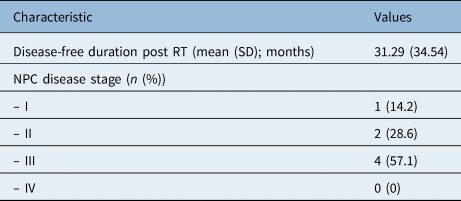
A total of 12 patients who fulfilled the selection criteria and consented to join the study were enrolled. The total number of ears was 14, as 2 patients had bilateral involvement (Table 1). For bilateral involvement, each ear was analysed separately; however, the symptomatic score (Eustachian Tube Dysfunction Questionnaire score) was designated to be the same, as it was not practical to score each ear separately. Additional information for the nasopharyngeal carcinoma group regarding disease staging and the disease-free period after RT was recorded (Table 2).
Patient demographics and characteristics

NPC = nasopharyngeal cancer; ETDQ-7 = seven-item Eustachian Tube Dysfunction Questionnaire
NPC group characteristics

NPC = nasopharyngeal cancer; RT = radiotherapy; SD = standard deviation
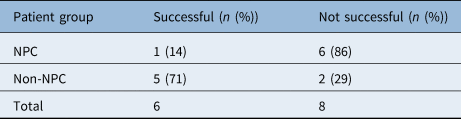
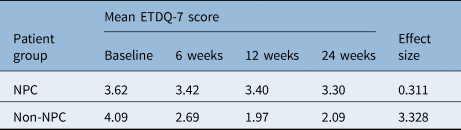
The success rate of the nasopharyngeal carcinoma group and the non-nasopharyngeal carcinoma group was 14 per cent and 71 per cent, respectively (Table 3). The symptomatic score as assessed by the Eustachian Tube Dysfunction Questionnaire showed improvement in both groups. In the nasopharyngeal carcinoma group, comparisons of the scores between baseline and 6, 12 and 24 weeks post-procedure were not significant (p-values of 0.641, 0.601 and 0.261, respectively). Changes in the non-nasopharyngeal carcinoma group, however, were significant at 6, 12 and 24 weeks post-procedure (compared with baseline), with p-values of less than 0.005. The effect size for balloon Eustachian tube dilatation in the nasopharyngeal carcinoma group was 0.311, while the effect size for the non-nasopharyngeal carcinoma group was 3.328. These findings are summarised in Table 4 and Figure 1.
Secondary outcome: mean seven-item Eustachian Tube Dysfunction Questionnaire (ETDQ-7) scores. There were no statistical differences between the baseline score and the scores post balloon dilatation at 6 weeks, 12 weeks and 24 weeks in the nasopharyngeal cancer (NPC) group (p-values = 0.641, 0.601 and 0.261 respectively). There were statistically significant differences between the baseline score and the scores post balloon dilatation at 6 weeks, 12 weeks and 24 weeks in the non-nasopharyngeal cancer (non-NPC) group (p < 0.005).

Primary outcome: treatment success

Success = normalisation or improvement on tympanometry at three months. Fisher's exact test comparing outcome was not significant (p = 0.103; odds ratio = 15). NPC = nasopharyngeal cancer
Secondary outcome: mean ETDQ-7 score

ETDQ-7 = seven-item Eustachian Tube Dysfunction Questionnaire; NPC = nasopharyngeal cancer
There were no serious adverse effects from the balloon Eustachian tube dilatation in any of the patients observed. Common mild adverse effects included minor epistaxis and slight pain, which resolved spontaneously without any further intervention.
Discussion
Eustachian tube dysfunction with middle-ear effusion is a known and common complication after receiving RT to the head and neck region. The incidence of Eustachian tube dysfunction with middle-ear effusion is reported to be 20–40 per cent in patients who have received RT.Reference Bhandare, Antonelli, Morris, Malapaya and Mendenhall2,Reference Jereczek-Fossa, Zorowski, Milani and Orrechia3 This is believed to be caused by mucosal oedema and loss of Eustachian tube function. The effect may be transient or permanent.Reference Schwarz, Manogaran and Danial1
Currently, there is no ideal treatment for post-RT Eustachian tube dysfunction with middle-ear effusion. Xu et al. have compared three management methods: simple myringo-puncture with aspiration, tympanic membrane fenestration and cauterisation, and myringotomy with grommet insertion.Reference Xu, Ou, Zheng, Chen and Ji9 Myringotomy with grommet insertion yields the highest cure rate, but it is also associated with the highest rate of complications, such as eardrum perforation and chronic suppurative otitis media. The risk for complications is reported to be as high as 20–30 per cent.Reference Xu, Ou, Zheng, Chen and Ji9
Patients suffering from this condition must live with significant morbidity in the form of ear discomfort, tinnitus, varying degrees of pain and discomfort, and poor hearing. Treatment choices all come with additional morbidities. Some patients accept the situation and opt for hearing aids to assist with their hearing. It is hoped that the recent advancement of balloon Eustachian tube dilatation may offer an additional option to treat this condition, without any associated morbidity.
Balloon Eustachian tube dilatation was first performed on cadavers in 2010.Reference Ockermann, Reineke, Upile, Ebmeyer and Sudhoff10 It was shown to be easily performed without any damage to essential structures. Since then, multiple reports have been published on the efficacy and safety of balloon Eustachian tube dilatation. Poe et al. compared the outcomes of 342 patients divided into a control group and those who underwent the procedure.Reference Poe, Anand, Dean, Roberts, Stolovitzky and Hoffmann7 The outcomes favoured the balloon Eustachian tube dilatation group with respect to normalisation of the tympanogram after six weeks and symptom improvement.
There were no significant adverse effects associated with the use of balloon Eustachian tube dilatation. Most adverse effects were mild and self-limiting, such as minor nosebleed, mild pain, rhinitis and tinnitus.Reference Poe, Silvola and Pyykko4,Reference Catalano, Jonnalagadda and Yu6,Reference Poe, Anand, Dean, Roberts, Stolovitzky and Hoffmann7
Within the literature, there have been no reported cases of injury to the internal carotid artery, which lies close to the Eustachian tube. Abdel-Aziz et al. concluded from their retrospective study that pre-operative high-resolution computed tomography (CT) of the temporal bone does not predict intra-operative or post-operative difficulty in performing balloon Eustachian tube dilatation.Reference Abdel-Aziz, Schroder, Lehmann, Gehl, Ebmeyer and Sudhoff11 Accordingly, a routine temporal high-resolution CT scan is not needed for all patients.
To the best of our knowledge, there has been no published case or study on the use of balloon Eustachian tube dilatation to treat post-RT Eustachian tube dysfunction. Preliminary results from a limited number of patients have shown that patients with long-standing Eustachian tube dysfunction following RT do not respond well to balloon Eustachian tube dilatation. Balloon Eustachian tube dilatation is founded on the idea that the balloon-mediated crushing of diseased mucosa will cause normal mucosa to heal over the affected area.Reference Catalano, Jonnalagadda and Yu6 However, in post-RT patients, the damaged segment of the Eustachian tube may be fibrosed and stenosed, hence the ineffectiveness of the balloon.
In the present study, the decision to recruit patients to the nasopharyngeal carcinoma group only six months after RT is based on the possibility that Eustachian tube dysfunction may resolve spontaneously, and this may occur at any point up to six months after initial onset.Reference Jereczek-Fossa, Zorowski, Milani and Orrechia3 Further studies will be needed to explore the possibility of earlier intervention to prevent stenosis. The outcomes for non-nasopharyngeal carcinoma patients fell within the expectations as described in the available literature.Reference Huisman, Verdam, Stegeman and de Ru12
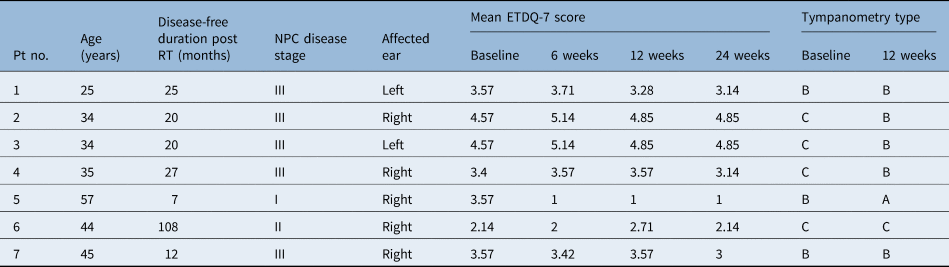
In this study, there was a single patient who showed a full recovery following balloon Eustachian tube dilatation. This patient was treated with balloon Eustachian tube dilatation about six months after RT for stage I nasopharyngeal carcinoma (Table 5). Though it is difficult to draw conclusions from a single patient, it is possible that the early timing of intervention, before fibrosis and mature scarring had occurred, may have led to a better outcome. Another possible explanation is the early stage of cancer diagnosis in this patient. This could indicate the presence of a less extensive tumour, which may have preserved the normal functional nasopharyngeal structures compared with more extensive disease progression in the other patients.
NPC patient characteristics and outcome

NPC = nasopharyngeal cancer; pt no. = patient number; RT = radiotherapy; ETDQ-7 = seven-item Eustachian Tube Dysfunction Questionnaire
The preliminary findings in five patients who underwent balloon Eustachian tube dilatation for post-RT Eustachian tube dysfunction do not show a clear benefit clinically. A larger sample size would be appropriate to assess the feasibility of a full randomised, controlled study. The statistical significance of these preliminary data should be interpreted with caution given the small sample size.
• Eustachian tube dysfunction is a common sequela post radiotherapy (RT) in nasopharyngeal cancer patients
• It has significant morbidity, and treatment options are limited
• Eustachian tube balloon dilatation is a less invasive option and can be conducted in an out-patient setting
• However, this pilot study did not show a clear benefit of this procedure for post-RT Eustachian tube dysfunction
Conclusion
The preliminary results of this pilot study show that balloon Eustachian tube dilatation offers a minor benefit for nasopharyngeal carcinoma patients with post-RT Eustachian tube dysfunction. However, these changes were not significant and should be viewed with caution because of the small sample size of this study. Balloon Eustachian tube dilatation has been shown to be safe and easy to perform in an out-patient setting; however, further investigation is needed before a conclusion can be reached regarding its effectiveness.
We believe that this study is a relevant addition to the available literature on the usage of balloon dilatation. While the findings may not be significant, the observations presented here will perhaps guide future researchers and clinicians to conduct studies of a larger scale in order to test this method.
Competing interests
None declared