

Introduction
Livestock are an important asset in sub-Saharan Africa (SSA) and have been shown to contribute significantly to rural development through the provision of food, cash, manure and general livelihoods in the rural and peri-urban households (Agyemang, Reference Agyemang2005; Zaibet et al., Reference Zaibet, Traore, Ayantunde, Marshall, Johnson and Siegmund-Schultze2011). Despite the rapid growth, the livestock sector in SSA is faced with several challenges and hence livestock's contribution to sustainable livelihoods is neither optimal nor sustained in most parts. These include limited breeding stock, low productivity, poor management and inadequate access to extension, health and other support services (Goyder and Mang'anya, Reference Goyder and Mang'anya2009). These challenges have negative impacts on productivity and genetic improvement initiatives (Rege, Reference Rege2005). With respect to genetic improvement initiatives, some of the reasons for their sub-optimal contribution are: low capacity (human and infrastructural) for livestock genetics; high cost of livestock genetics and breeding research and development (R&D) infrastructure; limited and disjointed R&D efforts within countries; limited effort to share the available capacity between countries; and inappropriate imported genetic technologies (genotypes and genetic improvement technologies and methods) which have often failed to deliver the expected results. However, there are some technologies developed elsewhere (in either the North or South) which offer opportunities for Africa. These may need to be tested in, and adapted for, local contexts. Further rapid developments in genetics and genomics offer opportunities which remain relatively unharnessed in, and for, Africa's development.
Sustainable options that would enhance the efficiency and effectiveness of future research needs for livestock genetics is urgently required. These are the kind of options that would interface with overall livestock and agriculture development in SSA. Robust strategies would enhance the efficiency and effectiveness for delivering the R&D that would address high priority constraints for SSA. However, generating such strategies requires the involvement of a wide range of players. Establishing avenues of consultation, engagement and support from local and international R&D community is a vital part of this process. From 8th March to 20th April 2011, an e-conference aimed at collating views that would inform the development of such strategies was conducted. The current paper provides a synthesis of the e-conference, analyses the situation and outlines the drivers that were identified to have the potential to enhance the efficiency and effectiveness of livestock genetics research for development in, and for, SSA.
Methodology
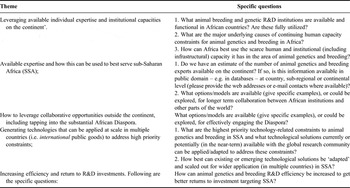
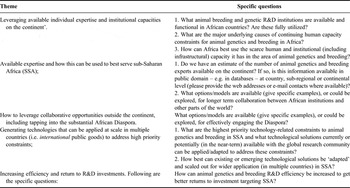
Prior to the e-conference, announcements were sent through animal genetics associated discussion groups such as Domestic Animal Diversity Network (DAD-Net), Animal Geneticists Discussion Group (AnGenMap) and animalgenetics listserv. Prospective participants were requested to circulate the announcement to anyone in their network and as widely as was possible. Animal Scientists, Agricultural Economists, Agronomists and experts in Agricultural Research not only from Africa but also from other countries around the globe participated in the e-conference. The 43 experts who participated in the e-conference were from Bangladesh, Cameroon, Canada, Egypt, Ethiopia, Ghana, Italy, Kenya, Malawi, Nigeria, South Africa, Spain, Sudan, Sweden, Tanzania, United Kingdom, and Zimbabwe. The e-conference was hosted by the animalgenetics listserv (animalgenetics@sympa.sun.ac.za) based at Stellenbosch University in South Africa. In the e-conference, a framework was defined as ‘a basic structure underlying a system’ and could take a variety of forms. The scope and definition of the framework were introduced at the beginning of the e-conference. Following were the envisioned aims of the framework for the discussion: (a) to provide a mechanism for leveraging available individual expertise and institutional capacities on the continent; (b) to create functioning and effective mechanisms for harnessing available collaborative opportunities within Africa and between Africa and the international R&D community, including Africa's Diaspora; (c) to highlight ongoing development of technical and human capacity in genetics and breeding on the continent to provide the required critical mass; (d) to generate technologies that can be applied at scale in multiple countries (i.e. international public goods) to address high priority constraints; (e) increasing efficiency and return to R&D investments; and (f) to catalyse the evolution of sustainable R&D platform(s) on the continent. During the e-conference, a moderator introduced the theme based on each aim for discussion, together with some guiding questions for the participants as shown in Table 1. The moderator neither censored nor limited the level of debate and discussion. Rather, the moderator asked questions that would bring up either more information or different perspectives. At the end of each theme, the moderator produced a summary that was shared back to all participants and all on the networks by email, to allow corrections, additions and even more in-depth discussion. Towards the end of the e-conference, a request for information that would enable the start of the process for developing a database of experts in animal breeding and genetics in Africa was made. The information requested was: name (including title), institutional affiliation, physical and postal address, telephone contacts, email address and, areas of training, expertise and current work focus.
Main themes covered in the e-conference'
Current status
Institutional capacity
Participants highlighted that infrastructure in animal breeding and genetics comprises hard and soft infrastructure. Hard infrastructure is the physical and organizational structures needed for the delivery of technological innovations and R&D in animal breeding and genetics. Soft infrastructure is made up of all the operational and quality assurance capacity that promotes and facilitates the implementation of the technological know-how generated from the R&D. In the e-conference there was a general consensus that some premier and other potentially premier institutions for animal genetics and breeding R&D exist on the continent. However, these institutions are very varied in terms of both the physical and human capacity. Equally varied is the level of utilization of these institutions. Specific examples that were given were from countries like Zimbabwe, South Africa, Malawi, Kenya and Nigeria. The majority of these are public institutions in the form of universities and research centres. Very few of these have long-term experiments and research programmes running. Where some long-term experiments and research programmes are running, they do not seem to be well supported and their value not well appreciated.
Although difficult to maintain and at times to economically justify, long-term experiments and research programmes have valuable scientific resources providing data and continuity. The following are some examples of long-term experiments spanning over a decade and research programs that are still running albeit not at full capacity. In Zimbabwe, Matopos Research Station runs a beef cross-breeding experiment and is also home to the only known flock of indigenous Sabi sheep; Makhoholi Research Station maintains a Mashona beef herd; while the Grassland Research Station keeps a Tuli cattle herd. In Malawi, Mbawa Research station has a pure Malawi Zebu breed which is used in a cross-breeding programme with the Brahman breed. These centres have the potential of hosting and maintaining nucleus herds of farm animal genetic resources (FAnGR) in an either open or closed nucleus breeding system. Long-term experiments also have the potential to provide unique data sets that may provide a huge resource for ongoing analysis and also provide a case of best practice. However, the value of long-term datasets can only be noticed when such data are utilized. One issue that was raised in the e-conference is that most of the institutions are not effectively utilized.
Most countries in SSA have artificial insemination (AI) centres. Most of these produce and distribute semen to farmers. However, AI centres are mostly considered as semen and support service providers to the genetic improvement sector. The e-conference participants noted that functioning AI and livestock breeding programmes exist where there was a market oriented (commercial) livestock sector. An example is South Africa where there are functioning and well developed breeding programmes and support infrastructure such as stud breeders and breeders associations for many species, national performance recording and genetic evaluation.
Human resources
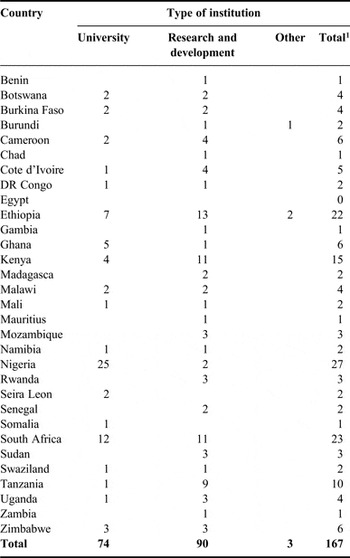
Databases of animal breeding and geneticists exist at different levels of detail. For example there is a relatively comprehensive database in South Africa where there are about 45 Animal Breeders and Geneticists. Lack of proper databases and lists of animal breeders could mainly be attributed to the fact that in some countries there are very few animal breeders and hence co-workers know each other. Currently, most animal breeders and geneticists work for universities and research institutions (Table 2). Although there are animal breeders and geneticists in the different countries, it was noted that there are very few animal breeding organizations (implementers of genetic improvements) on the continent. The absence of animal breeding organizations may be one reason why in most countries, the advantages of using new improvements and technologies are neither appreciated nor utilized under field conditions. This may also be the reason as to why there are only a few organized breeding programmes on the continent.
The landscape of human capacity in animal breeding and genetics in the different countries.
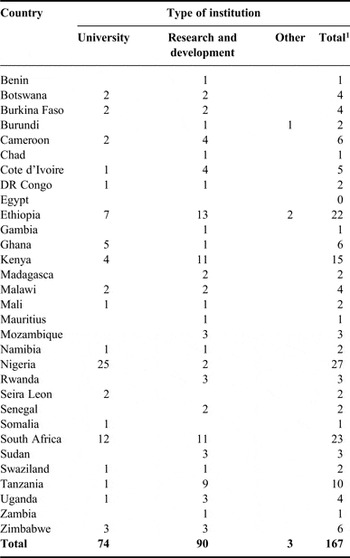
1 Data were based on what the e-conference participants could recall and not on a head-count. Although the absolute numbers may not be accurate, they are precise enough to present the overall picture.
Ongoing human and technical capacity development
In terms of training in Animal Breeding and Genetics, most universities/colleges in SSA had programmes in Animal Science, and teach Animal Breeding and Genetics. Training is mostly at first degree level. Post-graduate training opportunities in animal breeding and genetics in Africa are very limited. Only a few universities have post graduate programs, and these universities have less than optimum capacity in terms of expertise and facilities, to deliver high quality M.Sc. or Ph.D. training. Regional programmes have been initiated in the past. An example is the M.Sc. in Animal Science programme that was hosted by Bunda College in Malawi on behalf of the Southern Africa Centre for Coordination of Agricultural Research (SACCAR) and financially supported by GTZ from 1990 to 2000 (Wollny et al., Reference Wollny, Chagunda, Molapong, Richter, Mumba and Schultze2002). Through that programme, which now continues as a local programme, animal scientists including animal geneticists mainly from the Southern Africa Development Community (SADC) region received tuition from Bunda College and were allowed to travel back to their home countries to conduct research. Another successful programme was the training of trainers’ project that was launched in 1999 by the International Livestock Research Institute (ILRI) in collaboration with the Swedish University of Agricultural Sciences and supported by the Swedish International Development Cooperation Agency (Sida). This project was based on an approach that targeted university lecturers and researchers who were actively involved in teaching and supervising research in animal breeding and genetics (Ojango et al., Reference Ojango, Malmfors, Mwai and Philipsson2011).
Even with these within country and regional training and educational programmes, there is a general deficit in the numbers of animal geneticists on the continent. Two problems exist in this respect. One is the lack of strategies to maintain and retain the trained personnel and the other is the failure to attract the numbers from young scientists to join the field. Quite a good number of animal geneticists are now gainfully employed either in other countries or in other organizations that do not deal in animal breeding and genetics. There is outward migration of personnel to other fields such as relief and development non-governmental organizations (NGOs). Different reasons were given in the e-conference for this situation. Some of these are: low remuneration, limited career development prospects, and lack of appreciation for work output. Further, there is a general decline in the numbers of students in animal breeding and genetics. The discipline seems not to attract high numbers of new students who would be the next generation of movers and shakers. Ironically, the quantitative and numerate skills that animal geneticists possess are highly appreciated when moved into other fields.
There is need for innovative regional graduate programs that harness collective capacities of multiple universities (Gibson, Rege and Chagunda, Reference Gibson, Rege and Chagunda2014). Such an initiative could be linked to advanced research institutes/universities in the developed world. One fundamental difference between successful livestock genetic professionals (researchers, industry and extension) in the developed world vs those in Africa is that after receiving their M.Sc. or Ph.D., the former generally receive strong mentoring and continuous ‘learning-through-doing’, while there is limited or no opportunity to gain deep experience and high-level mentoring for most African graduates of livestock genetics training. This is an area that needs some attention if the sector is to retain its human resources.
Breeding programmes
In most African countries R&D related to animal breeding is under the control and support of government institutions. These institutions were established with the aim of providing improved stock and technologies to the farmers. The majority of these institutions were established with either little or no participation of the end users (farmers). As a result, most of the organizations seem not to address directly the needs of the smallholder farming community. Therefore, their contribution to the nations as well as to the farming community is very low relative to the cost incurred in either establishing or running these institutions. In addition to the government institutions, in some countries there are private breeding companies and NGOs that are selling germplasm (semen and embryo) and live animals imported from the Europe, America and to a limited extent from South Africa. This is mainly for dairy cattle and poultry.
Apart from a few commercially orientated operations in a handful of countries, in the rest of Africa there are no strong breeding institutions. As the result of this weakness, farmers are dependent on imported animals for the replacement stock. However, several studies on genotype by environmental (G × E) interaction have shown the strong negative effect of the indiscriminate importation of germplasm (e.g. Chagunda et al., Reference Chagunda, Bruns, King and Wollny2004; Friggens and Newbold, Reference Friggens and Newbold2007). In very few countries there is targeted livestock genetics research meant for the local environment (Rege, Reference Rege2005). One of the consequences of the disjoined R&D activities is the lack of coherent breeding policies. This has resulted in a mismatch of genotypes with production systems. Private sector, farmer organizations and the emerging commercial farmers are mostly disconnected to the research programmes. Most R&D initiatives seem to be developed with little attention paid to the production environment. The issue of identifying and matching the animal genetics and breeding R&D to the existing and appropriate farming systems was emphasised during the e-conference. This was identified to have been a major problem in small-scale and communal farming systems. The paradox is that in most African countries, the dominant type of livestock farming is either small scale or subsistence, where animals are managed under communal farming system with no control mating. In most cases, there is no controlled breeding in this sector. However, where planned breeding takes place, the breeding stock predominantly come from research station based breeding programs and Government run multiplication centres. There is strong need for studies to determine not only the optimal breeds and genotypes for different production systems but also the methodologies and tools for determining these optimal combinations. Further, there was recognition in the e-conference that the subsistence farmer keeps his/her livestock for multiple purpose use – food, power, cash, etc. The animal numbers per farm in this sector are small, sometimes mixed species. The vital questions are: how to define breeding objectives that would be appropriate for the multi-functional production systems, and how to implement such an improvement program? Answering these questions would help inform the debate on making animal breeding and genetics relevant and appropriate to the existing and future production systems. This is where robust and clear breeding policies are needed. As indicated by Zonabend et al. (Reference Zonabend, Okeyo, Ojango, Hoffmann, Moyo and Philipsson2013), a livestock breeding policy is an important tool to show the direction of priorities and activities to be conducted in livestock breeding. For such breeding policies to have sustainable contribution to rural livelihoods, they would need to be informed by a broader livestock development policy. Together with R&D organizations, breeding organizations and performance recording organizations there is need to take the new developments forward to the users and feedback to the R&D organizations. The existence of institutional herds at research and multiplication centres would act as nucleus herds for spreading genetically improved germplasm across commercial herds. However, if the appropriate infrastructure for the gene flow is not available the advantages of using the new improvements and technologies cannot be proven at farm level.
Low profile
Participants in the e-conference expressed concerns over the low profile of animal breeding and genetics in the different SSA countries. Despite the fact that this is one of the few disciplines that brings about permanent change and improvement in livestock, it is very often considered as a technology that may not respond to urgent needs especially to the policy makers. This picture, however, may reflect more the fact that it takes a considerable number of years to reap the benefits of genetic improvement and yet there may be other more urgent system constraints which need to be addressed. This may apply even more to smallholder and subsistence livestock production systems than to large multinational companies that are now increasing their presence mainly in the poultry sector. Their investment in animal genetics is growing faster than in animal nutrition and animal health (KPMG, 2013). It was noted that the production sector and society do not appreciate research as a part of their activity and hence researchers are not rewarded with reasonable remuneration. However, it was also noted that animal scientists and more specifically animal geneticists have themselves not demonstrated the value of animal breeding to society. In summary, it was pointed out that animal breeding and genetics should not only be done but should be seen to be done. Another issue may be that the many failed animal breeding programs in Africa have reduced confidence. There is need to investigate and implement strategies that may help to avoid these failures in the future. An example is by better targeting in terms of where and when to apply breeding interventions.
Some possible ways to raise the profile of animal breeding and genetics are:
-
• Animal Breeding and Genetics courses in different universities and colleges should be made more attractive while maintaining its relevance and robustness.
-
• Teaching and research facilities and equipment should be established in order to make the course more practical than theoretical which is often the case when practical facilities are lacking.
-
• The importance of within-country collaboration is that it would enable students do practical work or placement in research institutions. This could be extended to formal scientific exchange programme between institutions.
-
• The need for clear information on career path and expected returns from the career are crucial in creating not only a clear demand for and place of animal breeding on the market but also helping to develop the area.
-
• Use already existing resources and forums such as, All Africa Conference of Animal Agriculture (AACAA), World Congress (WCGALP), pedigree of animal breeders. These resources should be utilized more to increase the profile and visibility of the activities that animal breeders undertake in Africa.
Sociological and ecological differences
The need to recognize regional social, economic and environmental differences and similarities was highlighted and acknowledged during the e-conference. This line of discussion extended to sociological and ecological differences among countries. This means that it might be more efficient to promote regional collaboration. However, caution should be taken not to breakdown the regions too much, resulting in hindering any benefits that could be accrued from collective effort. Similarities and common platforms are worth exploiting because the similarities may outweigh differences. Gibson, Rege and Chagunda (Reference Gibson, Rege and Chagunda 2014 ) pointed out that cross-institution collaboration, within and between countries in livestock genetics is extremely limited. Ironically, SSA has a continent-wide level of cohesion and shared vision. This is facilitated by among other things, use of a limited number of shared languages. A number of well-functioning pan-African institutions and mechanisms for collaboration have arisen in recent decades. This indicates that there are good opportunities to establish regional or pan-African institutions and collaborations to promote more effective training and delivery in livestock genetic improvement (Gibson, Rege and Chagunda, Reference Gibson, Rege and Chagunda2014). Strong national human capacity begets strong regional human capacity. Animal Geneticists need to work together to improve each other's weaknesses and build each other's strengths. Mentoring of young scientists should be done at both national and regional levels.
Harnessing available collaborative opportunities
Collaboration both within Africa and with those in the Diaspora remains an untapped potential source of capacity. There are some initiatives that require regional collaboration in order to achieve sustained impact. Some useful observations in this regard were made by Wollny et al. (Reference Wollny, Chagunda, Molapong, Richter, Mumba and Schultze2002). Even with some within-country initiatives, there is need to break-down the traditional subject boundaries among research, extension and training. In most of the countries, NGOs have contributed substantially to change the gene pool through the importation of different genotypes especially in dairy cattle, pigs and goats. Animal geneticists need to integrate their activities with those of the NGOs through taking the work forward and adding the genetic improvement dimension to rural development work. This can be, for example, through setting up systematic animal performance recording; conducting genetic evaluation, and sire selection; and carrying out breed comparison research that would inform the decisions on the genotypes that would be appropriate for different production systems, all of which are lacking in most countries in SSA. To compliment this kind of initiative, there is need for a robust and functioning extension service. This would bring out the comparative advantage of an innovation such as genetic improvement (Agwu, Dimelu and Madukwe, Reference Agwu, Dimelu and Madukwe2008).
Since quantitative genetic analyses rely on availability of high volumes of routinely collected data, initiatives such as pooling data from either across institutions or across countries and analysing such data with appropriate statistical models that account for regional and country differences, would not only provide some fundamental information but also work as a training ground for students and young scientists. This would be even more useful for training if different methodologies and procedures would be used to harmonize data and account for different data collection protocols. Not every country would have the human resources with such skills. Skill sharing and knowledge exchange would help Africa best use the scarce human and institutional capacity it has in the area of animal genetics and breeding. Some models of collaboration exist between African institutions and other parts of the world. Most of these could be explored further for longer term benefits on institutional capacity. This is because most of the collaboration efforts that go a long way start as researcher-to-researcher initiatives. Although this is the case, other formidable collaboration initiatives have been those that have been initiated through bilateral agreements. Clearly articulating the R&D needs helps to identify relevant projects and work-areas. Forming project consortia and responding to specific research calls has been another very successful strategy for collaboration. Involving both Africa-based scientists and those in the Diaspora has a synergistic effect to the collaboration effort. Simpler networks and approaches that are affordable in Africa must also be encouraged and funded, for example, strengthening the African Animal Production Association, initiating e-forums and discussion groups. Formal scientific exchange programs for researchers between institutes should be considered as a catalyst for further long-term collaboration. SSA is in a unique position for potential joint and regional postgraduate training programmes. As was noted by Gibson, Rege and Chagunda, (Reference Gibson, Rege and Chagunda 2014 ), there are vast regions that share language, cultural and political diversity. Utilizing African scientists that are in the Diaspora can take several forms that need institutional involvement. Initiatives like joint supervision of graduate students, joint projects, and joint short to medium-term appointments would promote knowledge exchange and skills-sharing.
Generating technologies and increasing efficiency
Research in animal breeding should be attractive to the private sector and funding community in order to attract investment and innovation. It should also give political mileage to Governments so that they can justify spending scarce financial resources in supporting the research. There is need to recast animal breeding and genetics as part of a bigger dynamic innovation system in agriculture and rural development. An innovation systems’ approach should be taken in order to reshape the pathway through which animal breeding and genetics can contribute to poverty alleviation in Africa. An innovation system approach offers a holistic and multi-disciplinary approach to innovation and processes, incorporating emerging reforms and approaches for agricultural development (Agwu, Dimelu and Madukwe, Reference Agwu, Dimelu and Madukwe2008). Following are some considerations that should be encompassed in livestock innovation systems:
-
• Animal breeding and genetics must focus on innovations not merely research or science and technology. Innovation is defined as ‘the application of knowledge to achieve social and economic outcomes’.
-
• Animal breeding and genetics must develop working styles and practices, both as individuals and as organizations and the incentives, support structures and policy environments that encourage innovation.
-
• Breeders and geneticists in Africa must be responsive to stakeholder demands and agendas, not their own religiously guarded pet projects or academic interests. In other words, think beyond the ‘laboratory’ or ‘experimental field’ to find out what clients really need out there.
-
• Breeders and geneticists in Africa need to be dynamic – new challenges require new partners and new ways of working. Institutional learning is central to this process and will ensure successes and failures of the past are used to inspire future solutions. ‘If you cannot change you will soon become irrelevant’.
Institutions like African Union Information Bureau for Animal Resources (AU-IBAR) and ILRI should continue to take the lead and create opportunities to motivate scientists on the continent to come up with solutions to the numerous challenges of Animal Genetics. They need to continue to support capacity building and also to bring a fair balance of projects on Animal Genetic Resources across the continent.
Catalysing the evolution of sustainable R&D platforms
Essential to any breeding programme is the accurate and appropriate estimation of genetic parameters and the consequent formulation of breeding goals. Currently, there are no such breeding programmes at both national and regional level in most of SSA (Rege et al., Reference Rege, Marshall, Notenbaert, Ojango and Mwai2011). Mostly, this is due to lack of infrastructure and functioning animal recording systems. The inevitable consequence of the lack of coherent and well-grounded breeding strategies is the use of inappropriate genotypes and germplasm. There is need to take a concerted effort and have a relook in order to incorporate different and novel approaches that may not only improve productivity but also promote the implementation of livestock genetic improvement in SSA. Some of the questions that would guide this evolution are: are there any easy-to measure phenotypes that would be used as indicator and proxy traits, are there any new and readily available easy-to-use technologies that would help in gathering the required phenotypes, is it possible for several institutions to initiate a joint animal recording system, and would it add value to any potential breeding scheme to pool together any existing phenotypic data from across institutions and countries and analyse such data with appropriate statistical models that will account for regional and country differences? Affirmative responses to these questions would create the needed platform that would provide the footing for fundamental information in terms of genetic parameters, breeding values and the basis for the formulation of national and regional breeding programmes. An alternative breeding program could be one changing the genetic merit of the population by increasing the proportion of animals that are of the most appropriate breed-type, be it either pure-bred or cross-bred for any given production system. Although institutional herds and flocks have a role to play in generating new knowledge, they tend not to be managed in a similar manner as local farmers’ herd and flocks. Where this is the case, the differential management strategies may lead to significant G × E resulting in re-ranking of sires. However, institutional herds and flocks, as well as on-farm livestock populations are valuable resources. For example, in some smallholder farms, with small numbers of animals per farm, the lack of contemporary groups becomes important, and hence institutional herds and flocks may be more appropriate. An alternative would be on-farm livestock populations managed in a scientist-farmer partnership. This would provide a valuable resource in an open nucleus breeding scheme. Collaborative efforts would provide the technical expertise needed for such initiatives and analyses.
Conclusion
This paper provides a synthesis of an international e-conference on one of the fundamental issues in livestock development in SSA. Participants expressed gratitude at the usefulness of the exercise that brought out a lot of issues and constructive suggestions that would inform the development of a framework for enhancing the efficiency and effectiveness for delivering livestock genetics R&D. General consensus was towards developing fundamental soft infrastructure and capacity that would form the basis of vital R&D with minimal bureaucratic constraints.
Capacity should be developed around systems for organizing, collecting and utilizing livestock performance data. Improved communication and coordination of efforts within and across countries should be in the centre for these developments. The conference highlighted that animal breeders and geneticists within SSA should be the ones to ‘kick-start’ the process and raise the profile of the profession. This is because they are the ones who have the political contacts and local knowledge to obtain the buy-in on different R&D initiatives from the key people within Governments and the farming community. Colleagues in the Diaspora should be involved on initiatives in transferable-skills and help to identify new project opportunities.
Acknowledgements
Thanks to all the participants in the e-discussion. Many thanks to the organizers and hosts, animalgenetics forum, for the space and time that they dedicated to this e-discussion. We really appreciate the contribution and comments from the Journal Reviewers. Thanks to Nicola Boyes for her assistance during the preparation of the manuscript.
Statement of interest
There is no conflict of interest.