Introduction
The sand smelt (Atherina boyeri Risso, 1810), Osteichthyes: Atherinidae is one of 19 fish species found in Lake Iznik (Ozuluğ et al., Reference Ozuluğ, Altun and Meric2005). Atherina boyeri is a small euryhaline fish which mainly inhabits littoral areas, brackish lagoons and estuarine waters. Sand smelt are also found in freshwater biotopes. The distribution of A. boyeri has been broadly defined as Mediterranean, but this species also naturally inhabits the Aegean Sea, Marmara Sea, Black Sea, Caspian Sea and Aral Sea. It is also found in the north-east Atlantic between the Azores and the north-west coast of Scotland (Whitehead et al., Reference Whitehead, Bauchot, Hureau, Nielsen and Tortonese1986; Geldiay & Balık, Reference Geldiay and Balık1988; Leonardos, Reference Leonardos2001). In Turkey, sand smelt have been found in the Sapanca, Koycegiz, Iznik, Buyukcekmece and Kucukcekmece lakes (Geldiay & Balık, Reference Geldiay and Balık1988; Altun, Reference Altun1991). In 2003 A. boyeri was also introduced by fisherman into the Egirdir and Beysehir lakes (Küçük et al., Reference Küçük, Sari, Demir and Gulle2009), because of their reasonable commercial value as well as to be bait fish for other commercially valuable fish.
As the average price of sand smelt was US$0.3/kg from fishermen and total catchment quantity was 1300 metric tonnes from Lake Iznik in 2010 (Anonymous, 2009a, b), they have become of economic importance to local fishermen. Parasites of A. boyeri have been studied by some authors. For example, Dezfuli & Rossi (Reference Dezfuli and Rossi1991) studied acanthocephalan infection (mouth of the River Tirso in Sardinia); Bello et al. (Reference Bello, Vaglio and Piscitelli1997) studied infestation by Mothocya epimerica (Lesina Lagoon, Italy); Leonardos & Trilles (Reference Leonardos and Trilles2003, Reference Leonardos and Trilles2004) investigated the occurrence and effects of M. epimerica and the reproduction and growth pattern of M. epimerica (Mesolingi and Etolikon lagoons, Greece); Gerasev & Dimitrieva (Reference Gerasev and Dimitrieva2004) made a re-description and diagnosis of Gyrodactylus atherinae on A. boyeri pontica caught near Karadag (Black Sea) and Giovinazzo et al. (Reference Giovinazzo, Antegiovanni, Dörr and Elia2006) found only one parasite species, Bothriocephalus acheilognathi (Lake Trasimeno, Umbria, Italy). Oktener & Sezgin (Reference Oktener and Sezgin2000) and Ozer (Reference Ozer2002) studied M. epimerica infestation (Black Sea, Turkey). As can be seen, most of the above-mentioned studies were carried out in a marine or estuarine environment and dealt with generally ectoparasite species of A. boyeri. Kaygusuz (Reference Kaygusuz2006) studied the reproduction and growth biology of A. boyeri in Lake Iznik; however, the parasitic fauna of A. boyeri has not been studied in Lake Iznik. Therefore the aims of the present study were to investigate the seasonal occurrence and main determinants of ectoparasites of sand smelt in a freshwater population (Lake Iznik), and to determine whether there was a relationship between the feeding habits of the fish host and variations in the metazoan parasite fauna. We determined seasonal change in the metazoan parasites in terms of infection parameters such as prevalence, intensity and abundance, and also investigated whether there was a seasonal change in prey (by studying stomach content analyses).
Materials and methods
Lake Iznik, the fifth largest lake in Turkey, is located in Bursa province, between the small towns of Iznik (Nicea) and Orhangazi (40°23′ to 40°30′N; 29°30′ to 29°42′E) at 80 m above sea level. It is a tectonic lake of 313 km2 and maximum depth of about 73 m. Lake Iznik is supplied by five inflows and one outlet, the Karsak stream, which connects the lake to the Marmara Sea, but artificial barriers make the lake impassable to marine fish (Ozuluğ et al., Reference Ozuluğ, Altun and Meric2005).
Collection and examination of fish for parasites
A total of 271 specimens of A. boyeri, 208 females (76.8%) and 63 males (23.3%), mean total length 8.4 ± 2.2 cm (range 3.1–12.2 cm) and mean total weight 4.7 ± 3.5 g (range 0.1–11.7 g), were taken from monthly catches made by local fishermen with beach seine of 5 mm mesh size between June 2008 and May 2009, with no samples taken in November 2008. During the closed season from December to the end of March, the fish were caught using gill nets of 10 mm mesh size from a sampling depth of 15 m. To avoid artefacts of beach seine and gill net samplings, especially for any ectoparasite, fish specimens were transported to the laboratory on the lake shore alive in aerated lake water, killed immediately before examination and their total length (to the nearest 0.5 mm), weight (to the nearest 0.01 g) and sex recorded. All fish samples were examined for ectoparasites and endoparasites under a dissecting microscope (10–40 × magnification) on the same day without prior preservation. The examination included skin, fins, gills, eyes, body cavity and visceral organs (stomach, intestine, liver, swim bladder and gonads). The gill arches from both sides were dissected and examined. Both of the eyes were removed and dissected in Petri dishes with physiological saline for counting Tylodelphys clavata Nordmann, 1832 metacercariae (Digenea) from the vitreous humour and for counting Diplostomum sp. metacercariae (Digenea) from the lenses of the eyes. The intestine was removed and put into a Petri dish with physiological saline, cut longitudinally and Bothriocephalus cf. acheilognathi (Cestoda) were collected. Eustrongylides excisus (Jagerskiöld, 1909) larvae (Nematoda) were collected from the body cavity and from under the epithelial layer of the skin. Dissection and then preparation of the parasite specimens were carried out according to Bylund et al. (Reference Bylund, Fagerholm, Calenius, Wikgren and Wikstöm1980). Identification of the parasites was made according to Bykhovskaya-Pavlovskaya et al. (Reference Bykhovskaya-Pavlovskaya, Gussev, Dubinina, Izyumova, Simirnova, Sokolovskaya, Shtein, Shulman and Epshtein1962), Fagerholm (Reference Fagerholm1982), Niewiadomska & Kiseliene (Reference Niewiadomska and Kiseliene1994) and Niewiadomska & Laskowski (Reference Niewiadomska and Laskowski2002).
For diet analysis the percentage of frequency of occurrence for each prey was used to describe the diet of A. boyeri according to Hyslop (Reference Hyslop1980). The alimentary canal was removed and put into a Petri dish with physiological saline, cut longitudinally, and then the stomach contents were removed with forceps. The number of individuals of each prey group was recorded and then represented as a percentage of all stomachs.
Data analysis
Prevalence, mean intensity and mean abundance were calculated for each parasite species as defined by Bush et al. (Reference Bush, Lafferty, Lotz and Shostak1997). Variation in mean total length, mean total weight and mean intensity were expressed as mean ± standard deviation. A χ2-test was performed to compare the number of Diplostomum sp. between seasons. Independent t-tests were used to compare the number of both Diplostomum sp. and T. clavata between the left and right eyes. Mann–Whitney U-tests were used to compare the number of B. cf. acheilognathi and E. excisus between winter–spring and summer–autumn.
Results
From the total of 271 specimens of A. boyeri, four parasite species were recorded: Diplostomum sp., T. clavata metacercariae, B. cf. acheilognathi and E. excisus larvae. Of the 271 dissected fish, 33 (12.17%) were not infected. The prevalences of fish infected by one, two, three or four parasite species were 31.37, 40.59, 14.03 and 1.84%, respectively. The average overall prevalences and mean intensity found were: 39.13%, 3.5 for Diplostomum sp.; 74.16%, 10.4 for T. clavata; 40.59%, 31.8 for B. cf. acheilognathi; and 6.64%, 1.2 for E. excisus, respectively.
Diplostomum sp.
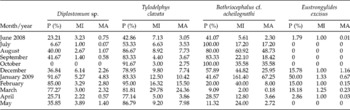
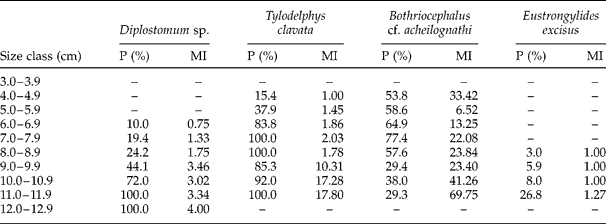
The total number of individuals found in the eye lenses was 368. Even though there was no significant difference between monthly prevalences (Kruskal–Wallis χ2= 3.955, df = 3, P= 0.266, P>0.05), prevalence was highest in the winter, with a maximum in January of 91.67%, and lowest in the summer, with a minimum of 6.67% in July (table 1). The differences in the number of Diplostomum sp. between summer–autumn (June, July, August–September, October, November) and winter–spring (December, January, February–March, April, May) were significant (χ2= 6.265, df = 3, P= 0.099, P< 0.05). The mean abundance increased in the winter months, with a maximum in January of 4.83, and decreased during the summer months, with a minimum in July of 0.07. Of the Diplostomum sp., 172 (46.7%) infected the left eye and 196 (53.3%) the right. The average intensity was 3.61 in female and 2.78 in male fish. Numbers varied with host body size, the highest occurrence being found in the size classes of 7.0–7.9 cm and 11.0–11.9 cm. The prevalence and mean intensity of Diplostomum sp. infection increased with fish size classes (table 2).
Infection levels of Atherina boyeri Risso, 1810 with Diplostomum sp., Tylodelphys clavata, Bothriocephalus cf. acheilognathi and Eustrongylides excisus from Lake Iznik from June 2008 to May 2009.

P, prevalence; MI, mean intensity; MA, mean abundance.
Infection levels of Atherina boyeri Risso, 1810 with Diplostomum sp., Tylodelphys clavata, Bothriocephalus cf. acheilognathi and Eustrongylides excisus from Lake Iznik from June 2008 to May 2009, according to size class of fish.
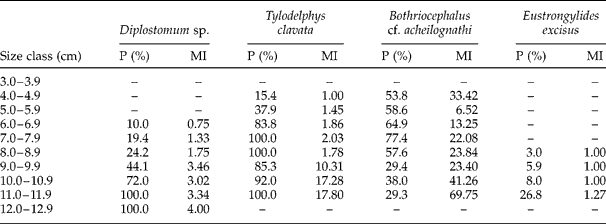
P, prevalence; MI, mean intensity.
Tylodelphys clavata
The total number of individuals found in vitreous humour was 2093. There was no distinct seasonality for T. clavata (Kruskal–Wallis χ2= 2.820, df = 3, P= 0.420, P>0.05), although the lowest prevalence was observed in June (42.86%) and July (53.33%); in the other months prevalence varied between 77.14 and 95.00% (table 1). Even though there was no significant difference between the monthly prevalences of T. clavata (Kruskal–Wallis χ2= 6.742, df = 3, P= 0.081, P>0.05), there was a significant difference in abundance between summer and winter. The mean abundance increased in the winter months and early spring to a maximum in March of 24.36 and decreased during summer and autumn to a minimum in October of 2.75 (table 1). Of the T. clavata, 1115 (53.3%) infected the left eye and 978 (46.7%) infected the right; the differences were not significant (independent t-test df = 20, P= 0.74, P>0.05). The average intensity was 11.81 in female and 6.09 in male fish. The prevalence and mean intensity of T. clavata infection increased with fish size class (table 2).
Bothriocephalus cf. acheilognathi
The total number of individuals found in the intestine was 3502. Although there were no statistically significant differences in the number of B. cf. acheilognathi between spring–summer and autumn–winter (Mann–Whitney U-test, U= 4, P= 0.024, P>0.05), the prevalence of this cestode was highest during the summer months, and lower in the winter and spring months. Its mean abundance is given in table 1. The mean intensity was 33.03 in female and 28.15 in male fish. The prevalence of B. cf. acheilognathi infection increased with fish size up to the 7.0–7.9 cm size class (77.41%) and then decreased with fish size. The mean intensity was found to be 33.42 in the 4.0–4.9 cm size class and, after a fall in mean intensity in the 5.0–5.9 size class, increased with fish size (table 2).
Eustrongylides excisus
Twenty-one individuals were found, two in the body cavity and the others in visible positions just under the skin of the anterio-ventral region of the host. The prevalence and mean intensity of infection with E. excisus were generally low and, although there were no statistically significant differences in the number of E. excisus between spring–summer and autumn–winter (Mann–Whitney U-test, U= 15.5; P= 0.668, P>0.05), the prevalence of E. excisus was maximum during winter and decreased in summer. No E. excisus were found from July to October. The mean abundance was increased in the winter months and decreased during the summer and autumn months (table 1). The prevalence and mean intensity of E. excisus infection were found to be zero in size classes from 3.0–3.9 to 7.0–7.9 cm and then increased in all size classes gradually (table 2). The mean intensity was found to be 1.18 in female and 1.0 in male fish. No metazoan parasites were found on the gills of the A. boyeri studied.
Feeding habits
The feeding habits of sand smelt were also studied by examining the stomach contents. Of the total number of stomachs examined, 27 were empty; prey was found in the stomachs of the rest of the fish samples. Prey in stomach contents included: rotifera; cladocera (Diaphanosoma lacustris, Bosmina longirostris); copepods (Cyclops vicinus); insects (Chironomus plumosus); oligochaeta (Tubifex sp.) copepodit and nauplii larvae. Cladocera and copepods were recorded throughout the study period and D. lacustris dominated in summer–autumn, whereas B. longirostris dominated in winter–spring, and C. vicinus dominated in spring. Maximal C. plumosus and Tubifex sp. were recorded in the late autumn–winter period. By overall prevalence, the most important prey derived from stomach contents were cladocera (43.5%), copepods (27.8%) and insects (23.4%).
Discussion
The sand smelt usually inhabits an ecosystem in which salinity, turbidity, current and temperature, as well as the quality and quantity of food, vary greatly (Bartulovic et al., Reference Bartulovic, Glamuzina, Conides, Gavrilovic and Dulcic2006), and phenotypic polymorphism is high (Astolfi et al., Reference Astolfi, Dupanloup, Rossi, Bisol, Faure and Congiu2005). These characteristics enable A. boyeri to inhabit the Mediterranean, Aegean, Marmara and Black Sea coasts, estuarine waters, lagoons and inland waters of Turkey. Atherina boyeri has also successfully adapted to freshwater biotopes after being introduced by fishermen as bait fish for Sander lucioperca in Egirdir and Beysehir lakes.
In the present study, the subjects were 76.75% female and 23.25% male, with size ranging from 3.1 to 12.2 cm. Kaygusuz (Reference Kaygusuz2006) studied the reproduction and growth biology of sand smelt in Lake Iznik, with 73.7% female, 24.4% male, 1.9% juvenile fish and a size range of 2.7–11.9 cm. They reported a spawning period from the beginning of April to the end of August.
Atherina boyeri has been described as a generalist and also as an opportunistic carnivore; its main prey is copepods in deep water and benthic fauna in shallow water (Vizzini & Mazzola, Reference Vizzini and Mazzola2005). During prey analyses of stomach contents of A. boyeri, Chrisafi et al. (Reference Chrisafi, Kaspiris and Katselis2007) identified six major groups: copepods, cladocera, bivalvia (larvae), insects (larvae), cestode worms and finfish (fry and eggs) from Trichonis Lake, Greece. In the present study, analyses of stomach contents showed that the sand smelt feeds on planktonic prey from spring to late autumn, while in late autumn and winter its diet is based exclusively on benthic prey; these findings indicate the opportunistic feeding characteristic of the fish. In Lake Iznik the maximum age of A. boyeri has been found to be 4+ years (Kaygusuz, Reference Kaygusuz2006). In fish in the three smaller size classes, feeding on zooplankton in the pelagial region, no Diplostomum sp. was found (table 2). When A. boyeri change their feeding habits with season and feed on benthic invertebrates, they are exposed to diplostomid cercariae much more than in the pelagial zone, and the prevalence and mean intensity of Diplostomum sp. increase in the bigger size classes. Rumyantsev (Reference Rumyantsev1975) noted that the relatively low infection of Coregonus albula with Diplostomum sp. in the Kuito Lakes at the end of summer was related to the pelagic mode of this fish, which prevented contact with the first intermediate hosts, molluscs. Marcogliese et al. (Reference Marcogliese, Dumont, Gendron, Mailhot, Bergeron and McLaughlin2001) reported white suckers, which are benthic consumers, to be more heavily infected with Diplostomum sp. than walleyes, which are pelagic piscivores. Our infestation findings are in accordance with these previous results. A gradual accumulation of Diplostomum spathaceum has been indicated in the eyes of Oncorhynchus mykiss (Karvonen, Reference Karvonen, Sarka, Olsbo and Tynkkynen2004).
Tylodelphis clavata has a life span of 1 year or less and the parasites die within the fish. Diplostomum sp., in contrast, has a life span of at least 1 year (Kennedy & Burrough, Reference Kennedy and Burrough1977). Accumulation and life span have to be taken into consideration for the occurrence of T. clavata and Diplostomum sp. in A. boyeri in Lake Iznik. There may be a relationship between fish mortality by means of overfishing and low mean intensity and abundance of T. clavata and Diplostomum sp. throughout the spring and summer months in the lake. During the closed season, fish were inevitably caught by using gill nets and, in this period, average fish length increased from 7.9 to 10.2 cm. In this case, it should be borne in mind that epidemiological values may be affected by fish specimens of larger size. However, on the other hand, there is no addition to the fish population by juveniles in the winter period.
Several groups of common parasites, including cestoda, are transmitted through zooplankton (Bergh et al., Reference Bergh, Nilsen and Samuelsen2001). In the first year of life, growth for A. boyeri (66%) is remarkably faster than during consequent age groups (Pombo et al., Reference Pombo, Elliott and Rebelo2005). We observed that juvenile A. boyeri in Lake Iznik feed on abundant cladocers and copepods during spring, summer and early autumn in the pelagic and littoral zones. Thus, the A. boyeri grow quickly, and during this time the procercoid of the cestode in C. vicinus is expected to be available and transmitted to the fish, hence the high summer–autumn prevalence and mean abundance of B. cf. acheilognathi. When A. boyeri changes its habitat to deep water in the late autumn and winter and feeds on benthic animals, the prevalence and mean abundance of B. cf. acheilognathi decreases. However, Giovinazzo et al. (Reference Giovinazzo, Antegiovanni, Dörr and Elia2006) recorded B. acheilognathi in A. boyeri for every sampling month, with a high prevalence in winter.
Members of the genus Eustrongylides have been reported to utilize oligochaetes such as Tubifex tubifex and Limnodrilus sp. as first intermediate hosts. Third- and fourth-stage larvae have been recorded in many freshwater fish species as second intermediate hosts (Measures, Reference Measures1988; Coyner et al., Reference Coyner, Spalding and Forrester2003). In the present study the prevalence of infection with E. excisus was significantly higher in winter than in the other seasons. When A. boyeri feeds on zoobenthos as well as insect larvae and Tubifex sp., it becomes infected with nematodes.
Our findings showed the impact of diet and feeding habits on the parasitic infection of sand smelt in Lake Iznik. When A. boyeri lives in the pelagic zone, it feeds on planktonic prey from spring and summer to the middle of autumn, while in late autumn and winter the diet is based exclusively on benthic prey. Cyclops vicinus dominated in the spring months, and juvenile sand smelt that fed on this prey, in particular, were infected with B. cf. acheilognathi. During winter their living environment changed to the benthic zone and so the smelts were parasitized with Diplostomum sp. and T. clavata because of close contact with the first intermediate host, molluscs. Also, the smelts were parasitized with E. excisus as a result of feeding on benthic animals such as Tubifex sp.
Acknowledgements
I would like to thank to Dr Erhan Soylu for his valuable contributions and the Turkish Ministry of Agriculture and Rural Affairs, Iznik District and local fishermen for their help and support. This study was supported by Istanbul University, Department of Scientific Research Projects, Project no. BYP 4250.