Introduction
Each year, Emergency Medical Services (EMS) personnel respond to over 30 million calls for assistance in the United States alone.Reference Maguire and Walz 1 There are over three million annual calls in Australia, 2 and over nine million annual EMS calls in England. 3 Occupationally, EMS professionals prepare for and respond to emergencies including illnesses, crashes, fires, and disasters;Reference Maguire, Dean and Bissell 4 - Reference Mitchell, Maguire and Guidotti 7 they are integral components of local and national health, medical, public safety, and disaster management systems around the world. 8 - Reference Al-Shaqsi 10
The EMS profession has been recognized as having high levels of occupational risk. Paramedics have the highest rate of occupation injury and fatality among all occupations in Australia.Reference Maguire, O’Meara and Brightwell 11 In the US, EMS personnel have exposures to occupational risks and have fatality and injury rates that are far above the average for all workers.Reference Maguire, Hunting and Smith 12 - Reference Amiry, Bissell and Maguire 18
A large number of both fatal and non-fatal injuries are the result of violence. A review of the literature found evidence of the problem in nine countries.Reference Maguire, O’Meara and O’Neill 19 There were almost 600 EMS assaults in 2013 among a staff of 4,500 ambulance personnel in London (England).Reference Dean 20 There is, on average, more than one fatal assault, as well as between 250 and 560 serious, non-fatal assaults among EMS personnel in the US each year.Reference Maguire and Smith 16 , Reference Maguire and O’Neill 21 In two reports from Sweden, 66%Reference Petzäll, Tällberg and Lundin 22 and 80%Reference Suserud, Blomquist and Johansson 23 of EMS respondents were subjected to threats and/or violence. Bigham reported that 75% of EMS survey respondents in Canada experienced violence in the previous 12 months.Reference Bigham, Jensen and Tavares 24 Gershon found that five percent of all injuries among EMS personnel in Baltimore, Maryland (USA) were the result of assaults.Reference Gershon, Vlahov and Kelen 25 One-third of EMS respondents in one survey reported that they were assaulted in the previous 12 months.Reference Maguire, O’Neill and O’Meara 26
While these studies provide valuable insight into the extent of the problem, the use of different research methodologies makes it difficult to make comparisons and to understand commonalities from country to country. Therefore, a world-wide survey is needed to gain a more cohesive picture of the extent of, and factors associated with, occupational violence against EMS personnel.
The objective of this research is to identify the occupational risks of physical violence among EMS personnel internationally, and to identify: who is getting hurt, when, and by whom, as well as to determine the types of injuries received by the personnel.
Methods
The authors developed an online questionnaire (Supplementary Material; available online only) based upon a tool developed by the World Health Organization (WHO; Geneva, Switzerland). 27 SurveyMonkey (San Mateo, California USA) was the host site and responses were collected from April through November 2016. The survey URL was distributed by social media (Facebook [Menlo Park, California USA]; LinkedIn [Sunnyvale, California USA]; and Twitter [San Francisco, California USA]) and by email to EMS personnel, ambulance agencies, unions representing EMS personnel, university EMS programs, and to EMS professional organizations. The project was announced at conferences and presentations in Sweden, Australia, the United Kingdom (UK), and the US. The URL and project announcement were also distributed in the Australasia paramedic magazine Response Reference Maguire, O’Meara and O’Neill 28 (Melbourne, Victoria, Australia) and by EMS World News (Malvern, Pennsylvania USA), 29 JEMS (Tulsa, Oklahoma USA), 30 the UK College of Paramedics (Bridgwater, England), 31 the US Fire Administration’s Emergency Management and Response – Information Sharing and Analysis Center (EMR-ISAC; Emmitsburg, Maryland USA) newsletter, 32 and an online news site. The inclusion criteria were anyone involved with ambulance or EMS world-wide; the exclusion criteria were anyone not associated with ambulance or EMS.
The survey provided specific definitions of violence and asked EMS respondents to describe their violence-related event, even if they did not formally report the incident. All participants who chose to be included were entered into a raffle as an incentive to participate; four respondents won new iPads (Apple; Cupertino, California USA). The survey was offered only in English.
The survey included 163 questions. It asked respondents to describe their EMS career experience (eg, years working and job title), demographics (eg, gender and age), and asked them to enter: the number of hours worked in EMS (either on ambulances, cars, or helicopters) for the past year; the type of work area (eg, rural or urban); and if assaulted on-duty over the past year. If an assault was entered, then the respondent was asked to complete a series of questions about each event, including: types of injuries (eg, fractures); body part(s) injured; medical care required; lost work time; weapons used; circumstances of the event (eg, transporting a patient to the hospital); identity of perpetrator; if the victim knew the perpetrator prior to the event; if the respondent reported the assault to his or her employer; and any other conditions (eg, perpetrator was intoxicated).
Data Analysis
A Poisson regression with a log link and a constant offset for exposure t (hours worked) was used to investigate differences in the mean incidence rate
 $\mu $
of violent incidents:
 $$log\left( \mu \right){\equals}\beta _{0} {\plus}\beta _{1} {\it x}_{1} {\plus}\,\ldots\,{\plus}log\left( {\it t} \right),\,{\it y}\,\sim\,{\it Poi}\left( \mu \right).$$
This model estimates the mean incidence rate per hour worked, incorporating the assumption that the count of incidents
 $\it y$
is linearly related to the duration
 $\it t$
, and log-linearly related to other covariates. In many applied settings, the strong assumption of Poisson regression that
 ${\rm var}\left( \,{\it y} \right){\equals}\mu $
is violated due to over-dispersion, which can lead to anti-conservative parametric tests. In these circumstances, negative-binomial (NB) regression may be appropriate, which is similar to Poisson regression, but treats the error distribution as:
 $${\it y}\,\sim\,{\it NegBin}\left( {\mu ,\theta } \right),{\rm }$$
with
 $${\rm var}\left( \,{\it y} \right){\equals}\mu {\plus}{{\mu ^{2} } \over \theta }.$$
The constant dispersion parameter
 $\theta $
is estimated from the data and accommodates a potentially broader and more skewed distribution of positive counts around the mean. Analyses were conducted in the R statistical programming environment, relying on the MASS and countreg packages for specialized routines for handling incidence data.
33
For the purpose of modelling incidence rate as a function of demographic covariates, cases with missing data for any variables, and also those who reported working less than 100 hours in this period, were excluded.
Incidence rates are reported per 100 full-time equivalent (FTE) individuals per annum, assuming a 2,000-hour full-time workload (ie, setting
 ${\it t}{\equals}20,000$
.) This is equivalent to calculating a simple scaled average:
 $${\it y}{\equals}\sum {\it y_k} \cdot 20000\,/\,{\it t}_{\it k} .$$
This is equivalent to the method used by the US Bureau of Labor Statistics (Washington, DC USA):
Incidence Rate=(sum of injury cases * 200,000)/ sum of the hours worked. 34
Ethics
Central Queensland University’s Human Research Ethics Committee (HREC; Rockhampton, Australia) approved the study. The requirement for written informed consent was waived by the Committee.
Results
Respondent Characteristics
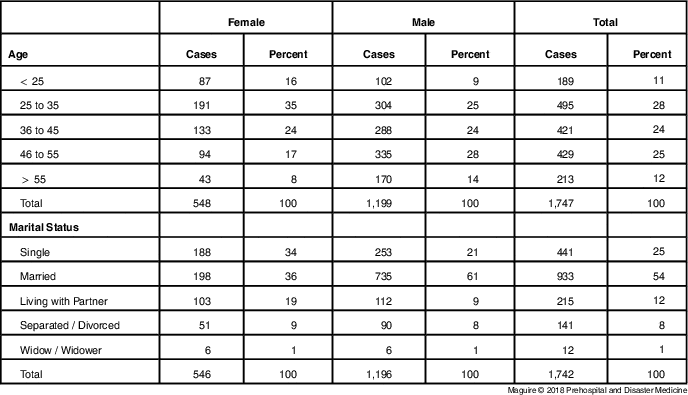
There were 1,778 respondents to the survey. Table 1 illustrates the results of 1,744 participants who entered their year of birth and gender; of those, 69% were male and 54% were married. Around 55% described their primary EMS work location as “urban,” while approximately 20% indicted “regional” and 20% indicated “rural.” Around 68% described their employer as a “public provider,” 28% worked for a private company, while five percent of respondents worked for volunteer EMS services.
Respondent Age and Marital Status (N=1,747)

Respondents were asked to enter their “current work title” in a text box. One-third of the respondents (34%) described themselves as paramedics, nine percent entered “emergency medical technician/EMT,” and four percent included “firefighter” in their title. Ten respondents’ titles included the word “nurse.” The remaining entries covered a large variation of titles and included the words: supervisor, chief, officer, student, instructor, and flight.
Seven-hundred and forty-seven respondents indicated their country. The majority (488) were from the United States, with responses also received from: Australia (102), UK (93), Ireland (38), New Zealand (9), Canada (6), Sweden (4), Germany (2), and one each from Portugal, Saudi Arabia, South Africa, Uruguay, and Uzbekistan.
Career Experience of Assault
When asked “Have you ever been physically attacked while on-duty?” 761 (65%) of the 1,172 who answered the question answered “Yes.” Male respondents were 1.38-times more likely to report being attacked than females (
 $\chi ^{2} \left( 1 \right){\equals}5.82{\hbox{\rm ;}}\, {\it P}{\equals}.0158)$
; men were no more likely to have been attacked with a weapon than women (
 $\chi ^{2} \left( 1 \right){\equals}1.651{\hbox{\rm ;}}\, {\it P}{\equals}.1988)$
.
Of 632 cases, 47 (7%) indicated that the incident caused them to lose time from work. Six-hundred and twenty-nine respondents answered the question: “Did you report this assault to your ambulance agency?” Of those, 274 (44%) answered “No.”
The countries with >20 respondents were the US, Australia, UK, and Ireland; the data from those countries were used to compare the likelihood of experiencing assault across those nations. There was no significant difference with respect to nationality
 $(\chi ^{2} \left( 1 \right){\equals}1.151{\hbox{\rm ;}}\, {\it P}{\equals}.7648)$
.
Incidence Rates in Last Three Months
For the 1,082 participants who reported their working hours (and reported working more than 100 hours in the last three months), the average rate of violent incidents was 229.3 per 100 FTE workers per year. The incident rate was modelled as a function of age and gender, considering up to order two polynomial terms for age. Diagnostic plots suggested that the Poisson model was a poor fit to the data. This was confirmed by a likelihood ratio comparison with the NB model (
 $\theta {\equals}0.3091$
;
 $\chi ^{2} \left( 1 \right){\equals}556.4{\hbox{\rm ;}}\, {\it P}\,\lt\,.001)$
. Graphical inspection of the NB residuals suggested a close fit to the observed frequencies, confirming that the NB was more appropriate than the Poisson model. A model including only main effects was a significant improvement over the null model (
 $\chi ^{2} \left( 2 \right){\equals}12.28{\hbox{\rm ;}}\, {\it P}{\equals}.0064)$
. The age x gender interaction model provided a further significant improvement in model fit (
 $\chi ^{2} \left( 3 \right){\equals}6.01{\rm \hbox;}\, {\it P}{\equals}.049)$
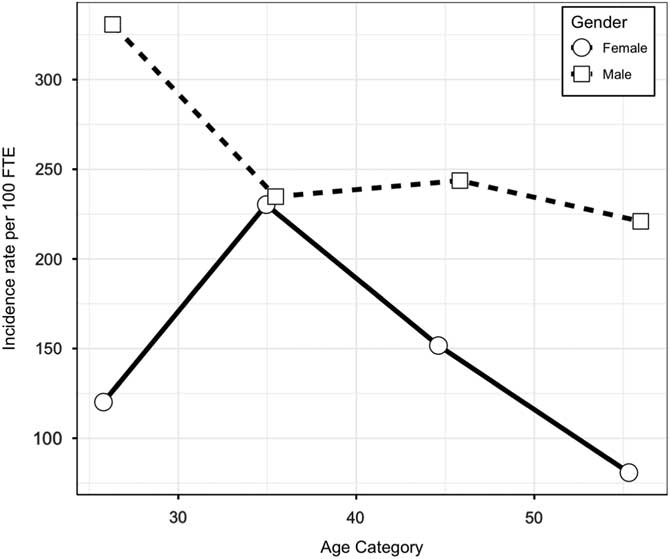
. Figure 1 illustrates the relationship between age and gender and incidence rate. Overall, men experienced more assaults than women, and older workers experienced fewer assaults than younger workers. However, this effect differed markedly by age, with 30-40-year-old men and women experiencing similar rates of assault, and the female assault rate reducing markedly at younger and older ages. In a separate model, only cases from US, Australia, UK, and Ireland were selected to test whether or not incidence rates varied by nationality; no significant differences were found
 $(\chi ^{2} \left( 3 \right){\equals}7.27{\hbox{\rm ;}}\, {\it P}{\equals}.0635)$
.
Mean Incidence Rate Grouped by Gender and Age (by Decade). Abbreviation: FTE, full-time equivalent.

Time of Incident
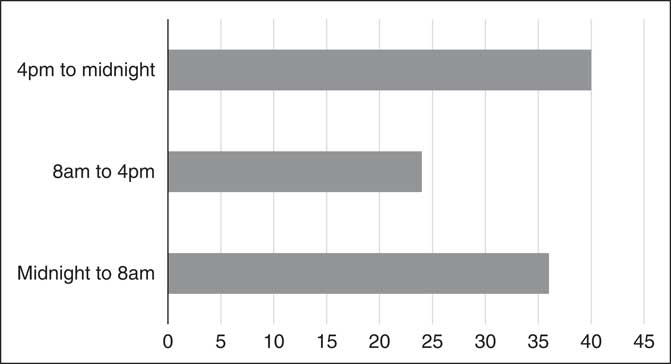
Figure 2 shows that approximately 40% of the 592 respondents to this question indicated that the incident occurred between 4:00pm and midnight.
Time of Violence Incident (N=592).

Perpetrators
In almost 10% (67) of the 761 attacks, the perpetrator used a weapon. The perpetrator was a male in just over 70% of the cases. Respondents believed that over 80% of the attackers “may have been intoxicated or under the influence of drugs.” In 24% of cases, the attacker was arrested.
In 631 responses, the attacker was identified: 567 (90%) were patients, 31 (5%) were patient family members, and there was one attack each by: a co-worker, a “friend/personal acquaintance,” and “a member of your family.” Almost five percent of the responses identified the attacker as “other.”
Six-hundred and thirty-two respondents answered the question: “Did you know your attacker prior to the incident.” Of those, 38 (6%) indicated “Yes.”
Type of Injury
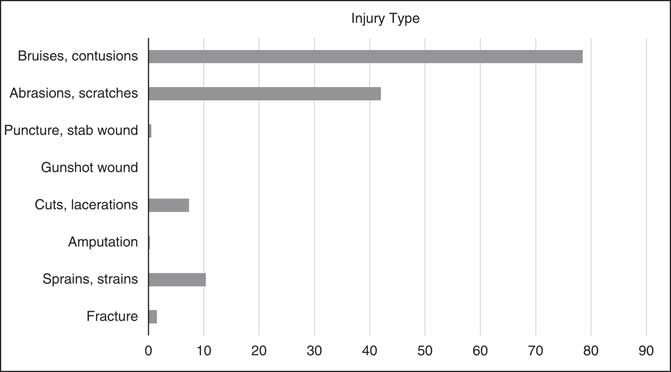
Three-hundred and ninety-five respondents indicated that they received a violence-related injury during the previous 12 months. As shown in Figure 3, almost 80% were bruises and contusions. However, the victims also received fractures, stab/puncture wounds, and an amputation.
Type of Injury (N=359).

Discussion
The respondent population was 69% male. This is comparable to the US average of 67% male 35 and similar to the proportion of US EMS personnel reporting a violence-related injury (60% male).Reference Maguire and O’Neill 21
Among respondents from seven countries, the average rate of attack was 2.3 cases for every one FTE worker per year. The rate of attack was higher in males (2.6) than for females (1.7). Grange also found a higher attack rate against male EMS personnel,Reference Grange and Corbett 36 but Taylor found a higher rate among female EMS personnel.Reference Taylor, Barnes and Davis 37 Maguire’s research found that females may have a much higher rate of injury compared to male EMS personnel.Reference Maguire, Hunting and Smith 12 , Reference Maguire 14 - Reference Maguire and Smith 16 , Reference Maguire and O’Neill 21
Sixty-five percent of the EMS personnel responding to the survey indicated that they had been the victim of violence. Previous studies have found that between 66% and 88% of paramedics reported experiencing violence in the previous 12 months;Reference Petzäll, Tällberg and Lundin 22 - Reference Bigham, Jensen and Tavares 24 , Reference Gormley, Crowe and Bentley 38 , Reference Boyle, Koritsas and Coles 39 Boyle reported that 61% of respondents had been assaulted.Reference Corbett, Grange and Thomas 40 In comparison, Alexander found that 68% of nurses, 47% of allied health workers, and 48% of physician general-practitioners experienced violence within the previous 12 months.Reference Alexander, Fraser and Hoeth 41
The majority of injuries were bruises, but victims also received fractures, stab/puncture wounds, and an amputation. Bruises were also the primary injury type in a study of French emergency medical personnel who were assaulted.Reference Duchateau, Bajolet-Laplante and Chollet 42
Forty-four percent of these respondents indicated that they did not report an assault to their agency. Previous research found that 43%Reference Findorff, McGovern and Wall 43 and 88%Reference Arnetz, Hamblin and Ager 44 of health care workers did not report violent incidents to their agency.
There were a number of findings related to the perpetrators. Respondents to this survey identified the patient as the perpetrator in 90% of the cases. Grange also found that patients were the perpetrators in 90% of the violence cases directed against EMS personnel.Reference Grange and Corbett 36 Gerberich found that patients were the perpetrators in 97% of the assault cases against nurses in Minnesota (USA); in 80% of the cases, the respondent believed that the perpetrators were under the influence of drugs or alcohol.Reference Gerberich, Church and McGovern 45 This is similar to Petzall’s finding that over one-half of the perpetrators were under the influence.Reference Petzäll, Tällberg and Lundin 22 In six percent of the cases in this study, the victim knew the attacker prior to the incident.
Limitations/Future Investigations
Limitations
Although open web-based surveys offer less control than face-to-face surveys, research has shown that, in general, findings tend to be consistent with more traditional survey methods.Reference Gosling, Vazire and Srivastava 46
There were approximately 800,000 EMS personnel in the US in 2011, 35 16,000 ambulance personnel in Australia in 2016, 47 and 1,600 in Ireland in 2016. 48 No reliable source of data describing the total number of EMS personnel in the other countries was found. The project announcements may have been seen by many thousands of EMS personnel world-wide, and yet only 1,778 personnel responded. This in not only a limitation of the study, but it also highlights that poor participation among EMS personnel is one of the significant challenges associated with EMS research. The study has a possible bias toward those having been violence-victims being motivated to participate in the survey.
Potential Areas for Future Investigations
A great deal of uncertainty remains about the incidence of violence against EMS personnel. Future research should aim to: codify case definitions; recommend standard reporting criteria; identify the actual rate of violence; and identify methods to ensure that a higher proportion of cases are appropriately reported. A mechanism to record and analyze near misses (almost assaults) would also be valuable.
There is an urgent need for studies of interventions. Research is needed to identify if and how often EMS personnel receive violence-related training. Pozzi found that 71% of EMS personnel lacked the training to protect themselves.Reference Pozzi 49 This is similar to Gates who noted that 64% of emergency department staff had not received any violence training in the previous 12 months.Reference Gates, Ross and McQueen 50
Anecdotal reports describe agencies and jurisdictions that have implemented programs such as issuing protective vests (eg, bullet or stab proof), legislative efforts such as increasing the civil penalties for assaulting EMS personnel, bodycams, public education, and other personnel training; however, Maguire found no reporting of the outcomes of any EMS violence-prevention projects.Reference Maguire, O’Meara and O’Neill 19 Reporting both positive and negative outcomes of intervention projects is imperative so that the profession can learn from each project as it works toward developing effective, efficient, reliable, evidence-based interventions.
Conclusions
This study has identified that occupational violence against EMS personnel is a risk in many countries. The majority of perpetrators are patients, the influence of alcohol and drugs is prevalent, and weapons are likely to be involved. Assaults are more prevalent from 4:00pm to midnight. Although the types of injuries are mainly bruises and contusions, personnel also reported penetrating trauma, fractures, and an amputation. This information provides a foundation upon which interventions to mitigate risks can be developed, implemented, and evaluated.
In order to develop and implement measures to increase safety, EMS personnel must be involved with the research and implementation process. For future studies, EMS agencies should work with university researchers to quantify agency-level risks and to develop, test, and implement interventions in such a way that they can be reliably evaluated and the results published in peer-reviewed journals.
Acknowledgements
The authors wish to thank the Falck Foundation (Denmark) for their generous support of the project (there was no grant number) and the WHO for giving them permission to adapt their survey for this project.
Supplementary Material
To view supplementary material for this article, please visit https://doi.org/10.1017/S1049023X18000870