INTRODUCTION
Over the period of mass criminalization, social scientists have developed and tested rigorous theories concerning the perspectives and struggles of people and communities subject to criminal legal control in the United States. Theories such as procedural (in)justice (Hagan et al., Reference Hagan, Shedd and Payne2005; Tyler Reference Tyler2006; Weitzer and Tuch, Reference Weitzer and Tuch2005), legal cynicism (Sampson and Bartusch, Reference Sampson and Bartusch1998), custodial citizenship (Lerman and Weaver, Reference Lerman and Weaver2014; Weaver and Lerman, Reference Weaver and Lerman2010), legal estrangement (Bell Reference Bell2017), and cop wisdom (Stuart Reference Stuart2016) have been offered to variously explain the cognitive landscapes of criminalized communities, measure differences in group-level attitudes toward (and compliance with) the criminal law, and describe the social and political consequences of legal exclusion. This profusion of theories has been generative for empirical research on the phenomenology of criminalization and has, at least in the last decade, increasingly incorporated analyses of race (Rios et al., Reference Rios, Carney and Kelekay2017). While this scholarship has noted differences across racial groups, it has yet to fully examine the ways racism and criminalization interrelate in the making of criminalized people’s perspectives. Moreover, existing research affords little insight into how those subject to criminalization imagine transforming the legal system.
This article advances a theory of criminalized subjectivity that is attuned to the way racism and criminalization interrelate in the subjective realm and that aims to uncover subaltern strategies and visions for transforming the structure of the criminal law and broader society. W. E. B. Du Bois (Reference Du Bois1903a, Reference Du Bois1920) theorized the unique subjective burdens and visions arising from being racialized as Black in the United States at the turn of the twentieth century. His tripartite theory of racialized subjectivity (Itzigsohn and Brown, Reference Itzigsohn and Brown2015, Reference Itzigsohn and Brown2020) offered theoretical concepts for explaining racism during this period and for prescribing strategies to contest it that centered the voices of those marginalized by racial oppression. In the late twentieth and early twenty-first centuries, mass criminalization has been a defining feature of racial social control and injustice in the United States (Alexander Reference Alexander2012; Bobo and Thompson, Reference Bobo and Thompson2010). Whereas research on the perspectives of criminalized people has done much to catalogue racial differences in attitudes toward the law and legal authority, few scholars have gone further to locate criminalization as a technique of racism that has implications for criminalized people’s perceptions of, and reactions to, the subjective racial order and the structure of the law (for notable exceptions, see Lerman and Weaver, Reference Lerman and Weaver2014; Lopez-Aguado Reference Lopez-Aguado2018; Walker Reference Walker2016). This article places the interdisciplinary literature on criminalized people’s perspectives and experiences in conversation with Du Bois’s tripartite theory of racialized subjectivity. In doing so, I frame research and theory on the attitudes and experiences of criminalized people as investigations into various components of criminalized subjectivity, defined broadly as the unique understandings and visions attendant to being a person, or part of a community, routinely subject to legal control and exploitation sanctioned by the criminal law. Criminalized subjectivity is, I argue, inseparable from processes of racialization and White supremacy.
The analysis unfolds in two parts. In the first, I engage with Du Bois’s writings on racialized subjectivity to develop an overarching theory of criminalized subjectivity that seeks to cohere a broad, interdisciplinary literature on the perspectives of criminalized people and communities in an era of racialized mass incarceration. This research has been catholic in discipline and method, iterating between qualitative and quantitative approaches, from ethnographic observations and in-depth interviews to survey collection and analysis, from psychology and sociology to criminology and political science. I argue that Du Bois’s concepts of the veil, twoness, and second sight can be generatively applied to the racialized experience of criminalization. Surveying influential research and theories on experiences of policing, courts, and prisons, I show how these concepts harmonize disparate interpretations, clarify the place of White supremacy and racism, and provide a theory of legal change rooted in ordinary people’s experiences and needs. Inspired by Du Bois’s concept of second sight, I introduce the concept of legal envisioning, defined as a social process whereby criminalized people and communities imagine and build alternative futures within and beyond the current legal system. Legal envisioning, like second sight in relation to racialized subjectivity, is one component of criminalized subjectivity. Growing research has documented paradoxes in, and complexities about, the way the criminalized view themselves as blameworthy for their conditions (e.g., Lerman and Weaver, Reference Lerman and Weaver2014; Manza and Uggen, Reference Manza and Uggen2008) or appear to rely on legal authorities, such as police, and even desire increased police presence in their communities (e.g., Bell Reference Bell2016; Campeau et al., Reference Campeau, Levi and Foglesong2020; Carr et al., Reference Carr, Napolitano and Keating2007). Legal envisioning offers additional ways to make sense of these paradoxes all the while highlighting the subaltern voices and strategies that offer the most radical and emancipatory critiques of existing carceral apparatuses.
In the second part, I analyze legal envisioning as articulated in interviews conducted with a diverse sample of forty criminal defendants during the early years of the Black Lives Matter (BLM) movement (2015–2018). Defendants in the study were asked how they would change the criminal legal system. This empirical analysis examines two components of legal envisioning—problems that criminalized people report, and their solutions to those problems. Problems that defendants report emanating from behind the veil of criminalization include unequal treatment based on race and class; lack of resources for rehabilitation; corruption; and stigma. I show how racism is recognized as a central problem, even among White people in the sample, suggesting that criminalization may enable solidarity across racial lines. Yet, I also show how White people can leverage anti-Black stereotypes to distance themselves from criminalized people of color or reference class-based forms of oppression in ways that obscure the system’s racism. Although nearly all the people in this study do not consider themselves activists or organizers, I situate their proffered solutions within the context of the BLM movement, which has articulated both reformist and abolitionist visions for change (see Akbar Reference Akbar2018; Murray Reference Murray2020). Some people in the study reported abolitionist solutions (i.e., solutions that would dismantle components of the legal system), but most proposed reformist solutions (i.e., solutions that would tinker with problematic features of the system while keeping it largely intact). I explain how these different visions can be explained by the concepts of the veil and twoness. In sum, this article reveals how a Du Boisian approach to the study of criminalized subjectivity can explain legal envisioning’s contradictions, identify areas of solidarity (or explain its limits in relation to racism), and illuminate emancipatory possibilities for legal transformation.
THEORIZING CRIMINALIZED SUBJECTIVITY AND LEGAL ENVISIONING
In the last couple decades, growing work has reassessed Du Bois’s scholarship, moving from efforts at canonization to efforts at resurrecting Du Boisian methods and theories for use in contemporary sociological inquiry (e.g., Bobo Reference Bobo2000; Conwell Reference Conwell2016; Hunter Reference Hunter2015; Quisumbing King Reference Quisumbing King2019). Several panels at the American Sociological Association’s annual meetings in the past few years have engaged this project, as have recent convenings of The Du Boisian Scholar Network. The network is “composed of scholars and activists working in the tradition pioneered by W. E. B. Du Bois” and seeks “to enact emancipatory change both within and beyond the academy.”Footnote 1 The task of resurrecting Du Bois’s theories and methods requires critical engagement with Du Boisian texts—carefully detailing the relevance, limitations, and possibilities of his approach for contemporary research. This part of the article critically engages with Du Bois’s theory of racialized subjectivity, placing it in conversation with contemporary research on the understandings and experiences of the criminalized. Doing so offers a tripartite theory of criminalized subjectivity relevant for the study of people and communities routinely subject to racialized forms of criminal legal control in the twenty-first century.
Du Boisian Theory and Racialized Subjectivity
In The Souls of Black Folk, Du Bois (Reference Du Bois1903a) theorized how it felt to be Black in a White-dominated society. One of the best-known terms from this monograph is “double consciousness,” which Du Bois defined as a “sense of always looking at one’s self through the eyes of others, of measuring one’s soul by the tape of a world that looks on in amused contempt and pity” (Du Bois Reference Du Bois1903a, p. 3). Black people, Du Bois argued, are perceptive of the anti-Black prejudices held by many Whites as well as the collective experiences and aspirations of other Blacks. Double consciousness refers to these dual perspectives as well as the unease and ambivalence that it produces in the minds and actions of many Black people (Du Bois Reference Du Bois1903a). Although the concept has a long tradition within and beyond academia, it has only recently been considered alongside other sociological theories of the self and identity. José Itzigsohn and Karida L. Brown (Reference Itzigsohn and Brown2015, Reference Itzigsohn and Brown2020) provide the most comprehensive theoretical resurrection of double consciousness theory, detailing how double consciousness serves as the foundation of a broader theory of racialized subjectivity under the conditions of modernity. They argue that this theory has three constitutive elements: the veil, twoness, and second sight.
The veil is a metaphor for the structural boundaries—both symbolic and social (see Lamont and Molnar, Reference Lamont and Molnár2002)Footnote 2—that exist between Black people and White people (Du Bois Reference Du Bois1903a, Reference Du Bois1920). As a structure, the veil shapes people’s identities and perceptions—the dimensions that constitute individual and group subjectivity (Brown Reference Brown2018, appendix; Ortner Reference Ortner2006).Footnote 3 Black people can see both within and beyond the veil and are thus acutely aware of their own and the outside world’s perceptions. This results in a twoness, or the weight of holding often irreconcilable perspectives from two different social worlds. By contrast, White people “project their own constructions of Blacks onto the veil, and in this way the veil works as a one-way mirror: those on the dominating side of the veil see their projections of the racialized reflected on it” (Itzigsohn and Brown, Reference Itzigsohn and Brown2015, p. 235). White people are unaware of the gaze from those behind the veil who are racialized as Black (Blau and Brown, Reference Blau and Brown2001)—a cause and consequence of the lack of social interaction and intellectual exchange between the two groups (Du Bois Reference Du Bois1903a). White people’s lack of awareness affords them racial innocence, allowing them to believe they are blameless in the reproduction of racial inequality (Du Bois Reference Du Bois1920). Moreover, as Charles W. Mills (Reference Mills, Sullivan and Tuana2007) argues, the veil metaphor can also explain White ignorance, or “false belief and the absence of true belief,” such as a belief in White supremacy (p. 16).
Black people’s responses to the veil are heterogeneous. In much of his empirical research, Du Bois documented the diversity of material conditions and lifestyles within Black communities (Hunter Reference Hunter2015), which he argued were differentiated along various axes such as class, gender, and geography (Du Bois Reference Du Bois1903a, Reference Du Bois1903b, Reference Du Bois1909, Reference Du Bois1996 [1899]). Such diversity also existed in the subjective domain. Black people, Du Bois suggested, have diverse behavioral and attitudinal responses to the veil based on their social positions. For instance, Du Bois suggested that divergent experiences of Blackness in the North versus the South could, in part, explain heterogeneity in subjectivities (Du Bois Reference Du Bois1903a). Itzigsohn and Brown (Reference Itzigsohn and Brown2015) posit that Du Bois theorizes three distinct responses to the veil: self-assertion, rebellion, and assimilation. Du Bois articulated these responses as ideal types (“divergent ethical tendencies”), sometimes referring to two main types: “radicalism” (self-assertion and rebellion) and “hypocritical compromise” (assimilation) (Du Bois Reference Du Bois1903a). While Black people’s responses are heterogeneous, the experience of existing and communing behind the veil is nevertheless a common collective experience, affording Black people a form of collective consciousness regarding race even if their beliefs about how to deal with racism and racialization are varied.
Certain responses to the veil can also represent everyday visions and strategies for contesting racism and injustice. Across various strains of his work and activism, Du Bois was interested in documenting and enacting progressive social change. Aldon D. Morris (Reference Morris2015) and others have argued that Du Bois sought to use his empirical and theoretical scholarship not only to uncover social truths but also to advocate for racial justice (Morris and Ghaziani, Reference Morris and Ghaziani2005). To be sure, the early Du Bois was quite skeptical of reform-oriented social scientists. He was intimately aware of the way anti-Black bias affected many White scholars’ understandings of African Americans.Footnote 4 His position later evolved, however, as he came to realize that, even in the face of contradictory scientific evidence, many White academics of the time held fast to false beliefs about Black people (Morris and Ghaziani, Reference Morris and Ghaziani2005). Du Bois’s racialized subjectivity therefore provided a theory of social change rooted in Black people’s subjectivities (on standpoint theory in general, see Itzigsohn and Brown, Reference Itzigsohn and Brown2020, p. 203–205; Mills Reference Mills, Sullivan and Tuana2007) rather than White elites’ false promises. Second sight—defined as the “gift” of being able to see beyond the veil—is a concept that captures Du Bois’s interest in understanding how the conditions of racialized subjectivity provided the potential seeds for its own dismantling. Mentioned briefly in The Souls of Black Folk (Du Bois Reference Du Bois1903a), second sight illuminates the way Du Bois’s theory of racialized subjectivity accounted for, and provided avenues toward, social change. Du Bois used the term to describe how Black people imagine alternatives to their racial subordination (Itzigsohn and Brown, Reference Itzigsohn and Brown2015).
The notion of second sight captures the essence and emancipatory urgency of Du Bois’s investigations into Black subjectivity over his decades-long career. Marcus Anthony Hunter (Reference Hunter2013) argues that The Philadelphia Negro (Du Bois Reference Du Bois1996 [1899]) is, in many ways, a statement about the profound contributions Black people made in developing the city’s seventh ward. In “Efforts for Social Betterment among Negro Americans,” Du Bois and colleagues (Reference Du Bois1909) collected reports from “persons of standing” in several Southern cities, sending letters inquiring about charitable organizations run by and for the benefit of Black people. Their goal was to catalogue the “benevolent efforts […] of colored people themselves directed toward their own social uplift” (Du Bois Reference Du Bois1909, p. 9). The efforts catalogued included those of community leaders as well as ordinary citizens engaged in small, everyday efforts at “betterment,” such as members of local churches raising money for schools or doing “missionary” work. The monograph provided one of the first systematic accounts of the myriad ways Blacks envisioned, and possibly enacted, change in their communities, dispelling the myth that Black people were passive to their oppression. In other texts such as The Gift of Black Folk (Du Bois Reference Du Bois1924) and even in his photographic work for the 1900 Paris Exhibition, where he exhibited images of middle-class Black Americans meant to counter racist anti-Black tropes (Smith Reference Smith2004), Du Bois demonstrated how attention to the inner worlds of Black people could reveal routes for social reform—reform that could improve the conditions of Black people and broader society.Footnote 5 And in Black Reconstruction, Du Bois (Reference Du Bois1998 [1935]) documented the agency of enslaved Black people in emancipating themselves and, through their efforts, bringing forth the possibility of democracy in the United States.
From Racialized Subjectivity to Criminalized Subjectivity
Mass criminalization has been a defining feature of racial social control and injustice in the late-twentieth and early twenty-first century United States (Alexander Reference Alexander2012; Bobo and Thompson, Reference Bobo and Thompson2010). Defined as the historically unprecedented use of criminal legal techniques to control and exploit a broad swath of the population, especially targeting those in race-class subjugated communities (see Prowse et al., Reference Prowse, Weaver and Meares2019), the term mass criminalization captures the way various legal tools beyond the prison have been used to subordinate mostly poor people of color (Clair Reference Clair2020). While the rise of mass criminalization coincides with the growth of the carceral state in the middle of the twentieth century (Hinton Reference Hinton2016; Simon Reference Simon2007), the possibilities of using criminal law as a tool of racialized social control were being refined and enacted against Indigenous people and enslaved Africans as early as the colonial period. In Black Reconstruction (Reference Du Bois1998 [1935]), Du Bois described how Black Codes and convict leasing practices after the Civil War subordinated Black people. He also described the way police were used to protect Whites all the while offering little protection to Blacks: “If a white man is assaulted by a white man or a Negro the police are at hand. If a Negro is assaulted by a white man, the police are more apt to arrest the victim than the aggressor” (Du Bois Reference Du Bois1998 [1935], p. 699). Even during the Progressive Era, when rehabilitative logics infused through various criminal legal institutions, leniency under the law was largely reserved only for White people accused of deviance and crime (see Muhammad Reference Muhammad2019 [2010]; Ward Reference Ward2019).
Over the more recent period of mass criminalization, the anti-Black and anti-Indigenous foundations of the criminal legal system have also entrapped other, non-Black and non-Indigenous communities of color and even White people (Clair Reference Clair2020; Gottschalk Reference Gottschalk2016). Moreover, techniques of punitive legal control have been enacted as a form of poverty governance and a way to control populations marginalized due to constructions of mental illness and substance use disorders (see Stuart et al., Reference Stuart, Armenta and Osborne2015; Wacquant Reference Wacquant2009). These realities, however, do not contradict the persistently anti-Black logics of mass criminalization (Alexander Reference Alexander2012) or of poverty governance, as such governance intersects with racialized disciplining techniques (Soss et al., Reference Soss, Fording and Schram2011) and is made possible by the myriad punitive sanctions authorized by the criminal law (Winter and Clair, Reference Winter and Clair2021). The rise of the carceral state was, in large part, a political response to the Black freedom struggle in the 1950s and 1960s, which threatened White supremacy (Alexander Reference Alexander2012) and challenged the build-up of police and prisons in a dialectical way (Felber Reference Felber2020). As Elizabeth Hinton and DeAnza Cook (Reference Hinton and Cook2021) write, understanding criminalization as an “antiblack punitive tradition” in the United States is necessary for understanding “the perpetual criminalization of a constellation of marginalized, minority-identified populations. In effect, the criminalization of black Americans has been, and continues to be, the canary in the coal mine for underserved and hyperpoliced communities caught within the ever-expanding web of American law and order” (pp. 2–3).
In recent decades, growing work has examined the subjective experiences of criminalized people and communities, documenting how contact with the law and other punitive institutions influences people’s self-concepts, social identities, and conceptions of citizenship (for reviews, see Rios et al., Reference Rios, Carney and Kelekay2017; Stuart et al., Reference Stuart, Armenta and Osborne2015). This diverse and extensive literature has largely drawn on qualitative methods but has also relied on quantitative methods to describe attitudes and explain differences in criminalized behaviors across groups. Moreover, this scholarship has often engaged with early- and mid-twentieth century theories about criminality—such as strain theory, social disorganization theory, and labelling theory—to illuminate the causes of criminalized behaviors as well as community members’ and the state’s responses to such behaviors.Footnote 6 For instance, Victor M. Rios (Reference Rios2011) documents how Black and Latino youth labeled as delinquents managed a complex of authority figures who surveilled them. Feeling devalued, some of the youth exhibited disrespect toward probation officers and engaged in delinquent acts to maintain their dignity. Forrest Stuart (Reference Stuart2016) shows how mostly poor, Black men in Los Angeles’ Skid Row develop “cop wisdom,” or a cultural frame that enables them to interpret and predict police tactics. Although cop wisdom allowed some men in his study to evade police, it also eroded community cohesion as street vendors and others sought to maintain informal social control by running drug dealers, unhoused people, and even congregating pedestrians off the block to avoid police attention. And from interviews with adolescents in Baltimore, Monica C. Bell (Reference Bell2017) reveals the sense of individual and collective estrangement that youth growing up in the city felt from the police and other authorities—even if they never had direct experience with police. For them, the law was not simply an untrustworthy institution but an institution they felt to be chaotic, corrupt, and alienating. Their sense of alienation from police structured their daily lives, preventing them from moving freely around the city and participating in society as equal citizens (see also Clair Reference Clair2020, chapter 1; Lerman and Weaver, Reference Lerman and Weaver2014; Miller and Stuart, Reference Miller and Stuart2017). Other work, often drawing on survey data, has considered attitudes of procedural (in)justice (Hagan et al., Reference Hagan, Shedd and Payne2005; Weitzer and Tuch, Reference Weitzer and Tuch2005) and legal cynicism (Kirk and Papachristos, Reference Kirk and Papachristos2011; Sampson and Bartusch, Reference Sampson and Bartusch1998) among the criminalized. In addition, while much work and theory has focused on subjectivities in relation to policing, growing scholarship over the period of mass criminalization has examined subjectivities formed through encounters with courts (Clair Reference Clair2020), probation (Clair Reference Clair2020; Phelps and Ruhland, Reference Phelps and Ruhland2021), jails and prisons (Ellis Reference Ellis2021; Gibson-Light Reference Gibson-Light2018; Lopez-Aguado Reference Lopez-Aguado2018; Walker Reference Walker2016), and various re-entry programs and parole obligations (Gurusami Reference Gurusami2017; Halushka Reference Halushka2020; Maruna Reference Maruna2001; Miller Reference Miller2014; Werth Reference Werth2012).
This work has often been attuned to the disproportionate way mass criminalization has operated in race-class subjugated communities; indeed, many theories of criminalized subjectivity seek to explain the distinct attitudes and perspectives of these disadvantaged communities in contrast to privileged ones (e.g., legal cynicism and procedural (in)justice). Yet, this scholarship has focused more so on group-level differences in perspectives and identities rather than examining how racism is central to the making and expression of these subjective differences. In other words, whereas research on criminalized subjectivities has done much to catalogue racial differences in attitudes toward the law and legal authority, it has done less to describe and explain the operation of subjective and intersubjective racialization processes among those subordinated by the criminal law (see Lamont et al., Reference Lamont, Beljean and Clair2014). More than interpreting criminalization as disproportionately burdensome on communities of color, such scholarship could go further to locate criminalization as a form of racism targeted against these communities that has implications for the way criminalized people perceive and react to the racial order and the structure of the law. This move in relation to research on the subjectivities of those subordinated by the criminal law would respond, in part, to Nicole Gonzalez Van Cleve and Lauren Mayes’ (Reference Van Cleve and Mayes2015) call for criminal justice scholars to more broadly examine how “criminal justice is one social practice that constitutes race and affects how individuals understand and interpret race” (p. 409). Doing so has often entailed a kind of interpretive analysis more common in critical race theory (e.g., counter-storytelling, parables, textual analysis), which has largely not been in conversation with the social sciences (see Obasogie Reference Obasogie2013), despite a long social scientific tradition of interpretive analysis of interview and ethnographic data to make empirical claims about social patterns.
There are notable exceptions in the social sciences, however, that locate criminalization in relation to racism and racialization in the subjectivities of the criminalized. Amy E. Lerman and Vesla M. Weaver (Reference Lerman and Weaver2014), for instance, describe how interaction with the carceral state teaches race, especially among Black custodial citizens, who explain their disproportionate presence through colorblind logics that do not indict racism or discrimination as much as their own failures. In their recent study of ordinary people having conversations with one another about policing in their respective communities, Gwen Prowse and colleagues (Reference Prowse, Weaver and Meares2019) find that people living in race-class subjugated communities view police as contradictory authorities—at once abandoning them when they need them most and surveilling them for minor transgressions. While the authors focus their analysis on the place of such police criminalization in ordinary people’s theories of the state, their findings also speak to the specifically racist logic of the state as experienced through policing. In one conversation, two Black people in their study describe police as a tool of racial subordination. The authors write: “the police become a rhetorical stand-in for White authority” (Prowse et al., Reference Prowse, Weaver and Meares2019, p. 23). Similarly, in his study of forty young Black men in St. Louis, Missouri, Rod K. Brunson (Reference Brunson2007) shows how some men viewed police aggression as specifically anti-Black. One respondent said, “police don’t like black people,” and another said, “They can’t see a black male these days having a good job” (Brunson Reference Brunson2007, pp. 84–85). Moreover, in his analysis of “carceral identity,” Patrick Lopez-Aguado (Reference Lopez-Aguado2018) shows how racial identity and gang-association is learned and contested through young people’s interactions in—and the spillover between—carceral facilities and everyday life on the streets.
Such work illuminates critical ways the criminal legal system reproduces the subjective racial order, especially among people in race-class subjugated communities; yet, a Du Boisian approach—drawing on the concepts of the veil, twoness, and second sight—adds additional dimensions for consideration. The veil metaphor, when applied to the condition of criminalization, invites scholars to consider how the subjectivities of people who occupy various social positions alongside their criminalized statuses are (differently) formed by structures of criminalization. To understand the place of race in the making of criminalized subjectivities, we must also examine how criminalized (and non-criminalized) White people’s subjectivities are influenced by the veil and their sense of group position as White versus their position as criminalized (Weitzer and Tuch, Reference Weitzer and Tuch2005; see also Saperstein and Penner, Reference Saperstein and Penner2010, who show that stereotypes of Black criminality can have implications for racial self-identification and external classification). White people, of course, are not the targets of mass criminalization, but (and for precisely this reason) understanding their subjectivities when they are in a criminalized social position allows us to more “fully comprehend the system’s inequality” (Clair Reference Clair2020, p. 32). In his ethnography of a county jail in Southern California, Michael L. Walker (Reference Walker2016) draws on racial formation theory to reveal how the incarcerated are subject to various racial projects, justified by correctional officers’ apparent efforts to prevent violence (see also Lopez-Aguado Reference Lopez-Aguado2018). These racial projects include practices of racial classification and segregation in everyday interactions and in physical spaces. Leaders of each classified racial group—Blacks (which included Asians), woods (White ethnic groups), and sureños (Latino ethnic groups and Indigenous people)—worked to maintain the racial logics of the jail, often doing more to cause, rather than prevent, violence. Although Walker does not directly draw on Du Bois, his findings implicitly demonstrate the power of a Du Boisian analysis in clarifying the way race operates in the making of criminalized subjectivities (to be sure, racial formation theory directly engages with Du Bois’s oeuvre). Researchers, too, could be reflexive and consider their own subjective positions in relation to the veil and how their positionality may impact the conclusions they draw about criminalized communities, especially if they are not a part of them. In addition to clarifying the way criminalization and racism intertwine subjectively in these ways, a Du Boisian approach harmonizes existing theories and provides a theory of legal change rooted in ordinary people’s experiences and needs, as I will show below.
A Du Boisian Theory of Criminalized Subjectivity and Legal Envisioning
Placing the interdisciplinary literature on criminalized people’s attitudes and experiences in relation to Du Bois’s theory of racialized subjectivity provides scholars with an overarching theory of the ways criminalization and racism interrelate in the subjective domain: criminalized subjectivity. I define criminalized subjectivity as the unique understandings and visions attendant to being a person, or part of a community, routinely subject to legal control and exploitation sanctioned by the criminal law. To be criminalized or live in a criminalized community does not necessarily entail that one, or one’s neighbors, have committed crime; moreover, commission of crime is not sufficient to be deemed by others, or to view oneself as, criminalized. Many Americans have violated the law, given the country’s ever-expanding criminal codes (see Husak Reference Husak2008). The difference between a criminalized person and one who is not has to do with whether the person becomes, or perceives that they are, subject to legal punishment or exploitation because of their alleged criminal behavior (see Stuart et al., Reference Stuart, Armenta and Osborne2015)—a reality that, as described above, is racialized in the United States. The social position of being criminalized is therefore constructed and contested in relation to material conditions and power imbalances, much like other social classifications, such as race, ethnicity, and social class (see Tilly Reference Tilly1998). Like these other social categories, being criminalized has real implications, especially when the markers that differentiate a criminalized person from a non-criminalized person are agreed-upon by powerful actors (see Lamont and Molnar, Reference Lamont and Molnár2002), such as police, prosecutors, judges, and correctional officers. We might consider a person sitting in prison to clearly be criminalized no matter their other social positions in broader society, whereas a working-class Black person who may never have engaged in crime personally could nevertheless also consider themselves—and be treated by law enforcement as—criminalized because of their race and residence in a highly-policed neighborhood. By contrast, a person who is generally privileged in social life and, therefore, routinely gets away with committing crime—such as a middle-class White person with a substance use disorder—may not perceive themselves as criminalized despite their behaviors (see Clair Reference Clair2020, Chapter 1).
What is important for a theory of criminalized subjectivity is a person or group’s subjective perception of their position in relation to the structure of criminal legal control and exploitation. A theory of criminalized subjectivity focuses on the individual and collective consciousness—the concerns, attitudes, and narratives (Ortner Reference Ortner2006)—that result both from direct experiences of punitive control as well as its possibility, as personally or vicariously experienced. Even when measured as individual-level attitudes, criminalized subjectivity emerges from social relations within a legal social structure that constrains and enables ideas and actions (see Sarat Reference Sarat1990) and therefore speaks not just to individual sentiments but also to social relationships (see Brown Reference Brown2018, appendix). Like legal consciousness more broadly, criminalized subjectivity (which could be understood as a kind of legal consciousness specific to the criminal law and its enforcement) also constitutes “a social practice […] that both reflects and forms social structures” (Silbey Reference Silbey2005, p. 334). This consciousness can serve both as explanandum and explanans—everyday perspectives that could either be explained or be used to explain other social patterns, including changes to the law’s structure.
Du Bois’s concepts of the veil, twoness, and second sight—when applied to the condition of criminalizationFootnote 7—help to cohere existing scholarship on criminalized subjectivities, revealing common features across the literature. The veil metaphor underscores the distance between criminalized and non-criminalized people. The boundary between the groups has both material and symbolic dimensions. For instance, incarceration in jails and prisons—physical spaces set apart from the rest of society—is one example of a physical boundary maintained between the criminalized and the non-criminalized. Scholars have long conceptualized prisons as total institutions, where incarcerated people are separated from broader society and are therefore socialized into conformity and rule-following (Goffman Reference Goffman1961). Rachel Ellis (Reference Ellis2021), however, has recently suggested that prisons are more like “porous institutions”—where “there are pre-defined openings in the structure of the prison institutions through which influences may permeate from the outside in and from the inside out” (p. 2). The concept of porosity fits well with Du Bois’s concept of the veil, which allows undistorted sight among Black people from within the veil and which, rather than fully occluding Black people from being seen by the outside White world, more so distorts White perceptions of Black people. Understanding prisons as “porous” does not “seek an overhaul of our understanding of prisons as harsh and coercive” (Ellis Reference Ellis2021, p. 20) but rather more clearly reveals the way prison experiences are fused with, and dependent on, techniques of legal control in the broader carceral state during and after incarceration. After release, exclusions of the formerly incarcerated from voting, living in public housing, and working certain jobs are additional examples of social boundaries that, though they are not physical prison walls, still have material implications for criminalized people’s interactions with others and their general well-being (Asad and Clair, Reference Asad and Clair2018; Kirk and Wakefield, Reference Kirk and Wakefield2018).
For the criminalized, these dimensions of the veil frustrate, and at times fully foreclose, interaction between them and the non-criminalized, much like Du Bois described the veil frustrating interactions between Blacks and Whites. For instance, in his study of formerly incarcerated people returning to society, Bruce Western (Reference Western2018) describes how AJ, one of his respondents, experienced stress living in “free society” and secluded himself from crowded public spaces. As was the case with AJ, formerly incarcerated people’s difficulties reintegrating into society are often worsened by underlying mental health issues; yet, spending so much time segregated in a prison contributed to stress, confusion, and disorientation among many in the study (see also Umamaheswar Reference Umamaheswar2021). On the other side of the veil, among the non-criminalized, the veil obscures the ability to fully recognize the criminalized as equal members of society. The veil thus explains, in part, the reaction of street vendors in Stuart’s (Reference Stuart2016) study of Skid Row, described earlier. Although the vendors were themselves criminalized at times, they often sought to maintain their status as non-criminalized. In seeking to avoid police involvement, they often adopted the “gaze of the police” (Stuart Reference Stuart2016, p. 166). Their response to the veil was an assimilationist one—their efforts to be viewed as non-criminal furthered the criminalization of others through informal means of social control such as asking people to stop using drugs and shooing unhoused people from street corners. In addition, the veil results in empowered legal authorities’ ignorance in the reproduction of racial inequalities and other abuses targeted at the criminalized. In her study of the Cook County, Illinois, courts, Van Cleve (Reference Van Cleve2016) describes how various symbolic and material veils between court officials and people processed in court (e.g., separate entrances into the courthouse) not only signify but also normalize (in the minds of officials) the procedural injustices enacted against mostly Black and Brown defendants.
The experience of twoness—or, holding two, seemingly irreconcilable perspectives from two different social worlds—emerges from the presence of the veil. Criminalized people hold perspectives from mainstream, non-criminalized society as well as from within their own communities. Much like double consciousness in racialized modernity, double consciousness in the racialized experience of criminalization entails measuring one’s worth by the standards of mainstream society as well as those of one’s own criminalized communities. Scholars have long shown that criminal “sub-cultures” hold both mainstream and “deviant” values at the same time (see Matza Reference Matza1964). Shadd Maruna (Reference Maruna2001), who develops a “phenomenology of desistance” in his study of former offenders, describes how those who strove to desist from crime constructed redemption narratives that drew on mainstream society’s characterizations of the wrongs of their past criminal behaviors. We can understand such desistance scripts as efforts to traverse the veil and assimilate, even in the face of structural barriers. Marginalized communities oft-defined by social disorder and lawlessness by those on the other side of the veil can, more fully, be understood as constituted by complex social orders emerging under conditions of marginalization. Contrary to popular assumptions, for instance, Waverly Duck (Reference Duck2017) argues that such communities develop sophisticated local interaction orders defined by dual commitments. Such social orders facilitate daily life both behind the veil (e.g., interaction between community members) and on the other side (e.g., in interaction with police or other authorities). Duck, who explicitly draws on Du Bois’s double consciousness, shows how residents of a poor and working-class Black neighborhood rely on one of two strategies to interact with police—submissive civility or nonrecognition. The former entails conforming to the norms and presumed assumptions of police, all the while containing one’s frustration (see also Young Reference Young2014 on second-order legal consciousness; Malone Gonzalez Reference Malone Gonzalez2019 on double consciousness among Black mothers when thinking about their children and police violence). Performing submissive civility in police encounters allows for self-preservation but at the cost of one’s dignity.
Double consciousness among the criminalized, as in the case of racialization, can be experienced differently across various axes of social difference. As articulated throughout this article, criminalization is a form of racial social control in the United States. Nevertheless, among Black people and across racial groups, criminalization has different implications given criminalized people’s intersecting dimensions of privilege and disadvantage. For instance, in their study of Black residents in Baltimore, Erin M. Kerrison and colleagues (Reference Kerrison, Cobbina and Bender2018) find generational differences in perceptions of Black criminality and of the usefulness of performing what they describe as “Black respectability” when interacting with police. Most of the respondents in the study reported direct contact with the Baltimore Police Department over their lives. Yet, they learned different lessons from these experiences. Black millennials were less likely than their older peers to believe that respectability would save them from police harassment, and they were more likely to forgive and justify criminal behaviors committed by members of their communities. Other studies have examined how gender (Fader Reference Fader2013; Gurusami Reference Gurusami2017; Jones Reference Jones2009; Malone Gonzalez Reference Malone Gonzalez2019), social class (Clair Reference Clair2020; Malone Gonzalez Reference Malone Gonzalez2019), and motherhood (Williams et al. Reference Williams, Spencer and Wilson2020) differently influence the subjectivities of criminalized people and communities, within and across racial groups.
The concept of second sight underscores the implications of being in a criminalized social position for imagining social change. Just as Du Bois described Black people as having a “gift” of unique insight, so too might criminalized people and communities. Analyzing representative survey data, scholars have shown that people who have had contact with the criminal legal system hold uniquely negative attitudes about the system’s legitimacy compared to people without direct system contact (Hagan et al., Reference Hagan, Shedd and Payne2005; Weitzer and Tuch, Reference Weitzer and Tuch2005). Second sight also constitutes behaviors—not just attitudes—that may be unique. For instance, Erin Eife (Reference Eife2020) shows that Black people with criminal legal system contact are more likely to report participating in protests than both Black people without such contact as well as non-Black people with contact, suggesting that perceived racism may impact second sight among the criminalized (see also Cobbina Reference Cobbina2019). Criminalized people’s experiences could contribute novel visions about how the system and broader society could be changed to better incorporate, forgive, and heal the criminalized. Drawing on interviews with thirty-three prisoners, parolees, and probationers in Minnesota, Jeff Manza and Christopher Uggen (Reference Manza and Uggen2008) examine how respondents in their study think about government and civic responsibility. Many worried about inequality in the United States, especially in education, health care, and the criminal legal system. Yet, some surprisingly advocated for tougher laws, especially with respect to violence. Their experiences in prison heightened their awareness of “just how bad other criminals are” (Manza and Uggen, Reference Manza and Uggen2008, p. 144). Other scholarship has shown that criminalized communities, while critical of police-perpetrated abuse, nevertheless desire a stronger—though equitable—police presence in their neighborhoods (Campeau et al., Reference Campeau, Levi and Foglesong2020; Carr et al., Reference Carr, Napolitano and Keating2007). Patrick J. Carr and colleagues (Reference Carr, Napolitano and Keating2007) argue that, despite legal cynicism, youth in race-class subjugated neighborhoods in their study may desire more policing given the “political, ideological, and psychological” dominance of “get-tough policies” in American culture (p. 468). Holly Campeau and colleagues (Reference Campeau, Levi and Foglesong2020), based on interviews with recently arrested people in Cleveland, Ohio, describe arrestees’ hope for recognition and the presence of order in their communities through the provision of fair policing. Taken together, these findings highlight criminalized subjectivity’s complexity and heterogeneity. Just as Du Bois theorized two ideal typical responses to the veil under conditions of racial subordination (“radicalism” versus “compromise”), criminalized people’s visions about changing the system—constrained and enabled by the veil’s presence and the experience of twoness—may occupy a similar kind of range.
I draw on Du Bois’s notion of second sight to introduce the concept of legal envisioning, defined as a social process whereby criminalized people and communities imagine and build alternative futures within and beyond the current legal system. Legal envisioning is one component of criminalized subjectivity—specifically, the “visions” feature of such subjectivity. It includes diagnoses of the legal system’s problems, subaltern solutions to these problems, and strategies for enacting these solutions. As I will show in the empirical analysis to follow, the veil and twoness help to make sense of the visions of the criminalized. Legal envisioning, like Du Bois’s second sight, provides a potentially emancipatory theory of change rooted in ordinary people’s experiences. But unlike second sight, legal envisioning is a theory that seeks to characterize the specific ways criminalized people scrutinize the legal system as a particular component of oppression and reimagine its possibilities. In this way, legal envisioning is narrower than second sight, as it understands criminalization as one—among other—dimensions of racialized social control and exploitation. Legal envisioning’s theoretical lineage to Du Bois’s second sight is nevertheless important because the social process whereby criminalized people of all racial groups articulate the problems of criminalization and come to imagine, and enact, alternatives is inseparable from the conditions of racism. Thus, legal envisioning, as we will see below, may encompass efforts to make possible societal changes beyond the law that are meant to dismantle not only the carceral state but also other, interrelated systems of racialized social control. Finally, the term legal envisioning is a gerund, meant to indicate a social or cultural process (Lamont et al., Reference Lamont, Beljean and Clair2014), whereas second sight could be read as more static—an attitude or a perspective that one has rather than a dynamic process that individuals and groups are constantly negotiating. As Michèle Lamont and colleagues (Reference Lamont, Beljean and Clair2014) argue, cultural processes are ongoing and open-ended in that they make various arrangements possible—from the reproduction of structures of inequality to the possible transformation or dismantling of such structures. Although one could (as I have to some extent) interpret Du Bois’s second sight as containing dynamic elements—i.e., encompassing not just attitudes but also strategies of action taken by Black people—I want to suggest that the word “envisioning” (as opposed to “sight”) better connotes the individual and collective process of moving toward an alternative future, and the opportunities and roadblocks encountered along the way.
EXAMINING THE VISIONS OF CRIMINAL DEFENDANTS
This part of the article presents an empirical analysis of legal envisioning, revealing how a Du Boisian approach to criminalized subjectivity clarifies the roles of racism and White supremacy and offers possibilities for change within and beyond the criminal law. This past decade, the BLM movement has advocated for, and organized around, material investments in Black communities alongside reform of the criminal legal system, which the movement—like many scholars (many of whom are part of the movement)—has critiqued as upholding and legitimizing White supremacy (Akbar Reference Akbar2018). Many in the movement have advocated for reforms such as banning chokeholds, improving police training, prosecuting police, and ending cash bail. In the wake of the police killings of George Floyd, Breonna Taylor, and other Black people in the spring of 2020, many activists—though not all (Murray Reference Murray2020; Phelps and Ward, Reference Phelps and Ward2021)—moved beyond advocating for these kinds of reforms toward articulating, and investing in, practicable strategies that would lead to the ultimate abolition of police, prisons, and other components of the carceral state. Abolitionist thinking and organizing around the carceral state (often referred to as the “prison-industrial complex” [see Davis Reference Davis2003, p. 84]) has a long history in the United States, dating back to the Black Panther Party in the 1960s and, even further intellectually, to Du Bois’s insistence on “abolition-democracy” to ensure the full inclusion of formerly enslaved people into the body politic (Du Bois Reference Du Bois1998 [1935]). Thus, abolitionists today envision not just an end to the criminal legal system as a tool of racialized social control but also investments in the well-being of race-class subjugated communities that have been disproportionately criminalized for decades (Akbar Reference Akbar2018; Clair and Woog, Reference Clair and Woogforthcoming; Davis Reference Davis2003; Roberts Reference Roberts2007).
The distinction between reformist and abolitionist thinking and organizing is useful for making sense of legal envisioning not just among activists in the BLM movement but also among criminalized people who may not consider themselves activists. The way people and communities imagine and build alternatives to the legal system depends on the way they understand the problems they encounter in the system. As Dorothy E. Roberts (Reference Roberts2007) argues, an abolitionist envisioning understands racism in prisons and policing as an inherent feature of a system rooted in a history of slavery and racial subordination, whereas a reformist vision of policing and prisons interprets racial bias as an “aberrational malfunction” that could be excised from a system that has just ideals and functions (see also Butler Reference Butler2015). Consequently, for abolitionists, reforming police and prisons would not solve the problem of racial social control; only their complete elimination would (Kaba Reference Kaba2021).
In the empirical analysis that follows, I draw on in-depth interviews collected among criminal defendants in Boston, Massachusetts, during the earlier years of the BLM movement and prior to the most recent organizing efforts, and increasingly abolitionist demands, following George Floyd’s murder. The people I spoke to largely do not consider themselves activists or organizers. Some are unhoused and struggling to make ends meet, whereas others are employed in working-class service jobs or have even had experience in middle-class professional occupations. Growing scholarship and media attention has examined the visions arising from organizers in the BLM movement (Akbar Reference Akbar2018; Cobbina Reference Cobbina2019; Phelps and Ward, Reference Phelps and Ward2021), providing an important window into legal envisioning’s political strategies and tactics.Footnote 8 Many of these organizers, of course, are themselves part of criminalized communities, but scholarly attention to criminalized people who have not been active in the movement could provide another, complementary lens into the possibilities and limits of enacting emancipatory change within and beyond the law.
Data and Methods: Interviews with Criminal Defendants
To examine legal envisioning among ordinary people who are likely to view themselves as criminalized, I draw on in-depth interviews with forty criminal defendants in the Boston, Massachusetts, metropolitan area. Interviews were collected between October 2015 and October 2018 as part of a larger study on the experience of race and class inequalities in the criminal courts (Clair Reference Clair2020). Over the study period, scholars, policymakers, and activists debated criminal justice reforms at the local and national level. For instance, in November 2018 in Boston’s Suffolk County, Rachael Rollins was elected District Attorney (DA) on a reformist platform. Over the course of that preceding year, her campaign promised to hire and promote people of color in the DA’s office, seek to reduce prison sentences, and decline to charge low-level, first-time offenses. Some of these reforms as well as other reform ideas discussed during the Democratic primary and general election were mentioned among defendants in the sample, even though respondents rarely referred directly to the electoral campaign.
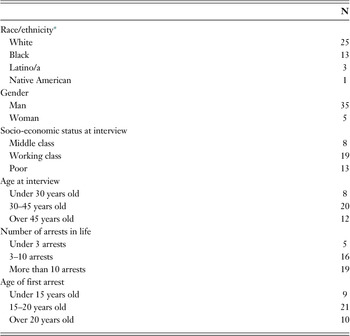
The sample was selected to maximize race and class variation (see Weiss 1994). Just as Black people are diverse and experience heterogenous responses to the veil of racialized subjectivity, so too are criminalized people, who can occupy various social positions that intersect with their criminalized positions. I relied on multiple recruitment strategies to generate the sample, including mailing letters to a sampling frame of people arrested in Boston and Cambridge in 2014, posting flyers in public spaces, and asking halfway houses, homeless shelters, needle exchanges, and justice-involved organizations to share my study with the people who regularly interact with them (see Clair Reference Clair2020, appendix for more details on the recruitment strategy and response rate). By design, every person in the study faced at least one drug or alcohol-related charge at some point in their lives. But defendants shared experiences with various other charges, ranging from felony murder and gun possession to shoplifting and disorderly conduct. Table 1 shows the sample characteristics. Twenty-five defendants are White, thirteen are Black, three are Latino/a, and one is Native American. Eight are middle-class, nineteen are working-class, and thirteen are poor.Footnote 9
Characteristics of defendants in the study (N = 40)

* N is more than 40 because some people identify as more than one race/ethnicity
In the larger study, fifty-two defendants sat for an in-depth interview and an additional eleven were observed ethnographically, but this paper is restricted to the forty respondents who were explicitly asked about their legal visions for change in the interview context.Footnote 10 Of these forty interviews, the median lasted eighty minutes, with the shortest lasting fifty-six minutes and the longest lasting 282 minutes. Near the end of these interviews, I asked: “If you could, how would you change the criminal justice system?” I followed up with various probes, including: “How would you change how the courts work? How would you change jails? How would you change probation?” These questions facilitated a conversation about the respondents’ perceptions of the system’s problems and their ideal visions for change within and beyond the legal system (though most, given the wording of the question, focused on changes within the system), as I detail in the discussion section of this article.
When asked how they would change the criminal legal system, defendants in the study responded by proposing solutions to specific legal system problems that bothered them. Defendants’ responses therefore provided two kinds of information about their legal envisioning: first, their responses revealed their personal diagnoses of the system’s failures; and second, their responses revealed their ideas for imagining and building alternative futures within (and sometimes beyond) the law that would solve these diagnosed problems. The problems and solutions defendants reported indicted all criminal legal institutions—from police and the courts to the indigent defense system, probation, and correctional agencies. Only two defendants in the study (5%) did not report any problems and, as a result, did not offer any solutions. Interview responses were analyzed abductively (Timmermans and Tavory, Reference Timmermans and Tavory2012). First, I read each transcript to identify recurring themes. Next, transcripts were coded to differentiate between problems and solutions. Problems were then grouped into categories relating to unequal treatment, rehabilitation, corruption, and stigma. Next, solutions were analyzed through an iterative process, whereby I compared the literature on criminal justice reform with respondents’ specific articulated solutions. I grouped the specific solutions envisioned by respondents into reformist and abolitionist categories.
Findings: Visions Regarding the Problems of the Criminal Legal System
Defendants in the study commonly reported four main problems with the criminal legal system: unequal race- or class-based treatment; lack of resources for rehabilitation; stigma; and corruption. Thirteen (33%) defendants believe that the system and/or its officials treat defendants unequally along race or class lines. Another thirteen (33%) defendants believe the system lacks sufficient rehabilitative resources for treating drug misuse and/or mental health problems. Eight (20%) believe that the system and/or its officials are corrupt. Finally, six (15%) believe that the system, its officials, and/or mainstream society stigmatizes people with criminal records. As I will show, the problems of unequal treatment, stigma, and corruption all relate to criminalized people’s unique experiences of living behind the veil. The problem of rehabilitation also speaks to the criminalized’s twoness; defendants are aware of the expectations of broader society with respect to their struggles with addiction, mental illness, and criminalized behaviors that result from such adversities. Their beliefs that more resources should be devoted to rehabilitating them reveal their internalization of these expectations.
One of the most common problems described was unequal treatment along race and/or class lines. This problem was mentioned by defendants occupying a range of race and class backgrounds, not just those marginalized by racism or poverty. Caleb, a middle-class Black man, felt that the police exhibited both race and class bias. He said:
I do feel like the police abuse their power a lot. Not all of them, obviously, but there’s a large amount that […] don’t treat everyone the same way. It would be different if they were the same way towards everyone, but obviously race affects how they react around us [and] social class. And I’ve personally seen that a million times where a police officer will treat someone in a specific way and treat someone else in the same situation but a different class or race completely different. And that upsets me. And that is something obviously I have no idea how that would be fixed because that’s a huge issue but… that would be something I’d definitely like fixed on the policing side.
Caleb’s statement reflects the common criticism among people in the study with respect to individual-level bias and discrimination among legal officials. Legal officials, in defendants’ minds, may view White or middle-class people as non-criminalized but refuse to recognize the humanity of racially subordinated groups—especially Blacks and Latinos—and the poor, whom they place on the other side of the veil.
Problems of unequal treatment were also framed in more structural terms. For instance, Gregory, a poor Black Latino man, described how laws disproportionately target racial and ethnic minorities. He said: “they make stricter laws ‘cause it would hurt the majority of people who are selling, which are the Black people or the Puerto Rican people.” He went on to mention the crack-cocaine sentencing disparity, which much scholarship has shown disproportionately impacts Black drug offenders. Gregory said: “now [between] cocaine and the hard [kind of] cocaine, there’s two different laws.” For Gregory, unequal treatment emerged not just from the individual biases of legal officials but also from the law’s targeting of certain criminalized behaviors more common among certain groups.
Racism against people of color was also described, among some White defendants, as a problem. For instance, Waine, a working-class White man, believed police to be racist in their decisions to stop and frisk. He said, “All my friends that aren’t White have been a victim of stop and search. Every single one. Every single one. My White friends? None of them.” Jane, a middle-class White woman, mostly viewed class bias as a problem but spoke to the racialized nature of the system. When asked about how she would change the system, she immediately responded by distancing herself from the typical criminal defendant. She said:
I feel like I don’t know enough information about it in order to actually give you a valid response. But it just seems like when I was there, there were so many people who were homeless who didn’t care. I shouldn’t say “homeless,” but there were so many druggies there. It wouldn’t be the court system but the world [that needs to be changed]. [laughs] There’s so many people that just have no money. It’s so sad. They don’t have anything going for them, so they don’t care that they’re in court or not.
A bit later in the interview, she continued:
[…] But also, I’m probably a bad person to ask because I grew up and money was never an issue for me. […] I’m probably the worst person to ask because I’m on the other side of it, like, so the money thing wasn’t a problem for me. But I’m sure if you ask somebody who struggles with it, they’re going to be like ‘What the fuck?’
Jane holds contradictory views about poverty in relation to the criminal legal system. On the one hand, she recognizes that hiring a private attorney can be “like a huge financial burden” for the poor. On the other hand, she distances herself from most defendants whom she sees as poor “druggies” who “don’t have anything going for them” and therefore shuffle in and out of court with little care. In other parts of the interview, she uses racialized tropes (e.g., “a really ghetto baby momma”) to describe the other criminalized people she has seen in her court-mandated treatment program. Thus, for Jane, her experience with the system reproduced—in her mind—the subjective racial order whereby Black people and poor people are prototypical criminals. Both Waine and Jane’s views speak to the possibilities and limits of solidarity and collective consciousness among the criminalized. Both recognize the disproportionate presence of racially subordinated groups among the criminalized as a problem. Yet, where Waine identifies racism as a specific cause and suggests solidarity with his non-White friends, Jane distances herself from other criminalized people who do not share her White, middle-class status.
Another common problem mentioned was that the system lacks the rehabilitative resources to deal with substance use disorders and mental health problems. Like many people in the study, J.M., a middle-class White man, felt that most people in the system are suffering from such adversities. He said: “these are people who need help, you know, these are—I don’t want to say disabled people—but they’re people who are ill, who need help.” A self-described alcoholic and heroin addict, J.M. expressed his worries that the criminal legal system does not currently have the resources to deal with addiction and mental illness. He said, “things are gonna get worse and worse—and it has! Look at all the deaths last year from this fucking fentanyl stuff […] It’s crazy. A hundred times stronger than heroin. Kicked my ass, man. I was out for four hours.” Mitchell, a working-class White man, described how courts are unable to ensure people have access to drug treatment because of the lack of space in holding facilities and rehabilitation programs:
You know, there’s not a lot of funding. It definitely needs more…more like halfway houses and more holdings, you know, because I’ve seen it so many times: People will go and they’ll want to get treatment, but there’s nowhere for them to go and you’re forced to be on the streets and it kind of sucks because I…even with me, there’d be sometimes my insurance wouldn’t pay, and I’d be put to the street when I really wanted help, you know? It’s real difficult to stay clean when you’re sleeping outside […] and there’s no one there for you, you know? Emotionally, it’s a bad spot.
The latter part of Mitchell’s statement shows how a lack of resources emanate not just from the court and other criminal justice agencies, but also from private and public actors in broader society, such as welfare agencies, which provide services, and insurance companies, which often subsidize the costs of court-mandated treatment (see Halushka Reference Halushka2020). Joe, a working-class White man, recounted how his probation officer did not understand such basic limitations. After relapsing and violating probation, his probation officer asked why he did not simply go to the doctor to get Suboxone, a legal drug that treats opioid addiction, rather than use illegal street heroin. Joe explained, “I just can’t go to the fucking doctor and get a Suboxone. I’m like, ‘Heroin and Suboxone are interchangeable, and I’m—I was—sick, dude. What don’t you get?’ […] It was so hard explaining this, because he just doesn’t fucking get it; he doesn’t understand.” His probation officer’s lack of awareness is a function of the veil between them, frustrating their social interactions and making mutual understanding difficult.
A belief that the system and/or its individual officials are corrupt is the next most common problem described by defendants. Criminal justice officials and organizations, especially the police, were often described as corrupt. Slicer, a working-class Black man described police as too eager to find, and even manufacture, crime. Reflecting on police officers in his low-income, majority-Black neighborhood, he said, “The system is very corrupt […] most of them [the police in the neighborhood] are the rookies.” He went on to tell me that these rookies intentionally escalate situations: “some of them just walk around, run around, looking for trouble.” Some believed that officials and institutions were economically exploitative or extractive. Justin, a poor White man, expressed frustration at how often he must return to court for his cases. He suspected that the court’s requirements to return every thirty days were “money driven.” He went on to criticize the way money can be exchanged for leniency:
Don’t go there without money, you know? I’ve seen judges and the DAs snickering and laughing about people not having money like it’s a big joke [laughs] “You don’t have no money,” you know? And I’m like, “Wow. He’s right: what a joke.” Because that’s how they treat it. As a joke. They need money. It’s what they want. It’s money driven. Money, money, money. You give money, and they smile and things get nice, you know? […] Go in there with a pile of money, and suddenly you’re almost heroic, you know? Don’t go in there poor. You know? And it’s like how do you expect me to get a job to pay these fees? Like, you’re not letting me work! How am I going to get the money? Steal it? That’s so much more pressure on me. Should I sell drugs to pay it off? How am I going to pay it off?
Justin suggested that the pressure of court fees encouraged criminalized behaviors—increasing his likelihood of remaining in the system even longer. Another common critique was of prison corporations, which several defendants argued profited from mass incarceration. Kema, a middle-class White woman, reflected: “[…] jails are big business. The companies that do the jail make a lot of money, and they lobby the government.”
Finally, a meaningful number of respondents articulated stigma—from contact with the system to the undignified way they are treated by officials—as a problem. Defendants described frustration at the way their records excluded them from participation in mainstream society. Many mentioned labor market and housing discrimination, which has been routinely documented among scholars. For example, Justin told me his record makes it difficult for him to get low-level service jobs:
Basically, anybody that wants to know about my criminal history, you know, that’s where I don’t feel comfortable anymore. And it’s completely just held me back now. Whereas in the past it never mattered, you know? People would hire you based on your skills or your knowledge. Now the first thing they do is look at records and eliminate them immediately. So I’m at the bottom of every list, and that’s that. That’s it, and that’s that. I couldn’t even get a job at a convenience store. It’s ridiculous.
Justin feels “held back” because of his record, suggesting that the anticipation of discrimination makes him less comfortable applying for jobs (Smith and Broege, Reference Smith and Broege2020). For his part, J.M. listed other places where his record excluded him: “Apartments. Other types of jobs. Car insurance. Loan applications.” Other defendants reported feeling stigmatized when their alleged crimes appeared in newspaper reports or websites (see Lageson Reference Lageson2020). Caleb told me that his online presence upsets him: “it really upsets me that [my arrest] comes up with my name now. I used to Google myself, and now when I Google myself, that’s what comes up. It really upsets me.” He elaborated that he feels judged in “the public eye” even though “that case got dismissed.” Within the criminal legal system itself, stigma also exists. Some defendants reported feeling stigmatized by legal officials and the general tenor of the court process. For instance, Mary, a working-class Latina, described the slowness of the court process as indicative of the little respect the system holds for defendants. She told me: “People cannot keep calling out of work or […] taking time out of their day to constantly keep coming to the court so that all you do is call them up and be like, ‘Alright you’re coming [back to court] the next day.’” Mary also described the police as “disrespectful.” She said: “I feel like they need to understand that we’re human, and you can’t just treat me like an animal.” Defendants’ keen awareness of both the corrupt and stigmatizing motives of the officials and corporations determining their lives is a hallmark of their double consciousness. They are ever aware of how these empowered actors view them with “contempt and pity” (Du Bois Reference Du Bois1903a, p. 3).
Findings: Visions Regarding Solutions to Criminal Legal System Problems
Defendants offered numerous solutions to the above-mentioned problems, which I group into two categories: reformist and abolitionist. I define reformist solutions as those that are framed by defendants as, and would logically result in, efforts to fix a problematic feature of a criminal legal institution while at the same time keeping that institution largely intact and largely supporting that institution’s broader functions. For instance, many defendants expressed a desire for police to receive better training on how to deal with people suffering from addiction or mental illness. This solution advocates fixing policing rather than abolishing it. I define abolitionist solutions as those that are framed by defendants as, and would logically result in, efforts to remove a problematic feature of a criminal legal institution completely, thereby gutting the ability of that institution to continue to function with the same purpose. Reformist solutions were more common than abolitionist ones. In total, respondents offered twenty unique solutions. Of these, seventeen (85%) were reformist, and three (15%) were abolitionist. Reformist solutions were also the most commonly stated solutions.
The most common proposal among the defendants in the study was to provide drug offenders with rehabilitation. Although this solution could logically result in a slight decrease in incarceration rates if used as an alternative to incarceration, most people did not frame it as an alternative. Many argued rehabilitation should be used as a complement to incarceration (e.g., providing treatment programs in jail). They believed that drug offenders needed substance use treatment and viewed the court system and other apparatuses of legal control as legitimate institutions for treatment provision, if only they were provided more resources (see also Phelps and Ruhland, Reference Phelps and Ruhland2021 on probation service provision). Mitchell offered a typical vision of this solution. Above, Mitchell described how courts do not provide enough access to drug treatment facilities. One solution he suggested was providing more funding for halfway houses and holding facilities. He also insisted that such treatment programs should be additions to, not replacements for, incarceration. Reflecting on his own experience, he thought time in jail was a necessary wake up call to kick his addiction and incentivize him to seek treatment: “[…] that night in the jail cell: it makes you think how like… ‘This is what I’m doing has landed me, you know. Maybe it’s a good idea to go to a program and work on myself.’” Ryan, a middle-class White man suffering from alcoholism, also reflected that his time in jail “taught me a lesson.” And Red, a working-class White man speaking about jail as a tool to solve drug addiction, said: “I’ve heard people say that jail saved their life. I have heard it.” Mitchell, Ryan, and Red are all White men. Although they have been criminalized, their Whiteness affords them more opportunities to find themselves on the non-criminalized side of the veil in their daily lives than their Black, Latino, and Indigenous peers. Thus, their racial privilege may contribute to their reformist visions.
Providing more resources to the criminal legal system, however, was also commonly articulated as a solution to the specific problem of unequal treatment among racial minorities and White people alike. Various reformist solutions of this type were suggested. First, some suggested the indigent defense system should be better resourced, thereby affording poor people legal advocacy on par with that of their wealthier peers who can privately-retain lawyers. When asked how he would change the system, Christopher, a poor White man, energetically responded that the system needed to allow indigent defendants to hire attorneys of their choice:
Right off the bat, hiring attorneys […] Maybe they’re going to call it socialism, or whatever, where everyone has the same opportunity for a lawyer, but I think that’s only fair. I mean ’cause that’s where I think that’s a huge difference right there. […] I think the biggest thing would be to change the system with the lawyers, because it’ s like if you hire Johnnie Cochran—look at O. J. Simpson who got himself off.
Christopher’s reference to O. J. Simpson—a Black man who Christopher seems to suggest was factually guilty but “got himself off”—could be interpreted as Christopher’s belief that wealth can absolve those who are not just guilty but also Black. By noting the exceptional case of O. J. Simpson, Christopher highlights the system’s class bias while obscuring its racism.
Second, some proposed that carceral institutions should hire more racial/ethnic minorities. William, a middle-class Black man, said: “I think we need more minority officers in jails. I think they need to do more extensive background checks on correctional officers. We have a lot of racism among correctional officers.” Another proposal was that officials should receive more education and better training. Jimmy, a working-class Black man, expressed concern over racial bias in policing and courts, telling me: “the system favors and was created by a White man.” He proposed that police “should have psychologists that are doing mental health conditioning and trainings with these police officers” to ensure fair treatment. Training was also suggested as a solution to other problems, such as legal officials’ corruption and stigmatizing disrespect for defendants. For instance, Red suggested that officials needed to be trained to be more compassionate. He told me:
[…] if you’re robbing, cheating, stealing, lying, manipulating, doing all those things to get, you know, your next fix, you’re doing those things because you have to do them […] I just think there needs to be a little more compassion. A little more understanding. Some sympathy, some empathy. Everything is not so cut and dry; it’s not always so black and white.
Red’s solution, much like that of others seeking more training, can be understood as a plea for legal officials to traverse the veil.
Even if such solutions would not dismantle the system’s overarching control over defendants’ lives, many of these proposed solutions could reduce the system’s harm. One common critique of reformist solutions is that they serve to legitimate an oppressive system by making it appear more equal and just (see Butler Reference Butler2015). As William, who earlier proposed trainings for officials, insisted: “You know, there’s nothing wrong with the system. It’s the people in the system that’s the real problem.” William’s statement reveals that he does not question the legitimacy of the legal system; rather, he questions the motivations and decisions of certain bad actors. By definition, the solutions coded as reformist in this study all served to legitimate the system to some degree (even if unintentionally); yet, some went further by proposing to increase the system’s capacity for social control. For instance, J.M., mentioned above, expressed concern about the system’s lack of resources to handle substance abuse. To solve the problem of overdose deaths, he felt the system needed to enforce drug testing requirements more strictly. He said, “I think they should drug test everybody once a week instead of once a month. […] they’re not taking care of people. If you test someone [only] once a month, you don’t really know what they’re using, [what] other substances, you know? A lot of people have died because they’re not being monitored.”
Solutions that sought more social control reflect heterogeneity among the criminalized. Du Bois described some Black people’s responses to the veil as “hypocritical compromise” (Du Bois Reference Du Bois1903a, p. 203), whereby they internalized White society’s views and sought to assimilate rather than rebel or assert themselves. Similarly, some defendants expressed a feeling of compromise, seeking to square their struggles with society’s disapproval. James, one of the two people in the study who did not feel that there were any problems with the criminal legal system, represents an extreme version of such compromise. A talkative poor White man, James clammed up when asked how he might change the criminal legal system if he could. “How can we deal with the system?” he responded quizzically to my question. I probed: “Does it bother you at all that we are arresting people and putting them in jail for drug crimes?” He responded, “Not really.” He elaborated: “I mean, you really can’t shame them for arresting people. I mean, you’re the one that’s [doing drugs].” James blames criminalized people like himself for their own conditions; the legal system’s control over their lives is, in his mind, justified by criminalized people’s own choices.
Yet, some reformist solutions described by people in the study might both reduce harm to defendants and unmask the system’s social control power. For instance, Jimmy, concerned about police abuse, felt that police officers should be prosecuted for their crimes and held to a higher standard than ordinary people who commit similar crimes. Jimmy said:
[…] since they have that position of power […] I think they should get a higher charge than the criminals who are unknowingly— […] they have more power than a citizen [who is] selling drugs […] like if you murder someone, you should do that time. But say if you’re a police officer and you murder someone and they see that on camera that you murdered someone, I think you should get a double sentence than what a citizen should. Because, one, you’re a police officer and should know what you should be doing. And you [should] know what’s right from wrong. And if it’s not defending your life and it’s obvious you weren’t defending your life and you killed this person, I think the sentence should be heavier on you because you have the responsibility to protect and serve. And if you’re not doing that, you should not have that job.
Jimmy’s proposal that police officers should get “double” the sentence of ordinary people for murder rests on his understanding of the unequal power dynamics inherent in police-civilian interactions. Although his proposal would not eliminate the police as an institution and may strengthen the power and legitimacy of prosecutors, it could reduce harm to alleged offenders and unmask the racialized social control power of policing through a doubly burdensome sentencing process.
Beyond reformist solutions, three distinct abolitionist solutions were proposed by defendants in this study. One proposal was to eliminate incarceration for drug users. This solution entailed the complete removal of incarceration as an institution with respect to drug possession (though one person, Don, also advocated for no incarceration among drug dealers as well). Such a proposal would gut the ability of incarceration to function as a technique of legal control against drug offenders, pressuring the system to shift its resources toward non-carceral rehabilitative alternatives—a commonly articulated desire. Michael, a poor White man, summarized this vision: “Probably easiest would be: don’t put drug offenders in jail. Or at least not for possession.” Within this solution, some suggested adjudicating all drug possession offenses in drug courts, where sentences of incarceration might be barred. “I would have a larger community for drug courts, and it would take a lot of the people who were in prisons,” Wolf, a working-class White man, proposed.
Two other abolitionist proposals focused on legislative change—one advocating for crafting new laws, and the other advocating for removing laws from the books. Both would have the effect of reducing the number of behaviors that fall under the criminal legal system’s authority. One type of proposal was to make new laws legalizing, or at least decriminalizing, drugs. Whereas Diego, a middle-class Latino, advocated for the “decriminalization of marijuana,” Wolf believed the United States should follow the lead of other countries who have “decriminalized all drugs.” This proposal was suggested as yet another remedy to the problem of the system’s lack of resources for drug offenders. The other abolitionist proposal mentioned by defendants sought to remove laws from the books, largely to reduce the problem of unequal treatment. Three-strikes laws, for instance, were viewed by two defendants as racially and socioeconomically biased. They believed that their removal would reduce disparities in incarceration. Wolf said, “[…] what I would change about the criminal justice system is that three strikes law.” Richard, a working-class Black man, elaborated that the three strikes law is racially discriminatory:
[…] you have guys who go to prison and the three-strike rule is in effect, and they get caught so many times. […] they go to prison on their third strike and do that type of time. That’s what they do. […] there’s a lot of white guys who I see hustling and doing the same thing and get money and they sell drugs and do all this, but…fortunately they know the right people, they don’t go to prison. But the majority of our black youth and black men … the percentage of black men who are in prison is a difference.
Although eliminating three strikes laws would not eliminate incarceration as an institution, it would abolish it as a tool used to punish the mere act of repeat offending (as opposed to a tool that is meant to punish a specific criminal behavior deemed morally deserving of incarceration).
DISCUSSION
Mass criminalization in the United States has had profound implications for our society, including for the subjectivities of criminalized people and communities. This article has relied on Du Boisian sociological insights to conceptualize an overarching theory of criminalized subjectivity and to empirically examine one of its central components: legal envisioning. Through an interdisciplinary review of interpretive scholarship on the perspectives and experiences of criminalized people and communities, I illustrated how a Du Boisian approach coheres existing theories and reveals how criminalization interrelates with racism and White supremacy in ways that reproduce the subjective racial order and have implications for the structure of the law. Drawing on Du Bois’s concept of second sight in relation to racialized subjectivity and engaging with more recent sociological theory on legal consciousness and cultural processes, I developed the concept of legal envisioning. I defined legal envisioning as a social process whereby criminalized people and communities imagine and build alternative futures within and beyond the current legal system. By attending to a racially and socioeconomically diverse group of ordinary criminalized people’s legal envisioning, I uncovered possibilities for solidarity across race and class lines, showing how not just people of color but also some White people came to understand the system’s racist functions and proposed both reformist and abolitionist proposals to reduce its unequal effects. Yet, the findings also revealed the limits of solidarity: some White people (e.g., Jane) leverage racist stereotypes to draw boundaries between themselves and poor people of color, whereas others indict the system’s class bias in ways that obscure its racism (e.g., Christopher).
The article’s empirical analysis of legal envisioning revealed how Du Bois’s concepts of the veil and twoness enrich understandings of the way criminalized people articulate the problems they encounter in the legal system and their heterogenous visions for dealing with these problems. Although the people in this study do not view themselves as activists, their legal envisioning occupies a similar range as organizers and protesters in the BLM movement. Defendants in the study described both reformist and abolitionist solutions to deal with the problems of unequal treatment, lack of rehabilitative resources, corruption, and stigma. Some solutions were novel even if they were reformist: for instance, Jimmy’s proposal to charge cases of police-perpetrated violence more harshly than violence committed by everyday people, given the immense power and authority the state grants police. Whether solutions were reformist or abolitionist often had to do with problem diagnosis (see Bell Reference Bell2017, pp. 2065–2066 on the link between problem diagnoses and solutions). For instance, the problem of the legal system not having enough resources for rehabilitation was often met with solutions seeking greater resources within carceral systems, such as more coercive drug treatment or more funding to incorporate rehabilitative programs in jails and prisons. Some people, however, indicted not just the legal system but also broader society, where a combination of private and public actors, such as insurance companies and welfare agencies, failed them. Such indictments did not clearly translate into abolitionist proposals among the people in this study. In general, their greater emphasis on reformist visions could be explained by the veil and twoness. Several criminalized people in this study have internalized the view that their criminalized behaviors are problematic and should be controlled, especially in relation to their own health (e.g., substance use disorders). Some fear they will die if they do not receive coercive treatment for their addictions. Moreover, their reflections in the interview setting often suggested a desire to traverse the veil and be included as equal members of non-criminalized society, receiving the material (e.g., healthcare and housing) and symbolic (e.g., no longer stigmatized as a criminal) benefits of such inclusion. Among these respondents, their reformism and internalization of the law’s proscriptions may reflect true support for state-enforced legal control (Carr et al., Reference Carr, Napolitano and Keating2007) and a hope that the law is fairly applied in ways that afford them, and their communities, recognition (Campeau et al., Reference Campeau, Levi and Foglesong2020). Du Bois might suggest that such reformist visions more so reflect the pragmatism of criminalized people (much like some Black people’s pragmatism in response to racism), given their awareness of the attitudes and power of dominant society.
The veil between the criminalized and the non-criminalized, however, offers a distinct set of explanations for these findings and has implications for scholarly analysis of legal envisioning more broadly. The veil between me (a researcher who has never been arrested) and my respondents (people who have been arrested, processed in court, and often incarcerated) could offer another explanation for their generally reformist visions in at least three ways. First, respondents may have been hesitant to share their true feelings about how to change the criminal legal system with a person they viewed as living on the other side of the veil. In other words, social desirability bias—or the desire to tell a researcher what is understood as socially appropriate—may have shaped their responses in the interview setting. Such bias could also exist in other interview-based studies that reveal respondents’ legal cynicism alongside their support for greater law enforcement (Carr et al., Reference Carr, Napolitano and Keating2007; Campeau et al., Reference Campeau, Levi and Foglesong2020). Second, living on the other side of the veil, I may not have interpreted their statements in ways that fully capture the complexity of their visions. As a generally non-criminalized academic, I am vulnerable to a distorted rather than “objective” view of criminalization. Third, the way I worded the question about their visions in the interview could have delimited the articulation of abolitionist perspectives. I asked respondents “how would you change the criminal justice system” rather than asking them how they might change society, or the broader social structures that control and exploit them and their communities (e.g., Mitchell indicts the retrenched welfare state alongside his indictment of the legal system). Abolitionists do not simply seek the dismantling of racialized punitive systems of legal control but also seek investments in race-class subjugated communities. Bell (Reference Bell2017) refers to the potentially “bounded creativity” that may exist among marginalized people accustomed to punitive policing from the state and the limited presence of “alternative community social control resources” (p. 2119). Researchers, too, could have a kind of bounded creativity in our approach to data collection and analysis. Oftentimes, scholars engaged in inductive interview research may not have asked explicit questions in interviews that tap the underlying themes they ultimately find important when coding their data. These possibilities underscore the need for researchers to be both reflexive and iterative, taking care to routinely assess the many ways the veil may impact their research interests, questions, and analyses.
By relying on Du Boisian conceptual tools (i.e., the veil, twoness, and second sight) to scrutinize how racism and criminalization interrelate in the subjective domain, the theory of criminalized subjectivity developed here offers common terminology for future research. As I illustrated in the first part of the article, existing scholarship on the perspectives of criminalized people and communities could be interpreted in relation to these concepts, revealing commonalities across research streams and theories that are often placed in contrast to one another. Rather than diminishing the importance of debates in the literature, such a synthesis could provide scholars with a common language for understanding and debating the implications of mass criminalization across demographic groups, social spaces, and time periods. For example, whether a prison should be understood as “total” or “porous” in its effects (Ellis Reference Ellis2021) or whether distrust of police in a race-class subjugated community should be understood as indicative of procedural injustice or legal estrangement (Bell Reference Bell2017) could both be understood as important investigations into the nature and import of the veil—and how it may change over historical time periods or affect criminalized groups differently. In the former instance, the theoretical debate is about the veil’s strength—when and under what conditions it can be lifted in the prison context, and whether it acts as a two-way mirror or, instead, affords some moments of mutual exchange across the boundary. In the latter, the debate is about which dimensions of the veil (individual-level encounters or social structures) constitute a crisis of policing, a question that has profound implications for social policy. Pushing a Du Boisian analysis even further, these debates and others could also attend to the way racism and criminalization mutually constitute the dimensions of the veil, likely operating differently for some people and communities than for others. Scholars have increasingly examined how criminalization shapes people’s (especially racial minorities’) subjective understandings of race and of their racialized positions in social and political life (Lerman and Weaver, Reference Lerman and Weaver2014; Lopez-Aguado Reference Lopez-Aguado2018; Prowse et al., Reference Prowse, Weaver and Meares2019; Walker Reference Walker2016). This article shows how scholars could additionally attend to the ways legal envisioning—visions for changing one’s conditions, not just interpretations of one’s conditions—is also shaped by racism and White supremacy. Beyond examining how components of legal envisioning may or may not vary across racial groups (Carr et al., Reference Carr, Napolitano and Keating2007), scholars could do more to examine the conditions that account for solidarity (rather than distancing) across racial lines (Cobbina Reference Cobbina2019), the racialized ways internalization of non-criminalized society’s norms operates, how attention to those multiply-marginalized by systems of oppression could afford the most radical and urgent visions (see Cohen Reference Cohen2004), and how ordinary people’s visions are formed by—and inform—social movements for racial justice.
Future research on legal envisioning could take a page from legal scholars who seek to “take seriously the epistemological universe of today’s left social movements, and their experiments, tactics, and strategies for legal and social change” (Akbar et al., Reference Akbar, Ashar and Simonson2021, p. 4). These scholars seek to work alongside activists in the production of knowledge and strategizing for change. To be sure, much scholarship in the social sciences examines social movements in this very way; yet, the dominant work on criminalized subjectivities, in particular, has yet to fully engage with social movements or critical race theory. Meanwhile, critical race theorists have often been influenced by Du Boisian concepts—even if they have not relied on similar empirical methods (Bell Reference Bell1977; Matsuda Reference Matsuda1987). A Du Boisian theory of legal envisioning would, in addition to studying social movements among the criminalized, also assess the ways social movements—and their specific articulations—relate to ordinary people’s visions and strategies. Interviews and surveys could, in addition to tapping individual attitudes and perspectives, ask respondents about collective understandings and the practices of organizations in their communities. Systematic analysis of the literatures produced by and circulated among criminalized people living in race-class subjugated communities could also provide greater insight. For instance, prison writings, such as Assata Shakur’s (Reference Shakur1978), and poems written by formerly and currently incarcerated youth, such as They Called Me 299-359 (Free Minds Reference Minds2020), provide unique lenses into the conditions of criminalization and potential alternatives, as does research among incarcerated people published in peer reviewed journals like The Journal of Prisoners on Prisons. Such writings can also—to some extent—lift the veil. As Kenneth, one of the youth poets who edited the original edition of They Called Me 299-359, stated: “I hope that readers will see that we are more than criminals. We are human beings who have made mistakes” (Free Minds Reference Minds2020, p. xix). A Du Boisian approach would also suggest not just assessing the knowledge produced from within race-class subjugated communities but also working alongside these communities in the research and writing process, as Du Bois did when working alongside “community researchers” (Wright Reference Wright2006). The scholarship of Janet Moore and Silicon Valley De-Bug (Moore et al., Reference Moore, Sandys and Jayadev2014), Marisol LeBrón and Taller Salud (LeBrón Reference LeBrón2019), and Ruth Wilson Gilmore and Mothers Reclaiming Our Children (Gilmore Reference Gilmore2007) demonstrate the value of such work—and how it often requires engagement with organizers as well as the ordinary people they work alongside. In these ways, a Du Boisian approach provides the methodological and theoretical tools necessary to assess legal envisioning’s content and chart possibilities for emancipatory change within and beyond the law.
ACKNOWLEDGMENTS
I thank Asad L. Asad, Monica C. Bell, Frank Edwards, Peter Francis Harvey, Annette Lareau, Christopher Muller, Michelle S. Phelps, Blair Sackett, Alix S. Winter, and the anonymous reviewers for their helpful comments. I am also grateful for feedback from audience members at the American Society of Criminology’s 2019 Annual Meeting and at an informal reading group organized by Bruce Western. I am indebted to the criminalized people whose experiences are at the heart of this research. This research has been supported by the National Science Foundation (Grant no. DGE1144152), the Harvard Merit/Term-Time Fellowship, the Quattrone Center Research Fellowship, the Ruth D. Peterson Fellowship for Racial and Ethnic Diversity, and the School of Humanities and Sciences at Stanford University.