Urinary tract infection (UTI) is the most common infection among nursing home residents, and the microorganisms prevalent in this setting pose significant challenges for treatment.Reference Nicolle, Strausbaugh and Garibaldi1 Cranberries (Vaccinium macrocarpon Aiton) are thought to reduce UTIs; this view is supported by a placebo-controlled trial showing lower rates of bacteriuria plus pyuria with daily ingestion of 300 mL of cranberry juice cocktail (15.0% versus 28.1% in controls).Reference Avorn, Monane, Gurwitz, Glynn, Choodnovskiy and Lipsitz2 However, subsequent studies of cranberries for prevention of UTI, including a large Cochrane meta-analysis, have shown mixed results.Reference Jepson, Williams and Craig3 Various mechanisms of the bacteriologic effect of cranberries are postulated; however, inhibition of P fimbriae–mediated adhesion of E. coli by proanthocyanidin (PAC) remains the leading theory.Reference Ofek, Goldhar, Zafriri, Lis, Adar and Sharon4 We sought to compare antibiotic susceptibility and proportions of non–E. coli Enterobacteriaceae among Gram-negative urinary isolates from participants randomized to cranberry capsules compared to placebo.
METHODS
Data were collected from a double-blind, randomized, placebo-controlled trial of 80 residents from 11 nursing homes in Connecticut.Reference Bianco, Perrelli, Towle, Van Ness and Juthani-Mehta5 Because the parent study had Yale University Human Investigation Committee (HIC) approval, this analysis was not considered human subject research and did not require additional HIC review. Inclusion criteria included female, history of UTI, age 65 years or older, long-term residence in the nursing home, and English-speaking. Exclusion criteria were total incontinence, warfarin therapy, <4 weeks residence in a nursing home, chronic indwelling catheter, terminal prognosis, antibiotic therapy, nephrolithiasis, dialysis, cranberry therapy, or cranberry allergy. Daily doses of 0, 1, 2, and 3 capsules containing 0, 36 mg, 72 mg, and 108 mg of PAC, respectively, were compared over 1 month with 4 weekly urine collections (ie, 320 scheduled urine cultures). Of 80 enrolled participants, 20 were randomized to receive placebo and 60 to receive varying doses of cranberry (ie, 20 participants per active treatment group).
Of 302 urine cultures collected, those reported as ‘no growth’ (n=19), as <10,000 colony forming units (CFUs) with no specific microorganism identified (n=8), as ‘mixed flora’ (n=111), and as Gram-positive isolates (n=14) were not included. Of 150 cultures with identified Gram-negative bacteria, 19 had growth of second isolates that were included. A total of 169 isolates were divided into those taking cranberry capsules (42 participants, 118 isolates) and placebo (15 participants, 51 isolates).
The primary outcome, antibiotic susceptibility, was quantified using counts and percentages of susceptible isolates to each of 6 antibiotics. Ampicillin, ampicillin/sulbactam, trimethoprim/sulfamethoxazole, ceftriaxone, ciprofloxacin, and nitrofurantoin were chosen to represent classes of orally available antibiotics used to treat UTI. In addition, percentages of E. coli and non–E. coli were compared according to treatment group.
Rao-Scott χ2 tests accounting for the clustering of repeated isolates within individuals were used as a measure of association. A multivariate generalized estimating equations (GEE) model was used to test the association of treatment group with the total count of antibiotics to which isolates were susceptible.
RESULTS
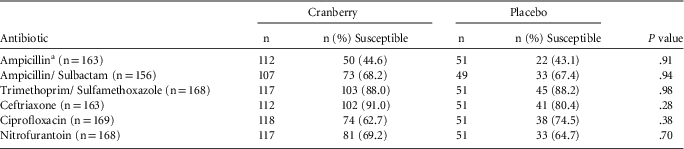
The smallest P-value comparing antibiotic susceptibility between the cranberry and placebo groups was for ceftriaxone (91.0% susceptible in participants receiving cranberry vs 80.4% receiving placebo); however, the difference was not statistically significant (P=.28) (Table 1). The lowest susceptibility rates were seen for ampicillin (<45% in both groups). Relative proportions of E. coli to non–E. coli Gram-negative bacteria were not statistically different between cranberry and placebo groups (71.2% E. coli in cranberry group versus 72.5% E. coli in placebo, P=.90). Finally, the GEE model did not show an adjusted association between treatment group and the total count of antibiotics reported as susceptible (adjusted means: cranberry 4.16 and placebo 4.20; P=.91).
Frequency of Antibiotic Susceptibility in Cranberry Capsule versus Placebo Treatment Groups
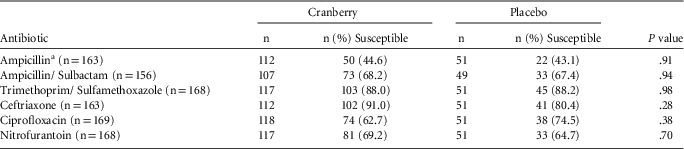
NOTE. N-values indicate the numbers of Gram-negative isolates for which antibiotic susceptibility testing was available.
a Antibiotic susceptibility data for all six antibiotics was not available for all 169 isolates based on laboratory protocol.
DISCUSSION
A pilot study conducted in nursing home residents to establish the optimal dose of cranberry capsules in females demonstrated a dose-dependent trend toward decreased bacteriuria plus pyuria.Reference Bianco, Perrelli, Towle, Van Ness and Juthani-Mehta5 This effect was seen among E. coli isolates but not with non–E. coli Enterobacteriaceae, consistent with the purported E. coli–specific mechanism of PAC.
Non–E. coli urinary isolates are susceptible to fewer antibiotics than E. coli among nursing home residents in the greater New Haven area.Reference Das, Perrelli, Towle, Van Ness and Juthani-Mehta6 We hypothesized that overall bacterial susceptibility to oral antibiotics would be decreased due to an increased proportion of non–E. coli Enterobacteriaceae in the cranberry group compared to the placebo group. These results do not suggest that cranberry affects antibiotic susceptibility or the proportion of non–E. coli Gram-negative bacteria.
One potential explanation for these findings is that proportions of non–E. coli compared to E. coli isolates were similar in both groups, suggesting that cranberry may not act through an E. coli–specific mechanism. Although P fimbriae are typically associated with E. coli, P fimbriae and P fimbriae–like proteins have been identified in other Enterobacteriaceae including Klebsiella, Proteus, and Enterobacter.Reference Jagielski, Sztabińska-Koncka, Rastawicki, Szych, Kałuzewski and Mrozowska7 Moreover, cranberry has been shown to act through fimbriae-independent mechanisms by modifying bacterial gene expression, disrupting quorum sensing, and altering virulence factor production.Reference Ahuja, Kaack and Roberts8, Reference Harjai, Gupta and Sehgal9
The strengths of this study include its relevant nursing home population known for high rates of UTI and bacterial resistance, in addition to its setting, where broad introduction of prophylactic measures is possible. However, this study has limitations. In this secondary data analysis, the benefits of randomization are diminished. Small sample size and a short observation period limited the ability to detect subtle or long-term, but potentially important, effects on antibiotic susceptibility.
Although these data favor the suggestion that cranberry does not foster antibiotic resistance, larger studies must be conducted to confirm its efficacy and to investigate the effect on antibiotic resistance over a longer period of time and in different patient populations.
Acknowledgments
Financial support. The original study was supported by the National Institute on Aging Claude D. Pepper Older Americans Independence Center (P30-AG21342), the National Institute on Aging (1K23AG028691), and CTSA Grant Number UL1 TR000142 from the National Center for Advancing Translational Science (NCATS), components of the National Institutes of Health (NIH) and NIH Roadmap for Medical Research. Its contents are solely the responsibility of the authors and do not necessarily represent the official view of the NIH. This publication was also made possible by the Yale Research in Residency Program.
Potential conflicts of interest. All authors report no conflicts of interest relevant to this article. All authors submitted the ICMJE Form for Disclosure of Potential Conflicts of Interest, and the conflicts that the editors consider relevant to this article are disclosed here.