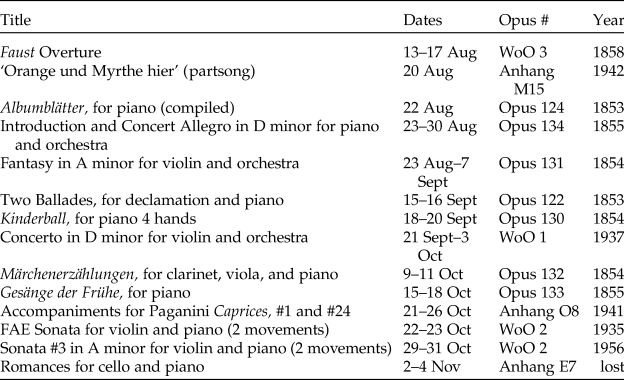
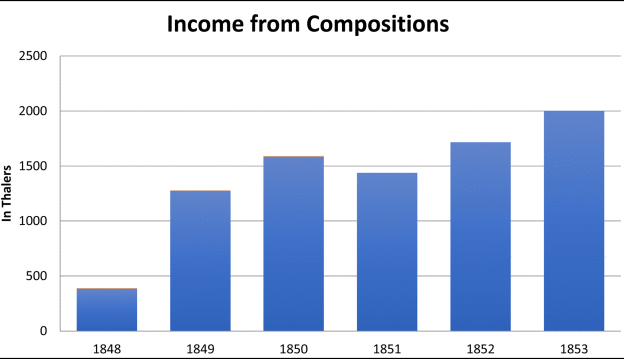
Between 13 August and 4 November 1853, Robert Schumann enjoyed one of his most prolific and creative periods, composing about a dozen works in less than three months, in a wide range of styles and genres (see Table 1). These include several pieces of chamber music, a fantasy and a concerto for violin and orchestra, and a variety of piano works – for piano and orchestra, for solo piano and for piano four hands. He also composed the overture to his Szenen aus Goethes Faust, thus completing the most ambitious project of his career, which he had begun nearly ten years earlier.
Schumann's Compositions, August–November 1853 (Margit L. McCorkle, Thematisch-Bibliographisches Werkverzeichnis, Robert Schumann Neue Ausgabe sämtlicher Werke, series 8, vol. 6 (Mainz: Schott, 2003).

During this same period Schumann faced a significant professional crisis. He was beginning his fourth season as the music director in Düsseldorf, a position that involved conducting both the municipal orchestra, or Allgemeine Musikverein, and the chorus, or Gesangverein, in eight to ten subscription concerts and two or three mass performances each year.Footnote 1 Schumann was ill-suited for this position in terms of both his temperament and his abilities, and the situation had been going from bad to worse almost from the moment that he began the job. In the fall of 1853 it erupted into a major confrontation with the administrative committee of the Verein. The committee ultimately requested that Schumann turn over most of his conducting duties to his assistant, Julius Tausch. Schumann considered this arrangement unacceptable and decided to resign his position altogether. It is not clear why he took this drastic step, but one factor may have been his increasing success as a composer. Perhaps Schumann felt that he could afford to give up a position that was causing him nothing but grief, and try to make his living solely from composing.
This is not the way things turned out, of course, and while Schumann's life was about to undergo a profound change, it was very much a change for the worse. On 10 February 1854 he began to experience aural hallucinations and on 27 February he attempted suicide. A few days later he was voluntarily committed to a mental hospital in Endenich, where he would spend the remaining two and a half years of his life. This turn of events apparently came as a shock to Schumann's friends and acquaintances. Eventually, however, the knowledge of Schumann's end altered his life story. As Beate Perrey observes, many biographers ‘inevitably ended up reading Schumann's life backwards. … Schumann's future – his death, his madness – comes to shadow his past.’Footnote 2 This retrospective knowledge has certainly influenced accounts of Schumann's last months in Düsseldorf. The suddenness of his tragic decline has become more gradual, and the symptoms of mental illness now appear much earlier. Schumann's mental deterioration has been blamed for the loss of his job, both because it supposedly made it impossible for him to fulfil his duties, and because it supposedly led him to react irrationally to the administrative committee when they tried to relieve him of those duties.
Clara Schumann, Joseph Joachim and Johannes Brahms unintentionally provided support for this new version of Schumann's life story when they decided to suppress three compositions from the last months of his career and to destroy the only manuscript of a fourth.Footnote 3 Schumann's survivors were undoubtedly motivated by the noblest of aims. They had come to believe that his last works were tainted by madness and would damage his reputation if they became public. Ultimately however, their efforts backfired completely. The perception of madness in music is so subjective and so ill-defined that it inevitably spread beyond the few works that Schumann left unpublished at his death, and eventually came to encompass most of the music that he composed in the last three or four years of his career. And the stigma of mental illness, which they were hoping to minimize as much as possible, became ever more firmly attached to Schumann's reputation, making him perhaps the most famous archetype of the mad musician.
In recent decades a number of scholars have reevaluated Schumann's late music and attempted to remove the dark cloud that has hung over it since his death.Footnote 4 The present essay is intended as a kind of biographical counterpart to that project. The reception of Schumann's music has long been dominated by the interpretive practice that Yael Braunschweig refers to as ‘biographical listening’, in which critics and scholars assume that a composer's biography ‘can provide keys to a work's impetus and meanings’:Footnote 5
In reference to the works from 1853–4, ‘madness’ has helped rationalize the aesthetic disappointment some critics experience with the music. … [A]ttributing ‘madness’ to Robert's works has humanized them, making his presence in the music palpable and providing a tragic and yet for many critics compelling analytical context.Footnote 6
As Braunschweig points out, madness is a ‘poetic designation’, but in Schumann's case it has ‘gained impetus and legitimacy through its proximity to biographical perceptions’.Footnote 7 If we want to disentangle Schumann's late music from his biography, we need to reconsider the primary sources that document his years in Düsseldorf dispassionately, and avoid the casual use of the term madness.
My argument is twofold: first, the preponderance of evidence suggests that Schumann was in good health and of sound mind throughout the summer and fall of 1853. Second, his professional behaviour was completely rational, and his decision to resign his post in Düsseldorf was arguably his most reasonable course of action at that time. I present a narrative of Schumann's last 14 months in Düsseldorf, which I interleave and contrast with the traditional narrative that appears in virtually all biographies of the composer. Schumann is typically depicted in these months as a man beset by internal demons and external enemies, who has lost control of his life and career. But the surviving documentary evidence presents a very different portrait.
By the time Schumann faced the first significant challenge to his leadership, in December 1852, he was fed up with his job and anxious to devote more time and energy to his composition. He proposed a new arrangement, that was ultimately accepted by the administrative committee, in which his assistant, Tausch, would take over the chorus rehearsals and Schumann would just conduct the concerts. Over the course of the following year this arrangement yielded mixed results: by the summer of 1853 Schumann was composing at a red-hot pace, but by the fall his relationship with his musicians had deteriorated further, and he faced an even more serious challenge to his position. Once again Schumann took the initiative, in this case by resigning. He was earning more from his composing than ever before, and he was trying to decide whether he should look for another conducting job, in either Berlin or Vienna, or take a chance and try to earn his living solely as a composer. In either case, he had managed to give himself some breathing room by successfully negotiating to have his salary paid for another year.
In addition to the letters, diaries, and first-person accounts that have repeatedly been cited by Schumann's biographers, my narrative relies on two primary sources that have become publicly available relatively recently and have not yet been considered in the secondary Schumann literature. The first source is a lengthy document entitled Promemoria, which was written to the Düsseldorf city council by Wilhelm Wortmann, the head of the administrative committee of the Düsseldorf Allgemeine Musik-Verein and an oboist in the orchestra. The document is undated, but it was apparently written between 19 November and 5 December 1853.Footnote 8 It is the only first-hand account that we have of Schumann's interactions with the administrative committee, and the most comprehensive first-hand narrative of his tenure in Düsseldorf. Although this source was first published in 2002, it has never been cited in any subsequent biography. The second source is a series of letters between Schumann and Julius Stern, a composer and choral conductor working in Berlin. In this correspondence, which was written between 22 November 1853 and 14 February 1854, Schumann proposes that he and Stern switch jobs. These letters were first published in 2015.Footnote 9
Taken together, these two sources depict Schumann at the end of his career as a man who realized that his professional position in Düsseldorf had become untenable and was planning his next move. He was keenly aware of the political situation in Düsseldorf and he managed to negotiate his exit from the city strategically and capably.
Wasielewski's Account
We can already read the altered version of Schumann's life story in the very first biography, which was published in 1858, just two years after his death. The author, Josef Wilhelm von Wasielewski, was a friend of the Schumanns and the concertmaster of the Düsseldorf orchestra during Schumann's first two seasons there. He describes a falling off in Schumann's creative productivity in the second half of 1852 and attributes it to his ‘diseased condition [krankhaften Zustandes] and physical suffering [körperlichen Leiden], which may be regarded as the continuation of his illness in Dresden [der Dresdener Krankheitszufälle] and as the direct precursor of the sad catastrophe [traurigen Katastrophe] that occurred at the beginning of 1854’. Wasielewski continues: ‘Already in the year 1851 the alarming symptoms appeared of the dreadful illness that was gradually developing and secretly lurking [besorgnißerregende Symptome der schrecklichen, sich mehr und mehr vorbereitenden, unheimlich lauernden Krankheit]’.Footnote 10 When he turns to Schumann's last months in Düsseldorf, Wasielewski writes:
The inadequacy of his ability as a director initially remained hidden to the uninitiated; it first became noticeable when his increasingly ill condition [mehr und mehr sich entwickelnder krankhafter Zustand], as well as the gradual emergence of a certain indolence [gewissen Indolenz], robbed him of the possibility of performing what he had truly been capable of earlier.Footnote 11
Wasielewski's description of Schumann's ‘diseased condition’ in 1852 as the ‘continuation of his illness in Dresden’ and the ‘direct precursor’ of his mental breakdown in February 1854 suggests a continuity that is demonstrably inaccurate. Schumann was already ill when he first moved to Dresden in 1844, and he continued to suffer from poor health through 1846. He was then in relatively good health until 1852. It is clear from his Haushaltbuch – the main source of evidence that we have for Schumann's health during the Düsseldorf years – that he had some sort of debilitating illness in the summer of 1852, which continued through the winter. He sometimes complains in general terms of not feeling well and sometimes specifies his symptoms – a cold, insomnia, fatigue. Schumann does not mention his health at all between January and July of 1853, and describes only occasional symptoms after that – rheumatism, a strange weakness of his speech organ, and some unspecified hearing affliction.Footnote 12 This is a pattern that Schumann records throughout his adult life: he had periods of ill health that could last for several months, or even a couple of years, during which he suffered from a variety of physical symptoms, and these alternated with periods when he was relatively healthy and productive. None of the symptoms that Schumann describes in 1852 and 1853 appear to be psychological in origin. Yet Wasielewski's assumption that there is a direct connection between these symptoms and the onset of psychosis in February 1854 has been accepted by virtually all of Schumann's subsequent biographers, and Wasielewski's account of a gradual and continuous psychological decline has become the accepted version of Schumann's life story.
With the rise of psychology as a scientific field in the early twentieth century, the vaguely defined ‘dreadful illness’ that Wasielewski describes became far more specific. The new genre of the pathography enabled psychologists with an interest in the arts to posthumously diagnose an array of creative artists. One of the earliest pathographies is Paul Julius Möbius’ Über Robert Schumanns Krankheit, published in 1906, which argues that Schumann suffered throughout his life from dementia praecox (schizophrenia), and eventually died of the disease. In a response to Möbius's book, a psychiatrist named Hans Gruhle argues that Schumann suffered from manic-depressive illness (bipolar disorder) rather than schizophrenia, and died of syphilis.Footnote 13 The ensuing controversy has continued to the present day, and the diagnosis of Schumann's mental illness has become central to his biography.
Recent biographies
Perhaps the most ambitious and influential pathography of Schumann is Peter Ostwald's Schumann: The Inner Voices of a Musical Genius, which first appeared in 1985. Ostwald, a professional psychiatrist, argues that Schumann suffered from a ‘major affective disorder’ that was ‘bipolar’ in nature, as well as a ‘narcissistic’ or ‘borderline’ personality disorder’.Footnote 14 He offers psychoanalytic interpretations for much of Schumann's behaviour, and finds evidence of mental illness throughout his adult life. Near the beginning of his chapter on Schumann's last years in Düsseldorf, entitled ‘Incipient Madness, 1852–1854’, Ostwald describes the same gradual descent into mental illness as Wasielewski. He writes that, starting in the fall of 1852, Schumann's ‘madness gradually took on the shape and dimensions that finally expressed themselves when he became demonstrably psychotic a little more than a year later’.Footnote 15
Ostwald's book has become one of the most popular and oft cited of Schumann's biographies, and it was posthumously reprinted in an expanded edition in 2010. It has been cited as a source in three recent German-language pathographies, which follow Ostwald's lead in describing severe psychological symptoms during Schumann's Düsseldorf years, and a precipitous decline into psychosis during the final months of his career.Footnote 16 It has also been cited in a recent biography by Eric Jensen, who describes it as one of ‘the two leading studies of Schumann written by psychiatrists’. Jensen eschews Ostwald's more extreme psychoanalytic speculations, but he agrees with his overall diagnosis of Schumann – ‘“severe recurring depressive episodes” with indications of mania (bipolar depression)’.Footnote 17
There have been other biographers who have taken a more sceptical view of Ostwald's pathography. Some have questioned his diagnosis of Schumann, but none have explicitly challenged the narrative of a gradual decline. John Daverio, for example, writes in the introduction to his biography:
The focal point of Ostwald's biography is the composer's final illness, which casts a pall over the entire study; witness the author's decision to devote his opening chapter to an account of Schumann's suicide attempt in February 1854 and its immediate aftermath. Biographical narrative and value judgment go hand in hand, for Schumann's works are thus reduced to a therapeutic means of warding off impending madness.Footnote 18
Daverio questions Ostwald's insistence on viewing Schumann's life through the lens of mental illness, but his primary concern is how this lens distorts our perception of Schumann's music. This is characteristic of Daverio's approach to Schumann's biography. He is more interested in challenging the traditional assessment of Schumann's late music than he is in refuting the traditional narrative of his life. When he turns in his final chapter to the Düsseldorf years, Daverio does not speculate about Schumann's mental health, but he also does not respond to the speculations of other biographers. In the first section of the chapter he presents a narrative that is more concerned with Schumann's creative and intellectual pursuits than with his behaviour and his psychological state. And this is followed by an equally long section that is devoted exclusively to a critical discussion of the music that Schumann composed in the last four years of his career.
John Worthen, another recent biographer, takes on Ostwald's narrative more directly. He acknowledges that Schumann ‘suffered episodes of severe anxiety, and at times was both depressed and exhilarated’, but he insists that he ‘never approached a state for which diagnoses like “bipolar disorder” or “schizophrenia” or “progressively unbalanced” or even “instability” would be appropriate’.Footnote 19 Worthen relies heavily on the medical records from Schumann's time in Endenich, which had not been available to Ostwald. They were first published in their entirety in 2006.Footnote 20
Where Ostwald sees evidence of mental illness throughout Schumann's life, Worthen argues that virtually all of his symptoms can be traced to organic causes. In particular he points to syphilis, which Schumann may have contracted in 1831. For Worthen, ‘nothing else makes so much sense of his symptoms over the years’. He believes that syphilis was responsible for ‘a long series of physical illnesses’, beginning in the early 1830s, ‘until the tertiary phase of the disease made its horrifying appearance’.Footnote 21
In his account of Schumann's final months in Düsseldorf, Worthen does not challenge the narrative of gradual decline, but simply replaces Ostwald's descent into psychosis with a loss of control over the nervous system. We read that by the spring of 1853, Schumann's ‘capacity to hear and to perform music – in particular, to play the piano, or to conduct – had begun to be seriously impaired in ways of which he was unaware’. By October he ‘was in effect no longer hearing the music being performed’, but instead only hearing the music that was ‘playing in his head’. Worthen explains that this may ‘occur when the parts of the nervous system responsible for processing complex musical experiences are damaged’.Footnote 22
Worthen and Ostwald describe very similar symptoms at this point in Schumann's life. They disagree only in their diagnoses – syphilis in one case, psychosis in the other. As Worthen puts it: ‘No one would … think of describing as ‘psychotic’ an individual suffering from brain damage caused (for example) by a brain tumor, no matter how fearsome the resulting damage’. Schumann may not have been suffering from psychosis, in Worthen's telling, but his symptoms are indistinguishable from psychosis: he was losing touch with external reality and becoming ‘lost in his inner world of music making’.Footnote 23
I am not interested in the fruitless exercise of posthumously diagnosing Schumann's final illness. I am more interested in his symptoms, and in particular whether he was psychologically impaired in the fall of 1853. I do believe that recent biographers, such as Worthen and Daverio, make a convincing argument that Schumann suffered from tertiary syphilis but, assuming that this is the case, it appears from the extant primary sources that the onset of his psychological symptoms was quite sudden, and began on 10 February 1854.
I am also not interested in the question of Schumann's mental health earlier in his life, in particular the bouts of anxiety and depression in 1833 and 1844 that he refers to in his diaries and correspondence. Daverio describes Schumann's 1854 psychotic break as the last in a series of ‘three more-or-less evenly spaced and progressively worsening episodes’.Footnote 24 Elsewhere he refers to ‘the madness that he managed to keep in check in the 1830s and 1840s but that spun hopelessly out of control in February 1854’.Footnote 25 These formulations suggest a common underlying cause for all three episodes. Eric Jensen argues more explicitly that there is a pattern, in which a ‘concern for his livelihood’ led in each case to ‘a personal crisis of major proportions’, as Schumann became ‘severely depressed and suffered nervous breakdowns’.Footnote 26 It is plausible that Schumann's anxieties about his career adversely affected his psychological health, but it requires a selective and distorted reading of the evidence to conclude that this was the primary cause of these episodes.
More relevant to my present essay is the fact that the symptoms that Schumann experienced in 1833 and 1844 are different in kind, and not just in degree, from those he experienced in 1854. In Schumann's accounts of the 1833 episode, which he did not write until 1838, he describes a period of ‘the most dreadful melancholy [der fürchterlichsten Melancholie]’, during which he became afraid he would go mad and possibly even kill himself.Footnote 27 In 1844 and 1845 Schumann complained of anxiety, dizziness, insomnia, and twitching in his limbs.Footnote 28 Dr Carl Helbig, who treated him at the time, later described severe anxiety that was brought on by a variety of phobias.Footnote 29 In 1854, by contrast, Schumann experienced a psychotic break, began to hallucinate, and actually did attempt to kill himself. The earlier episodes temporarily incapacitated him, but in both cases he gradually recovered. After the onset of his psychosis in 1854 he asked to be institutionalized, and he was never able to resume his professional or social life.
Dissension in the Chorus
Wilhelm Wortmann's Promemoria provides the most detailed description we have of Schumann's interactions with both the members of Düsseldorf's chorus and orchestra, and with the administrative committee, during his three and a half years in the city. According to Wortmann, Schumann's approach to his job differed from that of his three predecessors – Felix Mendelssohn, Julius Rietz and Ferdinand Hiller. They all led the chorus rehearsals from the piano and offered clear and helpful comments to the singers. Schumann conducted rehearsals from the podium, with his wife at the piano. ‘His manner with the chorus members was extremely reserved, and it was the exception for him to speak with one of them’. Unlike his predecessors, who made announcements and took care of the business of the chorus themselves, Schumann sat silently while a member of the administrative staff came in and addressed the singers. As Wortmann perceptively observes, the result of this was that ‘Herr Dr Schumann was and remains a stranger to the great majority of the chorus members, and so he did not gain that sympathy for his person which would lead them to overlook possible weaknesses’.Footnote 30
When Schumann made comments about the chorus’ performance, he spoke so quietly that most of them could not understand him. Some members complained that ‘the Herr Music Director must not have heard mistakes that occurred, because he disregarded them, while in other cases, passages had to be repeated, without the necessary instruction from Herr Dr Schumann as to where the mistake had been and how it could be made better’. As the quality of the chorus began to suffer, the morale did as well. Many members became bored at the rehearsals and stayed home, and it was often difficult to gather a sufficient number of singers for performances.Footnote 31
It is clear from Clara Schumann's diary that the antipathy between the chorus and their conductor was mutual, and that it began within a few months of the Schumanns’ arrival in Düsseldorf. Unsurprisingly, the Schumanns believed that it was the poor attitude of the singers, and not Robert's manner of conducting, that was responsible for the problem. In early September 1851, as Robert's second season began, Clara suggested that he would like to give up the chorus completely:
The people here are often shameless, and we really cannot put up with it for long; already there are all kinds of problems. The choral society is completely foundering, no enthusiasm, no love for the thing. … Robert has avoided giving up the choral society altogether, which would scarcely be possible, unless he wants to cause a huge breach.Footnote 32
A couple of weeks later, on 23 September 1851, Clara wrote:
Once more anger with the chorus. Several movements from Bach's B minor mass were to be sung, but the ladies and gentlemen certainly do not come to the chorus to learn something, no, they just want to amuse themselves, and they show their reluctance unreservedly. – The people here have no respect for art or for their conductors! And it has always been so!Footnote 33
In an entry of 30 March 1852, she again expresses the desire that Robert resign from the chorus:
[T]ruly nothing would please me more than if Robert withdrew from the Verein, since the position is not worthy of his rank. If only he would do so at once. But all kinds of things hang on it, and it would cause many problems if Robert did this.Footnote 34
Confrontation
A turning point in Robert's relationship with the chorus came at the beginning of his third season, in the fall of 1852. He had been ill during the summer and was not well enough to resume conducting when the season began, so his assistant, Tausch, conducted the first two subscription concerts in his place. This apparently encouraged some members to demand that Tausch replace Schumann on a more permanent basis. Berthold Litzmann, Clara Schumann's earliest biographer, reports that Robert received a ‘cold’ reception when he returned to the podium on 2 December 1852 for the third concert of the season:
That this was deliberate among a certain faction became clear in the following days. Three members of the Gesangverein board, with the greatest insolence, sent Schumann a request that he resign his position, since he was unable to fulfill it. This was doubtless a faux pas on the part of some tactless individuals, which was set right through the mediation of the more distinguished members … at a general meeting that was apparently called for this purpose, and at which the authors eventually apologized most humbly.Footnote 35
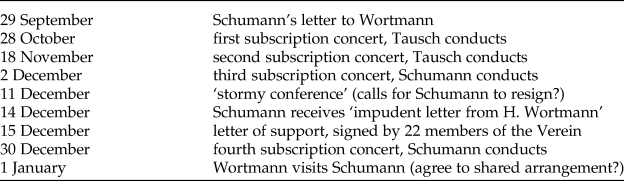
Litzmann's account, which is uncited, presumably originated in the circle of the Schumann family. Robert Schumann's recent biographers essentially retell the same story, with a few minor elaborations, which mostly involve identifying entries in Schumann's Haushaltbuch that apparently refer to the events Litzmann describes (see the chronology in Table 2). Several biographers mention a ‘stormy conference’ that Schumann refers to on 11 December.Footnote 36 They also mention an ‘impudent letter from H. Wortmann’, to which Schumann also refers, on 14 December, and they claim that it contained a request either that Schumann resign or that he turn over some of his conducting duties to Tausch.Footnote 37 And they report that the ‘mediation’ that Litzmann mentions consists of a letter of support for Schumann dated 15 December and signed by 22 members of the Gesangverein.Footnote 38 Most of them omit the public apology that Litzmann refers to, and in fact it is not verified by any contemporaneous source.Footnote 39
Chronology: September 1852–January 1853 (Schumann, Tagebücher, vol. 3: 610–13; Appel, ‘Schumann als Dirigent’, 137; Appel, ‘Promemoria’, 34n51)

The most significant addition to the story, in Daverio's, Worthen's,and Michael Musgrave's versions, is that the entire affair ended with what Worthen refers to as a ‘messy compromise’ and Musgrave calls a ‘tacit agreement’.Footnote 40 As Worthen tells it, the letter of 15 December supporting Schumann ‘could not save the situation’. There were further letters and meetings ‘and a stream of visitors to Bilkerstrasse’ and then finally:
[A] visit from Wortmann on Saturday 1 January led to a messy compromise: the choral rehearsals would be taken by Tausch (thereby satisfying the rebellious elements of the choir) and Schumann would conduct the concerts (thus satisfying him and Clara, and preserving the crucial distinction between the director and the deputy).Footnote 41
There are two elements that remain consistent in virtually all of these versions of the story. The first is that Schumann himself did not play an active role as his fate was decided. He was asked to resign and he was defended by his supporters. Secondly, Schumann narrowly escaped losing his job, but the outcome of the episode was still a defeat for him. Musgrave, for example, writes that ‘the damage had been done. There was now a tacit agreement that Tausch should train the choir and Schumann take orchestral rehearsals and public concerts.’ Martin Geck writes that ‘the corrosive effect of the dispute continued to make itself felt throughout the 1852–53 season’. And Daverio refers to the agreement as a ‘pyrrhic victory’ for Schumann.Footnote 42
Wilhelm Wortmann's Account
Wortmann is the only contemporary witness who has left a written account of the episode, in the Promemoria, and he tells a very different story. He claims that the proposal that Tausch conduct the rehearsals and Schumann the concerts was first suggested by Schumann himself, in a letter of 29 September 1852, now lost, that was written after he returned from a rest cure in Holland.Footnote 43 Wortmann's description of the letter is as follows:
After Dr Schumann's return, he proposed, on his own initiative, that when the Gesangverein practiced a new work, Herr Tausch would always lead the first rehearsals, and Herr Dr Schumann himself would lead the later rehearsals and the performance. In a letter to the undersigned, Herr Dr Schumann gave as a reason for this that it was too stressful for a creative artist to have to lead the first rehearsals of an amateur chorus after completing a full day's work.Footnote 44
Meanwhile, Wortmann, August Secherling and Raphael Naegelé – the three directors of the administrative committee of the Musikverein – were hearing complaints from many of the chorus members, who were upset that Schumann was returning and who wanted Tausch to conduct all of the rehearsals. It was for this reason that Wortmann wrote, and Secherling and Naegelé signed, the ‘impudent letter’ that Schumann received on 14 December 1852. Wortmann ‘did not dare to bring up his abilities as a conductor, but touched on his manner of conducting from the podium, instead of from the piano’ and suggested that this style of rehearsing, which differed from his predecessors and from Tausch, might have been the reason that the chorus members preferred Tausch. The committee eventually reached an ‘amicable agreement’ with Schumann: Tausch would lead the chorus rehearsals and Schumann would lead the orchestra rehearsals and conduct the performances, and he would transfer the portion of his salary for the chorus to Tausch.Footnote 45 There is no mention in Wortmann's account of a request that Schumann resign.
As a participant in the events that he is describing, Wortmann is obviously not an objective source. Schumann's tenure in Düsseldorf had been contentious and divisive, and as someone with a leadership position in the Musikverein, Wortmann obviously had a strong incentive to present his own actions to the city council in a positive light. It is thus not surprising that he presents himself as an honest broker and not – as Schumann's biographers would have it – an adversary who was doing what he could to oust Schumann altogether. But the text of Wortmann's letter to Schumann provides corroboration for his version of the story.
Wortmann begins his letter by describing the practice of Schumann's predecessors, which worked well, and then turns to Schumann's use of the podium to lead the chorus rehearsals:
The direction of the chorus rehearsals from the podium, which your Honour implemented, has not experienced the same success. Many chorus members either could not hear or misunderstood your comments, and the pianist could not make any comments, offer any help and absolutely could not sing along, without forestalling the actual conductor, and was limited as a rule to the accompaniment. The members soon felt the difference; the rehearsals became more difficult and tedious, and one noticed a decline in the performances of the society. – This led to discord among the members which, already at the general meeting of 15 September 1851 was made known by some of those present, although other influential members succeeded in preventing further declarations.Footnote 46
He suggests that when Schumann returned after his illness, the dissatisfaction increased, since Tausch, who had taken on a larger role, rehearsed the chorus from the piano:
In several chorus rehearsals your Honour has again directed from the podium and the same problems noted above immediately returned. The discord among the members that this has provoked is now even more widespread, since they experience the difference between the two ways of rehearsing directly, sometimes in one and the same rehearsal.Footnote 47
Wortmann then alludes to the question of Schumann's continued leadership, but he is clear that it is the chorus members, and not he and his colleagues, who might call for Schumann's resignation:
This time the opinion among the members is so broad that a public declaration is highly probable. Next month we must have the annual general meeting; there is no doubt that the musical leadership of our Verein will come up for discussion and the result is impossible to predict; furthermore, the directors of the board are obligated to call an extraordinary general meeting when ten members request one and we have heard that they intend to.Footnote 48
Wortmann encourages Schumann to defuse the situation and propose some sort of compromise:
In a letter to the undersigned Wortmann on 21 June of this year, your Honour … stated that the first rehearsals of our Verein are very gruelling and debilitating [sehr angreifend und aufreibend] for you, so that we might view the musical leadership of our Verein almost as a sacrifice that you make. We realize that it may be potentially uncomfortable for your Honour if the members were to provoke a discussion in the general meeting over the leadership of the Gesangverein. We feel obliged through our respect towards your Honour to suggest that you express the above feelings directly, take the initiative, and make proposals about this to the Verein.Footnote 49
Aside from Wortmann's own commentary in the Promemoria, there is one other contemporary reference to his letter, which contradicts Wortmann and corroborates Litzmann's account. In a diary entry dated 15 December 1852, Ruppert Becker, the concertmaster of the orchestra and a friend of the Schumanns, writes:
This evening brought news that enraged everyone! The administration of the Gesangverein has written a rude letter to Schumann in which they asked that he rid himself of his directorship [seiner Direction zu entledigen]! We have not yet seen how it will turn out. But in any case it is unpleasant for Schumann!Footnote 50
How can we reconcile these conflicting accounts? Perhaps Becker was aware of contextual factors that enabled him to read between the lines. There were undoubtedly political machinations that would have been visible at the time but are now lost to history. What reads to us as a friendly warning that Schumann should seize the initiative may have read to a contemporary as a veiled threat. Becker may have known that Wortmann really did want Schumann to resign, and he may have understood the letter as a self-serving document intended to provide the administrative committee with political cover.
It is also possible that Becker received misinformation, or made an unwarranted assumption, since he presumably never read the letter himself. There was a faction within the Gesangverein that wanted Schumann to resign, and since Wortmann had come into conflict with Schumann in the past, Becker, and other supporters of the conductor, may have mistakenly assumed that he had asked for Schumann's resignation.
Whatever the case, Wortmann's claim that it was Schumann who suggested the new arrangement is entirely plausible. As Clara's diary entries make clear, the chorus rehearsals had become increasingly stressful for him, and it seems likely that this stress interfered with his creative work. It is hard to see how the compromise he agreed to was a defeat. He no longer had to lead the rehearsals, but he would still conduct the concerts and reap the applause. The only downside for him was that he had to give up a portion of his salary to Tausch, although according to Wortmann, Schumann himself had already offered to do this in his letter of 29 September.Footnote 51 It may be that he considered this a reasonable trade off. By 1852 he was earning more than two-thirds of his income from composing, and he may have calculated that if he had more time and energy to devote to it, he could increase this income even more.
In the accounts of his recent biographers, Schumann is portrayed as a helpless victim, whose position was threatened by one faction of the Verein and then ultimately saved by another. But if Wortmann's version is accurate, then the episode illuminates Schumann's character in a completely different light. He managed to fend off the threat and then press his advantage to win a concession that he had desired for at least a year – ridding himself of the chorus rehearsals.
Summer 1853: Schumann's Account
The new arrangement went into effect at the beginning of 1853. Schumann continued to rehearse the orchestra and conduct the concerts, and Tausch rehearsed the chorus. But according to Wortmann, matters did not improve:
Under Herr Dr Schumann's direction, the orchestra found lacking: firm and reliable setting of the tempo, a steady beat, clearly specified and comprehensible comments and instructions in rehearsals, constant presence of mind, and those little signals and hints through which a more skilful conductor can contribute so much to the secure, perfect, and through the most sensitive nuances, sophisticated performance of the composition.Footnote 52
Despite Schumann's continuing problems, there were apparently no further crises for the first nine months of the year. Wortmann claims that the only reason that ‘unfortunate consequences’ were avoided is because all of the parties involved showed forbearance:
[T]his stemmed from the administrative committee's constant support of Herr Dr Schumann; from the willingness of the orchestra members (amateurs and professionals) to persevere as long as possible, out of deference to Herr Dr Schumann's greatness as a composer; and from the patience of the audience to put up with the declining performances.Footnote 53
There is reason to be somewhat sceptical of this obviously self-serving explanation. A more significant reason that the next crisis was put off for so long, which Wortmann does not mention, is that Schumann only conducted two of the four remaining concerts in the 1852–53 season.Footnote 54
At the same time, Schumann's productivity as a composer, which had practically slowed to a halt in 1852, continued to lag as 1853 began. But in the late summer there was ‘an amazing surge in Schumann's creativity’, as Daverio puts it, and the 12 weeks between 13 August and 4 November were one of the most prolific periods in the composer's life.Footnote 55 This period roughly coincided with Schumann's close personal and professional relationships with Joachim and Brahms. Schumann got to know Joachim when they collaborated in a successful performance of the Beethoven Violin Concerto at the Niederrheinische Musikfeste in May. Brahms then showed up at the Schumanns’ door with a letter of introduction from Joachim on 30 September. Brahms became a constant presence in their household during the next few weeks, and Joachim visited from Hannover three times between 23 September and the end of October.
Schumann's Haushaltbuch portrays a positive and satisfied person throughout 1853 and reflects his increased productivity during the late summer and fall. He uses a variety of terms to express his happiness and the enjoyment of his friends, such as ‘vergnügt’, ‘Freude’, ‘glücklich’, ‘schöne Stunden’, ‘sehr fröhlich’, ‘wunderschön’, and ‘ziemlich lustig’. He also frequently refers to himself with the word ‘fleißig’, which he used throughout his adult life when his composing was going well. In the first seven months of 1853 the word appears only eight times in the Haushaltbuch, but then, during the 12 weeks between 12 August and 3 November it appears 15 times.Footnote 56
Schumann only rarely complained of ill health during this year. On 30 July 1853, while in Bonn, he notes: ‘Morning, severe attack of rheumatism. Unable to do anything [Früh heftiger Rheuma = anfall. Unfähig für Alles]’. The following day he writes: ‘Somewhat better. Always dismal inclement weather. Hr Dr Kalt, very clever’.Footnote 57 Wasielewski claims, contrary to this entry, that Schumann believed he had suffered a stroke (‘einem Nervenschlag’), and that Dr Kalt ‘expressed very decisive concerns about Schumann's future’.Footnote 58 Litzmann also writes of the incident that ‘Schumann at first took it for a stroke’, but he claims that the doctor ‘reassuringly diagnosed it as lumbago [Hexenschuss]’.Footnote 59 Neither biographer reveals the source for his respective version of the story.
A month later, on 30 August, Schumann notes in his Haushaltbuch a ‘strange weakness of the speech organ [sonderbare Sprechorganschwache]’, and on 14 November he complains of a head cold [‘Erkältung’].Footnote 60 In his travel diary we read that on 24 November, while in Holland, he suffered an ‘intolerable hearing affliction, which finally went away [unleidliche[s] Gehöraffection, die endlich verging]’, and on 15 December he mentions that during an audience with the Dutch queen he was having trouble hearing (‘meine Harthörigkeit’).Footnote 61 These are the only complaints that Schumann makes about his health before February 1854.
Summer 1853: Biographical Narratives
As they construct a narrative of gradual decline, recent biographers tend to read Schumann's few entries about his health not as isolated incidents, but as intermittent complaints about an ongoing illness that they believe was neurological in origin. They may have been influenced in this by Wasielewski, who is generally regarded as an authoritative source, since he knew the Schumanns personally. But while Wasielewski was Schumann's concertmaster during his first two seasons in Düsseldorf, he moved to Bonn in May 1852, so he was only an occasional eyewitness to Schumann's condition during the last year and a half of the composer's career. And since Clara Schumann did not cooperate with Wasielewski's biography, he did not have access to most of Robert's papers, including his diaries and correspondence.Footnote 62
Wasielewski claims that Schumann's final disease was already ‘gradually developing and secretly lurking’ as early as 1851. But the supposed symptoms that he describes are vague and it is not always clear that they are the result of a physical or mental illness. Wasielewski quotes a letter from Schumann of 11 June 1851 in which he complains that he is ‘sometimes affected by a nervous disorder [nervösen Leiden]’, and then suggests that by 1852 this disorder had gotten worse and had resulted in such ‘peculiar symptoms’ as ‘sluggish speech [schwerfällige Sprache]’, a tendency for musical tempos to appear faster than they actually are, slumped posture (‘seine körperliche Haltung hatte etwas gedrücktes’), and apathy.Footnote 63 He also cites an anecdote reported by Ruppert Becker, who succeeded Wasielewski as Düsseldorf concertmaster, in which Schumann claimed that he was hearing an imaginary tone, which suggests that he may have been suffering from tinnitus.Footnote 64
Wasielewski only reports three incidents that he himself witnessed. He was present at two music festivals where Schumann chose to conduct only a small number of pieces because he was unable to take on any more. At a choral festival in August 1852 the ‘exhaustion’ of Schumann's ‘mental and physical powers [eine Erschöpfung der geistigen und physischen Kräfte]’ was ‘undeniable’.Footnote 65 And on the third day of the Niederrheinische Musikfeste in May 1853 he conducted only two pieces, and this required a ‘great effort’ on Schumann's part (‘aber unter großer Anstrengung geschah’).Footnote 66 The third incident was a conversation in Schumann's home in May 1853 about Schumann's interest in table turning. Wasielewski points out that this was a popular fad at the time, and so Schumann's enthusiasm in and of itself was not of concern to him, but he was frightened by Schumann's ‘uncanny, spooky expression [unheimlichem geisterhaftem Ausdrucke]’ and the ‘threatening severity [drohenden Ernst]’ with which he recommended the practice.Footnote 67
Even assuming that Wasielewski's impressions are accurate, the symptoms he describes and the incidents he recounts do not in and of themselves indicate that Schumann was suffering from a psychological or neurological illness in 1852 and 1853. But later biographers have created a continuous medical narrative by exaggerating Wasielewski's list of symptoms and looking for confirmatory evidence in Schumann's Haushaltbuch. Wasielewski's unverified claim that Schumann thought he suffered a stroke in July plays a large role in virtually all these recent accounts.
Jensen, for example, writes:
During 1853, recovery from his infirmities of the previous year was slow … His physical actions, including the pace at which he walked, appeared slower, and his speech at times was slurred and difficult to comprehend. On 30 July while in Bonn Schumann collapsed, and was fearful he had a stroke.Footnote 68
Theo Payk writes that ‘at the end of August Schumann's speech problems intensified to such a massive extent that he was sometimes scarcely comprehensible; his movements became even clumsier’.Footnote 69 And Udo Rauchfleisch writes:
[I]n the summer of 1853 his health again deteriorated: during a trip to Bonn he suffered a stroke or, as the doctor whom he consulted postulated, an attack of lumbago … At the end of August 1853 a significant speech disorder developed.Footnote 70
Worthen makes an explicit connection between two of Schumann's Haushaltbuch entries, and argues that the complaint about his speech organ on 30 August provides evidence that the attack on 30 July had in fact been a stroke. Relying on both Schumann's entries and Litzmann's account, he expresses doubts about Dr Kalt's supposed diagnosis:
Schumann described Dr Kalt as ‘very bright’, but all he could suggest was another attack of sciatica. It is again likely to have been a small stroke … his state afterwards suggested something rather more significant than sciatica. On 30 August he would note in his household book ‘remarkable weakness in the organ of speech’ and in September Clara observed that, after working in his room for a while, he was quite unable to speak, as if he had some kind of paralysis of his mouth or tongue. That suggests the after-effects of a small stroke, or even a series of them.Footnote 71
The source for Worthen's latter claim – that what Schumann vaguely describes as a weakness of his speech organ was in fact paralysis, and that this condition continued in September – is not Clara Schumann herself, but a pianist and aspiring composer named Louise Japha, who travelled to Düsseldorf in the fall of 1853 to study composition with the Schumanns and later wrote a letter about her experiences to Max Kalbeck, Brahms’ earliest biographer.
Kalbeck reports that Japha was disappointed because her lessons were almost exclusively with Clara, who told her that Robert ‘could not tolerate any disturbance of his work and absolutely did not give lessons’. Japha complained that ‘in a quarter of a year she set eyes on Schumann scarcely six times, and then only exchanged a few pleasantries with him’.Footnote 72 She also reported on the precarious state of Schumann's health. Kalbeck summarizes her account:
Clara's concern for her Robert was so great, that she always accompanied him in the afternoons to the door of the coffee house, where he used to sit and chat with his friends, and whenever possible went back again to pick him up. Schumann's speech became increasingly awkward [immer schwerfälliger], and Frau Clara reported already in September 1853 that often when she called him out of his work room, he could not speak at first, because he felt some kind of paralysis of his tongue [eine Art Lähmung der Zunge].Footnote 73
Japha's most alarming anecdote is her account of Clara's birthday, on 13 September. After a group of students surprised Clara by singing a part song that Robert had composed for her, he said to one of them: ‘Very pretty, very pretty, dear D., who is it by?’ Kalbeck cites this as evidence that Robert was suffering from memory loss, but if he truly did not remember that he had just composed the song, it would suggest something far more serious.Footnote 74
Kalbeck's biography was published in 1908, so Japha presumably wrote her letter a half century after these incidents had occurred, by which point her memory had likely been coloured by subsequent events. She would have had an especially strong incentive to misremember Schumann's state during her disappointing time in Düsseldorf. She could reassure herself that the only reason the great composer refused to teach her was because he was already losing his mind.
Summer 1853: Clara's Account
It is clear that Schumann suffered from some kind of speech problem in the summer of 1853, and it is plausible that Clara discussed it with Japha. But to judge from Clara's own account, Japha's reminiscence greatly exaggerates the severity of his condition. In her lengthy description of her birthday celebration, Clara's only worry is that Robert spent so much money on a new piano for her. If Robert actually asked who composed the part song, he most likely meant it in jest, which would fit with the presentation of a birthday surprise. In Clara's diary entry about the birthday she writes: ‘I cannot express what I felt, but my heart was full of love and admiration for Robert, and of gratitude to heaven for the great happiness with which it overwhelms me. It may sound presumptuous, but am I not truly the happiest wife in the world?’Footnote 75
These words echo a letter that Clara had written three weeks earlier, on 23 August, to her close friend Emilie List, whose sister Elise had recently lost her husband to typhus. After expressing her condolences, Clara turns to her feelings about her own husband:
Love and admiration for him are always growing, and can never reach an endpoint. May God preserve for me this highest of all earthly happiness – such a man does not belong to many women – perhaps what I want to say will sound arrogant – to any woman! No, in my heart I am certainly humble, and I enjoy my happiness, not with the confidence that it must be so! I know that at any moment God can snatch it from me! But my gratitude to Him increases daily!Footnote 76
Two months earlier, on the occasion of Robert's birthday, Clara expressed a similar sentiment in her diary, and in this case she is clear that her gratitude is for Robert's health, which has been restored after his illness the previous year:
We spent a cosy evening at home with joyful hearts, glad that Robert spent the day so well and happy, which unfortunately was not the case last year … One must always thank God when one can be cheerful in body and soul, and one feels doubly thankful on such a special day … What the future brings we must leave to the heavens! Today I only wish to be thankful for the good that we have received.Footnote 77
One might argue that these passages, written over a period of three months, should not be read at face value, but should be understood as Clara's desperate attempts to deny her husband's failing health and reassure herself about the future. But while she was frequently in a state of denial about Robert's inability as a conductor, she was generally clear-eyed about his various health problems. In 1852, when he was ill, she frequently commented in her diary about his suffering and her fears for him.Footnote 78
Clara did not shy away from writing about Robert's psychotic break in February 1854, either. In fact, her hair-raising descriptions of his hallucinations – first in another letter to Emilie List, of 15 March, and then in a diary entry in April – provide the most detailed record that we have. At the beginning of her letter, she refers again to his unusually good health in the preceding months, and makes it clear that the onset of Robert's mental illness was sudden and unexpected:
For years I have enjoyed the greatest earthly happiness with my dear Robert, a rare happiness, but now I must bear a severe ordeal! – Imagine, my Mila, Robert was so well this winter, as he has rarely been, in December we took a magnificent trip to Holland, in January we were in Hannover, where he was also completely happy; in short I had no reason to be worried about him.Footnote 79
As much as we learn from what Clara wrote about the state of Robert's health in 1853, we learn even more from what Robert did not write. Although he began his Haushaltbuch in 1837 as a record of his financial accounts, he gradually added more and more details about his daily life. By the time he moved to Düsseldorf in 1850, he was methodically and comprehensively reporting on his work, travel, social engagements, moods, health, and even sexual intercourse. The fact that he refers to his health so rarely in 1853 is perhaps the strongest evidence that it was relatively good, and that the few complaints he does mention were isolated incidents.
By contrast, he refers to his health 26 times in a period of 62 days between 8 June and 8 August 1852. Nine times he describes specific symptoms that he was experiencing – a convulsive cough (‘Krampfhüsten’), a dreadful cold (‘furchtbare Erkaltung’), insomnia (‘unruhige Nacht’), a nervous condition (‘Nervenleiden’), fatigue (‘traurige Ermattung meiner Kräfte’) – and eight times he simply reports that he is unwell (‘sehr unwohl’, ‘uebles’ or ‘trauriges Befinden’). Twice he reports that his health is fair (‘leidliches Befinden’) and seven times that it is better (‘beßeres Befinden’).Footnote 80 But the only references that Schumann makes to his health during the entire year of 1853 are the four complaints I have already described, as well as three reports that his health is better.Footnote 81 Then, starting on 10 February 1854, as he is overcome by psychosis, he presents a daily record of his aural hallucinations – ‘evening very strong and painful hearing affliction [Abends sehr starke u. peinliche Gehöraffektion]’, ‘unhappy night (hearing and headache) [Traurige nacht (Gehör = u. Kopfleiden)]’, ‘still worse, but also wonderful [Noch schlimmer, aber auch wunderbar]’, ‘wonderful suffering [Wunderbare Leiden]’, ‘towards evening very strong (beautiful music) [Gegen Abend sehr stark (wunderschöne Musik]’. Ironically, his last entry, on 17 February, is ‘better’.Footnote 82
October Performances
As Schumann's fourth season in Düsseldorf began, in October 1853, the complaints about his conducting started up again. He conducted two performances that month, both of which were apparently disastrous. An article in the Niederrheinische Musik Zeitung, a local music journal, describes the performance of a mass by Moritz Hauptmann at the St Maximilian church on 16 October as ‘completely unworthy of a sacred place’. The author's description of the opening concert of the season on 27 October, which featured Joachim as both composer and soloist, is more expansive:
In the opening half we first heard Joachim's Hamlet overture. The performance was so poor that Joachim's abilities as a composer remain truly unknown to us. The difficult work passed by our ear so roughly that we had no idea what kind of piece it was. The accompaniment of the Beethoven Violin Concerto, the Schumann Fantasy for the same instrument, and the bass aria from Paulus went so badly that one was often overcome by uneasiness, induced by the fear that things would fall apart completely. We felt truly sorry for Joachim and the singer.Footnote 83
Ostwald and Worthen have relied on two anecdotes about these performances to argue that Schumann's psychological health had reached a perilous state. They, along with Daverio and Musgrave, recount a story that Tausch told to Friedrich Niecks, who wrote a biography of Schumann in 1925.Footnote 84 Niecks grew up in Düsseldorf, where his father played under Schumann, and Niecks himself later studied with Tausch. In 1889 he interviewed his former teacher, who described Schumann's conducting:
He conducted badly from the first, and was often absent-minded. Once at a mass he went on conducting after the movement was finished and the priest had begun to intone.Footnote 85
Tausch does not say when or where this incident occurred, although the reference to a priest suggests that it was at a service. But Wortmann, in his Promemoria to the city council, describes the same incident, and places it at the dress rehearsal of the Hauptmann mass:
In the orchestra rehearsal on Friday 14 October, Herr Dr Schumann seemed absent-minded [zerstreut], such as one had scarcely observed before. He was so engrossed in distant thoughts [in fremdartigen Gedanken vertieft] that, as attested by eyewitnesses, he continued beating time after a movement had ended.Footnote 86
In the case of the 27 October concert, Ostwald, Daverio, Worthen and Jensen all cite an incident that again took place in rehearsal, which Joachim told to his biographer, Andreas Moser.Footnote 87 Joachim paraphrases a comment that Schumann made in a letter of 8 June 1853, about a horn entrance in Joachim's Hamlet overture: ‘It must sound really magical; I look forward to it most especially!’ He then describes Schumann's rehearsal of the piece, on the morning of the concert:
After he ran through the piece from beginning to end, during which, naturally, lots of notes fell under the podium, Schumann came up to me, completely disappointed, and said: ‘Remarkable, how mistaken one can be, the horn passage was completely inaudible, but we will try it one more time’. When I objected that this was entirely natural because the horn player had missed the entrance, and only found his place again in the course of the piece, he simply called out to the horn player that he should pay better attention and not miscount in the preceding rests; but he did not do the obvious thing, and cue the entrance.Footnote 88
Worthen uses these two anecdotes to generalize about Schumann's mental state:
[B]y the second half of 1853 Schumann was in effect no longer hearing the music being performed. Whereas previously he had been no more – but no less – than competent … he was now incompetent. The music was playing in his head and that was what he was conducting.Footnote 89
Ostwald describes the situation in even starker terms:
Schumann's perception of external reality was evidently being drowned by his musical imagination, a flood of irresistible voices. Maintaining contact with the environment was becoming increasingly difficult.Footnote 90
Both biographers suggest that Schumann was now psychologically incapacitated to a very severe degree, which was making it increasingly difficult for him to carry out his duties as a conductor. But the anecdotes that Ostwald and Worthen use as evidence do not really support this conclusion. The original sources make no mention of mental impairment. Rather, they describe aspects of Schumann's character and patterns of behaviour that had been noted, and complained about, not only throughout his tenure in Düsseldorf, but throughout his ten-year career as a conductor.
Schumann the Conductor
Consider Worthen's ominous interpretation of Joachim's anecdote: ‘worryingly, [Schumann] does not hear the horn fail to come in. He believes it inaudible’. How could Schumann hear a solo that was not there? Presumably he was simply not paying attention, and did not look up to see whether the horn was playing. As Worthen acknowledges, the point of Joachim's anecdote is that the musicians in Düsseldorf are not very good and Schumann ‘has little authority’ over them.Footnote 91 Ruppert Becker made a similar observation in his diary ten months earlier, after a rehearsal on 29 December 1852. He contrasts Schumann with Rietz, one of his predecessors in Düsseldorf:
Unfortunately, my long-held opinion, that Schumann is not able to conduct well, keeps getting stronger. It is only through the greatest strictness and through subordination to the conductor that the orchestra could perform to advantage. Both are missing; Schumann's nature is not capable of the former and the latter is out of the question. The amateurs ruin things, as they do everywhere. How unpleasant to make music with them! Always discord and squabbling! There can be exceptions but they are damn rare. Their abilities are mediocre and with strictness and rigor, like Rietz had, one could attain a good performance of the music; but?Footnote 92
Wasielewski, who played under Schumann during his first two seasons in Düsseldorf, also felt that he lacked ‘the most essential qualities’ of a good conductor. Echoing a complaint reported by Wortmann, he writes that Schumann could not ‘make his intentions clear and precise’, because ‘he either does not speak, or else speaks so quietly, that he only rarely makes his wording comprehensible’.Footnote 93 Ferdinand David, who was the concertmaster in Leipzig when Schumann made his debut on 4 December 1843, conducting his own oratorio Das Paradies und die Peri, makes a similar complaint, in a letter to Mendelssohn:
Schumann had four orchestra rehearsals for the Peri, and he could just as well have had ten more, and still it would not have gotten any better. The only one who understood any of his comments was his baton, which he always held in front of his mouth when he spoke, so that everyone else heard nothing. The Leipzigers had to rely on their good will in order for the evening to be tolerable.Footnote 94
Turning to the mass anecdote, neither Tausch nor Wortmann suggest that Schumann was losing touch with reality. Rather, they both use the term ‘absent-minded’, which suggests that he was distracted by his own thoughts and was not really paying attention to what was going on around him. This too echoes descriptions of his conducting from throughout his career. Ludwig Meinardus, a conductor and composer, watched Schumann conduct a rehearsal of the third part of the Szenen aus Goethes Faust in Dresden in 1849. He later described it in his memoir:
His style of conducting differed markedly from everyone else's, and until one became familiar with it, its entire character stood out against what one was used to. He was deeply immersed in the score. The baton appeared to mechanically execute the motions on its own. The Dresden orchestra was accustomed to continually observing his conducting with the most attentive eye.Footnote 95
And Hiller, who knew Schumann in Dresden, and preceded him as the music director in Düsseldorf, remembered his conducting as follows:
He knew what he wanted but he did not express it. He appeared at his strangest when he conducted his own compositions. His head sunk in the score, I would say that he indicated the beat to the performers in passing – but it was obvious that he primarily heard his work with his inner ear and in this way he added whatever he did not hear with his outer ear.Footnote 96
Returning to October 1853, it may be that Wortmann's description of him at the mass rehearsal is accurate: he was ‘engrossed in distant thoughts’. According to Schumann's Haushaltbuch, he received a surprise visit from Joachim on the morning of that rehearsal, and the next day he was thinking about composing a sonata for him, and had begun working on the Gesänge der Frühe, which he completed two days after the mass performance on 16 October.Footnote 97
By 27 October, Schumann, Brahms, and Dietrich had composed the FAE Sonata, and Schumann would soon begin work on the additional movements that would fill out his third sonata for violin and piano. In the Haushaltbuch, the rehearsal and concert on that day appear almost as an interruption of an ongoing musical party. Joachim arrived on 26 October at 3:00, ‘to our joy’, and at a gathering at the Schumanns that included Brahms and Dietrich, he played Schumann's Violin Fantasy, and two Paganini caprices for which Schumann had composed accompaniments. The next day Schumann records the rehearsal and the concert and then ‘afterwards get-together’. On 28 October, after visits from Bettina Arnim and Peter Cornelius, Schumann, Brahms and Dietrich surprised Joachim with the FAE Sonata and then ‘afterwards company’.Footnote 98 It is easy to see how this flurry of far more fulfilling activity might have distracted Schumann and made him an even more incompetent conductor than usual.
In any case, Schumann's conducting is described in much the same way by virtually everyone – witnesses in Leipzig, Dresden, and Düsseldorf; adversaries, such as Wortmann; friends such as Hiller, Becker, and Joachim. According to the anecdotes from Leipzig and Dresden, Schumann was apparently successful despite his peculiar manner of conducting, because he was able to rely on the professionalism of the musicians, and on their respect and goodwill. He was also a guest in both cases, conducting musicians who were regularly rehearsed and led by another, presumably more skilled, conductor. In Düsseldorf he was completely responsible for rehearsing and leading a semi-professional orchestra and an amateur chorus. It is little wonder that things went awry.
Crisis
According to the surviving contemporary accounts, it was not Schumann's psychological state, but the new arrangement – in which Tausch led the rehearsals and Schumann conducted the concerts – that was responsible for the disastrous performances in October 1853. The Niederrheinische Musik Zeitung article, which I cited above, lays the blame for this squarely on Schumann:
The discontent in the choral society has reached such a height, that it could not remain hidden to Schumann. He arranged for Tausch to take over the direction of the rehearsals, and reserved the performances for himself. We experienced the results that one would expect from such a division of labour, at the performance in our Maximilian-Pfarrkirche of a mass by Hauptmann.Footnote 99
Wortmann's Promemoria echoes this account:
A mass by Hauptmann was rehearsed under the direction of Herr Tausch and, according to the testimony of an unbiased judge, the chorus was so solid and so good that they could hold their own before the public. The members of the Gesangverein had hoped that Herr Tausch would also conduct the performance. Herr Dr Schumann insisted on conducting, however, which was up to him according to the present agreement … The performance of the mass at the service was so poor that it almost caused offense.Footnote 100
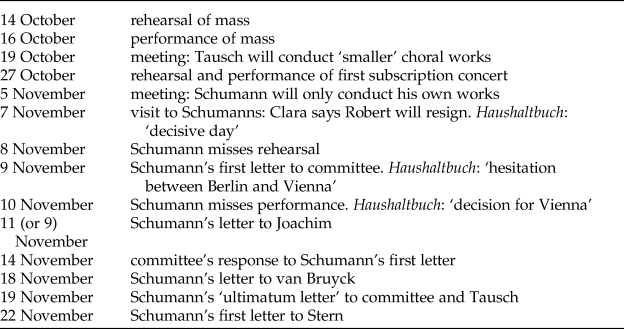
This performance, coming less than two weeks before the new season was to begin, caused another crisis that required the administrative committee's intervention (see the chronology in Table 3). An entry of 19 October in Schumann's Haushaltbuch refers to a meeting and a visit to his home: ‘Conference. Shameless people. Visit from Herrn von Heister and Herrn Illing’.Footnote 101 According to Wortmann, the conference was a regular meeting of the committee to prepare for the first subscription concert. Before Schumann arrived, the managers of the Gesangverein announced that, in the wake of the mass performance, the chorus was no longer willing to work under the shared arrangement between Tausch and Schumann. They would only perform in public if they were conducted by the person who had rehearsed them.Footnote 102 This created an immediate crisis, since the second half of the concert on 27 October consisted of a choral work – Mendelssohn's Walpurgisnacht.
Chronology: October–November 1853 (Schumann, Tagebücher, vol. 3, 639–42; Appel, ‘Promemoria’, 13–18; Robert Schumann, Robert Schumanns Briefe: Neue Folge, ed. Gustav Jansen, 2nd expanded edn (Leipzig: Breitkopf und Härtel, 1904): 382–3; Schumanns, Briefedition, series 2, vol. 17, 680–81).

Wortmann reports that Schumann was present to discuss the routine concert arrangements and got up to leave as soon as the discussion ended, but the chair asked him to stay for a moment longer because they had to consider ‘an unpleasant announcement from the Gesangverein’. After hearing the announcement, Schumann ‘left without uttering a syllable’. Needing to resolve the matter quickly, the committee sent Julius Illing, the chairman, and Joseph Eugen von Heister, who was a friend of the conductor, to Schumann's home to inform him that the committee had decided that Tausch would conduct performances of ‘smaller’ choral works and Schumann would conduct ‘larger works’. They had also decided that Walpurgisnacht would be considered a smaller work.Footnote 103
According to Joachim's account of the dress rehearsal for the 27 October concert, cited above, he was asked to conduct his own overture, but he refused because it ‘would be an insult, which I would not be guilty of against so honoured an artist as Schumann’.Footnote 104 Wortmann, however, implies that it was Schumann himself who again insisted on conducting a work that he was unprepared for:
The introduction to the concert was to be Herr Joachim's Overture to Hamlet, and one had hoped that he himself would conduct it, since the work is difficult, with frequent shifts in meter and tempo, and it requires a skilful conductor as well as a well-rehearsed orchestra. This hope was not fulfilled, however, since Herr Dr Schumann took over the direction in such a way that all of his previously observed faults were experienced most profoundly.Footnote 105
In the wake of this performance, the committee met again, on 5 November, and decided that they needed to take further action. They proposed that Schumann conduct only his own compositions and leave all of the rest to Tausch. A delegate was sent to find out if Tausch would be amenable to this new arrangement. The next day there was a formal meeting and after hearing that Tausch had agreed to act as a substitute for Schumann, the committee voted unanimously to send a delegation to try to persuade Schumann to agree.Footnote 106
The Schumanns’ Response
On 7 November Illing and Joseph Eberhardt Hertz, a lawyer and violinist in the orchestra, went to the Schumanns’ home and spoke to Clara. They asked her to communicate to Robert the committee's request, but, according to her diary, she ‘replied immediately, without speaking to Robert’, that what they were proposing was ‘an infamous intrigue and an insult to Robert, which would force him to resign his position completely’. She went on to say that the committee's suggestion was ‘a breach of contract, which Robert would not agree to under any circumstances’.Footnote 107 Robert himself echoed this latter argument in a letter to the committee of 9 November, and added that he was prevented, ‘through a moral obligation’, from conducting or participating in any way in the Verein, as long as his contract was not upheld. He concluded by spelling out the terms of the contract in detail.Footnote 108
Meanwhile, Robert failed to appear at an orchestra rehearsal on 8 November and at the next concert on 10 November, so Tausch conducted in his place. The committee then decided that Tausch should take over the chorus and the orchestra completely.Footnote 109 They responded to Schumann's letter on 14 November, and pointed out that they had made ‘a simple request’ (einer einfachen Anfrage) and not a ‘demand’ (Wunsch) and thus had not violated the contract. They also reminded him that there were contractual ‘obligations on both sides’, and that they were abiding by theirs and they expected him to abide by his.Footnote 110 He replied on 19 November with what he described in his Haushaltbuch as an ‘ultimatum letter to the Verein and Herr Tausch’. He accused the committee of colluding with Tausch ‘behind my back’ to take over the direction of the chorus and orchestra and concluded:
After such occurrences we can have nothing more to do with one another, the matter is clearly settled, and furthermore, I will refrain from any further written or oral discussion.Footnote 111
As Schumann's fourth season in Düsseldorf began, the administrative committee of the Verein again found themselves trying to resolve the ongoing conflict between their music director and the musicians who worked under him. This time, however, Schumann was far more recalcitrant. It is clear from Illing's description of his 7 November conversation with Clara that the ‘request’ that Robert turn over most of his conducting duties to Tausch was presented merely as an opening gambit, and that the committee was inviting Robert to negotiate:
We informed her in the gentlest way possible of the circumstances, and since it seemed preferable for all concerned, we told her that Herr Dr Schumann should not immediately make a decisive declaration directly to the committee, but should discuss the next steps with us confidentially, and at the same time declared that we would be ready to have such a discussion at any time.Footnote 112
Robert, with Clara's encouragement, ignored their suggestion completely. He not only responded to their request with his dismissive letter of 9 November, which was addressed to the entire committee, but he deliberately neglected his duties by missing a rehearsal and a performance. Why did he not try to negotiate and offer a counterproposal that was more acceptable to him? Even if he was offended by the particular arrangement that the committee was proposing, he clearly found nothing objectionable in principle about sharing the conducting with Tausch, since he had just agreed to let Tausch conduct Mendelssohn's Walpurgisnacht at the first subscription concert.
The authors of the most recent pathographies see Schumann's response as evidence that he was already exhibiting the symptoms of mental illness. Ostwald describes the ‘stiff, legalistic letter’ that Schumann wrote in response to the committee's proposal as an ‘indication of his faulty judgment’. In ‘denying any personal responsibility for the predicament he was in’, and accusing the committee of violating his contract, the letter was ‘defensive, if not paranoid’, and the ultimatum letter that Schumann wrote on 19 November was ‘distinctly paranoid’.Footnote 113
Rauchfleisch finds it understandable that Schumann felt the committee's request as a ‘severe affront’, but he argues that ‘his behaviour in this situation clearly shows that he had only a slight grasp on reality’. Schumann's failure to recognize that he was incapable of performing his duties as a conductor was a desperate attempt to fend off the psychosis that was beginning to overwhelm him. This is why he was so outraged that Tausch had agreed to replace him:
From a subjective point of view, such a feeling was perfectly understandable: one sees in his virtually desperate adherence to the idea, which had now become an illusion, of his continuing capability, the attempt to resist the regressive pull into severe mental illness. The more he sensed that external reality had shattered, and that he had become incapable of performing his professional duties, the more desperately he clung to the – certainly completely unrealistic – image of himself as a conductor who would be in a position to perform his duties.Footnote 114
Dagmar Hoffmann-Axthelm argues that the committee's action triggered a severe psychological trauma. Schumann's inner defences were nearly exhausted and the anxieties that he had successfully repressed earlier in his life now broke through, creating a disconnect with the realistic expectations of the outside world. The committee's actions unleashed ‘crippling, evil forces of an earlier experienced reality’. The ‘inner danger’ that Schumann felt assumed such a scale that it could no longer be expressed in words or in music, but ‘could only be communicated in silence and death’. It was this psychological state that led to Schumann's suicide attempt three months later.Footnote 115
If Schumann had hoped to remain in Düsseldorf, then his dismissive response to the committee might plausibly be cited as evidence that he was experiencing the delusions that these biographers ascribe to him. But if he had already decided to leave, then there would be nothing irrational about Schumann's response. It is true that he and Clara were both in denial about his abilities as a conductor. They could not see how they had contributed to the crisis, and so they laid the blame completely on the committee and on Tausch. But the inability to see things from your adversary's point of view is not an uncommon affliction, and it is certainly not evidence of mental illness.
If Schumann wanted to resign, then his ‘legalistic’ response may not have been a sign of paranoia, but a deliberate tactical move, which ultimately produced a positive result. By reminding the committee of the terms of his contract, and accusing them of violating it, Schumann put them on the defensive in their communication with the city council. He pointed out that his annual contract automatically renewed each October and that ‘one or the other party must give notice at least three months before 1 October in order to cancel the contract on 1 October. Therefore this cannot happen before 1 October [1854]’.Footnote 116
When the committee decided to replace Schumann they were careful to abide by these terms, as is clear from Wortmann's account. They appointed Tausch as a ‘substitute’ for the remaining subscription concerts of the season. Tausch would then take over ‘independently’ at the beginning of the following season, in the fall of 1854, presumably after they had given Schumann notice that his contract would not be renewed.Footnote 117 In the concluding summary of his Promemoria, Wortmann points out that since neither Schumann nor the committee had terminated the contract, the city council still had to pay Schumann's salary through the following summer.Footnote 118 This meant that the Schumanns would have several months to plot their next course, during which time Robert would have no responsibilities in Düsseldorf, but would retain both his title and his salary.
Hoping to leave Düsseldorf
Both of the Schumanns had expressed the desire to leave Düsseldorf several times during the previous three years, and on at least two occasions Robert had acted on the desire by asking colleagues in other cities about job possibilities. As early as 17 March 1851, in the middle of his first season, Robert wrote in his Haushaltbuch: ‘Doubts about remaining long in Düsseldorf’.Footnote 119 The following month Clara wrote to Pauline Schumann, the widow of Robert's brother Carl:
[B]y the way (told in confidence) we will not stay here long! such a small city is certainly not suitable as a permanent residence for an important artist! the people are petty, as are their interests and you know, I believe that they do not appreciate what they have because they lack higher education, which is only available in the life of the outside world.Footnote 120
A year later, on 8 May 1852, Clara wrote to her friend Marie von Lindeman in Dresden:
[O]ne could scarcely find a colder audience anywhere in Germany; they absolutely do not know what they have in my husband, any more than they knew what they had with the earlier conductors – Mendelssohn, Rietz, Hiller. We are leaving Düsseldorf at the first opportunity that offers itself. There are certainly still no prospects at hand, so please keep completely silent about it.Footnote 121
The following month Robert sought out just such a prospect. In a letter of 12 June 1852 he proposed to Gottfried Herrmann, the Kapellmeister in Sondershausen, that the two switch jobs.Footnote 122 And in a letter of 17 December of the same year, to Carl van Bruyck, a composer living in Vienna, he said he would like to move there if ‘a sphere of activity could be found for a conductor’.Footnote 123 Nothing came of either inquiry, and while he may have pursued other positions, no further evidence survives.Footnote 124
Despite their increasing unhappiness, the Schumanns continued to stay in Düsseldorf, presumably because they felt that they could not afford to give up Robert's salary, and he could not find a job elsewhere. It appears that by November 1853 their calculus had changed. Robert was still hoping to find another position, as we shall see, but the Schumanns were apparently also willing to leave Düsseldorf without one. One reason that they may have been ready to make this gamble is that Robert's relationship with his musicians had deteriorated to the point that his position was becoming untenable. But a more important reason is that he was earning enough money as a composer to support the family without his Düsseldorf income.
As late as 20 January 1853 there is possible evidence that Clara still did not think they could afford for Robert to be unemployed. In a letter to Wasielewski, she reminds him that they had discussed performing a soirée in Bonn and asks if he is still interested. It would bring her ‘joy’ to play with him again and ‘also perhaps a little income – you know well that here one has little, and our household requires much!’Footnote 125 It is hard to know whether this is just a casual complaint about the high cost of living, or an expression of her genuine concern about their finances. If it is the latter, then her concern had apparently subsided by November, when she peremptorily told Julius Illing that Robert would have ‘to resign his position completely’.
Such a change in Clara's attitude would simply be a reflection of Robert's improved health, which in turn led to a more positive outlook for the family's finances. In January 1853, Robert was still recovering from the illness that had plagued him for much of the previous year, and he was in the midst of one of the most unproductive periods in his career. He had completed virtually nothing since June, with the exception of a set of songs, and the income from his compositions was drying up (see Table 4).Footnote 126 On top of that, he had been too ill to conduct the first two concerts of the new season and had paid Tausch 60 thalers of his salary to substitute for him. And under the new arrangement he had agreed to, he would now pay him 100 thalers a year to lead the chorus rehearsals.Footnote 127
Schumann's quarterly income from compositions, 1852–53. (Amounts are listed in thalers, silbergroschen. There are 30 silbergroschen to a thaler (Schumann, Tagebücher, vol. 3, 679–83)

As 1853 began, Robert continued to be unproductive, and in the first three months of the year, the income from his compositions was a meagre sixty-seven thalers. But in the spring things began to pick up and by the beginning of November he had earned 1,292 thalers.Footnote 128 Furthermore, he had about a dozen works that he had completed during the previous three months and had not yet offered to publishers. Robert sold several of these works in the weeks after he and Clara decided he should resign, and by the end of the year he had earned another 710 thalers, which makes 1853 his most profitable year. And while we now know that Schumann's career as a composer was essentially over by 7 November, at that point it would have been reasonable to assume that his productivity would continue.
Another factor in the Schumanns’ improved financial outlook was Clara's increased earning potential. In May 1853 she returned to composing for the first time since 1846, when she had written her piano trio and two songs, and by July she completed four compositions, all of which would be sold to publishers over the next couple of years.Footnote 129 And, although Robert's resignation presumably meant that she would no longer play with the Düsseldorf orchestra, she now had other performance opportunities. In addition to Wasielewski, with whom she would play a soirée on 12 November in Bonn, she also had Joachim, with whom she had performed in Düsseldorf on 29 October. In between she travelled to Cologne on 8 November to play with Hiller's orchestra.Footnote 130 At the end of November she and Robert would leave for Holland, where she was scheduled to play 12 concerts. This would be her first tour since the couple went to Vienna and Berlin in 1847.
Berlin or Vienna?
The committee's suggestion that Schumann only conduct his own compositions, which so strongly offended both Robert and Clara, apparently provided them with the impetus that they needed to leave. In Robert's Haushaltbuch he describes 7 November, the day that Clara spoke to the committee members, as a ‘decisive day’. On 9 November he wrote: ‘Hesitation between Berlin and Vienna’. And then on 10 November: ‘Decision for Vienna’.Footnote 131 At the same time he wrote to Joachim:
What I have long had in mind has been decided. We are tired of this vulgar hustling. I have an offer (although through third hand) that will enable us to move where my wife and I have long desired to be … We will stay here until July.Footnote 132
A week later, on 18 November, he wrote to van Bruyck:
The time may soon approach when we can get to know each other better. We want to leave next winter ([18]54–55) and we intend to stay in Vienna for some time. Provincial life no longer appeals to us; everything repeats as if in a circle; and the resources and strengths are always the same. We would like to free ourselves and breathe a different air.Footnote 133
Musgrave dismisses Schumann's intention to relocate to Vienna as ‘pure fantasy’, and suggests that the job offer that he mentions to Joachim was imaginary: ‘Schumann was completely unproven as a director and his reputation already dimmed as such: he had no basis for a professional move’.Footnote 134 Ostwald likewise describes Berlin and Vienna as ‘delusional fantasies’. He writes: ‘Neither of these places had anything to offer him and his “decision” to go to Vienna was meaningless’.Footnote 135 It is true that there is no evidence of the job offer that Schumann mentions to Joachim, but that does not necessarily mean that it did not exist. In any case, as Worthen suggests, Schumann's ‘recent productivity may have persuaded him that they could now live on his earnings from music publication’.Footnote 136
Worthen, however, also sees ‘an element of fantasy’ in Schumann's decision to move to Vienna, since ‘[n]either he nor Clara ever showed any sign of acting on it’.Footnote 137 But there was no pressing reason for the Schumanns to ‘act’ on their decision, since they knew that his salary would be paid through the following summer. Robert tells Joachim that they were planning on leaving Düsseldorf the following July, and he tells Bruyck that they would leave the next winter. Ultimately, of course, the Schumanns never followed through because of Robert's psychotic break, but they could not foresee that at the time they made the decision.
Relocating to Vienna without a job would certainly have been a risk, but it would not have been an unreasonable one. The amount that Robert had earned from his compositions more than tripled between 1848 and 1849 and then continued to increase steadily (see Table 5).Footnote 138 As Worthen points out, in 1851, their first full year in Düsseldorf, the Schumanns had lived within their means ‘for only the second time in their marriage’. Schumann's salary was 750 thalers and he earned 1,439 thalers that year from his compositions. Their total expenses were 1,950 thalers.Footnote 139 By 1853 his salary had decreased to 650 thalers, since he was paying a portion to Tausch for leading the chorus rehearsals, but the income from his compositions had increased to 2,003 thalers, and their household expenses for that year amounted to only 1,838 thalers.Footnote 140 In addition, the Schumanns had 7,444 thalers in savings as of 20 November 1853, which would have provided a sizable cushion after he stopped receiving his Düsseldorf salary.Footnote 141
Schumann's annual income from compositions, 1848–53 (Schumann, Tagebücher, vol. 3, 674–83)

Schumann's correspondence also reveals that he had not entirely eliminated the possibility of moving to Berlin, and he was actively pursuing a position there. On 22 November, a few days after writing to Bruyck, and the day before he left for Holland, Schumann sent a letter to Julius Stern, a composer and choral conductor working in Berlin. Stern had corresponded frequently with Schumann between 1838 and 1843, when he was a young composer seeking help and advice. Schumann encouraged and actively mentored the younger man: he published some of Stern's songs in the supplement to the Neue Zeitschrift für Musik, and later reviewed several of his compositions. When Stern travelled to Paris in 1844, he wrote an account of musical life in the French capital that Schumann published in the Neue Zeitschrift. The two then apparently fell out of touch until 1851, when Stern heard a rumour that Schumann was about to take over Hiller's position in Cologne, and wrote to Schumann to ask if he could recommend Stern for Schumann's position in Düsseldorf.Footnote 142
Schumann now remembered Stern's interest, and he wrote to ask him if he would like to trade jobs. Stern replied three days later. He had heard that Tausch would be replacing Schumann, but if Schumann thought that Stern still had a chance, he would be willing to give it a try. On 29 December, a few days after he returned from Holland, Schumann wrote to Stern again and explained why his proposal would be feasible, despite Tausch:
The city council, who has the decisive vote, wants to keep me in Düsseldorf in any case. This could only happen if several base and malicious members are removed from the committee of the Allgemeines Musikverein. Otherwise, Hr Tausch will conduct the concerts this winter, on a temporary basis, but in no case does he have a realistic prospect of being appointed music director in the future. You, honoured sir, have a much greater chance of that. But for the moment there is nothing to be done in the matter but to wait and see. Even if the city council does not agree to my conditions, I would with pleasure propose you as my successor, since they will certainly ask my advice. I think that we might then be able to enter into an exchange in which I take your position in Berlin and you take mine here. But of course these are only ideas, told in confidence to you alone.Footnote 143
Reading this letter from our present-day vantage point, it appears that Schumann was not being very forthright with Stern. But the only evidence we have that Tausch had already replaced Schumann is based on his interactions with the committee of the Musikverein, and as Schumann rightly points out, it was the city council who would ultimately decide the matter. Schumann may have had reason to believe that the council would ultimately overrule the committee. The mayor, at least, was apparently supportive of Schumann, and there may well have been other allies on the council.Footnote 144 Schumann acknowledges that his plan would only be possible if his opponents were removed from the committee, and we have no way of knowing how plausible this would have been.
Stern apparently did not reply to Schumann's second letter, and on 6 February 1854 Schumann wrote again. The letter itself has not survived but he describes it in his Briefverzeichnis as a ‘sharp letter’.Footnote 145 It must have been very sharp, since Stern responded the next day and insisted that the letter ‘is not from you, since Robert Schumann could not strike such a tone’. Stern suggests that he return the letter to Schumann so that he could destroy it, and then Stern would forget that Schumann had ever written it, which may explain why the letter is lost. Schumann wrote again on 12 February and explained that he was upset because he had not heard from Stern after more than five weeks, and he had found out that ‘a rumour was already circulating in Berlin’, presumably that Schumann would be moving there. He proposes that he and Stern ‘let the grass grow over’ their disagreement, ‘or still better, flowers’.Footnote 146
Stern, willing to forgive and forget, responded to Schumann's conciliatory letter on 14 February. He defends himself against the implied accusation that he had started the rumour by pointing out that even before Schumann first wrote to him, the newspapers were already reporting that ‘Schumann is going to Leipzig or Berlin’. Turning to Schumann's proposal, he writes that even though Schumann had made the proposal ‘very casually’, Stern felt obliged to discuss it privately with ‘a board member of our Gesangverein who is very friendly with me’, and his response was what Stern had expected: ‘Schumann is a genius and we need a workman’. But at the end of his letter, Stern assures Schumann that if he came to Berlin ‘it would be an incalculable gain for us’. Stern is more concerned about what it would be like for Schumann:
You are the poet, who should go with the princes, that is your position. – That is just my humble opinion. If you are determined to come here and to stay here, then I will help with all I have; those are not just words.
Finally, Stern considers the question of whether it was possible for him to replace Schumann in Düsseldorf. He had again heard that he would have no chance, since Tausch was going to be hired. But he was willing to ‘lay my fate in your hands’.Footnote 147 Of course, the psychotic symptoms that Schumann was already beginning to experience by this point foreclosed any possible attempt for the two men to switch positions, and with this letter, their correspondence came to a close.
Although Stern's tone is respectful, and even enthusiastic towards Schumann, he is clearly sceptical about his chances of replacing Schumann and discouraging about Schumann's chances of replacing him. But even if Schumann's plan had little chance of success, it was not the ‘delusional fantasy’ of a desperate man. It was reasonable to assume that the Düsseldorf city council would follow the advice of the outgoing music director when they hired a replacement, and that they would prefer to hire a ‘genius’ with a national reputation, such as Stern, rather than a ‘workman’ whose only experience was local. After all, both of those factors had come into play when Schumann was brought to Düsseldorf just three years before.Footnote 148 And despite Schumann's encouraging words, he warned Stern that the plan would only be possible if the city council decided to dismiss several members of the administrative committee. Stern ultimately decided that applying for Schumann's position was worth a shot. He sent an application to Düsseldorf on 3 April 1855, more than a year after Schumann was hospitalized, but by this time Tausch had already been given the job.Footnote 149
The Myth of Madness
According to the reports of contemporary witnesses, and of Schumann himself, he was in good health and of sound mind during his last months in Düsseldorf. And despite the problems he was having with the Musikverein, his career as a composer was going well, and was poised to enter a new and even more successful phase. But the image that Schumann's biographers have created of the composer at the end of his career seems compelling to us nevertheless: he was living in his musical imagination and losing touch with reality, as his life and his career crumbled around him. This image is so plausible because it is so universal. He is the stereotypical artist, who creates in a state of inspired ecstasy, and behaves in his daily life like a mad genius or an idiot savant, utterly incapable of navigating the world and taking care of himself. In Schumann's case, biographers have argued that in the fall of 1853 this behaviour was the result of his increasing psychological impairment, which was either the result of psychosis, as Ostwald, Rauchfleisch, Hoffmann-Axthelm, and Payk all claim; an attack on his nervous system, as Worthen argues; or depression and anxiety, as several other biographers suggest.Footnote 150
The contemporary sources that have survived do not provide any evidence to support the claim that Schumann was suffering from symptoms of mental illness at this point in his life. This does not necessarily mean that the claim is incorrect, of course. Given the scandal that would be associated with such an illness in the nineteenth century, it is plausible that Schumann's friends and allies, as well as his adversaries, would have refrained from mentioning any symptoms that they observed, until it became impossible to ignore them. But the diaries and letters of the Schumanns themselves provide evidence that counters the claim. At several points between June 1853 and April 1854, Clara reports that Robert was in unusually good health until 10 February. And Robert's Haushaltbuch, which contains a systematic record of his health throughout his years in Düsseldorf, makes no mention of any symptoms that would be consistent with depression or psychosis.
The argument in favour of mental illness is based on speculative and sometimes tendentious interpretations of the documentary evidence that survives. But if we take this evidence at face value, it suggests more plausible explanations for the problems that led to Schumann's resignation, any one of which could have played a contributing role. It may be that Wortmann and the critic from the Niederrheinische Musik Zeitung were right, and the disastrous performances on 16 and 27 October were the result of the shared arrangement between Schumann and Tausch, since Schumann was now conducting pieces that he had not even rehearsed. Both Wortmann and the anonymous critic also make it clear that the musicians were becoming less sympathetic to Schumann, and so they would have been less willing to accommodate his strange style of conducting, and to compensate for his weaknesses. And since Schumann was becoming more focused on his composing, and thus more indifferent to his conducting, he may have been more ‘absent-minded’, as Wortmann put it, which would have exacerbated those weaknesses.
It is also possible that Schumann's conducting was no worse in October 1853 than it had been during the previous three seasons. There are no contemporary witnesses who report that Schumann's conducting had declined, and virtually all of the specific criticisms and complaints that were made during that month had already been voiced years before. The fact that the musicians were refusing to perform under Schumann, and that the administrative committee was responding by asking Tausch to take on a larger share of his duties, was nothing new either. All that had changed was that the resistance was stronger and the committee's proposed solutions were more draconian. Given the Schumanns’ inability to even acknowledge Robert's weaknesses as a conductor, and their haughty attitude towards the musicians, it is not surprising that his professional situation would decline so precipitously over time, regardless of whether his ability as a conductor had.
Schumann's biographers have generally treated the criticisms of Schumann's conducting simply as a record of the situation that caused the committee to take action. But in fact the criticisms were written to justify the action. This is obviously true in Wortmann's case, since he is writing to the city council to explain why the committee decided to limit Schumann's conducting, and why they ultimately decided to replace him. But it is also true of the criticisms in the Niederrheinische Musik Zeitung, which do not appear in a concert review, but in a column entitled ‘Aus Düsseldorf’, that is written in the style of an editorial. The writer's argument is not that Schumann has suddenly become incompetent, but that he has been incompetent from the beginning, and that the situation has been allowed to fester for too long because the administrators of the Musikverein have ‘completely subordinated themselves to Schumann's will’ and have not confronted him directly. The performances in October 1853 are cited simply as the most recent examples of the problem and the criticisms of his conducting are clearly intended to spur the administrative committee to finally take action.Footnote 151
From the beginning of Schumann's career as a conductor, he behaved as a man lost in his inner musical world and heedless of the musicians he was leading. After he arrived in Düsseldorf he showed himself to be socially oblivious and politically naïve, and he remained embattled throughout his tenure. But Schumann was not a complete naïf. When his position was threatened at the beginning of his third season he successfully negotiated a reduced workload that gave him more time to devote to his composing. By the time his position became truly impossible, he managed to get a severance package of an entire year's salary.
Despite the many problems and challenges that Schumann faced throughout his life, he was ultimately a success, not just artistically, but also professionally, and his success depended to a large degree on his intellectual abilities, his interpersonal skills, and his business acumen. This was still the case at the beginning of 1854, and had he not suddenly succumbed to psychosis on 10 February, his musical career might well have continued on to new heights.