Emerging evidence suggests that the development and/or maintenance of aggressive behaviors in childhood may be associated with specific physiological stress response patterns, but findings have been inconsistent, with both biological overactivation and underactivation implicated. A number of issues have limited the research on the biological underpinnings of aggression early in life: preferential focus on direct associations between isolated arms of the biological stress response system and behavior, generalized assessment of externalizing symptoms broadly (rather than aggression, specifically), reliance on self- or parent-report of behavior only, and limited consideration of sex differences. Using a developmentally appropriate, multidomain challenge paradigm to elicit physiological responses and employing an ecologically valid measure of peer-nominated aggression in the classroom, the current study tests associations between patterns of physiological stress responses across the sympathetic nervous system (SNS) and the hypothalamic–pituitary–adrenal (HPA) axis and aggressive behavior among children entering kindergarten and evaluates whether such relations differ between boys and girls.
Aggression in Early Childhood
Aggression is one component of children's externalizing problems, a broad category of early behavioral issues that also includes inattention, hyperactivity, oppositional, rule-breaking, and other problems that capture negative interactions between the child and his/her external environment (Hinshaw, Reference Hinshaw1987). Aggression during the transition to formal schooling is predictive of adjustment during later childhood (Hamre & Pianta, Reference Hamre and Pianta2001; Ladd & Burgess, Reference Ladd and Burgess2001), and may forecast the emergence of multiple psychological disorders in adolescence and adulthood (i.e., substance use disorders, personality disorders, conduct disorder, oppositional-defiant disorder, neurodevelopmental disorders; American Psychiatric Association, 2013). Unfortunately, findings from studies that measure the broader category of externalizing problems are often employed to make specific conclusions about aggressive behavior. This is problematic in early childhood, given that aggression is much less developmentally normative than hyperactive or inattentive behaviors. An additional challenge is that empirical investigations of children's behavior often rely upon reports from parents and teachers. The very nature of children's aggression is such that it often emerges within the dynamics of children's classroom and playground groups, peer contexts to which parents and/or teachers may not always be privy. In the current study, we examine nominations of different types of aggressive behavior from children's peers in the school environment.
Biological Underpinnings of Behavior
Much of the neurobiological research on aggressive behavior has focused on the two primary arms of the human stress response system: the HPA axis and the autonomic nervous system (ANS), with the latter comprising sympathetic (SNS) and parasympathetic (PNS) subsystems. The HPA axis is a slow-acting system that is contingent on the perception of threat, particularly threats that are social and evaluative in nature (Dickerson & Kemeny, Reference Dickerson and Kemeny2004; Johnson, Perry, Hostinar, & Gunnar, Reference Johnson, Perry, Hostinar and Gunnar2019; Perry, Donzella, Parenteau, Desjardins, & Gunnar, Reference Perry, Donzella, Parenteau, Desjardins and Gunnar2019). Stress-specific activation of the HPA axis is initiated via appraisals of threat signaling the paraventricular nucleus of the hypothalamus to instigate a cascade of releasing hormones terminating in the adrenal cortex with the secretion of cortisol (Ulrich-Lai & Herman, Reference Ulrich-Lai and Herman2009). In contrast to the relatively slow-acting HPA stress response, the ANS is a fast-acting system: immediately following stress exposure, the ANS engages in quick alteration of the body's physiological state through the secretion of norepinephrine and epinephrine and the excitation of the cardiovascular system, resulting in rapid increases in heart rate and blood pressure and the initiation of many other physiological processes that facilitate the “fight or flight” response (Carrasco & Van de Kar, Reference Carrasco and Van de Kar2003). The SNS and PNS are anatomically distinct divisions of the ANS, with the SNS typically predominating during threatening or challenging situations (fight or flight) and the PNS typically predominating during restful periods. The current study is focused on SNS and HPA activity (but not PNS activity), based on the extensive empirical and conceptual literature that emphasizes the role of arousal and threat-response in the expression of aggression in youth (Murray-Close, Breslend, & Holterman, Reference Murray-Close, Breslend, Holterman, Coyne and Ostrov2018), and prior theoretical frameworks proposing that the simultaneous consideration of sympathetic and neuroendocrine responses will offer critical information on child risk behaviors (Bauer, Quas, & Boyce, Reference Bauer, Quas and Boyce2002).
Psychophysiology of Aggression
Biological theories of aggression have primarily focused on threat and reward sensitivity and levels of over- and underarousal. Theories of biological underarousal suggest that lower HPA and/or sympathetic activity may reflect temperamental fearlessness and/or a higher threshold for stimulation that leads to engagement in aggressive and antisocial behavior (Van Goozen, Fairchild, Snoek, & Harold, Reference Van Goozen, Fairchild, Snoek and Harold2007). Evidence in support of the underarousal hypothesis can be seen in numerous studies showing a strong association between low resting heart rate and greater levels of aggressive or antisocial behavior in youth (e.g., Ortiz & Raine, Reference Ortiz and Raine2004); however, heart rate reflects the joint, counter-activity of both branches of the ANS. Thus, associations between low resting heart rate and aggression – while robust and consistently replicated – yield unanswered questions as to the specific role of individual differences in the SNS as it relates to aggressive behavior. Using skin conductance activity as a more precise measure of the SNS, several studies have implicated blunted sympathetic activity in childhood aggression (Posthumus, Böcker, Raaijmakers, Van Engeland, & Matthys, Reference Posthumus, Böcker, Raaijmakers, Van Engeland and Matthys2009), relational aggression specifically (Sijtsema, Shoulberg, & Murray-Close, Reference Sijtsema, Shoulberg and Murray-Close2011), and externalizing behaviors more generally (Erath, El-Sheikh, Hinnant, & Cummings, Reference Erath, El-Sheikh, Hinnant and Cummings2011). Also in support of underarousal theories, older children with disruptive behavior disorders have been shown to exhibit attenuated cortisol reactivity (Snoek, Van Goozen, Matthys, Buitelaar, & Van Engeland, Reference Snoek, Van Goozen, Matthys, Buitelaar and Van Engeland2004; Stadler et al., Reference Stadler, Kroeger, Weyers, Grasmann, Horschinek, Freitag and Clement2011; Van Goozen, Matthys, Cohen-Kettenis, Buitelaar, & Van Engeland, Reference Van Goozen, Matthys, Cohen-Kettenis, Buitelaar and Van Engeland2000), but less is known about the association between blunted cortisol responses and aggression, specifically, in young children. Theories of overarousal suggest that individuals who exhibit high activation in either the SNS or HPA axis experience an oversensitivity to negative events and negative affect, leading to aggressive behavior (Scarpa, Haden, & Tanaka, Reference Scarpa, Haden and Tanaka2010), though there has been less evidence in support of this hypothesis. Greater levels of reactive aggression (Hubbard et al., Reference Hubbard, Smithmyer, Ramsden, Elizabeth, Flanagan, Dearing and Simons2002) and physical aggression (Sijtsema et al., Reference Sijtsema, Shoulberg and Murray-Close2011) have been associated with greater sympathetic reactivity as indicated by skin conductance reactivity. In addition, higher cortisol activity in infancy predicted greater conduct problems and callousness in first grade (Mills-Koonce et al., Reference Mills-Koonce, Wagner, Willoughby, Stifter, Blair and Granger2015).
Work by Megan Gunnar and colleagues emphasizes the need to consider these findings within the context of development, as stress physiology and its function shifts in correspondence with brain maturation (Doom & Gunnar, Reference Doom and Gunnar2013; Gunnar, Reference Gunnar2017). Early experience shapes developing systems (Loman & Gunnar, Reference Loman and Gunnar2010) and peer relations during early childhood assume particular importance and influence the functioning of stress-sensitive physiological systems (Engel & Gunnar, Reference Engel and Gunnar2020). Therefore, it is critical to examine associations across key developmental periods to best understand risk of psychopathology, factors that promote resilience, and potential points of intervention (Cicchetti & Toth, Reference Cicchetti and Toth2009). Examinations in children as early as 3 to 5 years of age have shown childhood aggression is associated with elevated cortisol via a pathway of peer rejection (Gunnar, Sebanc, Tout, Donzella, & Van Dulmen, Reference Gunnar, Sebanc, Tout, Donzella and Van Dulmen2003), confirming the value of examining physiology and aggressive behavior in early childhood.
Multisystem stress responsivity and behavioral functioning in children
Greater recognition is being given to the importance of considering multiple arms of the stress response, and their coordination, when examining implications of physiological functioning for child behavior (Bauer et al., Reference Bauer, Quas and Boyce2002; El-Sheikh, Erath, Buckhalt, Granger, & Mize, Reference El-Sheikh, Erath, Buckhalt, Granger and Mize2008; Gordis, Granger, Susman, & Trickett, Reference Gordis, Granger, Susman and Trickett2006; Quas et al., Reference Quas, Yim, Oberlander, Nordstokke, Essex, Armstrong and Boyce2014). Given the lack of a one-to-one correspondence between neurobiological measures and psychopathology (Zisner & Beauchaine, Reference Zisner, Beauchaine and Cicchetti2016), researchers have argued for a multisystem approach that “acknowledges the complex, nonlinear, and self-organizing nature of biological systems” (Hostinar & Gunnar, Reference Hostinar and Gunnar2013, p. 123). A multisystem perspective is also consistent with the movement in the field of psychiatry toward a transdiagnostic perspective that incorporates neurobiological processes and observable behavior (Kozak & Cuthbert, Reference Kozak and Cuthbert2016). Both the SNS and the HPA axis mobilize metabolic resources to meet the demands of a perceived stressful or threatening situation. Although there is significant neural overlap between the two axes, there are important differences that allow for semi-independent functioning (Koss & Gunnar, Reference Koss and Gunnar2018). For example, the SNS and HPA share structural underpinnings in the amygdala; however, the central nucleus is preferentially involved in sympathetic reactivity, whereas the medial and basal amygdala nuclei appear to be more directly activated as part of the HPA response (Ulrich-Lai & Herman, Reference Ulrich-Lai and Herman2009). Although it has been suggested that the HPA axis is activated specifically by social-evaluative threat whereas the SNS can be activated by nonsocial stimuli (Gruenewald, Kemeny, Aziz, & Fahey, Reference Gruenewald, Kemeny, Aziz and Fahey2004; Johnson et al., Reference Johnson, Perry, Hostinar and Gunnar2019; Perry et al., Reference Perry, Donzella, Parenteau, Desjardins and Gunnar2019; Schommer, Hellhammer, & Kirschbaum, Reference Schommer, Hellhammer and Kirschbaum2003), there is evidence that social contexts are predictive of the magnitude of overall stress responsivity but not the pattern of physiological activation across multiple systems (Bosch et al., Reference Bosch, de Geus, Carroll, Goedhart, Anane, van Zanten and Edwards2009).
Given the neural and peripheral overlap of the SNS and HPA axis, it is likely that the two systems work in concert with one another across varied stressor types (Koss & Gunnar, Reference Koss and Gunnar2018), though research to explore their interrelations should ensure that stress reactivity protocols are optimally designed to activate both stress response systems. It may be that HPA axis activity permits, suppresses, and/or augments SNS reactivity (Sapolsky, Romero, & Munck, Reference Sapolsky, Romero and Munck2000). There is some empirical evidence that greater HPA reactivity is associated with greater SNS reactivity in adults (e.g., Bosch et al., Reference Bosch, de Geus, Carroll, Goedhart, Anane, van Zanten and Edwards2009; Cacioppo et al., Reference Cacioppo, Malarkey, Kiecolt-Glaser, Uchino, Sgoutas-Emch, Sheridan and Glaser1995; Uchino, Cacioppo, Malarkey, & Glaser, Reference Uchino, Cacioppo, Malarkey and Glaser1995), but this has not been apparent in kindergarten-aged children (e.g., Doussard-Roosevelt, Montgomery, & Porges, Reference Doussard-Roosevelt, Montgomery and Porges2003). The exploration of HPA and SNS reactivity interactions in young children has been a challenge, perhaps, in part, due to the lack of a standardized stress paradigm that reliably elicits a cortisol response in early childhood (Gunnar, Talge, & Herrera, Reference Gunnar, Talge and Herrera2009).
The implications of particular patterns of multisystem stress physiology for child behavior is unclear, despite notable theoretical and empirical work showing individual differences in the patterns of coordination across systems (e.g., Quas et al., Reference Quas, Yim, Oberlander, Nordstokke, Essex, Armstrong and Boyce2014). There are at least two explicit theoretical frameworks that describe how multistress physiology may be associated with negative behavioral outcomes. Bauer et al. (Reference Bauer, Quas and Boyce2002) posited two competing models: an additive model in which symmetrical activation or deactivation in two systems (i.e., heightened sympathetic and HPA reactivity or blunted sympathetic and HPA reactivity) increases the risk of behavior problems and an interactive model in which asymmetrical activation (i.e., heightened sympathetic reactivity coupled with blunted HPA reactivity or vice versa) gives rise to behavioral dysregulation. Although the authors acknowledge that the primacy of the additive or interactive model cannot be determined without additional empirical research, they note that the potential for SNS and HPA axis activity to be complementary may better support an interactive model. For example, high levels of HPA axis activity may operate to “balance” or suppress potentially maladaptively high levels of SNS activity and contribute to more adaptive behavioral outcomes, while an “imbalance” or lack of symmetry between the systems may contribute to maladaptive behavioral outcomes. More recently, the adaptive calibration model (ACM) posited Vigilant and Unemotional patterns of multisystem physiological activity that may be associated with heightened aggression (Del Giudice, Ellis, & Shirtcliff, Reference Del Giudice, Ellis and Shirtcliff2011). Although key components of the ACM relate to the genetic underpinnings and environmental contexts in which such physiological profiles may emerge, relevant to the current study are characterizations of Vigilant individuals as exhibiting patterns of concurrently high SNS and HPA axis reactivity and Unemotional individuals as exhibiting patterns of concurrently low SNS and HPA axis responsivity. Of note, such patterns bear similarity to the additive model proposed by Bauer and colleagues.
Studies of HPA–SNS interactions have produced inconsistent results with regard to symmetry or asymmetry and behavioral outcomes (Koss & Gunnar, Reference Koss and Gunnar2018). In a relatively small sample of maltreated and nonmaltreated adolescents (n = 67), Gordis et al. (Reference Gordis, Granger, Susman and Trickett2006) found that symmetrical deactivation (low HPA reactivity coupled with low SNS reactivity) was associated with increased aggression. This same pattern of cross-system under-arousal was also observed to increase the risk of externalizing and internalizing problems in larger samples of children (Chen, Raine, Soyfer, & Granger, Reference Chen, Raine, Soyfer and Granger2015; El-Sheikh et al., Reference El-Sheikh, Erath, Buckhalt, Granger and Mize2008). In an empirical test of the ACM among adolescent males, aggression and rule-breaking behaviors were highest among those classified within the Unemotional profile characterized by co-occurring low SNS and HPA axis reactivity (Ellis, Oldehinkel, & Nederhof, Reference Ellis, Oldehinkel and Nederhof2017). Conversely, symmetrical activation has also been associated with higher levels of disruptive behavior in adolescents. For example, in direct contrast to the support for the ACM model noted above (Ellis et al., Reference Ellis, Oldehinkel and Nederhof2017), high HPA reactivity coupled with high SNS activation predicted both high concurrent externalizing problems and increases in externalizing problems over time among adolescent males specifically (Nederhof, Marceau, Shirtcliff, Hastings, & Oldehinkel, Reference Nederhof, Marceau, Shirtcliff, Hastings and Oldehinkel2015). Interestingly, low HPA activity coupled with high ANS activation corresponded with elevated externalizing problems when the sample was not analyzed separately by gender (Nederhof et al., Reference Nederhof, Marceau, Shirtcliff, Hastings and Oldehinkel2015), which highlights the importance of probing for potential sex differences.
Although the studies reviewed thus far point to stress response system symmetry (whether it be symmetrical deactivation or symmetrical activation) as an indicator of increased risk of behavior problems, asymmetrical activation has also been association with disruptive behaviors in youth. Hastings et al. (Reference Hastings, Shirtcliff, Klimes-Dougan, Allison, Derose, Kendziora and Zahn-Waxler2011) found that high HPA axis reactivity in combination with low ANS reactivity was associated with greater externalizing problems. Interestingly, in the one study identified that examined interactions between SNS and HPA axis activity in young children specifically, low levels of pre- and postchallenge cortisol and high levels of prechallenge salivary alpha-amylase (thought to index sympathetic activity) were each associated with behavioral dysregulation but there was no multisystem interaction (Lisonbee, Pendry, Mize, & Gwynn, Reference Lisonbee, Pendry, Mize and Gwynn2010).
Sex differences in multisystem stress responsivity and aggression subtypes
As described above, there is some indication that important sex differences exist, but very few investigations have included large enough samples with male and female children that would allow for testing of interactions involving sex and multiple stress system response indicators. It may be that the psychophysiology profiles differ for girls and boys who engage in aggressive behavior with peers, such that aggression in girls is driven by hyper-reactivity whereas aggression in boys results more from problems with behavioral inhibition (Wright, Hill, Pickles, & Sharp, Reference Wright, Hill, Pickles and Sharp2019). In a sample of children ages 8–12 years old, Beauchaine, Hong, and Marsh (Reference Beauchaine, Hong and Marsh2008) found that lower SNS reactivity (as indicated by skin conductance response) was associated with parent-reported aggression in boys but not girls. In contrast, aggression in girls was associated with heightened SNS reactivity. The stress response system is sensitive to environmental influences, particularly early in development; as such, the socialization of girls and boys may play a role in shaping biobehavioral profiles even early in life.
Relatedly, studies often focus on overt or direct forms of aggression (i.e., physical aggression) to the exclusion of indirect or relational forms of aggression, such as social exclusion (Guerra & Leidy, Reference Guerra and Leidy2008). Relational and physical aggression can be reliably distinguished as early as preschool, with girls in particular more likely to engage in relational aggression compared to physical aggression and boys more likely to engage in physical aggression compared to relational aggression (Crick, Casas, & Mosher, Reference Crick, Casas and Mosher1997; Crick et al., Reference Crick, Ostrov, Burr, Cullerton-Sen, Jansen-Yeh and Ralston2006; Crick, Casas, & Ku, Reference Crick, Casas and Ku1999; Mcevoy, Estrem, Rodriguez, & Olson, Reference Mcevoy, Estrem, Rodriguez and Olson2003). Conflicting findings have emerged among the few investigations that have examined the neurobiological underpinnings of multiple types of aggression. While some studies have failed to find gender-specific associations between physiological indicators and relational or physical aggression (Murray-Close, Han, Cicchetti, Crick, & Rogosch, Reference Murray-Close, Han, Cicchetti, Crick and Rogosch2008), others suggest the coupling of physiology is stronger to physical aggression among boys and relational aggression among girls (Murray-Close & Crick, Reference Murray-Close and Crick2007). To our knowledge, no studies have explored sex difference in multisystem physiology and varied forms of peer-nominated aggressive behavior during early childhood.
The Current Study
The current study extends previous research on multisystem stress responses and aggression in children in several respects. First, an overreliance on parent-ratings of aggression may obscure important associations between multistress system functioning and aggressive behaviors that are more apparent in a peer context. In the present study, we examine child aggression using an ecologically valid sociometric measure of peer-nominated physical and relational (i.e. social exclusion) aggression in the fall of the kindergarten year. Second, many studies employing stress reactivity paradigms do not employ multidomain stress stimuli, which would better allow for simultaneous analysis of different stress systems that may be differentially activated by specific stimuli. To address this, we examined sympathetic and HPA reactivity to a multimethod, multidomain developmentally challenging task paradigm. Third, we employed a measure of pure SNS functioning (pre-ejection period), extending prior research that has relied upon heart rate, skin conductance level, or alpha-amylase to assess this system. Finally, a child's sex is both likely a biological and social–contextual factor that may confer risk for aggressive behaviors in males and females differentially. Yet, only a handful of studies have examined sex differences or sex-linked forms of aggression, and even fewer have done this in early childhood, when gender-typed behavior is canalizing (Martin & Ruble, Reference Martin and Ruble2010). We examine whether SNS reactivity interacts with HPA reactivity to predict peer's perceptions of children's physical or relational aggression and whether those associations differ for girls and boys.
Method
Participants
The current study included 271 racially and socioeconomically diverse kindergarten-aged children who were part of a larger sample of 338 children who participated in a longitudinal study of social determinants of physical and mental health. Participants were recruited during the fall semesters of 2003, 2004, and 2005, from 29 kindergarten classrooms across six public schools in Oakland, Albany, and Piedmont, CA school districts. The selected schools reflected the sociodemographic and ethnic characteristics of the San Francisco Bay Area. Recruitment involved a number of methods including home mailings, presentations at kindergarten parent welcome nights, and in-person recruitment during drop-off and pick-up. Every English- and Spanish-speaking family with a child in the target classrooms was invited to participate. Families received $20 per child enrolled in the study. Of the 338 children enrolled in the study, 28 children were missing at least one cortisol value, and an additional 20 children were excluded because they were taking medications known to influence neuroendocrine activity. In addition, 15 were missing sympathetic reactivity data and four children were missing peer nominations of aggressive behavior, leaving a final sample of 271 children. Children (52% female) were 5.32 years on average (SD = .31), and 44% were White, 18% African-American, 22% Multiethnic, 10% Asian-American, 4% Latino, and 2% Other. Of the 271 children, 260 families reported on income and parental education. Average family income was $60,000-$79,000 (Median = $80,000–$99,999) and most caregivers had at least a college degree (72%), commensurate with the geographic area from which the sample was recruited.
Procedures
Informed consent and assent were obtained from parents and children, respectively. Children were interviewed individually outside the classroom about their behavior and experiences in school. On a different day, children also participated in a 20-minute stress reactivity protocol that included four age-appropriate challenge tasks that were each paired with a nonchallenging “control” task that paralleled the attention and motor demands of the challenge tasks (Bush, Alkon, Obradović, Stamperdahl, & Thomas Boyce, Reference Bush, Alkon, Obradović, Stamperdahl and Thomas Boyce2011). The protocol began with a 2-minute baseline period during which children were read a calming story, after which the paired challenge and nonchallenge control tasks were administered. The protocol tasks spanned four domains (social, cognitive, sensory, and emotional). The social challenge (2 min) involved a structured interview and the social control task (2 min) involved naming common animals and colors. The cognitive challenge (2 min) was a digit span task which was paired with a cognitive control task (1 min) whereby children engaged in one- and two-digit repetition. The sensory challenge (1 min) involved taste identification of two drops of concentrated lemon juice, whereas the sensory control activity (1 min) involved taste identification of two drops of water on the tongue. Finally, the emotional challenge (2 min) involved watching an emotionally-evocative movie clip and the emotional control (2 min) involved watching an emotionally-neutral movie clip. As described in more detail below, sympathetic and cortisol reactivity scores were derived by averaging responses across the four paired challenge-control tasks. The use of a holistic/global paradigm that involves multiple domains of challenge allows for simultaneous analysis of different stress systems (HPA and SNS) that are likely to be differentially activated by varied types of stressors. As such, aggregating across different challenge types is an optimal approach for analyses that simultaneously examine functioning across multiple, differentially activated physiological systems.
Measures
Sympathetic reactivity
Children's sympathetic reactivity was assessed using a cardiac measure of pre-ejection period (PEP). After familiarization with the equipment, four spot electrodes (two current, two impedance) were placed in the standard tetrapolar configuration on the child's neck and chest, and ECG electrodes were placed on the right clavicle and lower left rib. A 4-mA AC current at 100 kHz was passed through the two current electrodes, and the basal thoracic impedance (Z0) and first derivative of change in impedance over change in time (dZ/dt) signals were acquired from the two impedance electrodes. PEP levels were monitored continuously during the protocol. Data were acquired using the Biopac MP150 (Biopac Systems, Santa Barbara, CA) interfaced to a personal computer. Analog data were continuously monitored on the computer for signal and noise, and digitized data were stored for offline analysis. Prior to analyses, each waveform was verified and interbeat intervals were visually checked and edited for artifacts using the MindWare software program (www.mindwaretech.com). In addition, outlier data were checked and verified minute by minute if they were greater than 3 SD from the group mean. PEP time intervals were calculated based on the time in milliseconds from the ECG Q-point (corresponding to the onset of ventricular depolarization) to the B-point of the dZ/dt waveform (corresponding to the onset of left ventricular ejection; Kelsey et al., Reference Kelsey, Reiff, Wiens, Schneider, Mezzacappa and Guethlein1998). As noted in previous publications using this sample (e.g., Obradović, Bush, Stamperdahl, Adler, & Boyce, Reference Obradović, Bush, Stamperdahl, Adler and Boyce2010), small amount of missing data (4.6%–5.8% of PEP values during challenge and/or control tasks) was attributable to acquisition or scoring problems, such as equipment malfunction, research assistant error, extraneous movement, and electrode misplacement or displacement. Sympathetic reactivity was assessed using standardized residual scores (which account for baseline differences), calculated by regressing PEP values during each challenge task on PEP values during the paired control task. These four residual scores were then averaged to create one index of PEP reactivity. Higher PEP reactivity is indexed by PEP intervals shortening in response to challenges and therefore is represented by negative residual scores (reflecting activation of the SNS); lower reactivity is indexed by longer PEP intervals or lengthening of intervals in response to challenges, and is represented by positive residual scores (suggesting deactivation of the SNS).
Cortisol reactivity
Saliva samples were collected at the beginning and end of the challenge protocol by instructing the child to chew on a cotton roll for 20–30 seconds, which was subsequently placed in a salivette tube and stored at −7°C until assay. Salivary samples were assayed for cortisol using a commercial immunoassay with chemiluminescence detection (Cortisol Luminescence Immunoassay; IBL-Hamburg, Hamburg, Germany). The detection limit of the assay was 0.41 nmol ⁄ L. The mean inter- and intra-assay variations were 8.5% and 6.1%, respectively. Cortisol values in saliva collected at the beginning of the challenge protocol reflected children's cortisol output in the familiar context of the kindergarten classroom and were treated as the baseline value. Given that the average session lasted 27 min (SD = 3 min, range = 19–38 min), and cortisol reactivity is known to occur approximately 20 minutes after stressor onset, cortisol values in saliva collected at the end of the session reflect the midpoint of the challenge protocol and thus capture response to a novel, mildly stressful context (e.g., strange experimenter, electrodes, challenge tasks). The challenge paradigm was administered in the afternoon to avoid the steep morning incline and evening decline associated with the diurnal rhythm of cortisol. Time of day was not correlated with baseline cortisol, r = −.08, p = .21. Cortisol reactivity was computed using standardized residualized change scores.
Peer-nominated aggression
Sociometric nominations provide a useful and ecologically valid alternative to parent and teacher reports that assess aggressive behavior from the perspective of children's peers (Bukowski, Cillessen, & Velasquez, Reference Bukowski, Cillessen, Velasquez, Laursen, Little and Card2012; Cillessen, Reference Cillessen, Rubin, Bukowski and Laursen2009). A rich body of literature has relied upon these sociometric measures with young children, and demonstrated the strong predictive validity of peer-nominations to more positive and negative psychosocial outcomes (Bukowski et al., Reference Bukowski, Cillessen, Velasquez, Laursen, Little and Card2012). Sociometric measures also offer the important advantage of aggregating many reports of children's behavior (each child is subject to evaluation by all of his/her classmates) across various school contexts (e.g., classroom, playground), as compared to evaluations that are based upon the single perspective of teacher or parent (Crick & Grotpeter, Reference Crick and Grotpeter1995). Children's ratings of aggression in peers were collected using a peer nomination instrument that uses sociometric techniques to elicit ecologically valid ratings of various social behaviors in the school environment. As reviewed in detail by Bukowski et al. (Reference Bukowski, Cillessen, Velasquez, Laursen, Little and Card2012), this peer nomination procedure has a long history dating back to the 1950s and reflects a method of partial rank ordering: for a given characteristic, the nominator ranks nominees at the top of the distribution and leaves the remainder of the group unranked. In the current study, children participated in the peer nomination interview during the fall of the kindergarten year. Children were presented with a display board containing individual photographs of all the children in the classroom, including children not participating in the study. This allowed children the opportunity to nominate the full range of potential classmates. The interviewer began by asking questions regarding the child's classmates, to ensure there was an adequate level of familiarity with peers, and then children were trained on the process of peer nomination by responding to example questions using the display board (e.g., who runs fast?). Once trained, interviewers asked children to identify three classmates who fit each characteristic. The current study includes peer nominations based on two items tapping physical and relational aggression, respectively: (a) “Who pushes, hits, kicks, or pinches other kids?” and (b) “Who leaves out other kids when they are playing or doing something together?” To create an index of the extent to which each child manifested the characteristic described in each of the two items, nominations on each item were summed separately for each child; these nomination scores reflect the number of times that each child was chosen for each item (Bukowski et al., Reference Bukowski, Cillessen, Velasquez, Laursen, Little and Card2012). The scores were then standardized within each class to address variability in classroom size (Range = 19–28; M = 21) and number of child nominators per classroom (Range = 8–19; M = 14). As such, each child has a proportion score that reflects the proportion of all possible voters who chose the participant for each question relative to other students in their classroom (Hodges & Perry, Reference Hodges and Perry1999). Higher values indicate more frequent nominations on the item.
Data analysis
Cortisol reactivity scores were nonnormally distributed. Application of a BLOM transformation normalized scores and eliminated the need for winsorization or exclusion of outliers. There was only one outlier among the sympathetic reactivity scores, which was >3 SD lower than the mean, and this score was winsorized to the next highest reactivity score. Children were nested in classrooms, requiring examination of nonindependence in peer nomination ratings to determine the need for multilevel modeling (i.e., examining whether children within classrooms were more similar on ratings of peer-nominated aggression than children between classrooms). Estimation of the intra-class correlation for each of the two aggression outcomes revealed that no variation could be attributed to clustering within classrooms. Owing to the lack of interdependence, multilevel modeling was not required (Park & Lake, Reference Park and Lake2005). The SPSS PROCESS Macro was employed to test two multiple regression models (physical and relational aggression, respectively) with bootstrapped standard errors (based on 5,000 bootstrap samples), each with the following predictors: sex, PEP, CORT, sex*PEP, sex*CORT, PEP*CORT, and sex*PEP*CORT. If the statistical significance of the higher order interaction was equal to or below .05, the relation between cortisol reactivity and aggression was examined at different values of PEP within each sex. Owing to the potential for age and socioeconomic status (SES) to influence key study variables, these were considered for inclusion as covariates. Age was not correlated with any of the study variables and was not included in the analysis. A standardized composite of parental income and highest education M = .03, SD = .85, Range = −2.39–1.18) was computed as an indicator of SES. It was only very weakly related to physical aggression (n = 260, τ = −.10, p = .033), reduced the sample size by 11 children, and did not alter associations if included in models described below. As such, SES was not included in the final analyses.
Results
Raw PEP values decreased significantly on average, M = −.179, t = −3.11, p = .002. Over half of the sample (60.5%, including 53% of males, 47% of females) showed PEP shortening in response to the developmentally challenging protocol (M = −.728, SD = .72), which reflected statistically significant reactivity, t = −13.09, p < .001. Cortisol values also decreased from pre to post, but this decrease did not reach traditional levels of statistical significance, M = −.473, t = −1.85, p = .065. However, more than a third of the sample (37.6%, including 52.9% of males and 47.1% of females) did show a rise in cortisol (M = 2.72, SD = 4.14), which reflected statistically significant reactivity, t = 6.62, p < .001. Average levels of PEP and cortisol change did not differ by sex (ps > .13). In terms of cross-system (HPA and SNS) reactivity, 73.4% of children showed a response in one or both systems, including 67 children (24.7%) who demonstrated both an SNS and HPA response, 35 children (12.9%) who showed an HPA response only, and 97 children who (35.8%) showed an SNS response only. Seventy-two children (26.6%) showed neither an HPA or SNS response.
Descriptive statistics for physical and relational aggression ratings for males, females, and the total sample are displayed in Table 1. Kendall's correlation analysis showed that physical aggression ratings were positively associated with relational aggression ratings (τ = .42, p < .0001) and the strength of this correlation was not substantially different between males and females (not shown). Males had significantly higher peer-nominated physical aggression, t = 7.45, df = 269, p < .0001, and relational aggression, t = 3.61, df = 269, p < .0001, on average compared to females. Within sex, paired t tests indicated that males had a significantly higher average rating on physical aggression compared to relational aggression, Mdiff = 2.89; t = 2.37, df = 129, p = .019, whereas for girls, the average relational aggression rating was significantly higher than physical aggression, Mdiff = –4.02; t = −5.44, df = 140, p < .0001.
Descriptive statistics for aggression ratings for males (n = 130), females (n = 141), and the full sample (N = 271)

Physical aggression
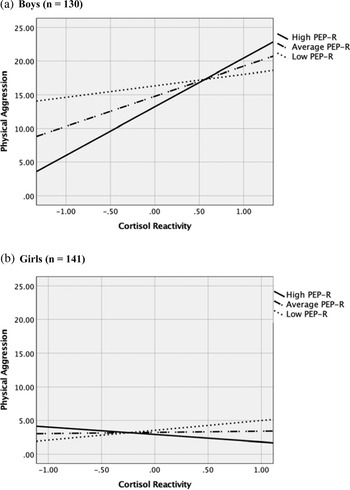
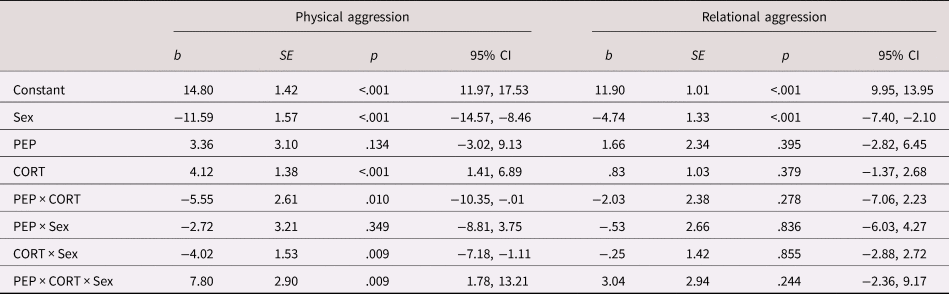
The overall model predicting physical aggression from the main and interactive effects of PEP reactivity, cortisol reactivity, child sex was significant, F(7, 263) = 12.47, p < .001, R2 = .25. As shown in Table 2, the interaction between PEP reactivity, cortisol reactivity, and child sex was statistically significant. The two-way interaction between cortisol reactivity and PEP reactivity was significant for males, b = −5.55, SE = 2.60, p = .024, but the interaction was not significant for females, b = 2.25, SE = 1.27, p = .08. Simple slopes reflecting the association between cortisol reactivity and physical aggression were plotted at different values of PEP (+1 SD, mean, −1 SD). As shown in Figure 1a, for males, there was a positive association between cortisol reactivity and peer-nominated physical aggression at high sympathetic reactivity, b = 7.24, SE = 1.72, p = .001. There was no association between cortisol reactivity and peer-nominated aggression at low levels of sympathetic reactivity, b = 1.69, SE = 1.95, p = .38. To complement the reporting of this interaction effect, we computed the regions of significance, which identify the specific values of PEP reactivity at which the slope between cortisol and peer-nominated aggression is significant (Preacher, Curran, & Bauer, Reference Preacher, Curran and Bauer2006). Findings from these additional analyses indicated that cortisol was significantly associated with aggression for approximately 75% of our sample, when children's PEP reactivity was below 0.1961. The majority of these children demonstrated PEP reactivity below 0 (those with greater PEP shortening in response to the challenge). Although the interaction between PEP and cortisol reactivity was not significant in females, the simple slopes were plotted to explore whether the pattern differed from males. As shown in Figure 1b, the pattern appeared to be opposite in females, but the coefficients associated with each simple slope were not significant (ps > .10). This is not uncommon when there is a full cross-over interaction (Baron & Kenny, Reference Baron and Kenny1986).
Associations between cortisol reactivity and peer-nominated physical aggression at low (+1SD), high (-1SD) and average PEP reactivity (PEP-R) in boys (Panel a) and girls (Panel b).

Unstandardized estimates in multiple regression models (based on 5,000 bootstrap samples) predicting peer-nominated physical and relational aggression, respectively

Note: Sex = Female coded 1, Male 0; PEP = pre-ejection period reactivity; CORT = cortisol reactivity.
Relational aggression
The overall model predicting relational aggression from the main and interactive effects of PEP reactivity, cortisol reactivity, child sex was significant, F (7, 263) = 2.375, p = .023, R2 = .06; however, as shown in Table 2, there was no evidence of an interaction between sex, cortisol reactivity, and/or PEP reactivity, and no significant main effects of cortisol or PEP reactivity on relational aggression.Footnote 1, Footnote 2 Females had significantly lower ratings of relational aggression than males.
Supplemental examination of respiratory sinus arrythmia
Given the role of the PNS in regulating both the stress response and behavior, and the likely interest of some readers in the role of PNS in the context of our study questions, further analyses were conducted to test three-way interactions between respiratory sinus arrythmia (RSA) reactivity, an indicator of PNS response, cortisol, and child sex in the prediction of physical and relational aggression. Of the 271 children, 47.6% (47.7% of males, 47.5% of females) showed RSA withdrawal. The overall model predicting physical aggression from RSA reactivity, cortisol reactivity, and child sex was significant, F(7, 263) = 11.69, p < .001, R2 = .24. However, the three-way interaction term (RSA*CORT*sex) was not significant, b = 5.12, SE = 3.035, p = .073. Given that statistical significance was marginal and to parallel our analysis above, simple slopes were estimated and tested for the interaction between RSA and cortisol, within gender, predicting physical aggression. The two-way interactions for males and females were nonsignificant and showed different patterns: Males: b = −3.28, SE = 2.68, p = .198; Females: b = 1.84, SE = 1.19, p = .12. Finally, the overall model predicting relational aggression from RSA reactivity, cortisol reactivity, and child sex was marginally significant, F(7, 263) = 2.08, p = .05, R2 = .05, and the three-way interaction term (RSA*CORT*sex) was not significant, b = −.218, SE = 2.513, p = .92.Footnote 3 As these analyses were not the primary interest in the current paper, they are not discussed further.
Discussion
Aggressive behaviors early in life portend multiple negative outcomes at later developmental stages owing to the way in which early aggression can alter developmental trajectories across multiple life domains – academic, interpersonal, and intrapersonal. Despite decades of research on the neurobiological underpinnings of aggressive behaviors, relatively little is known about what patterns of multisystem stress reactivity underlie different forms of peer-directed aggression in early childhood. We employed measures of sympathetic and neuroendocrine responses to a multimodal, multidomain challenge paradigm and peer assessments of physical and relational forms of aggressive behavior in the school environment. Analyses tested the hypothesis that an interaction between HPA and SNS activity would predict aggression and explored whether the pattern of this interaction differed by child sex. Findings revealed sex-specific patterns of HPA and SNS reactivity to a developmentally appropriate, mildly challenging stress paradigm were associated with peer-nominated physically aggressive behaviors, but no associations were found between stress reactivity and peer-nominated relational aggression.
The sex-specific rates of the different forms of aggression found in the current study were consistent with previous research that used multimethod assessments of physical and relational aggression (Mcevoy et al., Reference Mcevoy, Estrem, Rodriguez and Olson2003). Namely, peer ratings of both aggression types were higher in boys compared to girls, but boys were rated as more likely to engage in physical aggression than relational aggression, and girls were rated as more likely to engage in relational aggression than physical aggression. This finding differs, however, from studies using teacher ratings of aggression that report higher levels of relational aggression in girls compared to boys (e.g., Crick et al., Reference Crick, Casas and Mosher1997). The discrepancy between the current findings and previous research may reflect different insights and experiences by the 5-year old children due to variations in contexts in which different types of aggression are enacted and noted (e.g., in activities outside of adult supervision). Alternatively, the discrepancy might reflect how relational aggression was assessed. The present investigation measured relational aggression by soliciting peer nominations of social exclusion behavior, specifically, and the nomination process is likely to identify the most aggressive peers. In contrast, observational or teacher-report measures of relational aggression typically capture a range of behaviors including ignoring or overt social rejection (Crick et al., Reference Crick, Casas and Mosher1997, Reference Crick, Casas and Ku1999).
Importantly, peer-nominated physical aggression was predicted not only by sex but by an interaction between sex, HPA activity, and SNS activity, the implication being that not only do patterns of aggression differ but the neurobiological signature is particular to child sex. Physically aggressive behaviors appeared to be lowest among boys who evidenced low cortisol reactivity coupled with high sympathetic reactivity to a challenging task and highest when high cortisol reactivity was coupled with high sympathetic reactivity. This pattern suggests that an asymmetrical pattern of HPA and SNS activity, in the context of developmentally typical mild stress, was protective, whereas a symmetrical pattern might confer greater risk. The association between symmetrical activation and aggression observed in male children is consistent with other studies that have found greater levels of externalizing problems (Nederhof et al., Reference Nederhof, Marceau, Shirtcliff, Hastings and Oldehinkel2015), aggression (Gordis et al., Reference Gordis, Granger, Susman and Trickett2006), and perceived stress (Rotenberg & Mcgrath, Reference Rotenberg and Mcgrath2016) in children and adolescents who displayed HPA/ANS symmetrical activation or deactivation. The interaction between HPA and SNS reactivity did not reach statistical significance in girls. This may be due to the lower rates of aggression in girls compared to boys; however, it seems worthwhile to note that when the associations between PEP, cortisol reactivity, and physical aggression were plotted for girls, the pattern was in the opposite direction compared to boys. Alternatively, and perhaps more likely given the nonsignificant results, it may be that the symmetry or asymmetry of the neuroendocrine and sympathetic stress systems does not play a significant role in the manifestation of peer-directed physical aggression in girls.
The findings presented here must be considered in light of the study's limitations. First, peer-directed aggression was assessed using two items capturing physical and relational aggression, with peer nominations taking place early in the school year. Although in line with previous studies utilizing peer ratings or peer nominations, employing repeated assessments of peer-nominations may offer a more robust assessment of peer relationships that may shift over the course of the school year. In addition, prior studies document relational aggression during early childhood as an important and clearly measurable construct (Ostrov & Crick, Reference Ostrov and Crick2005) we acknowledge that its social complexities may pose challenges to its assessment via peer nomination (or parent/teacher report). Observational approaches may provide important complementary data, particularly for forms of aggression that can be subject to gender-stereotyping (Ostrov & Keating, Reference Ostrov and Keating2004).
Second, physiological activity was measured during a multimethod paradigm on a day separate from the peer-nominations of physical and relational aggression. Assessing physiological reactivity during the normal school day prior to and during aggressive acts might provide a more relevant measure of the biological underpinnings of aggressive behavior. Third, assessment of cortisol reactivity in the current study relied on two saliva samples: one at the beginning and one following the protocol. As such, it can be difficult to ascertain whether a true resting sample was collected. Fourth, the challenge tasks used to elicit stress reactivity did not activate all aspects of the physiological stress response in all children. Although the majority of children (almost ¾ of the sample) did show a response in one or both stress systems, approximately 38% of the sample exhibited an HPA response. Although this proportion may seem low, a review of cortisol reactivity studies by age group found that only 9% of a variety of stressor paradigms administered to young children (2–5 years old) elicited a mean increase cortisol (Gunnar et al., Reference Gunnar, Talge and Herrera2009), thus this is a challenge for the field, more broadly.
Furthermore, the hypotheses proposed here focused on whether interactions between the SNS and HPA axis would shed light on children's tendency to engage in physical and relational aggression with peers during their first formal year of schooling, without considering PNS activity. The decision to focus on these indicators was heavily influenced by Bauer et al. (Reference Bauer, Quas and Boyce2002), in which it was specifically posited that interactions between SNS and HPA axis are likely to be particularly meaningful. Moreover, Del Giudice et al. (Reference Del Giudice, Ellis and Shirtcliff2011) have argued that PNS activity in developmentally typical contexts is considered to be somewhat of a “nonspecific response” (i.e., activated in response to a variety of environmental stimuli), whereas HPA axis activity is “information rich” and SNS activity conveys information that contributes to children's perception of danger in the environment, the latter two of which are both relevant to peer-nominated aggression. Of note, supplemental analyses paralleling our study's primary analysis but using a PNS indicator (respiratory sinus arrythmia) in place of SNS did not find evidence of a statistically significant interactive effect of PNS, cortisol, and sex on peer-nominated aggression. Robust findings from tests of four-way interactions are scarce and difficult to interpret. Instead, an ideal test of the role played by three-system stress functioning (PNS, SNS, and HPA) in the expression of peer-directed physical and relational aggression might apply advanced latent profile analytic techniques (e.g., Quas et al., Reference Quas, Yim, Oberlander, Nordstokke, Essex, Armstrong and Boyce2014), which requires a much larger sample of boys and girls than the one utilized in the current study. Finally, the current study did not include assessments of temperament, social adversity, or quality of family and teacher relationships, which are known to interact in particular ways to shape the development of the stress response system and behavior (Hostinar & Gunnar, Reference Hostinar and Gunnar2013; Roubinov, Hagan, Boyce, Essex, & Bush, Reference Roubinov, Hagan, Boyce, Essex and Bush2017). Illustratively, the association between HPA–SNS symmetry and behavior problems may depend upon exposure to family adversity (Koss et al., Reference Koss, George, Cummings, Davies, El-Sheikh and Cicchetti2014). Future research should consider how temperament and contextual variables such as experiences of family conflict or socioeconomic stress might influence patterns of multistress system reactivity.
The rapid pace of development during early childhood can render it difficult to reliably assess early psychopathology, and children often move dynamically in and out of diagnostic classifications of mental disorders (Boyce et al., Reference Boyce, Chesney, Alkon, Tschann, Adams, Chesterman and Wara1995). For this reason, elucidating the intermediate, behavioral risk factors (i.e., aggression) and accompanying indicators of biological dysregulation (and resilience) offers utility for predicting the onset and intervening in the development of later serious behavior problems (Cicchetti & Gunnar, Reference Cicchetti and Gunnar2008). As elegantly and memorably illustrated in the work of Megan Gunnar and her students, physiological stress systems are socially regulated during the early years of life (Gunnar, Reference Gunnar2017; Hostinar & Gunnar, Reference Hostinar and Gunnar2013; Loman & Gunnar, Reference Loman and Gunnar2010). Greater childhood peer aggression, or the lack of protective friendships, may in particular compromise the use of healthy and effective social strategies that underlie the development of biological regulatory abilities (Gunnar, Reference Gunnar2017). A burgeoning literature now highlights the importance of expanding beyond examinations of single physiological systems to understand dynamic relations between multiple stress response systems and behavior in early childhood, and theory points to SNS and HPA as crucial for this understanding.
Findings from the current study suggest that particular patterns of HPA axis and SNS reactivity were associated with peer nominations of physically aggressive behavior in kindergarten. Underscoring the need for nuanced attention to potential sex differences, we observed different neurobiological signatures for physical aggression between boys and girls: greater cortisol was only associated with aggression among boys when coupled with high sympathetic reactivity (reflective of physiological symmetry), and the lowest levels of aggression were observed among those with high sympathetic reactivity and low cortisol reactivity (reflective of physiological asymmetry). Among girls, sympathetic reactivity and HPA axis reactivity were unrelated to both peer-nominations of physical and relational aggression. Understanding the complex associations between multisystem physiology, child sex, and peer-directed aggression in early childhood may offer insight into individual differences underlying the emergence of behavioral dysregulation in early peer contexts.
Funding Statement
This work was supported by the National Institute of Mental Health under Grant R01 MH62320; the MacArthur Foundation Research Network on Psychopathology and Development; and the Canadian Institute for Advanced Research.
Conflicts of Interest
None