Implications
This paper compared flocks with normal and high dead-on-arrival (DOA) numbers. The results showed that there are differences in the postmortem findings in DOA broilers from flocks with normal and high DOA%. In addition, the following variables had a significantly higher frequency in the high-mortality flocks: flock size, 1st week mortality, foot pad lesion (FPL) score, carcass rejection numbers and journey duration. It is important to reduce high mortality during transportation for both animal welfare and economic reasons. Aspects to consider for future improvements are health and environmental factors during the production period and journey duration.
Introduction
The broiler meat industry is one of the largest livestock sectors worldwide; the annual production is estimated to comprise ~60 billion slaughtered broiler chickens (The Poultry Site, 2014). The majority of these broilers are transported from farm to the abattoir before slaughter. Mortality during the journey is a recognized problem, both due to animal welfare issues, but also due to the considerable economic losses resulting from the large number of animals involved (Ritz et al., Reference Ritz, Webster and Czarick2005). Although the term welfare is relevant only when an animal is alive, mortality during the journey is likely preceded by a period of poor welfare and the percentage of broilers DOA can possibly be used as a quick indication of pre-slaughter welfare (Jacobs et al., Reference Jacobs, Delezie, Duchateau, Goethals and Tuyttens2016).
Reports of broiler mortality during transportation vary greatly between countries and studies; from 0.12% to 0.46% (Haslam et al., Reference Haslam, Knowles, Brown, Wilkins, Kestin, Warriss and Nicol2008 , Lund et al., Reference Lund, Kyvsgaard, Christensen and Bisgaard2013; Jacobs et al., Reference Jacobs, Delezie, Duchateau, Goethals and Tuyttens2016). A wide range of risk factors associated with DOA have been identified. These include catching-methods, the duration and length of the journey, lairage duration, thermal stress and density of birds in transport containers (Warriss et al., Reference Warriss, Pagazaurtundua and Brown2005; Vecerek et al., Reference Vecerek, Grbalova, Voslarova, Janackova and Malena2006; Mitchell and Kettlewell, Reference Mitchell and Kettlewell2009; Watts et al., Reference Watts, Graff, Strawford, Crowe, Burlinguette, Classen and Shand2011). The welfare implication of these stressors and their combinations may range from mild discomfort to death (Mitchell and Kettlewell, Reference Mitchell and Kettlewell2009). Dead-on-arrival may also be linked to factors that are not directly related to the transportation process per se; for example farm characteristics, such as flock size, mortality rates during the production period and BW (Nijdam et al., Reference Nijdam, Arens, Lambooij, Decuypere and Stegeman2004; Drain et al., Reference Drain, Whiting, Rasali and D’Angiolo2007; Whiting et al., Reference Whiting, Drain and Rasali2007; Chauvin et al., Reference Chauvin, Hillion, Balaine, Michel, Peraste, Petetin, Lupo and Le Bouquin2011; Jacobs et al., Reference Jacobs, Delezie, Duchateau, Goethals and Tuyttens2016). The most common postmortem findings in DOA broilers are signs of cardiac arrest and circulatory disorder, infections, ascites and traumas like liver ruptures and fractures (Ritz et al., Reference Ritz, Webster and Czarick2005; Nijdam et al., Reference Nijdam, Zailan, van Eck, Decuypere and Stegeman2006; Lund et al., Reference Lund, Kyvsgaard, Christensen and Bisgaard2013).
The DOA% in Norway is continuously monitored by the industry and by the official veterinarians at the abattoirs. The DOA% have shown a decreasing trend over the last 5 years and in 2015, the mean DOA% was 0.10 for all flocks transported to Norwegian abattoirs (Animalia, 2015). In the same year, 4.9% of the broiler flocks transported in Norway were defined as high mortality (i.e. DOA above 0.30%, range 0.32 to 5.60%) by the Norwegian poultry industry. Few scientific studies have compared broiler flocks with normal and high mortality during transportation. The overall aim of this study was to gain more knowledge of factors contributing to high mortality during transportation by comparing postmortem findings in DOA broilers from normal- and high-mortality flocks (DOA numbers above 0.30%) and to compare production data and journey characteristics from the associated flocks. This study may aid in designing future epidemiological studies on risk factors and causal relationships associated with high- and normal-mortality transportations.
Material and methods
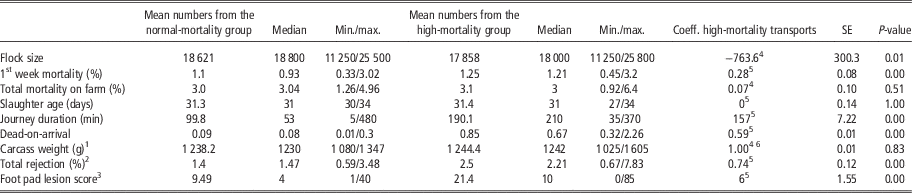
A retrospective cohort study was established to study normal- and high-mortality broiler transportations by comparing postmortem findings in DOA broilers from these transportations, along with farm characteristics, production data and journey data from the associated flocks. The statistical unit for calculation of DOA% was the mortality for all vehicles from the same flock and the flocks were assigned to two groups according to the mortality during transit. These two groups were treated as exposed (high mortality) and unexposed (normal mortality), as the two exposure groups displayed clearly distinct journey characteristics. A flock was comprised of broilers from the same barn, of the same age and hybrid and slaughtered at the same day. All flocks were of the hybrid Ross 308, mixed gender and fed ad libitum. Descriptive statistics for the two groups are listed in Table 1.
Descriptive statistics for the normal- (n=32 flocks) and high-mortality (n=29 flocks) group

1 Weight, without head, feet, feathers and internal organs.
2 Carcass rejection by the official veterinarians at the abattoirs.
3 Scored on 100 feet in each flock, score from 0 to 2.
4 Linear regression.
5 Quantile (median) regression.
6 Log transformed variable; e (0.002)=1.00.
For flocks with normal DOA%, the current study sampled postmortem findings, production data and journey characteristics from a database collected in a previous study (Kittelsen et al., Reference Kittelsen, Granquist, Kolbjørnsen, Nafstad and Moe2015). These data were collected from February 2012 to February 2013, according to a predesigned scheme (236 broilers from 32 different flocks, median DOA% 0.08, range 0.01 to 0.30%). High mortality was defined by the Norwegian broiler industry as flocks with mean DOA% above 0.30 (Atle Løvland, personal communication). For the high-mortality group, data were collected from January 2013 to September 2014. Abattoir personnel collected DOA broilers when the DOA% exceeded 0.30. Accordingly, a total of 299 broilers from 29 high-mortality flocks were sampled (median DOA% 0.67, range 0.32 to 2.26%), representing 9.5% (n=304) of all high-mortality transportations in Norway during that specific period.
Catching were performed manually in 57 flocks and four flocks were caught by machine (‘Chicken Cat’; JTT Conveying A/S Bredsten, Denmark). All four machine caught flocks had high transportation mortality. All transport containers had a firm metal frame containing eight drawers (the modular Marel Poultry GP Live Bird Handling System) with room for ~40 broilers at the median Norwegian broiler slaughter age of 31 days for both groups; that is one container held ~320 broilers.
From all 61 journeys (32 normal and 29 high mortality) a maximum of 10 DOA broilers were collected at random by the slaughterhouse personnel and sent fresh by express mail service to the Norwegian Veterinary Institute, Pathology Section, Oslo for postmortem examination. For some of the normal-mortality flocks, a number of 10 DOA broilers were not reached, due to low DOA% for the flock.
Source of data
-
(1) Postmortem examinations: a total of 236 DOA broilers from normal-mortality flocks and 299 DOA broilers from high-mortality flocks were subjected to gross postmortem examination by five trained veterinary pathologists according to a standard procedure at the Norwegian Veterinary Institute, Pathology Section, Oslo. Inter-observer reliability was not tested between the pathologists. All gross postmortem findings and diagnosis were considered and reported. Virology, bacteriology and histology were not performed. Broilers were allocated to pathological categories according to the postmortem findings. The diagnoses with the criteria were: lung congestion (congested and edematous lungs, with or without congestion of the liver and spleen, with or without mottled red and white pectoral muscles), trauma (fractures, liver rupture), ascites (accumulation of serous fluid in the abdominal cavity), tibial dyschondroplasia (TD) (a large mass of cartilage originating from the growth plate, primarily in the proximal tibiotarsus) endocarditis (irregular vegetation on the heart valves/walls of the cardiac chambers) and hepatitis (enlarged liver with gray and yellow foci). All pathological findings were registered and therefore, some of the birds received more than one diagnosis.
-
(2) Production data: farm and slaughterhouse data were collected for the respective 61 flocks. These included flock size, 1st week mortality, total mortality on farm, FPL, daily weight gain and slaughter weight. Production and slaughterhouse data were obtained from the abattoirs which collected it from the producers. Foot pad lesion were scored on 100 feet from each flock. The feet were scored from 0 to 2; 0=no lesions, 1 =small, superficial lesions, 2=deep lesions, then the scores were added to a total FPL score for the flock in the range of 0 to 200.
-
(3) Journey data: for all the 61 flocks in the study, information regarding the journey duration and distance were collected from the abattoirs. One flock consisted of two to four separate transported loads, three loads being the most common. All loads from the same flock were transported on the same day. All journeys took place during night and early mornings to avoid rising temperatures and traffic. Journey duration was registered per load and a median duration was calculated for the entire flock.
Statistical analysis of results
All data were continuously collected in a database (Microsoft Excel 2010) and reviewed for errors. The database was transferred to the statistical package Stata version 14 SE (StataCorp LP, College Station, TX, USA). Dead-on-arrival was categorized as either normal or high. Summary statistics included the calculation of, means, median, ranges and 95% confidence intervals (CI) for the diagnoses obtained from pathological examinations. All continuous variables were checked for missing data, outliers, normality, linearity and co-linearity by graphical methods (quantile–quantile plot, scatter diagrams, histogram and residual plots) as well as correlation analyses. Normally distributed variables were directly analyzed by simple linear regression (parametric) or after logarithmic transformation, with DOA% (mortality group) being the independent predictor variable (<0.3% or >0.3%). Mean and median values were displayed as percentages and the ranges were displayed as either percentages or natural numbers. As the two data sets technically represent two different populations (normal and high DOA%), sampled at different time periods, they were considered strictly as statistically unrelated. The design of the study was equal for both samples, but adjustment for time of sampling was not possible, as time was considered to confound the classification of flocks with normal and high transportation mortality. The displayed results of the statistical analyses are mainly descriptive. However, 95% confidence limits and P-values are generally provided in tables to aid the comparison of flock characteristics and diagnoses between normal- and high-mortality flocks. The distribution DOA% was positively skewed with a high density around 0 for normal mortality, whereas the distribution of DOA% in high-mortality flocks were more widely distributed, with the high density of observations in the interval of 0.5% to 1.0%. The median DOA was placed to the left of the mean for both mortality groups, thus the median was regarded as a better measure of the central tendency for such distributions. This approach also applied to 1st week mortality, slaughter age, journey duration, total rejection and FPL scores, for which non-parametric quantile regression (median regression) was used to identify differences in descriptive characteristics between the normal- and high-mortality groups. The statistical tests and transformation of variables are indicated as footnote to Table 1. Binary variables (diagnoses) were analyzed by univariable logistic regression, mortality groups being independent and estimates are displayed as proportions and 95% CI (Table 2). P-values<0.05 were considered statistically significant. A fraction of diagnoses, contributing to the DOA% in each group was calculated by multiplying the prevalence of diagnoses with the DOA prevalence for each mortality group separately (Table 3). The excess of incidents that can be attributed to the exposure (high or normal mortality) in the high-mortality flocks and in the population, the risk of disease in either mortality group and the total risk were calculated for each diagnosis. The fractions are given as attributable or preventive according to which diagnosis is predominant in either high- or normal-mortality flocks.
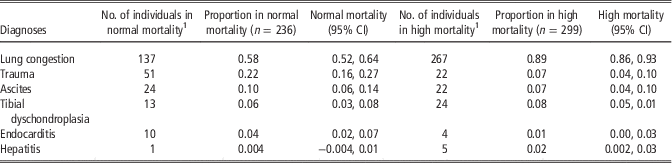
Proportion of birds with the diagnoses in the normal- (n=236 broilers) and high-mortality (n=299 broilers) flocks

CI, confidence intervals.
1 Broilers may have been given more than one diagnosis
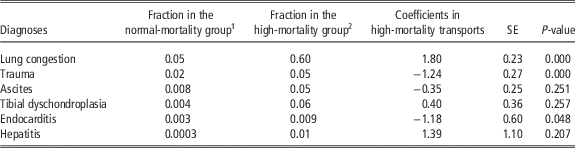
The fraction of diagnoses contributing to mortality in the study populations

DOA, dead-on-arrival.
1 DOA% 0.08 (median).
2 DOA% 0.67 (median).
Results
A total of 535 DOA broilers from 61 flocks were included in this study. The normal-mortality group was represented by 236 DOA broilers from 32 flocks, whereas the high-mortality group represented by 299 DOA broilers from 29 flocks. The DOA% ranged from 0.01 to 2.26 among the 61 journeys. Descriptive statistics of the transport mortality groups are provided as mean, median, range and 95% CI in Table 1.
Postmortem findings
Descriptive statistics on the frequency of diagnoses in the flocks with normal and high mortality are presented with 95% CI in Table 2. Fractions and regression outputs for postmortem findings are given in Table 3. Significant differences in the occurrence of diagnoses between the normal- and high-mortality flocks are indicated by P<0.05. Lung congestion was the most prevalent diagnosis in the sample. There was a significant difference in the prevalence of lung congestion between the two groups (P<0.01). The risk of lung congestion was 0.89 and 0.58 in the flocks with high and normal mortality, respectively. The total risk of lung congestion was 0.76. The attributable risk (AR) in the high-mortality group was 0.35 and AR in the population was 0.35. Trauma was significantly (P<0.01) more common in normal-mortality flocks than in high-mortality flocks. The risk of trauma was 0.07 in the high-mortality group and 0.22 in the normal-mortality group. The total risk was 0.14. The preventable fraction (PF) of trauma in the high-mortality group was 0.66 and in the population, 0.36. There was no significant difference in the prevalence of ascites between normal and high flocks (P=0.25). The risk of ascites was 0.07 in the high-mortality group and 0.10 in the normal-mortality group. The total risk of ascites was 0.08. The PF was 0.28 in the high-mortality group and 0.15 in the population. Tibial dyschondroplasia was relatively uncommon in both mortality groups, however more frequently observed in the high-mortality DOA broilers. The difference between the two groups was not significant (P=0.26). The risk of TD was 0.08 and 0.06 in the high- and normal-mortality group, respectively. The total risk of TD was 0.07, the AF was 0.34 in the high-mortality broilers and 0.22 in the population. Endocarditis was more common in the normal-mortality DOA broilers than in the high-mortality group. The prevalence was low in both groups and the difference in frequency was barely significant (P=0.048). The risk of endocarditis was 0.01 and 0.04 in the high- and normal-mortality DOA broilers, respectively. The PF was 0.68 for the high-mortality group and 0.38 for the population. Hepatitis was rarely found in both groups and the difference in frequency between the two groups was not significant (P=0.21). The risk of hepatitis was 0.02 and 0.004 in the high- and normal-mortality flocks, respectively. The AF of hepatitis was 0.75 in the high-mortality group and 0.62 in the population. The causal relationship between DOA and recorded diagnoses were not established due to diagnoses being determined when the broilers were already dead and transported. Hence, the diseases or traumas may have occurred before or after the transportation commenced.
Several diagnoses were given to 62 birds (11.6%). In the normal-mortality group, 22 individuals (9.3%) received either two (n=20) or three (n=2) diagnoses. In this group, the multiple diagnoses originated from nine flocks out of which two flocks contributed with two and five cases respectively (two and four cases were circulatory disorders and trauma respectively). The combinations of dual diagnoses from the normal-mortality flocks were; lung congestion and trauma (n=6, 31.6%), lung congestion and TD (n=6, 31.6%), TD and ascites (n=2, 10.5%), TD and trauma (n=2, 10.5%), lung congestion and ascites (n=2, 10.5%) and lung congestion and endocarditis (n=2, 10.5%). The combination of diagnoses in the individuals with three diagnoses were; TD, lung congestion and trauma (n=1), and ascites, lung congestion and trauma (n=1). In the high-mortality group, 40 individuals (13.4%) received multiple diagnoses out of which eight broilers received a combination of three diagnoses (20.0%). The multiple diagnoses originated from 11 flocks which contributed with one to nine cases of multiple diagnoses each. The combinations of dual diagnoses were; lung congestion and TD (n=16, 40.0%), lung congestion and ascites (n=5, 12.5%), TD and trauma (n=3, 7.5%), lung congestion and trauma (n=3, 7.5%), ascites and trauma (n=3, 7.5%), TD and ascites (n=1; 2.5%), lung congestion and endocarditis (n=1, 2.5%) and lung congestion and hepatitis (n=1, 2.5%). Of the triple diagnoses, three individuals were diagnosed with ascites, lung congestion and hepatitis, whereas one broiler was diagnosed with lung congestion, endocarditis and hepatitis.
The difference in the DOA% between normal- and high-mortality transportations was substantial (P<0.01) with a median difference of 0.59 and a mean difference of 0.76. Although being the selection criterion for grouping, the difference in DOA between the two groups made it necessary to adjust the frequencies of diagnoses to the magnitude of DOA in each group for relative comparison. This fraction is calculated from the median values (0.08 and 0.67, respectively) (Table 3).
Production and journey data
The flock size was significantly larger in the normal-mortality flocks (P<0.01). The 1st week mortality was higher in flocks classified as high mortality during transportation v. normal-mortality flocks (P<0.01). There was however, no significant difference in total mortality (P=0.51) and slaughter age (P=1.00) between the two groups. The journey duration and the journey distance showed nearly perfect linear correlation (Pearson’s correlation coefficient=0.97), therefore only duration (min) will be discussed. The average journey duration was ~1.5 h longer in the high-mortality group than in the normal-mortality group, a significant difference (P<0.001). The rejection number at the slaughterhouse was significantly higher in high-mortality flocks (P<0.001) and high-mortality flocks had a significantly higher FPL score than normal-mortality flocks (P<0.01).
Discussion
This study aimed at investigating how broiler flocks with high mortality during transportation differ from flocks with normal mortality with regards to postmortem findings in DOA broilers, production data and journey characteristics. In brief, significant differences in several postmortem findings, production data and journey characteristics between the two groups were identified.
The most common necropsy finding among all examined broilers was lung congestion, but the diagnosis was significantly more frequent in DOA broilers from high-mortality flocks than from normal-mortality flocks. Lung congestion is characterized by massive congestion of the veins and arterioles in the lungs (Aengwanich and Simaraks, Reference Aengwanich and Simaraks2004), an indication of a circulatory collapse and circulatory disturbance. Lung congestion, circulation disorders and other signs of acute heart failure have frequently been observed in previous studies of DOA broilers (Nijdam et al., Reference Nijdam, Zailan, van Eck, Decuypere and Stegeman2006; Petracci et al., Reference Petracci, Bianchi, Cavani, Gaspari and Lavazza2006; Lund et al., Reference Lund, Kyvsgaard, Christensen and Bisgaard2013). Sudden Death Syndrome (SDS) can give postmortem findings equivalent to the congested lungs, observed in both normal- and high-mortality DOA broilers, with congested lungs and mottled red and white pectoral muscles (Siddiqui et al., Reference Siddiqui, Patil, Khan, Khan and MAFSU2009). A known trigger for SDS is stress; modern broilers are highly susceptible to stress-induced cardiac arrhythmia and mortality may occur after sudden stress (Jones and Hughes, Reference Jones and Hughes1981; Olkowski et al., Reference Olkowski, Wojnarowicz, Nain, Ling, Alcorn and Laarveld2008). Previous studies have shown that the pre-slaughter chain, including the transportation, can cause severe stress that ranges from discomfort to death for the birds (Delezie et al., Reference Delezie, Lips, Lips and Decuypere2006; Schwartzkopf-Genswein et al., Reference Schwartzkopf-Genswein, Faucitano, Dadgar, Shand, González and Crowe2012). Therefore, it may be possible that the stress generated by catching, crating and transportation resulted in a cardiac arrest and SDS/DOA. As significantly more birds with lung congestions were found in the high-mortality group, it may be suggested that factors associated with these transportations caused more stress resulting in more SDS and more mortality as compared with the normal-mortality transportations. Such stress factors may for instance be the individual catcher’s handling of the birds, thermal stress during transportation and the duration of the journey. The potential effect of stress in regards to DOA% needs further investigation.
The relationship between postmortem findings in DOA broilers and thermal stress has not been determined in this study, due to lack of temperature records for the vehicles in transit. This was unfortunate, as it has been claimed that elevations in DOA values above the mean is almost solely due to thermal stress (Mitchell and Kettlewell, Reference Mitchell and Kettlewell2009). Heat stress on the vehicle has long been recognized as a major risk factor for DOA (Warriss et al., Reference Warriss, Pagazaurtundua and Brown2005; Whiting et al., Reference Whiting, Drain and Rasali2007; Mitchell and Kettlewell, Reference Mitchell and Kettlewell2009) and high temperatures may lead to heart failure (Elrom, Reference Elrom2001). It could therefore be hypothesized that thermal stress is an important factor contributing to the elevated mortality observed in the high-mortality flocks. In addition, it has been presumed that thermal stress on long distance journeys may have a great impact on DOA (Ritz et al., Reference Ritz, Webster and Czarick2005), an important aspect, considering that high-mortality flocks had a significantly longer journey duration. This is in accordance with previous studies that found a positive relationship between duration/distance and DOA% (Warriss et al., Reference Warriss, Bevis, Brown and Edwards1992; Nijdam et al., Reference Nijdam, Arens, Lambooij, Decuypere and Stegeman2004; Vecerek et al., Reference Vecerek, Grbalova, Voslarova, Janackova and Malena2006). Presumably, exposure to various physical stressors during journey, including thermal conditions, are magnified by the time spent in transit and thus, more broilers succumb due to SDS, congestive heart failure or generalized circulatory collapse, leading to the postmortem findings of lung congestion, more common in the group with long journey duration. However, the duration of the journey varied substantially within the two groups. Further studies are therefore needed to investigate DOA broilers with the most common postmortem finding, lung congestion, in relationship to transit temperature and journey duration.
Traumas, and especially fractures, represent conditions of compromised welfare as they usually are associated with pain (Nasr et al., Reference Nasr, Nicol and Murrell2012). The occurrence of injuries in DOA broilers from flocks with normal mortality (22.0%) is in accordance with the traumas reported in other studies, ranging from 22% to 35% (Elrom, Reference Elrom2001; Nijdam et al., Reference Nijdam, Zailan, van Eck, Decuypere and Stegeman2006; Lund et al., Reference Lund, Kyvsgaard, Christensen and Bisgaard2013). The high-mortality broiler group had a lower percentage of traumas (7.4%). However, as the median DOA% was 8.37 times higher in the high-mortality group, the fraction and contribution of trauma to mortality is higher in the high-mortality group compared with the normal-mortality group, even though the percentage of trauma was three times higher in the normal transportations than in the high-mortality transportations. A well-known cause of trauma is the catching process (Knierim and Gocke, Reference Knierim and Gocke2003), that can cause stress for the birds (Elrom, Reference Elrom2000; Delezie et al., Reference Delezie, Lips, Lips and Decuypere2006). Data on catching method were collected, however only four flocks were caught by machine; they were all high mortality and from the same abattoir. The low number of flocks caught by machine therefore makes catching method not applicable as a predictor for high mortality in this study. Catching method and differences in catching teams in regard to high-mortality transportations should be explored in more detail in further studies. In addition, the reason for a higher DOA% related to trauma in the normal-mortality group needs further investigation in the future. It has been reported that birds with heavy TD are predisposed to fractures during catching and transportation (Dinev, Reference Dinev2012). However, none of the broilers in our study exhibited TD along with fractures or hemorrhages. In addition, there was no significant difference in TD-prevalence between normal- and high-mortality flocks in this study.
Only two conditions with gross postmortem signs of infection were reported in this study: endocarditis and hepatitis. Endocarditis in broilers can be caused by the attachment of bacteria to the heart valves (Chadfield et al., Reference Chadfield, Bojesen, Christensen, Juul-Hansen, Nielsen and Bisgaard2005). Endocarditis was significantly more common among normal-mortality DOA broilers than in high-mortality DOA broilers. However, the total number of DOA broilers with endocarditis in the source population may be higher in the high-mortality group due to the higher DOA% in this group. The number of endocarditis diagnoses was overall low (a total of 14 cases), therefore, the result should be evaluated with caution. Hepatitis was reported in six DOA broilers. Totally, only 20 reported cases (3.7%) of infectious postmortem findings indicate that infections are not the major contributor to DOA% in this study. This is in contrast to the findings of Nijdam et al., (Reference Nijdam, Zailan, van Eck, Decuypere and Stegeman2006), who found infectious diseases in 64.9% of the investigated DOA broilers. However, only gross pathological examinations were performed in this study and microbial infectious factors of DOA could perhaps have been revealed, if microbiological culturing was attempted. Generally, the proportion of cases (diagnoses) in the entire study population that can be attributed to the exposure (high mortality), reflected the observed frequencies between the two groups. The attributable fraction among the exposed (high mortality), reflected the univariable regression analyses. The factors that are directly linked to different diagnoses in transport mortality settings, are not clearly defined. Further research is required to point out what factors should be eliminated to prevent the respective diagnoses and their relative importance in mortality during transportation of broilers.
Mortality during the 1st production week on farm was significantly higher in the flocks with high DOA%. However, there was no difference in the total mortality rate during the production period on farm. This contrasts with a previous study (Chauvin et al., Reference Chauvin, Hillion, Balaine, Michel, Peraste, Petetin, Lupo and Le Bouquin2011), were an increasing on-farm mortality has been associated with an increasing DOA%. Mortality during the 1st week of production is a measure of chick quality and health (Chou et al., Reference Chou, Jiang and Hung2004), and even though the total mortality rate during production not affected DOA% it can be hypothesized that a poor chick quality may persist thorough out the production period and give increased mortality in transit.
Foot pad lesion is a common and important welfare issue in broiler flocks (Haslam et al., Reference Haslam, Knowles, Brown, Wilkins, Kestin, Warriss and Nicol2007), caused by necrotic dermatitis on the plantar surface of the foot. In this study, the FPL scores were relatively low and heavily right skewed. However, the median FPL score was significantly higher in high-mortality flocks, compared with normal-mortality flocks. As mentioned, litter quality, wet litter in particular, is a major risk factor for developing FPL (De Jong et al., Reference De Jong, Gunnink and van Harn2014). Foot pad lesion and litter quality is affected by, for example management of the microclimate in the broiler house, the ventilation system, stocking density, feed composition, drinkers design and digestive disorders (Bruce et al., Reference Bruce, McIlroy and Goodall1990; Haslam et al., Reference Haslam, Knowles, Brown, Wilkins, Kestin, Warriss and Nicol2007; Allain et al., Reference Allain, Mirabito, Arnould, Colas, Le Bouquin, Lupo and Michel2009). It may be speculated that broilers from farms with poor ventilation system are wet before transport and therefore are less fit for transport and may succumb during the journey. Likewise, it could also be speculated that digestive disorders affect fitness for transport and make the broilers less robust to cope with the catching and transportation process. Further studies are needed to investigate why flocks with high mortality have higher FPL scores than normal-mortality flocks.
There was a significant difference in the total carcass rejection numbers at the abattoirs between high- and normal-mortality flocks in this study. The high-mortality flocks had a median rejection percentage of 2.21% v. 1.47% in the normal-mortality flocks. There are several reasons for carcass rejection, for example disease, fecal contamination, small and emaciated individuals. An association between DOA and carcass rejection numbers have previous been stated by Haslam et al. (Reference Haslam, Knowles, Brown, Wilkins, Kestin, Warriss and Nicol2008), who, for example found increasing numbers of small and emaciated broilers to be associated with increasing DOA%. The higher rejection numbers in the high-mortality group may for instance indicate the importance of the animal’s condition before the journey and that fitness for transport may affect DOA%.
In conclusion, the aim of this study was to gain more knowledge of flocks with high-mortality during transportation by comparing normal- and high-mortality flocks in Norway. An improved understanding and identification of characteristics representative for high-mortality flocks may aid in targeted improvement of animal welfare and increase profits in broiler production. The results indicate that high mortality during transportation may be linked to several steps in the broiler production chain.
Acknowledgment
The authors sincerely thank the farmers and abattoir staff that collected and sent broilers to postmortem examination for them. The authors extend the gratitude to Professor Eystein Skjerve for helpful advises. The authors are also very grateful to the staff at the Norwegian Veterinary Institute who performed the necropsies. The study was financed by the Norwegian Research Council (Project no. 207691), Animalia, Nortura, Norsk Kylling and KLF. Kjøtt- og fjørfebransjens Landsforbund.