INTRODUCTION
The bioethanol industry has developed mainly in North-Central and South America, which account for 0·44 and 0·35 of global production, respectively. In Europe, bioethanol production is growing steadily and is expected to grow faster in the future since legislation promoting the use of renewable energy has already been adopted and should promote biofuel production (Pilgrim Reference Pilgrim, Ingledew, Kelsal, Austin and Kluhspies2009). Amylaceous and sugar crops are the main sources used for producing bioethanol. Maize constitutes the main source (>0·95) for bioethanol in the USA due to the high starch content of the grain. Maize is also one of the most important feedstocks for bioethanol production in Europe. As a consequence, various research programmes aim to maximize ethanol yield by improving relevant grain quality characteristics. In this manner, the production of hybrids with high extractable starch and high total fermentables (HTF) has been achieved. High extractable starch hybrids contain larger quantities of starch available for extraction while HTF hybrids also contain small amounts of glucose, fructose, maltose and sucrose that can be fermented directly (Nichols & Bothast Reference Nichols, Bothast and Vermerris2008).
In Greece, maize is a long- and well-established crop, mainly being grown for feed purposes, occupying c. 230 000 ha. The yields are usually very high, sometimes exceeding 15 t/ha/yr (fresh weight), with a country average of c. 10·2 t/ha/yr (Hellenic Statistical Authority 2010).
Sweet sorghum is being investigated as an alternative feedstock for bioethanol production worldwide. Its high biomass yield potential, coupled with high fermentable sugar content in the stalks, make it an ideal candidate for bioenergy feedstock (Rooney et al. Reference Rooney, Blumenthal, Bean and Mullet2007; Stefaniak et al. Reference Stefaniak, Dahlberg, Bean, Dighe, Wolfrum and Rooney2012). It withstands drought stress effectively due mainly to a massive root system and reduced water loss from the leaves. Furthermore, it has been characterized as an ideal dedicated energy crop due to its lower demand for fertilizers and pesticides that reflect an environmentally sustainable and attractive crop (Rooney et al. Reference Rooney, Blumenthal, Bean and Mullet2007; Saballos Reference Saballos and Vermerris2008; Stefaniak et al. Reference Stefaniak, Dahlberg, Bean, Dighe, Wolfrum and Rooney2012). Sweet sorghum has been tested widely for bioethanol production in areas where sugarcane is already being used for biofuel production in order to overcome constraints attached to sugarcane production, such as drought susceptibility and absence of crop rotation (perennial growth habit). It constitutes an important feedstock for many small bioethanol plants in India where multiple cropping is possible, avoiding the high seasonality problem in other parts of the world (Rooney et al. Reference Rooney, Blumenthal, Bean and Mullet2007).
Sweet sorghum has been studied extensively in Greece at the experimental scale in an effort to assess its adaptability and determine the most appropriate agronomic practices for economically viable production. For the last 6 years, a large number of open pollinated and hybrid varieties were evaluated at the Agricultural University of Athens. The results, in agreement with other relevant studies, point to the suitability of most of these varieties under the agroclimatic conditions in Greece. Several varieties proved very high yielding and at times they exceeded 100 t/ha/yr (authors’ unpublished data). Similar studies in the country have reported yields up to 102 t/ha/yr (Dercas et al. Reference Dercas, Panoutsou, Dalianis, Sooter, Chartier, Beenakers and Grassi1994), while plantations established in countries that traditionally grow sweet sorghum, such as China, the USA and India, reached yields of 100 t/ha, pointing to sorghum's satisfactory adaptation and competitive performance under Greek conditions (Rooney et al. Reference Rooney, Blumenthal, Bean and Mullet2007; Rao et al. Reference Rao, Rao, Seetharama, Umakath, Reddy, Reddy and Gowda2009; Zhao et al. Reference Zhao, Dolat, Steinberger, Wang, Osman and Xie2009).
Sustainability criteria, as set by the 28/2009 EU directive, are of paramount importance for the characterization of biofuels (EC 2009). According to this directive, maize bioethanol should achieve a saving of at least 49% greenhouse gases (GHG) and total emissions should not exceed 20 g CO2e/MJ during the cultivation phase. Respective default values for sweet sorghum were not included in the directive, given that no systematic commercial crop production is practised in Europe to date. As a consequence, research is being focused on sustainability issues, mainly energy balance and GHG emission savings. Within that framework, Vlachos et al. (Reference Vlachos, Mariolis and Skaracis2014) conducted an emission analysis in order to estimate the GHG emitted for the growing of several oilseed crops as well as the GHG savings (%) achieved from the use of the biodiesel produced. A number of different farming practices in several regions were compared in order to determine the areas where the crops studied could lead to a biodiesel production meeting the aforementioned sustainability criteria.
Kim & Dale (Reference Kim and Dale2005) found that the emissions associated with 1 kg of grain were 244 and 204 g CO2e with tillage and no tillage cultivation practices in maize growing, numbers corresponding to 893 and 1547 g CO2e/kg of ethanol production, respectively. In terms of emission savings by substituting maize ethanol for gasoline, a reduction of 32–54% was estimated for the tillage system and 20–41% for the no tillage system. Wang et al. (Reference Wang, Wu and Huo2007) analysed the lifecycle to compare different types of first-generation bioethanol production based on maize starch. Based on the specific procedure followed, emission reductions ranged from 28 to 52%. When the stalks were also exploited for second-generation cellulosic ethanol production, the figure increased to 86%.
Venturi & Venturi (Reference Venturi and Venturi2003) studied energy inputs required for a variety of energy crops including sweet sorghum and estimated energy demands for the latter ranging from 13·8 to 19·1 GJ/ha/yr for low and regular input systems, respectively. In a similar study, Suman et al. (Reference Suman, Singh and Suman2006) have found significantly lower energy demands that ranged from 8·7 to 10·2 GJ/ha/yr for marginal and medium inputs, respectively. Finally, Monti & Venturi (Reference Monti and Venturi2003) estimated energy demanded to produce 1 t of ethanol from sweet sorghum at 21·5 and 23·8 GJ for low and high fertilizer regimes, respectively.
The aims of the present study were to compare maize and sweet sorghum for: (a) GHG emissions during their cultivation phase, (b) theoretical bioethanol yields and (c) GHG emission savings obtained by substituting the bioethanol produced for gasoline.
MATERIALS AND METHODS
Field experimentation
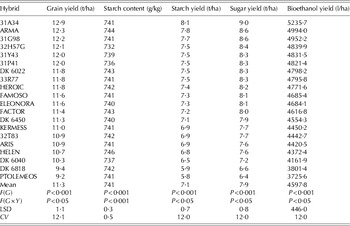
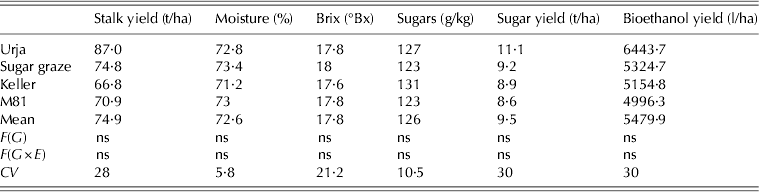
The field trials of maize and sweet sorghum were established at the region of Kopaida (38°23′N, 23°05′E, 102 m asl), 100 km northeast of Athens. The climate of the region is continental, characterized by harsh winters and extremely hot summers (temperatures exceeding 40 °C). The trials were conducted according to the RCB design with four replications in three consecutive years (2008–10). Maize trials included 20 hybrids (Table 1) in experimental plots of two rows each of 7 m long, while sweet sorghum trials included three varieties and one hybrid (Table 2) planted in plots of three rows each of 5 m long. Standard farming practices of the region were employed.
Combined analysis for all maize traits over the years 2008–10

Combined analysis for all sweet sorghum traits over the years 2008–10
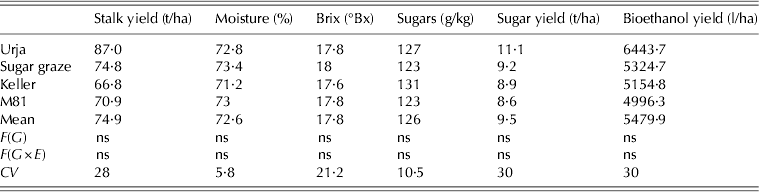
ns, not significant.
Maize hybrids were harvested when grain moisture content was reduced to c. 17% because harvesting maize at high moisture and then drying at high temperatures can result in poor ethanol yield (Lewis Reference Lewis2007). Sweet sorghum varieties were harvested at the soft dough stage when sugar content is maximized (Hoffmann-Thoma et al. Reference Hoffmann-Thoma, Hinkel, Nicolay and Willenbrink1996). Grain yield and moisture were measured for maize, while stalk yield and Brix degrees were measured for sweet sorghum. Finally, maize grain and sweet sorghum stalk samples were collected for laboratory analyses: maize starch content was determined by near-infrared whereas sweet sorghum stalk sugar content (%) was estimated with the dinitrosalicylic acid reagent and acid hydrolysis methods followed by spectrophotometric measurement (Miller Reference Miller1959).
Statistical analyses were based on Tukey's test, following a combined over years analysis of variance employing the JMP (vs. 8) statistical software.
Typical emission estimations – bioethanol production
Typical emissions represent the quantity of emissions (g CO2) per MJ of bioethanol by taking into account the overall emissions deriving from each operation during the cultivation phase and the energy (E bioethanol) of the theoretically produced bioethanol. All field operations, including soil cultivation, sowing, irrigation, fertilization and harvesting, were recorded in detail in order to estimate the overall energy consumed during the cultivation phase and the subsequent emissions. All operations except irrigation were conducted with the use of a tractor, meaning that fossil fuel (diesel) was consumed. The consumed energy (E diesel) and the emitted GHG (EM diesel) were estimated by taking into account diesel's least heating value (LHV diesel=43·1 MJ/kg) and diesel's GHG emission coefficient (EC) 87·6 g CO2e/MJ, respectively (EC 2009; BioGrace 2013). The application of irrigation was based on electric energy (E ir) consumption g CO2/ha, where energy required and the respective emissions (Em ir) calculations are presented in the following equations (Romanelli & Milan Reference Romanelli, Milan, Ortega and Ulgiati2004; BioGrace 2013):
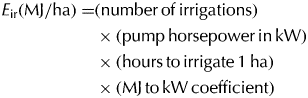 $$\eqalign{E_{{\rm ir}} ({\rm MJ/ha}) = &({\rm number}\,{\rm of}\,{\rm irrigations}) \cr & \times ({\rm pump}\,{\rm horsepower}\,{\rm in}\,{\rm kW}) \cr & \times ({\rm hours}\,{\rm to}\,{\rm irrigate}\,1\,{\rm ha}) \cr & \times ({\rm MJ}\,{\rm to}\,{\rm kW}\,{\rm coefficient})} $$
 $$\eqalign{Em_{{\rm ir}} = & \quad E_{{\rm ir}} \times {\rm medium}\,{\rm voltage}\,{\rm electricity} \cr & EC(128.25\,{\rm g}\,{\rm CO}_2 {\rm e/MJ})} $$
In total, three and five sprinkler irrigations per growing season were applied to sorghum and maize, respectively. Furthermore, the quantities of applied inputs (seeds and fertilizers) were recorded in order to calculate the emissions due to their application. Fertilizer quantities for maize were 270 kg/ha/yr of nitrogen (N), 40 kg/ha/yr of phosphorus (P2O5) and 40 kg/ha/yr of potassium (K2O) while the quantities for sweet sorghum were 120, 50 and 50 kg/ha/yr of N, P and K, respectively. The emissions (Em fert) due to fertilizer applications were estimated as follows (BioGrace 2013):
 $$Em_{{\rm fert}} \left( {{\rm g}\,{\rm CO}_2 /{\rm ha}} \right) = {\rm input}\;{\rm quantity}\left( {{\rm kg}/{\rm ha}} \right) \times {\rm input}\;EC\left( {{\rm g}\;{\rm CO}_2 {\rm e}/{\rm kg}} \right)$$
The EC for N, P and K, derived from the BioGrace calculation tool (version 4b; BioGrace 2013), were 5917·2, 1013·5 and 579·2 g CO2e/kg, respectively.
The seed emission factor (EF seed) for both crops was estimated based on the land area required to produce the seed quantity necessary to plant 1 ha of the crop (kg of sown grain/grain yield). Afterwards, the estimated factor was multiplied by the overall emissions.
Nitrous oxide (N2O) emissions (EM N2O) due to N fertilizer applications contained direct and indirect N2O emissions (i.e. N volatilization as NH3 and leaching to groundwater) and were calculated based on the IPCC Tier 1, 2 or 3 approaches (De Klein et al. Reference De Klein, Novoa, Ogle, Smith, Rochette, Wirth, McConkey, Mosier, Rypdal, Walsh, Williams, Eggleston, Buendia, Miwa, Ngara and Tanabe2006).
In the case of maize bioethanol, GHG emissions during the cultivation phase were estimated by taking into account the 54·6% energy allocation factor (AF) due to by-product exploitation (BioGrace 2013).
The theoretical estimation of bioethanol production for maize was based on a series of conversions proposed by Ingledew (Reference Ingledew, Ingledew, Kelsal, Austin and Kluhspies2009). Based on starch content, dry grain yield (t/ha) was converted to starch yield (t/ha) and afterwards to glucose yield (t/ha), using the 180/160 factor. Bioethanol yield (t/ha) was estimated by multiplying glucose yield by the bioethanol conversion factor (51·1%) and finally to litres per hectare, based on the bioethanol density (kg/l=0·794). The 90–93% efficiency of most industrial alcohol plants was also taken into account to estimate the final bioethanol quantity produced (Ingledew Reference Ingledew, Ingledew, Kelsal, Austin and Kluhspies2009). The theoretical estimation of bioethanol production from sweet sorghum was based on the sugar yield (t/ha) which was converted to bioethanol, using the same bioethanol conversion factor i.e. 51·1%. Sugar yields (t/ha/yr) were estimated by stalk yields (t/ha/yr) and their respective sugar content (% w/w) (Kim & Day Reference Kim and Day2011).
Finally, E bioethanol was estimated by multiplying the produced bioethanol to its LHV. The typical emissions (g CO2/MJ) were estimated as follows:
 $${\rm Typical}\,{\rm emissions} = Em_{{\rm total}} /E_{{\rm bioethanol}} $$
where Em total stands for overall emissions:
 $$Em_{{\rm total}} = (EM_{{\rm diesel}} + Em_{{\rm ir}} + Em_{{\rm input}} + EM_{{\rm N2O}} ) \times EF_{{\rm seed}} $$
Greenhouse gases emission saving (%) estimation
The final step of the analysis was the estimation of emission savings (%) due to the substitution of bioethanol for gasoline. To this end, typical emissions during the cultivation phase, GHG emitted during the feedstock and final product transportations and emissions during the production of the biofuel were taken into account (IDAE 2011; BioGrace 2013). Comparisons of bioethanol produced and the fossil fuel replaced were based on the energy content (LHV) and the emissions of each fuel.
RESULTS
Field measurements
The grain moisture of maize samples harvested ranged from 14 to18% and therefore, for yield comparisons, all yields recorded (Table 1) were converted to 15% grain moisture content.
Yield comparisons revealed only few statistically significant differences among maize hybrids, although the 31A34 hybrid was significantly (P<0·001) more productive than Aris, Helen, DK6040, DK 6818 and Ptolemeos (Table 1). The year effect was also significant (P<0·001) for all traits measured.
The mean yield of all sweet sorghum varieties was estimated at 74·9 (t/ha/yr). Comparisons among them did not reveal any statistically significant differences (Table 2). Brix degrees ranged from 12·3 to 13·1, also with no significant differences between varieties (Table 2). As with maize, the year effect for sweet sorghum was also significant (P<0·001) for all traits measured except for sugar content.
Sample analysis
Starch content (g/kg) was quite stable among hybrids and only few statistical differences were observed. It ranged from 73 to 75·6 g/kg in 2008, 74·3 to 76 g/kg in 2009 and 72 to 73·3 g/kg in 2010. The hybrid Helen demonstrated significantly (P<0·001) higher starch content than 31Y43, DK 6040, 31P41 and 32H57G. The resulting starch yields (t/ha/yr) also differed significantly in only a few comparisons, with the 31A34 hybrid being significantly (P<0·001) higher than Aris, Helen, DK6040, DK 6818 and Ptolemeos. As expected, the comparisons of the sugar yields and the theoretically estimated bioethanol quantity for each hybrid presented identical results to those achieved for starch yield comparisons, since starch yield constitutes the main factor that affects sugar and consequently bioethanol production. Bioethanol yields ranged from 3413 to 6060, 4116 to 5412 and 2750 to 5314 l/ha/yr in 2008, 2009 and 2010, respectively.
Sweet sorghum analysis results included stalk moisture content (%) and total sugar content (g/kg). The moisture content of the stalks ranged from 71·4 to 73·9% in 2008, 71·8 to 76·7% in 2009 and 67·7 to 73·2% in 2010 with no statistically significant differences among varieties.
Stalk sugar content (g/kg) ranged from 11·6 to 12·9 g/kg in 2008, 12 to 13·1 g/kg in 2009 and 11·9 to 14 g/kg in 2010 without any significant differences observed. As expected therefore, the respective comparisons among varieties regarding sugar yields (t/ha/yr) were also not significant. Finally, since sugar yields are strongly correlated to the bioethanol yields, the comparisons concerning the theoretically estimated bioethanol yields did not reveal any statistically significant differences.
Combined over years, the analysis revealed significant (P<0·05) genotype×year interactions for all maize characteristics, with this interaction being highly statistically different (P<0·001) for starch content. No such genotype×year interactions were found for any of the sweet sorghum characteristics studied.
Typical greenhouse gases emissions – emissions savings
The applied farming practices were common for both crops and the only differences concerned fertilizer regimes and number of irrigations applied. The operations not affected by the hybrid yields yet contributing to the overall emissions were those connected to tractor fuel consumption, irrigation and fertilization, which remained the same across years. In contrast, N2O emissions and the estimated seed emission factor were adjusted by the final yield of each crop. The overall diesel consumption for tractors during ploughing, harrowing, tilling, sowing, fertilizing, hoeing and harvesting was estimated at 123 l/ha/yr. The consumed energy per hectare due to fossil fuel consumption was calculated at 4410·68 MJ/ha/yr while the respective emitted GHG were estimated at 386·6 kg CO2/ha/yr for both crops. The application of irrigation added another 1015·7 and 609·4 kg CO2/ha/yr to the maize and sweet sorghum overall emissions, respectively. Finally, the emissions owed to fertilizer applications were 1661·4 kg CO2/ha/yr for maize and 789·7 kg CO2/ha/yr for sorghum.
Nitrous oxide emissions in maize ranged from 2080 to 2378 kg CO2e/ha/yr in 2008, 2154·5 to 2300·6 kg CO2e/ha/yr in 2009 and 2017·5 to 2306·5 kg CO2e/ha/yr in 2010. The respective ranges regarding sorghum were estimated at 1290·3–1522·8 kg CO2e/ha/yr in 2008, 1391·7–1534·7 kg CO2e/ha/yr in 2009 and 1621·1–1942·9 kg CO2e/ha/yr in 2010. As expected, the observed N2O emissions were significantly lower in sorghum since lower N fertilizer quantities were applied. The differences among seed emissions factors for all years were insignificant and ranged from 1·001 to 1·003 for maize, while sorghum demonstrated a stable seed emission factor estimated at 1·003 for all varieties grown.
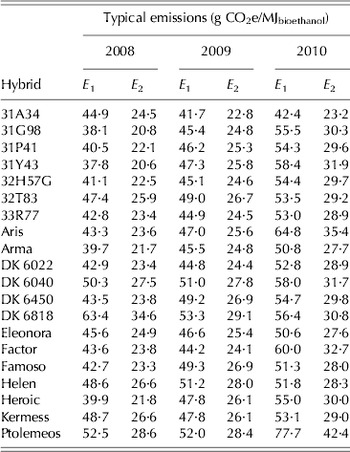
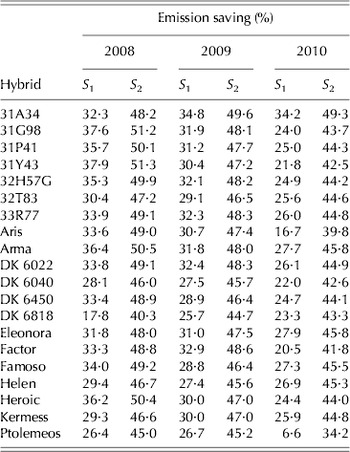
The estimation of the produced bioethanol energy for each variety of both crops was followed by the typical GHG emissions and emission saving estimations (Tables 3 to 5). In 2008, the lowest typical emissions regarding maize were estimated at 20·6 or 37·8 g CO2e/MJ for 31Y43 hybrid corresponding to the highest emission saving at 51·3 or 37·9%, depending on allocated or non-allocated emissions. The highest typical emissions were estimated for the DK 6818 hybrid (34·6 or 63·4 g CO2e/MJ without allocation) which also presented the lowest emission saving percentage of 40·3% (17·9% without allocation). The 31A34 hybrid presented the lowest typical emission amount of 22·8 g CO2e/MJ (41·7 g CO2e/MJ without allocation) in 2009 and 23·2 g CO2e/MJ (42·4 g CO2e/MJ without allocation) in 2010, while the respective emission savings were estimated at 49·6% (34·8% without allocation) and 49·3% (34·2% without allocation). In 2009 and 2010, the highest typical emissions and consequently lowest emission savings were estimated for the DK 6818 and Ptolemeos hybrids, respectively.
Typical emissions during the cultivation phase of maize
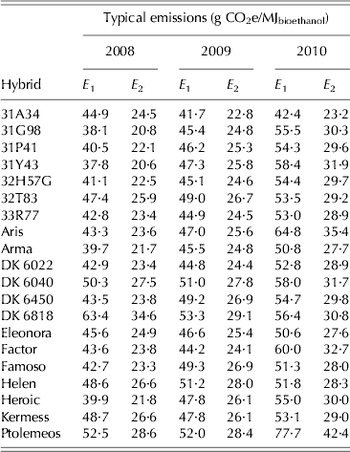
E 1 and E 2 stand for non-allocated and allocated typical emissions, respectively.
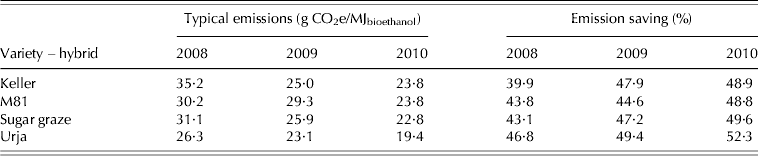
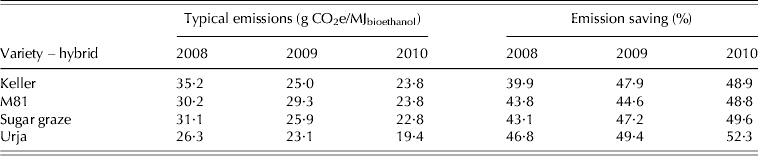
For sweet sorghum bioethanol, the Urja variety presented the lowest typical emissions and highest emission savings for all 3 years. The highest emission saving for this variety was estimated at 52·3% in 2010. Keller variety in 2008 and M81 variety in both 2009 and 2010 demonstrated the highest typical emissions and lowest emission savings (Table 4).
Emission savings resulting from maize bioethanol
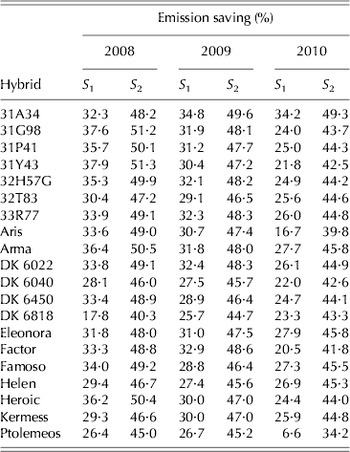
S 1 and S 2 stand for non-allocated and allocated emission savings, respectively.
Typical emissions during the cultivation phase and emission savings from sweet sorghum bioethanol production
Finally, it was shown that N2O emissions due to N fertilizer applications, fertilizer emissions and GHG emitted during irrigation were those that contributed the most to the overall GHG emitted when producing maize bioethanol averaging at 41·3, 31·7 and 19·4%, respectively, during the 3 years. The major contributors to the overall emissions for sweet sorghum bioethanol were the N2O emissions (49%), fertilizer production emissions (22·4%) and irrigation emissions (17·3%).
DISCUSSION
The mean grain yield of all maize hybrids was 11·34 t/ha/yr, with all hybrids performing satisfactorily. The limited yield variation between hybrids was attributed to the fact that all represented the best commercially available cultivars. Furthermore, the even more limited differences in starch content render selection of the most suitable for bioethanol production difficult. Sweet sorghum varieties also yielded well (average 74·9 t/ha/yr) and showed good adaptation and high yield potential when grown under Greek conditions.
The highest bioethanol yield for maize was estimated at 6060 l/ha/yr in 2008 for the 31Y43 hybrid and 5412 and 5314 l/ha/yr in 2009 and 2010, respectively, for the 31A34 hybrid. At the same time, the highest bioethanol yields for sweet sorghum were estimated for the variety Urja during all 3 years ranging from 5306 to 8037 l/ha/yr.
The above results suggest that sweet sorghum could produce significantly higher bioethanol yields than maize. Sweet sorghum is less popular as a sole source for the production of first-generation bioethanol than maize due to its high seasonality (1·5–2 month harvest window), rendering a processing plant very expensive and the whole process potentially unviable. However, sweet sorghum could be an excellent part of a multi-feedstock bioethanol production operation for the aforementioned 2-month period, the rest being based on storable material such as small cereals, grain sorghum and maize. Such a practice would be particularly useful in regions with irrigation shortages (Amorim et al. Reference Amorim, Basso, Lopes, Ingledew, Kelsal, Austin and Kluhspies2009).
Greenhouse gas savings from maize bioethanol for all years ranged from 34·2 to 51·3% with the respective typical emissions during the cultivation phase being from 20·6 to 42·4 g CO2e/MJ by taking into account the 54·6% allocation factor (BioGrace 2013). Similar results regarding maize were obtained by Wang et al. (Reference Wang, Wu and Huo2007), who compared different types of first-generation bioethanol procedures and presented emission savings ranging from 28 to 52%. Furthermore, Kim & Dale (Reference Kim and Dale2005) indicated that the emission reduction from maize bioethanol could range from 32 to 54% or 20 to 41% depending on the use of tillage or no tillage systems, respectively.
The comparison of the two crops studied in the present work indicated that sweet sorghum bioethanol was associated with similar, or in some cases higher, emission savings than those of maize bioethanol, even with no allocation of emissions to co-products. This is due to sweet sorghum's lower energy demands during the cultivation phase and reduced overall emissions alongside sweet sorghum's higher bioethanol yield (litres per hectare) potential.
Emission savings from sweet sorghum bioethanol ranged from 39·9 to 46·8% in 2008, 44·6 to 49·4% in 2009 and 48·8 to 52·3% in 2010. The fact that no allocation method was taken into account in order to allocate the emissions to possible co-products shows the suitability of this crop for first-generation bioethanol production in terms of sustainability.
Taking into account the GHG savings limit (49%) as set by the EU, many of the maize hybrids studied in the current work reached this limit only in 2008, when grain yields were higher than the following years. In 2009 and 2010, only the 31A34 hybrid achieved the aforementioned limit. However, many other hybrids could probably comply with this limit, provided that farming practices were altered to reduce the environmental cost. These findings highlight the importance of exploiting high yielding hybrids towards producing bioethanol since grain yield constitutes an important factor when dealing with maize bioethanol sustainability. At the same time, input excesses should be avoided and moderate-to-low input systems should be adopted so as to keep up with sustainability rules in order to minimize the input–output ratio. Finally, it was indicated that the production of first-generation maize bioethanol could be environmentally friendly only after fully exploiting the use of co-products as animal feed.
The contributions of N2O, irrigation and fertilizer emissions to the overall GHG emitted during the cultivation phase indicate the importance of improving and adopting farming systems assisting in a sustainable production of bioethanol. The results of the present study are in accordance with several other studies that indicated N2O, fertilizer and irrigation emissions mostly influence the overall emissions during the cultivation phase (Maraseni et al. Reference Maraseni, Mushtaq and Maroulis2009, Reference Maraseni, Cockfield and Maroulis2010; Vlachos et al. Reference Vlachos, Mariolis and Skaracis2014).
In general, both crops demonstrated satisfactory bioethanol yield potential that under certain circumstances could also have low environmental impact. Farming practice amendments are of crucial importance in order to keep up with the sustainability limits of the 28/2009 EU directive that should not be exceeded in order to produce environmentally acceptable biofuels. Finally, even if sweet sorghum constitutes a newcomer in Europe, it exhibits an adaptive and high yield potential, indicative of its excellent suitability as an additional-seasonal feedstock for first-generation bioethanol production in the Mediterranean region.