Many in America believe that the Democratic Party serves the interests of racial and ethnic minorities and that the Republican Party does not. Minorities themselves often make this claim. Over 70 percent of African Americans contend that the Democratic Party “works hard on issues black people care about.” Footnote 1 Latinos and Asian Americans are only a little less likely to believe that Democratic Party is particularly responsive to issues that affect their own pan-ethnic group. Footnote 2 Even among white Americans, two-thirds claim that the Democratic Party provides more aid to minorities than the Republican Party. Footnote 3 The logic behind these perceptions is straightforward. For decades the leadership of the Democratic Party has favored more liberal policies on race, welfare, education, crime, and a host of other social issues. The assumption is that all of these policies, when passed, have led to better outcomes for minorities.
But do minorities really gain when Democrats reign? Just how much the policy agendas of America’s two major parties benefit the racial and ethnic minority population remains an open question. Both parties make strong claims about how their agendas help minority groups. Republican leaders contend that greater efficiencies associated with more conservative policies and smaller government ultimately lead to more growth and higher incomes for all. As Ronald Reagan once argued in a speech to the NAACP, “a strong economy returns the greatest good to the black population. It returns a benefit greater than that provided by specific Federal programs. By slowing the growth of government and by limiting the tax burden and thus stimulating investment, we will also be reducing inflation and unemployment.” Footnote 4 Republicans also argue that the absence of policies targeting minorities reduces race-based stigmatization and results in a more just, color-blind society. Footnote 5
Democratic leaders counter that a program of greater redistribution, increased affirmative action, and tougher anti-discrimination measures does more for blacks and other minorities. As the 2004 Democratic Party platform stated, the party champions “vigorous federal enforcement of our civil rights laws” and “affirmative action to redress discrimination and to achieve the diversity from which all Americans benefit.” Footnote 6 Such measures are an integral part of the party’s vision of, as Bill Clinton recently described it, “a country of shared opportunities and shared responsibility.” Footnote 7 The two parties offer different paths, but both can clearly and logically claim to aid racial and ethnic minorities.
The racial dynamics of US party politics have been a major topic of political science research but here, too, there is real divide over the ongoing implications of partisan control for minority well-being. Scholars have clearly demonstrated close ties between race and party at different periods in American history. Indeed, Desmond King and Rogers Smith have compellingly shown that two competing institutional orders—a white supremacist order and an egalitarian transformative order—are at the center of much of America’s political and partisan history. Footnote 8 Moreover, the consequences of shifting control between these two orders for minority well-being have been clear at different points in American history. The Republican Party’s efforts to end slavery under Abraham Lincoln are the most obvious example of one party favoring a more racially egalitarian agenda than the other party. Footnote 9
It is, however, less clear whether in recent decades one party’s policies can and should be viewed as being more beneficial to minority well-being. There is little doubt that race and party are still closely intertwined. There is the sheer fact that racial and ethnic minorities tend to favor Democratic candidates—often overwhelmingly—while the majority of white voters typically end up on the Republican side. In 2010, for example, 89 percent of blacks, 60 percent of Latinos, and 58 percent of Asian Americans supported Democratic candidates for Congress, while a clear majority of whites (63 percent) favored Republicans. There is also considerable evidence that racial considerations have played, and continue to play, an important role in shaping that vote. Footnote 10 After the New Deal both parties were relatively quiescent and internally divided on the issue of civil rights, but the rise of the Civil Rights Movement led both parties to choose sides. Footnote 11 With Kennedy and Johnson increasingly embracing a civil rights agenda and with Republicans under Goldwater and Nixon favoring a “Southern strategy,” the racial policy gap between the parties grew substantially. Ted Carmines and James Stimson’s work effectively demonstrates the important role that racial considerations played behind the defection of large segments of the white population from the Democratic to the Republican Party. Footnote 12 Michael Dawson shows likewise that racial motivations such as linked fate were equally fundamental to the black vote. Footnote 13
The core question, however, is not whether race affects political choice, but rather whether the consequences of those political choices (e.g. party control) ultimately make one group better off. On this latter question there is both limited evidence and considerable disagreement. One widely held perspective maintains that Democratic Party control has indeed been an important institutional step for minority well-being. In this vein, Phil Klinkner and Rogers Smith and others laud the key part played by the Democratic Party in advancing the Civil Rights Act, the Voting Rights Act, and other transformative civil rights legislation of the 1960s. Footnote 14 Benjamin Page and James Simmons likewise provide considerable evidence that the Democratic Party’s support of liberal welfare policies has benefited the poor and working classes. Footnote 15 In what is undoubtedly the closest to a direct test of our hypothesis, Larry Bartels finds that Democratic control is associated with greater economic gains for the lower class than is Republican control. Footnote 16
From all of this one could conclude that Democratic Party control should greatly benefit America’s racial and ethnic minorities. That conclusion is not, however, without important counterclaims. One well-documented view holds that the Democratic Party, though more liberal than the Republican Party, has been half-hearted in its efforts to pursue racial equality. Both Ira Katznelson and Robert Lieberman, for example, show in different ways that liberal efforts to expand welfare and to aid the disadvantaged were at least over some periods undercut by racism in the writing and implementation of policy. Footnote 17 Paul Frymer persuasively argues that because blacks have been “captured” by the Democratic Party, neither party has much incentive to target African Americans. Footnote 18 A slightly different interpretation holds that although the Democratic Party has actively tried to uplift minorities and the working class, it has had little tangible impact. Supporting this perspective, Jacob Hacker and Paul Pierson show that inequality has grown over the last few decades regardless of the party in power. Footnote 19 Further underscoring this point are data from the APSA Taskforce on Inequality and American Democracy and critical studies by Martin Gilens and Larry Bartels showing that both political parties are especially responsive to and engaged with more privileged segments of the electorate. Footnote 20 The bottom line from this perspective is that neither party should be viewed as particularly pro-minority.
Still others maintain that the Democratic Party’s color-conscious policies have done little over the past five decades to improve the well-being of minorities, and that the more color-blind agenda espoused by the Republicans would ultimately benefit minorities more. Representative of this viewpoint is work by Stephan Thernstrom and Abigail Thernstrom showing that black economic gains were more pronounced in the period before the initiation of the Democrats’ racially liberal policy agendain the 1960s than after its implementation. Footnote 21
Ultimately, however, none of these studies of party dynamics directly assess gains and losses for racial and ethnic minorities under different American partisan regimes. There is an important parallel literature that evaluates different aspects of the political system’s responsiveness to minorities. Some scholars ask whether minorities are more likely than others to be altogether excluded from the polity. Footnote 22 There is little doubt, as research by Sidney Verba and many others shows, that Latinos, Asian Americans, and to a lesser degree blacks are less likely than whites to participate in an array of activities in the political arena. Footnote 23 Others examine the degree to which different racial groups are able to translate their votes into control over elected offices. Footnote 24 Zoltan Hajnal, for example, shows that blacks are especially unlikely to have their favored candidates elected. Footnote 25 Finally, and perhaps most importantly, researchers have begun to look at the link between minority preferences and legislator behavior. Footnote 26 The overwhelming view, as aptly illustrated by John Griffin and Brian Newman and Daniel Butler and David Broockman, is that legislators tend to be less responsive to their black and Latino constituents. Footnote 27 Griffin and Newman show convincingly that federal government-spending policies reflect the views of the white majority more closely than they do the views of Latinos and African Americans. Footnote 28 Taken as a whole, these studies suggest that although America’s democracy is at least somewhat responsive to minority interests, it ultimately remains more responsive to the white majority. Footnote 29
These different studies shed important light on the responsiveness of American democracy to minority interests. But we maintain that they are incomplete and therefore potentially misleading, because they tend to focus on the political process rather than on its distributive consequences. As Jane Mansbridge and others have so aptly illustrated, the process of democracy—who votes, who wins office, and what policies are passed—is vitally important to questions of legitimacy and civic identification, Footnote 30 but we would argue that the governed are likely to be even more concerned about their material well-being. If, in the end, a democracy does not make its citizens better off, then the value of that democracy can be questioned. While a voluminous literature has examined minority well-being over time, it has generally not tried to tie shifts in well-being to shifts in partisan control. Footnote 31 Outside of a handful of studies that have been limited to particular locales, we know little about whether minorities’ economic well-being has grown or declined under different party regimes. Footnote 32
Often ignored in this conversation is the place of Latinos and Asian Americans in America’s racial hierarchy and its party system. Should we expect Latino and Asian American outcomes to be shaped by partisan control in parallel fashion to black outcomes? On one hand, there are similarities between all three minority groups. As with blacks, Latinos and Asian Americans face widespread and often negative stereotyping from the white population Footnote 33 and have at times been subject to deeply racist and exclusionary practices. Footnote 34 Also like blacks, Latinos and Asian Americans have generally favored Democrats in the voting booth.
At the same time, there is a range of important dissimilarities between the groups that suggests they cannot be conceptually linked. First, the experiences of the Latino and Asian American populations are shaped much more by the process of immigration. As such, their structural location in the American economy and in American society may differ fundamentally from the position of African Americans. Second, the population of both pan-ethnic groups is extraordinarily diverse. As scholars from Pei-Te Lien to Lisa Garcia-Bedolla point out, it is not clear that either pan-ethnic population should be viewed as a cohesive entity. Footnote 35 Disparate socioeconomic circumstances within each group, distinctive paths to arrival in the United States, and different levels of incorporation once in the United States all imply that the same policy could affect members of each pan-ethnic group in sharply divergent ways. Third, although Asian Americans and Latinos tend to support Democrats, they do so in a far less hegemonic fashion than African Americans. To the extent political parties seek specific policies to reward particular constituent groups, one might expect blacks to experience greater benefits based on their more unstinting support as compared to the other minority groups.
Finally, and perhaps most critically for our study, the Asian American case may be particularly divergent from the black case because Asian Americans hold a less disadvantaged economic position in American society. The economic status of the Asian American population as a whole falls much closer to the status of whites than it does to either blacks or Latinos. Footnote 36 Asian Americans also report much lower levels of racial discrimination against their group than do blacks or Latinos. Footnote 37 For these reasons, Democratic leadership may have a less clear impact on Asian Americans. Footnote 38
To help answer these debates, we offer a simple, direct test that examines the correlation between party control and minority well-being. Footnote 39 This test for race does exactly what Larry Bartels’s study did for class. Footnote 40 We trace the well-being of racial and ethnic minorities over time using objective, empirical measures, and then compare the relative progress of these demographic groups under different partisan regimes. Specifically, we test to see whether blacks and other racial and ethnic minorities fare better on basic indicators of well-being like income, poverty, and unemployment when Democrats control the presidency or whether they do better under Republican administrations.
We find that blacks and Latinos have made major gains on whites under Democrats and have fallen further behind under Republicans. If Democrats had been in power over the entire period we examine, much of America’s racial inequality may well have been erased. Critically, these minority gains do not come at the expense of whites. We find that, on average, white incomes have grown, and white joblessness and poverty have declined, under Democratic administrations.
These findings are important on their own terms. They also offer the kind of empirical grounding that is essential to the development of broader theorizations about race and politics in the US. We do not believe that existing claims about the limited responsiveness of American democracy to minority interests are wrong, but we argue that they are incomplete in that they generally fail to directly assess the connection between politics and material well-being. We also very much see this work as a contribution to American public discourse in the spirit of the 2004 APSA Task Force on Inequality and American Democracy. In the words of Lawrence Jacobs and Theda Skocpol, “Political science is uniquely positioned and qualified to offer rigorous analysis of democratic life, checking the claims of partisans, powerful sectional forces, and ill-informed commentators. Rather than self-imprisoning ourselves in a gilded cloister, our independence offers a powerful vantage point to evaluate American politics and its democratic vulnerabilities.” Footnote 41 This function takes on added importance “in an era of political polarization and dramatic expansion of economic inequality.” Footnote 42 Following Jacobs and Skocpol, we hope our study constitutes an application of “rigor in the service of the public good.” Footnote 43
In what follows we explain our focus on race, party, and the presidency. We then detail our measurement strategy and data. That is followed by presentation and discussion of the empirical results. We conclude by highlighting the implications of our results, raising questions about what the Democratic Party has done to raise material well-being and offering a plea for more of a focus on objective, empirical evaluations of different partisan regimes.
Party, Race, and American Presidential Politics
We assess the relative impact of Democratic and Republican presidents on the well-being of racial and ethnic minorities. Party and race represent two of the most central factors in American politics.
Our focus on race requires little explanation. The importance of race in American life and politics is hard to dispute. Historical accounts illustrate all too clearly the uneven responsiveness of the American polity to minority interests. Footnote 44 In the past, blacks and other racial and ethnic minorities were routinely barred from participation. Footnote 45 Even after these groups were given the right to vote, whites regularly mobilized to prevent the effective use of that ballot. Footnote 46
Today, race still sharply divides Americans in terms of well-being. Lawrence Jacobs and Theda Skocpol note that “particularly striking” race-based disparities persist even as overall economic conditions improve. Footnote 47 In terms of household income, blacks earn on average only $40,685. Latinos are only slightly better off, earning $45,871 on average. Both figures fall well below the $65,317 average household earnings of white Americans. Footnote 48 Blacks and Latinos are twice as likely as whites to be poor, twice as likely to be unemployed, and between three and five times more likely to be arrested, and they accumulate less than one-tenth of the wealth that whites acquire. Footnote 49 Differences in educational outcomes are just as stark. While only 15 percent of Latinos and 23 percent of African Americans attain a bachelor’s degree by age 29, fully 40 percent of whites do so. Asian Americans tend, on the other hand, to fall closer to the top end of the spectrum in terms of material well-being with their average income and overall educational attainment both surpassing whites. Footnote 50 Moreover, there are signs that racial discrimination plays an important role in shaping at least some of these outcomes. Footnote 51 If we are concerned about the responsiveness of the political system to any group, race is certainly one area where we should focus our efforts.
Parties also play a critical role in American democracy and in American life. The Democratic and Republican Parties represent two very different brands with strikingly divergent policy agendas and recent polarization has only enlarged those differences. Footnote 52 There is also little doubt that control by one party or the other has wide ranging implications for policy outcomes. Footnote 53 Douglas Hibbs and Larry Bartels have, in particular, demonstrated sharp differences in economic outcomes under Democrats and Republicans. Footnote 54 As E.E. Schattschneider so aptly noted, “[T]he political parties created democracy and modern democracy is unthinkable save in terms of the parties.” Footnote 55 As such, the two major parties represent the two chief alternatives for individual voters. Determining which one better serves their interests is the core task facing almost every American voter.
Moreover, there is a very clear racial dimension to the partisan politics of America. Not only do the two parties offer contrasting policy prescriptions on matters of race but, as already noted, white voters and non-voters tend to favor different parties.
We focus on the president because that office stands at the top of American democracy. The president can veto any piece of legislation passed by Congress. As such he may have the institutional power to sway the direction of policy. Footnote 56 As the only leader elected by all of the people, the president may also have the bully pulpit and hence the ability to push American government in one direction or another. Footnote 57 Nevertheless, scholars have long debated just how much power the president has. Footnote 58 The Framers of the Constitution sought to ensure that the president’s power was checked by Congress and the judiciary. Presidents generally cannot unilaterally pass policy. Thus, the extent of presidential power is an open question. With the election of the nation’s first African-American president, that question has received extra attention, with some claiming that Obama has been able to effect only limited change, Footnote 59 and others citing important developments in health care under his presidency. Footnote 60 We hope to address this debate and contribute to the broader literature on presidential power by offering here a concrete test of what presidents can do. Can they effect real change in the relative well-being of different groups in society?
At the same time, given their prominent roles in the Constitution and in the ongoing politics of the nation, we cannot ignore Congress or the courts. As the primary law-making body in the polity, it is possible that Congress has greater influence over the well-being of different groups in society than does the president. Indeed, there is a long-standing debate about the relative influence of Congress and the presidency. Footnote 61 Therefore, in the analysis that follows we consider the partisan makeup of the House and Senate.
Some argue that the courts, too, are critical shapers of American public policy, especially with regard to racial and ethnic minority rights and well-being. Footnote 62 Landmark decisions by the courts have arguably altered the economic and social trajectory of African Americans and other minorities. Footnote 63 But here as well there are those who dispute the efficacy of these kinds of court decisions. Footnote 64 As such, a secondary goal will be to try to assess the relative contributions of these three institutions to policymaking and outcomes for the American public. Nevertheless, our primary goal is to assess the impact of party control. Because parties are clearly so central to politics and policy in American democracy, they are likely to play the driving role.
Measuring the Impact of Party on Racial Well-Being
The measurement strategy by which we propose to address this question is neither complex nor new. Footnote 65 We are simply reintroducing a basic tool that has largely been neglected in the American case (though used effectively in important comparative work by scholars like Arendt Lijphart, Bo Rothstein, and Ted Gurr) and highlighting its potential importance for studying democratic responsiveness in the US. Footnote 66 The strategy entails 1) identifying core demographic groups in society, 2) tracing their well-being using objective, empirical measures, and then 3) comparing the relative progress of these demographic groups under different regimes. This is the test that lies at the heart of the much of the comparative literature on governmental responsiveness, and it is a measurement strategy that can be applied to almost any group or set of groups in any democracy (though, to help minimize the confounding influence of other non-political factors, it is critical to incorporate a large sample of years and substantial variation in governing regimes).
To assess well-being, we focus first and foremost on basic measures of economic well-being: income, poverty, and unemployment. However, it is important to consider other non-economic indicators that are, nevertheless, critical determinants of life chances. Here we would consider education and arrest records. By showing that different types of outcomes all point in the same direction we hope to increase confidence in conclusions about the relative impact of different governing regimes.
We apply this general measurement strategy to the case of race and party politics in America. Specifically, we contrast changes in well-being for different racial and ethnic groups under Democratic and Republican presidents. Our dependent variables are core economic and social outcomes. Specifically, in terms of economic indicators we look at income, unemployment, and poverty. We measure income primarily as median family income in constant 2008 dollars. As robustness tests, we repeat the analysis focusing on mean family income and mean and median household income. For poverty we focus on the overall poverty rate for families in each racial and ethnic group. Unemployment is the adult unemployment rate for each group.
In alternate tests we also focus on non-economic indicators like criminal justice, education, and health. They are chosen because all are among the primary markers of basic well-being. In particular, given the prominent role that the criminal justice system plays in the minority community—one in five adult black men is in prison, on parole, or on probation—it is an especially critical measure to examine. We also focus on these variables because they allow us to differentiate between areas where we would expect presidential partisanship to have an effect (criminal justice) and those in which we think the president’s party should matter less (education and health). For criminal justice, we examine the overall arrest rate for all adults, the adult homicide arrest rate, and the juvenile homicide arrest rate (all per 1,000 residents). The FBI provides these figures through the annual Uniform Crime Reports. To assess educational outcomes we concentrate on two measures: the percentage of adults with a four-year college degree and the percentage of adults with a high school education. Our health indicators are life expectancy (measured in years) and the infant mortality rate (per 1,000 births). The education and health data are from the Bureau of the Census and are specifically derived from the Current Population Survey.
For all of these different outcomes, we assess change in two ways. First, we look at each racial and ethnic minority group’s progress from year to year in isolation. Specifically, we subtract the group’s previous year outcome from the group’s current year outcome to get our first measure of year-to-year change. Second, we measure changes in the gap between each minority group and whites to see if minorities are falling behind or catching up. For example, we would subtract the black unemployment rate from the white unemployment rate in the previous year, then subtract black unemployment from white unemployment in the current year, and finally subtract the gap in the current year from the previous year to see if the gap is closing or increasing. Finally, in alternate tests, we also look at changes in the ratio of white to non-white outcomes. All of the different measures of change lead to the same pattern of results. In alternate tests we also assess a more dynamic time series model with a lagged dependent variable. The findings from the time series model mirror the results presented here.
In our analysis we begin by assessing outcomes for African Americans. We do so for two reasons—one practical and one theoretical. The practical reason is that we have many more years of data for blacks than we do for Latinos or Asian Americans. The Census reports outcomes for Asian Americans for half (or fewer) of the years, only dating back to 1988, and it reports outcomes for Latinos for about two-thirds of the years, extending back to 1970. With fewer years and thus less variation in political leadership for Latinos and Asian Americans, our conclusions about these two groups will have to be much more tentative. For African Americans, the data extend as far back as 1948 and are available as recently as 2010.
We also focus primarily on blacks because of the uniquely central position of African Americans in the racial history and racial politics of the United States. In the past blacks have been the primary targets of much of the nation’s discriminatory practices. Likewise, when the nation has discussed or passed measures to address racial inequality, the African American population has often been the main focus of those initiatives. The disadvantaged status of the African American population today—their poverty and unemployment rates are twice those of the national average—also justifies the close attention we pay to black outcomes.
The main independent variable, presidential partisanship, is coded 1 for all years with a Democratic administration in office and 0 for all years with a Republican administration. Because it is unlikely that a president’s effect on the economy begins immediately during his first year in office, we lagged our measure of presidential control by one year. For example, changes in black poverty in 2009 are credited to George W. Bush and Republican control rather than to Barack Obama and Democratic control. Alternate lags of two or three years produce slightly less consistent results. In alternate tests, we also assess presidential ideology, as measured by different scholars’ ideal point estimates. Footnote 67
The president is obviously not the only political actor that could impact the well-being of different groups in society. As such, we also consider the role that the other two branches of federal government—Congress and the courts—play in shaping racial outcomes. Specifically, in our main regression models, we include controls for whether the Democrats are the majority in the Senate and the House. In alternate tests we also assess the proportion of Democrats in each legislative body as well as the median ideological score in each body. Footnote 68 Our tests of Congress and the presidency also consider the role of divided government Footnote 69 and partisan polarization. Footnote 70 Finally, to test the role of the courts, we examine several measures of court ideology and partisanship. Specifically, in alternate tests we add estimates of the median ideology of the Supreme Court produced by Michael Bailey, Footnote 71 Andrew Martin and Kevin Quinn, and Lee Epstein et al. Footnote 72 In order to gauge the impact of other federal courts, we incorporate a yearly measure of the percentage of all active US Court of Appeals judges nominated by a Democratic president. All court and Congress variables are lagged one year.
We also have to consider a variety of non-political factors. It is certainly possible that one political party has been luckier than the other and has occupied the White House when external economic forces were driving growth in the well-being of one racial group more than the well-being of other racial groups. Since oil is one of the most volatile and economically critical commodities and is generally viewed as largely beyond the control of American political actors, we control for the annual increase in the real price of oil (from the Federal Reserve Bank). Given that changes in family income and other aspects of well-being we focus on may be sensitive to changes in workforce participation, we also include a control for the annual change in the proportion of adults in the labor force (from the Bureau of Labor Statistics). Likewise, to account for other basic economic forces, we add controls for lagged median income and the current rate of inflation and in alternate tests GDP and change in GDP.
In addition, there are a number of broader changes occurring over time that may be impacting relative group well-being. For example, educational outcomes have risen steadily over time. So too have divorce rates. And as divorce has become more common, and Americans are increasingly having children later in life or not at all, the average size of families has consistently declined. One could also cite the increasing impact of globalization on American economic fortunes. Fortunately, because these factors are changing slowly and relatively constantly over time, they are unlikely to be confounded with the numerous alterations in partisan control of the presidency that we have seen over the past five decades. Footnote 73 Nevertheless, we can go some way to controlling for these broader trends by including a linear trend term in the analysis.
The Presidency and Black Well-Being
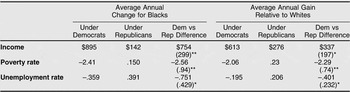
Do Democrats really help minorities? Or does Republican control actually do more to improve minority well-being? We begin to answer these questions by comparing gains in black well-being under Democratic and Republican presidents. Table 1 presents the average annual change in black well-being for income, poverty, and unemployment. The first three columns look at annual change for blacks alone. The last three columns present figures for blacks relative to whites.
Party of the president and black economic well-being

***p<.001 **p<.01 *p<.05 Standarderror in parentheses
The pattern of results is clear. African Americans tend to experience substantial gains under Democratic presidents whereas they tend to incur significant losses or remain stagnant under Republicans. On every basic economic indicator t-tests show that gains under Democrats were significantly greater than gains under Republicans. In terms of income, black families gained on average $895 annually under Democrats but only managed $142 in annual income growth under Republicans. The difference in income growth of $754 is not only highly significant (p<.01), it is substantial. The pattern for poverty is even starker. Under Democratic presidents black poverty declined by an average of 2.41 points per year. In sharp contrast, black poverty actually grew under Republicans—by .15 points annually. Finally, the difference is most remarkable for unemployment. The black unemployment rate declined over a third of a point (.36) annually under Democratic presidents while it grew by over a third (.39) under Republicans.
Moreover, as the second half of the table shows, it is not just that African Americans were doing better generally under Democrats, it is also that they were much more likely to catch up to whites under Democratic administrations. Black gains relative to whites in terms of income, unemployment, and poverty were all significantly greater under Democrats than they were under Republicans. Again, the starkest contrast is in terms of unemployment. On average the black/white unemployment gap declined by .20 points annually under Democrats while it grew by .21 points annually under Republicans. There were also substantial differences in trends in black/white well-being on measures of poverty and income. Under Democrats, blacks made real gains on whites in terms of poverty. Annually, the black/white poverty gap declined by just over two points under Democratic administrations. By contrast, under Republicans there was a .23 point annual increase in the black/white poverty gap.
This sharp partisan contrast exists no matter how we measure income, poverty, or unemployment. For example, whether we focus on mean or median income, whether we look at family or household income, whether we look only at adults or all persons, and whether we look at the gap between blacks and whites or at the ratio of black to white outcomes, the patterns are essentially identical: Republican administrations were, on average, bad for African Americans and Democratic administrations were, on average, good for them, both in absolute and relative terms.
The cumulative effects of these partisan differences are immense for the black population. If we simply add up all of the changes in black well-being under Democratic presidencies in our data set and compare that to a summary of all of the changes under Republican presidencies, dramatic differences emerge. Across the 16 years of Democratic leadership in our data the black poverty rate declined by a net of 38.6 percentage points. By contrast, over the 20 years of Republican presidencies, the rate of poverty for blacks grew three points. The figures for unemployment are even more pronounced. Across 35 years of Republican presidencies, black unemployment went up a net of 13.7 percentage points. Across 22 years with Democrats, the black unemployment rate fell 7.9 points. Putting those two numbers together and making the heroic assumption that the rest of the world would not have changed, one can speculate that black unemployment would be 21.6 points higher if Republicans had been in charge for the entire period than if Democrats had held the presidency for the duration. Finally, black incomes grew by $23,281 across 26 years of Democratic administrations (using constant 2008 dollars). Black incomes also grew under Republicans, but much more slowly—less than $4,000 across 28 years. Moreover, the cumulative effects are equally striking if we concentrate instead on black well-being relative to white well-being. Blacks made enormous gains relative to whites under Democrats and typically fell further behind whites under Republicans. Footnote 74 The results suggest that which party controls the presidency may be one of the most important influences on who wins and who loses in American democracy.
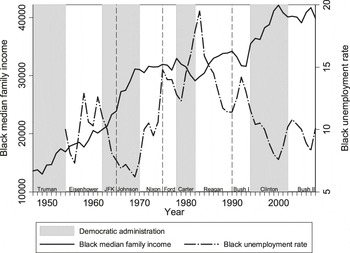
What is also impressive is the consistency of this partisan divergence over the last half century. As figure 1 illustrates, over the different years and different administrations, there are relatively few exceptions to the basic partisan pattern. Generally speaking, in the years when Democrats were in office, black economic well-being improved. Black incomes grew in 77 percent of the years that Democrats held the presidency, black poverty declined in 88 percent of those years, and black unemployment fell in 71 percent of those years. In sharp contrast, blacks more often than not lost under Republican administrations. In fact, during the majority of years of Republican presidential leadership black poverty increased and black unemployment grew. Only in terms of income did blacks make annual gains more often than not under Republicans. The same consistent partisan divergence appears whether we focus on black well-being in isolation or instead on black well-being relative to white well-being. Put simply, however measured, blacks made consistent gains under Democratic presidents and suffered regular losses under Republicans.
Black income and unemployment under different presidential administrations

A More Robust Test
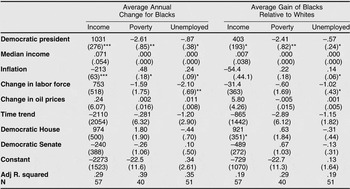
Could all of this be coincidence? Perhaps Democratic presidents have gotten lucky and presided over expanding economies while Republican leaders have won office in depressed times. There are, in fact, a range of economic factors that could affect basic economic conditions in the black community that might by chance be related to the partisanship of the occupant of the White House. The data we have presented so far also ignore other aspects of political representation in America. Presidents undeniably wield considerable power, but many would claim that Congress, as the main law-making body in the nation, has more influence over basic economic outcomes. In table 2 we begin to consider these other factors. The table presents six different regressions, three of which examine changes in black income, poverty, and unemployment in isolation and three of which focus on black outcomes relative to those of whites. Each includes measures for which political party controls the House and the Senate, as well as a range of basic economic indicators like inflation and median family income. We also include the range of basic economic indicators described above—changes in oil prices, labor force participation, inflation rates, and median family income generally—as well as a basic time trend. As an alternative, we also tested a time series model with a lagged dependent variable that focused on annual group well-being instead of changes in group well-being. The results from that model are essentially identical to what we present here.
Party of the president and annual change in black economic well-being: Regression

***p<.001 **p<.01 *p<.05 Standard error in parentheses
The main conclusion from table 2 is that presidential partisanship continues to be a critical predictor of black well-being. Even after controlling for a range of other factors, under Democratic presidents the black population is significantly more likely to experience growth in income, declines in poverty, and decreases in unemployment. The regression estimates in the first three columns of the table suggest that the gains are substantial. All else equal, black family incomes grew over $1,000 faster annually under Democratic leadership than they did under Republican presidents. Likewise, the black poverty rate declined 2.6 points faster under Democrats and the black unemployment rate fell almost one point faster. Moreover, as the last three columns indicate, all of these gains also occur relative to whites. Net of all the controls, under Democratic presidents blacks significantly close the gap with whites in terms of income, poverty, and unemployment. This result fits neatly with earlier work by Douglas Hibbs, who found that from 1948 to 1978 economic inequality grew markedly more under Republican administrations than it did under Democratic administrations. Footnote 75 It also parallels work by Larry Bartels, which concludes that Democrats did more for the lower classes than Republicans. Footnote 76
There are also signs, albeit extraordinarily limited ones, that Congress matters as well. The most obvious is that there is a significant and substantively large relationship between a Democratic majority in the House and changes in black incomes. Specifically, under Democratic majorities the black/white income gap declines $921 faster than it does under Republican majorities. At the same time it is clear that the results on Congress are mixed. Other coding schemes for Congress fare no better. Footnote 77 It may be that limited variation in Democratic and Republican control of Congress is at least in part to blame for these results. Given that Democrats controlled Congress continuously for the vast majority of this period (from 1955 to 1994), it is possible that Congressional partisan effects are confounded with broader economic trends. Footnote 78
What about divided government? Given that Congress and the president have to work together to get major policy changes enacted, we might expect the president to be less influential when Congress and the presidency are controlled by two different political parties. Footnote 79 To test this proposition, we substituted in a dummy variable that singled out years with both a Democratic president and a Republican Congress. That analysis reveals that Democratic administrations are less effective at raising black incomes when they have to work with a Republican Congress. In fact, the results show that black family income did not grow significantly under Democratic presidents when they were coupled with a Republican-controlled Congress. The effects of divided government were, however, only significant for black income. Neither change in black poverty nor change in black unemployment was significantly related to divided government. In short, there is limited evidence that Congress matters.
Although the courts are sometimes ignored in discussions of policymaking in the federal system, many have argued that in the realm of racial politics court decisions have been critical in protecting racial and ethnic minorities and in fostering real gains in minority well-being. Footnote 80 In light of the potentially important role played by the federal courts, we added several different measures of court ideology in alternate regression models. However, we found little connection between the ideology of the courts and black well-being. Regardless whether we measured court ideology using Michael Bailey’s or Andrew Martin and Kevin Quinn’s estimates of the median ideological position of the Supreme Court, Footnote 81 Lee Epstein et al.’s Judicial Common Space median scores, Footnote 82 or the percentage of all active US Courts of Appeals judges nominated by Democratic presidents, court ideology was insignificant when added to all of the models in table 2. It is also important to note that the inclusion of these different indicators of the politics of the Supreme Court and the US Courts of Appeals had no noticeable impact on the other relationships evident in table 2.
The multivariate analysis in table 2 strongly suggests that the strikingly divergent paths that African American economic fortunes follow under Democratic and Republican administrations are no mere coincidence of the timing of Democratic and Republican electoral victories. To try to confirm the robustness of these partisan patterns and to increase our confidence in the role that presidential administrations play in shaping America’s racial order, however, we explored a range of additional tests on the data.
First, we considered the role of economic growth. It could be that growth rather than partisan control is driving minority gains. However, when we added measures for GDP and annual changes in GDP to the models in table 2, there was no appreciable change in the size or significance of the party effects (refer to the online appendix for analysis). The robustness of the Democratic presidency effect to the inclusion of economic growth is important because it begins to help us understand what does and what does not drive minority gains under Democrats. Given claims by Larry Bartels and Douglas Hibbs that Democrats have been better at fostering growth, Footnote 83 one might suspect that minority gains under Democratic administrations are largely a function of increased growth. But at least at first glance, that does not appear to be the case. Other more racially-specific policies may instead be driving the gains under Democrats.
Another possibility is that the different paths taken by Democrats and Republicans are largely reactions to the policies of their predecessors. Republican administrations might, for example, have to counter the excesses of previous Democratic administrations by reining in spending. Likewise, Democrats might feel the need for expansionary policies in reaction to Republican belt-tightening. If this were the case, we would expect partisan divergence to be greatest when a president of one party succeeds a president of the other party. However, we find essentially the opposite pattern. The partisan gap in the economic trajectory of the black population is greater for administrations in which the president is in his second term or belongs to the same party as his predecessor than it is for administrations constituting a change of presidential party. Rather than reacting to the actions of the other party, each party seems to be pushing its particular agenda more and more the longer it is in office. Democratic administrations appear to help African Americans experience greater economic gains as their time in office increases; the longer Republican administrations hold office, the more the fortunes of blacks appear to fall.
Additional analysis shows that dropping one or two administrations at a time from the regressions, omitting partisan transition years, dropping presidential election years, or taking out years with unusually high or low economic growth has no appreciable effect on the overall pattern of results. Footnote 84 We also added an interaction between the party of the president and time to see if the effect of partisan control might be changing over time. In all but one case the interaction was not significant, suggesting that, generally speaking, the impact of presidential partisanship is not changing over time. Footnote 85 There is, in short, a consistency in the impact of partisan control strongly suggesting that the divergence in economic fortunes of African Americans under Democrats and Republicans is real.
When we extended our study beyond the economic sphere to criminal justice, one of the more highly partisan and politicized policy areas, we once again found substantial differences in black outcomes depending on the party of the president. As before, black outcomes improve under Democrats while under Republicans they get worse. For blacks, the overall arrest rate for adults, the homicide arrest rate, and the juvenile arrest rate all decline significantly faster under Democrats than they do under Republicans. Just as importantly for blacks, who have been much more likely than whites to be caught up in the criminal justice system, the racial gap in arrest rates declines significantly and substantially under Democrats while it grows under Republicans. Footnote 86 The cumulative effect of these partisan differences over the years in our data set dramatically impacted the racialized patterns of criminal justice evident in America. Across the twelve years of Democratic presidencies in our data, the black/white arrest gap experienced a 61-arrest net drop (per 1,000 residents). By contrast, across the 22 years of Republican leadership that same gap grew by a total of 36 arrests. Today, the black/white arrest gap stands at 69 arrests per 1,000 adult residents. Putting those two sets of figures together, it appears likely that the racial divide in arrest rates would be considerably smaller if Democrats had been in control for the entire period. Footnote 87
As a final test we looked to see if presidential partisanship shows effects for outcomes where we should not find them. Specifically, we collected annual educational outcomes by race. Since the federal government has traditionally had limited purview over education policy, there should be no link between presidential partisanship and changes in educational outcomes. That is exactly what we found. Regardless who holds the office of the president, black high school and college graduation rates increase slowly and very steadily over time. We also found no link between presidential partisanship and health outcomes (infant mortality and life expectancy), a policy area where ever-increasing technological gains have led to the same kind of slow, steady improvement in outcomes over time.
The bottom line of this set of analyses is that the pattern of results fits expectations. We find partisan effects where we would expect them and we find no partisan effects where we should not find them.
Measuring the Well-being of Other Minority Groups
Blacks have been the racial group most closely associated with the Democratic Party, and perhaps the group most likely to benefit from the Democratic Party’s racially liberal policy agenda. They may not be the only racial group that stands to gain from Democratic control of the presidency, however. For reasons we have already outlined, we might expect a similar pattern of partisan effects when we examine the fortunes of Latinos. For Asian Americans, the last group we consider, our expectations are less clear largely because of the more advantaged economic position that many members of that pan-ethnic group hold.
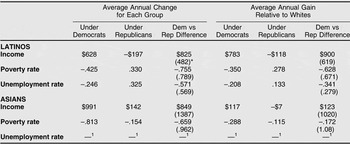
In table 3, we begin to assess the link between presidential partisanship and the welfare of these two other racial and ethnic minority groups. The table presents figures for mean annual changes in income, poverty, and unemployment for both groups broken down by whether they occurred under Democratic or Republican presidencies. The first three columns once again report the average annual change for each group in isolation and the second three columns present data on how changes in Latino and Asian American outcomes compare to changes in white outcomes.
Party of the president and Latino and Asian American economic well-being

*p<.05
**p<.01
1 Too few years available. Standard error in parentheses
The overall pattern of results for Latinos mirrors what we saw earlier for blacks. Latinos appear to benefit from Democratic leadership and often suffer losses under Republicans. For Latinos, Democratic presidencies are associated with large annual gains in income, substantial declines in poverty, and real drops in unemployment. By contrast, under Republican administrations Latinos tend to lose income, become poorer, and experience greater unemployment. This is true whether we look at Latinos in isolation or whether we compare Latino gains and losses to those of whites. Moreover, the magnitude of these partisan differences is once again quite substantial. Latino incomes grew an average of $628 annually under Democrats, while they declined by an average of $197 annually under Republicans. Similarly, Latino poverty declined at an average rate of about half a point under Democrats and grew at a rate of about a third of a point under Republicans. Finally, the unemployment rate for Latinos averaged a one-quarter point decline annually under Democrats and a one-third point increase annually under Republicans. The gains and losses are perhaps even more dramatic if we compare Latino to white well-being. Latinos closed the gap on white income about $900 per year faster under Democrats than under Republicans. The comparable annual figures for the Latino-white poverty gap and the Latino-white unemployment gap are .63 points and .34 points, respectively.
We have far fewer years of data for Latino outcomes than we do for black outcomes. Nevertheless, the cumulative partisan difference for the available years of Republican and Democratic leadership on Latinos is still dramatic. Across the years of Democratic administrations in our data, Latino incomes grew a total of $7,531, the Latino poverty rate dropped 5.1 points, and Latino unemployment fell 3.2 points. By contrast, adding together all of the available Republican years Latino family income suffered a net $4,728 decline, Latino poverty increased 7.6 points, and Latino unemployment grew 7.8 points. Had the patterns of racial progression that occurred under Democrats been in effect throughout the entire period, Latinos might be in a very different economic position in American society.
The figures for Asian Americans are less stark but point in the same direction—greater gains under Democrats and periods of stagnation under Republicans. Asian American family income grew by almost $1,000 annually under Democrats but only by $142 annually under Republicans. That means that Asian Americans closed the income gap on whites in Democratic years but failed to make any progress in Republican years. Similarly, annual declines in Asian American poverty were greater under Democrats (.81 points) than they were under Republicans (.15 points). Overall, it appears that Democratic presidential leadership enhanced the well-being of America’s racial minorities while Republican administrations tended to enlarge the gap between whites and minorities. Footnote 88
Despite the illustration in table 3 of the same general trends among Latinos and Asian Americans as table 1 shows for blacks, the relative lack of yearly data precludes a finding of statistical significance. Even though the magnitude of the partisan differences for Latinos is roughly on par with those for blacks on almost every indicator, for only one of the 10 cases in table 3—changes in the income of Latinos—does the partisan difference pass a t-test (p<.05). That the pattern for Latinos and Asian Americans mirrors the pattern for blacks and is consistent across most of the different indicators of well-being suggests that there is substance to the differences we see. Nevertheless, without more cases and the ability to present a rigorous multivariate model it is impossible to make definitive conclusions. In short, it looks like Latinos and Asian Americans also benefit considerably from Democratic administrations and lose under Republican presidencies, but we cannot be certain.
Do Whites Lose?
The dramatic gains that racial and ethnic minorities experience under Democratic presidents raise questions about white Americans and their well-being under Democrats. In Stanley Greenberg’s account of middle-class voting patterns, he contends that the Democrats’ “bottom-up vision” of social progress in the 1960s could only be interpreted through a racial prism, and this explicit association of Democrats with minority interests led white middle-class voters to embrace the Republican party. Footnote 89 As Ruy Teixeira and Joel Rogers note, it is possible for a party to maintain a base among black and Hispanic voters while appealing to members of the white working class, but only if the policies it champions have a universalist appeal. If these policies instead appear to promote minority interests at the expense of whites, such a result could splinter the coalition. Footnote 90
The question, then, is whether minority gains under Democrats are occurring at the expense of whites, or are instead due to growth and a rising tide that lifts all Americans—both minority and non-minority. In table 4, we briefly assess this question.
Party of the president and white well-being

**p<.01 *p<.05. Standard error in parentheses
The table shows average annual changes for white Americans under Democratic versus Republican administrations in the core economic outcome areas in which blacks and other minorities made real gains under Democrats.
Table 4 is clear on one point. White Americans do not lose out under Democrats. On average under Democrats white incomes have grown, white poverty has declined, and white unemployment has diminished. Footnote 91 Thus, there seems little chance that minority gains are largely at the expense of white gains. Democrats appear to be able to aid minorities without inflicting any major losses on the white community.
What is less clear is whether Democratic administrations actually benefit white Americans more than Republican administrations do. On the three measures of well-being in table 4, the average gains under Democrats are larger than the average gains under Republicans. But the partisan differences here do not quite attain the .05 level of statistical significance, and they are all much smaller than they were for blacks and other minorities. For example, the partisan gap in white incomes is only 60 percent of what we saw for black incomes. Combined, this suggests that the policies enacted by the Democratic presidents benefit all Americans, but that those benefits may disproportionately accrue to the minority population.
Conclusion: Why the Partisan Difference in Racial Well-Being Matters
The empirical evidence is clear: racial and ethnic minorities do better materially under Democrats than under Republicans. This finding has obvious relevance for political discourse in the US. It suggests that the conventional wisdom about the two parties is correct and that, however much racial inequality persists, there seems little doubt that it would be much greater were it not for the periods of Democratic Party dominance.
Here our work intersects with, and supports, an important stream of research in US politics on the liberal policy agenda of the Democrats and especially the racial dimensions of this agenda. The stark patterns presented here suggest that it is indeed accurate to view the American partisan conflict as partly a contest between two political orders, one of which is racially egalitarian and transformative, and the other of which is racially restrictive. Footnote 92 The significant and positive changes that have occurred under Democrats confirm that the Democratic Party is, in fact, more closely aligned with that racially transformative order. The pattern of economic gains under Democrats also closely mirrors Larry Bartels’s findings about class and verifies that these gains accrue to the economically disadvantaged of all racial stripes.
Our results do not directly contradict less sanguine assessments of the Democratic Party. One could still argue, as Paul Frymer does, that the Democratic Party often takes minorities – especially blacks—for granted. Footnote 93 It may also still be fair to claim, as Robert Lieberman and Ira Katznelson do, that the Democratic Party’s implementation of a liberal agenda has at times been marred by inordinate attention to lower-class whites’ welfare. Footnote 94 And one could still reasonably argue that the Democratic Party could and should have done more to advance an economically progressive and racially transformative platform.
The results presented here do, however, directly contradict scholarly claims by Stephan and Abigail Thernstrom and others about the ability of the colorblind politics of the Republican Party to advance minority well-being. Footnote 95 The enactment of the Republican agenda at different points in recent decades has clearly not helped minority interests, and may have actually hurt them.
Combined with existing studies, our results also offer some insight about the kinds of Democratic polices that have propelled these minority gains. Larry Bartels and Douglas Hibbs have both demonstrated that the policy agenda of the Democratic Party over this period has more effectively created economic growth than the competing policies of the Republicans. Footnote 96 The fact that we find economic gains for both white Americans and racial and ethnic minorities under Democrats suggests that overall economic growth undergirds many of the gains seen during these periods. But it is important to note that these racial patterns are not solely driven by economic growth. When we controlled for GDP, substantial partisan differences persisted.
The ability of the Democratic Party to enact a range of racially explicit, racially egalitarian policies likely contributed to the minority gains seen. Although landmark anti-discrimination measures like Truman’s executive order to desegregate the armed forces, the Fair Housing Act, and the Civil Rights Act are particularly worthy of study, more recent initiatives to expand affirmative action in government hiring may be important as well. A range of policy programs that are neither explicitly redistributive nor explicitly racial, such as those governing criminal justice and immigration, have also sparked major partisan differences. These may also disproportionately impact the minority community, and likely help explain the patterns we see. Finally, scholars have made strong claims about redistribution and the efficacy of various transfers to the poor (e.g., Johnson’s war on poverty or Clinton’s expansion of the earned-income tax credit). The APSA Taskforce on Inequality in American Democracy, in particular, highlights the important role that tax policy can play in expanding or mitigating economic inequality. Footnote 97 Because these kinds of redistributional efforts (e.g., taxing and spending) tend to fluctuate extensively from administration to administration, they are, in our opinion, among the most logical sources of minority gains and losses across different administrations.
Unfortunately, very few studies have been able to systematically tie the passage of particular policies to large-scale, quantifiable gains or losses in minority well-being. Footnote 98 Nevertheless, as the APSA Taskforce on Inequality in American Democracy has so forcefully established, these tests are critical. The more we can do to link minority outcomes to specific policy measures, the more we will be able to help disadvantaged minorities. In an age of growing inequality and sharp racial divisions in the vote, it is imperative that we use our research capacities “to scrutinize the health of our democracy” and to look for avenues to restore its vitality. Footnote 99
This study also has wide-ranging implications for our understanding of American political institutions. The results presented here suggest that politics matters. This is something that the comparative literature on the quality of democracy, responsiveness, and economic development has long argued. There has nevertheless been an ongoing debate—particularly in the economics literature—about the ability of governments to raise the welfare of their citizens. Footnote 100 The stark gains for minorities on core measures of well-being under Democratic administrations reinforce the view that governments can do a lot to positively impact the welfare of their constituents. Footnote 101 Our results also indicate that parties in American politics are far from empty shells. Indeed, judging by the magnitude of the partisan effects we observe here, party control may be one of the most important influences on who wins and who loses in American democracy. The patterns illustrated here also offer some insight into debates about the relative influence of America’s three branches of government. At least in this case, we find that presidents have more of a measurable impact than Congress or the courts. At the same time, there are some limited signs that Congress, and in particular divided government, can affect America’s racial hierarchy. Interestingly, as far as we can measure, there is little indication that courts have greatly impacted minority well-being.
Finally, there may also be some guidance for those interested in the proper role of the academy in the functioning of democracy. Objective assessments about the responsiveness of different leaders to constituent groups are indispensable to democracy. Voters cannot choose effectively if they do not know which candidate or party best serves their interest. Yet political scientists often prefer not to take partisan sides in their scholarly work, deeming such conclusions insufficiently “objective.” We tend to pride ourselves on remaining above the partisan fray. But in shying away from taking sides, we neglect one of the core elements of democracy—evaluation. As Lawrence Jacobs and Theda Skocpol have argued, such a refusal amounts to “[a]bdication . . . of [our] professional responsibility.” Footnote 102
Democracy rests, fundamentally, on the ability of the electorate to evaluate the responsiveness of those who govern. Elected leaders act and constituents then evaluate those actions. Have they done a good job or not? If voters cannot tell whom government has helped and whom it has hurt, they will not know which party to reward and which to punish. Without effective evaluation, elections lose much of their purpose, and democracy is diminished. What we demonstrate is that scholars can and should provide that effective evaluation. By assessing the relative gains and losses of different groups under competing regimes, scholars can contribute substantially to a healthy democracy.
A list of permanent links to supplementary materials provided by the authors precedes the References section.
Zoltan Hajnal is Professor of Political Science at the University of California, San Diego (zhajnal@ucsd.edu). He is the author of Why Americans Don’t Join the Party: Race, Immigration, and the Failure of Political Parties to Engage the Electorate (Princeton 2011; winner of American Political Science Association’s award for Best Book on Race/Ethnicity). Jeremy D. Horowitz is a doctoral student in the Department of Political Science at the University of California, San Diego (jdhorowi@ucsd.edu). The authors would like to thank Larry Bartels and Robert Erikson for generously supplying their data, as well as Robert Eisinger, Eric Liu, Dana Milbank, Barbara Walter, and the anonymous reviewers from Perspectives on Politics for their extremely helpful comments and insight.