Introduction
There is a deep concern that the criminal justice system in England and Wales is under significant strain due to underfunding;Footnote 1 criminal defence is one area that has faced serious resource constraints.Footnote 2 Within discussions on this, there is a need to involve criminal defence practitioners in order to explore how legal aid cuts are felt ‘on the ground’. In this paper, we examine how cuts – in both overall legal aid spending and the fees paid to lawyers (and increasing workload demands that, in effect, act as cuts) – have impacted on the criminal defence profession; how these cuts impact on the present and (potential) future of the profession; and how these cuts are perceived by criminal defence lawyers to have impacted on their practices and their interactions with clients. Herein we examine the challenges facing criminal defence in Wales and put forth the contention that criminal defence may not be available – at least in any recognisable form – in the near future. In doing so, we build on earlier socio-legal and empirical studies (including our own), based on data gathered in England, providing the first paper from an empirical project examining the experiences of criminal justice in Wales. Whilst we recognise that similar themes emerge in England (and we have noted these in our discussion below, such as between urban and rural areas of the two countries), we posit that this should not be assumed; it is important to recognise the value of place in examining how justice functions on the ground.
Thus, in addition to contributing to the debates on the underfunded criminal legal aid system, the paper also contributes to debates on justice in Wales. The rationale for doing so is two-fold: (i) to provide data – as it is often lacking – on justice in Wales (specifically criminal justice) thus enabling contrast and comparison with England; and (ii) to provide an important contribution to the debates on devolution of justice in Wales. The Commission on Justice in Wales has recommended the establishment of a Welsh legal jurisdiction, with criminal justice powers to be devolved as soon as possible.Footnote 3 Wales may have its own criminal justice institutions for the first time in 500 years and thus there is a pressing need to understand the operation of criminal justice in Wales, and the issues and challenges to be addressed. Thus far, academic and policy discussion has tended to focus on the larger of the two partners in the England and Wales jurisdiction, to the extent that criticisms could be levied for a failure to engage with the ‘minor partner’ Wales.Footnote 4 It must be noted that Wales is a country with regions of its own (as our south Wales sample), rather than simply a singular region of England.Footnote 5 Thus, not only do we examine the issues facing legally aided criminal defence lawyers, we also do so with an explicit focus on Wales.
This paper considers a combination of local (south Wales) and wider (England and Wales) issues. In blending the two, it is important that we acknowledge that there is a trade-off at play. Some of our findings are original because they specifically pertain to Welsh practice. Other findings are original because they hold relevance for wider practice across England and Wales. Wales-specific findings provide fresh insight into a country that has been neglected in socio-legal research, albeit they do not necessarily allow for broader conclusions about criminal legal aid work across the England and Wales jurisdiction. Findings more broadly relating to England and Wales as a jurisdiction draw out shared commonalities such as urban-rural divides, although they may not present scenarios unique to Wales. As we explore our findings, we highlight which issues are rooted in south Wales and which have wider application.
Within the discussion that follows, we will provide detail about the Welsh context, highlighting the similarities and differences between England and Wales. Thereafter, we provide detail on our methods before exploring – in brief – the cuts to criminal legal aid pursued during austerity and the impact on criminal defence resulting therefrom. Next, we examine our data and the overarching themes, questioning also whether there is a future for legally aided criminal defence work in Wales, and across England and Wales more generally. Finally, in our conclusion, we offer some suggestions for reform and future research.
The importance of the Welsh context
Whilst Wales has long been part of the England and Wales jurisdiction, it was, until the thirteenth century, independent from England. In the sixteenth century, the single unitary jurisdiction of England and Wales was established through the passing of two separate ‘Acts of Union’ (which sought to unite the two countries but importantly removed Welsh indigenous laws and practices).Footnote 6 Although there were attempts at devolution in the 1970s, it was not until 1999 that the unitary system of England and Wales began to splinter, following the Government of Wales Act 1998.Footnote 7 Criminal justice, and justice more generally, however, remains reserved to the UK Parliament in Westminster (which has caused considerable challenge as many intersecting areas, such as health, education, and housing are devolved). Wales thus differs significantly in devolution arrangements as compared with Scotland and Northern Ireland where the constitutional architecture has the trias politica (legislature, executive, and judiciary).Footnote 8 In 2014, the Silk CommissionFootnote 9 recommended that aspects of policing and justice be transferred to the Welsh Assembly (Senedd Cymru) (although it should be noted that the UK government had ‘reiterated its commitment to ensuring that Wales remained part of the single England and Wales justice system’Footnote 10). The call for devolution of justice functions has re-emerged yet again through the Commission on Justice in Wales,Footnote 11 which, as noted above, has called for the establishment of a Welsh legal jurisdiction, along with devolution of criminal justice powers.
Thus, whilst the legal system in Wales still ‘functions’ (and this term is used loosely) as part of the single joint jurisdiction of England and Wales, devolution has allowed Wales to be spoken of as both separate to and distinct from England.Footnote 12 Such arrangements have, however, led to significant dissatisfaction and dysfunction within Welsh legal practice and policymaking: Wales is largely unable to influence policy and the Welsh Government are prevented from deciding upon the trajectory of – and improvements within – the criminal justice system. Such issues are compounded by austerity-driven budget cuts from London. Wales is also different from England in political culture: Wales is sometimes considered more politically progressive than England, and Welsh Labour – who have won the largest share of the vote at every Westminster election since 1922 and in every Welsh Assembly election since 1999 – are purportedly more left-leaning than their UK counterparts.Footnote 13 Further, the state-citizen relationship in Wales is founded on solidarity, community, ‘good’ (rather than ‘big’) government, citizenship (instead of consumerism), equality of outcome and opportunity, and a commitment to pluralism and diversity.Footnote 14
There are further general differences between England and Wales in demographic, linguistic, and geographic terms. First, relative deprivation is higher in Wales (other than when compared with London), particularly rates of poverty and unemployment.Footnote 15 Wales also has high economic inequalities, the highest rate of aging population, and low social mobility,Footnote 16 which can result in greater reliance on the welfare state.Footnote 17 Secondly, Welsh is widely spoken in Wales, most notably in the north and west of the country but also in the south, with a total of one fifth of the population speaking Welsh as well as English.Footnote 18 Thirdly, Wales is geographically very unusual, as the Valleys effectively split the country in two, making transport around Wales – and particularly between north and south – incredibly challenging (for example, to travel from north to south by train is difficult and the quickest, direct routes must go through England).Footnote 19 When assessed from a computer screen in the Ministry of Justice, Pontypool to Merthyr Tydfil might appear close – 23 miles on a map. Yet for those who do not own a car, this can be a troublesome journey. Indeed, ITV News have reported how, ‘poor transport connections across the Valleys means it's currently faster to travel from Cardiff to London by train than it is to travel from Merthyr Tydfil to Pontypool, despite it being 7 times the distance’.Footnote 20
These differences and developments are important when examining and attempting to understand the operation of criminal justice in Wales and provided part of our rationale to embark on this research. In the next section, we provide detail on our methods.
Methods
Within this paper we explore the experiences of lawyers from across the 12 local authorities of south Wales from Carmarthenshire in the south west to Newport in the south east. South Wales is the most populous region of Wales; it includes the capital city (Cardiff) and next two largest cities (Swansea and Newport). South Wales also includes strong areas of difference in socio-economic and geographic profile within the region: Cardiff is a diverse metropolitan area, the Vale of Glamorgan has large areas of (often affluent) agricultural land, while the Valleys are post-industrial and significantly deprived compared with the rest of Wales and indeed the rest of the UK. Whilst Welsh language usage is generally lower than in the north and west of the country, Cardiff has the highest overall number of speakers, while the area around Swansea and Carmarthenshire contains significant levels of first-language Welsh speakers.
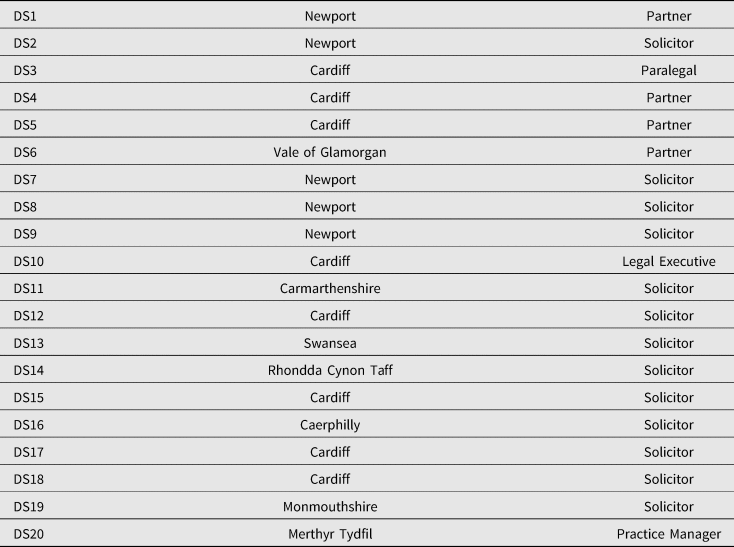
The data has been generated from semi-structured interviews with 20 lawyers and legal representativesFootnote 21 who conduct criminally legally aided defence work across south Wales (Table 1).Footnote 22 As per Kvale, the interviews aimed at ‘obtaining nuanced descriptions from the different qualitative aspects of the interviewee's life world’.Footnote 23 We recruited based on snowball sampling, taking recommendations on who to contact across the south Wales region from those already participating. There are 126 criminal law offices in Wales, 80 of which are in south Wales. The lawyers – which included solicitors, paralegals, legal executives, and practice managers – in our study were drawn from 16 firms, varying in size in terms of their criminal practice and other areas of law.Footnote 24 Whilst based across 9 local authorities, the lawyers worked across all 12. Our sample (16 firms out of a total of 80) places limits on generalisability, but our research nevertheless provides an important window into criminal legal aid in (south) Wales.
interviewees

The interviews were premised, inter alia, on the criminal defence practitioners’ experiences of interacting with clients, and whether this had been constrained by cuts to funding.
From undertaking previous research in criminal legal aid and the lawyer-client relationship, and a thorough consideration of the literature, we were aware of the important issues that lawyers often raise about their practice and their views on funding. For the purposes of this paper, the relevant questions centred on lawyers’ interactions with clients such as whether they were able to meet their clients before the day of the hearing, how well they got to know their clients, how often they would see clients, what pressures were imposed on criminal defence lawyers, and the impact, if any, of legal aid funding on the lawyer-client relationship. We also asked lawyers, at the start of the interview, to give us some background as to how – and why – they got involved in criminal defence work and how long they had been working in criminal defence.
Interviews lasted on average 1 hour and 2 minutes, with the longest taking 2 hours and 2 minutes and the shortest lasting 29 minutes. The interviews were transcribed, and then coded using thematic analysis – a method for identifying, analysing and reporting patterns across a data set, allowing the authors to draw out new insights.Footnote 25
The focus on Wales was also central to our methods: we sought to investigate the co-constitutive relationship between people, place, and the law.Footnote 26 In doing so, we build upon Newman's call for a greater sense of place in socio-legal studies and the need for studies of the criminal justice system to account for the place within which they are conducted.Footnote 27 Such analysis must draw out the specificities of local conditions and circumstances; assumptions regarding the effects of the austerity programme and the functioning of justice on the ground should be avoided.
Central to this is the focus on space and time; whilst we recognise – as noted above – that these themes may relate to state funded criminal defence beyond England and Wales, we argue that the research is also grounded within Wales – and more specifically in south Wales.Footnote 28 In doing so, we contribute to the – still underdeveloped – geography of law discipline that has been deemed central to understanding the relationship between legal institutions and norms.Footnote 29 We also recognise the construction of place:Footnote 30 whilst the boundaries of south Wales can be – and are – contested and the notion of culture herein can be debated, the label ‘south Wales’ made sense to our participants.
The recognition of Wales as a site of socio-legal exploration has also informed our research: Wales has been largely ignored in the socio-legal literature with the notable exceptions of Mungham and Thomas's study in the late 1970s (on plea-bargaining),Footnote 31 Franklin and Lee's work in 2007 (on the legal profession in rural areas),Footnote 32 and Newman's aforementioned research in 2016 (on access to justice in mid-Wales).Footnote 33 For a country that forms one half of the England and Wales jurisdiction, the dearth of research is one of great significance. The problem, as we recognise it, has been that for many socio-legal scholars, Wales is either not considered at all or is assumed to be synonymous with England. However, Wales is not a region of the UK but instead a country with regions (often with great variance); this must be recognised in order to understand how criminal justice operates in Wales and, more broadly, how it operates (variances included) within England and Wales.
Access to criminal justice and the challenges facing criminal defence
Criminal legal aid is a means-tested entitlement to state-funded legal representation available for police stations and, depending on means-testing and the nature of the offence, courts in England and Wales. Thus, in police stations and in courts, criminal duty solicitors, funded by the public purse, may be present to advise and represent suspects and defendants.Footnote 34 Yet, criminal legal aid has suffered significant cuts in recent years. During the period of austerity, criminal legal aid was cut by 8.75% under the Coalition;Footnote 35 the overall Ministry of Justice (which includes legal aid) budget fell by 29%,Footnote 36 signalling the most significant cut to any Whitehall department. Such cuts may undermine access to justice, as access relies on the availability of criminal defence lawyers funded by legal aidFootnote 37 (although there may indeed be instances where access to justice does not require access to legal advice and/or representation, such as in non-contested speeding offences).
In addition to cuts to the legal aid budget, the fees payable to criminal duty solicitors have not increased in England and Wales since 1998,Footnote 38 such that they are worth less than they were 20 years ago. Whilst disincentivisation can occur without fee reductions, it most certainly will happen – and is happening – with such reductions.Footnote 39 Even those lawyers committed to public service may reach a point where they feel compelled to compromise their principles to address practical (and justifiable) business concerns,Footnote 40 thus necessitating a moral compromise between the best – but lengthiest (and most expensive) – option and one that is quicker, cheaper and simply ‘good enough’.Footnote 41 Practice viability – and survival – will thus depend on a mass volume of clients.Footnote 42 The consequences are negative for both lawyers and their clients. First, working conditions deteriorate and morale is eroded with legal aided criminal defence becoming unsustainable in practice.Footnote 43 Secondly, citizens are unable to fully enforce their rights (something that is central to the state-citizen relationship);Footnote 44 within the frame of cuts and fee stagnations, the suspect (or defendant) may struggle to access a lawyer (as a result of firms going out of business, which leads to an absence of advice in some areas) or, at least, to access a lawyer who is able to devote themselves to the client's case. The result is that significant sections of society may be unjustly denied access to an essential public service in terms of quantity or quality of provision.
To further compound these issues, the age of the criminal duty solicitor is steadily rising, particularly outside of large urban areas: nearly half of duty solicitors in England and Wales are over 50; this proportion rises to nearly two thirds in rural areas.Footnote 45 It is thus significant that the Law Society predicted ‘in five to 10 years’ time there could be insufficient criminal defence solicitors in many regions, leaving people… unable to access their rights’.Footnote 46 The impact is most likely to be felt in rural areas, where there are fewer firms, greater distances to travel, and fewer draws for young graduates. The Law Society figures show that in Dorset, Somerset, Wiltshire, Worcestershire, west Wales and mid Wales, over 60% of duty solicitors are aged over 50, while in Norfolk, Suffolk, Cornwall and Worcestershire there are no criminal duty solicitors aged under 35, with only one in west Wales and mid Wales, and only two in Devon.Footnote 47
In the section that follows, we further address the overarching themes emerging from our data: the impact of political decision-making, the consequences of underfunding, and the sustainability of criminal legal aid practice. Whilst lawyers spoke in general terms about these matters, there were also issues that were specific to Wales, which will also be explored below.
Political decisions and criminal legal aid
It has been rather easy for the legal aid budget to be hacked away and publicly funded legal assistance to be degradedFootnote 48 without offending or upsetting most of the electorate. Legally aided criminal defence lawyers work within ‘the least loved arm of the welfare state’,Footnote 49 something that is not helped by the media (who in concert with (some) politicians) speak about lawyers with a general disdain, often as fat cats who continuously milk the system.Footnote 50 Their clients – an underclass distinct from the good, law-abiding citizens of the general population – are also viewed as either unimportant or a burden on the state. Increased criminal justice spending is not generally perceived to be a subject of any significance to voters (who arguably view it through the lens of Bottoms’ populist punitivenessFootnote 51 and Pratt's penal populismFootnote 52 and are therefore unsympathetic to those accused of criminality). The lawyers recognised this issue:Footnote 53
It's never a vote-winner, which is why the justice budget is being cut continually. To say you're a criminal defence lawyer never goes down well with the public. They see, you know, you get all these ‘fat cat’ labels and, ‘How can you defend people that are guilty?’ (DS9)
The decline in legal aid, as most clearly exposed by Smith and Cape, means that ‘the prospects for criminal legal aid in England and Wales are bleak’.Footnote 54 Yet, whilst England and Wales have both been negatively impacted by cuts to criminal legal aid under austerity, the cuts have been more pronounced on Wales than they have in England. The Commission on Justice in Wales has shown that total expenditure on criminal legal aid across England and Wales as a jurisdiction fell from £1,045 million in 2011/12 to £873 million in 2018/19, whilst for Wales in the period 2011/12 to 2018/19, it reduced from £48.44 million to £36.10 million.Footnote 55 Thus, while the whole jurisdiction faced a real terms reduction of nearly 26%, Wales saw a larger real terms reduction of nearly 34%. The Commission on Justice in Wales noted that:
The decline in expenditure in Wales has had a severe impact on the availability of publicly funded criminal legal aid in Wales which has a much smaller part of the available funding than it had in 2011–12. This cannot be justified by the argument that criminal legal aid is demand led and that there are more large scale cases in England. The differential reduction is too severe for that.Footnote 56
However, little is often known about developments at a Welsh level: most data presented are not generally disaggregated and breakdowns can be difficult to impossible to find in official publications, thus masking the specific challenges within Wales. Whilst the Ministry of Justice has recognised the value of collecting and publishing ‘Welsh-only’ data, pledging to make it more easily accessible on its website,Footnote 57 ‘access to Welsh-only data… remains poor and, in a number of areas, disaggregated data held by the Ministry of Justice has only become available by means of requests for information under the Freedom of Information Act 2000’Footnote 58 (an FOI request). One example of a lack of disaggregation relates to the decline in criminal legal aid firms such that, arguably, Wales could be lost amongst a dataset dominated by England. The table below (Table 2), produced via Written Questions to the Secretary of State for Justice for February 2019, illustrates the decline across England and Wales. Table 3 provides the information for Wales only based on an FOI request. Whilst there has been a 31.7% decrease in criminal legal aid firms across England and Wales, the decline was almost 8% higher (at 39.04%) in Wales. Further, the decline in offices was higher in Wales as compared with England and Wales – at 26.06% across the jurisdiction compared with 32.36% within Wales. The result is that, for England and Wales, with a total population of 59.12 million there are 30.78 criminal offices per head of population; in Wales only this drops to 24.9 offices per head of the population (there are 3.14 million people in Wales). To judge by access to lawyers, the crisis in access to criminal justice appears to be more pronounced in the Welsh portion of the England and Wales jurisdiction.
decline in criminal legal aid firms: England and WalesFootnote 59

decline in criminal legal aid firms: Wales onlyFootnote 60

The general neglect of Wales emerged during interviews, with DS19 highlighting the disregard that Westminster has for Wales:
What do the government care about it? …It's Wales for a start, and there's not – there's nothing in it … for Westminster in Wales, is there? Because it's… a Labour stronghold, or so they think, and – it's part of the Assembly although, obviously, criminal justice, all that sort of stuff, has nothing to do with the Assembly, but you know, there-there's nothing politically in it for them, so why would they bother? (DS19)
DS19 reflected the idea which often came up, that Wales was not a priority for the UK government; as such, the ‘crumbling’ of the system is thus particularly pronounced in Wales. More generally, there was a concern that the justice system was low-hanging fruit for the UK government when cutting budgets:
Why should the Ministry of Justice suffer more cuts than any other department… it's the political decision that those people aren't going to scream and shout, whereas the health services, they cut that – or education, which has actually had cuts but you know… under the radar – then there would be political consequences. It's a factor that the Ministry of Justice is considered the, the lowliest sort of department, or the one that can suffer cuts without any public or media attention. (DS19)
Thus, the Ministry of Justice and – within that – legal aid has suffered from cuts with relatively little public protest. Yet, as will be explored below, there are serious implications for reducing and under-funding criminal legal aid.
Underfunding and its consequences
The under-funding of criminal legal aid has an impact on the working practices of lawyers, restricting what they can do (and what they are inclined and/or willing to do) and shaping how they can do it. This is an issue that does not appear to have a particular Welsh focus and would be common across England and Wales, as evidenced by previous scholarship in England.Footnote 61 Due to the fee cuts and stagnation, lawyers are required to take on more cases to make their practice sustainable. However, due to pressures on capacity and resources necessitated by the volume of work, the per case scope of a defence lawyer's work required reduction. Lawyers in our study told us how they require a criminal practice based on taking on a large number of clients in order to ensure that criminal legal aid brings in enough money to make a profit for the firm, ie economies of scale. This is evidenced by the following lawyer, who discussed how they need to keep busy:
So you probably work out how much work you need to do on a case and know that you're, you know, the fixed fee comes nowhere near it. So, yeah, again sometimes that may impact on the way that you prepare the case. It's possible. Yeah. Especially when you're busy. You know, because you, in order to try to make a living out of this, the only way round [sic] the fixed fees is to have a lot of work. So that the volume increases, so that you're still getting lots of work in. And sometimes when that happens, because you're so busy, you can't give a certain client enough time that they really should deserve on their case. We try our best, but sometimes it doesn't happen. (DS4)
This lawyer, then, worries about the time they can give to their clients. They have identified the need to make compromises: individual clients may get less time than they need in order to ensure that the firm still offers representation to criminal clients as a whole, by remaining viable as a business. This is the tension that Welsh identifies between acting efficiently and providing the best level of service they can.Footnote 62
Another lawyer in this research compares this approach to the factory system as discussed in academic literature.Footnote 63 They identify responsibility for necessitating such an approach on successive governments and their approach to criminal justice, as in this quote:
But I can certainly appreciate that if you're sort of fully funded and reliant on legal aid work, what you're going to do is go to a factory sort of system where you are just bringing them in, getting them done, getting them out, because you haven't got time to mess about. And that is a terrible indictment of the position that a decade worth of cuts and efficiencies and everything else has done to our criminal justice system. (DS10)
The above articulates a little of the anger felt by the practitioners with whom we spoke. There was a sense of frustration, and often resignation, about the way that successive governments had degraded the criminal justice system and, in particular, the legal aid scheme, such that it undermined the ability of practitioners to deliver access to justice for those suspected and accused of crimes.
An important part of understanding the need for volume is reflected in how some cases have the effect of losing money for the firms. We were told that, often, longer cases were not cost efficient. Welsh has detailed the calculations to be made as lawyers’ work on cases moves between different categories of fee, which can pose great difficulties in allowing practitioners to do the work they need to do in order to deliver a quality service and, in particular, be paid for it.Footnote 64 Our participants often discussed problems of fees. In the following example, one lawyer talked to us about their experiences of how the working out of these fees created problems:
… say a two-hour trial in a magistrates’ court, where you're not going to get into a higher standard fee, then you're going to get two hundred and seventy quid, plus about maybe fifty quid travelling weight. So three hundred pounds for a trial. With two hearings and all the prep. So you lose money hand over fist on your general police station work, unless you've got a load of people in, and you get picking up standard fee. Standard fee in the police station's a hundred and seventy-seven. Oh, no it's not, a hundred and sixty-nine. Pounds. And that's regardless of how many times you've got to go back. So you can do up to, I think it's sixteen hours’ worth of work, for your hundred and sixty-nine pounds. So you lose money on that, you lose money on the magistrates’ court, and you make your money on the odd Crown Court case which happily falls within one of the four well-paid categories. So my colleagues just dealt with a case which was a higher-paid category. In that case it was a long trial, but we got paid fifteen thousand pounds. Comparative case on the lower category you get paid fifteen hundred pounds. So the whole funding of the Crown Court thing makes no sense at all. (DS1)
The bulk of lawyers’ remuneration is derived from long, complex work; however, such work is relatively rare. Rather, it is volume work (chiefly at the magistrates’ court and police station) that makes up most of lawyers’ day-to-day work. This can be unprofitable in circumstances where the amount of work needed on a case does not match up with that funded through the standard fee. As such, legal aid remuneration is skewed, causing lawyers to place little value on most of their work, and excessive value on a small number of complex cases; the payment system may also give the impression that volume work is not valued. Some of the more time-consuming volume cases were thus framed as problems for these lawyers as they felt such cases were not properly reflected in the criminal legal aid scheme as presently constituted. Volume work meant doing the simpler jobs wherein it was feasible to balance multiple cases (such as long lists of clients to work through as quickly as possible on any day in court) and, in the end, make money on the work that was done. When cases such as those raised by the lawyer slowed them down, it risked the profitability – and, crucially, the sustainability – of the firm.
A human factor that needs to be taken into account is that highly qualified, vastly experienced professionals will invariably be expecting to do more than just scrape toward profitability. Sommerlad has shown how the marketisation of legal aid has changed the status of such legal practitioners.Footnote 65 As Newman found, despite legal aid pressures, practitioners are still proud of what they do – the lofty principles of justice that they stood for and the idea of civic service.Footnote 66 However, these lawyers did not feel valued in financial terms, as expressed by DS16, for whom, ‘if you're in the police station on a Saturday night, dealing with an attempted murder, you've been a solicitor for eighteen years, you'd expect to earn more than seventy quid to do that case’. Beyond the professional pride alluded to by the previous lawyers, one of the inevitable consequences of funding restrictions is that it will mean that lawyers may only be able to do just about enough. As noted above, the marketisation of legal services identified by Sommerlad means that even the most committed lawyers reach a point where they feel the need to compromise their principles for practical business concerns.Footnote 67 The lawyers we spoke with were sometimes despondent about how this played out: they needed to focus the bulk of their energies on ensuring that funding was sufficient to keep them in business. They were thus often unable to go over and above for their clients, in the way they would have liked (or, at least, they suggest that they once had more freedom to do so). The following quote reflects the sense of hopelessness felt by some of our participants in this regard:
Especially if you're a duty solicitor on the day [in court?], then you're, it's just a matter of going through the motions in terms of funding. (DS13)
Some practitioners told us about the extra work they did without payment, such as meeting previous or regular clients at court to talk to them before a case is heard. Such extra work is done either on top of legal aid fees or in place of them when it was refused, and thus the system is operating on the goodwill of these practitioners. The downbeat tone of DS13, though, was more commonplace, as practitioners lamented the practical restrictions that were placed on them.
In the next quote, a useful example is offered of how this can play out. Here, the effects of legal aid cuts can be seen to have an impact on how much work can reasonably be put into a case:
Back ten years ago, if there was a road traffic collision, I'd go out and go to the road and have a look at it and take pictures. I'd go around and speak to various people about the incident. If it went to Crown Court, I'd go to Crown Court and seek out Counsel and make sure Counsel have everything ready for the case. Now with the legal aid cuts and the way things are, you don't get paid for any of that, and there's less incentive to do a good job other than pride and responsibility and they can only carry you so far, especially with a firm that wants to make money, like every firm does, otherwise we couldn't stay open. I can't go out and do the best job that I can do and justify it. I just can't. I mean, on the more serious ones you can, but on the less serious ones, which are still serious for them, you can't justify it. There's no incentive to go out and do anything above and beyond what you're expected to do and that's really, really sad. (DS2)
Lawyers, then, might be doing enough but not as much as they think should be done. In some cases, they are cannot afford – or feel unable – to perform certain tasks that may indeed be vital to their client's case. Legal aid is not necessarily providing those suspected and accused of crime with the full skills and attention of their lawyers (what may be termed a ‘full service’); sometimes, perhaps increasingly, it is compelling talented, knowledgeable professionals to offer a minimal level of service. Enough but not what it could and – according to the professionals that might be considered best placed to judge the quality of legal advice and representation – should beFootnote 68 (although it should be recognised that professionals are not necessarily neutral in judging the quality of their own work, even if they may be best placed to do so).Footnote 69 The end result was burnt out, worn down practitioners, who increasingly lacked the capacity or energy to put the extra work in, or to be ‘zealous advocates’.Footnote 70
In the following quote, a lawyer describes this process in terms of goodwill:
In common with all publicly-funded services I suppose it, it, it diminishes the amount of goodwill there is in any system, whether it's teaching, nursing, local government, whatever it may be. Because if people are, find themselves under pressure, expected to deliver more work for stagnating or less remuneration, then it will create a degree of ill-will, ie whereas there would be slack in the system so you might help people out, when you're not getting paid to do it, there, there will be less of that goodwill around, in any environment that's treated in that way. (DS18)
This lawyer, then, identifies what has happened to criminal legal aid lawyers as part of a wider trend under austerity whereby public sector workers, as a whole, are becoming demoralised by the chronic underfunding of essential state services. This demoralisation then has a consequent impact on the quality of services delivered in our Wales study, and probably across the jurisdiction.
The future of criminal defence practice
Issues around criminal legal aid have had an impact on firms and the ability of practices to provide criminal legal aid. This has impacted England and Wales, although Wales has been harder hit overall. Compared with 2010 and the start of the austerity period, there are almost a third fewer criminal legal aid firms in operation across England and Wales, and two-fifths fewer in Wales. This is a geographical retraction of legal aid, as work becomes concentrated amongst a smaller number of providers, and causes problems across the England and Wales jurisdiction, with the potential adverse impact highest for any rural area or smaller town. This was recognised by those we interviewed. The following extract reflects on the decline of criminal legal aid firms:
I do tend to do work around the country… I can see how in bigger cities there is a dearth of client care. That's possible. But the reality of that is that those firms who have got a larger number of clients coming through and a greater pool from the legal aid fund will be able to survive, whereas south Wales has historically been a lot of smaller companies, a lot of one-man bands. It's just going to be impossible for them to survive with legal aid cuts, with legal aid regulation, with all the requirements that are placed on you to just have a firm with SRA [Solicitors Regulation Authority] compliance. We're in a different, different position of, there is quality being provided but how long can it last? (DS5)
This lawyer shows concern about the impact of reductions in the number of firms and offices, and how this will impact on the quality of work and the service received by clients. It, crucially, also identifies particular issues for the communities that we have been studying, wherein the closure of criminal legal aid services is part of the wider retraction and centralisation of the state from rural areas (where poor transport links present a problem) to the large towns and cities.Footnote 71 There is, therefore, a risk of advice deserts emerging in areas that are less densely populated.Footnote 72 While this would be best addressed through quantitative research, it was an issue that the lawyers we talked to were keen to discuss.
Reflecting on how this played out in one of the areas within our research, the scale of criminal legal aid losses is demonstrated by the following:
I mean, even in Abergavenny there were probably about ten firms of solicitors when I first started; there's now three. And in Ebbw Vale…two or three, out of, maybe – there were ten or fifteen. So, it's just declined and declined and declined. (DS19)
One problem facing Welsh firms was the notion that Wales was supposedly a nation of high-street practices according to many of those with whom we spoke. This was identified as a Wales-specific finding. Welsh legal culture outside the large cities was supposedly based on a nation of high street practices, firms that did not generally specialise in crime but covered a multitude of legal areas such as conveyancing and family law matters. For DS11, ‘the number of duty solicitors is getting less, but they're also concentrated in less, in fewer firms’. We were told that high street practice was a thing of the past, partly as older lawyers in rural and remote areas retired and were not replaced because there was a lack of will for younger lawyers to take on relatively low paying criminal practices. The lawyers often talked about the Valleys as an area of concern for such high street practices. Giving the example of Tredegar, a town in Blaenau Gwent, this lawyer expressed their worries:
If your high street practitioner in Tredegar closes? You know, in fact… I could probably bet you ten pounds that if you walk down Tredegar high street, you're not going to find a solicitors’ practice, because they can't afford to dabble in bits. You either have to go all in or not at all. So as a nation of high street practices it's a very Welsh issue, that if you lose one aspect of it you can't afford to run the rest, so you close the firm down, and then the rural areas especially, if they, you know, they want a defence solicitor, they've got to come to Newport or Cardiff. (DS9)
In this, DS9 presented the idea that those in the Valleys found it hard to take on the volume of work needed to make criminal legal aid sustainable.
This reduces client choice and raises possible issues of availability. Reduced client choice may also lead to less competition (as practitioners may have a monopoly over services), which in turn may result in stagnated quality (as there is little or no competition to drive up quality) or may force lawyers to work longer hours (often unpaid) out of a sense of professional pride. It also raises significant problems of access: some people will not be able to travel to the next nearest office, whether through disability and chronic health conditions or through the cost implications of travel, and this raises serious questions about access to justice.
Losing lawyers from the community – who know and are known by the community – risks removing the local expertise lawyers often rely on while also reducing trust amongst clients, which is vital to a workable lawyer/client relationship, particularly in criminal proceedings. This is an issue that will impact rural areas broadly, and has been identified in previous socio-legal research beyond Wales. Lawyers change their service to fit local conditions.Footnote 73 For example, Eisentein shows how social life in rural communities emphasises the importance of personal relations, with day-to-day life characterised by intimacy and high visibility.Footnote 74 In such scenarios, the expectation is that personal relationships and cohesion keep the local community functioning, so that any system of justice that was too alien for the local community would be rejected.Footnote 75 Investigating the Welsh context in particular, Franklin and Lee have demonstrated the importance of such considerations in many parts of Wales and they form key considerations for Welsh lawyers in many of the country's more rural areas,Footnote 76 as in areas of our sample such as Bridgend, Carmarthenshire and the Vale of Glamorgan.
Reductions in numbers of law firms and offices providing criminal legal aid should be understood to also reflect a loss of practitioners from this branch of the profession, as some will invariably leave the profession. To worsen matters, these practitioners are also not being adequately replaced. The impact of the criminal legal aid situation on recruitment and retention must, then, also be considered, according to lawyers in our study such as DS13, who told us that ‘because there's just no recruitment, essentially, people are leaving the profession and nobody's coming through’.
In part, problems with recruitment and retention come from the fees earned – criminal legal aid work is so poorly remunerated that many newly qualified lawyers are deciding not to practise in criminal law, whilst others are moving from criminal into other areas, for example, local authority work. The following quote has a lawyer explaining how they respond to potential criminal lawyers:
It impacts on the advice that I give to students that want to be criminal lawyers, I tell them not to do it. With a heavy heart, but I tell them not to do it, because they'll never – they'll always be poor! Because it's hard work being a legal aid lawyer and it's very important, obviously. And it's so badly remunerated, it's just, it's, it's ridiculous. I could earn more money if I went and managed a KFC than I could if I was a legal aid lawyer in Cardiff. (DS16)
This lawyer, then, openly advocates that law students look elsewhere for their legal careers as the legal aid situation is so dire. This was a common message from respondents; they found it hard to honestly recommend criminal legal aid as a career due to the pay conditions. As such, many of the brightest and most hard-working graduates may go elsewhere; criminal legal aid work will be left to the most dedicated and, perhaps, those who struggle to get work in the better remunerated avenues of legal work.Footnote 77
The following highlights a potential future for criminal defence:
My two sons who are sixteen and eighteen who probably, certainly the younger one would have definitely become a criminal lawyer but how can you recommend a profession which is – it's not just the money but you need money to be able to live and unfortunately in the next five, ten years I can't see it is going to be a profession which is going to attract those of perhaps the calibre that it once would have done. (DS5)
Our research also highlighted that many practitioners follow relatives into practice. However, this lawyer could not recommend that their children follow them into criminal legal aid work. If, as this lawyer suggests, only a lower calibre of graduate will apply for criminal work it will only fuel the situation whereby fewer firms offer criminal legal aid as they may decide they do not want to, or cannot justify, parts of the firm being run by supposedly less capable lawyers.Footnote 78 The following quote suggests an uncertain future for criminal work:
And I think lots of, lots of firms are in that position at the moment where they are considering their future in terms of crime, certainly legal aid crime. And that's one of the problems that you've got with crime, is being able to offer a young lawyer a salary worthwhile. (DS9)
If criminal legal aid work cannot offer a good enough wage, the lawyer echoes the sentiment of others with whom we spoke: there may be serious problems ahead for this part of the justice system. The institution – both in terms of the firms and the wider structure of criminal legal aid – is therefore at risk.Footnote 79
For Thornton, overcoming the problems facing criminal legal aid must include addressing the financial situation, as it underpins many practitioner frustrations:
Currently, those who cannot stomach this, leave…. In this way, whilst financial issues can be blamed for recruitment and retention issues, it is important to understand how this operates indirectly as well as directly. On that basis, it may well be that a relatively small increase in funding could have a disproportionately positive effect in terms of lawyer morale, because although it would not allow defence lawyers to experience a champagne lifestyle, it would go some way to alleviating the concerns…. As it stands though, the profession, as we know it, appears unsustainable.Footnote 80
This was true in his English research, just as it was in our Welsh research: it must, therefore, reflect a jurisdiction-wide finding. Read alongside these issues are anxieties regarding the demise of the criminal defence profession and crucial schemes such as the duty solicitor. Without a lawyer, the power of the police may remain unchecked (something that is particularly worrying, given that – as Jackson has highlighted – what happens at the police station has effectively become part of the trial).Footnote 81
As noted above, the average age of the criminal duty solicitor is steadily rising across England and Wales (albeit with some of the most concerning trends in rural parts of Wales). This issue was raised by one of our participants:
There was a recent statistic saying the average age of the criminal duty solicitor is now something like fifty … there is less coming through the other end than there ever has been. So that could be a problem going forward. (DS4)
Where the next generation of criminal duty solicitors is coming from should be a major concern, particularly as many lawyers will leave practice in the coming years. The following quote highlights the issue:
Because there's a batch of solicitors around the sort of fifty-five to sixty-five age, that are going to be leaving the profession in the next ten years. And that means those of us who are left are going to be doing more and more, especially on-call work. And you know you're also getting to an age then when you – going to the police station three times a week in the middle of the night is, health-wise, it'll take its toll. But what's the alternative? Because there's not enough money to employ younger members of staff to train them. (DS7)
Whilst the issue of recruitment arguably affects all of England and Wales, particularly outside large urban areas, it was noted as of particular concern in mid and north Wales (which are both largely rural areas). The following quote identifies the spread of this problem:
Well it depends where you are, doesn't it, in mid Wales, north Wales? It's just numbers. At the moment it's very difficult to find anybody. I've got a friend who's … got a practice in mid Wales, and they can't get anybody, and I think that's going to come… there are still youngsters who want to come into the profession in south Wales, but I think that's going to become the same. (DS5)
A counter-argument on the decline in lawyers might run that, with fewer people and lower overall crime rates, these areas might have a lesser need for legal services.Footnote 82 Of course, such an argument would be highly controversial when discussing, for example, a lack of doctors. The difficulty of making a similar argument on health care has been seen in the angry protests in the region over the proposed closure of a Valleys Accident and Emergency facility.Footnote 83 As a welfare-oriented public service, to accept a lack of lawyers in this way would also be to focus on figures to such a degree that it would devalue the individual needs of citizens in such areas. According to the Law Society, the situation is not as bad in south Wales as in many other areas of England and Wales but, with nearly half of all criminal duty solicitors over the age of 50, it is a source of anxiety and one of which our respondents were aware.Footnote 84 The decline of criminal legal aid – and consequently of criminal defence services for ordinary citizens – is a live concern. Our participants noted the apprehension for current practitioners and there was overwhelming pessimism regarding improvements in the situation.
Conclusion
Our research raises important issues with regard to the future of criminal defence in Wales and across England and Wales. The interviews with lawyers support the statistics that suggest a decline of legally aided criminal defence work. The implications of undervaluing criminal defence work, and underfunding the criminal legal aid scheme, need to be taken seriously. They pose a threat to the future of access to justice in the criminal justice system.
This paper has highlighted that criminal defence practitioners in Wales do not feel able to do their job to the best of their abilities due to the current funding situation (although earlier studies conflict on whether lawyers would ‘do their best’ anyway).Footnote 85 This finding resonates with other studies across the England and Wales jurisdiction. Lawyers know what they could and should be doing, whilst they have the knowledge and expertise to be doing it. We have heard that it is the legal aid system that is holding them back; they are in a systemic straight-jacket.Footnote 86 The result is that those suspected and accused of crimes may find themselves in situations where – as a result of cost-cutting to the criminal justice system – their access to justice is undermined by a practitioner who is not able to provide the service they need. The accounts of practitioners that we have collected show that important rights within the criminal justice system are in danger of being undermined, as part of the reduction in spending represented by the wider ideological drive for austerity.
The lesser service that lawyers fear they will have to provide has been shown to reduce the morale of practitioners. As a result, they are less likely to accept the low pay and reduced status, which will in turn stifle recruitment into and retention within this branch of the profession. Even if they can manage to make criminal legal aid profitable, there may not be enough high-quality practitioners around to provide the service. The loss of criminal legal aid provision is emerging as an ever more serious challenge, and we run the risk of losing any service at all, which would undermine rights and protections provided in UK and European human rights law. There is a risk that the provision of such services may decline in some areas faster than others, creating justice deserts, and a postcode lottery for advice and representation and – by extension – access to justice.
Legal aid is necessary to ensure that suspects and defendants can be provided with support (although legal aid may, in and of itself be insufficient). Funding and a wider commitment to legally aided criminal defence is also necessary to ensure that defence practitioners can continue to work in this field (and can do so adequately) and to ensure that criminal defence, as an institution, is sustainable in the long term. For some time, the system has been operating, in part, on goodwill; such an approach is unsustainable. Without adequate state support, it is likely that the death knell will soon ring for legally aided criminal defence work.
Our research sample, given its relatively small size in one region of the England and Wales jurisdiction, is indicative rather than conclusive (and there are thus limits to the generalisability of the data). However, it supports a widely established and discussed narrative on legal aid and adds to a small but growing body of contemporary studies into criminal legal aid in England and Wales and thus complements important studies such as Newman,Footnote 87 WelshFootnote 88 and ThorntonFootnote 89 and adds a (southern) Welsh experience to their primarily (southern) English samples. In future publications, we intend to add to these insights by including the voices of other actors in the criminal process. Moving forward, more research should be conducted to explore and examine the experiences of practitioners, including the impact of fees on the service provided, and how – or whether – suspects and defendants (as clients) experience cuts to these services, with particularly emphasis on similarities and differences between the experiences of client and practitioner.
Many of our findings have potential application across England and Wales (such as the unfavourable impact of criminal legal aid cuts on individual lawyer practice). Others, such as the decline in criminal legal aid practices caused by cuts, may also be generalisable across the two countries as part of a rural-urban divide, albeit with specific Welsh characters as found, for example, in issues around accessibility for Valleys communities that are ostensibly close to urban centres. We posit that further research should also be conducted in Wales both as a point of academic inquiry and as a matter of principle. Whilst the south Wales case indicates similar trends as compared with England, this cannot be assumed. Without engaging with the smaller – but equally important – part of the England and Wales jurisdiction, knowledge production, debate and discussion are being stifled. As noted in the introduction, the Commission on Justice in Wales has recommended the establishment of a Welsh legal jurisdiction, with criminal justice powers to be devolved as soon as possible.Footnote 90 There is a pressing need to examine the coalface of criminal justice in Wales, as we have done here (albeit limited to criminal legal aid). Further, there is the potential to address the problems of the legal aid provisions in England and Wales and learn from the limitations that currently exist. Exploring the impact of legal aid cuts, as we have in this paper, provides crucial lessons. We hope other scholars will follow suit and conduct more research on criminal legal aid in other regions of Wales and investigate a range of other criminal justice issues across the country. Such research will benefit Wales here and now, and in any future devolved justice system, but should also have broader interest and impact for those involved in criminal justice matters across England and Wales.