INTRODUCTION
Ciliated protozoa are an important component of microplankton communities in many aquatic ecosystems and play a crucial role in the functioning of microbial food webs (Azam et al., Reference Azam, Fenchel, Field, Gray, Meyer-Reil and Thingstad1983; Pratt & Cairns, Reference Pratt and Cairns1985; Sherr & Sherr, Reference Sherr and Sherr1987; Caron & Goldmann, Reference Caron, Goldmann and Capriulo1990; Dolan & Coats, Reference Dolan and Coats1990; Kchaou et al., Reference Kchaou, Elloumi, Drira, Hamza, Ayadi, Bouain and Aleya2009; Xu et al., Reference Xu, Yiang, Al-Rasheid, Song and Warren2011a, Reference Xu, Zhang, Jiang, Min and Choib). It has been increasingly recognized that ciliated protozoa have many qualities that make them suitable for the assessment of water quality (Cairns et al., Reference Cairns, Lanza and Parker1972; Cairns & Henebry, Reference Cairns, Henebry and Cairns1982; Xu et al., Reference Xu, Cao, Xie, Deng, Feng and Xu2005, Reference Xu, Min, Choi, Jun and Park2009a, b; Tan et al., Reference Tan, Shi, Liu, Xu and Nie2010). With their short life cycles and delicate pellicles, they usually respond more rapidly to environmental change than most metazoa (Coppellotti & Matarazzo, Reference Coppellotti and Matarazzo2000; Ismael & Dorgham, Reference Ismael and Dorgham2003; Kchaou et al., Reference Kchaou, Elloumi, Drira, Hamza, Ayadi, Bouain and Aleya2009). Thus, ciliated protozoa have been increasingly used as bioindicators of water quality in aquatic ecosystems (Xu et al., Reference Xu, Min, Choi, Jun and Park2009a, Reference Xu, Min, Choi, Kim, Jung and Limb, Reference Xu, Yiang, Al-Rasheid, Song and Warren2011a, Reference Xu, Zhang, Jiang, Min and Choib; Jiang et al., Reference Jiang, Xu, Al-Rasheid, Warren, Hu and Song2011a, Reference Jiang, Xu, Hu, Zhu, Al-Rasheid and Warrenb).
Several studies have demonstrated that natural aquatic communities tend to have inherent patterns of body-size spectra and their normalized variants (Sheldon et al., Reference Sheldon, Prakash and Sutcliffe1972; San Martin et al., Reference San Martin, Harris and Irigoien2006; Kamenir et al., Reference Kamenir, Dubinsky and Harris2010). Thus, body-size spectrum analysis has long been considered as one of the tools capable of assessing ecosystem change due to environmental stress and anthropogenic impact (Sheldon et al., Reference Sheldon, Prakash and Sutcliffe1972). However, this pattern may be affected directly by biological rather than abiotic factors, since body-size is an important feature influencing biological interactions such as predation and competition, and physiological traits such as metabolic rate, growth and mortality (Peters, Reference Peters1983; Akin & Winemiller, Reference Akin and Winemiller2008).
The size distribution of the pelagic community has the potential to compare ecosystems with different species composition as well as to identify the main functional properties of the system. Plankton size spectra are an effective approach for summarizing the size-structure of the community and have the potential to indicate the transfer of energy up the trophic food web. Ciliated protozoa have long been considered as primary mediators of energy transfer from pico- and nanoplankton producers to higher trophic levels (Stoecker & McDowell-Cappuzzo, Reference Stoecker and McDowell-Cappuzzo1990; Gifford, Reference Gifford1991; Legendre & Rassouldezgan, Reference Legendre and Rassouldezgan1995; Sime-Ngando et al., Reference Sime-Ngando, Gosselin, Roy and Chanut1995; Elloumi et al., Reference Elloumi, Carrias, Ayadi, Sime-Ngando, Boukhris and Bouain2006; Jiang et al., Reference Jiang, Xu, Al-Rasheid, Warren, Hu and Song2011a, Reference Jiang, Xu, Hu, Zhu, Al-Rasheid and Warrenb). Thus, their body-size spectra may be influenced by the body-size patterns of their prey (e.g. bacteria and microalgae) which may themselves be directly related to water quality status, as reported for other zooplankton organisms such as copepods (Akin & Winemiller, Reference Akin and Winemiller2008; López & Anadón, Reference López and Anadón2008). So far, however, the relationships between the body-size spectra of marine planktonic ciliates and environmental conditions have been subject to only limited investigation.
In the present study, the temporal variation in the body-size spectra of planktonic ciliated protozoan communities in Jiaozhou Bay, Qingdao, northern China was analysed using multivariate approaches based on an annual-cycle dataset (June 2007–May 2008). Our aims were: (1) to document the temporal patterns of body-size spectra of ciliated protozoan communities during an annual cycle; and (2) to investigate relationships between the body-size spectra of planktonic ciliated protozoan communities and environmental conditions in a marine ecosystem.
MATERIALS AND METHODS
Study areas and data collection
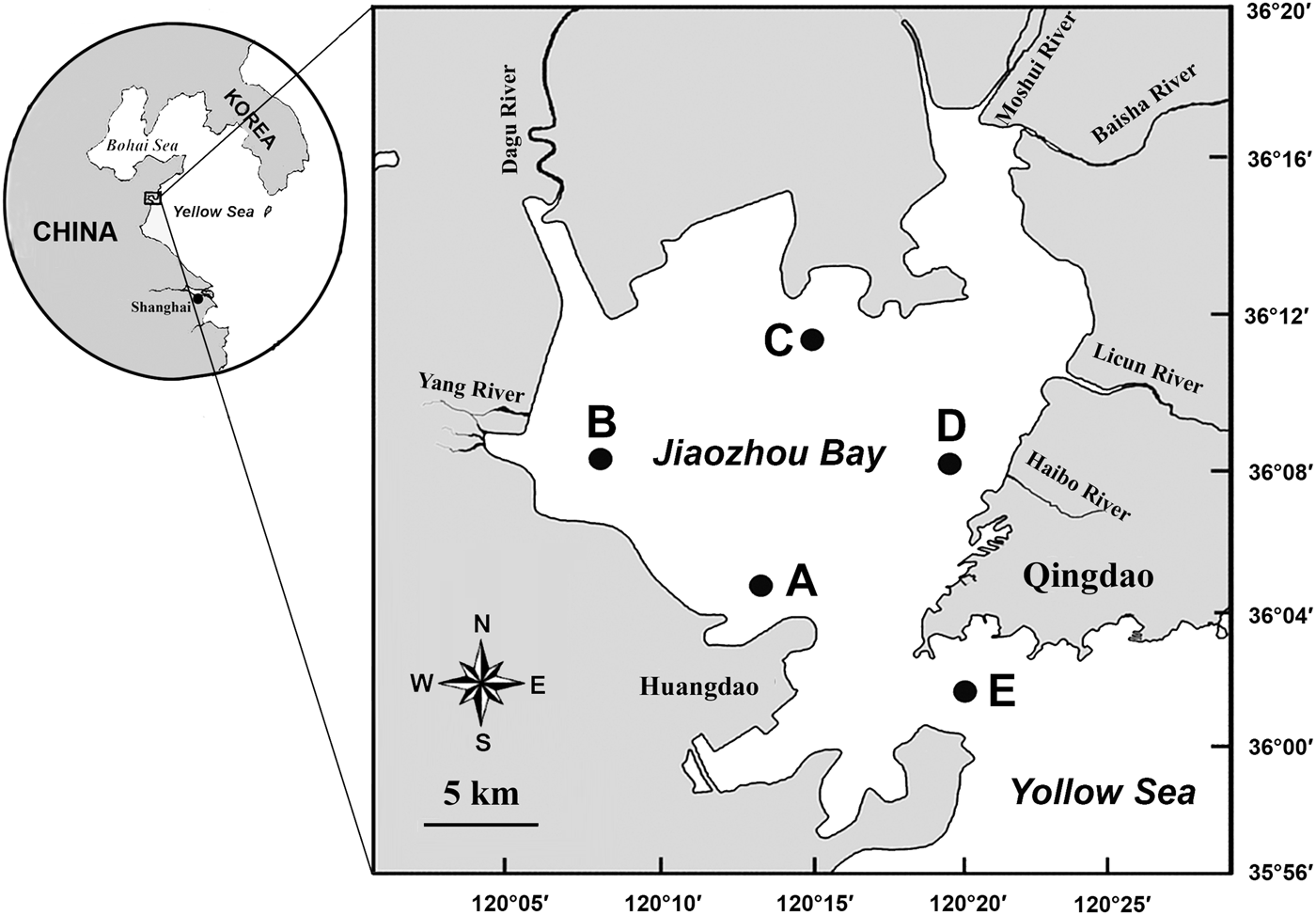
Seawater samples were collected between June 2007 and May 2008 from Jiaozhou Bay, which is a semi-enclosed basin near Qingdao, northern China. Five sampling sites were selected according to their environmental status and type of pollutants based on the marine water quality standard of China. Site A was slightly stressed, mainly due to the input of nutrients from inshore waters emptying into the bay; site B was a severely stressed area with a mixture of pollutants (e.g. nutrients and heavy metals) from domestic sewage and industrial effluents; site C was located at the site of mariculture activities which are the source of heavy organic pollution; site D was moderately stressed by both domestic organic and heavy-metal pollutants; site E was considered as the cleanest area and was located at the mouth of the bay (Figure 1).
Map showing the sampling sites in Jiaozhou Bay, northern China.
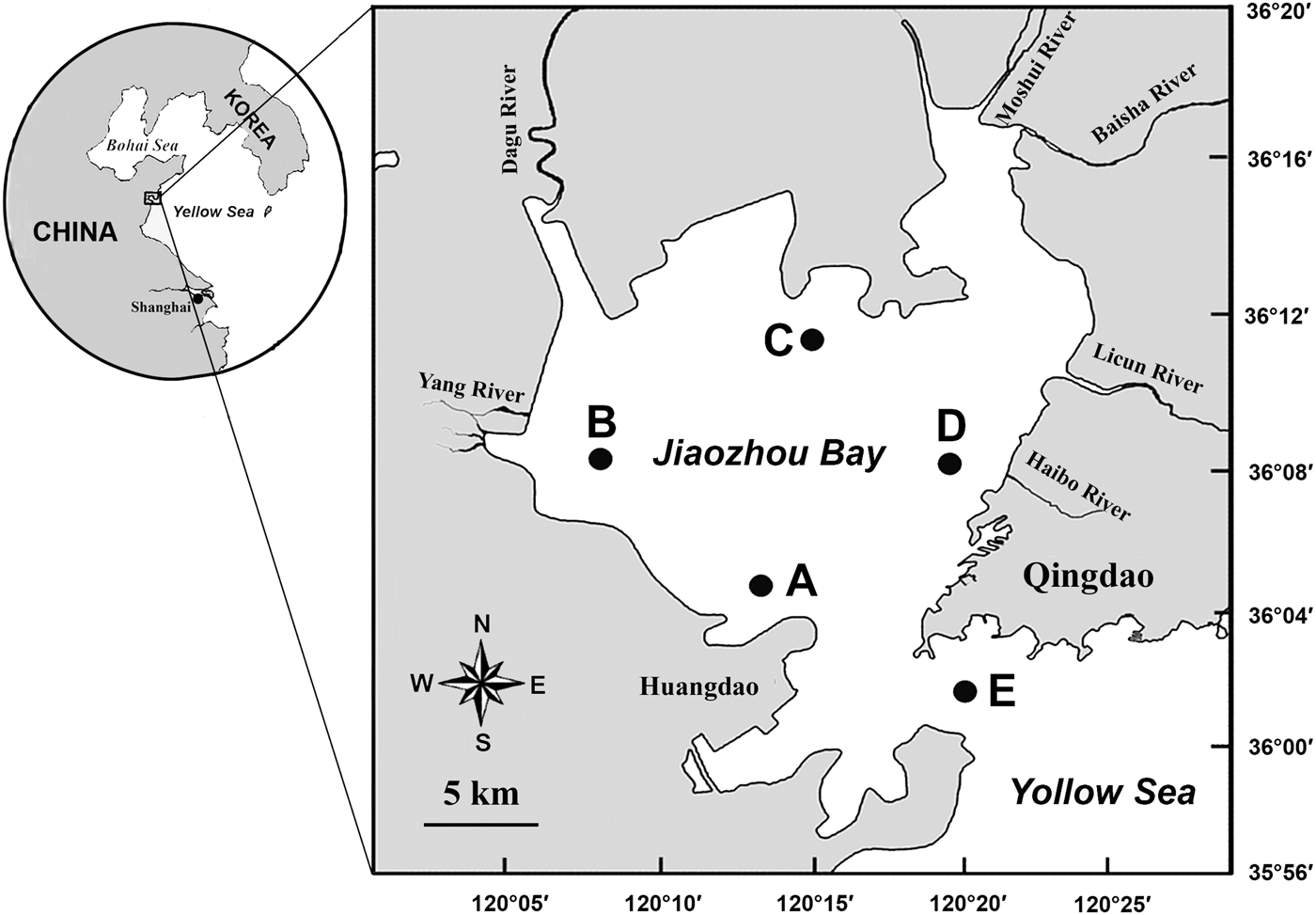
A total of 24 samplings were carried out biweekly from June 2007 to May 2008. All water samples were collected at a depth of 1 m. Thus, the samples from five sites distributed among 24 samplings gave a total of 120 datapoints.
For both quantitative studies and identification of ciliates, 1000 ml seawater samples were fixed with acid Lugol's iodine solution (2% final concentration, volume/volume) (Pitta et al., Reference Pitta, Giannakourou and Christaki2001; Kchaou et al., Reference Kchaou, Elloumi, Drira, Hamza, Ayadi, Bouain and Aleya2009).
Salinity (Sal), pH, chlorophyll-a (Chl a) and dissolved oxygen concentration (DO) were measured in situ, using a multi-parameter sensor (MS5, HACH). Samples for nutrient analyses were preserved immediately upon collection by placing at −20°C in the dark. Concentrations of soluble reactive phosphate (SRP), ammonium nitrogen (NH3-N), nitrate nitrogen (NO3-N) and nitrite nitrogen (NO2-N) were determined using a UV-visible spectrophotometer (DR-5000, HACH) according to the Standard methods for the examination of water and wastewater (APHA, 1992).
For the enumeration of ciliates a 0.1 ml aliquot of each concentrated sample (10 ml) was placed in a Perspex chamber and the ciliates were counted under a light microscope at a magnification 400×. A total of 0.5 ml concentrated sample was counted which yielded a standard error (SE) of <8% of the mean values (Jiang et al., Reference Jiang, Xu, Al-Rasheid, Warren, Hu and Song2011a, Reference Jiang, Xu, Hu, Zhu, Al-Rasheid and Warrenb). Those individuals whose identity could not be ascertained following examination of Lugol's-fixed specimens were picked out with a micropipette and identified using protargol impregnation after re-fixing with Bouin's solution (Montagnes & Humphrey, Reference Montagnes and Humphrey1998). Species identification of ciliates was based on published keys and guides such as Song et al. (Reference Song, Warren and Hu2009).
Biovolumes of ciliate cells were determined from measurements of their linear dimensions and using volume equations of appropriate geometric shape (Winberg, Reference Winberg1971). Equivalent spherical diameters (ESD) that were used to evaluate the body-size spectra of the ciliate communities were calculated from the biovolumes. Five ranks (S1–S5), i.e. S1 (5–35 µm), S2 (35–55 µm), S3 (55–75 µm), S4 (75–100 µm), and S5 (100–350 µm), were defined based on cluster analysis (Jiang et al., Reference Jiang, Xu, Zhang, Zhu and Al-Rasheid2012).
Data analyses
Multivariate analyses of spatial variations in ciliated zooplankton communities were analysed using the PRIMER v6.1 package (Clarke & Gorley, Reference Clarke and Gorley2006) and the PERMANOVA+ for PRIMER (Anderson et al., Reference Anderson, Gorley and Clarke2008). Bray–Curtis similarity matrices were computed on log-transformed species-abundance data. Spearman rank correlation matrices were derived from log-transformed body-size data. The separate clusters of biotic and abiotic samples were assigned by the routine CLUSTER. The spatial differences of ciliate communities among the five sampling sites were determined using the submodule CAP (canonical analysis of principal coordinates) of PERMANOVA+ on both matrices from log-transformed data (Anderson et al., Reference Anderson, Gorley and Clarke2008; Xu et al., Reference Xu, Warren, Al-Rasheid, Zhu and Song2010). Differences between groups of samples were tested by the submodule analysis of similarity (ANOSIM) (Clarke & Gorley, Reference Clarke and Gorley2006). The spatial environmental status of the five sampling sites was summarized using the principal component analysis (PCA) based on Euclidean distance matrices from log-transformed/normalized abiotic data (Clarke & Gorley, Reference Clarke and Gorley2006). The submodule BIOENV was used to explore potential relationships between the biotic and abiotic data. The significance of biota–environment correlations was tested using the routine RELATE (Clarke & Gorley, Reference Clarke and Gorley2006).
RESULTS
Environmental variables
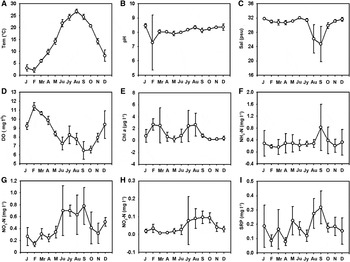
The monthly mean values of 8 environmental variables from a total of 24 samplings are summarized in Figure 2. Water temperature followed a clear annual pattern, ranging from 2.16°C to 26.86°C (mean 14.65°C). Salinity was around 30.22 psu and maintained relatively stable levels throughout the year apart from sharp drops in August (26.16 psu) and again in September (24.72 psu) due to the heavy rainfall. The pH values ranged from 7.70 to 8.46, averaging 8.11. Values of DO varied inversely with temperature. Soluble reactive phosphate (SRP) ranged from 0.08 mg l−1 to 0.32 mg l−1 (mean 0.18 mg l−1) with a minor peak in August and September. Concentrations of Chl a peaked twice, in February and March at 2.50–2.68 μg l−1 and in August and September at 2.43–2.65 μg l−1 respectively. NH3-N showed a similar annual pattern to SRP whereas low concentrations of NOn-N (sum of NO3-N and NO2-N) were recorded throughout the year apart from a minor increase between July and September.
Temporal variation of environmental variables temperature (A), ph (B), Salinity (C) dissolved oxyyen (D), chlorophyll-a (E), NH3-N (F), NO3-N (G), NO2-N (H) and soluble active phosphate (H) in Jiaozhou Bay during an annual cycle (June 2007–May 2008) (mean values of 2 samples per month from each sampling site). Tem, temperature; Sal, salinity; DO, dissolved oxygen; Chl a, chlorophyll-a; SRP, soluble active phosphate; J, January; F, February; Mr, March; A, April; Ju, June; Jy, July; Au, August; S, September; O, October; N, November; D, December.

Annual pattern of body-size spectra of planktonic ciliates
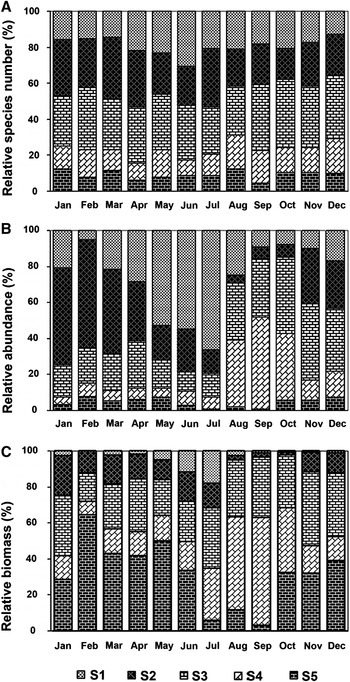
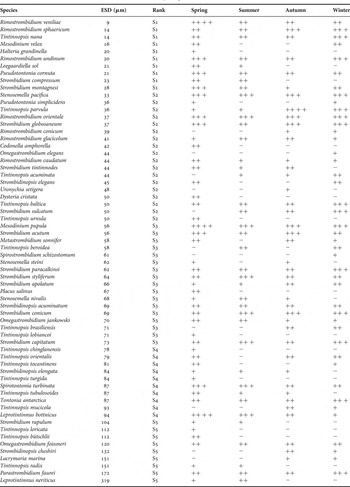
The ESD ranks and occurrences of total 64 ciliate species recorded during the survey are summarized in Table 1. Annual variations in relative species number, relative abundance and relative biomass of five body-size ranks (S1–S5) are summarized in Figure 3. Based on body-size spectra, the planktonic ciliate communities showed clear temporal patterns of variability in relative species composition, abundance and biomass (Figure 3A–C). It is noteworthy that ranks S1, S2 and S3 were the primary contributors to the species compositions of planktonic ciliate communities throughout the annual cycle (Figure 3A). In terms of the relative abundances, four structural types of ciliate communities can be recognized: (1) those dominated by rank S2 being the primary contributor in late winter (January and February) and early spring (March); (2) those dominated by rank S1 in late spring (May) and early summer (June and July); (3) those dominated by ranks S3 and S4 with the latter being the greatest contributor in late summer (August) and early autumn (September and October); and (4) those dominated by the rank S4 in late autumn (November) and early winter (December) (Figure 3). Thus, these body-size ranks showed a annual succession in the order S2 (January–April) → S1 (May–July) → S4 (August–September) → S3 (October–December). By contrast, in terms of biomass, three ranks were main contributors to the body-size patterns of the ciliate communities, i.e. ranks S3, S4 and S5, and the succession of dominance was in the order: S5 (February–June) → S4 (August–October) → S3 (December–January).
Temporal variation in relative species number (A), relative abundance (B) and relative biomass (C) of planktonic ciliates in Jiaozhou Bay, northern China during the study period.

Equivalent spherical diameter (ESD) ranks and abundance of total 64 ciliate species recorded in Jiaozhou Bay during the study period of June 2007–May 2008.

S1–S5, body-size ranks: S1, 5–35 µm; S2, 35–55 µm; S3, 55–75 µm; S4, 75–100 µm; S5, 100–350 µm. Abundance (ind. ls−1): +, 0–9; ++, 10–99; +++, 100–999; ++++, 1000–9999; −, absence.
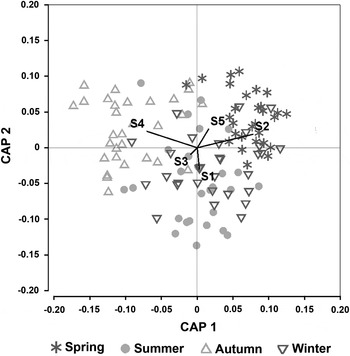
The 120 datapoints, plotted by CAP on Spearman rank correlation matrices from log-transformed ESD data, showed an annual pattern of ciliate communities in term of body-size spectra (Figure 4). The first canonical axis separated the ciliate communities sampled in spring (on the right) from those in autumn (on the left), whereas the second canonical axis discriminated the samples spring and autumn (upper) from those in summer and winter (lower) (Figure 4). It should be also noted that the body-size ranks showed a clear temporal succession: S2 (spring) → S1 (summer) → S4 (autumn) → S3 (winter) (Figure 4). The ANOSIM test revealed that there were significant differences among the four assemblages in the four seasons (R = 0.387, P = 0.001) and between each pair of seasons (P < 0.05).
Canonical analysis of principal coordinates on Spearman rank correlation matrix from log-transformed body-size (ESD) data of the ciliates, with vectors of average abundances of the ciliated zooplankton communities at five body-size ranks (S1–S5), in Jiaozhou Bay during the study period.

Linkage between ciliated zooplankton body-size spectra and abiotic variables
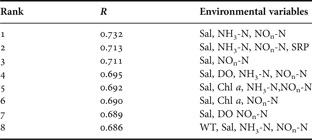
RELATE analysis revealed that there was a significant correlation between temporal variations in the body-size spectra of planktonic ciliate communities and changes of environmental variables (R = 0.352; P = 0.045). The correlations between temporal variation in body-size spectra of the ciliate communities and the changes of environmental variables were revealed by multivariate biota-environment (BIOENV) analysis (Table 2). The top five variables matching with the ciliates were all combinations of salinity, DO, Chl a, NH3-N, NOn-N and SRP. It was also notable that the nutrients NOn-N and NH3-N were included in most correlations (Table 2).
Summary of biota-environment (BIOENV) analysis showing the 8 best matches of environmental variables with spatial variations in ciliate abundances at five sampling sites in Jiaozhou Bay during the study period.

R, Spearman correlation coefficient; Sal, salinity; DO, dissolved oxygen; NOn-N, sum of NO2-N and NO3-N; SRP, soluble active phosphate.
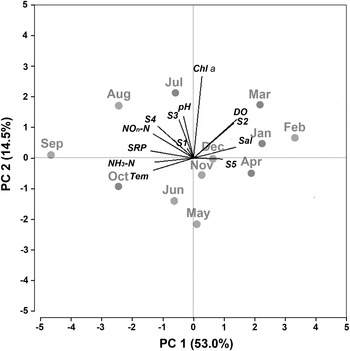
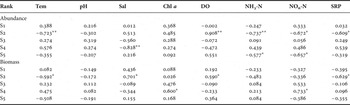
Principal component analysis ordination with vectors for individual abundance of each ciliate assemblage at the five body-size ranks and physical–chemical variables is shown in Figure 5. The two principal components explained 67.5% of the total temporal environmental variability. In terms of abundance of each body-size rank, it is clear that ranks S2 and S5 were positively correlated with salinity and DO but negatively with the nutrients and water temperature, whereas the reverse was true for ranks S1, S3 and S4 (Figure 5). Correlation analyses demonstrate that the average abundance of rank S2 was significantly correlated with water temperature, DO and nutrients, while those of ranks S4 and S5 were correlated with salinity and nutrients respectively (P < 0.05) (Table 3). In terms of biomass, rank S2 was correlated with water temperature and SRP, whereas rank S4 was correlated with the average concentrations of Chl a and NOn-N (P < 0.05) (Table 3).
Principal component analysis (PCA) plot based on log-transformed abiotic data, and correlations of physico-chemical variable and average abundances of the ciliated zooplankton communities at five body-size ranks (S1–S5) with the two PCA axes. Axes 1 and 2 accounted for 53.0% and 14.5% respectively of the total variation present. Sal, salinity; Chl a, chlorophyll-a; SRP, soluble reactive phosphorus; DO, dissolved oxygen; NOn-N, sum of NO3-N and NO2-N.

Correlation between the abundances and biomass of ciliated zooplankton assemblages at the five body-size ranks and environmental conditions in Jiaozhou Bay from June 2007 to May 2008.

*, significant difference at 0.05 level; **, significant difference at 0.001 level; S1, 5–35 µm; S2, 35–55 µm; S3, 55–75 µm; S4, 75–100 µm; S5, 100–350 µm. See Table 2 for other abbreviations.
DISCUSSION
Body size is a highly informative, ‘taxon-free’ trait of individuals, linking their phenotypes to their overall ecological success and general performance (e.g. Beaver & Crisman, Reference Beaver and Crisman1982, Reference Beaver and Crisman1989; Gaedke, Reference Gaedke1992; Ruhl, Reference Ruhl2007). Previous investigations have demonstrated that ciliate assemblages are strongly related to eutrophication status in terms of species body size and composition in a range of freshwaters (e.g. Beaver & Crisman, Reference Beaver and Crisman1982, Reference Beaver and Crisman1989). In our study, the body-size ranks of the ciliates showed a clear temporal succession: S2 (January–April) → S1 (May–July) → S4 (August–September) → S3 (October–December) in terms of ciliate abundance. Correlation analyses demonstrate that the temporal variations in the body-size pattern of the ciliate abundances were significantly correlated with the changes of environmental conditions such as salinity, DO, Chl a, NH3-N, NOn-N and SRP. Rank S2 was significantly negatively correlated with the water temperature and nutrients (P < 0.05), implying that these ciliates were low-temperature bacterivores. This may be why they dominated the communities from winter to middle summer (April), followed by rank S1 from May to July, although both ranks may be bacterivores. Rank S4 dominated the communities from the late summer to middle autumn followed by rank S3, since rank S4 were high-temperature algivores that significantly positively correlated with nutrients (P < 0.05). Rank S5 may have acted as larger algivores and predominated the communities during the seasons with low temperature (except summer and early autumn) in biomass although they represented a significant negative correlation with nutrients in abundance (P < 0.05). Multivariate correlation analysis revealed that the temporal variations in abundance of all body-size ranks were significantly correlated with salinity, DO and nutrients (P < 0.05). These findings suggest that the annual patterns of body-size spectra of the ciliate assemblages are significantly related to the environmental conditions.
Body size is an important feature influencing both ecological interactions among organisms and physiological traits, e.g. metabolic rate, growth and mortality (Peters, Reference Peters1983; Akin & Winemiller, Reference Akin and Winemiller2008). Although there are little background data on planktonic ciliate assemblages, previous investigations on other zooplankton organisms (e.g. copepods) suggest that the body sizes of predator taxa are significantly correlated with the body size of their prey (Akin & Winemiller, Reference Akin and Winemiller2008; López & Anadón, Reference López and Anadón2008). Thus, we suggest that the body-size patterns of planktonic ciliates may be directly influenced by the body-size pattern of available food organisms and only indirectly influenced by abiotic factors. For example, the blooms of bacteria due to the organic pollution may result in the bacterivorous ciliates with small sizes dominating the community, whereas the blooms of microalgae may increase the abundance of the algivorous ciliate predators which generally have larger cell sizes. This may explain why in terms of biomass rank S4, which mostly comprises algivores, was positively correlated with Chl a and NOn-N, whereas rank S2, which mostly comprises bacterivores, was negatively correlated with nutrients. However, it should be noted that the biomass of rank S5 was not found to be significantly correlated with Chl a. This may be due to the interaction between ranks S4 and S5, for example, rank S5 dominated the communities during the spring-peak period of Chl a, while rank S4 was the dominant group during the autumn-peak period of Chl a. This suggests that the body-size spectra may indirectly reflect the changes of environmental conditions, and thus might be used as a potential indicator of water quality in marine ecosystems.
It has long been known that body-size patterns can be used for assessing ecosystem change due to environmental impacts (Sheldon et al., Reference Sheldon, Prakash and Sutcliffe1972). Several studies have shown that natural aquatic communities tend to have inherent patterns of body-size spectrum (Sheldon et al., Reference Sheldon, Prakash and Sutcliffe1972; San Martin et al., Reference San Martin, Harris and Irigoien2006; Kamenir et al., Reference Kamenir, Dubinsky and Harris2010). However, this numerical resolution may not be cost-effective for routine monitoring as the estimation of biovolume (using microscopy methods) tend to be very time-consuming (Zhang & Wang, Reference Zhang and Wang2000; Jiang et al., Reference Jiang, Xu, Al-Rasheid, Warren, Hu and Song2011a, Reference Jiang, Xu, Hu, Zhu, Al-Rasheid and Warrenb). In order to mitigate this, counting programmes may be used in order to reduce sample processing time and to obtain reliable and more ecologically relevant information for monitoring purposes (San Martin et al., Reference San Martin, Harris and Irigoien2006; Kamenir et al., Reference Kamenir, Dubinsky and Harris2010). It should be noted that the shape of the organisms is also known to reflect the changes of environmental conditions (Peters, Reference Peters1983; Akin & Winemiller, Reference Akin and Winemiller2008). Nevertheless, although we may lose some useful information concerning body shape, the ESD was found to be a powerful tool for estimating ciliate body-size.
In summary, these body-size ranks showed a clear temporal succession: S2 (January–April) → S1 (May–July) → S4 (August–September) → S3 (October–December) in terms of ciliate abundance. The temporal variations in body-size patterns of ciliated zooplankton assemblages were significantly correlated with changes in environmental conditions, especially water temperature, salinity, DO and nutrients. In terms of abundance, S2 was significantly correlated with water temperature, DO and nutrients, whereas S4 and S5 were correlated with salinity and nutrients respectively (P < 0.05). These results suggest that the temporal variation in body-size spectra of the planktonic ciliate communities was significantly associated with environmental conditions and thus might be used as a potential indicator of bioassessment in marine ecosystems. However, further studies on a range of marine environments and over long time-periods are needed in order to verify this conclusion.
ACKNOWLEDGEMENTS
This work was supported by ‘The Natural Science Foundation of China' (project number: 41076089), the Darwin Initiative Programme (Project No. 14-015) which is funded by UK Department for Environment, Food and Rural Affairs, and funded by King Saud University Deanship of Scientific Research, Research Group Project No. RGP-VPP-083. Our special thanks to Professor Weibo Song, Laboratory of Protozoology, Institute of Evolution and Marine Biodiversity, Ocean University of China, for his helpful discussion with preparing the manuscript.