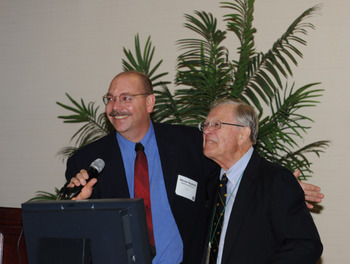
This special issue of The Canadian Entomologist is dedicated to the memory of our colleague and friend, Dr. Steven J. Seybold (1959–2019) (Fig. 1). Sadly, Dr. Seybold passed away unexpectedly on 15 November 2019 while nearing completion of constructing the introduction to this special issue (Seybold and Fettig Reference Seybold and Fettig2020). Dr. Seybold was a giant in our field and a rare scientist who excelled at all levels. He earned his B.Sc. in Forestry from the University of Wisconsin, Madison, Wisconsin, United States of America in 1983 and his Ph.D. in Entomology from the University of California, Berkeley, California, United States of America in 1992. His Ph.D. was funded by a National Science Foundation Doctoral Dissertation Fellowship. Dr. Seybold completed postdoctoral research at the Pacific Southwest Research Station, Forest Service, United States Department of Agriculture, Albany, California and University of California-Berkeley on the geographic variation in pheromone production and response of the pine engraver (Ips pini (Say) (Coleoptera: Curculionidae)) and later at the University of Nevada, Reno, Nevada, United States of America on biosynthesis of bark beetle pheromones. In 1996, he joined the Department of Entomology and the Department of Forest Resources at the University of Minnesota, Saint Paul, Minnesota, United States of America. Dr. Seybold and his family returned to California in 2002 where he joined the staff of the Pacific Southwest Research Station in Davis, California as a Research Entomologist. He worked there for the remainder of his remarkable career.
Dr. Steven J. Seybold (left) with his mentor Dr. David L. Wood. Dr. Seybold was a noted American forest entomologist (1959–2019). His research focussed on the chemical ecology and management of bark beetles and woodborers in western North America.
Dr. Seybold’s research spanned a continuum from molecules to organisms to populations to ecosystems. He published over 230 papers, which have been cited thousands of times. His early research contributed greatly to our understanding of pheromone biosynthesis and endocrine regulation (e.g., Tillman et al. Reference Tillman, Seybold, Jurenka and Blomquist1999; Seybold et al. Reference Seybold, Huber, Lee, Graves and Bohlmann2006) and the chemical ecology and management of bark beetles and woodborers (e.g., Allison et al. Reference Allison, Borden and Seybold2004; Seybold et al. Reference Seybold, Bentz, Fettig, Lundquist, Progar and Gillette2018). In recent years, Dr. Seybold focussed on developing methods of detection and control for notable invasive pests, including the walnut twig beetle (Pityophthorus juglandis Blackman) (Coleoptera: Curculionidae) (e.g., Seybold et al. Reference Seybold, Dallara, Hishinuma and Flint2013, Reference Seybold, Klingeman, Hishinuma, Coleman and Graves2019), the goldspotted oak borer (Agrilus auroguttatus Schaeffer) (Coleoptera: Buprestidae) (e.g., Coleman and Seybold Reference Coleman and Seybold2009; Coleman et al. Reference Coleman, Graves, Hoddle, Heath, Chen, Flint and Seybold2012), and the Mediterranean pine engraver (Orthotomicus erosus (Wollaston)) (Coleoptera: Curculionidae) (e.g., Seybold et al. Reference Seybold, Penrose, Graves, Paine and Lieutier2016). He was active in many professional societies, including the Entomological Society of America, the Entomological Society of Canada, the International Society of Chemical Ecology, and the Western Forest Insect Work Conference, and he organised and chaired numerous symposia. He served on the editorial boards of Acta Phytopathologica et Entomologica Hungarica, Frontiers in Ecology and Evolution, Journal of Chemical Ecology, Journal of Economic Entomology, and Journal of the Entomological Society of Ontario.
Despite leaving the University of Minnesota, Dr. Seybold was always passionate about mentoring graduate students and young scientists and served as a lecturer and advisor at the University of California, Davis, California, United States of America in recent years. He set the bar high for all of his students, many of whom are now well-established scientists working throughout North America. Dr. Seybold was regarded by many as an international expert in bark beetle ecology and management, pheromone biochemistry, and invasive species ecology and management. He was equally at home at the end of a chainsaw as working in the most sophisticated chemical analytical laboratory. He maintained an encyclopaedic knowledge of forest entomology – past and present – and was always happy to apply that knowledge in discussions of new ideas. Dr. Seybold was a remarkable scientist, hard working, and generous with his time and intellect. With this dedication, we hope to honour his legacy in some small way.