





Internet gaming is a common form of leisure activity among adolescents, but excessive gaming increases the risk of maladaptive outcomes (Paulus, Ohmann, von Gontard, & Popow, Reference Paulus, Ohmann, Von Gontard and Popow2018; Schneider et al., Reference Schneider, King and Delfabbro2017). Adolescents are particularly vulnerable to game addiction due to developmental characteristics of this age period, including heightened emotional reactivity, impulsivity, and difficulties in self-regulation (Fam, Reference Fam2018). Although individual and environmental factors associated with adolescents’ gaming have been widely studied, there remains a critical gap in delineating the relative importance of these predictors. To address this gap, this study integrated individual, family, and school factors, and used machine learning to identify the key predictors of game addiction in a large sample of Chinese adolescents spanning early to late adolescence.
Game addiction
Game addiction has gained increasing attention in psychological research. It refers to excessive and compulsive use of computers or video games that leads to social and/or emotional problems, yet the player is unable to control their gaming despite these negative consequences (Lemmens et al., Reference Lemmens, Valkenburg and Peter2009). Conceptually, game addiction is closely related to Internet Gaming Disorder, as described in the Diagnostic and Statistical Manual of Mental Disorders, Fifth Edition (DSM-5; American Psychiatric Association, 2013), and Gaming Disorder, as defined in the International Classification of Diseases, 11th Revision (ICD-11; World Health Organization, 2019). While the operational definitions of these constructs differ in certain respects, they share core diagnostic features, such as diminished control, adverse consequences of gaming, and functional impairment (Brand et al., Reference Brand, Rumpf, King, Potenza and Wegmann2020). Importantly, game addiction is not merely characterized by extensive playtime; it involves impaired self-regulation and continued gaming despite social, emotional, academic, or daily-life difficulties. Observable gameplay behaviors, such as time spent gaming and frequency of play, are often used as indicators of problematic use (Paulus et al., Reference Paulus, Ohmann, Von Gontard and Popow2018). However, previous studies have questioned whether these behavioral indicators can reliably distinguish game addiction from highly engaged but non-problematic gaming, suggesting that their predictive value remains uncertain (Billieux, Flayelle, Rumpf, & Stein, Reference Billieux, Flayelle, Rumpf and Stein2019; Király et al., Reference Király, Tóth, Urbán, Demetrovics and Maraz2017). Meta-analyses indicate that, with few exceptions, adolescents exhibit higher internet gaming disorder prevalence than adults (Paulus et al., Reference Paulus, Ohmann, Von Gontard and Popow2018). Among adolescents, reported prevalence rates range from 0.6% to 19.9%, with a pooled prevalence of 4.6% (Fam, Reference Fam2018). Game addiction can significantly impair adolescents’ personal and social functioning and has been linked to a range of adverse outcomes, including maladaptive coping strategies (Schneider, King, & Delfabbro, Reference Schneider, King and Delfabbro2018), depressive and psychosomatic symptoms (Hellström, Nilson, Leppert, & Åslund, Reference Hellström, Nilsson, Leppert and Åslund2015), and social withdrawal (Fong, Junus, Wen, & Yip, Reference Fong, Junus, Wen and Yip2024). Given its high prevalence and wide-ranging negative consequences, identifying the key predictors of adolescent game addiction is essential for informing early prevention and targeted intervention efforts.
Intrapersonal and interpersonal factors associated with game addiction
Research has identified multiple predictors of game addiction, which can be categorized into intrapersonal and interpersonal domains (Zhuang et al., Reference Zhuang, Zhang, Tang, Ng, Lin and Yang2023). Focusing on intrapersonal factors, the Interaction of Person–Affect–Cognition–Execution (I-PACE) model (Brand et al., Reference Brand, Young, Laier, Wölfling and Potenza2016) proposes that behavioral addictions, including game addiction, emerge from dynamic interactions among individual traits, affective states, cognitive biases, and executive functions. Consistent with this framework, empirical research has identified a range of cognitive, emotional, and behavioral factors that influence adolescents’ game addiction. Specifically, protective factors such as resilience (Robertson, Yan, & Rapoza, Reference Robertson, Yan and Rapoza2018), self-control (Kristensen, Jørgensen, & Haug, Reference Kristensen, Jørgensen and Haug2024), cognitive reappraisal (Kökönyei et al., Reference Kökönyei, Kocsel, Király, Griffiths, Galambos, Magi, Paksi and Demetrovics2019), and prosocial behaviors and life satisfaction (Lemmens et al., Reference Lemmens, Valkenburg and Peter2009; Sarda et al., Reference Sarda, Bègue, Bry and Gentile2016) can buffer against addictive behaviors, whereas emotion suppression (Yen et al., Reference Yen, Yeh, Wang, Liu, Chen and Ko2018) and internalizing/externalizing problems (Richard, Marchica, Ivoska, & Derevensky, Reference Richard, Temcheff, Fletcher, Lemieux, Derevensky and Déry2022) are associated with greater vulnerability to game addiction. From a motivational perspective, Self-Determination Theory (Deci & Ryan, Reference Deci and Ryan2012) provides a useful framework for understanding why adolescents may turn to gaming. According to this theory, frustration of the three basic psychological needs – competence, autonomy, and relatedness – may motivate adolescents to seek need fulfillment in virtual environments. For instance, academic struggles may undermine adolescents’ sense of competence, prompting them to pursue achievement and mastery through gaming (Gao, Wang, & Dong, Reference Gao, Wang and Dong2022; Kristensen et al., Reference Kristensen, Jørgensen and Haug2024). Moreover, individual characteristics, such as gender, also play an important role, with males consistently exhibiting a higher prevalence of game addiction than females (Mihara & Higuchi, Reference Mihara and Higuchi2017).
Interpersonal predictors of adolescents’ internet gaming are primarily embedded within the family and school contexts. According to Compensatory Internet Use Theory (Kardefelt-Winther, Reference Kardefelt-Winther2014), game addiction may develop when gaming functions as a means of escaping or coping with real-life stressors. Within the family context, adverse family dynamics – such as conflict (Schneider, King, & Delfabbro, Reference Schneider, King and Delfabbro2017), harsh parenting (Chung et al., Reference Chung, Bae, Kim, Lee, Hwang and Han2023), parental psychological control (Lin et al., Reference Lin, Yu, Chen, Sheng, Hu and Zhong2020), and parents’ emotional distress or non-supportive emotion socialization practices (Şenol, Şenol, & Can Yaşar, Reference Şenol, Şenol and Can Yaşar2024) – can heighten adolescents’ emotional distress and undermine adaptive coping, thereby making gaming a more attractive coping strategy and increasing the risk of game addiction. Conversely, a nurturing family environment may protect adolescents against game addiction. For example, parental involvement and warmth can provide emotional support, strengthen parent–child relationships, and foster a sense of security (Coşa, Dobrean, Georgescu, & Păsărelu, Reference Coşa, Dobrean, Georgescu and Păsărelu2023; Dou, Feng, Wang, & Li, Reference Dou, Feng, Wang and Li2022), thereby reducing adolescents’ reliance on gaming as a means of coping with stress. School environments also influence adolescents’ gaming behaviors. For instance, adolescents who feel disconnected from their school environment – because of peer difficulties (Yu et al., Reference Yu, Yen, Wang, Wu, Chen, Zhang, du, du, du and Lau2024), limited teacher support (Zou et al., Reference Zou, Deng, Wang, Yu and Zhang2022), low school engagement (Gan et al., Reference Gan, Qin, Xiang, Jin and Zhu2022), or experiences of bullying (Gao et al., Reference Gao, Wang and Dong2022) – may be more likely to use gaming as a source of social connection and emotional relief, thereby increasing their risk of game addiction.
Importantly, the links between intrapersonal/interpersonal factors and game addiction may vary by gender. For example, males are more vulnerable to game addiction, partly because they tend to experience greater reductions in self-control and stronger cravings for competition and achievement during gameplay (Dong & Potenza, Reference Dong and Potenza2022; Zhang et al., Reference Zhang, Chen, Jiang, Dong, Zhao, Du and Dong2021), whereas females’ gaming behavior is more strongly associated with loneliness and difficulties in emotion dysregulation (Ko et al., Reference Ko, Yen, Yen, Lin and Yang2007; Sioni, Burleson, & Bekerian, Reference Sioni, Burleson and Bekerian2017). Furthermore, household chaos has been found to predict problematic gaming among males but not among females (Pivetta et al., Reference Pivetta, Costa, Marino, Bottesi, Vieno and Canale2024). These contrasts highlight the importance of considering gender when identifying risk factors and developing targeted interventions for game addiction.
Using machine learning to identify predictors of game addiction
Given the large number of variables involved, identifying the most important predictors of game addiction is essential. A recent meta-analysis has found that, compared with interpersonal factors (e.g. family or school variables), intrapersonal factors, such as gaming time, self-control, mood disturbances, and attention problems, exhibited larger effect sizes (Zhuang et al., Reference Zhuang, Zhang, Tang, Ng, Lin and Yang2023). This pattern likely reflects the more proximal role of intrapersonal factors in directly shaping gaming behavior, whereas family, school, and social factors may exert their effects more indirectly by shaping these underlying processes (Ji et al., Reference Ji, Wang, Lyu, Liu, Wang, Heinen and Sun2022). However, meta-analyses synthesize findings across different studies, each of which often focuses on limited variables. As a result, they are unable to evaluate the relative importance of a broad range of predictors within a single analytical framework. Likewise, traditional statistical approaches, such as multiple regression or structural equation modeling, often have difficulty modeling complex relationships among numerous correlated predictors because of multicollinearity. In contrast, machine learning provides a promising alternative by accommodating nonlinear relationships, handling high-dimensional data, and identifying the relative importance of predictors, thereby improving both predictive performance and model interpretability (Andriopoulos & Kornaros, Reference Andriopoulos and Kornaros2023; Lundberg & Lee, Reference Lundberg and Lee2017).
In clinical research, machine learning has increasingly been used to identify key predictors and risk patterns of adolescent game addiction (Gülü et al., Reference Gülü, Yagin, Gocer, Yapici, Ayyildiz, Clemente, Ardigò, Zadeh, Prieto-González and Nobari2023). However, existing studies have largely focused on intrapersonal factors, with relatively limited attention to interpersonal influences, particularly those within the family and school contexts. Some studies have examined adolescents’ interactive technology use in relation to individual, family, and school factors. However, interactive technology use for entertainment is a broad category that encompasses a variety of activity-specific behaviors such as gaming, social networking, streaming, shopping, and pornography use, each of which is characterized by distinct psychological mechanisms and risk profiles (Brand et al., Reference Brand, Young, Laier, Wölfling and Potenza2016). Combining these heterogeneous behaviors into a single outcome may introduce conceptual heterogeneity and obscure activity-specific predictors. For example, depressive symptoms are more strongly associated with social media use than with gaming (Boers, Afzali, Newton, & Conrod, Reference Boers, Afzali, Newton and Conrod2019), and problematic gaming is more prevalent among boys and problematic social media use is more common among girls (Nagata et al., Reference Nagata, Singh, Sajjad, Ganson, Testa, Jackson, Assari, Murray, Bibbins-Domingo and Baker2022). Consequently, the same predictor may exhibit distinct, or even opposite, associations across different forms of interactive technology use (Twenge & Farley, Reference Twenge and Farley2021). Therefore, focusing specifically on gaming behavior and its related game addiction, rather than treating all forms of interactive technology use as a single outcome, provides greater conceptual precision and enables a more accurate identification of its predictors. Accordingly, the present study focuses specifically on game addiction, allowing for a more precise and clinically meaningful identification of its predictors.
The current study
This study used cross-sectional data and machine learning to identify factors associated with game addiction across individual, family, and school domains. All predictors were selected based on prior empirical evidence demonstrating their relevance to adolescents’ digital engagement (Gao et al., Reference Gao, Wang and Dong2022; Yu et al., Reference Yu, Yen, Wang, Wu, Chen, Zhang, du, du, du and Lau2024). Based on previous research, we proposed two hypotheses. First, positive individual characteristics (e.g. well-being, academic performance, prosocial behavior, emotion regulation, and resilience), supportive parenting, and high-quality parent–child and peer/teacher relationships were expected to serve as protective factors. In contrast, male gender, adolescents’ psychosocial problems, parental distress, maladaptive parenting, and adverse school experiences of adolescents (e.g. academic pressure and bullying) were expected to be associated with an increased risk of game addiction. Second, individual-level factors were hypothesized to be stronger predictors of game addiction than interpersonal factors. Among individual factors, gender, emotional functioning (i.e. internalizing problems, well-being, and resilience), academic performance, and perceived relationship quality with parents were expected to be particularly relevant predictors.
Given the mixed evidence regarding the predictive validity of gameplay behaviors for game addiction, we further examined whether incorporating behavioral indicators – specifically weekly gaming frequency and single-session duration – would improve model performance beyond individual, family, and school factors. To address this question, we developed two machine learning models: one including gameplay behaviors alongside individual, family, and school factors, and another excluding gameplay behaviors. We hypothesized that gameplay behaviors would provide incremental predictive value for identifying adolescents at risk of game addiction.
Method
Participants
A total of 21,239 adolescent–parent pairs were recruited from various schools in Shenzhen, Guangdong Province, China. The adolescents, aged 11–19 years, had a mean age of 13.41 years (SD = 2.14), and 45.0% of them were female (n = 9,566). Among them, 23.6% were the only child in their families (adolescents who have no siblings and are the sole child in their family). The participants in this study were students in grades 6 through 12, with 30.9% in sixth grade of primary school, 46.2% in junior high school, and 23.0% in senior high school. For each adolescent, one of their parents participated in the study, with 31.1% of the participating parents being fathers. Additionally, 18.5% of the parents had obtained a bachelor’s degree or higher.
Procedures
Families were recruited in collaboration with the local education department in Shenzhen, a major city in southern China, between late 2020 and early 2021. To ensure adequate representation from all administrative districts and subdistricts within the city, a stratified sampling procedure was employed. Schools were selected to reflect variation in educational settings, including both public and private institutions at the primary and secondary levels.
An invitation letter was distributed to families via WeChat parent forums – online group chats created by teachers on the WeChat platform to facilitate information dissemination and real-time communication with parents, which are widely used by schools in China for class management and parent engagement. Each family was invited to participate with one parent and one adolescent child, with the participating parent self-selected by the family. Informed consent was obtained from parents, and assent was obtained from adolescents before participation. Along with the invitation letter, a link to the online survey was distributed to families by school teachers.
The survey consisted of two sections. The first section, completed by the parents, collected demographic information and details regarding parenting behaviors; the second section, completed by the adolescents, focused on adolescents’ school and family contexts and physical health/status. Clear instructions were provided to ensure proper completion. For example, at the beginning of the survey, parents were instructed to complete the first section; upon completion, an on-screen prompt informed them that the remaining section should be completed by their child. Families completed the survey using computers, tablets (e.g. iPads), or mobile phones. The study was approved by the ethics committee of the corresponding author’s university.
Measures
All scales used in the study have demonstrated sound reliability and validity within Chinese cultural contexts in prior literature and showed sound reliability in the present study. The reference and detailed descriptions of the measures used (e.g. the example items and reliability indices) are shown in the Supplementary Materials.
Game addiction (reported by adolescents)
Game Addiction Scale (GAS), developed by Lemmens et al. (Reference Lemmens, Valkenburg and Peter2009), was used. GAS has seven items (e.g. ‘Did you think about playing a game all day long?’) to assess seven criteria of gaming addiction (i.e. salience, tolerance, mood modification, relapse, withdrawal, conflict, and problems), with each item being scored from 1 (never) to 5 (always). Every item in the scale was preceded by the statement: ‘How often during the last six months?’ According to Lemmens et al. (Reference Lemmens, Valkenburg and Peter2009), game addiction was operationally defined as meeting at least four of the seven addiction criteria within a 6-month period. Specifically, an individual criterion was considered met if participants reported a score of 3 (‘sometimes’) or higher on the corresponding item. Based on these criteria, game addiction was coded as a binary variable (1 = game addiction, 0 = no game addiction). Previous literature has documented that this scale had good validity and reliability in the Chinese youth sample (Y. Liu et al., Reference Liu, Wang, Jou, Wang, An and Li2020). The reliability (Omega) of the scale was 0.94 in this research.
Indicators of gaming behavior (reported by adolescents)
Gameplay behavior was measured using two questions representing gaming frequency and single-session gameplay duration: ‘How many times have you played online games approximately every week in the recent three months?’ and ‘How long do you play online games approximately each time?’. Each question was scored from 1 to 5 (for gaming frequency, 1 = once or less, 2 = two times, 3 = three times, 4 = four times, 5 = five times or above; for single-session gameplay duration, 1 = within one hour, 2 = one to three hours, 3 = three to four hours, 4 = four to five hours, 5 = over five hours). A higher score means that teenagers play games more often per week or for a longer time each time.
Family-level variables
-
• Parental Academic Involvement (Reported by Parents). The parental involvement scale developed by Hill and Tyson (Reference Hill and Tyson2009) was used. This scale evaluated three dimensions; these are school-based involvement, home-based involvement, and academic socialization. Parents gave responses from 1 (not true of me) to 5 (certainly true of me).
-
• Parental Responses to Adolescents’ Negative Emotions (Reported by Parents). The Coping with Children’s Negative Emotions Scale-Adolescent Version (CCNES-AV; Fabes, Leonard, Kupanoff, & Martin, Reference Fabes, Leonard, Kupanoff and Martin2001) was used to evaluate six types of parental responses to adolescents’ negative emotions: emotion-focused response, problem-focused response, expression encouragement, minimization, distress, and punitive response. Parents gave responses from 1 (very unlikely) to 5 (very likely).
-
• Parent Depression (Reported by Parents). Patient Health Questionnaire–9 (PHQ-9) (Kroenke, Spitzer, & Williams, Reference Kroenke, Spitzer and Williams2003) was used. PHQ-9 includes nine items (e.g. ‘Little interest or pleasure in doing things’), with each item being rated by parents from 1 (not at all) to 4 (nearly every day).
-
• Parent Anxiety (Reported by Parents). The short form of the state scale of the Spielberger State–Trait Anxiety Inventory (six items, e.g. ‘I feel relaxed’), developed by Marteau and Bekker (Reference Marteau and Bekker1992), was used to evaluate parents’ level of anxiety. Each item was rated on a 4-point Likert scale, ranging from 1 (rarely) to 4 (very much) by parents.
-
• Perceived Relationship Quality with Parents (Reported by Adolescents). Adolescents described their relationship quality with their parents using the Inventory of Parent and Peer Attachment (IPPA) developed by Armsden and Greenberg (Reference Armsden and Greenberg1987). This scale evaluated three dimensions: communication, trust, and alienation. Each item was rated on a 5-point Likert scale, ranging from 1 (not true of me) to 5 (certainly true of me) by parents.
School-level variables
-
• Adolescents’ Perceptions of School Environment (Reported by Adolescents). Adolescents’ perceptions of the school environment were evaluated using the scale developed by M. T. Wang and Holcombe (Reference Wang and Holcombe2010). This scale evaluated five dimensions, which are school performance goal structure, school mastery goal structure, support of autonomy, promotion of discussion, and teacher social support. Adolescents gave responses from 1 (not true of me) to 5 (certainly true of me).
-
• Peer and Teacher Acceptance (Reported by Adolescents). Peer acceptance was measured using two items (i.e. ‘I am getting along fine with others of my age’ and ‘My classmates seem to like me’) developed by Birkeland et al. (Reference Birkeland, Breivik and Wold2014). Two items for teacher acceptance were developed based on peer acceptance (i.e. ‘I am getting along fine with my teachers’ and ‘My teachers seem to like me’). Adolescents gave responses from 1 (totally disagree) to 7 (totally agree).
-
• Bullying Victimization (Reported by Adolescents). Five items from Chang et al. (Reference Chang, Lee, Chiu, Hsi, Huang and Pan2013) were used to evaluate school bullying victimization. Each item was rated on a 7-point Likert scale, ranging from 1 (strongly disagree) to 7 (strongly agree) by adolescents.
Individual-level variables
-
• Academic Self-efficacy (Reported by Adolescents). Adolescents’ perceptions of self-efficacy were assessed using the scale developed by M. T. Wang and Holcombe (Reference Wang and Holcombe2010). Each item was rated on a 5-point Likert scale, ranging from 1 (very unlikely) to 5 (very likely) by adolescents.
-
• Adolescents’ Psychosocial Problems (Reported by Adolescents). Pediatric symptom checklist questionnaire (PSC-17) developed by Gardner et al. (Reference Gardner, Murphy, Childs, Kelleher, Pagano, Jellinek and Sturner1999) was used. This scale included three subscales evaluating internalizing problems, externalizing problems, and attention problems. Each item was rated on a 3-point Likert scale (1 = never, 2 = seldom, 3 = often) by adolescents.
-
• Adolescents’ Well-being (Reported by Adolescents). The EPOCH measure of well-being (Kern, Benson, Steinberg, & Steinberg, Reference Kern, Benson, Steinberg and Steinberg2016) was used to evaluate five dimensions of adolescents’ well-being: engagement, perseverance, optimism, connectedness, and happiness. Each item was rated from 1 (totally disagree) to 7 (totally agree) by adolescents.
-
• Adolescents’ Prosocial Behaviors (Reported by Adolescents). Adolescents’ prosocial behaviors were assessed using the prosocial behaviors subscale from the Strengths and Difficulties Questionnaire (SDQ; Goodman & Scott, Reference Goodman and Scott1999). Adolescents gave responses from 1 (very unlikely) to 7 (very likely).
-
• Resilience (Reported by Adolescents). The Brief Resilience Scale (BRS; e.g. ‘I tend to bounce back quickly after hard times’) developed by Smith et al. (Reference Smith, Dalen, Wiggins, Tooley, Christopher and Bernard2008) was used to evaluate adolescents’ resilience. Each item was rated from 1 (totally disagree) to 7 (totally agree) by adolescents.
-
• Interpersonal emotion regulation (Reported by Adolescents). The Interpersonal Regulation Questionnaire (IRQ; Williams, Morelli, Ong, & Zaki, Reference Williams, Morelli, Ong and Zaki2018) was used to evaluate four dimensions of adolescents’ interpersonal emotion regulation: negative tendency, negative efficacy, positive tendency, and positive efficacy. Adolescents gave responses from 1 (very unlikely) to 7 (very likely).
-
• Expressive Suppression and Cognitive Reappraisal (Reported by Adolescents). Adolescents’ emotion regulation strategy, including expressive suppression and cognitive reappraisal, was evaluated using the Emotion Regulation Questionnaire (ERQ; Gross & John, Reference Gross and John2003). Adolescents gave responses from 1 (very unlikely) to 7 (very likely).
Data analysis
Data pre-processing
Before the formal analyses, data quality checks were conducted. A bogus item (i.e. ‘I was born on February 30’) was included to identify invalid responses, and the Isolation Forest algorithm was used to detect multivariate outliers (F. T. Liu et al., Reference Liu, Ting and Zhou2008). Isolation Forest is an unsupervised outlier-detection algorithm based on decision trees. It assumes that outliers are easier to isolate than normal observations; thus, observations with shorter average path lengths across a forest of randomly constructed trees are more likely to be outliers. Based on these procedures, 264 participants who endorsed the bogus item and 3,034 participants identified as outliers by the Isolation Forest algorithm were excluded from subsequent analyses. After outlier removal, the remaining participants were randomly divided into a training set (80%) and a held-out test set (20%). The training set was used for model development, whereas the held-out test set was reserved exclusively for evaluating the final model performance, thereby providing an unbiased estimate of model generalizability.
Categorical variables were transformed into numerical variables using contrast coding, while continuous variables were standardized. The contrast coding scheme and standardization parameters were determined using the training set and then applied unchanged to the held-out test set. To address the issue of class imbalance, which can bias classification outcomes toward the majority class and impair model performance, we employed an over-sampling technique using the SMOTE algorithm (Chawla, Bowyer, Hall, & Kegelmeyer, Reference Chawla, Bowyer, Hall and Kegelmeyer2002), which generates synthetic instances based on the existing minority class.
Variables selection
Game addiction was coded as a binary outcome variable. To reduce model complexity and improve interpretability, feature selection was performed using the Boruta algorithm (Kursa, Jankowski, & Rudnicki, Reference Kursa, Jankowski and Rudnicki2010) based exclusively on the training set. Boruta identifies relevant predictors by creating ‘shadow’ variables through randomly permuting the values of the original predictors. The original and shadow variables are then evaluated simultaneously using a Random Forest model. Predictors with importance scores consistently exceeding those of the shadow variables are retained, whereas those with lower importance are discarded.
Model development
Three supervised machine learning algorithms were developed and compared: Elastic Net, Random Forest, and Extreme Gradient Boosting (XGBoost). All analyses were implemented using the Python library scikit-learn. Hyperparameters for each model were optimized using grid search with 10-fold cross-validation within the training set. Because game addiction was treated as a binary outcome, model performance was evaluated using Accuracy, the area under the receiver operating characteristic curve (ROC-AUC), Precision, Recall, and the F1-score. Accuracy and ROC-AUC pay more attention to the overall classification performance, including both positive and negative classes. For example, accuracy measures the proportion of correctly predicted instances out of the total instances (in this study, both general adolescents and adolescents with a risk of game addiction) in the dataset. Precision, recall, and F1-score focus primarily on evaluating the model’s performance for the positive class. For example, precision calculates the proportion of positive predictions (i.e. game-addicted adolescents) that are correct, while recall, also known as true positive rate, calculates the proportion of actual positive instances that are correctly identified by the model. The F1-score is the harmonic mean of precision and recall: 2 × (Precision × Recall)/(Precision + Recall), which can penalize models where either precision or recall is low, providing a balance between avoiding false positives and false negatives. The model demonstrating the best performance was selected for further analysis.
Variable importance analysis
To interpret the contribution of individual predictors to the model’s predictions, we applied Shapley Additive Explanations (SHAP), a widely adopted model-agnostic interpretation method based on cooperative game theory (Cohen, Dror, & Ruppin, Reference Cohen, Dror and Ruppin2005). SHAP assigns each predictor a Shapley value that quantifies its contribution to the model output. Larger absolute Shapley values indicate greater predictor importance, whereas positive and negative Shapley values indicate that the predictor increases or decreases the predicted probability of game addiction, respectively (Lundberg & Lee, Reference Lundberg and Lee2017). SHAP computes these values by evaluating the marginal contribution of each predictor across all possible combinations of predictor variables. It is important to note that SHAP is a local interpretation technique, meaning it focuses on specific observations or regions within the predictor variable space. Consequently, the contribution of the same predictor may vary across samples. To quantify a predictor’s overall importance, we calculated the mean absolute Shapley value, which summarizes its average contribution to the model predictions across all observations (Henninger & Strobl, Reference Henninger and Strobl2024).
Predictors were then ranked according to their mean absolute Shapley values, and models were sequentially reconstructed by cumulatively adding predictors in order of importance. Based on the changes in cumulative accuracy, the most important variables were selected. Specifically, when the cumulative accuracy exceeded 85% (Weller et al., Reference Weller, Sagers, Hanson, Barnes, Snell and Tass2021), the corresponding coalition of variables was considered to have sufficiently high and stable importance. The model was then reconstructed using the optimal set of predictors identified through the SHAP-based procedure, and its classification performance was evaluated. Furthermore, we compared the performance of models with and without gameplay behavioral variables (i.e. weekly gaming frequency and average gaming session duration) to evaluate their incremental predictive value.
SHAP dependence plot: main effect and interaction effect
To visualize how a predictor contributes to the model’s predictions across its range of values, we generated SHAP dependence plots. In a SHAP dependence plot, each point on the plot corresponds to a sample. The x-axis shows the value of the predictor, whereas the y-axis shows the corresponding Shapley value, indicating the predictor’s contribution to the model prediction at that value.
SHAP enables the contribution of each predictor to be decomposed into its main effect and interaction effects with other predictors (Lundberg, Erion, & Lee, Reference Lundberg, Erion and Lee2018). The main effect refers to a variable’s individual contribution to the model’s prediction, independent of other variables. Interaction effects capture the combined contribution of two or more variables to the model’s prediction. To illustrate the unique contribution of each important predictor, we present SHAP dependence plots showing their main effects. In addition, we examined pairwise SHAP interaction values and report only interactions with absolute SHAP interaction values of at least 0.10, consistent with previous studies (Ji et al., Reference Ji, Wang, Lyu, Liu, Wang, Heinen and Sun2022; Niklason et al., Reference Niklason, Rawls, Ma, Kummerfeld, Maxwell, Brucar, Drossel and Zilverstand2022).
Sensitivity analysis
To evaluate whether the use of a binary outcome influenced our findings, we conducted a sensitivity analysis treating game addiction as a continuous outcome based on participants’ mean Game Addiction Scale scores. Using the same set, machine learning algorithms, and analytical procedures, we repeated the analyses to evaluate whether predictor importance and model performance differed from those obtained using the binary outcome. Because regression models require different evaluation metrics from classification models, their performance was assessed using coefficient of determination (R 2) and mean squared error (MSE) (Kovač, Ratković, Farahani, & Watson, Reference Kovač, Ratković, Farahani and Watson2024). Furthermore, to examine whether our findings were influenced by the use of SMOTE, we conducted additional analyses using the original training data without oversampling.
Results
Invalid data detection and handling
We removed 3,298 outliers (accounted for 15.5% of the total sample), leaving 17,941 participants (5,173 adolescents were identified as being at risk of developing game addiction) in the formal analysis. According to the ratio of 8:2, the sample size of the training set is 14,352 (the number of ordinary adolescents is 10,148, and the number of adolescents at risk of game addiction is 4,204). After the oversampling procedure, there were a total of 20,296 samples in the training set.
Descriptive statistics
Given the inclusion of many variables in the study, descriptive statistics for the key assessed variables were presented in Supplementary Table S1.
Variables selection
After the variable selection procedure with the Boruta algorithm, the final machine learning model incorporated 43 variables, including the variables presented in the Measure part, and 4 demographic variables, namely, adolescents’ sex, age, grade, and academic performance.
Machine learning model performance
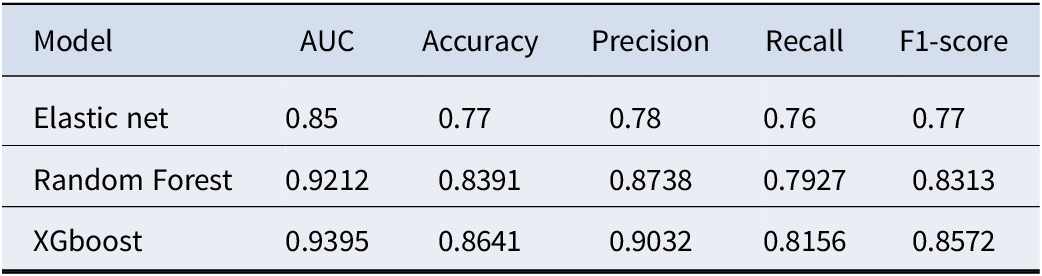
Table 1 presents the classification performance metrics for different models. In general, the classification performance of the elastic net is relatively poor. In contrast, the Random Forest model and XGBoost model showed good performance, obtaining an accuracy of 0.8391 and 0.8641. Considering the differing principles of the two algorithms and aiming for more robust results, we selected the two best-performing models for subsequent analyses of variable importance.
Performances of different machine learning model

Table 1. Long description
The table consists of six columns: Model, A U C, Accuracy, Precision, Recall, and F 1-score.
* Elastic net: A U C 0.85, Accuracy 0.77, Precision 0.78, Recall 0.76, F 1-score 0.77.
* Random Forest: A U C 0.9212, Accuracy 0.8391, Precision 0.8738, Recall 0.7927, F 1-score 0.8313.
* X G boost: A U C 0.9395, Accuracy 0.8641, Precision 0.9032, Recall 0.8156, F 1-score 0.8572.
Variables importance
Figures 1 and 2 present the summary and distribution of the Shapley value for the top 20 variables, respectively. We then selected the important variables based on the cumulative accuracy after re-ranking the variables according to their Shapley value. The mean cumulative accuracy in 10-fold cross-validation for both models is shown in Figures 3 and 4. The results reveal that for the Random Forest model, the cumulative accuracy reached 85% when incorporating the top 14 variables ranked by Shapley values. In the XGBoost model, the cumulative accuracy reached 85% when including the top 12 variables ranked by Shapley values. By identifying the intersection of important variables across both models, we found that externalizing problems, sex, bullying victimization, attention problems, perseverance, alienation from parents, academic performance, school performance-oriented environment, parent depression, and academic self-efficacy consistently emerged as highly important. Among these 10 important variables, except for parental depression, which was reported by the parents themselves, all the other variables were reported by the adolescents. As a result, we selected these 10 variables for further analysis. As indicated in Table 2, the classification model constructed with these selected variables continues to exhibit robust performance.
The mean of absolute Shapley values for the top 20 variables in (a) the Random Forest model and (b) the XGBoost model. Note: IRQ = interpersonal emotion regulation.

Figure 1. Long description
The image consists of two panels, a and b, each displaying a horizontal bar chart. The x-axis for both represents the mean of absolute S H A P values, indicating the average impact on model output magnitude.
Panel a, titled shapley value output Random Forest model, shows 20 variables. The top five variables in descending order of impact are Externalizing problem (approximately 0.075), Sex (0.068), Bully victimization (0.049), Attention problem (0.040), and Perseverance (0.026). The remaining variables include Alienation with parents, School environment: performance goal structure, Prosocial, Academic performance, Internalizing problem, Parent depression, Happiness, Connection, Academic self-efficacy, I R Q: negative tendency, Resilience, School environment: mastery goal structure, School environment: promotion of discussion, I R Q: positive efficacy, and Optimism.
Panel b, titled shapley value output X G B o o s t model, shows a different distribution. The top five variables are Externalizing problem (approximately 0.70), Sex (0.53), Bully victimization (0.37), Attention problem (0.28), and Perseverance (0.26). Following these are Academic performance, Alienation with parents, School environment: performance goal structure, Academic self-efficacy, Grade, Parent depression, I R Q: negative tendency, Internalizing problem, Resilience, Cognitive reappraisal, I R Q: positive efficacy, Engagement, Prosocial, I R Q: positive tendency, and School environment: support of autonomy.
The distribution of Shapley values for the top 20 variables in (a) the Random Forest model and (b) the XGboost model. The red data points indicate high values on the scale of the respective variable, while the blue data points indicate low values on the scale of the respective variable. Note: For the sex factor, red color represents male and blue color represents female; IRQ, interpersonal emotion regulation (Interpersonal Regulation Questionnaire).

Figure 2. Long description
A two-panel attribute space diagram. Each panel features a vertical list of 20 variables on the y-axis and S H A P values on the x-axis. A vertical zero line indicates no impact. Data points are colored red for high feature values and blue for low feature values.
Panel a, Random Forest model:
* The x-axis ranges from negative 0.2 to 0.1.
* Top variables include Externalizing problem, Sex, and Bully victimization.
* Externalizing problem shows a wide distribution with blue points on the left and red on the right.
* Sex shows red points (male) clustered on the right and blue points (female) on the left.
* Bully victimization shows a long tail of red points extending to the right.
Panel b, X G boost model:
* The x-axis ranges from negative 1 to 3.
* Top variables include Externalizing problem, Sex, and Bully victimization.
* Bully victimization shows a significant positive impact with a dense red cluster extending far to the right.
* Sex shows a distinct separation with red points on the right and blue on the left.
* I R Q negative tendency and I R Q positive efficacy are listed among the lower variables.
A vertical color bar on the far right of each panel indicates the gradient from Low (blue) to High (red) for feature values.
Mean cumulative accuracy of the top-20 variables in 10-fold cross-validation for the Random Forest model. The 16 red points indicate that cumulative accuracy increases from 0 to 0.85 as the top-16 variables enter the model. Note: IRQ = interpersonal emotion regulation.

Figure 3. Long description
A dual-axis graph titled Feature Contribution and Accuracy Performance (Top 16 Factors Highlighted).
Axes:
* The horizontal X-axis is labeled Features and lists 20 variables vertically.
* The left Y-axis is labeled Feature Importance, ranging from 0.00 to 0.16.
* The right Y-axis is labeled Cumulative A U C, ranging from 0.790 to 0.850.
Data Series:
* Bar Chart: Represents Feature Importance. The bars decrease in height from left to right. The first two bars (Externalizing problem and Sex) are dark blue, followed by three medium blue bars, and then light blue bars that fade to near-white.
* Line Plot: Represents Cumulative A U C. It starts at approximately 0.785 for the first variable and shows a general upward trend. The first 16 points are red, connected by a red line, reaching a peak of 0.850 at the variable Resilience. The final 4 points are black, connected by a black line, showing a plateau and slight fluctuation between 0.848 and 0.852.
Feature Labels (from left to right):
1. Externalizing problem (Red text)
2. Sex (Red text)
3. Bully victimization (Red text)
4. Attention problem (Red text)
5. Perseverance (Red text)
6. Alienation with parents (Red text)
7. School environment: performance goal structure (Red text)
8. Prosocial (Red text)
9. Academic performance (Red text)
10. Internalizing problem (Red text)
11. Parent depression (Red text)
12. Happiness (Red text)
13. Connection (Red text)
14. Academic self-efficacy (Red text)
15. I R Q: negative tendency (Red text)
16. Resilience (Red text)
17. School environment: mastery goal structure (Black text)
18. School environment: promotion of discussion (Black text)
19. I R Q: positive efficacy (Black text)
20. Optimism (Black text)
A horizontal dashed grey line is positioned at the 0.850 mark on the right Y-axis.
Mean cumulative accuracy of the top-20 variables in 10-fold cross-validation for the XGboost model. The 12 red points indicate that cumulative accuracy increases from 0 to 0.85 as the Top-12 variables enter the model

Figure 4. Long description
The x-axis lists 20 features from left to right. The primary y-axis on the left measures Feature Importance from 0.000 to 0.200. The secondary y-axis on the right measures Cumulative A U C from 0.780 to 0.850.
Vertical bars represent individual feature importance, decreasing in height from left to right. The first bar, Externalizing problem, is dark blue and has the highest importance at nearly 0.200. Subsequent bars transition through lighter shades of blue.
A line plot tracks the Cumulative A U C. The first 12 points are red, showing a steep increase from approximately 0.780 at Externalizing problem to 0.850 at Cognitive reappraisal. A horizontal dashed line marks the 0.850 threshold. After the 12th feature, the line turns black and plateaus, fluctuating slightly between 0.850 and 0.855 for the remaining 8 features.
The 12 red-labeled features on the x-axis are: Externalizing problem, Sex, Bully victimization, Attention problem, Perseverance, Alienation with parents, Academic performance, School environment: performance goal structure, Parent depression, Academic self-efficacy, Internalizing problem, and Cognitive reappraisal. The remaining 8 black-labeled features include Resilience, I R Q: negative tendency, I R Q: positive efficacy, Engagement, Prosocial, Grade, Parental school-based involvement, and I R Q: positive tendency.
Performance of the model including/excluding gameplay duration variables

Table 2. Long description
The table consists of six columns: Model, A U C, Accuracy, Precision, Recall, and F 1-score.
* Row 1: Model excluding gameplay duration (Random Forest) has an A U C of 0.9121, Accuracy of 0.8359, Precision of 0.8691, Recall of 0.7908, and F 1-score of 0.8281.
* Row 2: Model excluding gameplay duration (X G boost) has an A U C of 0.9308, Accuracy of 0.8557, Precision of 0.8963, Recall of 0.8046, and F 1-score of 0.8479.
* Row 3: Model including gameplay duration (Random Forest) has an A U C of 0.9344, Accuracy of 0.8569, Precision of 0.8761, Recall of 0.8313, and F 1-score of 0.8531.
* Row 4: Model including gameplay duration (X G boost) has an A U C of 0.9511, Accuracy of 0.8725, Precision of 0.8939, Recall of 0.8454, and F 1-score of 0.8690.
We then added weekly gaming frequency and average gaming session duration to the model containing the 10 selected predictors and evaluated whether these gameplay behaviors improved predictive performance. The analysis indicated that both weekly gaming frequency and single-session gameplay duration were of high importance, ranked first and fourth, respectively (see Supplementary Figure S1). In terms of model performance, although the XGBoost model demonstrated a substantial improvement in accuracy, with values of 2.10% and 1.68%, its precision remained largely unchanged or even showed a slight decline, with values of 0.70% and −0.24% (see Table 2), respectively.
SHAP main effect for the 10 important variables
Figure 5 demonstrates the SHAP main effect of the 10 most important predictors of game addiction. The SHAP dependence plots (note that all values reported below refer to the original, rather than standardized, scores) showed that the model was more likely to classify adolescents as having gaming addiction when they exhibited medium-high externalizing problems and attention problems (Externalizing problems > 1.41; Attention problems > 1.78), were male (Sex = male), had bully victimization experience (Bully victimization >1.85), demonstrated medium-low perseverance (Perseverance < 3.43), and had poor academic performance (Academic performances < 80) and academic self-efficacy (Academic self-efficacy < 3.26). Moreover, when adolescents experienced alienated relationships with their parents (Alienation with parent > 1.98) and attended schools that emphasize academic performance (School environment: performance goal structure > 2.42), the model was more likely to classify them as having gaming addiction. Additionally, parental depression (Parent depression > 1.31) was a risk factor for game addiction.
SHAP dependence plot: SHAP main effect value for important variables in the XGboost model. The measurements on the X-axis are the original scores of each scale rather than the standardized scores.

Figure 5. Long description
A multi-panel figure with ten scatter plots labeled (a) through (j). Each plot has a Y-axis labeled S H A P main effect value and a horizontal dashed line at zero. Red L O W E S S curves indicate trends, and vertical blue lines mark specific interaction points.
Panel (a) Externalizing problem. X-axis 1.00 to 3.00. Shows a linear positive correlation. Interaction line at 1.41.
Panel (b) Sex. Categorical X-axis with 0.0 and 1.0. Data points are clustered at the top left and bottom right.
Panel (c) Bully victimization. X-axis 1 to 6. Shows a positive trend that levels off. Interaction line at 1.82.
Panel (d) Attention problem. X-axis 1.00 to 3.00. Shows an S-shaped curve crossing zero at 1.78.
Panel (e) Perseverance. X-axis 1.0 to 5.0. Shows a linear negative correlation. Interaction line at 3.42.
Panel (f) Alienation with parents. X-axis 1.0 to 5.0. Shows a logarithmic growth curve crossing zero at 1.96.
Panel (g) Academic performance. Categorical X-axis 0.0 to 3.0. Data points show a downward step-like distribution.
Panel (h) School environment: performance goal structure. X-axis 1.0 to 5.0. Shows a positive sigmoidal curve crossing zero at 2.42.
Panel (i) Parent depression. X-axis 1.0 to 4.0. Shows a sharp initial increase followed by a slow decline. Interaction lines at 1.31 and 4.00.
Panel (j) Academic self-efficacy. X-axis 1.0 to 5.0. Shows a linear negative correlation crossing zero at 3.23.
SHAP interaction effect for variables with sex
Figure 6 presents the SHAP interaction effect between sex and the other six important variables (SHAP interaction value > 0.1) on game addiction. In addition to the stable SHAP main effects presented in Figure 5, the contribution of variables to classification varies across male and female individuals. To be specific, males with the following characteristics were more likely to be classified as being at risk of developing game addiction compared to females with the same conditions: high attention problems (Attention problems > 1.97), medium-low degree of perseverance (Perseverance < 3.41), and poor academic performance (Academic performance < 80). In contrast, females with the following characteristics were more likely to have a risk of game addiction than males: medium-high externalizing problems (Externalizing problems > 1.36) and exposure to bullying victimization (Bully victimization > 2.03). Additionally, the school factor – attending schools that emphasize academic performance (School environment: performance goal structure > 2.38) – is linked to a higher risk of gaming addiction for females compared to males.
SHAP dependence plot: SHAP interaction effect (with gender, SHAP interaction value > 0.1) for important variables in XGboost model. Note: Each dot is a single sample from the dataset; the red dot represents the female sample, while blue dot represents the male sample. Labels are color-coded to indicate the level of the variable: black for individual-level, green for school-level, and blue for family-level variables. The measurements on the X-axis are the original scores of each scale rather than the standardized scores.

Figure 6. Long description
A multi-panel figure with six scatter plots labeled a through f. Each plot features a horizontal X-axis representing original variable scores and a vertical Y-axis representing S H A P interaction values. Red dots indicate female samples and blue dots indicate male samples. L O W E S S curves are plotted for both genders, with a dashed horizontal line at S H A P equals 0.
* Panel a. Externalizing problem (black label). The male curve rises linearly while the female curve declines after an intersection at 1.41.
* Panel b. Bully victimization (green label). The male curve shows a positive exponential-like growth while the female curve trends downward after an intersection at 2.15.
* Panel c. Attention problem (black label). The female curve rises slightly while the male curve declines, crossing at 1.94.
* Panel d. Perseverance (black label). The male curve rises and then plateaus while the female curve declines, intersecting at 3.41.
* Panel e. Academic performance (black label). Discrete vertical clusters of data points at scores 0, 1, 2, and 3, showing gender-based separation in S H A P values without continuous trend lines.
* Panel f. School environment: performance goal structure (green label). The male curve follows an upward S-curve while the female curve follows a downward S-curve, intersecting at 2.37.
Each panel includes a color-coded vertical scale on the right, transitioning from blue at the bottom for male to red at the top for female.
According to Lundberg et al. (Reference Lundberg, Erion and Lee2018), the total SHAP value of a variable equals the sum of its main effect and all its interaction effects. Therefore, the overall direction (sign) of a variable’s SHAP value typically remains consistent with its main effect, even if some interaction effects are negative. Our results showed that the SHAP values of interaction effects are generally smaller in magnitude than those of the corresponding main effects, meaning that interaction effects primarily serve to amplify or attenuate the influence of the main effects, rather than override them.
Sensitivity analysis
Supplementary Table S2 presents the performance metrics for two different machine learning regression models. Both the XGBoost and Random Forest models demonstrated satisfactory performance, with mean squared errors (MSEs) of 0.3771 and 0.3967 and coefficients of determination (R 2) of 0.4388 and 0.4094, respectively. Supplementary Figure S3 presents the summary of the Shapley values for the top 20 variables. Variables that ranked highly in the machine learning classification models also showed consistently high importance in the regression models. Overall, whether game addiction was operationalized as a binary outcome (classification models) or as a continuous severity measure (regression models), the same machine learning algorithms produced comparable predictive performance and largely consistent patterns of predictor importance.
For the results without using SMOTE, as shown in Supplementary Table S3, the model without SMOTE achieved a similar overall accuracy to the SMOTE model. However, the recall for the positive class decreased substantially, indicating that SMOTE improved the model’s ability to identify adolescents at risk of game addiction. For the variable’s importance, as shown in Supplementary Figure S4, although the distributions of SHAP values for individual predictors changed to some extent, the overall ranking of the top predictors remained highly consistent with that shown in Figure 2.
Discussion
Methodologically, this study is among the first to apply machine learning to identify key predictors of game addiction across intrapersonal and interpersonal domains. The performance of the Random Forest and XGBoost models (accuracy >0.80) highlights the potential of using machine learning to accurately identify adolescents at risk for game addiction. Consistent with theoretical expectations, positive individual characteristics, supportive parenting, and high-quality parent–child and peer/teacher relationships acted as protective factors, whereas male gender, psychosocial problems, parental distress, maladaptive parenting, and negative school experiences were associated with increased game addiction risk. Both intrapersonal factors (especially externalizing problems, male gender, and attention deficits) and interpersonal factors (e.g. bullying victimization and alienation from parents) contributed to predicting game addiction, highlighting the multifaceted nature of its risk factors (Bender, Kim, & Gentile, Reference Bender, Kim and Gentile2020; Macur & Pontes, Reference Macur and Pontes2021). Nonetheless, the findings suggest that intrapersonal factors tend to be more important than interpersonal ones.
The prevalence of game addiction
The observed prevalence of game addiction in our sample (~29%) is relatively high compared with many previous studies. For example, a meta-analysis has reported that the pooled prevalence of internet gaming disorder among adolescents is 4.6% (95% CI: 3.4–6.0%), with male adolescents showing higher rates (6.8%, 95% CI: 4.3–9.7%) than females (1.3%, 95% CI: 0.6–2.2%) (Fam, Reference Fam2018). Another recent meta-analysis, including 407,620 participants from 155 studies across 33 countries, reported a pooled prevalence of 8.8% (95% CI: 7.5–10.0%) among adolescents (Gao et al., Reference Gao, Wang and Dong2022). However, as noted in previous studies, prevalence rates of internet gaming disorder vary widely across countries, ranging from 0.6% to as high as 50% in Korea, likely reflecting differences in assessment instruments, study populations, and diagnostic criteria (Paulus et al., Reference Paulus, Ohmann, Von Gontard and Popow2018).
This study used the Game Addiction Scale (GAS; Lemmens, Valkenburg, & Peter, Reference Lemmens, Valkenburg and Peter2009), a widely used measure of problematic gaming behaviors. Previous research has shown that the GAS does not yield systematically inflated prevalence estimates of game addiction (Nogueira-López et al., Reference Nogueira-López, Rial-Boubeta, Guadix-García, Villanueva-Blasco and Billieux2023), supporting its suitability for assessing game addiction in research settings. The relatively high prevalence observed in our sample may be related to contextual factors. To be specific, the participants of this study came from Shenzhen, a highly modernized and economically developed coastal city in China, where daily life is closely intertwined with digital technology. Meta-analytic evidence suggests that coastal provinces in China tend to show higher game addiction prevalence than inland regions (coastal: 15%, 95% CI: 10–20%; inland: 13%, 95% CI: 2–23%) (Gou et al., Reference Gou, Zhang, Tang, Zhang and He2024). Additionally, data were collected in late 2021 and early 2022, during the COVID-19 pandemic, which may have further contributed to elevated gaming behaviors.
Both intrapersonal and interpersonal factors are predictors of game addiction, with intrapersonal factors predominating
Consistent with the second set of hypotheses, intrapersonal factors showed greater relative importance than interpersonal factors, suggesting that individual characteristics tend to be more prominent than social factors in adolescents’ game addiction risk. Among the 10 most important predictors of game addiction, intrapersonal factors accounted for the majority. These results align with a meta-analysis of 39 longitudinal studies, which reported that, compared with interpersonal factors, intrapersonal factors exhibited larger effect sizes in predicting internet gaming disorder (Zhuang et al., Reference Zhuang, Zhang, Tang, Ng, Lin and Yang2023). According to Bronfenbrenner’s ecological systems theory (Bronfenbrenner, Reference Bronfenbrenner1994), individual behavior is shaped by multiple environmental layers. Factors within the microsystem – such as family and school contexts – may influence game addiction risk both directly and indirectly, for example, by interacting with or operating through more proximal individual-level characteristics.
The important intrapersonal predictors identified by the machine learning model
Ample studies have shown that children with internalizing and externalizing problems tend to show higher levels of disordered gaming symptoms in adolescence (Benarous et al., Reference Benarous, Morales, Mayer, Iancu, Edel and Cohen2019), with internalizing problems often being a stronger predictor than externalizing (Richard et al., Reference Richard, Temcheff, Fletcher, Lemieux, Derevensky and Déry2022). However, the present study showed that externalizing problems emerged as the strongest predictor of game addiction among adolescents, whereas internalizing problems ranked much lower – 10th or 11th – across different models. Consistent with our findings, a longitudinal network analysis documented that among various internalizing and externalizing indicators, fidgetiness (externalizing) was the strongest predictor of game addiction in boys, while irritability (externalizing) and fear (internalizing) were strongest for girls (Zhou, China, Zhang, & Gong, Reference Zhou, Zhang and Gong2023). One possible reason is that externalizing problems – such as impulsivity, hyperactivity, and behavioral dysregulation – may be more directly aligned with salient features of gaming (e.g. immediate feedback, intense stimulation, and continuous progression) (Liu, Qiu, & van den Wildenberg, Reference Liu, Qiu and van den Wildenberg2024; Richard et al., Reference Richard, Temcheff, Fletcher, Lemieux, Derevensky and Déry2022). Moreover, beyond externalizing problems, the current study identified attention problems and low perseverance – defined as the ability to persist toward goals despite obstacles (Kern et al., Reference Kern, Benson, Steinberg and Steinberg2016) – as important predictors of game addiction. Collectively, these three factors – externalizing problems, attention problems, and low perseverance – reflect core aspects of self-regulatory capacity and may collectively highlight how deficits in regulation, self-control, and impulse management are associated with heightened vulnerability to game addiction (Zha et al., Reference Zha, Tao, Kong, Li, Liu, Huang, Wei, Hong, Wang, Zhang, Fallgatter, Yang, Zhang, Liang and Rao2022).
The relatively lower predictive value of internalizing problems for game addiction may be attributed to the heterogeneity of internalizing symptoms (e.g. worry, depression, fear, or social withdrawal). For example, some adolescents with internalizing problems may use gaming as a way to escape real-life distress – a pathway commonly noted in the literature – which may increase the risk of game addiction. However, other adolescents with more severe internalizing problems, such as major depression accompanied by pronounced anhedonia (loss of pleasure), may lose interest and motivation in almost all activities, potentially including gaming (Watson, Harvey, McCabe, & Reynolds, Reference Watson, Harvey, McCabe and Reynolds2020). In other words, while internalizing problems may be associated with game addiction for some adolescents, this association appears to be heterogeneous and may vary according to symptom profiles or subtypes (e.g. escape-oriented coping) that are differentially related to gaming behavior. Nevertheless, this remains a theoretical hypothesis that requires empirical testing.
Among intrapersonal factors, gender was also an important predictor of game addiction, with males being more likely than females to develop the disorder, as supported by previous research (Mihara & Higuchi, Reference Mihara and Higuchi2017). With respect to interactions between gender and other risk factors, our results showed that the predictive contributions of several factors differed between male and female samples. In particular, attention problems, low perseverance, and low academic performance were more predictive of game addiction in males than in females. In contrast, externalizing problems, bullying victimization, and performance-oriented school environments were more predictive of game addiction among females than among males. However, the SHAP interaction effects for gender were relatively small; therefore, gender-specific conclusions should be interpreted cautiously.
The important interpersonal predictors identified by the machine learning model
This study showed that relationship-related variables – such as parent–child relationship quality and experiences of victimization – are significant correlates of game addiction. From the perspective of Self-Determination Theory (Deci & Ryan, Reference Deci and Ryan2012), impaired relationships may undermine adolescents’ need for relatedness, making them more likely to seek a sense of belonging through online gaming. Previous research has shown that adolescents with insecure attachment styles are more likely to engage in problematic gaming as a way to seek emotional security and connection (Milani, Di Blasio, & Osualdella, Reference Milani, Osualdella and Di Blasio2009), which is consistent with our finding that alienation from parents is an important correlate of game addiction. The strong predictive effect of bullying victimization on game addiction may reflect its nature as a salient form of interpersonal rejection (Zhao et al., Reference Zhao, Li, Zhou, Nie and Zhou2020). Emotionally, peer rejection may evoke feelings of exclusion and loneliness, leading adolescents to use gaming as a form of escape or to seek connection in virtual spaces; behaviorally, bullying victims may develop externalizing tendencies – such as irritability, rebelliousness, and interpersonal conflict – and may use gaming to vent (Richard et al., Reference Richard, Marchica, Ivoska and Derevensky2021; Zhao et al., Reference Zhao, Li, Zhou, Nie and Zhou2020). Together, these findings highlight the critical role of interpersonal relationships in adolescents’ game addiction.
Among interpersonal factors, parents’ depression was also among the most important predictors of game addiction, consistent with longitudinal studies showing that parental emotional problems increase the likelihood of children developing game addiction (Jeong et al., Reference Jeong, Yim, Lee, Lee, Potenza and Park2021). Parents who experience emotional distress often face greater challenges in caring for their children and monitoring children’s behaviors; consequently, their interactions with their children tend to decrease, and they may even display negative or non-supportive attitudes during interactions (Loechner et al., Reference Loechner, Sfärlea, Starman, Oort, Thomsen, Schulte-Körne and Platt2020; Mars et al., Reference Mars, Collishaw, Smith, Thapar, Potter, Sellers, Harold, Craddock, Rice and Thapar2012). As a result, adolescents whose emotional needs are not adequately met within the parent–child relationship may turn to online games as a compensatory means to fulfill these needs and cope with the lack of parental support (Mun & Lee, Reference Mun and Lee2023).
In addition, consistent with previous findings linking academic outcomes to game addiction (Gao et al., Reference Gao, Wang and Dong2022), this study highlights academic factors – such as a performance-oriented school environment, academic performance, and self-efficacy – as key predictors of game addiction. Academic stress, driven by pressure to succeed, often contributes to health-risk behaviors and emotional problems (Macgeorge, Samter, & Gillihan, Reference Macgeorge, Samter and Gillihan2005), including game addiction (Yang et al., Reference Yang, Jiang, Wong, Ma, Cai and Wang2023). In the Chinese context, where academic performance is a central criterion for educational advancement, adolescents often view academic success as a core indicator of personal worth and competence (Yang, Reference Yang2011). For those experiencing academic failure or low academic self-efficacy, online gaming may offer an accessible alternative for fulfilling unmet needs for achievement and competence. Similarly, schools’ strong emphasis on academic achievement may foster an excessive focus on grades and heightened social comparison among students, which may further intensify academic pressure and increase reliance on maladaptive coping strategies such as excessive gaming. Taken together, these findings suggest that academic achievement-related factors may be important correlates of game addiction.
The roles of gameplay behaviors
When gameplay behavior variables – specifically weekly gaming frequency and average session duration – were added to the model, overall classification accuracy and recall increased, whereas precision decreased. Overall accuracy reflects the proportion of correct predictions across all cases, whereas recall measures the proportion of true positive cases that are correctly identified. Precision reflects the proportion of predicted positive cases that are true positives. Incorporating gameplay behavior indicators led to a clear gain in recall (sensitivity), indicating that the model correctly identified a greater proportion of true cases with game addiction risk. This finding confirms our expectation that behavioral data provide straightforward incremental predictive value, which is particularly beneficial in screening contexts where missing at-risk individuals can be more detrimental than over-identifying them. At the same time, a modest decrease in precision was observed, reflecting a rise in false positives – some highly engaged but non-disordered gamers were incorrectly classified as having game addiction risk. This trade-off illustrates both the value and the limitation of behavioral features: they improve the detection of true cases, yet they can also capture intense but healthy gaming, thereby increasing false alarms. Such a dual effect is consistent with the view that high gaming involvement alone does not necessarily indicate game addiction (Griffiths, Reference Griffiths2010; Király et al., Reference Király, Tóth, Urbán, Demetrovics and Maraz2017). Taken together, these results suggest that gameplay behavior is a useful predictor, but its optimal contribution is realized when combined with core addiction symptoms (such as loss of control, functional impairment, and persistent craving). These findings caution against using ‘time spent gaming’ as a primary or sole criterion for diagnosis or screening. Instead, clinical evaluation should be grounded in the core diagnostic criteria outlined in the DSM-5 or ICD-11.
Limitations and future directions
Several limitations and future directions are worth consideration. First, while machine learning models can effectively utilize cross-sectional data for prediction, this approach limits the ability to draw causal inferences. Future research would benefit from incorporating longitudinal designs to capture developmental trajectories and dynamic interactions among risk factors and adolescent behaviors, thereby improving the interpretability and generalizability of the findings. Second, the data in this study were collected from a southern city of China – an economically developed area – during the COVID-19 pandemic, which may limit the generalizability of the findings to adolescents in less developed or rural areas and to non-pandemic contexts. Replication across diverse cultural and socioeconomic contexts is necessary to enhance external validity. Third, the study relied on parent-reported data for family-level variables and adolescent self-reports for game addiction and individual- and school-related factors. The reliance on self-reported data, particularly for sensitive variables such as game addiction, may be subject to social desirability bias. Future studies could incorporate additional informants, such as teachers or peers, or employ observational and behavioral assessments to enhance the reliability and ecological validity of the data. Fourth, the data used in this study were not drawn from a research design specifically designed to assess gaming addiction. Although the existing variables demonstrated good predictive performance, the model may lack certain influential predictors, such as factors related to game design or students’ attitudes toward gaming. Future research should consider incorporating a broader range of related factors. Fifth, the thresholds derived from the SHAP dependence plots represent the original scores of the corresponding scales. These scores may possess specificity within this model and cannot be regarded as formal clinical standards or as operational screening thresholds. Finally, a further limitation concerns the relatively high prevalence of game addiction symptoms in the present sample. Although this may partly reflect the urban context of Shenzhen and data collection during the COVID-19 pandemic, it may limit the generalizability of our findings to populations with lower prevalence rates. Future studies should replicate the present machine-learning models in more diverse regions and lower-risk samples.
Conclusion
This study advances the understanding of game addiction by applying machine learning to identify key predictors across individual, family, and school contexts. Ten core risk factors were highlighted, with Random Forest and XGBoost models achieving high accuracy (>0.80), demonstrating the promise of machine learning for early identification of at-risk adolescents. Findings underscore the multifaceted nature of game addiction, showing that both intrapersonal factors – particularly externalizing problems, male gender, and attention deficits – and interpersonal factors, such as bullying victimization and parental alienation, contribute to risk. Notably, intrapersonal factors emerged as more influential, offering valuable direction for targeted prevention and intervention strategies.
Supplementary material
The supplementary material for this article can be found at http://doi.org/10.1017/S0033291726106205.
Data availability statement
This study was not preregistered. The data, study materials, and analysis code are available from the corresponding author.
Acknowledgments
The authors are grateful to the adolescents and their parents for their participation.
Author contributions
Conceptualization: Z.L. and R.D. Data curation: R.D. Data analysis: Z.L. Funding acquisition: R.D. Project administration: R.D., T.L., Z.S., and C.S. Resources: R.D. Supervision: T.L. Visualization: Z.L. Writing – original draft preparation: Z.L. and R.D. Writing – review and editing: Z.L., R.D., Z.S., and C.S.
Funding statement
The research was funded by the Young Scientists Fund of the National Natural Science Foundation of China (No. 32300894) and Guangdong Basic and Applied Basic Research Foundation (No. 2025A1515010907) rewarded to Ruyi Ding.
Competing interests
The authors declare none.
Ethical standards
Written consent was obtained from all adolescent participants and their parents.


 Open access

