Introduction
The Federal Democratic Republic of Ethiopia (FDRE) was established on 21 August 1995. It comprises 11 Regional States or Administrative Areas having considerable degrees of autonomy. The country covers 1,220,000 sq km and varies in altitude from almost 120 m below sea level to over 4600 m above sea level, with much of the country being above a nominal ‘highland line’ of 1500 m. The human population comprises many ethnic groups speaking different languages or dialects and of various religious persuasions. The number of people was estimated at more than 75 million in 2006 occupying the national territory at a density of 61.5 persons/sq km. Annual population growth is 2.9%. In 2006 the rural population was equivalent to 84% of the total. Women account for about 42% of the labour force. Infant mortality is 113 per thousand and life expectancy at birth is 49 years with women having an advantage over men of about 3.2 years. Average income is US$ 91.37 per person per year. Poverty and malnutrition are major challenges to the country which, with a UN Human Development Index of 0.414, was ranked 171 of 182 world countries in 2007 (UNDP, Reference UNDP2009).
Agriculture is the cornerstone of the economy and about 80-85% of the Ethiopian people are employed in the sector which contributes about 40% of total GDP. Within agriculture some 60% of the output derives from crop production. Livestock and their products (but notably excluding draught power and manure that contribute perhaps almost 60% of the real gross value of livestock output) account for 30% of agricultural GDP. Livestock production has expanded recently at a faster rate than agriculture in general. In the early 1970s livestock contributed about 25% to agricultural GDP but in the 1990s this had risen to about 33%. Domestic animals are a major repository of national wealth but in relation to potential they make a disproportionately small and disappointing addition to national income and to food security. Livestock provide only 6% – less than 100 Kcals – of daily energy intake in the human diet. Poor performance is attributable, inter alia, to most native livestock resources being adapted to survival rather than to high production, a high disease challenge, inferior nutrition, inadequate support services and mediocre management.
Poultry, especially in the small scale scavenging village context, can make considerable contributions to poverty alleviation and in the supply of high quality protein. They have a high reproduction rate per unit time, are efficient in transforming otherwise largely unusable protein and energy into human food and require very little capital investment. Poultry are kept by all strata of society from the landless rural poor to the well off in the cities. Eggs and poultry meat are more readily available than many other animal products and the small unit size does not require them to be stored or preserved.
This paper reviews the poultry sector in Ethiopia with emphasis on traditional small scale activities and builds upon, expands and brings up to date some earlier studies (Alemu Yami, Reference ALEMU YAMI1995; Dessie and Ogle, Reference DESSIE and OGLE1996; Reference DESSIE and OGLE2001; Tadelle et al., Reference TADELLE, KIJORA and PETERS2003a).
Ethiopian field studies
Field surveys were undertaken in several areas of Ethiopia between 2001 and 2009. Key informants in villages were poultry owners (mainly women), extension workers and community leaders. One-on-one interviews and group discussions were held in villages with information being provided on reasons for keeping poultry, numbers and species kept, general management practices (housing and feeding), marketing and prices, production parameters and diseases and mortality. Further key informants were district (‘wereda’) and regional livestock extension workers.
Field information was complemented by data from district, regional and national statistics and agricultural censuses. Other sources of data included conventional literature sources, records and surveys of livestock and rural development projects (and information from their personnel if projects were still extant) and statistics from international organizations. In spite of the plethora of formal publications and mimeographed documents data remain deficient and are often contradictory. There is, nonetheless, sufficient information to provide an adequate overview of the poultry sector in Ethiopia.
production systems
Poultry production is characterised by small scavenging flocks of local birds kept by individual households and is concentrated in the temperate zones at 1500-3000 m altitude. Product output is achieved from a feed resource which is unsuitable for human consumption (FAO, Reference FAO2004) but inputs are low and housing, nutrition and health care are poor. Women own a large proportion of the birds and cash income is usually kept by them (Dessie and Ogle, Reference DESSIE and OGLE2001).
There are few farms in the commercial subsector. They have varying flock sizes. In addition to truly commercial enterprises, agricultural training centres, military camps, the Universities and Colleges of Agriculture, children's villages, women's organizations, the former Peasant Associations and the state owned Poultry Development and Animal Feed Processing Enterprise are considered commercial or semi-commercial. The main unit of the last at Shola on the outskirts of Addis Ababa - never very efficient or effective - is now defunct. The preferred breed for genetic improvement is the Rhode Island Red, although in the past White Leghorn, Brown Leghorn, New Hampshire, Light Sussex and Barred Rock were evaluated for egg production (DZARC, Reference DZARC1984). There is also a third and possibly increasing category of ‘small scale’ intensive systems with flocks of 50-500 birds in urban and peri-urban areas that uses mainly exotic birds and has somewhat better feeding, housing and health care (Alemu and Tadelle, Reference ALEMU and TADELLE1997). The leading commercial producer runs a vertically integrated operation at Debre Zeit some 50 km from the capital Addis Ababa. It maintains a modern hatchery to supply its own operations (and to farmers on demand), has efficient broiler and layer facilities, compounds its own feeds and slaughters and dresses birds in its own abattoir whence they are marketed throughout the country and beyond.
numbers and distribution
In the Ethiopian context poultry effectively means domestic fowl (‘chicken’). In no part of the available data, however, is there as much confusion as in the size of the national flock. Time series data in various Statistical Abstracts for the period 1980-2006 show very considerable – and sometimes almost unbelievable – fluctuations in annual numbers of all livestock species from year to year or over short blocks of years. Short term fluctuations in poultry numbers have apparently been more marked than those of ruminant species but an upward trend of 2.5% per year was considered to have been achieved that pushed numbers from approximately 14.2 million in 1981 to more than 32 million in 2005 (CSA, Reference CSA2006). The Food and Agriculture Organization of the United Nations (FAO) estimated 36 million birds in 2007, up from 30 million in 1997 based on its own earlier estimates (FAOSTAT, Reference FAOSTAT2003). A comparative analysis of FAO data ranks Ethiopia as fourth in African countries in the number of poultry. The principal and ‘official’ national source provides a precise (but estimated and extrapolated from sample surveys at varying intervals in the past) figure for 2005 of 42 915 625 birds (CSA, Reference CSA2006).
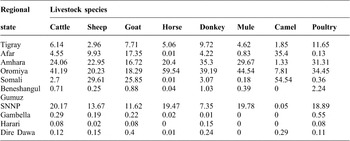
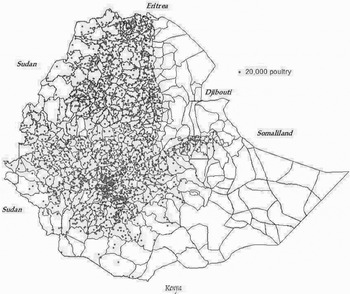
Ethiopia comprises many agro-ecological zones but, put very simply, there is a dichotomy of moist highlands at altitudes over 1500 metres above sea level in the centre surrounded by dry lowlands below that elevation. The highlands are characterised by high human population density and a mainly sedentary mixed crop-livestock farming system. Pastoral systems of production are common in the lowlands where there is an almost universal degree of transhumance or nomadism. Consequent on these ecological and demographic factors most poultry are found in the highland areas (Figure 1). The large central regions of Oromiya and Amhara each have more than 30% of the national poultry flock with parts of the Southern Nations and Nationalities Peoples and Tigray Regions also maintaining large numbers of birds (Table 1). Rural areas are home to more than 95% of all poultry with less than 5% in urban areas.
Percentage distribution of Ethiopian livestock numbers by regional state, 2005 (Adapted from CSA Reference CSA2006).

General distribution of poultry (domestic fowl) in Ethiopia.

household ownership
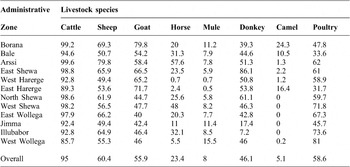
Ethiopia is exceptional over much of its territory in that more households own cattle (mainly as work oxen) than any other domestic livestock species. In the 12 Administrative Zones (sub-regional entities) of the huge Oromiya Region, for example, 95% of households own cattle whereas only 59% own poultry (CSA, Reference CSA2006). Average household flock sizes over the country as a whole are 6-10 birds. Flock numbers and composition vary over time, however, as a function of natural recruitment, disease and the occurrence of festivals which induce high rates of offtake through household consumption and sale.
Poultry ownership among zones in Oromiya varies from 32 to 74% of households (Table 2). At a microlevel in four Oromiya zones (which may or may not be representative of other areas), in Abigar 87% of households owned an average of 10.5 birds, in Gurage 42% of households owned 2.9 birds, in Horro 73% owned 6.4 birds and in Sheko 73% owned 4.2 birds (Stein et al., Reference STEIN, WORKNEH AYALEW, REGE, WONDYALEW MULATU, MALMFORS, TADELLE DESSIE and PHILIPSSON2009).
Percentage of households owning domestic livestock species in Oromiya Regional State (Workneh et al., 2004).

In general the flock comprises about 72% female birds and 28% males although at times the male ratio may be higher due to their being kept for sacrifice or for sale at festivals. Laying hens are equivalent to 23.0% of the total flock, cocks 9.4%, growers 31.5% and chicks 36.1% (Tadelle et al., Reference TADELLE, MILLION, ALEMU and PETERS2003b).
As already indicated women are the nominal owners – and are more knowledgeable – of poultry and much of the income accrues directly to them. Children own the next largest share. Poultry keeping is apparently too demeaning for grown men. Social status appears to have little effect on the numbers of birds owned but does affect use: wealthier families are ‘hobby farmers’ who keep birds mainly for home use whereas poorer households depend on birds for a securer income and for improved diets – one egg or 40 g of poultry meat provides all essential amino acids for one person for one day (Tadelle et al., Reference TADELLE, MILLION, ALEMU and PETERS2003c).
genetic resources
The poultry flock is dominated by the domestic fowl (‘chicken’) that is found in small scavenging flocks averaging 6-10 birds. There are very few ducks, geese and turkeys and these are mostly kept by non-traditional producers. Less than 5% of domestic birds in Ethiopia are internationally recognised or well known breeds.
Local fowl show great variation in body size and shape, feather contours, plumage colour and comb type. Naked neck types are present in some areas but are not preferred as they are considered to be poor mothers and also fetch lower prices when sold for meat in local markets (Tadelle et al., Reference TADELLE, KIJORA and PETERS2003a). In addition to economic use poultry are kept for socio-religious reasons. Plumage colour and cover, sex, comb type and age are important in this respect. The right bird at the right time commands a premium in the market whereas it may not be in such a situation on ordinary market days (Tadelle et al., Reference TADELLE, MILLION, ALEMU and PETERS2003c). The appearance of the right combination of characteristics may be fortuitous but selection for these characteristics alone may have adverse effects on production traits.
Little work has been done on classification or characterisation and this has been limited mainly to morphological characters or a distribution in a circumscribed area. Five indigenous ‘genotypes’, based mainly on plumage colour, were identified in the 1980s as Tikur (Black), Melata (Brown), Keiy (Red), Gebsima (Greyish mixture) and Netch (White) (Shanawany and Banerjee, Reference SHANAWANY and BANERJEE1991). In another study five ecotypes from different areas were described as Tilili from southern Amhara, Horro from western Oromiya, Chefe from central Oromiya, Jarso from north-eastern Oromiya and Tepi from Southern Nations and Nationalities Peoples Region (Tadelle et al., Reference TADELLE, KIJORA and PETERS2003a). In yet a third study, seven so-called ecotypes from Amhara Region in north-western Ethiopia were identified as Tilili, Gellilia, Debre-Ellias, Mello-Hamusit, Gassay, Guangua and Mecha (Halima Hassen et al., Reference HALIMA HASSEN, NESER, TADELLE DESSIE and VAN MARLE-KOSTER2006).
production
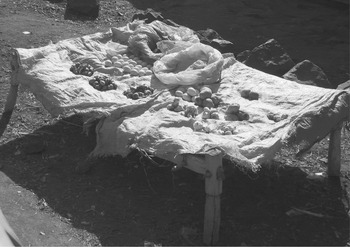
Poultry are kept mainly to produce eggs and meat for home consumption, to provide a surplus for sale (Figure 2) and for use in ceremonies and to provide feasts for guests.
Eggs displayed by a woman trader for sale with other produce near Bedele, southwest Ethiopia.

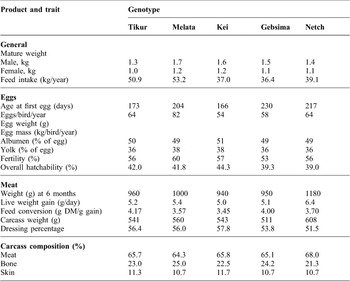
Local chicks weigh about 28 g at hatching, 185 g at eight weeks and 1.035 kg at 6.5 months which is point-of-lay (Dessie and Ogle, Reference DESSIE and OGLE2001). Mature body weights range from 1.0-1.2 kg for hens to 1.3-1.7 kg for cocks with carcass weights being around 800 g (Table 3; Shanawany and Banerjee, Reference SHANAWANY and BANERJEE1991). Annual egg production is 55-80 eggs per year in 5-6 clutches of 10-15 eggs with an average egg weight of 30 g (Dessie and Ogle, Reference DESSIE and OGLE2001). A study at Asela Livestock Farm showed that the average production of local birds was 34 eggs/hen/year with an average egg weight of 38 g (Brannang and Persson, Reference BRANNANG and PERSSON1990). In five areas of the highlands a further study showed somewhat higher production of 17 eggs in the first clutch, 21 in the second and 25 for third and all other clutches with 2.6 clutches being laid per year (Tadelle et al., Reference TADELLE, MILLION, ALEMU and PETERS2003b).
Egg and meat production characteristics of indigenous Ethiopian fowl (Shanawany and Banerjee Reference SHANAWANY and BANERJEE1991).

Within a clutch, eggs are not laid every day and a 10-egg clutch may be laid in 15-18 days whereas a 15-egg clutch may take 25 days (WBISPP, Reference WBISPP2003). Egg fertility under broody hens is only about 55% and hatchability about 75% so that total eggs hatched is only about 40% of the potential (Table 3). Other sources put eggs set as 13.5 per clutch and eggs hatched as 70-81% of those set in the overall range of 44-100% (Dessie and Ogle, Reference DESSIE and OGLE2001; Tadelle et al., Reference TADELLE, MILLION, ALEMU and PETERS2003b. There is some evidence that the egg laying period and the number of eggs laid per period are higher in urban than in rural areas which may be due to better husbandry in general or to more use of exotic types.
In a trial under experimental conditions using a balanced diet, five local ecotypes were compared to the Egyptian Fayoumi. The highest body weight gain per bird was recorded for Fayoumi chicks which were 11.9% heavier than Chefe chicks at six weeks of age, 97.7% heavier than the Jarso and 49.4% heavier than all local ecotypes combined. Fayoumi chicks consumed 41% more feed than Chefe, 115% more than Jarso and 65% more than all local types. Jarso and Tepi had the least body weight gains and Chefe and Tilili the greatest among the local types. The results were similar at 12 weeks of age. Highest feed requirement per unit gain was recorded for the Fayoumi followed by Tepi and Horro with lowest feed per unit of gain recorded for Tilili and Chefe chicks with overall feed conversion ratios in the range 4.95-5.20 (Tadelle et al., Reference TADELLE, MILLION, ALEMU and PETERS2003c). Similar differences in growth and feed conversion to those just described but for seven ecotypes were reported from a study in northwest Ethiopia. In this last case birds were taken to ‘mature’ weights at 22 weeks when they weighed between 1.034 kg and 1.394 kg with average daily gains in the range 6.6-8.8 g (Halima Hassen et al., Reference HALIMA HASSEN, NESER, TADELLE DESSIE and VAN MARLE-KOSTER2006).
The state-owned Shola Poultry Development Enterprise on the outskirts of the capital produced 69,789 kg of meat and 5,896,569 eggs in 1999, 125,209 kg of meat and 9,062,503 eggs in 2000 and 88,000 kg of meat and 6,474,000 eggs in 2001 (Addis Ababa, Reference ADDIS ABABA2003).
FAO data indicate that poultry meat production increased by about 45% between 1993 and 2006 and its availability per person by about 4.5% which is very much below the world average. Data for 1990 suggest that annual national production was about 79,120 tonnes of eggs and 76,560 tonnes of meat. Poultry accounted for about 15% of all Ethiopian meat production in 1990 but this had fallen to 11% in 2000 (FAO, Reference FAO2004). Total meat availability in relation to the national stocks of domestic animals remains, however, derisory in comparison to the capability.
consumption
Poultry meat and eggs are consumed readily in the highlands, however, in the lowland pastoral areas, eggs are usually left to be brooded by the mother hens and meat is more commonly consumed. Where there are alternatives, the preference is for meat and eggs from local scavenging birds, but higher productivity of improved birds would almost certainly offset any price disparity. In contrast to the very low per capita consumption of meat and milk, the large number of fowl means that Ethiopians consume more eggs per person than any other country in Africa. At an annual consumption per person of 57 eggs and 2.85 kg poultry meat (Alemu and Tadelle, Reference ALEMU and TADELLE1997) consumption level is still very low by world standards. Many of the eggs consumed are in the form of ‘douro wat’ which is a very popular spicy chicken and egg stew.
At the household level some 50% of eggs laid are set under hens to produce replacement birds, 27% are sold and 23% are eaten at home. About 30.6% of mature birds are kept as replacements, 44.4% are sold and 20% are used for home consumption (Tadelle et al., Reference TADELLE, MILLION, ALEMU and PETERS2003c). Some birds may be kept beyond their useful life for socio-religious reasons and others may be consumed for health reasons as prescribed by traditional healers (Tadelle et al., Reference TADELLE, MILLION, ALEMU and PETERS2003c).
marketing
Consumers overwhelmingly prefer local to exotic birds and eggs, and hence, in local markets, an indigenous bird of 1.25 kg live weight and its 40 g eggs (or lighter) command the same prices as exotic birds of 1.5 kg and eggs of 60 g. The premium for local birds is attributed to better meat flavour and more deeply coloured egg yolks (Dessie and Ogle, Reference DESSIE and OGLE2001).
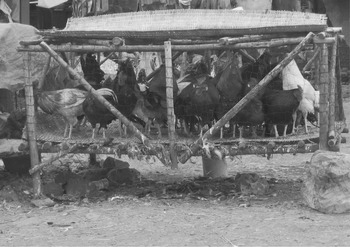
The marketing chain is almost completely informal. Birds are sold off the farm direct to a final consumer, to a local middleman or through a local market in both rural and urban areas (Tadelle et al., Reference TADELLE, MILLION, ALEMU and PETERS2003c). Some 42% of live sales are made between farmer and consumer, and 39% from farmer to trader. Due to the large number of traders attempting to obtain a living the volume of product handled by each is low (Kennea et al., Reference KENNEA, LEGESSE and ALEMU2003). Traders most often carry birds to regional centres where they change hands again to the final retail point of sale (Figure 3). Householders attempt to produce birds that can be sold at festival time to command high prices but, conversely, forced sales at periods of high disease risk or actual disease cause prices to slump.
Local poultry at final retail point of sale in Jimma, southwest Ethiopia.

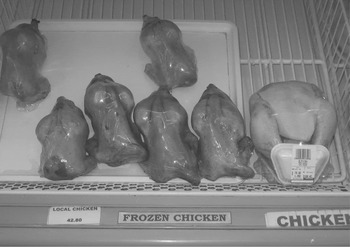
A survey of butchers’ shops in Addis Ababa area showed that all sold beef, 5.8% sold sheep meat but only 2.9% sold poultry. The customer base for these butcheries is largely local and mainly from lower social strata. In complete contrast to butchers, whereas 100% of supermarkets sold beef but 85.7% sold sheep meat, 28.5% goat meat and 85.7% poultry meat. The retail price of poultry meat in supermarkets is cheaper than all red meat types. Some 66.7% of supermarket poultry was obtained from the leading commercial producer with the remainder bought from smaller commercial enterprises and from farmers (Figure 4): the customer base of supermarkets is mainly expatriates and higher social strata Ethiopians who require a more hygienic product or who want a more ‘convenient’ presentation.
disease and mortality
Newcastle disease is one of only two poultry diseases included in List A of the Office International des Epizooties (OIE, Reference OIE2007). The disease is enzootic in Africa and has a major impact on village poultry production as it can devastate flocks every year (Alexander, Reference ALEXANDER2004). Up to 90% of fowl die every year from this pestilence (Spradbrow, Reference SPRADBROW1993). Village poultry owners interviewed at various times between 2000 and 2009 indicated Newcastle disease as a sporadic problem with devastating losses once in four or five years. In spite of this the Ethiopian authorities reported only 14 outbreaks in 1998, 16 in 1999, 8 in 2000, 34 in 2001, 67 in 2002, 16 in 2003 and 40 in 2004 (OIE, Reference OIE2006).
Local scavenging birds and commercial broilers on sale in a supermarket in Addis Ababa.

Avian Influenza is also an important List A poultry disease yet there has been only one suspected outbreak in Ethiopia in 1996 (OIE, Reference OIE2006) and no confirmed case of Highly Pathogenic Avian Influenza. A risk assessment considered possible sources of infection as legal trade through imports of eggs and birds, illegal cross border trade with neighbouring countries and transmission from the large number of resident and migratory water fowl. The conclusion on the possible transmission of the virus from wild to domestic birds was low for the scavenging system and negligible for the commercial system (Goutard et al., Reference GOUTARD, SOARES MAGELHAES, DEMISSIE, YIGEZE, JOBRE, PFEIFFER and ROGER2006).
Overall mortality in village birds is generally very high, with up to 60% of chicks dying before eight weeks of age (Dessie and Ogle, Reference DESSIE and OGLE2001). In a study of 250 households in villages widely dispersed across the highlands average mortality to eight weeks was 49% in the range 25-88% (Tadelle et al., Reference TADELLE, MILLION, ALEMU and PETERS2003b). Coccidiosis is a major factor in the aetiology of village chicken deaths (Halima Hassen et al., Reference HALIMA HASSEN, NESER, TADELLE DESSIE and VAN MARLE-KOSTER2006), but other diseases and a combination of neglect and predators (including domestic dogs and cats especially in urban areas) are important mortality factors.
Although limited in extent, commercial private or semiprivate poultry production of both layers and broilers is promoted by the Ethiopian authorities. This does not mean that practical support is provided and this lack risks killing the goose before it has laid any golden eggs. In three commercial broiler operations some 50 km from Addis Ababa, for example, deaths up to 15 weeks (but mainly in the period 3-6 weeks) were 5.0% at one farm, 23.3% at another and 44.5% at a third. A whole litany of risk factors was associated with these heavy mortalities: concurrent infections with two or several pathogens (salmonella, collibaccus, avian mycoplasma, coccidia and infectious bursal disease), poor housing, overcrowding (12 birds/m2), movement of personnel and equipment between clean and infected stock, easy ingress of wild birds, improper sanitation and biosecurity and keeping of other species of domestic animals (Mersha Chanie et al., Reference MERSHA CHANIE, TAMIRU NEGASH and SAMUEL BEKELE TILAHUN2009). On commercial farms in general, coccidiosis, Newcastle disease and respiratory diseases are very common and constitute major health-related constraint to production and profitability (Alamargot, Reference ALAMARGOT1987).
Conclusions
Poultry in Ethiopia, especially in villages, are kept for a multiplicity of reasons. In addition to yielding animal protein and providing a surplus for sale to generate small amounts of cash they are reared for sacrificial and cultural reasons. Small scale scavenging production could be an effective means of transfer of wealth from higher income urban consumers to poorer and poor rural and peri-urban members of the community. Many producers recognise the contribution of poultry to an improved diet that is higher in animal protein and thus promotes better growth in children and improved health in adults.
The traditional system makes effective use of local resources but there are considerable opportunities for improvement. Village poultry development should concentrate on the rural and peri-urban areas where the majority of producers live and where most village poultry are found. There is much academic and emotional support for this pathway out of poverty but unfortunately little practical activity.
The oft-preferred route to higher output and productivity is to modify (‘improve’) the local genetics. Before this takes place, however, it would be preferable to encourage changes in management (e.g. provision of feed to newly hatched chicks, indoor management of chicks and control of predators). This would considerably lessen the high mortality and in turn increase off-take rates whether for home consumption or for sale. One simple intervention – the manufacture and use of a hay-box brooder – was successful in reducing chick mortality and there was no significant difference in survival between hay-box and the far more expensive and complicated (and unreliable) electric brooders (Solomon Demeke, Reference SOLOMON DEMEKE1999).
Much damage has been done and the confidence of producers lost by attempted introductions of exotic stock either through cock exchange programmes or wholesale imposition of both males and females – only for these to succumb to the fighting qualities of the remaining local cocks or from disease and starvation. Producers should be made aware that it is possible to increase the benefits from local birds with small additional inputs and improvements in management as a first step. New breeding strategies to improve the genetic potential of local birds should come at a later stage (Tadelle et al., Reference TADELLE, KIJORA and PETERS2003a) although it has been advocated that ‘the introduction of exotic poultry breeds either for crossing with indigenous stocks or for use in their pure form seems the best choice’ (Alemu Yami, Reference ALEMU YAMI1995). Introduction of exotic birds, at whatever stage of development, should be carefully considered. Governmental and non-governmental interventions have yet to cause serious erosion of the local gene pool but the danger of losing valuable adaptive (and production) traits does exist.
Little action is taken by the local veterinary authorities against poultry diseases. This is partially due to the scattered nature and small size of the flocks and the perception that they are not of economic importance. It is additionally due also to the decentralization of many services from the federal to the regional level, where staff levels and budgetary allocations are inadequate and are not obliged to report to the federal services that hence do not have a full perspective of the problems.
Interventions to improve village production could have considerable benefits. Improved sanitation, for example, would improve all of growth (weight) rates, survival and reproduction. Provision of shelter, regular supplies of clean drinking water and some supplementary feeding would improve growth and reproductive rates and greatly increase survival. Biosecurity measures and vaccination against Newcastle disease would greatly increase survival rates. The smallholder producers would be the principal beneficiaries of these interventions in additional improvements to their food security and their nutritional status and in further reduced production risk.