Childhood and adolescence externalizing behaviors—encompassing aggressive, destructive, oppositional, impulsive, and delinquent conducts—are frequent precursors of serious psychopathology later in life (Loeber, Reference Loeber1991; Moffitt, Reference Moffitt1993). Genetic influences, as well as environmental factors, both unique and family shared (Caspi et al., Reference Caspi, McClay, Moffitt, Mill, Martin and Craig2002; DiLalla, Reference DiLalla2002; Van Beijsterveldt, Bartels, Hudziak, & Boomsma, Reference Van Beijsterveldt, Bartels, Hudziak and Boomsma2003; Wadsworth & Achenbach, Reference Wadsworth and Achenbach2005), are recognized determinants of individual differences along the complex phenotype of developmental externalization.
Twin and adoptive studies with the Achenbach (Reference Achenbach1991) Child Behavior Checklist/4–18 (CBCL/4–18) found moderate to substantial genetic contributions to externalizing behaviors, with heritability estimates ranging from .51 to .65 (Deater-Deckard & Plomin, Reference Deater-Deckard and Plomin1999; Edelbrock, Rende, Plomin, & Thompson, Reference Edelbrock, Rende, Plomin and Thompson1995; Hudziak, Rudiger, Neale, Heath, & Todd, Reference Hudziak, Rudiger, Neale, Heath and Todd2000; Pesenti-Gritti et al., Reference Pesenti-Gritti, Spatola, Fagnani, Ogliari, Stazi and Battagliain press; Schmitz, Fulker, & Mrazek, Reference Schmitz, Fulker and Mrazek1995; Spatola et al., Reference Spatola, Fagnani, Pesenti-Gritti, Ogliari, Stazi and Battaglia2007; Van den Oord, Boomsma, & Verhulst, Reference Van den Oord, Boomsma and Verhulst1994). The psychometric facets of CBCL/4–18 defined externalization, however, may have different heritability: the aggressive component has been found to have higher heritability than the rule-breaking component, whereas shared environmental factors appear to have greater influence over the latter than the former (Eley, Lichtenstein & Moffitt, Reference Eley, Lichtenstein and Moffitt2003; Eley, Lichtenstein, & Stevenson, Reference Eley, Lichtenstein and Stevenson1999).
Among the relatively few studies that investigated the nature of time stability of different externalized behaviors from early childhood into adolescence, at least four revealed that both genetic and shared environmental influences are important causal agents of continuity. In a twin study, Van der Valk, van den Oord, Verhulst, and Boomsma (Reference Van der Valk, van den Oord, Verhulst and Boomsma2003) showed that phenotypic stability from age 3 to 7 in CBCL-defined externalization was explained for 55% by genetic factors, whereas the same shared environmental factors influenced these behaviors at both time points. A twin-family study of antisocial behaviors (O'Connor, Neiderhiser, Reiss, Hetherington, & Plomin, Reference O'Connor, Neiderhiser, Reiss, Hetherington and Plomin1998) of children between 10 and 18 years showed that 54% of phenotypic stability was attributable to continuing genetic influences and 30% to continuing shared environmental factors. More recently, Haberstick, Schmitz, Young, and Hewitt (Reference Haberstick, Schmitz, Young and Hewitt2005) found a single common genetic factor, whose effects may act pleiotropically at each age in the presence of unique environmental influences, as the main cause of continuity of externalization from childhood into adolescence. Finally, a large twin study of problem behaviors at ages 3, 7, 10, and 12 (Bartels et al., Reference Bartels, van den Oord, Hudziak, Rietveld, van Beijsterveldt and Boomsma2004) found that a subset of genes expressed early in life, and remaining expressed at the next time point, contributed to 60% of CBCL-defined externalization, whereas a common set of shared environmental factors operated at all ages and accounted for 34% of time-stable externalized behaviors.
Moving on from estimations of general causal effects detectable via model fitting analyses and maximum likelihood theory, some identified environmental and genetic causal factors have been associated with externalization.
Well before the advent of the genomic and postgenomic era, several neurochemical indices were studied in relation to a host of broadly intended externalized behaviors, yielding evidence of altered dopaminergic and serotonergic functions in aggression, impulsivity, and antisocial behaviors (Lesch & Merschdorf, Reference Lesch and Merschdorf2000; Swann, Reference Swann2003). Although several different known genes contribute to regulate the dopaminergic and serotonergic functions and signaling patterns, the dopamine D4 receptor (DRD4) gene and the serotonin transporter (5-HTT) gene have been widely explored, alone or in combination, as possible contributors of variation along normative and psychopathological traits in adults and children (Ebstein, Benjamin, & Belmaker, Reference Ebstein, Benjamin and Belmaker2000; Oak, Oldenhof, & Van Tol, Reference Oak, Oldenhof and Van Tol2000; Reif & Lesch, Reference Reif and Lesch2003).
DRD4 is a G-protein coupled receptor belonging to the D2 receptor family that exerts an inhibitory effect on the adenylate cyclase mediated secondary messenger pathway (Kandel, Reference Kandel, Kandel, Schwartz and Jessel2000). The DRD4 gene is situated on the long arm of chromosome 11 (Gelertner, Kennedy, Van Tol, Civelli, & Kidd, Reference Gelernter, Kennedy, van Tol, Civelli and Kidd1992; Petronis, Van Tol, Lichter, Livak, & Kennedy, Reference Petronis, Van Tol, Lichter, Livak and Kennedy1993), with a 48 base pair variable number tandem repeat polymorphism in the third exon constituting the main focus of attention. Between 2 and 11 repeated elements have been reported in the literature, although the two predominant alleles in Caucasians consist of 4 and 7 repeats (Ding et al., Reference Ding, Chi, Grady, Morishima, Kidd and Kidd2002; Lichter et al., Reference Lichter, Barr, Kennedy, Van Tol, Kidd and Livak1993; Van Tol et al., Reference Van Tol, Wu, Guan, Ohara, Bunzow and Civelli1992). The polymorphic repeated segment codes for amino acids in the third intracytoplasmic loop of the receptor, a region that couples to G-protein and thus mediates intracellular signaling (Asghari et al., Reference Asghari, Sanyal, Buchwaldt, Paterson, Jovanovic and Van Tol1995). There is some evidence that the long (L) and short (S) forms of this protein have functional significance (Asghari et al., Reference Asghari, Schoots, van Kats, Ohara, Jovanovic and Guan1994, Reference Asghari, Sanyal, Buchwaldt, Paterson, Jovanovic and Van Tol1995), although more recent data suggest that the polymorphic region of the loop may not affect the specificity or the efficiency of G(i)alpha coupling (Kazmi, Snyder, Cypess, Graber, & Sakmar, Reference Kazmi, Snyder, Cypess, Graber and Sakmar2000).
These variants of the dopamine D4 receptor have been linked to human novelty seeking (Benjamin et al., Reference Benjamin, Li, Patterson, Greenberg, Murphy and Hamer1996; Ebstein et al., Reference Ebstein, Novick, Umansky, Priel, Osher and Blaine1996), a substantially heritable temperamental dimension encompassing individual dispositions toward exploratory excitability, impulsivity, and sensation-seeking behaviors that can be broadly defined as externalized (Battaglia, Przybeck, Bellodi, & Cloninger, Reference Battaglia, Przybeck, Bellodi and Cloninger1996). The association between DRD4 gene variants and phenotypic variation along human novelty seeking has been confirmed by several, but not all (see Kluger, Siegfried, & Ebstein, Reference Kluger, Siegfried and Ebstein2002, for a meta-analytic approach to the issue and Savitz & Ramesar, Reference Savitz and Ramesar2004, for a review), subsequent studies.
5-HTT has received particular attention because it is involved in the reuptake of serotonin at brain synapses and is the target of selective serotonin reuptake inhibitor antidepressants. The promoter activity of the 5-HTT gene is regulated by a deletion/insertion polymorphism in the proximal 5′ promoter region, designated the 5-HTT gene-linked promoter region (5-HTTLPR). The short (S) allele in the 5-HTTLPR is associated with lower transcriptional efficiency of the promoter compared with the long (L) allele (Lesch et al., Reference Lesch, Bengel, Heils, Sabol, Greenberg and Petri1996). Both adults and children and adolescents with the L-L genotype have significantly higher serotonin uptake compared to those with L-S or S-S genotypes (Greenberg et al., Reference Greenberg, Tolliver, Huang, Li, Bengel and Murphy1999; Nobile et al., Reference Nobile, Begni, Giorda, Frigerio, Marino and Molteni1999). This genetically influenced functional difference in serotonin uptake appears to influence a significant proportion of phenotypic variation along several human behaviors, including negative emotionality, proneness to anxiety/depression, interpersonal hostility, and aggressiveness (see, e.g., Battaglia et al., Reference Battaglia, Ogliari, Zanoni, Citterio, Pozzoli and Maffei2005; Nobile et al., Reference Nobile, Cataldo, Giorda, Battaglia, Baschirotto and Bellina2004; Lesch, Reference Lesch, Plomin, DeFries, Craig and McGuffin2002; Munafò et al., Reference Munafo, Clark, Moore, Payne, Walton and Flint2003, for reviews). However, association studies of 5-HTTLPR and aggressiveness in the developmental years provided conflicting results. For instance, Gerra et al. (Reference Gerra, Garofano, Castaldini, Rovetto, Zaimovic and Moi2005) found an association between the –S allele and aggressive behaviors within a group of adolescent drug abusers, and Sakai et al. (in press) found a within-family association between the –S allele and conduct disorder. However, except for teacher-rated aggressive behavior, the same association was not found in a sample of younger children (Haberstick, Smolen, & Hewitt, Reference Haberstick, Smolen and Hewitt2006) and two other studies (Beitchman et al., Reference Beitchman, Davidge, Kennedy, Atkinson, Lee and Shapiro2003; Davidge et al., Reference Davidge, Atkinson, Douglas, Lee, Shapiro and Kennedy2004) found no association at all with the 5-HTTLPR and aggressive/externalized behaviors.
Such conflicting results with DRD4 and 5-HTTLPR in developmental externalization might be at least partially accounted for by two important factors: interactions among genes and interaction between genes and the environment.
There are several hints that interactions among genes, a phenomenon often referred to as “epistasis,” may apply to the combined effects of DRD4 and 5-HTTLPR over externalized behaviors both in childhood (Auerbach et al., Reference Auerbach, Geller, Lezer, Shinwell, Belmaker and Levine1999; Auerbach, Faroy, Ebstein, Kahana, & Levine, Reference Auerbach, Faroy, Ebstein, Kahana and Levine2001; Ebstein et al., Reference Ebstein, Levine, Geller, Auerbach, Gritsenko and Belmaker1998; Lakatos et al., Reference Lakatos, Nemoda, Birkas, Ronai, Kovacs and Ney2003) and adulthood (Benjamin et al., Reference Benjamin, Osher, Kotler, Gritsenko, Nemanov and Belmaker2000; Strobel, Lesch, Jatzke, Paetzold, & Brocke, Reference Strobel, Lesch, Jatzke, Paetzold and Brocke2003). In particular, Benjamin et al. (Reference Benjamin, Osher, Kotler, Gritsenko, Nemanov and Belmaker2000) suggested that the short allele of 5-HTTLPR and the long allele of DRD4 oppose each other's effects inasmuch as approaching behaviors (e.g., orientation toward environmental stimuli in infants and novelty seeking in adults) are promoted by the long DRD4 allele and avoidant behaviors are promoted by the short 5-HTTLPR allele.
Because a variety of often-uncontrolled environmental factors (both family shared and idiosyncratic; see, e.g., Burt, Krueger, McGue, & Iacono, Reference Burt, Krueger, McGue and Iacono2003; Caspi et al., Reference Caspi, McClay, Moffitt, Mill, Martin and Craig2002; Jaffee, Moffitt, Caspi, Taylor, & Arseneault, Reference Jaffee, Moffitt, Caspi, Taylor and Arseneault2002; Manly, Kim, Rogosch, & Cicchetti, Reference Manly, Kim, Rogosch and Cicchetti2001; Rutter, Moffitt, & Caspi, Reference Rutter, Moffitt and Caspi2006; Shonk & Cicchetti, Reference Shonk and Cicchetti2001) moderate the expression of externalized behaviors and the amount of measured genetic influence (i.e., the heritability), interaction with the environment can be another, nonmutually exclusive, potential explanation for inconsistent results with DRD4 and 5-HTTLPR in externalization.
Parental socioeconomic status (SES) could be one such environmental factor. Although limited by the fact of being a generic, broad, distal risk variable that is measured at a family-wide rather than at a child-specific level, SES is a powerful predictor of externalization (Barry, Dunlap, Cotten, Lochman, & Wells, Reference Barry, Dunlap, Cotton, Lochman and Wells2005; Dodge, Petit, & Bates, Reference Dodge, Pettit and Bates1994; Keiley, Bates, Dodge, & Pettit, Reference Keiley, Bates, Dodge and Pettit2000; Loeber, Green, Keenan, & Lahey, Reference Loeber, Green, Keenan and Lahey1995; Wadsworth & Achenbach, Reference Wadsworth and Achenbach2005; Zukauskiene, Ignataviciene, & Daukantaite, Reference Zukauskiene, Ignataviciene and Daukantaite2003). The impact of socioeconomic disadvantage can be negative both cross-sectionally and in the longer term: low SES has been linked to higher prevalence of conduct disorder (Steiner & Dunne, Reference Steiner and Dunne1997), to both mother- and teacher-reported aggression and delinquency on the Child Disruptive Behavior Scale (Barry et al., Reference Barry, Dunlap, Cotton, Lochman and Wells2005), as well as to poor academic performance and severe disciplinary problems during adolescence (DuBois, Felner, Meares, & Krier, Reference DuBois, Felner, Meares and Krier1994). Low SES may contribute to these psychopathologies either directly or indirectly, through negative effects onto more proximal child-specific factors, such as parenting (Conger et al., Reference Conger, Wallace, Sun, Simons, McLoyd and Brody2002) or exposure to trauma (Egeland, Reference Egeland, Cicchetti and Toth1997). However, no study has so far analyzed the possible impact of SES in mediating the genetic contribution of the DRD4 and 5-HTTLPR polymorphisms to childhood externalization.
In the present study we examined the independent and joint effects of three potential, identified genetic (DRD4 and 5-HTTLPR polymorphisms) and environmental (parental SES) causes of developmental externalization in a general population sample of Italian children and adolescents.
Materials and Methods
Subjects
Participants in this study were subjects involved in two epidemiological studies of mental health in youth. Subjects from sample 1 (n = 442) were recruited by our group as a collaborating center of the Italian Project on Preadolescent Mental Health (Progetto Italiano Salute Mentale Adolescenti or PrISMA project; Frigerio et al., Reference Frigerio, Vanzin, Pastore, Nobile, Giorda and Marino2006). The PrISMA project was designed to estimate the prevalence of behavioral problems in a National probability sample of preadolescents (10–14 years old) living and attending secondary schools in seven medium to large Italian urban areas (Milan, Rimini, Lecco, and Conegliano, located in the north of Italy, Rome, and Pisa in the center, and Cagliari in the south of the Italian peninsula). Psychometric indexes were obtained through parental assessments of children's behavior with the CBCL/6–18 (Achenbach & Rescorla, Reference Achenbach and Rescorla2001) and the overall participation rate of the complete PrISMA sample was 61% of eligible subjects (Frigerio et al., Reference Frigerio, Vanzin, Pastore, Nobile, Giorda and Marino2006). The mean values of the CBCL/6–18 subscales did not differ significantly across these seven urban areas (data available from the authors upon request).
Among the seven PrISMA participating units, two (respectively based in Bosisio Parini near Lecco and Conegliano) have interests in behavioral genetics, together with the suitable technology for DNA collection and molecular genetic analyses. Therefore, for children living in Lecco and Conegliano, in addition to demographic and psychometric information, we asked for DNA collections, which were allowed by parental written informed consent for 442 of 1,211 (36%) eligible children.
Subjects from sample 2 belong to a relatively small suburban community (Ponte Lambro [PL], inhabitants 4,065) currently involved in an ongoing longitudinal study of emotional and behavioral problems, which encompasses the assessment of behavioral data with the CBCL/6–18 (Achenbach & Rescorla, Reference Achenbach and Rescorla2001) and simultaneous DNA collection. The DNA of 165 of 317 (52%) eligible preadolescents living in PL and aged 10–14, was made available after parental written informed consent. The PL and PrISMA samples have no overlapping.
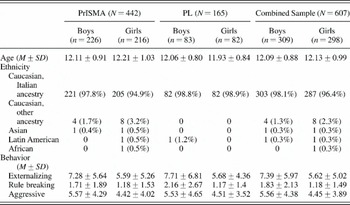
Because the inclusion (age between 10 and 14 years, regular school attendance, parental written informed consent) and exclusion (certification of mental handicap, which was present in 0.3% of eligible participants) criteria, and the psychometric instrument (parental assessments of children behavior through the CBCL/6–18) were the same for PriSMA and PL, subjects of both epidemiological samples were pooled for the present study to increase the statistical power after controlling for the homogeneity of demographic and behavioral variables (Table 1).
Demographic and behavioral variables in the two original epidemiological samples and the combined sample

Genetic data of both samples are shown here for the first time and analyzed in conjunction with demographic and clinical information as relevant to genetic and gene–environment interaction (G × E) effects upon the externalizing behaviors explored by this study.
Procedures
The study protocols were approved by the Eugenio Medea Scientific Institute Ethical Committee.
Behavioral Assessment
The CBCL/6–18 (Achenbach & Rescorla, Reference Achenbach and Rescorla2001) is an empirically based checklist of social competence and behavioral problems filled out by parents of children and adolescents aged 6–18 years. The CBCL/6–18 is divided into two major factors: the internalizing (with the anxious–depressed, withdrawn, and somatic complaints subscales) and the externalizing scale, which consists of 35 items and two subscales: rule-breaking and aggressive behavior. We employed parental employment as a measure of SES coded according to the Hollingshead (Reference Hollingshead1975) 9-point scale for parental occupation. A score (1–9) was assigned to each parental job; when both parents were employed the highest of the two scores was used. Because low SES, in contrast to medium and high SES, has been identified as a specific risk factor for both aggressive and rule-breaking behavior (Barry et al., Reference Barry, Dunlap, Cotton, Lochman and Wells2005; Dodge et al., Reference Dodge, Pettit and Bates1994; Keiley et al., Reference Keiley, Bates, Dodge and Pettit2000; Loeber et al., Reference Loeber, Green, Keenan and Lahey1995; Wadsworth & Achenbach, Reference Wadsworth and Achenbach2005; Zukauskiene et al., Reference Zukauskiene, Ignataviciene and Daukantaite2003), we split SES into two classes of risk: low (SES 1–3) and medium to high (SES 4–9).
DNA collection and extraction
Genomic DNA was extracted from mouthwash samples collected in 4% sucrose using the DNAzol Genomic DNA Isolation reagent (Molecular Research Center, Cincinnati, OH).
The methods for determining the DRD4/48 base pair repeat and 5-HTTLPR polymorphisms were the same as described by Macciardi et al. (Reference Macciardi, Petronis, Van Tol, Marino, Cavallini and Smeraldi1994) and Lesch et al. (Reference Lesch, Bengel, Heils, Sabol, Greenberg and Petri1996), respectively.
All amplification reactions were performed on a Mastercycler thermocycler (Eppendorf, Westbury, NY). The amplified products were analyzed on 2% agarose gels.
Statistical analyses
The DRD4–exon III polymorphism was classified according to the short (2–5 repeats; S) versus long (6–8 repeats; L) scheme (Benjamin et al., Reference Benjamin, Li, Patterson, Greenberg, Murphy and Hamer1996; Ebstein et al., Reference Ebstein, Novick, Umansky, Priel, Osher and Blaine1996), so that subjects could be split into DRD4-S-S versus DRD4-L (encompassing L-S and L-L subjects) carriers. For the 5-HTTLPR genotype we split the sample into S-allele carriers (encompassing SS and LS subjects) and LL subjects.
Demographic and behavioral variables were preliminarily tested by analysis of variance. Because in the PrISMA project parents were let free to participate through simple behavioral assessments or behavioral assessment plus DNA collection, for sample 1 it was possible to control for possible participation biases. When we compared the CBCL externalizing, rule-breaking, and aggressive behavior scores of PrISMA children belonging to families who agreed versus those belonging to families who did not agree to participate in the genetic study, we found that there were no significant differences (externalization: 5.84 ± 5.57 vs. 6.2 ± 5.04, t = −1.0, p = .32; rule breaking: 1.43 ± 1.95 vs. 1.37 ± 1.62, t = 0.47, p = .64; aggressive: 4.41 ± 4.08 vs. 4.83 ± 3.83; t = −1.553, p =.12). Moreover, there were no significant differences owing to SES (58.84 ± 22.25 vs. 57.69 ± 23.62, t = −0.72, p = .47) or age (12.14 ± 0.89 vs. 12.05 ± 0.95, t = −1.34, p = .18) between PrISMA children belonging to families who agreed versus those belonging to families who did not agree to participate in the genetic study.
After controlling for independence of genotypes' and SES classes' distribution, the DRD4 and 5-HTTLPR genotypes and SES (divided into low and medium to high) were entered simultaneously as independent variables, whereas the CBCL/6–18 rule-breaking and aggressive behavior scores were the dependent variables in a multivariate analysis of covariance (MANCOVA), with gender and age as covariates. Two analyses of covariance (ANCOVA) were subsequently run to estimate the effect of the independent variables on aggressive and rule-breaking behavior separately.
Furthermore, to investigate the effect of specific combinations of genotypes and SES upon rule-breaking and aggressive behaviors, we performed a two-loci genotype analysis whereby each subject was uniquely classified as belonging in one of four genetic variants: DRD4 (S-S)–5-HTT (L-L), DRD4 (S-S)–5-HTT (S-carrier), DRD4 (L-carrier)–5-HTT (LL), or DRD4 (L-carrier)–5-HTT (S-carrier), and in one of the two SES categories, again with age and gender as covariates, in two separate ANCOVAs (one for rule-breaking and one for aggressive behavior).
All analyses were performed using the Statsoft Statistica package (Version 6.0, 1997).
Results
Table 1 shows the demographic and behavioral variables in the two original epidemiological samples and in the combined sample. More than 95% of participating children were Caucasian and of Italian ancestry. Although attending the same school grade, children in the PrISMA sample were slightly but significantly older than children in the PL sample (F = 3.75, df = 1,605, p = .053), because of a modest difference in the timing of recruitment of the two samples (winter for the PrISMA sample and fall for the PL sample). The total score of externalizing (rule-breaking plus aggressive) behavior was significantly higher in boys (F = 13.45, df = 1,605, p < .001) than girls; likewise, both rule-breaking and aggressive behaviors were significantly higher in boys than girls (F = 20.76, df = 1,605, p < .001; F = 8.19, df = 1,605, p < .004) in the total sample, without significant differences between the PrISMA and the PL subsamples. These results are consistent with previous studies investigating externalizing behavior in children and adolescents (Bengi-Arslan, Verhulst, Van der Ende, & Erol, Reference Bengi-Arslan, Verhulst, Van der Ende and Erol1997; Collett, Ohan, & Myers, Reference Collett, Ohan and Myers2003; Fitzpatrick & Deehan, Reference Fitzpatrick and Deehan1999, Frigerio et al., Reference Frigerio, Cattaneo, Cataldo, Schiatti, Molteni and Battaglia2004; Lambert, Knight, Taylor, & Achenbach, Reference Lambert, Knight, Taylor and Achenbach1994; Larsson & Frisk, Reference Larsson and Frisk1999; Liu et al., Reference Liu, Kurita, Guo, Miyake, Ze and Cao1999; MacDonald, Tsiantis, Achenbach, Motti-Stefanidi, & Richardson, Reference MacDonald, Tsiantis, Achenbach, Motti-Stefanidi and Richardson1995; Novik, Reference Novik1999; Roussos et al., Reference Roussos, Karantanos, Richardson, Hartman, Karajiannis and Kyprianos1999; Steinhausen, Winkler Metzke, Meier, & Kannenberg, Reference Steinhausen, Winkler Metzke, Meier and Kannenberg1997).
Genotyping of DRD4 and 5-HTTLPR was successful for 589 subjects with complete sociodemographic and behavioral data. Both polymorphisms were in Hardy–Weinberg equilibrium. The 5-HTTLPR genotype frequencies in the total sample were L/L 33.6%, L/S 48.6%, and S/S 17.8% and the allele frequencies were L 57.9% and S 42.1%. The DRD4 genotype frequencies were S/S 68.9%, S/L 25.6%, and L/L 5.3% and the allele frequencies were S 81.8% and L 18.2%. Genotypes and allele frequencies were evenly distributed between the PrISMA and the PL subsamples (genotype: 5-HTTLPR: χ2 = 0.448, df = 2, p = .799; DRD4: χ2 = 0.094, df = 2, p = .95; alleles: 5-HTTLPR: χ2 = 0.468, df = 1, p = .494; DRD4: χ2 = 0.0, df = 1, p = .998) and across genders (genotype: 5-HTTLPR: χ2 = 2.128, df = 2, p = .345; DRD4: χ2 = 0.074, df = 2, p = .96; alleles: 5-HTTLPR: χ2 = 0.31, df = 1, p = .861; DRD4: χ2 = 0.697, df = 1, p = .712) and similar to those previously reported (Cusin et al., Reference Cusin, Serretti, Lattuada, Lilli, Lorenzi and Smeraldi2002; Gelernter et al., Reference Gelernter, Kennedy, van Tol, Civelli and Kidd1992; Lesch et al., Reference Lesch, Bengel, Heils, Sabol, Greenberg and Petri1996) for Caucasian populations. Among the 183 children who had one- or two DRD4 L allele(s), five had the 6-repeat and four had the 8-repeat polymorphisms.
The frequencies of genotype distribution across the two p-SES categories (low vs. middle + high) were even for both the DRD4–exon III and the 5-HTTLPR polymorphism, with only a mild trend toward having the Short DRD4–exon III more frequently represented among the lower SES (DRD4: χ2 = 3.11, df = 1, p = .09; 5-HTTLPR: χ2 = 0.23, df = 1, p = 0.64) subjects. Similarly, there were no significant differences when we analyzed the distribution of the two-loci genotypes (DRD4–exon III × 5-HTTTLPR polymorphisms) across p-SES classes (χ2 = 3.74, df = 3, p = .29).
Table 2 shows the rule-breaking and aggressive behavior scores grouped by DRD4–exon III and 5-HTTLPR genotypes and SES. The three-way MANCOVA (df = 2,578), with gender and age as covariates, revealed significant effects for the DRD4–exon III polymorphism and SES (DRD4: R = 5.14, p = .006, partial χ2 = 0.017, observed power = .83; SES: R = 6.46, p = .002, partial χ2 = 0.022, observed power = .91), and a modest trend for the 5-HTTLPR polymorphism (5-HTTLPR: R = 2.44, p = .09). There were also significant Gene × Gene (DRD4 × 5-HTTLPR: R = 5.64, p = .004) and Gene × SES interactions (DRD4 × SES: R = 7.50, p = .001), whereas neither the 5-HTTLPR × SES nor the DRD4 × 5-HTTLPR × SES interactions were significant (R = 2.54, p = .08 and R = 1.24, p = .29, respectively).
CBCL 6/18 externalizing behavior subscale: Rule-breaking and aggressive behavior according to genotypes and socioeconomic status

Note: Values are M±SD. CBCL 6/18, Child Behavior Checklist, 6–18; SES, socioeconomic status; DRD4, dopamine receptor D4 gene; 5-HTTLPR, serotonin transporter length promoter region gene; S, short; L, long.
The two ANCOVA run separately on rule-breaking and aggressive scores showed that only low SES (F = 5.13, df = 1,579, p < .024) and DRD4 × 5-HTTLPR (F = 6.35, df = 1,579, p < .01) significantly influenced rule-breaking behavior, whereas aggressive behavior was significantly influenced by SES (F = 12.94, df = 1,579, p < .001), DRD4 (F = 9.36, df = 1,579, p = .002), 5-HTTLPR (F = 4.87, df = 1,579, p = .028) and by the following interactions: DRD4 × 5-HTTLPR (F = 11.09, df = 1,579, p = .001), DRD4 × SES (F = 9.22, df = 1,579, p = .002), and 5-HTTLPR × SES (F = 5.06, df = 1,579, p = .025), always in the direction of more aggressive behaviors in subjects carrying an LL 5-HTTLPR genotype, carrying 1–2 long copies of the DRD4–exon III polymorphism, and living in families with low SES (Table 2).
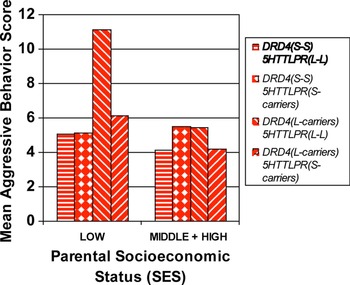
Table 3 shows the rule-breaking and aggressive behavior scores in children divided according to two-loci genotypes and SES. The ANCOVA (gender and age as covariates) run on rule-breaking behavior showed a main effect of SES (F = 5.134, df = 1,579, p = .024), but neither of genotype (F = 2.134, df = 3,579, p = 0.095), nor of SES × Genotype interaction (F = 1.074, df = 3,579, p = .36). The ANCOVA (gender and age as covariates) run on aggressive behavior showed the effects of SES (F = 12.943, df = 1,579, p < .001), genotype (F = 4.876, df = 3,579, p = .002), and SES × Genotype (F = 4.311, df = 3,579, p = .005) interaction. Post hoc analysis for aggressive behavior showed that children of low SES belonging in the DRD4 L–5-HTTLPR-LL two-loci genotype group were significantly more aggressive than children in all the other groups (significance range by Tukey honestly significant difference [HSD]: p = .025–.001), with the exception of children of low SES belonging in the DRD4 L–5-HTTLPR-S carrier group (p < .16 by Tukey HSD; Figure 1).
The mean aggressive behavior score according to socioeconomic status and two-loci genotype. [A color version of this figure can be viewed online at www.journals.cambridge.org]

CBCL 6/18 externalizing behavior subscale: Rule-breaking and aggressive behavior according to two-loci genotypes and socioeconomic status

Note: Values are M±SD. CBCL 6/18, Child Behavior checklist 6–18; SES, socioeconomic status; DRD4, dopamine receptor D4 gene; 5-HTTLPR, serotonin transporter length promoter region gene; S, short; L, long.
Discussion
Our findings of a significant effect of DRD4 and 5-HTTLPR on preadolescents' aggressive behavior scores are compatible with those of other studies investigating the influence and the relationship of the same polymorphisms upon different measures of externally oriented behaviors in childhood (Auerbach et al., Reference Auerbach, Geller, Lezer, Shinwell, Belmaker and Levine1999, Reference Auerbach, Faroy, Ebstein, Kahana and Levine2001; Ebstein et al., Reference Ebstein, Levine, Geller, Auerbach, Gritsenko and Belmaker1998; Lakatos et al., Reference Lakatos, Nemoda, Birkas, Ronai, Kovacs and Ney2003) and in adulthood (Benjamin et al., Reference Benjamin, Osher, Kotler, Gritsenko, Nemanov and Belmaker2000; Strobel et al., Reference Strobel, Lesch, Jatzke, Paetzold and Brocke2003). Specifically, Benjamin et al. (Reference Benjamin, Osher, Kotler, Gritsenko, Nemanov and Belmaker2000) suggested that the long alleles of DRD4 and the short alleles of 5-HTTLPR oppose each other's effects, in that the DRD4 long alleles promote approach and extraverted behaviors, whereas the short alleles of 5-HTTLPR promote avoidance behaviors. Inasmuch as our data are in keeping with studies of infancy and adulthood, which show an interaction between 5-HTTLPR and DRD4 in shaping extraverted and broadly intended externalized behaviors (Auerbach et al., Reference Auerbach, Geller, Lezer, Shinwell, Belmaker and Levine1999, Reference Auerbach, Faroy, Ebstein, Kahana and Levine2001; Benjamin et al., Reference Benjamin, Osher, Kotler, Gritsenko, Nemanov and Belmaker2000; Ebstein et al., Reference Ebstein, Levine, Geller, Auerbach, Gritsenko and Belmaker1998; Lakatos et al., Reference Lakatos, Nemoda, Birkas, Ronai, Kovacs and Ney2003; Strobel et al., Reference Strobel, Lesch, Jatzke, Paetzold and Brocke2003), they add evidence to the hypothesis that this antagonistic interaction mechanism may be present across the whole span of human life.
Our results are also consistent with previous studies showing that SES per se is a predictor of externalization (Barry et al., Reference Barry, Dunlap, Cotton, Lochman and Wells2005; Dodge et al., Reference Dodge, Pettit and Bates1994; Loeber et al., Reference Loeber, Green, Keenan and Lahey1995; Keiley et al., Reference Keiley, Bates, Dodge and Pettit2000; Wadsworth & Achenbach, Reference Wadsworth and Achenbach2005; Zukauskiene et al., Reference Zukauskiene, Ignataviciene and Daukantaite2003).
Of specific relevance to the topic of this Special Issue, which is G × E in developmental psychopathology, we also showed that the copresence of identified alleles of the DRD4 and 5-HTTLPR genes with low SES multiplies the risk for aggressive behaviors. Based on the empirical finding that the measured heritability of given behavioral traits can vary in time, or across social strata, a new generation of behavioral genetic studies (reviewed by Rutter & Silberg, Reference Rutter and Silberg2002; Rutter et al., Reference Rutter, Moffitt and Caspi2006) is now addressing the influence of societal moderators upon heritability of externalized behaviors across different segments of the population. Specifically, it has been shown that in the presence of familial moderators (such as religious upbringing) or societal constraints (such as social undesirability) the heritability of disinhibited behaviors (Boomsma, de Geus, van Baal, & Koopmans, Reference Boomsma, de Geus, van Baal and Koopmans1999) and cigarette smoking (Kendler, Thornton, & Pedersen, Reference Kendler, Thornton and Pedersen2000) can be low or even undetectable, respectively. In contrast, low social control associated with living in urban areas, and the secular trend toward sexual tolerance appeared to enhance the genetic influence over adolescent alcohol use (Dick, Rose, Viken, Kaprio, & Koskenvuo, Reference Dick, Rose, Viken, Kaprio and Koskenvuo2001; Rose, Dick, Viken, & Kaprio, Reference Rose, Dick, Viken and Kaprio2001) and variance in the age at first intercourse (Dunne et al., Reference Dunne, Martin, Statham, Slutske, Dinwiddie and Bucholz1997) in cohorts that differed respectively for geographic location or age. Although the major drawback of these studies is that the degree of social control is induced, rather than measured directly, across social strata, our results can be interpreted in a similar fashion, that is, by suggesting that diminished social constraints associated with low SES may act as enhancers of the genetic influence of DRD4 and 5-HTTLPR risk alleles over aggressive behaviors in preadolescence.
Our results should also be regarded with some limitations in mind, both of general and specific relevance. There is now a clear contrast between the enthusiasm elicited by behavioral studies that suggest interactions between identified candidate genes and specific environmental factors, and the sobriety induced by simulated data analyses studies, such as those failing to find significant G × E for liability to dichotomously defined depression or antisocial disorder (Eaves, Reference Eaves2006). Such divergence of results suggests prudence, because there might be risks of oversimplification, and inflation of significance in virtually any analysis of variance focused on a limited pool of polymorphisms and environmental risk factors for a single/few behavioral variable(s).
We can then add at least four, additional specific caveats for the reader. First, although this study is based on a genetically homogeneous sample (>95% of Caucasian children of Italian ancestry), the stratification bias typical of population-based association studies is still possible, and our results need independent replication in extended family-based studies. Moreover, because our population is primarily Caucasian, the implications of our results may not be extended to other ethnic groups with different allele frequencies or environmental and social factors that may impinge differently upon externalizing behaviors.
Second, although the sample size of about 600 subjects is well within the range of other similar studies, one has to consider that for every common polymorphism or environmental factor of known effect, the impact over phenotypic variance is expected to be modest (usually <5%), which leads to a relatively small effect size. Small effect sizes are thus typical of multifactorial conditions (see, e.g., Kendler, Reference Kendler1995) and within the expectations of psychiatric genetic epidemiology.
Third, we had a less than optimal participation rate. However, our participation figures are within the average reported for population-based investigations of mental health in several European countries including Norway (Harris, Magnus, & Tambs, Reference Harris, Magnus and Tambs2002; Battaglia et al., Reference Battaglia, Ogliari, Harris, Spatola, Pesenti-Gritti and Reichborn-Kjennerud2007) and Italy (Ogliari et al., Reference Ogliari, Citterio, Zanoni, Fagnani, Patriarca and Cirrincione2006). This seems to be especially true when when DNA sampling is added to the collection of psychometric variables in children. However, we found no evidence for selection effects owing to CBCL symptoms, SES, or age, at least for children in Sample 1, who in turn, had the same CBCL scores as children in Sample 2.
Fourth, the study is based on parent-rated CBCL externalized behaviors only. Although parental reports are often used for assessing problem behaviors and psychiatric disorders in children, and externalized behaviors typically provide good replicability across different observers (Achenbach, McConaughy & Howell, Reference Achenbach, McConaughy and Howell1987; Collett et al., Reference Collett, Ohan and Myers2003), direct assessments through direct interviews are by definition more informative and reliable.
Conclusion
In conclusion, this first report of a significant interaction between the DRD4 and 5-HTTLPR genes and low SES in influencing preadolescent aggressive behaviors is consistent with a considerable body of literature that analyzed identified functional genetic polymorphisms or environmental risk factors separately. Although it is becoming increasingly clear that specified genetic polymorphisms, as well as identified environmental conditions, affect the risk for psychopathology in development, a joint analysis of genetic determinants and environmental risk factors appears to be a more ecological and promising approach than studying genes and hazardous environments separately. Because functional variation at a given polymorphism ultimately supports evolutionary tolerance (i.e., lack of negative selective pressure/adaptive advantage) for alternative genetic expressions in at least some ecological niches, the finding that an identified environmental variable mediates the contribution of one or more genetic polymorphisms to human variability in aggressiveness is well within the expectations of the discipline of behavioral genetics.
Future investigations may better clarify which elements of the generic and distal risk variable identified with low SES influence at a child-specific level the individual risk to be more aggressive in the preadolescence years.