1. Introduction
With the rapid depletion of fossil fuels and the increasingly serious environmental problems, solar photovoltaic (PV) power generation, as one of the renewable energy sources, has great potential. The solar PV system has become the forefront of the worldwide shift toward non-conventional resources [Reference Javad, Rand, Shahad, Haya, Ghanima, Dalal and Zainab1–Reference Derakhshandeh, Arjomandi, Dally and Cazzolato3]. As a key component of the PV system, the cleanliness of the PV panel directly affects the power generation efficiency. However, the dust accumulated on the surface reduces energy absorption and photoelectric conversion efficiency, resulting in an output loss of about 2–10% for the PV system and even up to 25% in severe cases [Reference Mani and Pillai4–Reference Yotham, Tatiana and Baraka6]. If not cleaned for a long time, the failed parts will continue to generate heat, form hot spots, and damage the packaging structure on the surface of the PV panels [Reference Zhang, Xu, Li, Cong, Wang, Xu and Wei7]. Therefore, regular cleaning of PV panels is essential to ensure their power generation efficiency [Reference Younis, Cotfas and Cotfas8].
With the expansion of PV scale, many PV power stations have been constructed in mountainous areas that are difficult for personnel and vehicles to access [Reference Zhang, Fu, Tao, Han and Wang9]. The traditional cleaning method generally relies on manual cleaning, but in mountainous regions, manual cleaning is not applicable due to its high labor intensity, large water consumption, and high cost. Therefore, professional cleaning equipment is required to replace manual cleaning of PV panels. At present, the cleaning equipment used in the market generally includes cleaning vehicles [Reference Yang, Zhao, Gao, Guo and Zhao10, Reference Shayan, Adeel, Waqas, Nadia and Kashif11], hanging plate cleaning robots [Reference Parrott, Zanini, Shehri, Kotsovos and Gereige12, Reference Benjamin, Veronica and Juan13], small autonomous cleaning robots [Reference Farah, Alshehab and Alshehri14, Reference Zhao, Yang, Cao, Lv and Fan15], etc. Due to the rugged terrain of the mountain environment and the undulating arrangement of PV panels, the cleaning vehicles that need flat terrain and the hanging plate cleaning robots that need to lay out the inter-plate guide rails in advance are not applicable. Small autonomous cleaning robots are more suitable for such environments. The PV cleaning robot mentioned below refers to the small autonomous cleaning robot.
Small autonomous cleaning robots can be divided into wheeled [Reference Jia, Jia, Li, Zhao and Zhao16, Reference Wang, Li, Li, Zhang and Guan17], tracked [Reference Song, Yu, Chang, Yuan and Lin18–Reference Huang, Li, Xue, Chen and Liu20], and legged [Reference Prados, Hernando, Gambao and Brunete21–Reference Gu, Fu, Chen, Guan, Wu, Zhou and Zhu23] according to the type of mobile mechanisms. Traditional PV cleaning robots generally adopt wheeled and tracked mobile mechanism. Fan et al. [Reference Fan, Liang, Wang, Zhang and Cao24] proposed a wheeled robot for dust removal of PV panels in water-deficient areas, which can adapt to a 0–30° tilt angle and 0–10 mm gap; Ronnaronglit and Maneerat [25] proposed a four-wheeled drive PV cleaning robot; Sorndach et al. [Reference Sorndach, Pudchuen and Srisungsitthisunti26] designed a PV cleaning robot using omnidirectional wheels, which enables it to rotate and move freely, avoiding the steering of the robot during operation. There are also many robots that adopt the tracked type. For example, Antoneli et al. [Reference Antonelli, Zobel, Marcellis and Palange27] developed a PV cleaning robot for desert areas; Nguyen et al. [Reference Nguyen, Truong, Ngoc, Nguyen and Duong28] proposed a PV cleaning robot equipped with two belt-based tracked mechanisms; Mousavi and Farahani [Reference Seyedamirhossein and Gholamreza29] designed the MFv01 robot, and Le et al. [Reference Le, Nguyen, Phan, Truong and Duong30] added multiple suspension units to the tracked mobile mechanism to reduce the vibration impact on the PV panel. Wheeled and tracked cleaning robots have the advantage of high cleaning speed. However, in mountainous environments, PV panels are installed at a large tilt angle. It is difficult for wheeled or tracked mobile mechanisms alone to attach stably, relying solely on friction, so they need to be equipped with negative-pressure chamber adsorption. This continuous adsorption method brings about the coupling problem between adsorption and movement [Reference Cheng and Wang31], as well as the seal failure problem of the robot when crossing gaps. These problems seriously restrict the environmental adaptability of cleaning robots. In order to avoid the above problems, Bisht et al. [Reference Bisht, Pathak and Panigrahi32] proposed an improved scheme of integrated discrete suckers in the crawler, which realized the combination of adsorption and movement, but this mobile mechanism still has limitations in sharp steering.
In contrast, legged mobile mechanisms demonstrate superior environmental adaptability through a discontinuous adsorption mode with discrete contact points. However, this advantage is achieved at the expense of cleaning performance: the coverage area of a single operation is limited, and the trajectory is more complex, resulting in a low speed of cleaning the PV panel. Meanwhile, cleaning blind areas that cannot be cleaned also occur. To address the issue of cleaning blind areas, the coverage area can be expanded by improving cleaning methods. Nevertheless, this approach leads to repeated cleaning of the same area, and the increase in repeatedly cleaned areas will inevitably cause a decline in overall cleaning speed. For this reason, this paper proposes the concepts of ``cleaning integrity’’ and ``cleaning repeatability.’’ The former characterizes the degree of the robot’s cleaning coverage on the panel surface, while the latter describes the occurrence of repeatedly cleaned areas during the cleaning process. The latter is used to reflect the robot’s cleaning speed. Ideally, we aim to improve cleaning integrity while keeping the cleaning speed at a high level. In practical applications, however, these two indicators often exhibit a negative correlation. Therefore, how to enhance cleaning integrity and reduce cleaning repeatability through mechanism design and parameter optimization, while maintaining the environmental adaptability of the legged mechanism, stands as the research focus of this paper.
Based on the above analysis of the traditional wheeled, tracked, and legged PV cleaning robots, this paper decides to adopt the legged mobile mechanism. By applying bionics principles, Wang et al. [Reference Wang, Sun and Dai33] proposed a space-deployable, foldable mechanism based on features common to the flower blooming process. Chen et al. [Reference Chen, Chen, Yan, Kang, Wang, Kong and Wang34, Reference Chen, Luo, Yao, Yuan, Wang, Yu, Wang and Lin35] developed a flexible-rigid junction tensegrity robot. Kang et al. [Reference Kang, Chen, Yan, Wang and Chen36] proposed a flexible-strut tensegrity robot, which achieved inchworm-like locomotion. This paper is inspired by these ideas. By referring to the motion form of the inchworm, a three-legged compound mobile mechanism is designed. While retaining the advantages of the legged mobile mechanism, the structure is simple. By optimizing the size parameters of the mechanism, both the cleaning repeatability and the cleaning integrity can be taken into account.
The following sections of this article are structured as follows: Section 2 introduces the design process of the robot’s mobile mechanism and compares the performance of various types of PV cleaning robots. Section 3 optimizes several key parameters of the robot mechanism. Section 4 introduces the prototype model of the proposed robot and gives the experimental results to verify its adaptability to PV panels in mountainous areas. Section 5 gives the conclusion of the current work.
2. Design of the mobile mechanism for PV cleaning robots
2.1. Topological structure synthesis of mobile mechanisms
In nature, the locomotion mode of inchworms offers an efficient solution for the design of mobile mechanisms. Its typical movement characteristics are as follows: during crawling, the inchworm first anchors its hind prolegs, then extends its anterior body forward to secure itself at a new support point. Subsequently, it lifts its hind prolegs, contracts its posterior body to draw it closer to the anterior half, and repeats this sequence to generate a periodic, alternating motion cycle. When supported on a single foot, it also has the ability to rotate. By decomposing its action, it can be divided into lifting, extending, descending, and rotating. The number of degrees of freedom (DOF) in space is 3, the number of independent rotational elements is 1, and the number of independent translational elements is 2. When the mechanism is designed to imitate the inchworm, one foot is fixed on the ground and the other foot is lifted, which belongs to a typical serial mechanism. Based on this, topological structure synthesis of the serial mechanism is conducted in this section.
The key steps of topological structure synthesis of the serial mechanism [Reference Yang, Liu, Luo, Shen, Hang and Jin37] are as follows:
For the serial mechanism composed of only R pairs and p pairs, according to the POC (position and orientation characteristic) equation for serial mechanisms, the type and number of kinematic pairs should meet the following constraints:
 \begin{equation} F=m_{R}+m_{P} \end{equation}
where F is the DOF of the serial mechanism, m R is the number of R pairs, and m P is the number of p pairs.
The range of the number of R pairs m R and the number of p pairs m P is
 \begin{align} \begin{cases} m_{R}\geq \dim .\{M(r)\} \\[3pt] m_{P}\leq \dim .\{M(t)\} \end{cases} \end{align}
where dim.{M(r)} is the number of independent rotational elements of the POC set, and dim.{M(t)} is the number of independent translational elements of the POC set.
According to the analysis of the locomotion mode of inchworms, the following parameters can be obtained: the POC set of terminal link is
 $M_{s}=\left[\begin{array}{c} t^{2}\\ r^{1} \end{array}\right]$
, dim.{M(r)} = 1, and dim.{M(t)} = 2. Mechanism DOF is F = 3. According to Eqs. (1) and (2), there are three kinds of combination schemes of kinematic pairs: 3R, 2R1P, and 1R2P.
From the given POC set, the type of scale constraints that the serial mechanism may contain in each combination scheme can be determined:
Case 1: 3R
Since dim.{M(r)} = 1, the axes of all R pairs should be parallel to each other. Since dim.{M(t)} = 2 and
 $m_{R}\!\gt\!\text{dim}$
.{M(t)} = 2, the axes of several R pairs should intersect at the same point and be located at the end of the serial mechanism so that the rotation of these R pairs is not accompanied by movement. Obviously, there is a contradiction between the two.
Case 2: 2R1P
Since dim.{M(r)} = 1, the axes of all R pairs should be parallel to each other; the types of scale constraints that may be included are SOC{-R||R-}, SOC{-R||R⊥P-}. Since dim.{M(t)} = 2, the types of scale constraints that may be included are SOC{- (P)-}.
Case 3: 1R2P
Since dim.{M(r)} = 1, the axes of all R pairs should be parallel to each other; the types of scale constraints that may be included are SOC{-R⊥P-}, SOC{-P⊥R⊥P-}. Since dim.{M(t)} = 2, the types of scale constraints that may be included are SOC{-(P)-}.
Based on the combination of the type and number of kinematic pairs, as well as the type of scale constraints that may be included, these scale constraint types are connected in series to generate the structural type of the serial mechanism.
The structural type of the serial mechanism corresponding to 2R1P is SOC{-R||R-P-} and SOC{-R||R⊥P-}. The structural type of the serial mechanism corresponding to 1R2P is SOC{-P⊥R⊥P-} and SOC{-R⊥P-P-}.
According to the POC equation for serial mechanisms, it is not difficult to determine that the POC sets of the four structural types with the DOF of 3 meet the design requirements. A schematic diagram of these four types of structures is drawn, as shown in Figure 1(a)–(d).
Topological structure synthesis process of the serial mechanism.

Figure 1. Long description
A diagram illustrating the topological structure synthesis process of a serial mechanism. Panel A: A linear arrangement with two rotating joints labeled R and a prismatic joint labeled P. Panel B: A similar linear arrangement with an additional rotating joint. Panel C: A configuration with a rotating joint and a prismatic joint at an angle. Panel D: A vertical arrangement with a rotating joint and a prismatic joint. Panel E: A vertical arrangement with two prismatic joints and a rotating joint connected to a suction cup. Panel F: A horizontal arrangement with two prismatic joints and a rotating joint connected to a suction cup. Panel G: A horizontal arrangement with three suction cups connected by prismatic and rotating joints, including a telescopic joint.
These four mechanisms meet the functional requirements of the terminal link POC set and the mechanism DOF, and the target task requirements and cleaning mode requirements of the mechanism need to be further considered.
2.2. Mechanism design based on target tasks and cleaning method requirements
The target task requirement of the mobile mechanism is to carry the cleaning mechanism to complete the cleaning on the PV panel in the mountainous environment, which requires a simple and regular mobile mechanism configuration. The common point of the configuration of Figure 1(a)–(c) is that the revolute pair is located at the middle end, which is not regular enough for PV cleaning task, and the suction cup cannot be adsorbed on the panel surface in the case of inclination. For the configuration of Figure 1(d), since the prismatic pair is located at the middle end, the axis of the revolute pair is perpendicular to the panel surface. When the end prismatic pair is perpendicular to the previous prismatic pair and parallel to the axis of the revolute pair, the end suction cup foot will always be perpendicular to the panel surface, which is convenient for adsorption, so the configuration of Figure 1(d) is more suitable.
Further considering the needs of the cleaning method, the cleaning method needs to be able to take into account the cleaning repeatability and cleaning integrity. The selection of cleaning method will affect the selection of mobile mechanism configuration. The cleaning methods of legged mobile mechanisms are generally divided into linear cleaning and rotational cleaning. When the robot adopts the linear cleaning type, the robot adopts the configuration of Figure 2(a) to move, performing linear cleaning forward. The cleaning mechanism is mounted on both sides of the robot‘s rotational foot, defined as “two-legged linear-cleaning,” and its cleaning condition is shown in Figure 3(a). When the robot adopts the rotational cleaning type, it rotates and cleans 360° around the middle suction cup and then moves forward with a given step size and rotates and cleans again. Because the robot needs to rotate frequently, the balance of its configuration should be considered. The end “leg” is divided into two, symmetrically placed on both sides of the “leg” with a revolute pair, and keeps synchronous motion so the number of independent translational elements can still be maintained, as shown in Figure 1(e). The adsorption state of the other suction cup foot is shown in Figure 1(f). It can be concluded that all three “legs” contain prismatic pairs. To avoid offset, the prismatic pair in the z-direction is regarded as a telescopic joint, as shown in Figure 1(g). The cleaning mechanism is mounted on both sides of the robot‘s length direction, as shown in Figure 2(b), defined as “three-legged rotational-cleaning,” and its cleaning condition is shown in Figure 3(b). Obviously, the linear cleaning type has no repetitive cleaning area and high cleaning speed, but it has no ability to clean the area where the mobile mechanism is located, resulting in low cleaning integrity. On the contrary, the rotational cleaning type is the opposite: it achieves almost no cleaning blind spots but suffers from excessively high cleaning repeatability. Considering the combination of the two cleaning methods, we adopt the mobile mechanism type of “two-legged linear-cleaning” and the mounting mode of the cleaning mechanism of “three-legged rotational-cleaning”, as shown in Figure 2(c), defined as “three-legged compound”, and the cleaning situation is shown in Figure 3(c), that is, the simple moving process in the rotational cleaning mode is changed to linear cleaning.
Combination of mobile mechanism and cleaning mechanism.

Cleaning paths of three types of robots.

To further compare the performance of the mechanisms, we mathematically define cleaning repeatability and cleaning integrity. The cleaning repeatability is set as
 $\gamma$
, and the cleaning integrity is set as
 $\eta$
. The calculation equations are as follows:
 \begin{align} \gamma =\frac{S_{\textit{overlap}}}{S_{\textit{clean}}} \\[-10pt] \nonumber \end{align}
 \begin{align} \eta =\frac{S_{\textit{clean}}}{S_{\textit{total}}} \end{align}
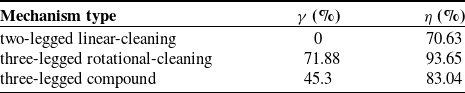
where S overlap represents the area cleaned repeatedly, S clean denotes the area that has been cleaned, and S total stands for the total area that should be cleaned. The length of the two-legged linear-cleaning and three-legged compound mobile mechanism is L. The width of the two-legged linear-cleaning and three-legged compound robot is w. Since the three-legged rotational-cleaning robot performs cleaning by rotating around its center, its length is set to w, which can ensure that the cleaning path width of the three robots is consistent. In order to reflect the characteristics of each mechanism, the step size c steer of the three-legged rotational-cleaning mobile mechanism can make the single cleaning area just cover the previous cleaning blind areas to achieve the maximum cleaning integrity. Let the step length of the three-legged compound mobile mechanism take the maximum value, c max , so that the cleaning repeatability is minimized. Considering the portability of the PV cleaning robot, its length should be less than the arm span of an adult man, set to 1,100 mm, the unilateral cleaning width is set to 250 mm, the width of the mobile mechanism is set to 180 mm, the panel length is set to 2,280 mm, w is 680 mm, c steer is 250 mm, and c max is 730 mm; according to Eqs. (3) and (4), the numerical calculations were performed, and the results are shown in Table I.
Comparison of parameters.

Through the specific numerical value, it can be seen that the first two mechanisms have a poor effect on the other parameter when one parameter is optimal, while the three-legged compound mechanism cannot achieve the optimal single parameter compared with the other two mechanisms, but it can better take into account the cleaning repeatability and cleaning integrity. Therefore, this paper adopts the three-legged compound mobile mechanism configuration shown in Figure 1(g). The three suction cup feet are named as the front suction cup, middle suction cup, and rear suction cup in sequence. When the middle suction cup is adsorbed, the guide rail drives the front and rear suction cups to extend forward, enabling the robot to move forward. When the middle suction cup is adsorbed and located in the middle position of the guide rail, the cleaning mechanism is opened and rotated to realize rotational cleaning; when the front and rear suction cups are adsorbed, the cleaning mechanism can be opened to realize linear cleaning as the middle suction cup moves on the guide rail.
3. Parameter optimization of mechanisms
In the previous section, the three-legged compound PV cleaning robot adopts the limit step length for calculation, but this step size will cause the robot to lose pressure when the suction cup is riding on the PV panel gap. In this section, the cross-gap of the robot is constrained. Based on the geometric size analysis, the promotion relationship between the key parameters of the PV cleaning robot and the cleaning repeatability and cleaning integrity is constructed, and the comprehensive performance index is constructed. Find the optimal size parameters based on the genetic algorithm. In order to facilitate the analysis, the following assumptions are made :
-
a. The robot frame and the PV panel surface are non-deformed rigid bodies;
-
b. There is no slip between the suction cup foot and the wall surface;
-
c. There is no error in the rotation of the robot; that is, the walking does not produce bias.
3.1. Construction of a comprehensive performance index
The total length of the PV cleaning robot is L, the starting position margin is l, the unilateral width of the cleaning mechanism is a, the width of the mobile mechanism is b, the effective step length is c, the vertical moving margin is d, the lateral moving effective step length is
 $c^{\prime}$
, the lateral moving margin is e, the front and rear suction cup diameter is S
cup1, and the middle suction cup diameter is S
cup2. Among them, ``vertical moving margin’’ refers to the distance that the central suction cup moves to the central position of the robot to ensure the balance during steering when it reaches the upper or lower edge of the PV panel; ``lateral moving margin’’ refers to the horizontal distance between the central suction cup and the right edge when the robot reaches the right edge of the PV panel. The cleaning range is set to a column of 2*1 PV modules, and the robot carries out cleaning work according to the J-shaped route. The cleaning path diagram is shown in Figure 4. Let the single length of the PV panel be u, the single width be v, and the gap width be x.
Cleaning path of the PV cleaning robot.

One linear cleaning operation followed by one rotational cleaning operation of the PV cleaning robot is referred to as one linear cleaning gait. Let the robot reach the upper or lower edge of the PV module after n straight linear cleaning gaits, where n is an integer, then
 \begin{equation} nc+d+\frac{L}{2}+l=2u+x \end{equation}
Eq. (5) has some constraints: 0
 $\, \lt \,$
d
 $\, \lt \,$
c/2, 0
 $\, \lt \,$
c
 $\, \lt \,$
L – 2S
cup1-S
cup2. For the starting position margin l, there is a relationship c = L–2l, indicating that l is also the distance from the center of the middle suction cup to the edge of the mechanism under different step sizes.
During the moving process of the PV cleaning robot, the suction cup falls on the gap, which will cause the problem of adsorption failure. Therefore, in the design of the size parameters, the three-foot landing points of the robot should be designed to avoid the gap as much as possible. The PV cleaning robot crosses the gap between the kth and k +1th linear motion gaits, where k is an integer, with constraints:
 \begin{equation} \frac{u+x}{k+1}\lt c\lt \frac{u-2l}{k} \end{equation}
When the PV cleaning robot reaches the edge, turns, moves forward, and then turns back, this movement sequence is referred to as one steering motion gait. The PV cleaning robot is set to reach the right edge of the PV module after m times of steering motion gait, where m is also an integer, and it is considered that each vertical cleaning path of the robot has no coincidence and no gap. In order to achieve this effect, when moving laterally after steering, multiple straight-line gaits can be performed to increase the step size. Then there are
 \begin{align} \begin{cases} c'=2a+b\\[3pt] mc'+a+\dfrac{b}{2}+e=v \end{cases} \end{align}
In the actual situation, the PV array is arranged with several 2*1 PV modules. The three legs of the PV cleaning robot can all avoid the gap when the mth steering lateral motion is set. The lateral veneer movement allowance e is the constraint, and there are constraints: S
cup1 + S
cup2/2
 $\, \lt \,$
e
 $\, \lt \,$
a or −a
 $\, \lt \,$
e
 $\, \lt \,$
− S
cup2/2 − x. And the lateral length of the robot should not be too long: 2a + b
 $\, \lt \,$
L–S
cup1.
Based on the relationship between the three parameters of a, b, and c, the cleaning situation of the PV cleaning robot can be divided into two kinds. When (b/2)2 + (c/2)2 ≤ (a + b/2)2, there is an overlap between the two adjacent rotational circles. For the convenience of calculation, the area overlap generated during steering is ignored. Combined Eqs. (4) and (5), the cleaning repeatability
 $\gamma$
and the cleaning integrity
 $\eta$
are
 \begin{align} \begin{cases} \gamma _{1}=\dfrac{\left(n-\dfrac{1}{2}\right)\left[\pi \left(a+\dfrac{b}{2}\right)^{2}-2S_{1}\right]+\left(n-1\right)S_{2}}{n\!\left(2a+b\right)\!c+\dfrac{1}{2}\pi \left(a+\dfrac{b}{2}\right)^{2}}\\[8pt] \eta _{1}=\dfrac{S_{scan}-S_{\textit{uncleaned}}}{S_{\textit{total}}} \end{cases} \end{align}
In Eq. (8),
 $S_{1}={\int}_{\!\!-\frac{b}{2}}^{\frac{b}{2}}\sqrt{\left(a+\dfrac{b}{2}\right)^{2}-x^{2}}\,dx=\left(a+\dfrac{b}{2}\right)^{2}\arcsin \left(\dfrac{b}{2a+b}\right)+\dfrac{b\sqrt{a\!\left(a+b\right)}}{2} , \pi \left(a+\dfrac{b}{2}\right)^{2} -2S_{1}$
is the overlap area of rotational-clean and linear clean.
 $S_{2}=2\left(a+\dfrac{b}{2}\right)^{2}\arcsin \left(\dfrac{b/2}{a+b/2}\right)+b\sqrt{a^{2}+ab}-2bc$
, S
2 is the overlap area of the two rotational – clean after removing the overlap area with the linear clean.
In Eq. (8) , S
total
=(2u + x)*
v, S
total
is the total area that the PV cleaning robot should clean. S
uncleaned
= bc–S
1
+ (m + 1)nπ(b/2)2 + be, S
uncleaned
is uncleaned area. S
scan
= (m + 1)[(2a + b)(nc + d) + (1/4)π(a + b/2)2 +a(a + b/2)]−(
 $mc^{\prime}$
+ 2a + b − v)nc, S
scan
is the sum of the cleaned area and the uncleaned area.
Similarly, when (b/2)2 + (c/2)2 > (a + b/2)2, two adjacent rotational circles do not coincide. Compared with the previous case, this case has less cleaning repeatability, but the cleaning integrity is also reduced. Combined with Eqs. (4) (5), the cleaning repeatability
 $\gamma$
and cleaning integrity
 $\eta$
are
 \begin{align} \begin{cases} \gamma _{2}=\dfrac{\left(n-\dfrac{1}{2}\right)\left[\pi \left(a+\dfrac{b}{2}\right)^{2}-2S_{1}\right]}{n\!\left(2a+b\right)\!c+\dfrac{1}{2}\pi\! \left(a+\dfrac{b}{2}\right)^{2}}\\[25pt]\eta _{2}=\dfrac{S_{scan}-S_{\textit{uncleaned}}'}{S_{\textit{total}}} \end{cases} \end{align}
In this case, the total area that the robot should clean remains unchanged, and the cleaned area plus the uncleaned area remains unchanged. The uncleaned area becomes S uncleaned ′ = bc − S 1 + (m + 1)[(n − 1)(bc − 2S 1) + nπ(b/2)2] + be.
Aiming at the two contradictory parameters of cleaning repeatability and cleaning integrity, a normalized comprehensive weighted performance index is constructed:
 \begin{align} \begin{cases} \gamma _{norm}=\dfrac{\gamma _{\min }+\delta }{\gamma +\delta }\\[10pt] \eta _{norm}=\dfrac{\eta }{\eta _{\max }}\\[10pt] \psi =\omega \times \dfrac{\gamma _{norm}}{m}+\left(1-\omega \right)\times \eta _{norm} \end{cases} \end{align}
In Eq. (10),
 $\gamma _{norm}$
and
 $\eta _{norm}$
are the normalized results of cleaning repeatability and cleaning integrity, respectively;
 $\gamma _{\min }$
is the minimum expected value of cleaning repeatability,
 $\eta _{\max }$
is the maximum expected value of cleaning integrity, and
 $\delta$
takes a small constant of 0.01 to prevent zero removal;
 $\psi$
is the constructed comprehensive index, according to Eqs. (8) and (9), m is eliminated in the equation of cleaning repeatability, but the amount of m largely reflects the cleaning speed of the robot, so it is necessary to add a penalty coefficient to the comprehensive index,
 $\omega$
is the weight within the range of [0, 1], reflecting the relative importance of cleaning repeatability and cleaning integrity.
3.2. Parameter optimization based on the genetic algorithm
In this paper, the genetic algorithm is used to optimize the parameters for the problem of maximizing the multi-parameter comprehensive index under multiple equality constraints and inequality constraints. The algorithm takes the maximization of the comprehensive performance index
 $\psi$
as the objective, with the optimization variables including n, m, c, a, d, e. In order to be closer to the actual problem, the chromosomes are encoded in real numbers. Each chromosome contains six genes: [n, m, c, a, d, e], where n∈{4,
 $\ldots$
,8} and m∈{1,
 $\ldots$
,5} are discrete variables, and the rest are continuous variables. Considering the robot kinematic constraints and PV panel size matching requirements mentioned in Section 3.1, a penalty function method is used to handle the constraint conditions.
The fitness function is defined as
 \begin{equation} \textit{fitness}=\psi -\textit{penalty} \end{equation}
In Eq. (11),
 $\psi$
is the comprehensive performance index of the PV cleaning robot, and penalty is the total penalty value corresponding to constraint violations. The larger the penalty value, the lower the fitness of the individual, and the higher the probability of being eliminated by genetic operations.
Constraint conditions can be divided into equality constraints and inequality constraints. The equality constraints include Eqs. (5) and (7), and the absolute values of the constraint deviation
 $\Delta _{1}$
and
 $\Delta _{2}$
are constructed, respectively, as
 \begin{align} \begin{cases} \Delta _{1}=\left| nc+d+\dfrac{L}{2}+l-2u-x\right| \\[8pt] \Delta _{2}=\left| m\!\left(2a+b\right)+a+\dfrac{b}{2}+e-v\right| \end{cases} \end{align}
When
 $\Delta _{1}\gt 10^{-6}$
or
 $\Delta _{2}\gt 10^{-6}$
, the constraint is considered violated, and a penalty of 5,000 units is added for each violation. The high penalty coefficient ensures that the equality constraints are strictly satisfied. The inequality constraints include 4 items of range constraints for parameters c, a, d, and e. The algorithm judges whether each parameter exceeds its boundary one by one and adds a penalty of 2000 units for each constraint violation. The initial value of the penalty term is set to 0. For each candidate solution, the above constraints are checked sequentially, and the penalty value is accumulated according to the penalty coefficient corresponding to the constraint type.
The genetic operator design is divided into three types: selection, crossover, and mutation. The selection operation adopts roulette, and the excellent individuals are retained. Arithmetic crossover is used for continuous variables, and single-point crossover is used for discrete variables. The mutation operation uses Gaussian mutation for continuous variables and random reset for discrete variables.
3.3. Simulation results and analysis
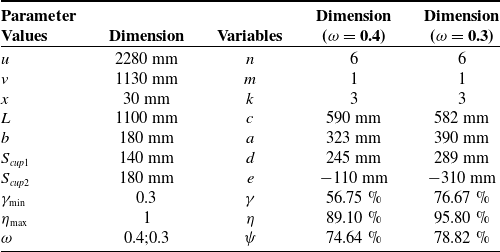
According to the basic setting of the above genetic algorithm, the algorithm is designed and implemented by MATLAB. The population number is 200, the crossover probability is 0.8, the mutation probability is 0.005, and the number of iterations is 500. The parameter values u, v, x, L, b, S
cup1, S
cup2,
 $\gamma _{\min } , \eta _{\max }$
, and
 $\omega$
are given as shown in Table II. Other parameter variables n, m, d, e, and so on all change with c and a, so the changes of
 $\gamma , \eta$
and
 $\psi$
actually depend on the changes of c and a. By giving the values of a and c, respectively, the accuracy of quantitative selection is verified by simulation. Among them, the value of the weight
 $\omega$
should be obtained through sensitivity analysis. By running the algorithm, the parameters that make the comprehensive performance index
 $\psi$
reach the optimal value under different weight values can be obtained. When
 $\omega$
= 0.1, 0.2, or 0.3, the optimal solutions mostly appear around c = 582 mm and a = 390 mm; when
 $\omega$
= 0.4, 0.5, 0.6, 0.7, 0.8, or 0.9, the optimal solutions mostly appear around c = 590 mm and a = 323 mm.
Results of parameter optimization.

Figure 5 illustrates the variation of the comprehensive performance index under different weights. It is found that the lower the value of
 $\omega$
, the higher the overall level of
 $\psi$
, and the curves are clearly stratified without overlap. This indicates that for the overall performance of the PV cleaning robot, cleaning integrity is more important than cleaning repeatability. Since
 $\omega$
reflects the importance of the cleaning repeatability in the comprehensive performance of the PV cleaning robot,
 $\omega$
should be selected within 0.5. However, the design concept of this section is to minimize the cleaning repeatability as much as possible while increasing the cleaning integrity so as to improve the cleaning speed. Therefore, the importance of the cleaning repeatability should not be so low. An initial weight of 0.4 is selected for analysis to verify the initial trend of each performance index.
The variation of
 $\psi$
with
 $\omega$
, c, a.

Figure 6(a) shows the variations of
 $\gamma , \eta$
and
 $\psi$
with c when
 $\omega$
= 0.4, a = 323 mm, and m = 1 are given. With the increase of effective step size c,
 $\gamma$
exhibits a rapid downward trend, while
 $\eta$
and
 $\psi$
show an overall upward trend. However, for the same n,
 $\eta$
shows a downward trend. The essence of this trend is that the increase in effective step size leads to a reduction in the number of linear cleaning gaits, which directly results in a decrease in cleaning repeatability, i.e., an improvement in cleaning speed. Meanwhile, the increase in step size will expand the area of cleaning blind zones. Nevertheless, due to the reduction in the number of linear cleaning gaits, the cleaning blind areas caused by the adsorption of the middle suction cup during rotational cleaning also decrease accordingly, making up for part of the cleaning blind areas induced by the increased step size. Therefore, the cleaning integrity presents an overall upward but segmentally decreasing trend. This result indicates the mutual influence among various parameters.
The variation of
 $\gamma , \eta$
and
 $\psi$
with c, a.

Figure 6. Long description
The image contains four line graphs depicting the variation of parameters with different variables in a solar photovoltaic system. Panel A shows three line graphs with the horizontal axis labeled c (centimeters) and the vertical axis labeled with values ranging from 0.55 to 0.95. The graphs are labeled with different values of n (6, 7, and 8) and show the variation of parameters with c for a fixed value of a (323 millimeters) and m (1), and omega (0.4). Panel B shows a single line graph with the horizontal axis labeled a (millimeters) and the vertical axis labeled with values ranging from 0.55 to 0.95. The graph is labeled with n (6) and shows the variation of parameters with a for a fixed value of c (590 millimeters) and omega (0.4). Panel C shows three line graphs with the horizontal axis labeled c (centimeters) and the vertical axis labeled with values ranging from 0.55 to 1. The graphs are labeled with different values of n (6 and 7) and show the variation of parameters with c for a fixed value of a (390 millimeters) and m (1), and omega (0.3). Panel D shows a single line graph with the horizontal axis labeled a (millimeters) and the vertical axis labeled with values ranging from 0.55 to 0.95. The graph is labeled with n (6) and shows the variation of parameters with a for a fixed value of c (582 millimeters) and omega (0.3). Each graph includes three lines representing different parameters, with red, green, and blue colors indicating different variables.
Figure 6(b) shows the variations of
 $\gamma , \eta$
and
 $\psi$
with a under the given conditions of
 $\omega$
= 0.4, c = 590 mm, and n = 6. As a increases, both
 $\gamma$
and
 $\eta$
exhibit an upward trend, reflecting the coupling relationship between the two performance indexes, while
 $\psi$
shows a slow abnormal downward trend. This is essentially because the cleaning repeatability can characterize the cleaning speed only when a is constant. However, when c is constant and a changes, the level of the comprehensive performance index should depend on the cleaning integrity. Therefore, the weight of the cleaning integrity in the comprehensive performance index should be increased.
When
 $\omega$
= 0.3 is substituted into the algorithm for re-operation, and the curves obtained after controlling variables are shown in Figure 6(c),(d). When a is fixed, the variation of each parameter with c is similar to the previous results; however, due to the increased weight of cleaning integrity,
 $\psi$
exhibits a slow downward trend within the same n interval, so the maximum value of
 $\psi$
no longer appears at the upper limit of the interval. When c is fixed, the comprehensive performance index increases with the increase of a and reaches the highest value at the upper limit of the a interval, which is consistent with common sense. Although the cleaning repeatability is relatively high at this point, it does not affect the cleaning speed.
When
 $\omega$
= 0.1 or 0.2, the importance of cleaning integrity in the comprehensive performance index is too large. As a result, the curve trend of
 $\psi$
will be basically consistent with
 $\eta$
, and the change of
 $\gamma$
can hardly affect the comprehensive performance index. Although Figure 5 shows that the overall level of
 $\psi$
is higher when
 $\omega$
= 0.1 or 0.2, this improvement of
 $\psi$
is only brought by the change of weight – the optimal values of the cleaning repeatability and cleaning integrity obtained by the optimization algorithm are still consistent with the results when
 $\omega$
= 0.3. Therefore,
 $\omega$
= 0.3 is selected as the final weight in this paper.
The specific optimization results of the parameters are shown in Table II. The optimal values of cleaning repeatability
 $\gamma$
and cleaning integrity
 $\eta$
are 76.67% and 95.80%. The
 $\gamma$
of the commercial three-legged rotational cleaning robot that can be used for PV panels in mountainous environments usually reaches 80–90%, and the
 $\eta$
usually reaches more than 95%. In this paper, through the design of a mobile mechanism and parameter optimization, the robot can achieve similar high cleaning integrity and lower cleaning repeatability (i.e., faster cleaning speed).
4. Prototype and experiments
4.1. Overall design
Through the previously optimized parameters, the mobile mechanism and the cleaning mechanism are integrated, and the robot is shown in Figure 7. The front and rear suction cup feet contain telescopic joints, which are driven by the steering gear. The gears are matched with a certain length of racks, and the racks are embedded on the telescopic column. The end of the telescopic column has a suction cup, which is connected with the air valve pump through its internal suction pipe to achieve the adsorption and desorption of the suction cup foot. The telescopic column moves in the sleeve, and the sleeve is fixed on the frame. When the steering gear drives the gear to turn counterclockwise or clockwise, the extension and retraction of the suction cup can be realized.
Overall design of robot.

Compared with the front and rear suction cup feet, the middle suction cup has an additional revolute joint. The middle suction cup is adsorbed on the panel surface, and the large gear is fixed as the sun gear. The other components rotate via the epicyclic gear train composed of the planetary gear and the large gear, and the planetary gear is driven by the steering gear. The robot body realizes the free rotation of the revolute joint by controlling the steering gear connected to the epicyclic gear train via the steering gear.
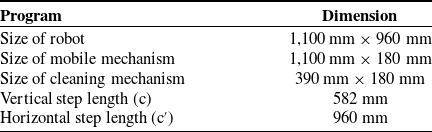
The main frame of the moving mechanism is two guide rails. The front and rear suction cups are fixed at both ends of the guide rail. The middle suction cup moves on the guide rail through the motor and the gear shaft. When the middle suction cup is adsorbed, the main frame of the mechanism can also move relative to the middle suction cup. The cleaning mechanism is installed on both sides of the middle suction cup. This design can adapt to the PV panel environment in mountainous areas and combines the linear and roll cleaning methods to ensure that the robot cleans the PV panel with a lower cleaning repeatability and a higher cleaning integrity. The main parameters of the robot are shown in Table III.
4.2. Principle prototype
Based on the above conclusions, a prototype of a PV cleaning robot for a mountainous environment is made, as shown in Figure 8. Its main frame adopts aluminum alloy, which has the characteristics of light weight and high strength compared with steel. The shell part adopts 3D printing, and the cleaning equipment adopts a brush, which can realize hydration-free cleaning. The prototype consists of four steering gears and one motor. Three steering gears are used to drive the rack in the telescopic column of the robot’s suction cup to lift and drop the suction cup. One steering gear is used to control the rotation of the planetary wheel around the sun wheel to realize the steering of the fuselage. One motor is used to realize the forward movement of the robot. Each suction cup contains an air valve and an air pump to control the adsorption and desorption of the suction cup.
The main parameters of the robot.

PV cleaning robot principle prototype.

4.3. Adaptive test under simulated mountainous environment
PV panels in mountainous environments are characterized by large tilt angles, with gaps and height differences between adjacent panels. The robot has two adsorption states on the PV panel: (a) the front and rear feet lower and attach, and the middle suction cup detaches and lifts; (b) the middle suction cup lowers and attaches, and the front and rear feet detach and lift.
In order to test the adaptability of the robot to the large tilt angle of the PV panel, we built a PV panel with a variable tilt angle in the laboratory and tested the adhesion performance of the robot on the panels of 20° and 45°, respectively. The adsorption state (a) on the 20° PV panel is shown in Figure 9(a), the adsorption state (b) is shown in Figure 9(b), the adsorption state (a) on the 45° PV panel is shown in Figure 9(c), and the adsorption state (b) is shown in Figure 9(d). Under different tilt angles and different adsorption states, the per capita adsorption of the machine is stable, and there is no slippage, overturning, offset, or other phenomena.
Inclination adsorption test.

Figure 9. Long description
The image contains four photos labeled (a), (b), (c), and (d), showing a robotic system designed for cleaning solar panels on an inclined surface. Panel A: A photo showing the robotic system positioned on an inclined solar panel. The robot has a rectangular shape with a blue frame and red markers. Panel B: A photo showing the robotic system moving along the inclined solar panel. The robot is in a different position compared to Panel A, indicating movement. Panel C: A photo showing the robotic system in another position on the inclined solar panel. The robot is slightly tilted, demonstrating its ability to adapt to the incline. Panel D: A photo showing the robotic system in yet another position on the inclined solar panel. The robot is positioned near the edge of the panel, indicating its capability to cover the entire surface.
Aiming at the characteristics of gaps and height differences between PV panels in a mountainous environment, PV arrays are artificially set up in the laboratory so that there are gaps with a width difference △w and height difference △h between the two panels. The front and rear legs of the robot are adsorbed on both sides of the gaps, as shown in Figure 10. In the test, △w is set to 30 mm and △h is set to 10 mm. It was found that the robot can maintain the adsorption state (a) and stably adsorb on both sides of the gap. It is demonstrated that the robot, through the design of its mobile mechanism, has high adaptability to photovoltaic panels in mountainous environments.
Cross-seam adsorption test.

Robot straight sweep and forward process.

4.4. Locomotion test
The specific cleaning process of the robot on the PV panel is as follows: the front and rear feet of the robot are adsorbed, the middle suction cup is detached, the cleaning mechanism is started, the cleaning mechanism is closed from the tail to the head along the guide rail, and the cleaning mechanism is closed. The linear cleaning process is shown in Figure 11 (a) (b); the middle suction cup is lowered and attached; the front and rear feet are detached and lifted, and the guide rail moves forward until the middle suction cup is located in the middle position of the guide rail. The forward process is shown in Figure 11 (c) (d): the cleaning mechanism starts, the rotating motor starts, the whole robot rotates 180° counterclockwise, and the cleaning mechanism is closed. The rolling process is shown in Figure 12 (a)–(c). The guide rail is moved forward until the middle suction cup is located at the head of the guide rail, and the forward process is shown in Figure 12 (d). Then the front and rear feet lower and attached, the middle suction cup detaches and lifts, and the next movement cycle is carried out. This method combines linear cleaning and rotational cleaning and completes the cleaning of two rows of 2*1 PV arrays. The walking cleaning process of the robot is consistent with the theoretical analysis. The upper edge of the PV module is reached through six linear motion gaits, and the right edge of the single-row PV module is reached through one steering motion gait. It takes a total of 450s to complete the cleaning of the single-row PV module. The total cleaning process is shown in Figure 13. Therefore, the cleaning integrity and cleaning repeatability in the cleaning process are in line with the optimal values obtained by theoretical analysis.
Robot rolling and moving forward process.

Robot cleaning time test.

5. Conclusion
In this paper, a mobile mechanism of a PV cleaning robot for mountainous environments is proposed. Its core feature is to rely on the alternating lifting and adsorption between the three feet to realize the movement on the PV panel with tilt angle, groove gap, and height difference. The mechanism adopts the topological structure design of the mechanism by imitating the locomotion mode of the inchworm, which meets the functional requirements of the POC set of the end member and the DOF of the mechanism. The mechanism combines the linear cleaning type with the rotational cleaning type, which can better take into account the cleaning repeatability and cleaning integrity of the PV cleaning robot. In this paper, the key parameters of the mechanism are optimized by a genetic algorithm. Theoretically, the cleaning repeatability is reduced to 76.67%, and the cleaning integrity is increased to 95.80%. Through the development and experiment of the prototype, the results show that the PV cleaning robot using the mobile mechanism can achieve stable movement and adsorption on the PV panel surface in the simulated mountainous environment, which reflects its adaptability to the environment. The parameters of the prototype are optimized by the optimal solution obtained after parameter optimization, and the cleaning of the two columns of PV modules can be completed. The actual situation is consistent with the simulation results, which reflect that the stability and efficiency of the robot are better through the research of this paper.
Although the stability and efficiency of the three-legged compound mechanism have been verified, there are still some limitations to be solved. For example, due to the influence of mechanical errors, it is difficult to ensure the absolute verticality of the robot after rolling motion, which may deviate from the original path and ride to the gap, causing adhesion failure. In view of the above problems, future research will innovate control strategies so that robots can respond autonomously when encountering gaps. This can not only solve the hidden danger of adsorption failure and improve adaptability but also reduce the cross-seam constraint in the design stage so as to achieve higher motion efficiency.
Author contributions
Di Zhang and Yifeng Song conceived and designed the study. All the authors completed the design and fabrication of the prototype. Di Zhang, Yong Chang, Tianlong Wang, Daqian Wang, and Fatao Qin conducted data gathering and texted the performance of the prototype. Di Zhang and Yifeng Song wrote the article.
Financial support
This work was supported by the National Natural Science Foundation of China (Grant No. 52575042) and the Fundamental Research Project of SIA (Grant No. 2023JC2K04).
Conflicts of interest
The authors declare no conflicts of interest exist.
Ethical approval
Not applicable.




 ψ
 ω

 γ,η
 ψ