Introduction
The legal field has (been) transformed dramatically in Turkey in the last two decades during the tenure of the Justice and Development Party (Adalet ve Kalkınma Partisi [AKP]).Footnote 1 This has been the case particularly since the 2010 referendum on the appointment procedures of high court judges and prosecutors.Footnote 2 While these changes in the judiciary wing of the legal field have been analyzed and criticized extensively (Tahiroğlu Reference Tahiroğlu2020; Demirtaş Reference Demirtaş2022; Ocaklı Reference Ocaklı, Cammett and Jones2022), what has remained unexplored is the situation of lawyers and the field’s professional wing.Footnote 3 While this is surprising given how much has changed in this sphere, it resonates with the relative lack of interest in the legal profession in broader discussions about democratic decline, in general, and autocratic legalism, in particular. The relationship between law and autocratization is usually discussed with reference to the judiciary and how an increasingly powerful executive branch encroaches on the powers of the judicial branch (see Corrales Reference Corrales2015; Bermeo Reference Bermeo2016; Scheppele Reference Schepelle2018). Recently, however, Fabio de Sa e Silva (Reference De Sa e Silva2023, 202) has suggested that “[s]tudies on law and illiberalism [must] pay greater heed to the social organization and the political impacts of the bar” and that “heterogeneity in the legal profession” is a phenomenon “which illiberal leaders use to coopt lawyers who can manipulate a liberal legal order for illiberal purposes, while providing illiberal practices with a cover of legal legitimacy” (304). Responding to this and similar suggestions, I analyze Turkey as a case study of legal professions in the context of autocratic legalism that not only demonstrates de Sa e Silva’s point but also expands his contribution in new directions.
This article has become (unfortunately) all the more timely and meaningful in the process of writing, particularly due to recent sociopolitical and legal developments in Turkey. In the last correction phase of this work—that is, April 2025—the authoritarian regime turned even more violent by arresting the mayor of Istanbul on highly dubious terrorism and corruption charges. This move was seen by many to be an example of the weaponization of law to eliminate one of the strongest political rivals to the long-time autocrat of Turkey, Recep Tayyip Erdoğan. Only two days after this development, and the political turmoil it generated, İbrahim Kaboğlu, the chairperson of the Istanbul Bar Association, and all the board members of the Istanbul bar were removed from office by the Second Civil Court of Istanbul. These almost simultaneous attacks on political and professional legal actors show clearly the links between further autocratization, attacks on the legal profession, and the background on which such attacks are built. In this article, I pursue these links.
I offer two lines of analyses and contributions in this article. First, Recep Tayyip Erdoğan, Turkey’s autocrat, and the broader regime of which he is part have attacked and sought to reshape the law and legal institutions to further bolster their autocratic rule. What is novel in the Turkish case is that it is not only the judiciary that has been attacked but also the legal profession in general, its institutional existence, and its oppositional pockets in a very explicit manner. To that end, since 2020, the AKP has passed laws or bylaws that have changed the rules for the election of the chairman of the Turkish Union of Bar Associations (Türkiye Barolar Birliği [TBB]) and made possible the establishment of additional bars in major cities with more than five thousand lawyers. My argument is that, in national contexts where the legal profession is perceived by autocrats to be originally and organically tied to the state—that is, the “ancien regime” that aspiring autocrats are trying to dismantle—autocratic legalism involves efforts to overtake not only the judiciary but also such legal professional institutions as bar associations and their umbrella organizations. The semi-public status of city bars and the TBB is also a factor in efforts to dismantle the legal profession in Turkey.Footnote 4
Second, what makes the Turkish case worthy of scholarly analysis is that a range of sociological and political-economic factors and processes have prepared the groundwork for, and extended, the impact of these autocratic interventions. It is this very groundwork that creates the cracks, splits, and, ultimately, the heterogeneity to which de Sa e Silva (Reference De Sa e Silva2023) rightly points. In Turkey, this groundwork has been prepared by neoliberal populism, which has opened the legal profession to a massive number of newcomers. This neoliberal move has been triggered by the desire to turn higher education into a private market, and it has been mediated by a populist discourse of opening up an “elite profession to ordinary people.” This flooding of the professional space has thoroughly “diluted” the profession. The sociological results of this dilution have included growing rifts between more experienced and economically advantaged professionals and younger more precarious professionals as well as rifts between bars as representative organizations and the mass of lawyers that these bars are supposed to represent. Ideological cracks have also arisen and made the profession further vulnerable to executive attacks, whether in the form of co-optation or infighting within the profession. My second argument is that, while these preceding steps create a landscape that is favorable to autocratic intervention, they are not part of an intentional attack led by an aggressive executive. As a result, “intentionality” in the building of autocratic legalism is more complicated than the current democratic backsliding or autocratization literature suggests.
In Turkey, the fractures generated by the political economy of neoliberal populism, combined with intentional attacks on the legal profession, have led to what I term a “professional liquidation.” Liquidation is a rich metaphor, and I touch upon it at various points throughout the article. To elucidate, professional liquidation involves the selling of valuable assets cheaply, as in regular liquidations. In Turkey, the material and status values associated with being a lawyer have been liquidated by the regime’s massive increase of law schools and the supply of lawyers since 2007–8. The legal knowledge, institutions, and other intangible assets that have been created within the legal sphere throughout the republican period have thus been devalued. In a more nuanced metaphorical manner, liquidation involves debt and insolvency. While amassing power through the electoral populist route, the AKP regime has cultivated itself as the sole commander of the state apparatus and of society at large. All other institutions and organizations, including big business, are now perceived as being in debt to the party and its autocratic leader. If that debt is not paid and the due reverence not publicly articulated, liquidation is the end result. Because the Turkish legal profession has not paid its metaphorical debt to the rising authoritarian party, as I will show, it has faced the threat of professional liquidation.
In the second section, I begin with a focus on the gaps in the literature on autocratic legalism with respect to the legal profession, and then, in the third section, I follow with a focus on Turkey, illustrating how its legal profession grew over time and was reconditioned under growing authoritarianism. This section houses my first argument and is broadly inspired by calls for attending to the unique historical and political configurations in analyzing the legal profession and its rise against, or its accommodation of, political (il)liberalism. Here, I focus on the institutional attacks on the profession, which have been intentionally carried out by the autocratic regime. In the fourth section, I focus on factors and processes that precede and run parallel to these institutional attacks. Here, I outline the massive increase in the size of the legal profession and the consequent emergence of the new fault lines referred to above. I thus develop my second argument, demonstrating that the liquidation of the legal profession is premised on the interplay between intentional interventions and broader social-economic processes. In the concluding section, I return to the discussion of professional liquidation to detail the connection between the legal profession and the consolidation of autocratic rule.
The data for this article comes from various sources, including online sources as well as interviews collected for the “Hidden Injuries of Justice: Legal Interns and Early Career Lawyers in Turkey,” a project completed at the Social Policy Forum of Boğaziçi University by myself, Cemre Canbazer-Şanlı, Ekin Ekici, and Zeynep Kesici, master’s students and research assistants.Footnote 5 This project focused on the increasing precarity of young lawyers and lawyer interns and the social policy implications of this increased precarity. In this context, a total of sixty young lawyers and interns working in cities across Turkey were interviewed in a semi-structural manner using Zoom software during the spring of 2022.Footnote 6 Participants were recruited via the Social Policy Forum’s Facebook site as well as numerous invitations through professional networks. While our resources would only allow us to accept sixty participants, we had more than three hundred volunteers. In the line of inquiry that I pursue here, I argue that this number alone demonstrates the depths of frustration that structures the legal profession in contemporary Turkey.Footnote 7
The legal profession in the context of autocratic legalism
There is an interesting gap or asymmetry in the literature on the politics of autocratization, illiberalism, and autocratic legalism.Footnote 8 While “the role of legal professionals in supporting liberal legal orders has been at the heart of important sociolegal works” (de Sa e Silva Reference De Sa e Silva2022, 201), not much ink has been spilled over the study of the legal profession in regimes that are “backsliding” into authoritarian political formations. In his insightful article coining this concept, Javier Corrales (Reference Corrales2015, 38) suggests that “autocratic legalism” is what facilitated the deepening of Venezuela’s authoritarianism, yet he does not directly discuss the legal profession. As a result, the elements composing legalized autocracy include the use, abuse, or non-use of laws by the executive branch, whose threats are directed mostly toward the judiciary. Likewise, Kim Lane Scheppele (Reference Schepelle2018), who popularized the concept of autocratic legalism, does not once mention the phrase “legal profession,” while the “constitution” (in its various forms) is mentioned 254 times, “courts” are mentioned seventy-three times, and the “judiciary” is mentioned fourteen times. The word “lawyer(s)” is mentioned on three occasions but without any bearing on the substance of the article.Footnote 9
Interestingly, in the recently emerging literature on resistance to democratic erosion or democratic resilience, the legal profession is not mentioned at all (Boese et al. Reference Boese, Edgell, Hellmeier, Maerz and Lindberg2021; Laebens and Lührmann Reference Laebens and Lührmann2021; Tomini, Gibril, and Bochev Reference Tomini, Gibril and Bochev2023; van Lit, van Ham, and Meijers Reference Van Lit, van Ham and Meijers2023). These works point to certain societal agents, such as political elites and civil society actors, as potentially significant obstacles to democratic erosion or breakdown. Additionally, they suggest that judicial elites (not including lawyers) might stand against expanding autocracy because their powers and bureaucratic domains could be under threat by such an expansion (van Lit, van Ham, and Meijers Reference Van Lit, van Ham and Meijers2023, 6). The literature on democratic resilience is not on autocratic legalism per se; nonetheless, it is telling that the legal profession, once hailed as one of the more important social groups to push for and sustain liberalism,Footnote 10 is fully absent from this discussion. If “the longue duree of liberal states cannot be explained without considering [the] legal activism [of lawyers],” should backsliding from such liberal political frameworks not also involve the changing roles and power of lawyers (De Sa e Silva Reference De Sa e Silva2022, 201)?Footnote 11
As Scott L. Cummings (Reference Cummings2024, 106; emphasis in original) summarily puts it, “while the autocratic legalism literature helpfully spotlights law as an essential tool of backsliding, it has largely ignored the actors who wield this tool: lawyers.” The same can be said for the democratic resilience literature, with the exception of the judiciary and judicial actors, who are considered to be the “the last bulwark against democratic breakdown” (Boese et al. Reference Boese, Edgell, Hellmeier, Maerz and Lindberg2021, 900). Surveying the field, de Sa e Silva (Reference De Sa e Silva2022, 202) rightly suggests that “future studies on law and illiberalism can and should explore what binds lawyers to illiberal projects.” He continues:
What distinguishes lawyers who support and those who resist illiberalism? Do these groups have similar composition in terms of race, class, and gender? Did lawyers in these groups attend similar schools, follow similar professional trajectories, and practice in similar settings? How do they build their links to politics and the state? How is their agency enabled and constrained by institutions, both national and international? (202)
It is of course not a major surprise that certain lawyers can act as legitimizers of state action for their own benefit; career objectives can lead many lawyers to act for and with autocratic governments (Kisilowski Reference Kisilowski2015, 701). Yet “the legal profession,” to the extent that it can still be conceptualized as a sociologically meaningful actor, is different from individual lawyers and even from their collectivity. A broader perspective is needed to analyze the profession as it intersects with an autocratizing regime because a profession boasts institutions, a past, accumulated experiences, and intangible assets, such as networks of relationships and tacit knowledge. While de Sa e Silva (Reference De Sa e Silva2022) and Cummings (Reference Cummings2024) emphasize the potential complicity or even active participation of lawyers in the making of autocratic regimes, David Owen (Reference Owen2022, 34) invites us to consider the ways in which legal professions are targeted as obstacles to the rule of autocrats and made docile. He suggests that part of the challenge that liberal democracy faces today has to do with the subordination of the legal profession by powerful autocratic executives. As Owen argues, “[autocratic rule] involves”
the cultivation of fear among members of the legal profession such as civil and criminal lawyers as part of a more general restructuring to the incentives for compliance with autocratic rule. It is notable that in Putin’s Russia, Orban’s Hungary and Erdoğan’s Turkey, we have seen constitutional moves, government policies and extra-parliamentary actions designed to subordinate the legal profession. (34)
But how does such subordination take place and under what conditions? Neither Owen (Reference Owen2022) nor the broader literature on autocratic legalism pursue this question in depth. De Sa e Silva (Reference De Sa e Silva2022) rightly designates the splits, cracks, and ultimate heterogeneity within the profession as important factors in the advance of autocratic legalism. I will demonstrate that the political apathy and even disenchantment of younger lawyers can reinforce such splits and cracks.Footnote 12 But how is this level of heterogeneity and disenchantment reached in the first place? In this article, I build on Owen’s approach to ask: what are the mechanisms of such attempts at subordination and silencing of the legal profession in Turkey and elsewhere?
On the one hand, we see the strong agency of autocratic rulers and their intentions to liquidate and reshape the legal profession. In contributing to the debates on autocratic legalism, such an approach requires turning to the historical and sociological relations between the state and the legal profession. Particularly in non-Western contexts, where the emergence of the legal profession is historically connected to the formation of the nation-state and its founding ideology, autocratic governments often aim to destroy such ideological formations in their self-defined fight against the ancien regime. Attention needs to be paid, in other words, to situations in which the legal profession (including occupational organizations like bars) is not fully bound to illiberal projects but also attacked, crippled, or subordinated by the autocratic matrix of power because it is perceived to be a key part of the “elitist” establishment.
On the other hand, such intentional attacks on the profession by autocrats are often preceded by economic and political variables, particularly neoliberalization and the disenchantment with the law that prepare the groundwork for autocratic legalism. This situation is not unique to Turkey. The (global) neoliberal openings in Turkey and in similarly situated semi-peripheral countries like Mexico, Brazil, or Argentina are certainly experienced in distinct ways, but they display similarities as well, making possible broader theoretical analyses of authoritarian and populist neoliberalization processes. In the existing literature on authoritarian neoliberalism, one major avenue of analysis suggests that the authoritarian surge has been a key means for governments to control and tame the masses who have been impoverished by decades of deregulation and deindustrialization. It is only through authoritarian measures, such scholars argue, that neoliberal policies can be implemented (Bruff Reference Bruff2014; Bruff and Tansel Reference Bruff and Burak Tansel2020).
This line of analysis is directly relevant to, yet rarely replicated in, the literature on autocratic legalism and even autocratization: while the focus is on the executive and its encroachment on the judicial field and actors, the political economy of such executive growth is not sufficiently discussed, if at all. However, lawyers under neoliberalism face the authoritarianism of their respective states as economic incentives take priority over the rule of law and legality, perhaps with the exception of the field of economic affairs, where a nascent rule of law still exists.
A second line of analysis concerns how the masses become open to populist exploitation both politically and economically in the context of neoliberalism, which, in essence, effectively fuses neoliberalism and populism (Streeck Reference Streeck2014, Reference Streeck2017). At times, populism has offered a “cushion” or a mechanism that has concealed or delayed the devastating effects of neoliberalism on the masses (Streeck Reference Streeck2014; Akçay Reference Akçay2018). In fact, such neoliberal populism was the mechanism that initially led to the growing of lawyer populations across semi-peripheral countries in the context of global integration (Weyland Reference Weyland1999). However, neoliberal populism turned out to be a short-lived project since crisis dynamics hit only a few years after this strange fusion. And once neoliberal populism lost its force, neoliberalism persisted, but populism, or the cushion that it provided, was not able to continue. It is when such fusion between neoliberalism and populism was shattered that lawyers—like other white- or blue-collar workers—began to face the dire consequences of neoliberalism alone. This was also the moment when lawyers began to lose their belief in law and legality in their profession—which, by then, was mostly deregulated and opened to fierce competition—and in meritocracy more generally. These factors combined naturally and led them to apathy and disenchantment with the law.
Finally, a third avenue of analysis takes a Foucauldian approach and points to the elective affinity between neoliberalism and authoritarianism in the form of the shrinking of democratic space (Springer Reference Springer2012; Brown Reference Brown2015, Reference Brown2019; Kiersey Reference Kiersey and Busse2021). These scholars approach neoliberal authoritarianism from the perspective of individual subject positions and point to the myriad ways in which individuals can be implicated in the erosion of democracy or democratic backsliding. As a “novel art of government,” neoliberalism holds competition as its ultimate ethos, both at the level of individuals and of wider economies. When individual subjects are configured to compete with one another in every sphere of life, more traditional political values such as democracy, public(ness), or rule of law lose value and are treated as luxurious, antiquated notions. This atomization and competition, in turn, provide a fertile ground not only for authoritarian surges but also for significant erosions in the rule of law (Brown Reference Brown2015, Reference Brown2019).
All these perspectives can be mobilized to enrich and contribute to the literature on autocratic legalism. For legal professionals, the global neoliberalism initially brought about a greater demand for lawyers, which led to the opening of many new law schools and a massive increase in the number of law graduates. In all these contexts, such expansion naturally dovetailed with the populist rhetoric of “democratizing an elite profession.” However, as the economic fortunes of these countries declined and authoritarian tendencies began to rise—particularly, in the aftermath of the 2008–10 recession—many of these new graduates not only found themselves in a competitive marketplace with economically precarious positions, but they also experienced a disenchantment with the law and legality in their respective countries. The combination of autocracy with neoliberalization, I argue, has not only paved the way for autocratic legalism but also weakened the legal profession’s ability to function as a meaningful sociological/political actor, leading to its silencing. The atomization of legal professionals, the profit motive/competition that has begun to organize the legal domain, as well as the erosion of the rule of law due to neoliberalism has made it possible to ask whether we can still speak of a profession in today’s world.
Such connected dynamics of neoliberalization, autocracy, and populism echo across a range of country cases.Footnote 13 In hybrid regimes, factors like trade liberalization and the privatization of education have led to skyrocketing numbers of law graduates and lawyers and a corresponding un- or de-regulation of the profession. In Brazil, for instance, “[w]ith investments from private entrepreneurs and support from the government and international investors, the number of law schools grew exponentially, from 130 in 1980 to 1,171 in 2015. … Consequently, the number of [accredited] lawyers quintupled between 1980 and 2017, exceeding one million in 2016” (Bonelli and Fortes Reference Bonelli and Fortes2020, 393). A similar increase can be seen in Mexico; since 1988, “[t]he number of higher education institutions offering a Bachelor of Laws degree (LLB) has grown at a rate of a new law school a week, rising from 93 to 1,715. The number of licences issued annually to practise law increased by 848 per cent, climbing from 3,549 to 33,631” (Perez-Hurtado Reference Perez-Hurtado2020, 429). While Luis Perez-Hurtado (Reference Perez-Hurtado2020, 435) underlines a range of social factors that traditionally direct individuals to obtain law degrees, including “the opportunity to expand democracy, social justice, and the common good,” it is unclear if connotations of prestige, good earnings, and overall respectability remain as robust today due to the massive accumulation of lawyers over the years and the accompanying devaluing of legal knowledge and social capital.Footnote 14
While the impact of neoliberal policies is visible across different cases, intentional authoritarian interventions into the legal profession are echoed loudest in the paradigmatic case of autocratization in Venezuela. Manuel Gomez and Rogelio Perez-Perdomo (Reference Gomez and Perez-Perdomo2020, 450) note that “there has been an exponential increase in the number of government-sponsored law schools and their graduates” since the “Chavista revolution,” adding that this has altered not only the number of law students but also the geographic dispersal of law schools (460). Furthermore,
[a]lthough only three [government-controlled law schools] have been created since 2000, they enroll the vast majority of law students. The most visible one belongs to the UBV (Universidad Bolivariana de Venezuela), which has branches throughout the country. Its curriculum emphasizes project-based learning but offers very little law-related content…. Its website declares that UBV’s mission is to serve as “one of the engines of the revolution”, which sounds more like grooming political loyalists than training legal professionals. UBV graduates are favoured for government positions and judgeships, which may be the main attraction of these government-controlled law schools. (461–62)
What we see in common in these hybrid and wholly autocratic regimes is a desire to use the increased population of law students and lawyers as an instrument of populist politics. In both Mexico and Brazil, such opening is perceived to be a result of “democratization,” at least initially (Perez-Hurtado Reference Perez-Hurtado2020, 431–32). The theme of expanding a once-restricted educational opportunity to the masses is visible in Poland as well. “Sometime around 2003,” writes Kaja Gadowska (Reference Gadowska2020), “politicians [in Poland] began to characterise professional associations of lawyers as exclusive and elitist…. The legal establishment was perceived by politicians and the media as a corporation that overwhelmingly favoured its own interests over those of newly qualified lawyers and clients” (326). Political attacks eventually led to the profession losing its social and political standing, its “social capital” (326). While democratization and inclusion are certainly worthy ideals, scholars suggest that such political discourses have failed to bring about stronger professions. On the contrary, increased numbers have brought increased heterogeneity, “diversification, stratification and fragmentation” (Bonelli and Fortes Reference Bonelli and Fortes2020, 402), the impossibility of professional regulation (Perez-Hurtado Reference Perez-Hurtado2020, 429), and deregulation (Gadowska Reference Gadowska2020, 322)—dynamics that are then exploited by increasingly autocratic regimes and leaders, as de Sa e Silva (Reference De Sa e Silva2022) argues.
As I show in detail below, the Turkish case echoes the developments in Mexico, Brazil, and Venezuela. The attempts to liquidate the profession, the discourse of populism, and an immense injection of newcomers to the profession is quite similar. However, there are also distinctly unique features of the Turkish case, and these features result mostly from the nature and historical configuration of the relationship between the state and the legal profession. Another perhaps counterintuitive distinct feature of Turkey is the degree of coherence and resilience within the profession, which, again, is a consequence of the relations between the state and the legal profession.
The Turkish legal complex and recent institutional attacks on the legal profession
Turkey is among a group of late modernizing countries that attempted to mobilize law and legality for social and political engineering purposes, and such attempts ended up shaping its legal profession until very recently (Arjomand Reference Arjomand and Arjomand2007, 7–8). Because legal professions navigate and negotiate the fusion of, and tensions between, values such as justice, fairness, legitimacy, legality, and overall rationality, which are at the very heart of regime-building dynamics, they are frequently targeted by the political authority in the early phases of regime construction.Footnote 15 Turkey is no exception. In the Turkish context, where top-down modernization and the nation-building process went hand in hand, the legal profession was dominated and controlled by the regime according to its predetermined ideological values (Özman Reference Özman2007, 69).
Due, essentially, to such an urge for control, the profession was (re-)established during the early Republican period (1923–50) as a close ally of “the state,” which, back then, mostly applied to the single party that ran the country (the Republican People’s Party [Cumhuriyet Halk Partisi]) and the founding president of the republic himself, Mustafa Kemal Atatürk. An implicit deal was struck between the profession and the state: in exchange for the recognition of a limited professional autonomy, lawyers and, indeed, the whole legal complex were to act as guardians, even missionaries of the newly established republican regime, providing it with a discourse of scientific legitimacy as well as spreading its ideals of modernity and secularism (Erozan Reference Erozan2005). When multiparty democracy was (re)established and the opposition party ruled the country from 1950 to 1960, the republican regime was seen to be under threat by the founding cadres and institutions of the republic—most notably, the military. During this period, lawyers and bar associations, alongside the higher judiciary, did not shy away from joining these authoritative voices to criticize and act against the elected government (see Parslow Reference Parslow2015).
After 1960, the year in which the elected government was toppled by a coup d’état, the contours of what Ceren Belge (Reference Belge2006) calls “the Republican alliance” became concrete. Put somewhat simply, the military would be the guardian of the republican regime, and the high judiciary would act as a check on elected governments (and their supposed excesses). This configuration, which served as the “establishment” that the AKP’s authoritarianism later sought to destroy, would continue well into the late 2000s. The military intervened in the field of politics either through the infamous National Security Council (Milli Güvenlik Kurulu), an advisory board meant to direct the government on issues of national security, or, more violently, through three direct interventions in 1971, 1980, and 1997, the last one often deemed “softer” compared to the first two yet perhaps equally consequential. The high judiciary, in contrast, intervened by establishing constitutional checks on the elected governments and (increasingly after the 1980 coup) by drawing the boundaries of the national political space, essentially through party closure cases. During this time, Islamist- and Kurdish-leaning parties were routinely closed by the Constitutional Court for constituting threats against the basic tenets of the republic (Koğacıoğlu Reference Koğacıoğlu2004). In fact, the AKP faced a closure case itself in 2008 due to its Islamism, about a year after it obtained almost half of the votes in the parliamentary elections of July 22, 2007—elections in which it obtained 46.5 percent of the popular vote.
This was the environment in which the AKP began its attack on the legal complex. Initially, the target was more clearly the high judiciary. Erdem Demirtaş (Reference Demirtaş2022) argues that from 2007 to 2010, the AKP waged this battle by establishing alliances with several vocal (and influential) groups in society and the state, such as the “Gülenists”Footnote 16 and the liberal intelligentsia, who saw the possibility of real democratization in Turkey through the weakening of the military and high judiciary. After forging this very vocal coalition, and sustaining his party’s popular appeal even after the 2008 economic recession, Erdoğan succeeded in passing a referendum in 2010, which effectively “packed the high judiciary”— in particular, the Constitutional Court.Footnote 17 In addition, the referendum ended the relative autonomy of the Higher Board of Judges and Prosecutors from governmental influence and considerably increased the power of the executive branch in the appointment and disciplinary powers of judges and prosecutors. In other words, the judiciary would not be the same after the 2010 referendum.
Throughout this period, several frictions emerged in the relationship between the AKP and the legal profession as well: “The Government’s Islamist pedigree raised serious anxieties among Kemalist segments of the population,” which included the legal profession and its representative organizations—most notably, the TBB (Kalem Reference Kalem2020, 682). The Istanbul and Ankara bars, representing more than half of the lawyers in Turkey combined at the time, severely criticized the governmental practices that they saw as threatening the rule of law, such as the constitutional referendum of 2010 and the cases brought against top-ranked military officials with the accusations of plotting a coup (684). This rift reached such heights that, on the 146th anniversary of the establishment of the Council d’État in May 2014, Erdoğan, then prime minister, left the room angrily in protest against the veiled yet directed criticisms of the then chairman of the TBB (BBC News Türkçe 2000). Tensions further peaked following the Gezi protests of 2013,Footnote 18 when legal professionals and bar associations emerged as actors who were instrumental in helping the victims of the government’s attacks. İdil Elveriş (Reference Elveriş2014, 146–47) suggests, for instance, that the autonomy and independence of the Istanbul Bar Association, in particular, and the legal profession, in general, facilitated the practice of cause lawyering for those who were targeted by the government at that time.Footnote 19
While the post-2000 period witnessed a growing rift between the TBB, the various bar associations, and the increasingly authoritarian government, the formation of regional blocs and, thus, some sort of organizational heterogeneity was also becoming visible among the then eighty (now eighty-three) bar associations. First, the bars of the Kurdish-populated areas in the southeast, second the bars which included the major metropolitan areas (Ankara, Istanbul, and Izmir) and third the Anatolian heartland, where the AKP and the nationalist parties usually have garnered a super majority of votes, comprised three such blocs, with such bloc formation surfacing particularly after the 2015 uprisings in the Kurdish southeast and the corresponding state massacre of citizens as well as, more importantly, after the coup attempt of July 15, 2016. Despite this heterogeneity, however, the TBB as well as most city bar associations have stood against the government in its clearly unlawful/ autocratic practices, particularly regarding the rights of lawyers.Footnote 20 In 2019–20, the chairs of fifty-two of the then eighty bar associations, which represented more than 90 percent of the lawyers in Turkey, boycotted the opening ceremony of the legal year because it was being held at Erdoğan’s presidential palace, asserting that the executive branch was literally taking over the legal branch and its independent powers (Deutsche Welle Türkçe 2019). In response, Erdoğan, who was now president with unprecedented powers,Footnote 21 criticized the bars and stated that “[the government’s] first order of business should be to make the election procedures of these professional organizations align with the principles of representative democracy” (Deutsche Welle Türkçe 2019).Footnote 22 In the eyes of the autocrat, these were the moments when the legal profession failed to pay its metaphorical debt to the AKP regime and thus constituted the building blocks of increased attempts at liquidation.Footnote 23
Clearly wishing to crush these professional organizations, yet unable to bend them to his will fully, Erdoğan finally decided to introduce institutional measures to significantly curb the power of metropolitan/major city bars and the TBB. This was a twin project, serving, first, to liquidate the profession and, then, to drastically alter its structure. The first institutional change included new articles introduced to the 1969 Lawyering Code that would allow for more than one bar association to be established in any provinces with more than five thousand lawyers.Footnote 24 This move was meant to break the unified nature of lawyers in the largely oppositional cities that fit this measure—namely, Istanbul, Ankara, and Izmir—and also to give lawyers supporting the government in these metropoles a chance to “show(case)” themselves. Secondary bars have since been founded in Ankara and Istanbul.
As of the end of 2023, however, the original Ankara Bar Association has 23,684 members, while the second bar has 2,295. In Istanbul, the original bar has 62,587 members, while the second bar has 3,116 members (Barobirlik 2024). These numbers clearly show that the government miscalculated the level of unity and solidarity within the profession or, at least, that they miscalculated the number of lawyers supporting the government and the level of their willingness to form a second bar.Footnote 25 What was perhaps unforeseen by the government was that even the bar associations from conservative/ religiously oriented cities joined the protest marches and demonstrations against these measures, showing that the legal profession, at least at the level of the bar associations, was rather unified in its opposition to the government on issues related to the legal profession (Serbestiyet 2020).
The second institutional change involved curbing the influence of oppositional bar associations in major cities by changing the weight of major (and usually oppositional) city bars in the selection process of the president of the TBB, thus ensuring the selection of a pro-government president. The change was drastic: the number of delegates voting in the TBB’s presidential elections decreased from 137 to thirteen for Istanbul, fifty-three to seven for Ankara, and thirty to five for Izmir, thus empowering both bars and individual lawyers in smaller cities, where the AKP is much more powerful both electorally and among legal professionals (Medyascope 2021). Despite these changes, the government lost the election for the presidency of the TBB in 2021. The race was between Metin Feyzioğlu, who was supported by the government, and Erinç Sağkan, who was the chairperson of the Ankara city bar. Feyzioğlu was the president of the TBB from 2013 to 2021 and was once hailed as an anti-Erdoğan figure. He was even considered as a potential presidential candidate against Erdoğan in some circles.
However, after 2015–16, Feyzioğlu became a government supporter. Presenting himself as a middle-of-the-road candidate, he appeared to convince the government to issue “state-backed ‘green’ passports” to lawyers who had a tenure of fifteen or more years in the practice. This passport allowed such lawyers to travel to many destinations (including European countries) without having to obtain a visa, at a time when many countries boasted increasingly stringent visa requirements for Turkish citizens. Thus, this passport regulation was a rather tasty “carrot” in the government’s attempts to win over the legal profession, yet it, too, was not sufficient to conquer the TBB and demonstrated yet another moment when the metaphorical debt to the AKP was not paid. Although he lost the election, Feyzioğlu was rewarded for his pro-regime efforts with the ambassadorship of Turkey to Nicosia in the Turkish Republic of Northern Cyprus and later to Prague. While there is ample documentation of how the AKP government has targeted elite figures within the top levels of the judiciary (see Pehlivan and Terkoğlu Reference Pehlivan and Terkoğlu2020), Feyzioğlu remains the only known example of this practice extending to the bars or the TBB. His radical U-turn from a staunch critic of the government to an avid supporter shows that the AKP and the autocratic regime can also play “dirty” games behind closed doors and that this practice may be used in the future to target more lawyers.
At this point, it is important to draw attention to a number of key dynamics. First, while the legal profession enjoyed a close connection with the state during its formative years, its experiences in major socio-political events, such as the Gezi protests or the infighting for the rights and freedoms of lawyers, demonstrate that the profession has an equally strong footing within the civil society domain.Footnote 26 Thus, the AKP’s representation and targeting of lawyers as an elite profession within the republican establishment is an instrumental (and misleading) discourse that positions the AKP as the voice of the masses, fighting its elite enemies. Second, the institutional attacks by the AKP resonate with the autocratic legalism literature’s focus on the conquering of the judiciary as a significant path toward the building of authoritarian regimes. Yet the Turkish case is distinct in that it involves the open targeting of the legal profession, something rarely discussed in this literature, if at all. An important dimension of this action are the rifts that the AKP’s regime actively sought to create within the “legal complex,” particularly between judges/prosecutors and lawyers, by increasing the salaries of prosecutors and judges and appointing many more (regime-friendly) judges and prosecutors so that their workloads would decrease.Footnote 27
At the same time, the Turkish case also shows that neither political attacks nor rifts of the kind outlined above, guaranteed the destruction of the legal profession’s oppositional stance, particularly at the level of institutions. What remains to be explained, then, is how and to what extent professional liquidation has taken place even in a context where professional/institutional opposition remained strong.
Beyond the institutional attacks: the sociological background and the “liquidation” of a profession with a neoliberal twist
The most significant dimension of this professional dissolution has involved the dilution of the profession by dramatically expanding the number of law schools and lawyers, which can also be seen in hybrid or authoritarian contexts such as Mexico, Brazil, and Venezuela, as discussed earlier. The increase in the number of lawyers in a global context of increased economic insecurity and precarity produced several major fault lines, first by severing the links between professionally powerful lawyers (that is, those who run the bar associations) and the remaining mass of lawyers and, second, by pitting the profession’s haves against the have nots—these two groups usually overlap but not always. Combined with the conscious attacks of the government, and a disenchantment with the law triggered by the erosion of the rule of law, these fault lines have fundamentally shaken the meaning, practice, and institutionality of the legal profession in Turkey and produced a precarious profession without a clear future. As a result, whatever political gravitas the profession once had at the national scale has declined significantly, if not completely.
More law schools, more lawyers
One of the major mechanisms through which the AKP has shaped the legal profession is by increasing its size beyond measure. According to De Sa e Silva (Reference De Sa e Silva2022, Reference De Sa e Silva2023), aspiring autocrats often try to exploit the heterogeneity within a profession to further their agenda. In the Turkish context, that heterogeneity has been created via an increase in the number of law schools and lawyers, which has diversified the profession in terms of class, ideology, and age.Footnote 28 Similar to the Venezuelan case, the geographic dispersal of law schools has also increased significantly during the AKP’s era: while there were law faculties in eleven major provinces before the AKP came to power, that number has increased to thirty-two from 2003 to 2021. Such an increase likely decreased the more uniform educational experience among law students, thereby leading to a more diversified profession upon graduation.
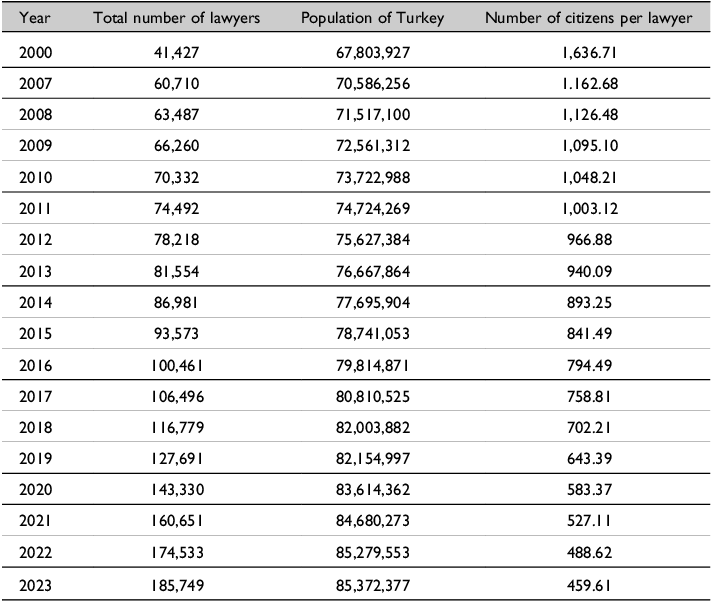
The salience of this topic is rarely discussed, which is surprising given the staggering numbers. While the total number of law school students was approximately ten thousand in 2000, this number had increased to almost seventy-seven thousand in 2021.Footnote 29 Similarly, while there were 46,522 registered lawyers in 2002, which was the year the AKP came to power, the total number of lawyers registered in city bars had risen to 185,749 by 2023, according to the TBB. As can be seen in Table 1, in addition to the sheer increase in the absolute number of lawyers, the number of people represented per lawyer had also decreased significantly. In 2000, there was one lawyer per 1,636 persons. This figure had dropped to one lawyer per 459 persons in 2023.Footnote 30 In addition to, and as a result of, this significant increase in numbers, the lawyering field not only became ideologically heterogenous but also damagingly competitive, with increasing costs and decreasing earnings for a majority of the lawyers.
Number of practicing lawyers and number of citizens per lawyer in Turkey

Source: Compiled by the author based on the numbers provided by the Turkish Statistics Institute and the TBB (Barobirlik 2025). The population figures for the years 2000–7 are not provided by the Statistics Institute—hence, their absence. See Türkiye İstatistik Kurumu 2024. For a more user-friendly version, see Wikipedia 2025 (based on the Türkiye İstatistik Kurumu’s figures).
Of course, such heavily increased numbers could only be attained through the creation of new law schools. From the founding of the republic in 1923 to 1978, there were only two law schools, housed at Istanbul University and Ankara University. A third faculty was opened in 1978 at Ege University, which was later transferred to 9 Eylül University. Between 1980 and 2003, ten new law faculties were opened at various state universities. In total, there were only thirteen public law faculties before the AKP came to power in 2002, and this same party established thirty-seven more by 2021, with thirty-three law schools established in or after 2007. Additionally, while there were twelve private law schools before 2002, twenty-six new private law schools were established in the decades following, with twenty-three of these established after 2007.Footnote 31
With the benefit of hindsight, it appears that the AKP effectively “packed the profession” by increasing its size, particularly after 2007–8. As Seda Kalem (Reference Kalem2020) indicates, the year 2007 marks a significant turning point in the tenure of the AKP, when the party decided to actively fight for what it saw as the republican establishment. Whether such actions represented an intentional move toward autocratic legalism is hard to fully establish; in the absence of the regime’s undisputable statements to that effect in the public domain, their intention and agency remains a thorny question. On the one hand, it would be naive to consider the massive increases in the number of law students and schools—both public and private—after that year as decisions that merely pertain to the legal sphere. On the other hand, we can consider different explanatory factors, such as the neoliberalization/privatization of education or the precariatization of the younger members of the profession, as facilitators of autocratic legalism. While the massive injection of newcomers to the professional field would be very useful for the AKP in weakening the legal profession and its institutional representatives, this increase also bolstered a populist rhetoric of democratizing elite professions and opening them up to “the people,” mirroring anti-elite discourses in a range of similarly transforming countries such as Poland and Venezuela.Footnote 32
Importantly, the AKP’s rhetoric of “democratization” has not increased the quality of legal education; rather, this process of expansion has brought about a key facet of professional liquidation: mediocratization. One of our relatively older interlocutors in the Hidden Injuries of Justice project put it thus:
In the process of neoliberalization of legal education, notable legal academics were immediately plucked from public law schools by the newly emerging “elite” private law schools, and most of the public law schools and the average private law schools ended up with “high school teachers”, who might have knowledge about codes, but no clear notion of legality. Thereby, a new generation of lawyers without a clear sense of what legality is the end result.
In this statement, the reference to lawyers graduating without a “notion of legality” points not only to a decrease in the quality of their education but also to a broader experience of liquidation: the devaluing of the law itself.
The neoliberal twist(s)
This packing and ultimate dilution of the profession took place in the context of particular neoliberal twists. Certainly, aspiring to dismantle or weaken semi-public professional organizations such as the TBB or the Turkish Union of Medical Doctors, which are remnants of a semi-corporatist/statist era, is neoliberal in its own right. When it comes to the legal realm, the privatization of legal education was an additional and undeniable aspect of such neoliberalization. To reiterate the numbers spelled out above, the twenty-six new private law schools established after the AKP’s rise to power (including many in rapid succession in recent years) are part of an overall neoliberal transformation of higher education in the country. Even the new public universities in different cities and towns are now seen as businesses that can further enliven economic activity in those particular locales. Across different disciplines, the pursuit of (quality) knowledge has been replaced with, or at least moved to the backseat in comparison to, the pursuit of economic activity (Tekerek Reference Tekerek2023). This move is similar to the massive increase of privatized legal education in Brazil and features the populist discourse claiming that the AKP is making it possible for the masses to go to college and receive a university degree. As in Mexico, legal education in Turkey has been further “marketed” with the promise that, upon graduation, one will have immediate access to a money-making enterprise, and law schools have thus been popular choices for students taking the nation-wide university entrance exam.
However, such neoliberal transformation goes squarely against the populist rhetoric in which it is couched: with the massive increase in the number of law schools and students, the profession has absorbed so many newcomers that competition between lawyers—the ultimate ethos of neoliberalism—now reigns supreme and lawyering is no longer a profitable business. As I demonstrate in the next section, many young lawyers complain about this situation and claim that the profession lacks a future. As a corollary of such competition, the market for law can no longer be regulated by bar associations. Setting minimum fees, for example, loses its meaning when there are scores of lawyers who are willing to ignore such regulations. As both the market and competition become the organizing logics of the professional domain, the ability of both the city bars and the TBB to have a say on their professional affairs has decreased in turn. In fact, the TBB keeps repeating that no further law schools are necessary and that a focus on quality, rather than quantity, is needed (Yüce Reference Yüce2022).
A precarious (and disenchanted) legal profession without a future
In Turkey, such an increase in numbers and the resulting competition have created not only an extremely diverse and economically weakened legal profession, with a significant split between old and young and well-to-do and precarious lawyers, but also a notable anomie that has weakened professional identity, particularly among the younger members of the profession who face an uncertain professional future. Compounding the matter has been the sheer devaluation of the rule of law by the autocratic regime, which has led to apathy and disenchantment on the part of younger lawyers in particular. This is the kind of heterogeneity that renders certain segments of the legal profession open to co-optation by the autocratic regime. More importantly, however, such developments can dissolve a potentially strong institutionalized group, such as the bar, even without explicit co-optation taking place.
These points are visible in the interviews that were conducted with young lawyers and interns as part of the Hidden Injuries of Justice project. For example, one young lawyer who works in a small law office neatly contrasted the widespread sense of a golden past and the economically impoverished status of young lawyers today:
In the old[en] days, lawyers earned really high amounts, because there were few of them. The pie was not divided as much. Even the lawyers who were employed by other lawyers made very decent amounts of money back in the day. … Nowadays, though, there are so many lawyers who make only as much as the minimum wage [especially if they work for/under another lawyer].Footnote 33
An intern in a mid-sized law firm similarly highlighted the increasingly undervalued nature and status of the legal profession: “I can see that the profession lost its value and this loss of value is accentuated each day. [Particularly young] lawyers and interns are so many that they are easily replaceable, [and totally disposable]. They are just so many!” Yet another, slightly older lawyer working in a small-sized law office is worth quoting at length to convey this sense of precarity, insecurity, and the “worker-ization” of lawyers:
[My material earnings] are really bad compared to the past earnings [of older lawyers], but a significant portion of lawyers are worse off compared to me. A big group of lawyers who have no capital [to run their own businesses] emerged. [They are worker lawyers], but I see a problem here: Many worker lawyers do not see themselves as workers and do not accept that they are exploited. The perception of a worker is still a blue collar one who does manual/ bodily work. When you tell [the worker lawyers] that they are workers indeed, they tend to think of themselves as petite bourgeois, and cannot face the truth that they are workers.Footnote 34
Such economic hardships and decline in status are combined with a disillusionment with bar associations and the TBB as professional organizations that represent and protect their members. One lawyer working solo thus criticized the Istanbul Bar Association:
I do not think that the Istanbul Bar Association stands by me at any point, ever. On the contrary, they take money from lawyers as they start their practice under various guises. But then, the Istanbul Bar Association forms a skiing and snowboarding team. Now what does this have to do with the profession? … The Bar does not try to solve the problems of the younger lawyers, the leaders in the bar have their political agenda and that is all that they follow…. That is why there is a major disconnect and the young lawyers, or even a majority of the lawyers do not go and vote in the bar elections…. So there is no professional unity.
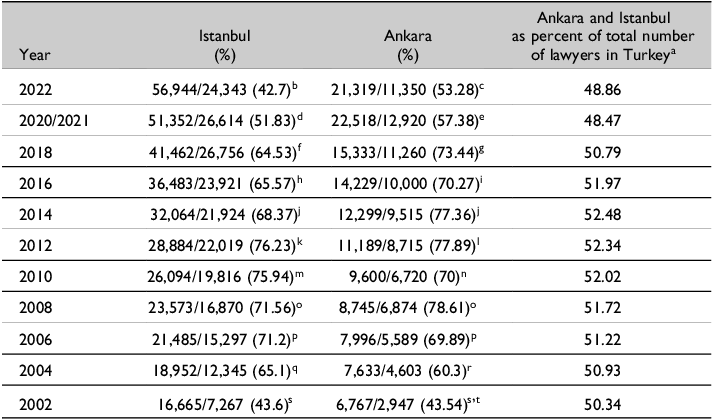
This dissolution of professional unity and general apathy on the part of younger professionals is visible in the participation rates in bar association elections in the two most crowded bars of the country, Istanbul and Ankara.Footnote 35 As can be seen in Table 2, since these two bars host about half of all the lawyers in the country, such numbers reflect the political apathy mentioned in the interviews.
Participation rate in bar elections in Istanbul and Ankara

Sources:
a Türkiye Barolar Birliği 2025;
b İstanbul Barosu 2022;
c Microdestek 2022;
d Yaşar Reference Yaşar2021;
e Cumhuriyet 2021;
f Kalem and Elveriş Reference Kalem and Elveriş2018, 173;
g Alan Reference Alan2018;
h Microdestek 2016;
i Çepni Reference Çepni2016;
j Microdestek 2014;
k HukukiHaber 2012;
l Bianet 2012;
m İstanbul Barosu 2010;
n Memurlar.net 2010;
o Bianet 2008;
p Sendika.org 2006;
q Sendika.org 2004;
r Memurlar.net 2004;
s Bianet 2002.
Notes: Despite calls for an election boycott in the bar elections of 2010 in Istanbul, participation reached almost 76 percent, showing the politicization of the Istanbul bar against the attacks on the profession by the increasingly authoritarian government.
While there may be various interpretations of this data, the sharp decline in participation rates since 2018 for both bars is obvious. From 2002, the year when the AKP came to power, to 2018, participation in fact gained momentum, fed, in part, by a secular-nationalist reaction to the Islamist AKP’s rise and, later, by concerns over the party’s attacks on the republican establishment. As a result, while showing a certain amount of decline, the participation rate stayed well over 60 percent until after the 2018 elections. At that point, a combination of factors may have led to the sharp decline. On the one hand, the political frustration connected to the regime’s change to a “Turkish-style presidency” with the 2017 referendum effectively rendered the system of law even more arbitrary and created oft-referenced corruption in the legal sphere.Footnote 36 On the other hand, the sharp economic decline of the new white-collar middle classes, including lawyers, began to be felt most heavily in these two main cities, such that participation in the bar, especially when it was seen as not addressing the problems of young lawyers, appeared to become increasingly meaningless.Footnote 37
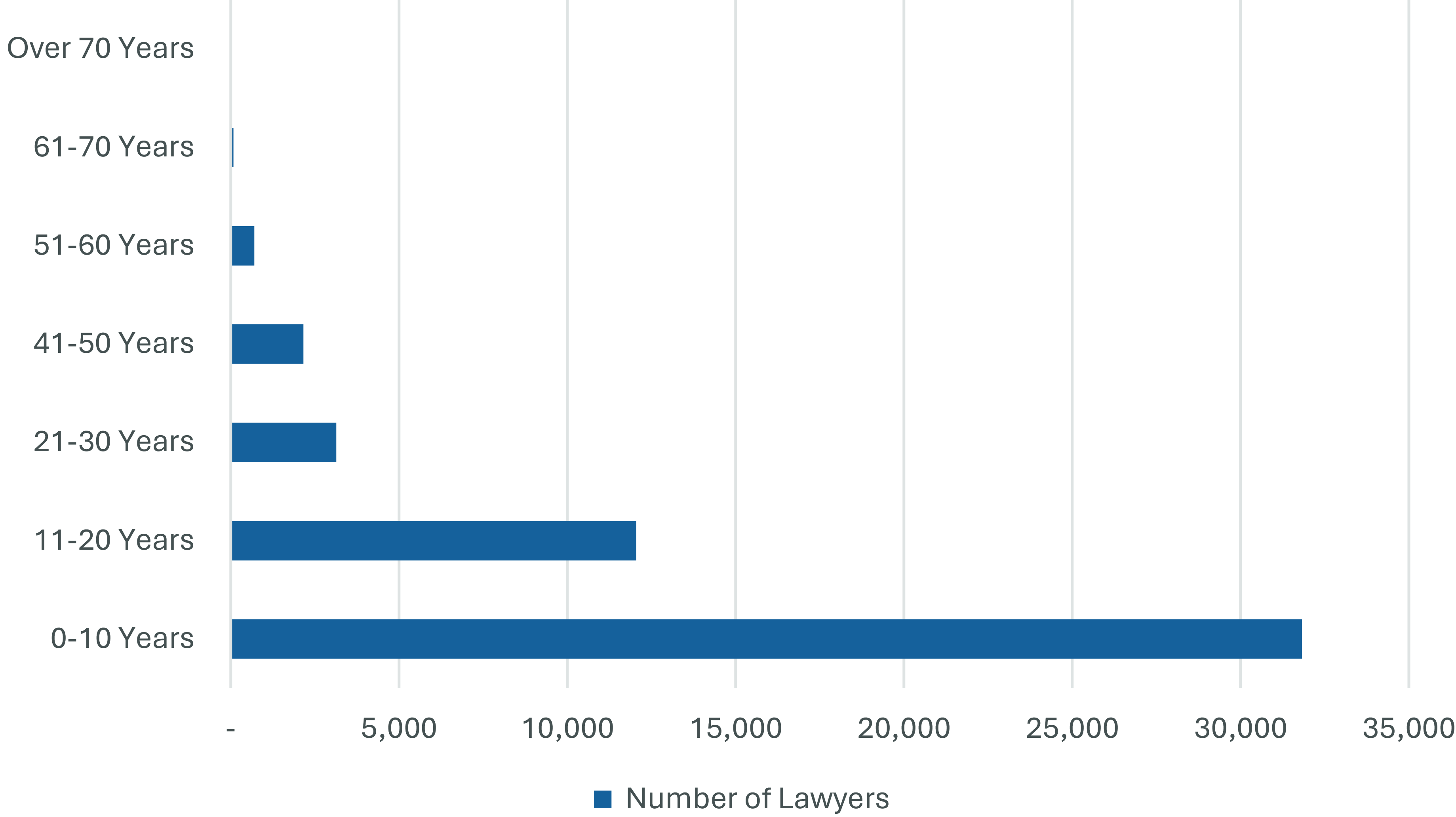
This last inference is supported by striking facts that are highlighted in the Figure 1: even though young lawyers and interns in these cities complain about their economic situation most vociferously, they also try and stay in Istanbul (or Ankara) because these cities boast the widest range of business opportunities. In a study that traces the age and years of experience of lawyers in the country, the average age of Istanbul lawyers is quite young at thirty-eight years old. More importantly, 56 percent of the lawyers in Istanbul have between one and ten years of experience practicing law (Avukat Hakları Grubu 2022). This data help explain the conundrum that the legal profession is facing today in the face of political pressure. While bar associations—notably, in Istanbul and Ankara—engage in oppositional politics against the autocratic regime, younger lawyers are so economically disadvantaged that they are not only indifferent to, but also often resentful of, the political stances taken by the leaders of the bar associations, who are usually more experienced and economically advantaged professionals. One young lawyer working solo did not shy away from making exactly this point:
The bar does not help us with our [economic and professional/occupation-related] problems; they follow their political agenda. This is the reason why young lawyers have almost nothing to do with the bars with which they are registered. Now, you look at the bar elections, the “dinosaurs” go and vote. They are the ones who count the ballots. Now, in fact, an 80-year-old lawyer should not be interested in who the head of a bar association is. But they go and vote, and the young lawyers do not. [This is the reason why] the participation in the bar elections is so low. … The young lawyers have no emotional connection to the bar. There is no unified bar.Footnote 38
Number of lawyers registered to Istanbul bar according to their years of practice
Source: Avukat Hakları Grubu 2022 .

This contradictory predicament echoes the point that de Sa e Silva (Reference De Sa e Silva2022) makes about autocratic regimes exploiting the divisions within the legal profession to its advantage. What is interesting in the Turkish case is that the division is initially created through a process of professional dilution and, later, by generational fractures and apathy on the part of young lawyers who are critical of the politicized bar associations, even though they themselves are by and large opposed to the AKP. In other words, co-optation is not the only way in which an autocratic regime can silence an otherwise potentially strong oppositional institution. Professional liquidation can have the same effect.
Here, liquidation’s connotations of debt are relevant once again: frequently, older and more well-to-do lawyers tend to see themselves as mentors and their younger colleagues as mentees and justify the latter’s lower wages as a price for such mentoring. This traditional craft mentality implies that younger lawyers are indebted, in a sense, to the older generation for the transfer of tacit knowledge and thus need not make much fuss within the profession about their economic status. While this point is not necessarily about the profession being actively subdued by the government, it shows that the traditional structures of an age-based and culturally established hierarchy in a society and within one of its professions can also expand the rifts within a profession, once again rendering it open for governmental attacks.
Finally, the younger generation has a much more “disenchanted” view of law and lawyering not only because of the reality of the neoliberal market mentality, feelings of precarity, and generational conflicts but also due to the erosion of the rule of law in the hands of the autocratic regime. This disenchantment was visible across many of our interviews. When asked about the general legal environment in Turkey, numerous younger lawyers spoke about the “unfair” conviction and imprisonment of national figures such as Selahattin Demirtaş, the ex-president of the Kurdish-leaning political party Labor Party of the Peoples (Halkların Emek Partisi), or Osman Kavala, a businessman and civil society activist who has been sentenced to life in prison for his alleged role in masterminding and financing the Gezi protests of 2013. These convictions, according to the lawyers, are clear examples of the politicization of the law in the hands of the authoritarian regime.
In such an environment of disenchantment, professional cohesion also melts into air. Referencing news about a prosecutor who was indicted as a member of a drug cartel, a young lawyer in Istanbul stated: “There is a problem of politicization and political cronyism in every aspect [of the legal system]. You can tell the massive negative impact of the regime on the judiciary/law the moment you step into the court room from the eyes of the judges. You can easily guess in what way the judge will decide.” When asked what he thinks of the state of law in Turkey, another young lawyer added: “What can I say? You see that certain lower courts do not even recognize or apply the decisions of the [highest court in the country] Constitutional Court [for political reasons]. So, is it possible to think positively about the state of law in such a country?” Finally, a relatively older lawyer in our sample literally burst out when asked about the state of law in Turkey. To summarize his points in a highly selective quote, he suggested that,
if journalists are imprisoned [due to the president’s orders], if the people do not feel free, if there are over a million “terror suspects” in a country, if civil society leaders, or authors, or party leaders are in prison without actual or credible charges, and if the decisions of the European Court of Human Rights on these cases/issues are not taken into account. … What can I say about law and legality in this country? It’s all out there: Independence, objectivity and meritocracy. … All are lost in the legal field [just like in other domains].
Discussion and conclusion: autocratization and “professional liquidation”?
So where does all of this leave us? The point has already been made that the legal profession needs to be brought into the studies of autocratic legalism. Here, I have suggested that, in contexts where the legal complex is seen as a strong element of the historical establishment that aspiring autocrats want to dismantle, autocratization targets not only the high judiciary but also the legal profession and its institutions, such as oppositional city bars or their umbrella organizations. The Turkish case clearly shows that aspiring autocrats attack these professional organizations not only to silence any type of organized dissent but also because they perceive these organizations as representatives of the ancien regime. As stated above, in many non-Western contexts where legal professions are historically intertwined with the state in a specific manner, efforts to establish an authoritarian regime have involved attempts to co-opt lawyers for such autocratic projects. Yet this has taken different forms in different countries, whether through direct attacks, as in the Turkish context, or through a more coordinated effort to co-opt a certain segment of lawyers, as in Venezuela (Gomez Reference Gomez2022). Further research must not only identify the different strategies of aspiring autocrats in engaging legal professions but also the response of the legal professions to such strategies, whether via resistance, joining the authoritarian coalition, silent resignation, or cynicism.
These are the types of heterogenous moments that must be identified to “bring the legal profession [back] in” to the study of illiberalism and autocratic legalism. Specifically, heterogeneity is useful for illiberal rulers as it allows the rulers to co-opt parts of the profession and play different segments against one another. We can see this happening in the context of many similarly situated countries such as Mexico, Brazil, and Poland: the increase in the population of lawyers has led to various levels of un- and de-regulation, which leaves the professional legal arena disunified and vulnerable. In the Turkish context, however, the possibility of such co-optation is not yet fully evident. From the evidence presented above, pro-government lawyers do not constitute a unified front, as do the “lawyers of the right” in the United States, for instance (Southworth Reference Southworth2008). Heterogeneous legal professions, in other words, do not necessarily boast lawyers bound to illiberal projects. What the Turkish case demonstrates is that docility and subordination can be the end product of a range of processes that are not automatically the outcome of intentional autocratic legalism and illiberalism.
It is equally important to remember that these authoritarian strategies do not take place in a sociopolitical vacuum but are empowered by processes that are originally associated with different goals. In Turkey, as explained above, the creation of new law faculties was a neoliberal and populist move that attempted to turn higher education into a business while maintaining a discourse of expanding higher education to the masses. However, by the time the first cohort of these students graduated and became practicing lawyers (circa 2013–14), the country’s economic fortunes had turned, and lawyering as a profession had become much less rewarding, both materially and symbolically. In such a diluted professional space, the neoliberal logic shattered the practices by which professions tend to regulate and protect themselves from competition. Younger lawyers, in particular, faced an ever-tougher economic landscape, becoming white-collar workers themselves and displaying both veiled and open resentment toward the more established lawyers preceding them. Their disenchantment, resentment, and apathy have minimized solidarity not only with their more established counterparts but also with the bar associations that they perceive as being unrepresentative.
We need more empirical or anecdotal data perhaps, but this discrepancy between the generations also explains the interesting and somewhat counterintuitive trend in Turkey: while the profession is being liquidated, as diluted and devalued, the organizations/institutions of the profession still show a significant degree of resilience and opposition toward the autocratic regime. It appears—and the quotations that I presented above also confirm—that the resistance is being handled by the well-to-do lawyers who are administering the bar associations but that the younger and more precarious lawyers, representing more of the lawyer population, are being disenchanted with the law, with the result that the profession is being liquidated partially, if not fully. Will this change in the near or medium term, it is hard to tell for now, but more research about bars and the TBB will likely produce very interesting results regarding the Turkish profession and the legal profession in an autocratic setting at large.
The autocratic agenda and its moves, and how it influences the profession as a whole also needs to be watched quite closely. In fact, one other interesting fact is that the government’s agenda to open secondary bars and change the election system of the TBB failed, and perhaps it is these failures themselves that have created new and unexpected rifts and cracks in the profession as well as unifying the profession in ways that the government has not anticipated. Thus, in other words, the end result of governmental actions may be the creation of a more heterogenous and less unified profession but through the unintended consequences of governmental action.
Autocratic legality and the changing fortunes of legal professionals worldwide cannot be thought of apart from global neoliberal processes. While the economic dimensions of such changes are important, equally so is the loss of status experienced by lawyers due to the overall devaluing of education and the attacks on intellectuals and intellectualism in a post-truth era (Owen Reference Owen2022). Of course, such devaluing has taken place in an environment of increasing resentment toward traditional political elites, who have come to value globalization and its political economy to the detriment of the masses and democracy at large (Aman Reference Aman2004; Rodrik Reference Rodrik2011). As such, authoritarian-leaning politicians not only in the non-West but also in established democraciesFootnote 39 have mobilized populist measures to attack and subordinate (and co-opt) whenever possible legal professions and/or lawyers. The second coming of Donald Trump in 2025 has only exacerbated this tendency toward a global authoritarian surge, the devaluing of knowledge, and the decline in legal certainty. The legal profession, therefore, is in a crossfire globally and under threat of liquidation; the question that remains, and that is in need of theoretical as well as empirical reflection, is whether the profession can retain its (semi-)autonomous status against the onslaught of authoritarian neoliberalism.