


1. Introduction
Space-time singularities are often described as a puzzling and strikingly nonclassical feature of general relativity. This is in part because, as John Earman (Reference Earman1995) has emphasized, singularities are closely connected to indeterminism and acausality in relativity theory. But in a sense the puzzles arise before one gets to such issues. Even identifying when a space-time is singular has proved to be a major foundational problem. And, perhaps most remarkably of all given these difficulties, one apparently cannot avoid singularities in general relativity: the celebrated Penrose-Hawking-Geroch singularity theorems show that singular space-times are generic among the physically reasonable models of the theory.Footnote 1
The problem is not that singularities do not arise in other theories. They do. For instance, there are solutions to Maxwell’s equations on which the electromagnetic field diverges at some point(s) of space-time.Footnote 2 Such solutions are naturally characterized as singular, with singularities occurring at the points of divergence. In general relativity, however, one cannot reason in this way, since the dynamical fields themselves determine the geometry of space-time. Thus, if one of these fields fails to be defined at a point, that point must be “removed” from the space-time. For this reason, there is now broad consensus that the best way to think of singularities in general relativity is in terms of “incomplete” space-times—specifically, space-times that are (time-like or null) geodesically incomplete (I make this precise below). But the situation is still murky, and questions remain concerning both (1) whether geodesic incompleteness is a necessary (or even sufficient) condition for a space-time to be singular and (2) how to understand the relationship between geodesic incompleteness and the divergence of some physical quantity.
In its standard formulation, Newtonian gravitation (conceived as a field theory) is essentially similar to electrodynamics. In this sense, general relativity is starkly different from classical gravitational theory with regard to singular structure, which justifies the view that space-time singularities of the sort that lead to foundational problems are a distinctly nonclassical feature of relativity theory. However, there is a reformulation of Newtonian gravitation due to Élie Cartan (Reference Cartan1923, Reference Cartan1924) and Kurt Friedrichs (Reference Friedrichs1927) known as geometrized Newtonian gravitation (or often, Newton-Cartan theory). Although in various senses equivalent to Newtonian gravitation,Footnote 3 geometrized Newtonian gravitation shares many important qualitative features with general relativity. Most importantly, in geometrized Newtonian gravitation, as in general relativity, the dynamical fields determine the geometry of space-time.
This feature of geometrized Newtonian gravitation raises a cluster of interesting questions in connection with singularities. There is a sense in which the difficulties associated with singularities in relativity theory arise from the geometrical character of the theory, and geometrized Newtonian gravitation is geometrical in a very similar sense. But there is also an important difference between the theories: in a wide variety of cases, one can “translate” back and forth between models of geometrized Newtonian gravitation and of standard Newtonian gravitation, where singularities are well understood. This suggests that one might gain some insight into singular structure in general relativity by investigating singularities in geometrized Newtonian gravitation.
This article is a first step in this investigation. I hope to make two modest points. The first is that geodesic incompleteness is a natural way of thinking about singularities in geometrized Newtonian gravitation, and indeed, the route to geodesic incompleteness is more direct than in relativity theory. The second point is that singularities arise naturally in Newtonian gravitation. To support this claim, I will state and prove a Newtonian singularity theorem analogous to a historically important singularity theorem due to Raychaudhuri (Reference Raychaudhuri1955) and Komar (Reference Komar1956).Footnote 4 The upshot of this theorem is that all homogenous and isotropic Newtonian cosmological models with nonvanishing matter content exhibit either an initial (big bang) or final (big crunch) singularity, or both.
2. Classical Space-Time Structure and Geometrized Newtonian Gravitation
I begin by briefly reviewing the geometrical structures I will work with.Footnote 5 A model of general relativity is a relativistic space-time, which is an ordered pair (M, gab), where M is a (smooth) four-dimensional paracompact Hausdorff manifold,Footnote 6 and gab is a Lorentzian metric, with signature (+1, −1, −1, −1). Associated with any such metric is a unique torsion-free covariant derivative operator,  , satisfying
 . We call a tangent vector
 at a point p time-like if
 , space-like if
 , and null if
 . A vector field is time-like (respectively, space-like or null) if it is time-like at every point; likewise, a curve is time-like if its tangent field is at every point. Matter is represented by its (symmetric) energy-momentum tensor Tab, which is related to the Ricci curvature of
 by Einstein’s equation,
 . Time-like curves are the possible trajectories of massive point particles; in the absence of an external force, massive point particles traverse time-like geodesics.
Models of both standard and geometrized Newtonian gravitation, meanwhile, are classical space-times. These are ordered quadruples, (M, tab, hab,  ), where M is as above, but tab and hab are degenerate “metrics” with signatures (1, 0, 0, 0) and (0, 1, 1, 1), respectively, and
 is a torsion-free derivative operator. The metrics are required to satisfy habtbc = 0, and the derivative operator is required to be compatible with the metrics in the sense that
 and
 . (We have to stipulate a derivative operator since there are in general many that are compatible with the degenerate metrics.) The field tab can be thought of as a temporal metric: given a vector
 at a point p, the temporal length of
 is given by
 . If
 , we say the vector is time-like; otherwise it is space-like. Similar considerations apply to vector fields and curves. The field hab, meanwhile, can be understood as a spatial metric in the following extended sense: given a space-like vector
 at a point p, the spatial length of
 is given by
 , where
 is a (sufficiently unique) covector at p such that
 . We say a classical space-time is temporally orientable if there exists a smooth (globally defined) field ta, called a temporal orientation, such that tab = tatb. In what follows, it will be convenient to restrict attention to temporally orientable classical space-times and work directly with a choice of temporal orientation instead of the full temporal metric.
In standard Newtonian gravitation, one considers a flat (i.e.,  ) classical space-time along with a scalar field
 representing the gravitational potential and a symmetric tensor field Tab called the mass-momentum tensor, which represents the matter content of space-time. These together satisfy Poisson’s equation,
 , where
 is the mass density. The (spatial) gradient of the gravitational potential,
 , is the gravitational field. Time-like curves are again the possible trajectories of massive point particles. In the absence of any external force, including gravitation, massive point particles traverse time-like geodesics; in the presence of a gravitational field (and no other forces), a massive point particle will follow a trajectory with acceleration
 , where
 is the tangent field to the trajectory.
In geometrized Newtonian gravitation, meanwhile, there is no gravitational potential. Instead, one considers classical space-times in which the derivative operator is curved in the presence of matter, with Ricci curvature given by the geometrized Poisson equation,  . (As in standard Newtonian gravitation, Tab and
 are the mass-momentum tensor and mass density fields, respectively.) And in the absence of external forces (where gravitational influences are no longer conceived as external forces), massive point particles traverse time-like geodesics. Thus, in geometrized Newtonian gravitation, gravitation is a manifestation of space-time curvature, in much the same way as in relativity theory; similarly, the geometrical structure of space-time—specifically, the derivative operator—depends on the distribution of matter. It is in this setting that I explore singularities.
3. Singular Space-Times in Geometrized Newtonian Gravitation
As I noted above, the standard rough-and-ready characterization of singularities in general relativity is as follows: one says that a space-time is singular if it is geodesically incomplete. To make this precise, let M be a manifold endowed with a covariant derivative operator  . Given any point p ∈ M and any tangent vector
 at p, there always exists a unique maximal geodesic
 satisfying
 and whose tangent vector at p is equal to
 , where by maximal I mean that given any other geodesic
 with
 and whose tangent vector at p is
 , I′ ⊆ I and
 for all s ∈ I′. A geodesic is said to be incomplete if it is maximal but its domain is not all of ℝ. A relativistic space-time (M, gab) is (time-like, null, or space-like) geodesically incomplete if it admits an incomplete (time-like, null, or space-like) geodesic. Otherwise, it is geodesically complete.
The definition of a geodesic puts a strong constraint on the parametrization of the curve, which permits the following interpretation of geodesic incompleteness: a space-time is geodesically incomplete if there exists a maximal geodesic that “ends” after only finite distance (as measured by the affine parameter). In particular, for time-like geodesically incomplete space-times, there is a trajectory that in principle could be followed by a nonaccelerating observer that extends into the future or the past for only finite time. Any such space-time clearly exhibits pathological behavior, which is what justifies the idea that geodesic incompleteness is at least sufficient for a relativistic space-time to be singular.Footnote 7
What is the situation in geometrized Newtonian gravitation? If one begins by thinking exclusively about the geometrized theory, one confronts many of the same problems that arise when one tries to characterize singularities in general relativity. These considerations might well push one to geodesic incompleteness as a rough-and-ready definition of singular space-times in this context as well. But here we have an additional resource: models of geometrized Newtonian gravitation are systematically related to models of the standard theory, where singularities are comparatively well understood. In particular, given any model of Newtonian gravitation, there exists a unique corresponding model of geometrized Newtonian gravitation. This claim is made precise by the following theorem, due to Andrzej Trautman.
Theorem 1.— (Trautman Geometrization Theorem). Let  be a flat classical space-time. Let
 and
 be smooth scalar fields on M satisfying Poisson’s equation,
 . Finally, let
 , with
 .Footnote 8 Then
 is a classical space-time;
 is the unique derivative operator on M such that, given any time-like curve with tangent vector field
 ,

and the Riemann curvature tensor relative to  ,
 , satisfies
 .
This theorem allows us to ask what characterizes the geometrized equivalent of a singular model of standard Newtonian gravitation.
In what follows, suppose that  is a flat classical space-time, and let
 and
 be scalar fields representing the mass density and gravitational potential on M, respectively. Suppose, too, that
 and
 together constitute a solution to Poisson’s equation. Given such a model, there is a natural candidate for the field whose divergence would signal a “gravitational singularity,” namely, the gravitational field
 —or more precisely, the energy density of the field, which is proportional to the scalar
 .Footnote 9 Were this quantity to become infinite, it would indicate that a point particle passing through the region where the field diverged would experience unbounded acceleration.
Of course, neither the gravitational potential nor the gravitational field appears in a model of geometrized Newtonian gravitation. But the Trautman geometrization theorem makes clear what role the gravitational field plays in determining a model of the geometrized theory: it enters directly in the definition of the curved derivative operator,  . More specifically, the gravitational field is used to determine the
 field that specifies the action of
 in terms of the action of
 on arbitrary smooth tensor fields. Thus, given a point (or region) on which the gravitational field becomes infinite (or otherwise undefined), one has a failure of geometrization, insofar as it proves impossible to define a curved derivative operator satisfying the conditions of the Trautman geometrization theorem at that point. This indicates that these points would need to be excised from a model of the geometrized theory, since (by definition) a classical space-time consists of a manifold along with the specification of the two degenerate metrics and a compatible covariant derivative operator satisfying certain conditions, and no such derivative operator exists at the points in question. Hence, singularities in this context can be thought of as points that have been removed from a nongeometrized model precisely because a certain part of the geometrical structure could not be defined at those points.
Once the points are removed, one encounters a number of problems that are familiar from the relativistic case. But, given the nature of the failure of geometrization, there is nonetheless a direct way of thinking about what pathological features the geometrized model should be expected to exhibit: the excised points correspond to regions where the derivative operator could not be defined. In general, though, a covariant derivative operator both fully determines and is fully determined by a collection of geodesics. Indeed, one can think of the covariant derivative operator in Newtonian gravitation (or even relativity theory) as equivalent to a standard of (non)acceleration. This means that a failure of the derivative operator to be defined can be understood as a breakdown in the standard of geodesy associated with the space-time. This suggests that the natural way of thinking about the divergence of the gravitational field in geometrized Newtonian gravitation is in terms of incomplete geodesics.
It is worth emphasizing the difference between this situation and the one in general relativity, in which the option of direct translation between a “geometrized” theory and some alternative theory on which singularities seem less troublesome is not available. There, one gets to geodesic incompleteness via a circuitous route of trying other (historically speaking) more “obvious” alternatives. And at least on some accounts (e.g., Geroch Reference Geroch1968), the ultimate motivation for using geodesic incompleteness as the characteristic feature of singular space-times is that it is an indication that something has gone wrong with a space-time “at finite distance” and not that it is a direct way of capturing the kind of pathology we were originally interested in. In geometrized Newtonian gravitation, meanwhile, geodesic incompleteness captures exactly the kind of pathology one was originally interested in, insofar as geodesic incompleteness is a natural way of characterizing the failure of a derivative operator—and hence, a pathology in the gravitational field.
Indeed, one might take the naturalness of geodesic incompleteness as a way of characterizing singular models of geometrized Newtonian gravitation as a new motivation for adopting geodesic incompletenessFootnote 10 as the standard condition in general relativity. After all, the analogies between general relativity and geometrized Newtonian gravitation are strong, and in the latter case it is clear that it is the failure of the derivative operator to be well defined that corresponds most closely with the divergence of the gravitational field. And so, there is a sense in which even in general relativity geodesic incompleteness is the condition that best captures the intuition about what constitutes a singular solution inherited from electromagnetism.
As a final remark, in the context of relativity theory, one sometimes considers cases where in addition to admitting an incomplete geodesic, a space-time also has some scalar measure of curvature, or even the physical components of the curvature tensor expressed in a parallel propagated orthonormal frame, diverge along an incomplete curve (or geodesic). When this occurs, one speaks of the space-time as admitting a curvature singularity; some physicists have urged that the existence of a curvature singularity somehow emphasizes, or makes more physical, the singular nature of a geodesically incomplete space-time.
I do not want to comment on what, if anything, is added once one observes that a geodesically incomplete space-time also exhibits a curvature singularity. But I do want to point out that one can also consider curvature singularities in geometrized Newtonian gravitation. In that context, the so-called Ricci curvature scalar,  , always vanishes, so that is not a good candidate for a potentially divergent scalar curvature. But there is another natural candidate, namely, if the geometrized Poisson equation holds, then one gets a scalar quantity by contracting the Ricci curvature tensor Rab with an arbitrary unit time-like vector,
 . This quantity is independent of the choice of time-like vector—indeed, it is just
 . In other words, a model of geometrized Newtonian gravitation exhibits a curvature singularity of this kind just in case the mass density diverges along an incomplete geodesic. So curvature singularities have a clear interpretation in this context: they correspond to singularities in the source matter of a space-time, whereas geodesic incompleteness simpliciter corresponds to singularities in the gravitational field. Of course, in many cases of physical interest, both conditions will be met, although they are in principle conceptually distinct.
4. A Newtonian Singularity Theorem
As we have seen, there is a sense in which the Trautman geometrization theorem provides a more direct route to geodesic incompleteness as a characterization of singular space-times than is available in general relativity. But one might worry that there remains an important difference between the two theories. Perhaps one can introduce singularities in geometrized Newtonian gravitation if one wants. But the Penrose-Hawking-Geroch theorems show that one is forced to reckon with singular space-times in general relativity, and the same cannot be said about geometrized Newtonian gravitation.
I want to resist this line, however. There are certainly senses in which singularities are endemic to general relativity but not to Newtonian gravitation. Nonetheless, singularities do appear, naturally and universally, in a broad class of realistic models of Newtonian gravitation. In particular, one can prove a singularity theorem directly analogous to a theorem of relativity due to Raychaudhuri (Reference Raychaudhuri1955) and Komar (Reference Komar1956) that shows that essentially all homogeneous and isotropic cosmological models of Newtonian gravitation are singular, in the sense that they are geodesically incomplete.Footnote 11
To state and prove the theorem, I first need to introduce some background material concerning cosmological models of geometrized Newtonian gravitation.Footnote 12 The models I have in mind are the Newtonian analogue to FLRW space-times, which are the standard cosmological models of relativity theory (setting aside inflation). In both general relativity and geometrized Newtonian gravitation, these are models characterized by assumptions of spatial homogeneity and isotropy relative to some choice of time-like vector field. This assumption can be made precise as follows. A classical space-time  is homogeneous and spatially isotropic relative to a time-like vector field
 if, given any point p ∈ M and any two unit space-like vectors
 and
 at p, there exists an open set O containing p and a (derivative operator preserving) isometry
 that preserves p and
 and that maps
 to
 .
One can show that if a classical space-time is spatially homogenous and isotropic relative to a vector field  , then it must be a perfect fluid solution with velocity vector field
 —that is, it must be a space-time whose matter field has an associated mass-momentum field of the form
 , where
 is the mass density of the fluid and p is an (isotropic) pressure term. Moreover,
 must be geodesic (i.e.,
 everywhere), irrotational (i.e.,
 ), and shear-free (i.e.,
 , where
 and
 is the unique smooth symmetric field such that (a)
 and (b)
 ). Finally,
 must be constant on space-like surfaces (i.e.,
 ). Note that the requirements that
 is geodesic, irrotational, and shear-free jointly imply that
 .
Definition 1.— An FLRW-like classical space-time is a sextuple  , where
 is a time-like vector field on M and
 is a classical space-time that is spatially homogeneous and isotropic relative to
 and that, together with the (perfect fluid) mass-momentum field Tab, satisfies the geometrized Poisson equation.
There are two additional standard assumptions about the matter fields associated with FLRW-like classical space-times. First, we assume that the conservation condition is satisfied (i.e., that  ). For a perfect fluid, the conservation condition implies the continuity equation (i.e.,
 ), which is a statement of the conservation of mass. Second, we assume the mass condition is satisfied (i.e.,
 ). The mass condition plays the role of an energy condition in geometrized Newtonian gravitation.
The classical analogue to the Raychaudhuri-Komar theorem concerns FLRW-like classical space-times.
Theorem 2.— Suppose that  is a FLRW-like classical space-time satisfying the conservation and mass conditions. Then either
 or the space-time is time-like geodesically incomplete.
Proof.—
In what follows,Footnote 13 suppose that  (the theorem trivially holds if
 , and the mass condition prevents
 ). We begin by deriving a special case of Raychaudhuri’s equation for the perfect fluid Tab.Footnote 14 Consider that
 , where the penultimate equality is a consequence of the definition of the Riemann tensor and the last equality follows from Leibniz’s rule. Now, since
 is geodesic, irrotational, and shear-free, we know that
 and that
 . Moreover, since an FLRW-like space-time is required to satisfy the geometrized Poison equation, we know that
 . Together, these imply that
 . Since
 , it follows that
 everywhere.
Now pick a point p ∈ M and consider the integral curve  of
 passing through p. Since
 everywhere, there can be at most one point x ∈ I such that
 at
 . This means that it is always possible to reparameterize (and possibly truncate)
 so that either
 and
 at
 or else
 and
 at
 . Without loss of generality, we can assume that the first case holds.
We can now define a new function  . A quick calculation shows that
 ; moreover, by the derivation above, we know that
 everywhere. Since
 , and since
 , it follows that f < 0 everywhere on [0, a). Since f ≠ 0, it follows that 1/f is well defined and, more, that
 . If we integrate both sides of this inequality on [0, a) from 0 to T < a, we find,
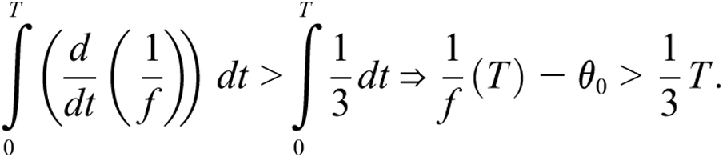
This, in turn, implies that  . But now note that, since
 by construction,

It follows that  , since by construction f was well-defined everywhere on [0, a). Thus, there is an upper bound on the parameter value for the geodesic
 , and so
 must be incomplete. It follows that the space-time is geodesically incomplete. QED
Several remarks are in order. The first is that, although the current version of the theorem is effective at making my point, it can be strengthened in several ways. For instance, the theorem states that there is an incomplete geodesic. It is clear, though, from the current argument that in fact every maximal integral curve of  is an incomplete geodesic. Moreover, one can show that if there exists a geodesic
 for which a takes the maximal value of
 , then there is a curvature singularity in the sense given above: if
 is the tangent field to such a curve, then
 . Finally, the assumptions of spatial homogeneity and isotropy are of special interest because of their connection to standard cosmological models in general relativity. But in fact, the argument would go through for any perfect fluid solution whose flow vector is geodesic and irrotational.Footnote 15
Regarding the interpretation of the theorem: note that in the proof, I identified two cases. In one, the scalar θ is always negative moving forward along a (half) geodesic; in the other, the scalar is negative moving backward along a (half) geodesic. Although mathematically these cases are equivalent, they have rather different interpretations. In the first case, one has a situation in which the cosmic fluid is everywhere collapsing into itself. This will ultimately (i.e., in finite proper time as measured by an observer comoving with the fluid) lead to a big crunch singularity. In the other case, meanwhile, is the time reverse of this situation—that is, a space-time corresponding to a big bang singularity. In some cases, one will have both initial and final singularities (those are the cases in which θ passes through 0); in all cases in which  , however, one will get at least one of these.
5. Conclusion
As I noted in the introduction, this article had two (modest) goals. One was to argue that an analysis of singularities in geometrized Newtonian gravitation provides a more direct route to geodesic incompleteness as a natural characterization of singularities. Although hardly dispositive with regard to whether geodesic incompleteness is necessary or sufficient for a space-time to be singular in relativity theory, these considerations provide a new perspective on that question and on the physical interpretation of singular behavior more generally. The second goal was to show that singular space-times do arise naturally in geometrized Newtonian gravitation. These considerations suggest that further study of singular classical space-times may be a fruitful way to explore singularities in geometric theories of gravitation.
 —or, in perhaps more familiar notation, the invariant quantities
 and EaBa, where Ea and Ba are the electric and magnetic fields relative to some observer. Both of these capture, in different ways, the “magnitude” of the electromagnetic field at a point.
 is explained in Malament (
 such that
 —one can choose the gravitational potential in such a way as to diverge wherever one likes. For instance, pick a coordinate system and let
 , where t is the time coordinate in that coordinate system. Then
 will diverge as t → 0, even though the gravitational field (and the gravitational force experienced by any point particle) vanishes everywhere.


