Disasters can impact an individual on many levels. Loss of a home, devastation of a community, changes to the workplace, or injuries and deaths of family and friends—these events are all too common in the wake of a disaster. It can take months and even years to recover, which can lead to sustained chronic stress during the recovery process.Reference Ursano, Cerise and DeMartino 1
Well-Being of Health Care Providers After a Disaster
Heath care and social service providers from disaster-affected communities are at high risk for emotional distress symptoms immediately after the event and during the recovery period.Reference Benedek, Fullerton and Ursano 2 They provide support to others both physically and emotionally, while at the same time may be in the process of recovery and rebuilding within their own lives. Health care providers, particularly those in community health care centers, often serve high-need communities, where incomes are lower, health issues are elevated, and health care is scarce. 3 Research indicates that individuals from high-need communities suffer greater stress in day-to-day life,Reference Turner and Avison 4 and after disasters the disproportionate burden of stress and post-traumatic stress symptoms suffered by communities in poverty is even higher.Reference Norris, Friedman and Watson 5
A number of studies have indicated that health care workers disproportionately experience post-traumatic stress symptoms. For example, the prevalence of post-trauma symptoms in rescue and recovery workers ranges from 5% to 32%, higher than the national prevalence of 4%.Reference Epstein, Fullerton and Ursano 6 - Reference Guo, Chen and Lu 8 Another study of health care workers after a sniper attack in Washington, DC, found the participants reported increased alcohol consumption, post-traumatic stress disorder symptoms, and depressive symptoms.Reference Grieger, Fullerton and Ursano 9
Post-disaster emotional reactions commonly experienced by health care and social service providers include job burnout, compassion fatigue, secondary traumatic stress, vicarious traumatization, and depression. Job burnout generally occurs from being overworked with symptoms such as a reduced sense of achievement, emotional exhaustion, and diminishing idealism.Reference Figley 10 Secondary traumatic stress and compassion fatigue, often used interchangeably, involve emotional responses related to working with survivors of traumatic events. Secondary traumatic stress and compassion fatigue are generally sudden and related to stress caused by hearing about traumatic events experienced by clients.Reference Sabin-Farrell and Turpin 11 Similarly, vicarious traumatization refers to a process of cumulative exposure to patients’ traumatic experiences, which can lead to changes in the worker’s view of the world and their abilities, beliefs, and psychological needs.Reference McCann and Pearlman 12 Moreover, vicarious traumatization can threaten a worker’s sense of trust, safety, and control leading to changes in their professional or self-identity.Reference Saakvitne, Pearlman and Abrahamson 13
Protective Factors for Health Care Workers
While health care workers are at high risk for psychological distress after a disaster, there are strategies and protective factors they can employ to mitigate negative psychological sequelae. Moreover, scholars have noted that health care workers who provide care to trauma survivors need support on both the individual and agency level.
On the individual level, a number of strategies have been suggested to mitigate distress among health care workers. Healthy coping strategies may include spending time with others, participating in activities that provide a sense of purpose, and asking for support when needed.Reference Bills, Levy and Sharma 14 Advocates have also posited that is essential for health care workers to have awareness about secondary traumatization, and prevention programs should provide education before distress is present.Reference Salston and Figley 15 Such programs include training in self-care, psychological first aid, monitoring of cognitive changes such as a sense of safety and control, and how to create work–life balance. On the organizational level, it has been suggested that supervisors should support staff, limit caseloads, and make mental health services available to health care workers.Reference Salston and Figley 15
While the importance of supporting health care workers in a post-disaster context is well established, there are few empirically supported interventions specific to mitigating distress and reducing the potential for secondary traumatic stress or burnout. A number of empirically supported interventions address clinical levels of distress such as post-traumatic stress disorder or other anxiety-related symptoms. Other brief interventions such as critical incident stress debriefing have been implemented with first responders but have had mixed results and may even have a damaging impact on the health care workers.Reference Litz, Gray and Bryant 16
In response to the need for intervention strategies specific to the longer-term recovery of health care providers who have responded to a disaster, we developed and tested the Resilience and Coping for the Healthcare Community (RCHC) intervention with participants who provided care during and after Hurricane Sandy, a superstorm that impacted a wide swath of the northeastern United States on October 29, 2012. The purpose of the current mixed-methods study was to describe the effects of the RCHC intervention when implemented with health care and social service providers after a mass trauma.
Description of the RCHC Intervention
The RCHC intervention was originally conceived in an effort to address the needs of health care and social service providers who provided disaster response services in the days following Hurricane Sandy, specifically pertaining to coping with acute and chronic stress as a result of both their work and their own experience in the disaster. Development of the RCHC workshop was necessary to address the gap in group-based psychoeducational services for those who play the dual role of survivor and caregiver after a disaster. This 3-hour program draws from existing literature and theory on effective psychoeducational programs and integrates an open interactive learning environment, safe for open communication, with psychoeducation about stress and coping, planning for coping strategies, and identification and referral to mental health resources. The learning objectives associated with the RCHC workshop include: (1) define types and dimensions of stress, (2) identify stress responses commonly experienced by health care professionals after a traumatic event, (3) recognize signs of job burnout and compassion fatigue, (4) identify healthy coping strategies that increase an individual’s level of resilience following a traumatic event, and (5) devise strategies to support each other in the workplace.
Psychoeducational Approach
The psychoeducational approach used in RCHC is not intended to serve as therapy but as a treatment modality that integrates psychotherapeutic and educational components.Reference Lukens and McFarlane 17 Psychoeducation takes a holistic and competence-based approach, stressing health, collaboration, coping, and empowerment. It is based on strengths and focused on the present. The psychoeducational approach of RCHC is intended to help participants understand and normalize common reactions to a traumatic event and the stress they may experience during the recovery period. The program provides information on common post-disaster stress reactions, care provider reactions to stress and trauma, and healthy and unhealthy coping strategies. By providing psychoeducation on common reactions to stress and trauma, participants can discuss and normalize their experiences.Reference Madrid and Grant 18 Additionally, practical approaches are provided to expand the capacities of health care and social service professionals to support their patients, their colleagues, themselves, and their families.Reference Howard and Goelitz 19
Solution-Focused Techniques
The program also utilizes solution-focused techniques derived from social cognitive theory. The solution-focused approach is used to strengthen self-efficacy around coping strategies and to help participants take a proactive role in amplifying their individual, familial, and community strengths and resources. The solution-focused approach aims to help a participant envision how they would like things to be and devise the steps they need to take to reach their goals.Reference Green, Oades and Grant 20 Further, there is little exploration of a problem, but more of a focus on envisioning change and building capacity within participants to proactively amplify their strengths.
METHODS
RCHC was implemented with individuals from 6 organizations (3 community health centers, 2 social service agencies, and 1 disaster response organization) during the weeks of July 29 and August 19, 2013, in areas affected by Hurricane Sandy. The key objectives of this mixed-methods study were to assess the immediate and 3-week impact of the RCHC workshop with health care, disaster response, and social service providers and to evaluate the acceptability and applicability of the RCHC workshop in a post-disaster context. The study was reviewed and approved by The University of Texas at Austin’s Institutional Review Board and all participants provided informed consent prior to participation.
Data Collection
For the quantitative data gathering portion of the study, participants completed baseline measures using computerized and paper form surveys approximately 1 week before the RCHC intervention. Participants then participated in the RCHC intervention and completed paper form post-tests directly after the workshop and computerized follow-up surveys 3 weeks later.
To gather data for the qualitative portion of the study, the researchers conducted interviews with 10 randomly selected participants from 5 of the 6 sites where the RCHC was implemented, approximately 3 weeks after participation in the intervention.
Quantitative Measurement Strategies
At baseline, all participants provided demographic information and a description of their involvement with responding to or living through Hurricane Sandy. Participants completed a series of validated measures for several outcomes of interest: professional quality of life, perceived stress, social provisions, coping styles, and coping self-efficacy. Participants also completed 7 questions assessing their own perception of knowledge about stress, reactions to trauma, coping, and mindfulness. Baseline measures were completed online 1 to 2 days before the workshop.
The ProQOL 5 is a 30-item scale for measuring professional quality of life among people who work in the helping professions.Reference Stamm 21 Reliability for each of the scales (reported for ProQOL version IV) is acceptable (compassion satisfaction α=0.87, burnout α=0.72, and compassion fatigue α=0.80).Reference Stamm 22 Daily, potentially chronic stress was measured by using the Perceived Stress Scale, a widely used measure of the degree to which situations in one’s life are appraised as stressfulReference Cohen, Kessler and Underwood Gordon 23 and which has demonstrated Cronbach’s alpha at 0.85 or higher in multiple studies. Acute stress levels were measured by the stress domain of the Stress Arousal Checklist, a short mood adjective checklist assessing stress and arousal.Reference Cox and Mackay 24 The Cronbach’s alphas for both the stress and arousal scales have been variously reported in the range of 0.80 to 0.90. Subscales of the Social Provisions Scale measuring quality of social relationships and provisions were also included. Reliability for the total support score in a previous study was 0.92, with reliabilities of the 4-item subscales ranging from 0.76 to 0.84.Reference Cutrona, Russell and Rose 25 The Ways of Coping tool measures coping styles; for this study the coping aspects of Seeking Social Support (6 items), Planful Problem Solving (6 items), and Positive Reappraisal (7 items) were used.Reference Folkman and Lazarus 26 Cronbach’s alphas for each of the subscales have been reported in the range of 0.56 to 0.85.Reference Endler and Parker 27 The Coping Self-Efficacy Scale was used to measure confidence (self-efficacy) in performing coping behaviors when faced with life challengesReference Chesney, Folkman and Taylor 28 on a ruler of 1 to 10. Cronbach’s alphas for each subscale ranged from 0.80 to 0.91.Reference Chesney, Neilands and Chambers 29
Immediately following the workshop, the questions on process, perceived importance, perceived knowledge, satisfaction with the workshop, and acute stress levels were readministered on a paper form survey. Three weeks following the workshop, the scales measuring professional quality of life, perceived life stress, acute stress, social provisions, ways of coping, and coping self-efficacy were completed online by participants.
Qualitative Measurement Strategies
One interview guide was used and evaluative inquiries revolved around the following: (1) what the participants thought about the program, (2) what they learned from participation in the RCHC, and (3) what they thought could be improved. The interview schedule was semi-structured, meaning that it started with basic questions followed up with intuitive probes based on the participants’ answers. The interview schedule was written by the research team. Most of the questions and probes were open-ended to elicit the participants’ beliefs, thoughts, and experiences in their own words. The researcher audiotaped each interview to obtain accurate retention of the participants’ responses. Each interview lasted approximately 30 minutes.
Sample
A purposive sampling approach was employed. AmeriCares, a disaster response agency with existing relationships with community health centers, identified community health centers, social service agencies, and disaster recovery agencies that had provided services during Hurricane Sandy, expressed interested in participating, and were willing to provide time for their employees to attend. Employees were informed of the opportunity to participate in the intervention by an onsite coordinator and participation was voluntary. There were 3 inclusion criteria: participants took part in the full 3 hours of the intervention, provided informed consent to participate in the research study, and were employed by one of the identified agencies. All individuals invited to attend the intervention agreed to participate in the research study.
Data Analysis Methods
First, descriptive analyses were performed on the demographic characteristics of the sample and the summed scale scores. Second, paired-sample t-tests were used to assess differences from baseline to after the workshop, and from baseline to the 3-week follow-up measure. All analyses were conducted in SPSS 22.0 (IBM Corp, Armonk, NY).
The qualitative analysis of the transcribed data involved the process of coding to elicit patterns and themes in the data by using NVIVO software. Two coders independently coded the data and compared findings on all 10 interviews. Any discrepancies between the coders were resolved by mutual agreement. Themes were identified by using conventional content analysis, meaning the researchers immersed themselves in the data allowing themes to emerge.Reference Hsieh and Shannon 30
RESULTS
Quantitative Results
Demographic Characteristics
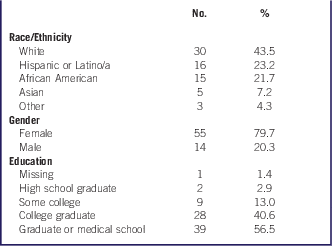
The majority of those who participated in the study were white (n=30, 43.5%), female (n=55, 79.7%), and were either a college graduate (n=28, 40.6%) or had completed graduate school (n=39, 56.5%). The demographic characteristics of the sample are shown in Table 1.
Sample Demographics of the Study Sample

Baseline to Post-Workshop Comparisons
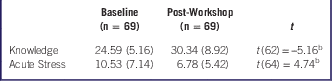
Two concepts were assessed at baseline and immediately after the workshop (n=69): participants’ perceptions of their own knowledge of stress, reactions to trauma, coping and mindfulness, and participants’ levels of acute stress, as measured on the Stress and Coping Checklist (Table 2). Significant changes were found on both measures, with perceived knowledge increasing from 24.59 (5.16) to 30.34 (8.92), t(62)=5.16 (P<0.001), and acute stress scores decreased significantly from 10.53 (7.14) to 6.78 (5.42), t(64)=4.74 (P<0.001).
Results of Paired-Sample t-Tests Comparing Baseline to Post-Workshop Scores on the Stress and Coping ChecklistFootnote a

a Values are mean (SD).
b P≤0.001.
Baseline to 3-Week Follow-Up Comparisons
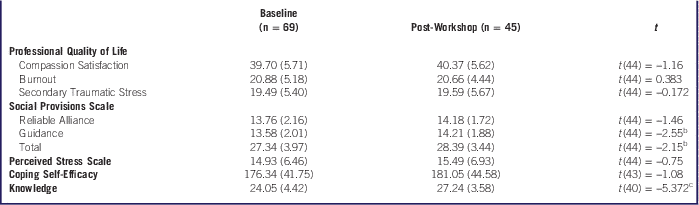
In analyses comparing baseline scores to the 3-week follow-up (n=45), scores improved significantly on the Social Provisions Scale [27.34 (3.97) to 28.39 (3.44); t(44)=2.15; P<0.05] and on perceived knowledge [24.05(4.42) to 27.24 (3.58); t(40)=5.37; P<0.001] (Table 3). No significant changes were seen in professional quality of life, life stress measured on the Perceived Stress Scale, or coping self-efficacy; however, nearly all measures trended in the expected direction (eg, increase in compassion satisfaction, coping self-efficacy, and reliable alliance and reduction in burnout).
Results of Paired-Sample t-Tests Comparing Baseline to 3-Week Follow-Up ScoresFootnote a

a Values are mean (SD).
b P<0.05.
c P≤0.001.
The sample size was lower at the 3-week follow-up owing to the elimination of 24 (34.7%) participants who did not complete the 3-week follow-up assessment. Chi-square tests evaluating whether the individuals who completed the 3-week measure (n=45) differed demographically from those who did not (n=24) indicated there were no significant differences on education, race, or gender.
Qualitative Results
The 10 interviews conducted 3 weeks after the RCHC intervention yielded in-depth information on the participants’ perceptions of the intervention. Participants’ responses fell into 4 broad themes: stress, coping, team building, and social support.
Stress
Although the participants came from diverse workplace settings (community health centers, non-direct-service organizations), learning about common types of stressors, not specific to disasters, was one of the most common themes that participants mentioned when asked about what they gained from the program. Responses revolved around workplace stressors and how to respond to specific situations. One participant in an organization that did not deliver direct services stated, “I think for me it more related to just all the stress….so for me it was more related to office stress and it was helpful in that regard.”
Other participants who worked in a community health center discussed working directly with patients and how participation in the intervention helped them with effectively handling difficult situations, including “how to deal with your stressful moments here at the clinic.” In addition to handling stressful situations with patients, respondents also mentioned that participation in the RCHC intervention helped them gain techniques to manage their stressors and devise strategies that would work for them in the clinic. One participant stated:
I think the biggest thing that I really took away was like kind of the end part of it which is how to de-stress myself. I am not a person who likes yoga or something like that, but I do have an office where I can shut the lights…so it’s like at the end of the day when I’m really stressed out I just click it off and I just take a few moments out because I never used to do that before.
Coping
A second theme from the qualitative interviews was that participation in the RCHC helped participants devise healthy coping strategies. Participants stated that they learned coping skills that translated into their day-to-day routines. One participant mentioned the importance of both developing their own concrete coping skills as well as helping their coworkers cope with stressors:
Just understanding different ways to cope for myself and….when one of your colleagues could potentially be stressed out you know how to work with them, how to help alleviate some of that stress.
Another participant noted that learning how to cope with hearing stories from clients who were adversely impacted by the hurricane was an important part of the RCHC. She described how stressful it was to work with so many who had experienced extreme loss related to the storm. She also discussed the importance of learning healthy coping skills which enabled her to continue to effectively work with these patients without experiencing secondary traumatization or survivor’s guilt:
You’re treating all of these people. We particularly in this area didn’t get hit as much but I mean obviously it’s just learning how to cope and deal with that so it’s important.
Team Building
The importance of team building was also a notable finding from the qualitative interviews. Participants stated that the workshop built cohesion and a sense of camaraderie in the workplace. They mentioned that it was a safe setting to learn about and support each other. One participant stated:
I’m always for things that can help the staff as individuals and as a group and that’s [RCHC] is one of those things that I think that more agencies should incorporate within their staff training and just part of work.
Other participants noted that simply having the time to strategize how to support each other was helpful. They explained that learning about their colleagues’ stressors in the workplace helped them understand how to support each other. They also stated that it was a safe environment for people to be “very open about issues that are causing them stress.”
It was also noted that the RCHC was a helpful program to bring colleagues together, especially in a large agency. They explained that they often don’t see each other and are not able to share information or thoughts with each other and indicated the workshop assisted them in hearing about experiences of their coworkers: “it’s a very diverse department and not even everybody works out of this building so it’s rare that we all get to sit together and share our thoughts.”
Social Support
Building social support was also described as an essential piece of the RCHC workshop. Participants indicated that taking part in the workshop helped them realize they weren’t alone in their stressors, and they were able to normalize their emotions which helped them work through difficult situations. Regarding learning that they weren’t alone one participant stated, “You don’t realize that other people around you are going through the same things also.”
It was also stated that recognizing that others were experiencing the same feelings or emotions helped them feel that they were not alone:
The biggest takeaway for me was similarly hearing or remembering that your co-workers often are experiencing the same feelings so I think that was really valuable something that I saw or would think would be very valuable for direct care providers in the wake of the disaster.
Participants also stated that this was also a time to learn that others also experienced stressors, which in turn helped them work together to devise healthy coping strategies. For example, it was noted:
It showed me that some of the same feelings that I had about being a little burned out were shared amongst my colleagues but you know it’s good to see that everyone is just fighting to do whatever they can because we believe in the mission and we believe in the goals of [the organization] but it sometimes does take a toll on you and it was good to step back and learn some ways to help to just realize that you do have some issues and that you can do things to help cope with them.
DISCUSSION
Findings from this mixed-methods evaluation demonstrated that the RCHC intervention showed promising results for health care workers in a post-disaster context. As a small pilot study, the findings should be considered within the limitations of the study size and design. A consistent finding in both the quantitative and qualitative analyses was the increase in social support and social provisions. Quantitatively, the significant increase in the Social Provisions Scale score indicated that social support was enhanced from the baseline measure to the 3-week follow-up. Qualitatively, social support and team building was a theme that arose among participants. As the literature states, social support is a key factor in reducing distress among health care providers in post-disaster contexts.Reference Adams, Figley and Boscarino 31 - Reference Skogstad, Skorstad and Lie 33 Research has suggested that health care workers in an unhealthy workplace are particularly vulnerable to burnout, but a positive professional environment is a primary setting for workers to receive social support and encouragement.Reference Adams, Figley and Boscarino 31 Moreover, social support has been shown to potentially reduce the impact of stressful events on a person’s well-being.Reference Adams, Figley and Boscarino 31
There was also a significant decrease in acute stress from before to after the workshop as indicated by the Stress Arousal Checklist. This aligns with the qualitative outcomes that participation in the RCHC helped to reduce stressors among program participants. The reduction in acute stress reactions is a notable finding given that stress in post-disaster environments can increase the likelihood of burnout and secondary traumatic stress.Reference Sabin-Farrell and Turpin 11 , Reference Jacobson 34
Qualitatively, participants indicated that strategizing different coping mechanisms was a strength of the program. Healthy coping strategies, such as asking for support, spending time with others, and participating in activities that are meaningful to a person, all help to mitigate distress.Reference Bills, Levy and Sharma 14 While coping self-efficacy was not significant on the quantitative findings, it trended in the expected direction and future studies with larger sample sizes should examine how participation in the RCHC may impact the utilization of healthy coping strategies.
A final outcome from this pilot study was the significant increase in perceived knowledge about effective coping strategies, the physical and emotional impact of stress, and the effects of traumatic events on health care providers. This finding was particularly important given that awareness and knowledge about common reactions to traumatic events can empower health care workers to identify and seek out the supports they may need.Reference Salston and Figley 15 Moreover, it has been suggested that prevention programs that educate health care providers on self-care and healthy coping are a key way to mitigate distress in the individual and workplace.Reference Salston and Figley 15
Limitations
This single-group study design could not establish a definitively causal relationship between the intervention and the outcomes, because there was no control group. This study was also limited by time constraints. Although 3 weeks is a reasonable follow-up period, it would be ideal to look at whether changes are sustained over longer periods of time. Additionally, the sample for this study was relatively small. Not all participants completed the 3-week follow-up assessment, but there were no significant differences in race, gender, or education between the 45 who completed all measures and the 24 who did not complete the 3-week follow-up. Generalizability outside of the testing area, in other disaster recovery situations, or within other types of agencies may be limited and implementation in other regions with other agencies should be further evaluated, especially if the RCHC program is changed on the basis of the findings of this evaluation.
CONCLUSIONS
After a disaster, communities are disrupted and health care facilities are often over capacity owing to the mental and physical needs of those affected. Health care and social service providers have the dual stresses of directly experiencing the disaster and also providing care for those in need. Given all of the stressors those in the health care community may face, it is essential that programs are available to mitigate the impact of trauma. The results of this pilot study indicated that the RCHC intervention is a promising program to support health care workers after a disaster. This intervention and other programs should be further developed and researched to provide an evidence-based approach to supporting community health care workers after disasters.
Acknowledgments
Financial support for this research was provided by AmeriCares, a nonprofit emergency response and global health organization.