In the foreword to a book lauding the Ulster Special Constabulary (USC), the former Northern Ireland Prime Minister Basil Brooke stated that ‘younger people probably do not realise what the “B” Men have meant to Ulster. Without their courage and devotion to duty it could well have been the Province we all love would have perished before it was born.’Footnote 1 The ‘Specials’ project involved the mass mobilisation of male unionists in 1920–22 to secure the new polity of Northern Ireland. Yet, the USC is barely mentioned in twenty-first-century public discourse, even that related to the decade of centenaries.Footnote 2 For example, in January 2020, Minister for Justice Charlie Flanagan announced that the Irish state was planning to commemorate the ‘525 policemen’ that were killed during the War of Independence.Footnote 3 There followed a month-long controversy focused on policing in the revolutionary years, during which there was virtually no mention of the USC.Footnote 4 This is despite the fact that the Specials were the largest police force on the island in 1920–22 with the combined USC membership of over 40,000 dwarfing that of the Royal Irish Constabulary (RIC), which had 15,904 officers in July 1921.Footnote 5 Indeed, seventy-three Specials were among the ‘525 policemen’ killed.Footnote 6
This silence mirrors longer-term academic neglect. Sean Newman notes that ‘only four histories of the U.S.C. are published … [and] none is written by an academic historian but instead by activists or veterans, who produce value-laden accounts’.Footnote 7 Arthur Hezlet’s The ‘B’ Specials is among the works to which Newman refers. This is essentially the history of the force from a unionist perspective. Hezlet claims that ‘nearly half of the men were ex-soldiers’, and he positions the Specials as defenders of law and order ‘blackened’ by nationalist propaganda.Footnote 8 Another widely-read work is Michael Farrell’s Arming the Protestants.Footnote 9 Given that Farrell is a left-wing activist associated with the radical People’s Democracy movement, it is easy to dismiss his work as being politically skewed. Nonetheless, he assembled an impressive array of sources to catalogue a litany of repressive actions carried out by the Specials. Many general histories of the period cite Farrell’s work extensively, often to support the idea of a neat transformation of the Ulster Volunteer Force (UVF) into the USC.Footnote 10 This latter notion has previously been questioned in the research of Timothy Bowman and, more recently, in Christopher Magill’s Political conflict in east Ulster, and will be further challenged in this paper.Footnote 11
Three possible reasons for the relative neglect of the Specials are worth highlighting. Firstly, there is a tendency in some historiography to treat the northern and southern experience as separate, with the result that modern Irish history becomes a ‘teleological biography of the southern nation state’.Footnote 12 The 1922 disturbances involving Specials are overlooked because they do not fit neatly within the timeframe of events central to southern state building. A lack of archival material is a second factor. The USC was founded in a hurry and disbanded similarly quickly, so the paper trail is thin. Moreover, access to the records that do exist is limited and strictly controlled.Footnote 13 To view the USC files cited in this paper, an access request had to be made to the Police Service of Northern Ireland. Once this was approved, a research agreement was concluded with PRONI that granted file access on a number of conditions including that no data be made public that ‘can be directly linked to any identifiable living person’.Footnote 14 It is unclear in what circumstances access to USC records would be denied, but presumably there are some. Such privileged access is, in itself, problematic in creating hierarchies among researchers. However, the silence goes beyond a paucity of source material and a third possible explanation is worth noting. The Specials are tied to the origin story of Northern Ireland and exploration of the topic can very quickly bring researchers into heated contemporary debates relating to political violence. During the Troubles, according to Margaret O’Callaghan, ‘addressing the fundamental issue of partition was seen as potentially justifying the Provisional I.R.A. campaign, [and] there was a moratorium on serious historical research on certain kinds of questions about the North’.Footnote 15 In recent years, in part stimulated by discussions related to Brexit, a plethora of publications on partition have somewhat addressed the imbalance.Footnote 16 Nonetheless, the Specials are one part of the origin story that remains underexplored.
This article begins with a brief overview of the founding of the Specials, followed by a profile of its membership and a discussion of their involvement in the violent events of the first half of 1922. The membership profile will be based on data from Fermanagh, the county best represented in the surviving records. The profile addresses basic questions about age, occupation, class and whether the Specials were veterans of the First World War or members of the pre-war UVF. Religious and political sympathies and the question of what became of them after 1922 are also addressed. Not all questions can be answered definitively. Nonetheless, insights into motivations and the influence of the USC can be gauged by exploring these areas. In considering the violence associated with the USC, the focus will be on the rural border counties in the first half of 1922. This was the period when the conflict was most intense and the border region was where the USC was deployed in greatest numbers. There was also a policing vacuum at the time, as the RIC was in the process of being disbanded and the Royal Ulster Constabulary (RUC) would not become functional until June 1922, leaving the Specials in a pivotal security position. Overall, it will be argued, in the concluding remarks, that the events of 1922 significantly shaped post-partition identities north of the new border.
I
With the rise of republican sentiment across Ireland in 1919–20, there was concern among northern unionists about violence spreading to the six counties. The fears were greatest and calls for action loudest in the soon-to-be border counties of Fermanagh, Tyrone, Derry and Armagh.Footnote 17 Added to this, unionists distrusted the mostly Catholic RIC. The Fermanagh unionist newspaper the Impartial Reporter claimed that while ‘the old RIC had many gallant and trusted men in its ranks, it had also men who were not above suspicion, and who have been accused of giving information to the enemy’.Footnote 18 Such views were widespread in unionist communities and were not entirely inaccurate, given significant IRA infiltration of the police. Even the Northern Ireland Minister for Home Affairs, Dawson Bates, publicly stated that the ‘better type’ of policeman was sent south while those that ‘could not be trusted or were inefficient’ were sent to Belfast’.Footnote 19
The lack of unionist faith in the RIC and increasing republican activism led to the emergence of quasi-legal loyalist vigilante groups across the north. In Fermanagh, the future Northern Ireland Prime Minister Basil Brooke set up ‘Fermanagh Vigilance’ in June 1920, which patrolled using old UVF rifles to ‘maintain law and order’.Footnote 20 The same month, a second Fermanagh loyalist group was holding their first meeting in Lisbellaw Orange hall when word reached of an impending IRA attack. The loyalists enjoyed a significant propaganda coup when they chased off the republican attackers.Footnote 21 By September 1920, the ‘second-in-command’ of yet another Fermanagh ‘defence body’ told the Impartial Reporter that if republican attacks persisted, reprisals ‘would not take an eye for an eye and a tooth for a tooth but two eyes and two teeth’.Footnote 22 The pattern of hastily organised vigilante groupings was repeated across Ulster. In Armagh, John Webster and Rev. Walter Stack travelled to Orange halls in the county throughout April 1920 trying to re-organise the UVF as a vigilante force and distributed 174 rifles obtained from the Unionist Association in Belfast. Webster himself was unsure of the legality of his actions and later recalled his trepidation when a senior RIC visited the family home. Rather than make an arrest, the officer expressed gratitude and quizzed Webster on the vigilante operation, presumably with the intention of briefing superiors for the broader USC project.Footnote 23 A loyalist group in Lisburn, meanwhile, was one of the first to receive official sanction. Here, 500 Special Constables were recruited by the town council after sectarian riots in August 1920. It turned out that some of the new officers were themselves guilty of instigating the violence.Footnote 24 Other vigilante forces emerged across the north through the summer and into the autumn of 1920 and the pattern was similar: a local decentralised force centred on pre-existing Protestant networks.Footnote 25 The UVF itself was also beginning to reorganise, having become almost ‘moribund’ at the onset of the First World War.Footnote 26 As Timothy Bowman stresses, however, the UVF ‘did not simply become the USC in 1920’.Footnote 27
Unionist leaders, such as James Craig and Basil Brooke, used these paramilitary stirrings to bolster demands for an officially-sanctioned loyalist force. Elements in the British government, particularly Winston Churchill, also saw an opportunity to co-opt loyalist manpower into the state apparatus as a means of combatting the IRA. However, there was by no means consensus within the British administration about the wisdom of such a strategy. Indeed, the United Kingdom’s Chief of the Imperial General Staff, Sir Henry Wilson, wrote: ‘Winston suggested arming 20,000 Orangemen to relieve troops from the North. I told him that would mean taking sides, would mean civil war and savage reprisals … Winston does not realise these things in the least and is a perfect idiot as a statesman.’Footnote 28
In the end, it was those sharing Churchill’s view who won the argument. The government’s USC plans were made public on 22 October 1920.Footnote 29 It is worth emphasising that this announcement pre-dated the establishment of Northern Ireland. The Government of Ireland Act creating the polity did not receive Royal Assent unti1 23 December 1920 and the new governing executive was not operational until 7 June 1921. Even then, some powers, notably in relation to policing, were ‘reserved’ for the imperial government.Footnote 30 These powers were only transferred in November 1921 in an effort by British Prime Minister David Lloyd George to assuage hostility in the governing coalition to negotiations with Sinn Féin.Footnote 31 As Bew et al. (2002) note, the chronology is important:
The formation of the state had been anticipated by the formation of one of its most critical apparatuses — an independent paramilitary force whose populist flavour of Protestant self-assertiveness was not to be diminished by its new [official] status. The official endorsement of this spirit, was to shape both state formation and Catholic attitudes to it.Footnote 32
In terms of structure, the October 1920 announcement detailed three classes of Specials. The ‘A’ class was to be well paid, similar to RIC rates, operating full time on six-month contracts. The ‘B’ and ‘C’ class were to be part-time, with only the ‘B’ category receiving a small annual allowance. The commitment for this latter group was roughly one night per week, whereas ‘C’ men were an entirely reserve force. Significantly, in rural areas, ‘B’ Specials were permitted to take their service weapons home.Footnote 33 In theory, the reserve category were only to operate when accompanied by the RIC, so no legislative change was required to set up the force.Footnote 34 In practice, regular police rarely accompanied Specials, especially in rural areas.Footnote 35
Advertisements for the Specials were posted in newspapers across the north, and anyone of good character could theoretically walk into a police station and apply to join. There is little dispute, however, that established Protestant networks were to the fore in organising recruitment, particularly for the reserve categories. Emphasising this point, the Northern Ireland Prime Minister, James Craig, recalled in 1922: ‘it is from the ranks of our Orange institution our splendid Specials have come.’Footnote 36 Wallace Clark’s local study, Guns in Ulster, illustrates the importance of pre-existing loyalist structures, not just in supplying manpower but also in terms of practicalities like access to meeting facilities, such as Orange halls.Footnote 37
Leadership at local level tended to be granted to the first movers in the loyalist vigilante groups or those with UVF service. Examples include the aforementioned John Webster in Armagh and Basil Brooke in Fermanagh.Footnote 38 Loyalists had made it clear that they would only join the USC if they were assured that the distrusted Dublin Castle administration had no power over them.Footnote 39 Therefore, unionist leaders successfully lobbied for powers of discipline to rest with these local commanders.Footnote 40 At non-commissioned officer level, meanwhile, the sergeants were to be elected by the constables and the head constables by the sergeants.Footnote 41 Such was the decentralised nature of the force that the military advisor to the Northern Ireland government, Major General Arthur Solly-Flood, was ‘amazed to find’ that the USC had no common disciplinary code.Footnote 42 This overall structure made it almost impossible to control a part-time, unpaid and volunteer force. As an early leader lamented, ‘you cannot expect a man to be a chum for six days and an exacting N.C.O. on the seventh’.Footnote 43
Organisational factors contributed greatly to the diversity of USC performance. The Northern Ireland government took complete operational charge when security powers were devolved in November 1921 and the decentralised structure remained. It is worth noting that the Belfast administration was also supposed to take over the substantial financial burden of funding the Specials but, after more unionist lobbying, the British government, for its own strategic reasons, agreed to continue to cover these costs.Footnote 44 S. G. Tallents was the ‘man on the ground’ representing the British government from early 1922, and later that year he would formally be appointed imperial secretary to the government of Northern Ireland.Footnote 45 After the decision to continue to fund the USC, Tallents warned: ‘the British government has armed and is paying for the forces, it is told by the one who controls them [James Craig], will in certain eventualities be turned against itself.’ Tallents’s fear was that in the context of boundary changes as a result of the Anglo-Irish Treaty, the guns of the Specials could be used against crown forces. He continued:
It is difficult to avoid the conclusion that the government of Northern Ireland has succeeded in assuming the military functions specifically reserved for the British government by calling their forces ‘Police’. Our equivalent force of Police in Great Britain would make at least 800,000 or in Germany about 1,300,000 men. What would France make if Great Britain allowed Germany to maintain well over a million ‘Police’ armed with rifles?Footnote 46
By 1922, the London government continued to supply weaponry, uniforms and wages to the USC, but it was clear to their representative on the ground that it was the local loyalists who were in charge.
II
So, who were the members of the USC? Scholars such as Timothy Bowman have previously noted that ‘the surviving paperwork on the “B” Specials is very poor, crucially on enlistment men were not asked to give details of their employment or previous military experience’.Footnote 47 However, the personnel files of some USC recruits can now be viewed by those approved by PRONI and the PSNI. These files, which were not available to Bowman, include a form completed by all applicants. ‘B’ recruits were asked for their name, address, occupation, age, height, marital status, ability to cycle and details of prior military service. This data has also been used by Christopher Magill in Political conflict in east Ulster 1920–22.Footnote 48 Magill focused on predominately Protestant east Ulster and the ‘B’ Specials, whereas the intention here is to consider all three forces in Catholic-majority Fermanagh. As noted previously, the reason for the choice of geographic location is, in part, pragmatic since the most complete USC archival records relate to Fermanagh.Footnote 49 Moreover, USC recruitment in the border county was extensive. In 1922, there were nine ‘A’ Special bases in Fermanagh, each with platoons of up to sixty men.Footnote 51 Added to this, ‘B’ Special membership peaked at 3,200.Footnote 52 Including a further 646 ‘C’ class,Footnote 53 possibly more, this totals over 4,000 Specials, meaning that more than 40 per cent of the adult Protestant male population in the county were in one or other branch of the USC. In contrast, just 1 per cent of the Catholic population in Fermanagh were in the IRA.Footnote 54
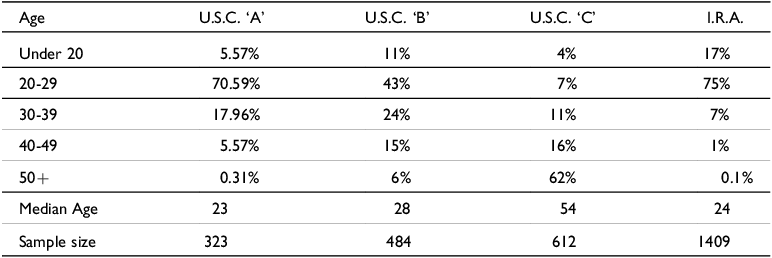
The age-related data in Table 1 provides several insights into the Specials. While republican activists are often depicted as a generation apart,Footnote 55 the USC were not. Broadly speaking, young loyalists joined the ‘A’ Specials; what was left of those aged between about 18 and 45 joined the ‘B’ Specials; leaving a significantly older cohort in the inactive but armed ‘C’ class, whose median age was fifty-four. The men in the ‘C’ category were never active and its main purpose seems to have been to allow Protestant households access to weaponry. There was also a separate, and quite controversial, ‘C1’ category made up of loyalist paramilitaries from the larger urban centres. Plans to recruit the ‘C1’ category en masse from the loyalist UVF and Imperial Guards were made public in November 1921, in the midst of the Treaty negotiations, causing considerable controversy.Footnote 56 However, the ‘C1’ class did not exist in the largely rural county Fermanagh.Footnote 57
The ‘A’ Specials were most similar in age profile to the IRA, with a median age of twenty-three. There is, however, a contrast with republicans when it comes to marital status. Peter Hart noted a marriage rate of less than 5 per cent among an IRA sample, whereas 30 per cent of ‘A’ recruits were married.Footnote 58 Two distinct groups within the full-time force can be identified from this data, a married cohort with a median age of thirty, and a much larger group of single men, most of whom were nearly a decade younger. For these older married men, lucrative pay was likely to have been a significant enticement to join the Specials.
Unfortunately, there is no archival documentation providing detail on full-time recruits’ prior military service. Therefore, we are left to surmise much from the age-related data. From this, there is reason to doubt the general perception that ‘A’ Specials were mostly First World War veterans. For a start, some recruits were too young. With a median age of 23, over 50 per cent were under 16 years of age in 1914, meaning they were certainly too young for the pre-War UVF. Even in 1918, one-third were still under eighteen and, therefore, less likely to have been in the British army. Some caveats need to be attached to this analysis. There is the possibility that individuals lied about their age to join the British army. There is also the anomaly of under eighteens that served in non-combat roles. For example, George Graham was a twenty-two year old ‘A’ Special shot dead in Newry in July 1921. He had joined the British army at the outbreak of the First World War, aged fourteen years. Graham’s military career features prominently in reports of his death. However, such reference to service history is actually quite rare in funeral reports. Genealogy records, as well as inquest and funeral reports, for thirty-eight ‘A’ Specials were examined and, of these, only fifteen noted prior service in the British army. It is hard to be definitive, but the age profile and biographical material tends to support Timothy Bowman’s claim that ‘many men who had served in the Great War do not seem to have been keen to revisit a military lifestyle, even on a part time basis’.Footnote 59 For younger men, meanwhile, joining the ‘A’ Specials offered the opportunity to gain the type of social standing that war veterans enjoyed. Bowman draws a comparison with youthful recruits to the Freikorps in Germany.Footnote 60 On this latter movement, Robert Gerwarth points to the attraction of a paramilitary force for younger recruits who came of age ‘with tales of heroic bloodshed’ and were now offered a ‘welcome opportunity to live a romanticised warrior existence.’Footnote 61 The younger cohort of USC recruits were likely to be attracted to a martial life for similar reasons.
Age of USC recruitsFootnote 50

Aside from the youthful locals, there was also an officer class in the ‘A’ category. A sample of ninety-three officers has been examined. These were, with one or two exceptions, veterans of the First World War. About half the officers had also been members of the Auxiliary Division of the RIC. Some transferred north early in 1921, either volunteering due to an attachment to Ulster or because they were identified as individuals likely to provide positive leadership to the nascent USC. Later, there was a greater influx as the Auxiliary force was demobilised in 1922. There was some internal criticism of the higher ranks recruited. The commander of the USC training camp in Newtownards wrote that ‘there is a tendency amongst individuals of this class to regard this place as a sort of casual rest home’.Footnote 62 This chimed with the observations of a Tyrone USC leader, who claimed that the best army officers would not leave permanent employment to join a temporary force, leaving the ‘A’ Specials composed of those who lost their job or were at a ‘loose end’.Footnote 63 There was particular criticism of the Northern Ireland government’s military advisor to the Specials, Major General Arthur Solly-Flood.Footnote 64 Andrew Phillip Magill, assistant secretary to the Ministry of Home Affairs, complained that Solly-Flood had brought over a ‘host of his own friends and put them in well paid positions as director generals and assistant director general of various activities … they took an expensive house in the Malone Road for their headquarters, and of course the most lurid tales of orgies there began to circulate through Belfast.’Footnote 65 Magill accepted the unsubstantiated nature of these rumours, but their existence does typify a generally negative attitude towards the officer class. As an outsider, Solly-Flood made many enemies in Ulster, and his efforts to curb the worst sectarian excesses of the USC undoubtedly contributed to his unpopularity.Footnote 66
It is possible to be more definitive about the military service of the ‘B’ category. Thirty percent of Fermanagh ‘B’ men were too young to have been pre-war UVF veterans, further emphasising that there was not a neat transition from UVF to USC. Kieran Glennon and Christopher Magill have made similar findings in relation to samples they studied elsewhere in Ulster.Footnote 67 With a median age of twenty-nine, ‘B’ recruits were clearly an older cohort and, therefore, most would have been eligible to serve from 1914–18. However, in their applications to join, just 11 per cent in the ‘B’ sample claimed any prior military service. Magill calculated a similar figure of 17 per cent in his sample of east Ulster.Footnote 68 It is thus clear and pretty definitive that only a small minority of ‘B’ Specials had any kind of service history during the First World War. For an organisation seemingly rooted in loyalty to the crown, this is striking. Indeed, the commander of the Specials in Fermanagh, Basil Brooke, complained that many ‘B’ Specials would ‘only answer the call for service if there was trouble in their own districts, few would do so if required to travel’.Footnote 69 This all points to motivations based on localised rather than strictly ideological factors and chimes with micro-sociological research on intragroup behaviour which shows that ‘human beings are substantially more motivated by chains of interpersonal interaction than by uncompromising doctrinal principles’.Footnote 70 The desire to defend a family home, the opportunity to gain standing, as well as intra-community pressure, are likely factors that spurred USC recruitment. This final point is worth emphasising. Recalling that nearly every second Protestant male in Fermanagh was in the force, pressure locally and from above is likely to have been significant. Refusal to enlist in many cases was seen as a sign of disloyalty.Footnote 71 Unionist media outlets were to the fore in pushing a narrative critical of ‘shirkers.’ The Fermanagh Times, for instance, wrote: ‘the shirker, the sit-on-the fence man and the penny grubber should be reminded of his neglect and of his duty. If a man has already served in the army, he is all the better qualified for the work, he is the last man who should be loafer in time of peril.’Footnote 72 Meanwhile, a group of disgruntled USC leaders complained to Tallents that ‘great pressure [is being] put on people who will not join [the USC]’.Footnote 73 This is not to suggest that loyalist ideology had no role in recruitment, but rather to point to other contributing factors.
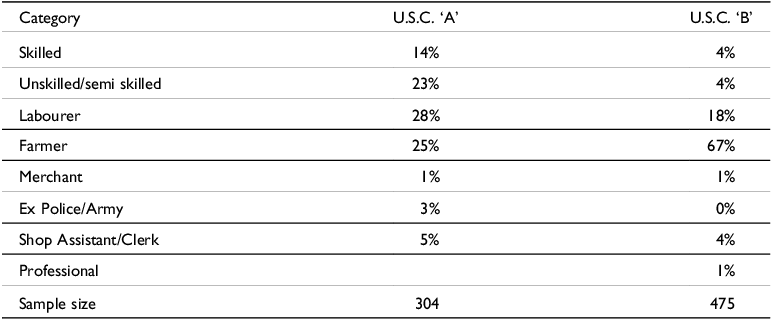
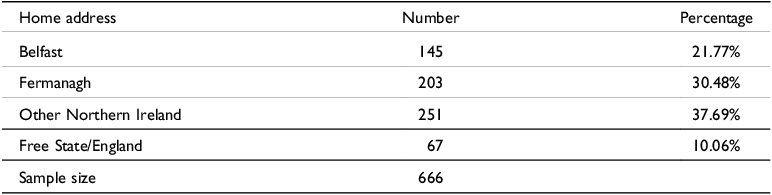
Farmers dominated ‘B’ Special recruitment in Fermanagh (Table 2). Given that 77 per cent of the male population in the county reported farming as their occupation, this is unsurprising.Footnote 74 By contrast, ‘A’ Specials mostly came from non-farming backgrounds. Many of these were young, unskilled and, as Table 3 shows, from the urban centres, notably Belfast and Derry. This was a very different pool than that from which the RIC typically recruited. Giving evidence to a panel set up to organise the RUC, the ‘A’ special commander in Newry, W. H. Sandford, was particularly critical of literacy levels and claimed that only 10 per cent of his men were suitable for a regular police force. He argued that ‘if a man is any good, he has found a job outside the Specials’. Another ‘A’ Special commander, W. K. Tillie, was somewhat less damning, suggesting that up to 40 per cent of the ‘A’ force might be suitable candidates for the new RUC.Footnote 75
Occupation of Specials serving in Fermanagh

Home address of ‘A’ Special rank-and-file recruits

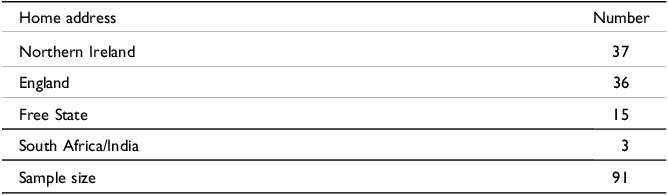
‘A’ Special recruits came to Fermanagh from across the six counties, as Table 3 shows. A small number, just under 10 per cent, were from south of the border, mostly from the Ulster counties of Donegal, Monaghan and Cavan. The officer class included further southerners as Table 4 illustrates. These were often former British army officers who also had connections with the RIC. An interesting example is the son of the former head of the Dublin Metropolitan Police. A Catholic, he had previously served in the British army and the Auxiliary division of the R.I.C.Footnote 76 There were other Catholic recruits but not many. One Catholic Special, Thomas Sheridan, was killed by the IRA on the Tyrone-Monaghan border on 6 June 1922.Footnote 77 In recent years, Sheridan’s case has been cited as evidence to support the view that in its early days ‘there were quite a lot of Roman Catholics in the USC’.Footnote 78 However, this does not seem to have been the case. The religion of about 150 ‘A’ Specials in the sample group can be ascertained. Of these, seven can be positively identified as Catholics. Just one Catholic was found in the Fermanagh ‘B’ Special sample. Likewise, Magill identified only seven Catholic ‘B’ Specials in Down,Footnote 79 while it was reported in 1922 that there were three Catholic Specials in Tyrone.Footnote 80 In truth, only a handful of Catholics were ever willing to join, and a fair estimate would be that less than 1 per cent of the ‘B’ Specials were Catholic, with, at very most, 5 per cent of ‘A’ Specials. The Craig-Collins peace pact of 30 March 1922, which initially enjoyed broad unionist and nationalist support, did include a clause that would have seen greater Catholic recruitment, but, in the context of ongoing violence, this initiative failed.Footnote 81 Overall, it seems republican intimidation was not the primary cause of the failure to recruit Catholics. The USC had a loyalist and Protestant culture at its core. The UVF, unionist associations, the Orange Order and Protestant churches were the important networks that facilitated recruitment. Moreover, some individual USC commanders refused to accept Catholic recruits. It is, therefore, difficult to disagree with Christopher Magill’s assessment that the USC was ‘a bastion of Protestant power in which Catholics were not welcome’.Footnote 82
‘A’ Special officers’ home address

Of the southerners joining the USC, some came from the loyalist tradition. A few had been driven out of the south for their perceived political affiliation. Jack Elliott, for instance, was a Protestant living on the Cavan–Fermanagh border. He was victim of ongoing intimidation by the IRA and opted to move north when he discovered a macabre scene near the family turf plot. Republicans had dug an empty grave complete with a cross inscribed with the name ‘Jack Elliott’. He sought employment with the Specials’.Footnote 83 John Glennie, meanwhile, was a Cork Protestant living in Monaghan with a similar story. Glennie was threatened by the local IRA, forcing him to leave the county, and out of economic necessity he joined the ‘A’ Specials.Footnote 84 Some southerners may have been retained in the Specials almost out of a sense of obligation. Robert Parks from Monaghan seems to have been singularly unsuited for a policing role, his ‘A’ Special commander explaining: ‘there are four unfavourable records against him [Parks] and he would have been dismissed long ago but for the particular circumstances of the case.’ Parks had given information to the RIC and the family home was burned down prior to the 11 July 1921 truce.Footnote 85 Meanwhile, in some border areas, southern loyalists regularly crossed the frontier to don a Special uniform on a part-time basis. The Fermanagh village of Roslea is a typical example. Here, fourteen members of the local ‘B’ Special unit were from Monaghan.Footnote 86 While small in number, southern loyalists had disproportionate influence. Ed Burke convincingly argues that southerners displaced to the north would later become among the most committed and militant loyalist activists.Footnote 87
Although the rank and file of the Specials were mostly local to Northern Ireland, the officer corps included a significant number from England. Some of these non-Ulster officers used their letters of application to stress loyalist credentials. Others were sought out by the Northern Ireland government because they were connected to powerful figures in London. For instance, Dawson Bates was anxious that a particular individual should be recruited because his father was ‘one of the top men in the Morning Post’. The hope here was that the journalist would report positively on the USC as a result of his son’s role in the force.Footnote 88 Despite what carefully crafted applications stated, financial opportunity seems to have been the greatest motivator for officer recruits. At least some appear to have had difficult situations, following the First World War, with alcoholism — euphemistically referred to as ‘tippling’ — cited as an issue in several cases.
Overall, what we can infer from this profile of the Specials is that there were multiple motivations for joining. Certainly loyalist ideology was a factor but so too was a search for adventure and money, particularly in the case of ‘A’ Specials. Meanwhile, for ‘B’ Specials, the micro-level motivations are more complex than cursory analysis might suggest, with communal pressure being a hitherto underexplored factor. Significantly, the age-related data confirms that there was no neat transition from the UVF to the British Army to the USC.
III
Further insight into what motivated USC recruits can be gleaned from an exploration of the violence of the time. Seventy USC members died in service between the forces’ inception and July 1922. It is not possible to be definitive in all cases, but two broad categories can be identified: those killed by republicans and a smaller group involved in accidents, friendly fire incidents and Belfast’s street disturbances. Beginning with this latter category, two Specials died of natural causes on duty.Footnote 89 Twelve were killed in accidents of different sorts,Footnote 90 and four in exchanges of ‘friendly fire’.Footnote 91 At least three lost their lives while off duty during disturbances in Belfast.Footnote 92 There are some similarities here with the National Army in the Free State, where accidents and friendly fire accounted for almost 31 per cent of pro-Treaty fatalities.Footnote 93 Two Specials were also killed by the British army/RIC whilst trying to ‘evade lawful custody’.Footnote 94 As these two deaths indicate, ill discipline was a factor in at least some of the cases, and further elaboration confirms this point. Special Constable Robert McCleary was shot dead in Lurgan on 12 July 1922 after a round was accidentally discharged by a drunken colleague.Footnote 95 In another case, a platoon of Specials illegally raided a licensed premises south of the border in Clones and following an exchange of gunfire with the RIC, James McCullough, an ‘A’ Special from Belfast, was killed. Unlike the McCleary case, charges were successfully brought against Specials in respect of the Clones incident and heavy sentences imposed.Footnote 96 Alcohol abuse was a factor on both occasions and in the full-time force more generally. The Tyrone USC leader, General A. S. Ricardo, complained that ‘pay is excessive’ and there is ‘much trouble from drink and consequent indiscipline’.Footnote 97 Even Basil Brooke, a staunch defender of the Specials, was critical, stating that the ‘A’ class were ‘more trouble than they were worth. Many of them were ex-soldiers delighted to have lucrative short service appointments … a wild crowd.’Footnote 98 This frequently held assumption that ‘A’ recruits were mostly veterans may help explain some of the accidental deaths, as lack of training might have been a factor. In theory, full time Specials were supposed to undergo an intensive six-week induction course at Newtownards Camp. However, training was often cut short, and some ‘A’ Specials got as little as two days’ instruction.Footnote 99
Despite failings in training and discipline, the greatest threat to USC members was still the IRA. Republicans killed twelve Specials in 1921 and thirty-five in the first six months of 1922, indicating that the conflict was more intense after the War of Independence. In terms of the spatial patterns of violence, rural Ulster was more dangerous than Belfast for Specials.Footnote 100 According to police records from 1922, 84 per cent of fatalities in Northern Ireland were in Belfast,Footnote 101 but less than 30 per cent of USC deaths occurred there. Given that Belfast was the ‘most violent place in Ireland’, this is obviously surprising.Footnote 102 A number of factors contributed to the lower USC death toll in the city, including their focus on border areas. ‘B’ Specials recruitment was also greater outside the city and their official use in Belfast was more tightly controlled due to a stronger RIC presence.Footnote 103
The various categories of Specials were also targeted in different ways. ‘A’ Specials were more likely to be killed on duty. Twenty-nine ‘A’ Specials were killed in uniform, as opposed to five ‘B’ Specials. Nine ‘B’ Specials were killed off duty in the border counties, compared to just one full-time officer.Footnote 104 The part-time force still lived in their family homes and were a softer off-duty target. One example of a large-scale attack on ‘B’ Special homes occurred on the night of 8 February 1922, when the pro-Treaty IRA raided premises across Tyrone and Fermanagh, kidnapping fifty unionists, most them Specials.Footnote 105 The tactic of sporadically kidnapping border Specials continued up to July 1922. Those captured were usually released after a few weeks, but one man, William Frazer, was killed and secretly buried.Footnote 106 While these kidnappings are only briefly mentioned in standard narratives of the period, fifty years later Basil Brooke still recalled their significance for cross-border relations: ‘there was no statesmanship at all [by new Free State government in 1922] … they kidnapped 48 loyalists, they’ve shot people, they’ve burned people, they’ve done every damn thing. Just too short sighted for words.’Footnote 107
Republican reprisals did go beyond kidnapping. For example, James McGleenan was a sixty-year-old Catholic shot dead by a party of Specials near Keady in March 1922.Footnote 108 The IRA retaliated, killing William Fleming. An RIC report noted that Fleming’s brother was in the USC party that fired on McGleenan.Footnote 109 South Armagh was also the scene of the most notorious republican reprisal, at the village of Altnaveigh. Again, this was part of a localised cycle of violence. The Specials were accused of murdering a number of local CatholicsFootnote 110 and sexually assaulting a woman during a raid on the home of a republican.Footnote 111 On 17 June 1922, the IRA launched a vicious reprisal on the village of Altnaveigh, killing six Protestant civilians, none of whom turned out to be members of the USC.Footnote 112 The attack was very similar to a retaliatory republican raid a year earlier in Roslea, County Fermanagh. On that occasion, sixteen homes of USC personnel were targeted and two ‘B’ Specials killed.Footnote 113 These, and similar incidents, left a legacy. Henry Patterson writes that ‘this period [1922] is still recalled by Protestants in the area. Memories of the violence and cross border incursions fed into the sense of being under siege that had existed amongst Protestants in these border areas throughout the history of the Northern Irish state.’Footnote 114
The Specials were, of course, also perpetrators of violence on a very significant scale. There were in the region of thirty killings by the loyalists in the border counties in the first six months of 1922. Breaking these cases down, Specials killed three republicans in combat situations.Footnote 115 In six other incidents, the Specials accepted responsibility for killings but claimed they were justified in their action.Footnote 116 In the twenty or so other cases, nationalists suspected Specials of carrying out murders, but there was rarely official acceptance of this.Footnote 117
Looking first at examples where the Specials accepted responsibility, the case of south Armagh-man James McGleenan in March 1922 has already been mentioned. McGleenan was shot dead when he failed to stop on a dark night after being challenged by Specials. A senior civil servant in the Northern Ireland Home Office wrote on the case file: ‘I think a party of seven men [Specials] might have stopped one man walking along the public road without recourse to firearms.’ A senior colleague replied: ‘at night they can hardly be flawed for not taking risks.’Footnote 118 That seems to have been the end of any official inquiries. Francis Reilly was similarly shot dead at a checkpoint on 17 April 1922 as he crossed the border from Monaghan into Tyrone. Reilly’s travelling companions claimed that he was shot without warning, but the Specials disputed this. The Specials’ version of events was again accepted, the main witness to the contrary being discounted as a ‘well known Sinn Féiner’.Footnote 119 Such cases were not confined to rural districts. A Catholic man, James Murray, was shot dead at his home on 25 June 1922 in Derry city while sleeping. A passing Special had recklessly discharged a firearm and the stray bullet killed Murray as he lay in bed. Unlike the other cases, the Special involved in the Derry incident was dismissed.Footnote 120
There seems to have been official acceptance that Specials were untrained but well intentioned, so they were given leeway by superiors, juries and the judiciary. The case of Patrick Tumelty and John McAlinden at first appears to illustrate this point. The two republicans were arrested by Specials at Ballybrick, County Down on 22 June 1922. An intercepted IRA letter named the pair as participants in a planned ambush, hence their arrest. The Specials claimed the men had attempted to escape and were shot dead. At the inquest, the USC sergeant who led the arrest party said he had only joined the force three weeks previously and had no military experience. This seems to have swayed the coroner to accept the Specials’ explanation of events. The local newspaper reported the coroner’s conclusions:
The B Specials had not military training and had not police training yet. They were men who were called out to do the best they could to preserve the peace of the country, without probably a very great knowledge of the use of firearms — at least, they had not the same knowledge of their duties that better trained men had, but he [coroner] supposed and he hoped that they endeavoured to perform their duties to the best of their ability.Footnote 121
So, for readers of this report in the local paper, the Frontier Sentinal, this likely seemed like a case of sheer incompetence, with men being shot, as they tried to escape, by hapless but well-meaning amateurs. Not all the facts were aired at the inquest, however. Before his death, Tumelty had made a sworn statement claiming that neither he nor McAlinden had attempted to escape. He claimed that they had been told to run by the Specials, who then shot them. Northern Ireland Home Office officials suspected an even deeper conspiracy. It turned out that the letter that first implicated the pair was discovered by a former ‘B’ Special of dubious character. The suspicion amongst Home Office officials seems to be that the incriminating letter was a forgery planted due to a personal vendetta.Footnote 122 Interestingly, there is a claim in IRA pension files that the duo were targeted because Specials were upset by Tumelty’s relationship with a local Protestant woman.Footnote 123 The Specials involved were temporarily suspended from the force, but in the end, no one was even dismissed over the double killing.
In several cases, the Specials refused to accept any blame for their actions. These often followed a formula of witnesses seeing a Catholic taken into custody who was later found dead. Commenting on this pattern, Tim Wilson notes that a striking feature of USC ‘death squads’ was ‘they did not hide their identity … but openly flaunted it’.Footnote 124 The murders of Thomas Crawley and Patrick Creegan are a typical example. In June 1922, the two south Armagh men were taken into custody by a uniformed party, presumed to be Specials. Crawley and Creegan’s dead bodies were later found dumped in a roadside crater that had been created by an exploded IRA mine.Footnote 125 The message was clear that this was revenge. Unusually, Dawson Bates ordered an inquiry. The investigator appointed ‘completely exonerated local police’ but suggested that the murders were possibly perpetrated by police from another jurisdiction in Down or Louth.Footnote 126 Republicans, however, remained convinced that local Specials were responsible. The Altnaveigh massacre happened days later in reprisal.
Cycles of violence were common and because of the interconnected networks of ‘A’ and ‘B’ Specials, retaliation could spread beyond the immediate vicinity. For example, four ‘A’ Specials were killed in Clones, County Monaghan on 11 February 1922. When word of the incident reached Alfred Cope, the principal British civil servant in Dublin, he telegrammed Winston Churchill to warn: ‘if as probable, the Specials killed in Clones are Belfast men, Belfast will take some holding.’Footnote 127 His warning proved prophetic. The Belfast News Letter reported that two of those killed were from the city, as were some of the other eight injured.Footnote 128 Within a week, thirty people were killed in Belfast,Footnote 129 with Specials implicated in some of the worst violence.Footnote 130 Another example is the case of a Portadown man, Anthony McConville, who was shot dead in May 1922.Footnote 131 The IRA initially blamed locals but subsequently attributed responsibility to a group attending the wake of a Portadown ‘A’ Special killed in Tyrone.Footnote 132
The Specials were most ill-disciplined in Tyrone and parts of South Derry. In 1921, the overall commander of the Specials, C. G. Wickham, wrote to the county commandant in Tyrone, expressing concern that ‘B’ men of the district were not ‘sufficiently under control’.Footnote 133 In his memoir, A beleaguered station, John McKenna, a Catholic RIC head constable in the county, describes in detail the lawlessness, sectarianism and indiscriminate violence perpetrated by Specials in Tyrone. McKenna writes:
I saw how helpless I was in being compelled to assist in committing such outrages on decent, inoffensive people. It was horrible to think that, after having spent 30 years in what I thought to be an honourable job, to find it so rotten and … to take part in such foul deeds’Footnote 134
In June 1922, three disgruntled USC leaders — Colonel Percival Maxwell, Major Robert Stevenson and Brigadier General A. S. Ricardo — wrote what nowadays would be described as whistle-blowing accounts documenting for S. G. Tallents the failures of the Specials. Two of these, Stevenson and Ricardo, were from Tyrone and their reports corroborate many of McKenna’s later complaints. In his account, The ‘B’ Specials, Arthur Hezlet implies that Ricardo’s criticisms were due to personal differences with the county commandant and his failure to achieve a command position.Footnote 135 However, the combined accounts of Stevenson, McKenna and Ricardo suggest that the criticism of the Tyrone USC was well placed. Stevenson’s testimony was particularly prescient:
There can never be any possibility of establishing confidence or security so long as the B force, the ordinary Protestant countryman and in many cases corner boy is supplied with arms and clothing by his government and authorised to ‘get on top’ as it were of his RC (sic) neighbours. The latter resents it all the time and even the most respectable and constitutional nationalist gets more bitter as the record of raids and abuses by uncontrollable elements piles up and harmless and innocent people suffer.Footnote 136
Stevenson specifically highlighted incidents where ‘there are B men who have confessed to authorities in one instance, they committed a certain murder, in another case quite recently the authorities have in their possession the names of two other ‘B’ men who committed murder in broad daylight’. (On neither occasion were the culprits apprehended). The latter case was likely the murder of Peter Hagan and Charles Lavelle in May 1922. These murders typify the violence of the period. The IRA shot dead a local Special, Cecil Caldwell, and in turn the USC saturated the area, searching nationalist homes. Some of the Specials involved were ‘unable to stand they were so drunk’.Footnote 137 Two local Catholics, Charles Lavelle and Peter Hagan, were stopped by the USC, and a RIC report is quite clear that the Specials shot Lavelle dead and bayoneted Hagan. The police account further claimed that drunken Specials also stole property during raids on Catholic homes.Footnote 138 The final line of the RIC precis detailing the incident is barely legible, having been crudely blacked out, but with close examination, the words ‘two arrests were made’ can be read.Footnote 139 Presumably, USC men were arrested at the scene and later discreetly released. No one was ever charged with the murders. As well as informing Tallents, Stevenson took the unusual step of writing to a local newspaper condemning the murders and sympathising with the bereaved families.Footnote 140 In private comments, Tallents was scathing, writing that the ‘present reputation of the B Specials in the six counties is disgusting’, adding that ‘Catholics regard it with a bitterness that exceeds the Black and Tans in the South’. Particular ire was reserved for the Minister of Home Affairs, Dawson Bates, whom Tallents blamed for failing to control the Specials.Footnote 141
Funeral and inquest reports subtly, and at times not so subtly, made it clear to readers of the nationalist press that the Specials were the main suspects in many of these murders. When a party of men dressed as police shot dead an elderly Tyrone grocer, John McCracken, on 6 May 1922, the celebrant at the funeral was reported as saying if the murder was ‘not committed with the sanction of their rulers, it had their connivance’.Footnote 142 Meanwhile, William Cassidy was one of three Catholic men murdered after a Special was killed in Trillick, County Tyrone. Cassidy’s father, Hugh, told the inquest: ‘I served 23 years and 4 months in the police force. When I retired from the police I served 5 years and 3 months in the Army as a drill instructor during the Great War. The reward for my loyalty is that when I come back my son is murdered.’Footnote 143 In a later unsuccessful claim for a dependent’s military service pension, Hugh Cassidy stated that his son was an active IRA member. Furthermore, the former R.I.C. officer explicitly blamed the Specials for the murder.Footnote 144 Some of the worst such crimes were in Desertmartin in south Derry. Four Catholic men were killed there by men in police uniform on 19 May. The Specials were publicly accused of going on a rampage in the village.Footnote 145 Six weeks later another Catholic man, Dominic Wilson, was killed in the locality. By this time, the RUC were operational and their intelligence blamed Specials.Footnote 146
As Stevenson’s interventions indicate, there were efforts to restrain Specials in the interest of preserving law and order. In south Derry, local USC commander, H. J. Clark, made a similar, if more pragmatic, public appeal, warning that ill discipline could lead to a loss of support in England and withdrawal of the British army, leaving unionists at the ‘the tender mercies of 100,000 Shinners from the south and west’.Footnote 147 Aside from local leaders imploring restraint, Specials were also brought before the courts for a range of offences ranging from drunkenness through to arson and murder. About twenty such cases have been identified in the period under consideration. In Belfast, meanwhile, Kieran Glennon has found a further fourteen Specials prosecuted in relation to firearms offenses, with four imprisoned.Footnote 148 Indeed, three Specials were charged with murders committed in the first half of 1922. However, on each of these occasions, the accused were acquitted of all charges, despite what seemed strong eyewitness evidence to the contrary. Crucially, defence evidence usually relied on testimony from fellow Specials.Footnote 149 In cases like these, where the authorities suspected a crime they had the power to intern suspects, but no rural Specials were subjected to such measures. By May 1923, only fifteen loyalists, out of 644 internees, were incarcerated.Footnote 150 All the loyalist internees were from Belfast with Alexander ‘Buck Alec’ Robinson the most notorious example. Decades later Robinson became something of a Belfast folk hero, known for street fighting and walking a tamed lion around the city.Footnote 151 In 1922, police knew him as a part-time Special suspected of at least three sectarian murders.Footnote 152
Despite efforts to restrain their excesses, the USC were securing Northern Ireland and any threat to the force was seen by loyalist leaders as a threat to the polity itself. In Tyrone, the county commandant, John McClintock, intervened to explicitly make this point when it looked like some of his men were about to face charges. McClintock warned of the ‘difficulty there may be in keeping the only defence force for the Six Counties in being’ if there were any prosecutions of his men.Footnote 153 Overall, Sean Newman’s analysis sees McClintock’s intervention as fairly typical:
While RIC and RUC officers wrote aghast of the USC’s excesses, USC commanders excused the behaviour of their charges as instinctive in the febrile environment of 1920s Northern Ireland, or as wrong but allowable for the discipline of the force as a whole and the greater good. Politicians, without any qualms and in support of USC commanders, interfered in prosecutions of Special Constables by RIC and RUC County Inspectors, delaying them to the point that a conviction became unsafe, moving cases from professional Resident Magistrates to easily influenced and sectarian petty juries and JPs, or having the Attorney-General for Northern Ireland enter Nolle Prosequi on the charge sheet.Footnote 154
IV
The outbreak of civil war south of the border coupled with the overwhelming numerical strength of the Specials meant that the military conflict in Northern Ireland petered out from July 1922. Reflecting on the violence of the preceding months, S. G. Tallents argued against any judicial inquiry lest it ‘lead to a revival of propaganda about matters best forgotten’.Footnote 155 Whereas in the south the Auxiliaries, Black and Tans, RIC and to a large extent the IRA left the scene, north of the border the Specials remained. There were still sporadic armed confrontations and the inadequacies of the Specials led to more deaths in the months that followed.Footnote 156 More common, however, were incidents of everyday violence. A quick scan of the precis of RUC ‘Outrage’ reports in Fermanagh for November 1922 illustrates the extent to which the Specials remained deeply involved in low-level intimidation. On 2 November, the RUC district inspector reported that a drunken Special fired shots into the house of Andrew Keon near Kesh. On 14 November, three Specials raided the house of Edward Shannon in Lisnaskea and drove him to the border where he was beaten and shot. On 15 November, armed men raided the house of John Donnelly, beat him and threatened to shoot him. On 26 November, a Protestant, Thomas Howe, received a threatening letter that referenced his daughter, who was in a relationship with a Catholic.Footnote 157 In each of these cases, it was the police, rather than nationalists, that were pointing an accusatory finger. Coupled with this unofficial power, the Specials could enforce draconian laws, including a nightly curfew. Moreover, it was often USC intelligence that led to the internment of suspects or issuance of exclusion orders, which prohibited individuals from living in Northern Ireland or certain areas.Footnote 158
Publicly, James Craig argued in late 1922 that the volatile security situation necessitated the continued employment of Specials. Privately, the northern premier told British government officials that ‘he foresaw a renewal of trouble if these men [Specials] were deprived of pay which they had now grown used to drawing. Craig even feared the reduction [in pay or numbers] would give the discharged a motive to create trouble.’Footnote 159 The decentralised and ill-disciplined nature of the force meant that even Craig was unsure if he could control the USC. It was only after the boundary issue was finally settled that the full-time force and ‘C’ class were disbanded in 1926. The ‘B men’ would remain.
For those who served in 1922, this experience was worn as a badge of honour, particularly when seeking promotion within the ‘B’ force. Service in the Specials became a way of life for many in subsequent decades. Of the sample of 500 Fermanagh ‘B’ Specials, the average length of service after 1922 was fifteen years. Remarkably, five of the sample were in the force from 1922 right up until 1968. The personnel files of ‘B’ Specials relay a story of complex experiences that defy a one-dimensional view. Disciplinary issues give an insight into intra-community dynamics, as conflict between Specials is a recurring theme. For those near the border, there are occasional allegations of involvement in smuggling or poitín making. Issues relating to alcoholism and what the authorities judged as sexual impropriety are also evident. Convictions for bigamy and homosexuality are recorded in some files. Surprisingly, attitudes to the IRA differed. Individual Specials proactively targeted republicans, while others opted for a quiet life or even mixed with republicans.Footnote 160 Sectarianism is largely hidden in the records, but there are occasional glimpses. When a sub district commander sold land to a Catholic and was seen ‘drinking in the company of fenians’, his subordinates wrote to the county commandment complaining ‘we consider it dangerous to serve under any Sergeant who goes around telling Roman Catholics the secrets of our service’. After being notified of the complaint, the officer resigned.Footnote 161
The personnel files of the full-time ‘A’ officers hint at their very different afterlives. Many continued to live unsettled existences in subsequent decades. Some remained on the colonial trail in search of similarly well-paid security positions. There are requests for references from an eclectic list of prospective employers, including police forces in Uganda, South Africa and Rhodesia; the prison service in Kenya; and the British Union of Fascists. Lucrative careers failed to materialise for most, however. Indeed, right up to the 1940s, the Northern Ireland Home Office continued to receive letters from ageing former ‘A’ Specials looking for reengagement in the USC. The southern officers who had joined the Specials were left in a particularly precarious position. The previously mentioned son of the former DMP commissioner is one example. He wrote to the minister for home affairs in 1926, emotionally pleading for extra compensation due to his position as a southerner unable to return home.Footnote 162 The request was denied and the man left for Canada.
V
In his groundbreaking work on civil wars, political scientist Stathis Kalyvas observed that after conflict ends, a ‘master narrative’ tends to emerge that ‘provides a handy way ex post facto to simplify, streamline, and ultimately erase the war’s complexities, contradictions and ambiguities’.Footnote 163 The story of the Specials and the violence of early 1922 is one such complexity. This period is neither part of the War of Independence nor the Irish Civil War, so is a conflict without even a label, a forgotten war. As Tallents pointed out, for officialdom, ‘forgetting’ may have been for the ‘best’. However, the British official was warned by prominent unionists, likely Stevenson and Ricardo, that the Specials were ‘sowing feuds in the countryside that would not be eradicated for generations’.Footnote 164 This assessment proved correct.
The figures quoted in the introduction to this paper indicate that in 1922, one in every seven adult male Protestants was in the USC. For unionists, this level of recruitment created a tangible bond between the rural Protestant farmer and the working-class Shankill Road loyalist. The bond crossed not just geographic space but also spanned the generations, uniting youth and elderly. The imprimatur of the state gave an added sanctity that allowed loyalist coercion to be couched in more acceptable language associated with respect for the rule of law rather than overt sectarianism. While not all those that joined the Specials may have been initially motivated exclusively by loyalism, service in the force, over years and decades, likely forged an identity rooted in that ideology. The extent to which the 1922 mobilisation shaped unionism subsequently is beyond the scope of this article, except to say that this is an area that has been under-researched. For nationalists, meanwhile, the Specials represented the coercive power of the state. The purpose of the Specials was not to ethnically cleanse or eliminate Catholics in the rural Ulster borderlands but to control and subdue that population. This they did. Achieving such coercive control does not require massive violence. In his comparative study, Tim Wilson found that the conflict-related death rate in Ulster between 1920 and 1922 was much lower than Upper Silesia.Footnote 165 This was not a particularly bloody conflict. But the impact of violence is not always proportional to the number of fatalities. Explaining this point, Stathis Kalyvas quotes the Chinese proverb ‘kill one, terrify ten thousand’, before arguing that successful terror in civil war actually ‘implies low levels of violence’.Footnote 166 That the Specials murdered and intimidated with relative impunity in rural Northern Ireland was evident to any reader of the nationalist press in 1922. This same force remained prominent in border areas for decades after, a daily reminder for nationalists of loyalist control. When violence did erupt again in 1968/9, some Specials from 1922 were still serving, a further reminder of how interconnected the two epochs were.
Overall, the findings presented here reinforce traditional views of the Specials as an almost exclusively Protestant force made up of inexperienced and, at times, ill-disciplined recruits, most of whom were ill suited to any policing role. While there is evidence of official attempts to restrain the excesses of Specials, these efforts were always tempered by a stronger desire to protect the nascent Northern Ireland polity. However, the motivations of Specials were more complex than typically thought. Many likely joined for self-defence purposes or as a result of communal pressure. Moreover, there was not a clear transition from the pre-war UVF through the British army to the USC. Evidence of occasional southern and Catholic recruitment is important and interesting, but the significance of this should not be exaggerated. Michael Farrell was right in his argument that the Specials project was essentially about ‘arming the Protestants’.Footnote 167 Meanwhile, the presence of former Auxiliaries in command positions, coupled with the British exchequer’s bankrolling of the force, points to the significant role played by the imperial government. Most of all, this article has emphasised the scale of the Specials project. As Brooke claimed, the Specials secured Northern Ireland at its foundation and, in doing so, they helped forge a reimagined six-county loyalist identity.
Acknowledgements
This research has been funded by a Royal Irish Academy Decade of Centenaries Bursary. Funding for the research was obtained in cooperation with Dr Cillian McGrattan, Ulster University. Credit is due to Conor Mulvagh, John Dorney and Kieran Glennon for their generous sharing of research sources and to Brian Hanley, Séan Ó Murchadha and Edward Burke for feedback on drafts of this paper. A final acknowledgement is due to the diligent editors and anonymous peer reviewers at Irish Historical Studies.