Introduction
Anxiety and cognitive impairment in older adults are major public health problems. In the USA, a national representative survey, the National Comorbidity Survey Replication, estimated the lifetime prevalence of any anxiety disorder as 16.6% and 9.6% among women and men aged 65 years and older, respectively (Gum et al., Reference Gum, King-Kallimanis and Kohn2009). Another nationally representative study, the Aging, Demographics, and Memory Study, reported the prevalence of dementia as 16% and 11% among women and men aged 70 years and older, respectively (Plassman et al., Reference Plassman2007). Both conditions have been related to several adverse health outcomes including increased disability and mortality (Wolitzky-Taylor et al., Reference Wolitzky-Taylor, Castriotta, Lenze, Stanley and Craske2010).
Multiple lines of evidence support a significant association between anxiety and cognitive impairment. First, cross-sectional studies documented lower cognitive function in older adults with heightened anxiety (Mantella et al., Reference Mantella2007; Yochim et al., Reference Yochim, Mueller and Segal2013), and elevated anxiety symptoms in older adults with cognitive impairment (Lopez et al., Reference Lopez2003; Andreescu et al., Reference Andreescu, Teverovsky, Fu, Hughes, Chang and Ganguli2014). Second, longitudinal studies have suggested that anxiety increased the risk of progression of mild cognitive impairment (MCI) to dementia (Gallagher et al., Reference Gallagher2011). Third, a number of studies reported that the use of benzodiazepines, a group of anxiolytic medications, was associated with increased risk of dementia or cognitive decline (Paterniti et al., Reference Paterniti, Dufouil and Alperovitch2002; Billioti de Gage et al., Reference Billioti de Gage2012). This result potentially suggests that benzodiazepine may be used as a marker of the underlying condition anxiety, although the possibility remains that the medication themselves impair cognition (Yaffe and Boustani, Reference Yaffe and Boustani2014). Finally, there is a high co-occurrence between anxiety and depression (Byers et al., Reference Byers, Yaffe, Covinsky, Friedman and Bruce2010), which itself is a potential risk factor for cognitive impairment (Ganguli, Reference Ganguli2009; Byers and Yaffe, Reference Byers and Yaffe2011).
The longitudinal relationship between anxiety and subsequent cognitive impairment in older adults remains unclear (Beaudreau and O'Hara, Reference Beaudreau and O'Hara2008). Previous longitudinal research examining this relationship has reported inconsistent findings, and was limited by small sample size, short follow-up, measurement issues and not accounting for important confounders (Sinoff and Werner, Reference Sinoff and Werner2003; Bierman et al., Reference Bierman, Comijs, Rijmen, Jonker and Beekman2008; Cherbuin et al., Reference Cherbuin2009; Gallacher et al., Reference Gallacher2009; Potvin et al., Reference Potvin, Forget, Grenier, Preville and Hudon2011; Pietrzak et al., Reference Pietrzak2012; Burton et al., Reference Burton, Campbell, Jordan, Strauss and Mallen2013; de Bruijn et al., Reference de Bruijn2014). Previous studies also did not investigate how specific characteristics, such as severity, of anxiety are related to cognitive impairment.
Anxiety disorders have been shown to have unique influences on men and women. Compared with women, men with anxiety had lower disability (Baxter et al., Reference Baxter, Vos, Scott, Ferrari and Whiteford2014) but higher mortality (van Hout et al., Reference van Hout2004). Differences in biological, behavioral, or social factors that contribute to distinctive pathophysiological features in men and women may explain these findings. Therefore, it is appropriate to investigate anxiety separately among men and women. We are aware of only one prospective study that examined the association of anxiety with dementia and “cognitive impairment not dementia” in older men (Gallacher et al., Reference Gallacher2009), and this study included men aged 48–67 years and it did not adjust specifically for depression.
In this longitudinal study, we examined the association between presence and severity of generalized anxiety symptoms, and cognitive decline among older men enrolled in the Osteoporotic Fractures in Men (MrOS) study. We hypothesized that anxiety symptoms will be associated with increased risk of cognitive decline.
Methods
Population
We utilized data from MrOS Study, a prospective cohort study of community-dwelling men aged 65 years and older (Blank et al., Reference Blank2005; Orwoll et al., Reference Orwoll2005). In brief, 5,994 older men were recruited during 2000–2002 from the following six locations in the USA: Birmingham, Alabama; Minneapolis, Minnesota; Monongahela Valley (near Pittsburgh), Pennsylvania; Palo Alto, California; Portland, Oregon; and San Diego, California. Men were excluded if they were unable to walk without assistance or had a bilateral hip replacement. The institutional review board at each site approved the study and participants provided written informed consent.
For this analysis, we used data collected at three visits as follows: baseline (2003–2005; MrOS Sleep Visit), visit 2 (2005–2006; MrOS Visit 2), and visit 3 (2007–2009; MrOS Visit 3). From the 3,135 participants at baseline, 3,122 men had complete data on measurements of anxiety and cognitive function. Of the 3,122 men with complete exposure and outcome data, we excluded 162 men with probable cognitive impairment at the baseline with the following criteria: Modified Mini-Mental State Examination (3MS) (Teng and Chui, Reference Teng and Chui1987) score < 80 (Kuller et al., Reference Kuller2003) (n = 106), use of dementia medication (n = 44), or both (n = 12). Of the 2,960 cognitively healthy men with complete data, 2,818 men provided data on cognitive function at either visit 2 or visit 3, and thus comprised our analytical sample.
Measurement of anxiety symptoms
At the baseline, anxiety symptoms were measured using the Goldberg Anxiety Scale (GAS) (Goldberg et al., Reference Goldberg, Bridges, Duncan-Jones and Grayson1988). GAS is a 9-item self-report instrument that inquires about anxiety symptoms experienced in the past month. GAS items span cognitive, affective, and somatic symptoms of anxiety, and are rated as yes (1) or no (0) answers with a total score ranging from 0 to 9. Participants must answer yes to at least two of the first four items in order to have the subsequent five items included in their total score. The four screening items are as follows: being keyed up or on edge, worrying a lot, being irritable, and having difficulty relaxing. The recommended cut-off score of 5 suggests that a participant has a 50% chance of a “clinically important disturbance” of anxiety, while higher scores substantially increase the probability of a significant anxiety disorder. To study the severity of anxiety symptoms, we classified participants according to baseline GAS score into the following three groups: no anxiety (0), mild anxiety (1–4), and moderate/severe anxiety (5–9).
Measurement of cognitive function
At the Sleep Visit, Visit 2 and Visit 3, two neuropsychological tests were administered to participants: the 3MS and the Trails B (Reitan and Wolfson, Reference Reitan and Wolfson1985).
The 3MS assesses global cognitive function with components for orientation, concentration, language, praxis, and immediate and delayed memory. The 3MS score ranges from 0 to 100 with higher scores indicating better cognitive function. Cognitive decline in the 3MS is indicated by a negative change, with a lower score at a follow-up measurement. Development of substantial cognitive impairment in 3MS was defined as a decline of five points or more between baseline and visit 3 (Andrew and Rockwood, Reference Andrew and Rockwood2008; Blackwell et al., Reference Blackwell2014).
The Trails B is primarily a measure of executive function but it also assesses attention, sequencing, and visual scanning. This is a timed test with 300 sec allowed to complete it, with faster completion time indicating better cognitive function. Cognitive decline in the Trails B is indicated by a positive change, with a longer completion time at a follow-up measurement. Development of substantial cognitive impairment in Trails B was defined as being in the worst decile of change between baseline and visit 3 (change of ≥ 65 sec) (Ganguli et al., Reference Ganguli1993; Blackwell et al., Reference Blackwell2014).
Other measurements
At the Sleep Visit, additional measurements were collected via self-report questionnaires. Demographic information included age, race, and education. Marital status was obtained at visit 2. Medical history was defined as prior physician diagnosis of selected medical conditions. Participants reported smoking status, alcohol use, and self-rated health status. Physical activity was assessed using the physical activity scale for the elderly (PASE) (Washburn et al., Reference Washburn, Smith, Jette and Janney1993) Functional status was assessed by collecting information on difficulty with five instrumental activities of daily living (IADL), which included walking 2–3 blocks on level ground, climbing up to ten steps, preparing meals, doing heavy housework, and shopping for groceries or clothing. The number of activities that were difficult was summed for a total IADL score. The Geriatric Depression Scale (GDS) (Sheikh and Yesavage, Reference Sheikh and Yesavage1986) was used to assess depressive symptoms, with the standard cut-off score of 6 or more to define depression. The Pittsburgh Sleep Quality Index (PSQI) (Buysse et al., Reference Buysse, Reynolds, Monk, Berman and Kupfer1989) was used to assess sleep with the standard cut-off score of 5 or more to define poor sleep. Medication use was ascertained by asking participants to bring all current prescription and non-prescription medications used in the past month to their clinic visits. Medications were coded and categorized using the Iowa Drug Information Service (IDIS) scheme (Pahor et al., Reference Pahor, Chrischilles, Guralnik, Brown, Wallace and Carbonin1994).
Statistical analysis
We calculated descriptive statistics for all variables and compared participants by level of anxiety symptoms at baseline. For these comparisons, we used chi-squared test (or Fisher's exact test for low expected cell counts) for categorical variables, one-way ANOVA test for normally distributed continuous data and the Kruskal Wallis test for skewed continuous data. Next, we examined the association of anxiety symptoms with baseline and change in 3MS score and time to complete Trails B using repeated measures mixed effects linear regression models. These models take into account the within-subject correlation of repeated measures and the missing data. The models included random intercept and slope of the cognitive measurements over time, assuming an unstructured covariance matrix. Time was modeled as a continuous variable indicating years from baseline. Finally, we examined the association of anxiety symptoms with substantial cognitive impairment using logistic regression models. We present unadjusted and multivariable-adjusted models. In all models, we adjusted for clinic site, age, depression, poor sleep and psychotropic medications (benzodiazepines, non-benzodiazepine non-barbiturate sedative hypnotics and anti-depressants) due to their potential strong confounding effect on the relationship between anxiety and cognitive function. Additional baseline covariates (race, education, marital status, medical co-morbidity index [stroke, Parkinson's disease, myocardial infarction, hypertension, chronic obstructive pulmonary disease, diabetes, and osteoarthritis], physical activity, alcohol, smoking, self-rated health and IADL impairment) were selected for inclusion in the multivariable models by manual backward elimination of the least significant variable until all variables were less than p<0.05. In all analyses, we used the 2-level (any anxiety, no anxiety) and 3-level (moderate/severe anxiety, mild anxiety, no anxiety) anxiety variables we defined earlier. All statistical analyses were conducted with Stata version 13.1 (StataCorp LP, College Station, TX, USA).
Results
Characteristics of participants
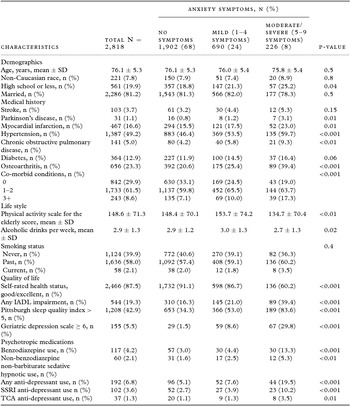
Baseline characteristics of participants are presented in Table 1. At baseline, there were 226 (8%) men who had moderate/severe anxiety symptoms and 690 (24%) who had mild anxiety symptoms. Men with moderate/severe or mild anxiety symptoms at baseline were more likely to have lower level of education, have depressed mood and poor sleep, take more psychotropic medications, suffer from more chronic medical conditions, and have more impairments in daily living activities compared to those with no anxiety symptoms. After mean follow-up time of 3.4 (standard deviation [SD] ±0.5) years, 472 (19%) men had substantial impairment in global cognitive function and 240 (10%) men had substantial impairment in executive function. The mean change in the 3MS score was 1.3 (SD ±5.5) points lower and the mean change in the time to complete Trails B was 9.1 sec (SD ±49.2) longer.
Characteristics of older men according to level of anxiety symptoms at baseline

Anxiety symptoms and 3MS test
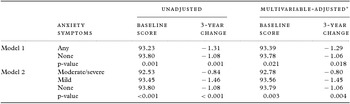
The mean baseline and 3-year change in 3MS score by baseline anxiety symptoms are shown in Table 2. In the multivariable-adjusted model, men with no anxiety symptoms at baseline had a mean score of 93.79 points versus 93.56 and 92.78 for those with mild and moderate/severe symptoms, respectively. The decline in 3MS score from baseline to year 3 was larger among men with mild anxiety symptoms compared with those with no symptoms or with moderate/severe symptoms (−1.45 points vs. −1.06 and −0.80, respectively). The 3MS scores across anxiety groups were significantly different at baseline (p=0.003) and throughout follow-up (p=0.004). In all models, there was no significant interaction between anxiety symptoms and time, indicating that anxiety groups did not change differently over time in their global cognition.
Mean baseline and 3-year change in modified Mini-Mental State Examination (3MS) score by baseline anxiety symptoms in older men

*Models were adjusted for clinic site, age, depression, poor sleep, psychotropic medications, race, education, marital status, and instrumental activities of daily living impairments.
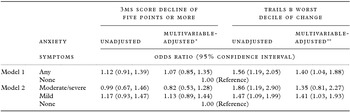
The association of anxiety symptoms with substantial impairment in the global cognitive outcome is shown in Table 4. Overall, there was no significant association between anxiety symptoms, including mild and more severe symptoms, and incident substantial cognitive impairment in 3MS at visit 3.
Anxiety symptoms and Trails B test
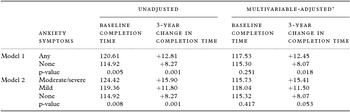
The mean baseline and 3-year change in Trails B completion time by baseline anxiety symptoms are shown in Table 3. In the multivariable-adjusted model, men with no anxiety symptoms at baseline had a mean test completion time of 115.32 sec versus 118.04 and 115.73 sec for those with mild and moderate/severe symptoms, respectively. The decline in Trails B test (increase in completion time) from baseline to year 3 was larger in men with moderate/severe anxiety symptoms compared to those with no symptoms or with mild symptoms (+15.41 seconds vs. +8.07 and +11.50, respectively). The Trails B completion times across anxiety groups were not significantly different at baseline (p = 0.417) or throughout follow-up (p=0.053). In all models, there was significant interaction between anxiety symptoms and time, indicating that anxiety groups changed differently over time in their executive function. For instance, the significant interaction term (p = 0.036) in the multivariable-adjusted model 2 depicted a faster decline in executive function among men with moderate/severe anxiety (graph not shown).
Mean baseline and 3-year change in Trails B completion time by baseline anxiety symptoms in older men

*Models were adjusted for clinic site, age, depression, poor sleep, psychotropic medications, race, education, marital status and instrumental activities of daily living impairments.
There was a consistent association between anxiety symptoms and substantial worsening of Trails B test completion time (Table 4). In the multivariable-adjusted model, older men with any anxiety symptoms at baseline were 1.40 times more likely to have incident substantial worsening in Trails B test completion time at visit 3 compared to those without any anxiety symptoms at baseline (OR = 1.40, 95% CI 1.04, 1.88). This relationship was strongest for moderate/severe anxiety symptoms (unadjusted OR = 1.86, 95% CI 1.19, 2.90); however, only mild anxiety symptoms remained significant in the multivariable-adjusted model.
Association between baseline anxiety symptoms and substantial cognitive impairment at visit 3 in older men

*Models were adjusted for clinic site, age, depression, poor sleep, psychotropic medications, race, education, marital status, and instrumental activities of daily living impairments.
**Models were adjusted for clinic site, age, depression, poor sleep, psychotropic medications, race, and instrumental activities of daily living impairments.
Discussion
This prospective study showed that older men with anxiety symptoms experienced greater declines in both global cognitive function and executive function over 3.4 years compared to older men with no anxiety symptoms. The decline reached substantial impairment level in executive function but not global cognitive function. These findings are independent of demographic characteristics, depression, poor sleep, and psychotropic medications.
Our findings are generally consistent with prospective studies that reported significant associations between anxiety and cognitive impairment, but we extend these findings to show that the cognitive domain that may be largely influenced by anxiety in older men is the executive function. Prior cross-sectional studies reported an association between anxiety and poor executive function (Mantella et al., Reference Mantella2007; Yochim et al., Reference Yochim, Mueller and Segal2013). For instance, Mantella et al. found that older adults with generalized anxiety disorder performed worse on Trails B compared to healthy controls (Mantella et al., Reference Mantella2007). Our study replicates these findings in a longitudinal design. Our work is also consistent with one prospective study of 1,160 men aged 48–67 years that reported an association between high anxiety level and incident cognitive impairment (adjusted OR 2.58, 95% CI 1.11, 5.99) (Gallacher et al., Reference Gallacher2009). Our study extends this finding to men aged 65 years and older, while adjusting specifically for depression.
It is noteworthy that other prospective studies found significant association between anxiety and “general cognitive impairment” (Potvin et al., Reference Potvin, Forget, Grenier, Preville and Hudon2011), but our study did not. Our study as well was not consistent with other prospective studies that found no association between anxiety and cognitive impairment in older adults (de Bruijn et al., Reference de Bruijn2014).
The literature suggests three possibilities to explain the relationship between anxiety and cognitive decline. First, anxiety could be a risk factor for cognitive decline. To support this etiological hypothesis, a dose–response relationship is to be expected, where increasing level of anxiety symptoms will be associated with increasing level of cognitive decline. Our findings showed that mild and moderate/severe levels of anxiety had contrasting relationship with cognitive function, and as such our study does not support this hypothesis. This is based on an assumption that levels of anxiety symptoms and cognitive domains reflect similar pathological processes within levels, which cannot be confirmed or ruled out by our measurements. Second, the association between anxiety and cognitive decline could be explained by shared risk factors, such as depression. It is noteworthy that about 30% of men with moderate/severe anxiety in our study reported significant depressive symptoms. However, we adjusted our models for depression and other important potential confounders, and therefore this hypothesis is less likely to explain our findings. Third, anxiety could be a consequence of cognitive decline. Severe cognitive impairment, such as dementia, is a degenerative disease with a long prodromal period, and thus it is plausible that anxiety may appear as an early symptom or as a reaction to subtle cognitive deficits before developing significant cognitive impairment. Our follow-up duration of 3.4 years may have been too short to show a substantial impairment in global cognitive function. The small but varying influence of anxiety symptoms level on global cognitive function and executive functioning may reflect clinical and pathological heterogeneity that stirred anxiety symptoms to present differently.
Strengths of this study include the prospective cohort design, a large, well-characterized cohort of older community-dwelling men, and consideration of a large number of possible confounders. Our study has several limitations. First, our sample was comprised of mostly Caucasian older men, and our results may not be generalizable to younger men, other ethnic groups, or women. Second, anxiety symptoms were self-reported without clinical assessment and were measured by an instrument that was developed in young adults; however, GAS has shown moderate validity in a sample of older adults (Pachana et al., Reference Pachana, Byrne, Siddle, Koloski, Harley and Arnold2007). Third, our measures of cognitive function were limited to measures of global cognitive function and executive function. It is often recommended that the score on Trails A be subtracted from the score of Trails B to remove the effect of psychomotor speed. However, we were restricted to instruments that were selected by the original investigators of the MrOS, and Trails A was not administered. Fourth, we excluded participants with probable cognitive impairment at baseline using established criteria for cognitive impairment. However, we did not have clinical assessments and therefore our sample may have included participants with subtle cognitive impairment. Finally, we could not control for residual confounding inherent in the observational design of the study.
In cognitively healthy older men, our findings suggest that mild anxiety symptoms may potentially predict incident decline in executive functioning. This finding is independent of depression, poor sleep, use of psychotropic medications and other important confounders. Future studies should explore potential underlying biological mechanisms linking anxiety symptoms to cognitive decline in older men. Future research may also investigate the relationship between anxiety and decline in specific cognitive domains, such as executive function in older women.
Conflict of interest
None.
Description of authors’ roles
JAC is the principal investigator of the MrOS study. AMK and JAC formulated the research questions and designed the study. AMK analyzed the data and drafted the manuscript. All co-authors interpreted the results and contributed to the preparation of the final manuscript and approved the manuscript. In addition, the MrOS Publications Committee approved the study.
Acknowledgments
The Osteoporotic Fractures in Men (MrOS) study is supported by National Institutes of Health funding. The following institutes provide support: the National Institute on Aging (NIA), the National Institute of Arthritis and Musculoskeletal and Skin Diseases (NIAMS), the National Center for Advancing Translational Sciences (NCATS), and NIH Roadmap for Medical Research under the following grant numbers: U01 AG027810, U01 AG042124, U01 AG042139, U01 AG042140, U01 AG042143, U01 AG042145, U01 AG042168, U01 AR066160, and UL1 TR000128. The National Heart, Lung, and Blood Institute (NHLBI) provides funding for the MrOS Sleep ancillary study “Outcomes of Sleep Disorders in Older Men” under the following grant numbers: R01 HL071194, R01 HL070848, R01 HL070847, R01 HL070842, R01 HL070841, R01 HL070837, R01 HL070838, and R01 HL070839. Dr Mary Ganguli is supported by grant number K07AG044395.