Far from being the taboo subject that it was just a few years ago, the issue of child sexual abuse (CSA) is now front and centre in the Australian community consciousness. This is thanks, in great part, to the courage of the many survivors, their advocates (e.g., Biggs, Reference Biggs2004; Mullinar, Reference Mullinar1997), and a few offenders (e.g., Hampson, Reference Hampson2009) who have spoken out since the 1970s Women's Movement first demanded criminal redress for victims (Lawrence, Reference Lawrence1987).
The common presumption, strongly promoted by the media (White, Reference White2008), and reflected in government responses (e.g., Australian Institute of Family Studies, 2013), is that CSA is mostly committed by strangers, and that criminal penalties and sanctions are the best way to deal with the problem. This is at odds with the empirical evidence, which shows that most CSA occurs in families, or situations where the offender is known to the victim (Fergus & Keel, Reference Fergus and Keel2005); most is not disclosed or reported to the authorities (Cashmore & Shackel, Reference Cashmore and Shackel2013); and most child victims are reluctant to engage in the criminal justice process and often suffer when they do (Eastwood & Patton, Reference Eastwood and Patton2002).
Around 6295 cases of CSA were substantiated in Australia in 2011–12 (Cashmore & Shackel, Reference Cashmore and Shackel2013), and it is clear that criminalisation, in and of itself, is failing to protect our children, or to provide them with healing (Harries & Clare, Reference Harries and Clare2002). A persuasive argument has been raised that “child sexual abuse should not just be thought of as a crime, but as a serious social and public health issue requiring urgent attention and preventative action” (Purvis & Joyce, Reference Purvis and Joyce2005, p. 334), and so the debate about how best to respond to CSA continues on two fronts: how to respond to the crime and how to respond to the harm caused to children, families, and communities.
The Harm
The Particular Harm of Intrafamilial Child Sexual Abuse
A substantial amount of research knowledge exists about the nature and extent of CSA (Butchart, Phinney-Harvey, Mian, & Furniss, Reference Butchart, Phinney-Harvey, Mian and Furniss2006); the short and long term effects of abuse on victim/survivors (e.g., Cashmore & Shackel, Reference Cashmore and Shackel2013; Fergus & Keel, Reference Fergus and Keel2005); and the individual characteristics of offenders (e.g., Ogloff, Cutajar, Mann, & Mullen, Reference Ogloff, Cutajar, Mann, Mullen and council2012).
However, when a child's abuser is a member of their immediate family, the dynamics of the abuse experience are very different to those when the abuser is a stranger or distant relative (McGregor, Reference McGregor1994), and a whole new level of harm is inflicted. Finkelhor (Reference Finkelhor1979) recognised the complexity of the ICSA situation and saw that there were consequences for victims emanating from three different aspects of the experience: the trauma of the sexual experience itself (sexual trauma), the trauma induced by interactions with institutions (systemic trauma), and the trauma induced in relationships with friends and family (relational trauma).
Relational Approach to Intrafamilial Child Sexual Abuse
The relational approach advocates that the most parsimonious view of ICSA is that it is a relational problem with relational trauma at its core. This is because the abuse is fundamentally a betrayal of the child's and the non-offending family members’ primary relationships, and inevitably traumatises the child's relationships with all other family members. In addition, the abusive behaviour is a reflection of the offending person's distorted relational premises about power, sexuality, and the parental role in his/her relationships with the child and other family members (Sheinberg & Fraenkel, Reference Sheinberg and Fraenkel2001), and can often be traced to the offender's own unresolved relational trauma in childhood (Hudson -Allez, Reference Hudson-Allez2011; Ogloff et al., Reference Ogloff, Cutajar, Mann, Mullen and council2012).
The recent development of sophisticated neural imaging technology has enabled the negative effects of trauma and childhood abuse on brain structure to be seen in the thickening (from overuse or hyperarousal) or frailty (from underuse or disconnection) of the neural connections between structures in the brain (Wilson, Hansen, & Li, Reference Wilson, Hansen and Li2011). This provides support for earlier theories that the damage done to the child's psyche by sexual abuse impacts heavily on their maturing brain (e.g., Briere, Reference Briere1992; Finkelhor & Browne, Reference Finkelhor and Browne1986).
ICSA victims also suffer a distortion in their sexual development which can affect their later relationships with partners and other people (Carnes, Reference Carnes2001). Relational problems are central to the increased risk of re-victimisation, which has been demonstrated consistently for both men and women survivors (Cashmore & Shackel, Reference Cashmore and Shackel2013), and the intergenerational transmission of abusive behaviour. CSA survivors are about eight times more likely than the general population to be charged with a sexual offence in later life (Ogloff et al., Reference Ogloff, Cutajar, Mann, Mullen and council2012).
Paradoxically, ICSA victim/survivors face stigmatisation as a consequence of the public outrage on their behalf toward offenders (e.g., Jagannathan & Camasso, Reference Jagannathan and Camasso2011). The abused child's sense of self-worth is decimated, not only by having suffered the indignity, shame, and embarrassment of the abuse, but also by the stigma of having the same genes as the offending parent or sibling, and, thus, being at risk of having inherited their perceived intrinsic badness (McGregor, Reference McGregor1994). Male siblings and cousins of victims are often stigmatised as being “a chip off the old block” and potential abusers.
Generally, the closer the relationship is with the person who abused them, the greater is the child's expectation of being guided safely and protected from harmful activities, and so the more profound the experience of betrayal is likely to be. The more profound the experience of betrayal, the deeper and more painful will be the feelings of shame, guilt, and loss of confidence in his or her own judgment and efficacy in relationships (Briere, Reference Briere1992). Furthermore, the closer the relationship with the abuser, the less likely the child's disclosure is to be believed (Berliner & Elliott, Reference Berliner, Elliott, Briere, Berliner, Bulkley, Jenny and Reid1996), and being disbelieved at disclosure, especially by the non-offending parent, is frequently experienced as more traumatic than the sexual abuse itself (Lovett, Reference Lovett2004). It is, therefore, not unusual for ICSA survivors to have great difficulty being in adult relationships, and to have problems dealing with conflict; problematic fear of abandonment; high anxiety levels; great difficulty regulating their feelings; and an inability to keep a sense of their own identity (Briere, Reference Briere2000).
The Healing
Relational Approach to Recovery
The relational approach moves away from conceptualising the impact of abuse in terms of the child's symptoms and problem behaviours, and seeks to directly explore “the possible circular, recursive relationships between the child's symptomatology, resilience, and the specific reactions of other family members to the child, and among themselves” (Sheinberg & Fraenkel, Reference Sheinberg and Fraenkel2001, p. 200).
Primary Relational Processes
Our understanding of the vital role of parenting and nurture in a child's psychological development has been greatly advanced by the extensive body of attachment studies that now exist and the researchers who have contributed to it (e.g., Main & Soloman, Reference Main, Soloman, Greenberg, Cicchetti and Cummings1990). The study of how relationships affect our psychological processes has developed into the new multidisciplinary science known as Interpersonal Neurobiology (IPNB) (Siegel, Reference Siegel2012), which is based on the premise that humans are complex, dynamic open systems that are continually influencing and being influenced by others. Tronick (Reference Tronick2007) outlines the basic process by which this recursive feedback loop develops. He posits that humans are capable and active meaning makers from birth, and are constantly trying to make a coherent and complex meaning of their sense of self-in-the-world, and to share this with others. The individual's sense of self, and self-in-the-world arises from his or her state of consciousness (system deep, not just in awareness), and is created by using both self-organised and dyadic interpersonal regulatory and meaning-making processes.
Tronick (Reference Tronick2007) noticed that it was normal for mismatches to occur in the dyadic meaning-making process, and that efforts at reparation, if successful, result in great relief and positive emotions (as measured in the biofeedback). However, failure to repair the mismatch results in great stress, and chronic and reiterated mismatches of meaning have devastating effects on a child's concept of their own efficacy and their self-worth. Attachment styles are created from these experiences by infants forming internal working models of their expectations about their own and others’ roles in relationships. These models serve as templates for interpreting later experiences, and they influence the choices of behaviour in trying to get needs met. Four types of attachment style have been identified – one secure and three types of insecure. Insecure styles are predominant in children who have suffered abuse, and in child sexual offenders (Hudson-Allez, Reference Hudson-Allez2011).
Recovery and Relational Processes
Within self
Siegel (Reference Siegel2012) describes resolution of, or recovery from trauma as a process of integration whereby the images, bodily sensations, thoughts, and emotions attached to the trauma memories are re-processed so that the experience is integrated through all levels of the body, brain, and mind system. It then becomes a fully accessible part of a coherent life narrative. The need to make meaning of the experience is fundamental to the integration process.
Walsh, Fortier, and DiLillo (Reference Walsh, Fortier and DiLillo2010) researched the strategies employed by adolescents who were coping with having been sexually abused as children. They found that long-term coping strategies of their participants reflected cognitive efforts to integrate their memories of abuse. Finding meaning in the abuse experience was associated with less social isolation and better overall adjustment; lower psychological distress, better social adjustment, increased self-esteem, and resolution of the abuse experiences, (coming to terms with their abuse-related issues) compared to others still searching for meaning.
With others
Aspirations for relational processes with others feature prominently in recovery from CSA. Julich (Reference Julich2001), for example, highlighted that victims of sexual abuse would eventually seek closure to their victimisation experience, and, in doing so, felt the need to tell their story, the need to educate outsiders about the complexity of the issues involved in their experience of abuse, and the need to experience a sense of justice. A sense of justice for her participants included “having their story heard by witnesses in a forum based on equality, an acknowledgment of the difference between right and wrong, and having the offender take responsibility for his or her actions and demonstrate accountability” (p. 249). These desired relational processes indicate that the experience of closure is strongly connected to achieving a level of matched meanings with outsiders and with their offenders.
Relational Processes in Post-abuse Contact between Offender and Victim
Seeking justice through the retributive criminal justice system provides a valuable avenue of vindication for victim/survivors but the process rarely provides much assistance with meaning-making or closure (Eastwood & Patton, Reference Eastwood and Patton2002; Julich, Reference Julich2001). For some years, criminologists have been studying the potential of restorative, or relational, approaches to provide a better way to do justice than the traditional retributive criminal justice system (Strang, Reference Strang2002). Restorative justice interventions are arrangements designed to bring together “all the parties with a stake in a particular offence, to resolve collectively how to deal with the aftermath of the offence and its implications for the future” (Strang, Reference Strang2002, p. 44). A central theme is to provide the victim with an opportunity to find closure “by being able to explain directly to their offenders the impact of their behaviour” (p. 51).
There is increasing evidence of benefit to victims of ICSA from these types of interventions in the justice system (Morris, Reference Morris, Strang and Braithwaite2002), but reservations are held by many (e.g., Stubbs, Reference Stubbs, Strang and Braithwaite2002) who believe that face-to-face interactions with their offenders may prove damaging, or even dangerous, for ICSA victims/survivors. Preventing contact with the offending parent during childhood is generally seen as the safest option. Although this strategy clearly helps protect the child from further physical and sexual abuse by that individual, it is questionable whether it helps the child to resolve the abuse experience, especially if the sexual abuse incident was not physically hurtful and the child is too young to understand what they are being protected from. Furthermore, preventing all contact can result in a generalised fear of the absent parent and chronic anxiety about their whereabouts and intentions.
As reflected in Julich's (Reference Julich2001) study, seeking justice is not the end point for many ICSA survivors, and there are those who also feel the need to transform or restore their relationship with the offender “. . . to the extent that it would not imply intimacy or trust, but. . .would enable the offender, victim and bystanders to co-exist in their community” (p. 248). In a family situation, it is likely that contact will occur eventually, either by accident or arrangement, and the terms of such a co-existence will be negotiated through direct or indirect communication between the survivor and offender. Where there is direct communication, there is the possibility that dyadic meaning-making about the abuse will be attempted, (e.g., asking why) and the issues of acknowledgement or apology or both will arise. The concepts of apology and forgiveness are usually thought of as two sides of the same relational process, but neither actually depends on the other, and mismatches in timing and intent often occur (e.g., Leunissen, De Cremer, Reinders Folmer, & van Dijke, Reference Leunissen, De Cremer, Reinders Folmer and van Dijke2013). The issue of forgiveness is controversial in relation to child sexual offences, especially ICSA, but research has shown that forgiveness of the person (rather than the behaviour) can provide both mental and physical health benefits to the forgiver (Cooney, Allan, Allan, McKillop, & Drake, Reference Cooney, Allan, Allan, McKillop and Drake2011).
Summary of Impact of ICSA on Relational Processes
Secure relationships with parents and friends are core to children's happiness, resilience, and neuropsychological development, and the drive to establish a mutual understanding of relationship experiences is a fundamental process for both children and adults. The success or failure of attempts to match meanings in relationships affects the individual's core sense of self-in-the-world. The disruption in the family attachment network and chronic mismatches of understanding in the parent–child relationships following ICSA, causes significant additional suffering for victims over and above the harm caused by the sexual and systemic trauma aspects of the experience, because, amongst other things, chronic and reiterated mismatches of understanding (e.g., keeping the secret, denial, or re-abuse) have devastating effects on children's concepts of their own efficacy and undermine their relationships with themselves and others.
There is evidence that successful attempts to reach a mutual understanding of the meaning of the abuse in post-abuse contact with the offender (seeking acknowledgement, asking why, etc.) has aided recovery for victim/survivors in some restorative justice contexts. It is likely that the drive to make meaning has also led ICSA survivors to seek post-abuse contact outside of the justice system, but the degree of perceived risk means that this strategy is not generally supported by the authorities or helping professionals in Australia.
Although preventing any direct or indirect contact with the offender will ensure that there can be no repeat of the sexual abuse, which is clearly in the child's best interest, there is no empirically-derived theory about the overall helpfulness (or otherwise) of that course of action to a child's recovery. It is possible that such radical excision of a parent from a child's life causes other significant emotional and psychological problems for that child and that a less radical “parentectomy” might assist recovery and deliver fewer side-effects.
Rationale for Study
There are numerous studies on the effects of CSA, many of which address the family support strengths and deficiencies in relation to the abused person's resilience, however there is a dearth of studies examining the effects of post-abuse (or post-disclosure) relational processes with the offender (or, conversely, the effects of having no further contact) on the victim/survivor's recovery. This study was undertaken to begin to fill the gap by gathering information directly from survivors about the impact of contact with an offending parent on their recovery.
The research, which builds on Julich's (Reference Julich2001) study, aims to explore relational processes that have taken place between victims of ICSA and their offending parents after the abuse has stopped or been disclosed. In cases of ICSA, most of which are not reported to the authorities, the opportunity exists for some form of healing processes to take place spontaneously, or through therapeutic intervention. Equally, the opportunity exists for the abuse to be repeated, and or the trauma response to be exacerbated. Discovering the contexts, if any, in which post-abuse contact has proved helpful to recovery, will provide vital knowledge for the counselling of survivors, and may even provide some insight into a more effective community response to this major social problem.
Method
Participants
A purposive participant sample of 35 adult survivors (31 female and 4 male) who had been sexually abused as children by a parental figure (biological, step, or defacto parent or grandparent) were recruited from Western Australia, Queensland, New South Wales, and New Zealand through word of mouth, media advertising, and survivor e-mail networks. Essential criteria were that participants should be living independently of their offending parental figure; have had some degree of contact with them after the abuse was stopped or disclosed, and that at least 5 years had elapsed since the last sexually abusive incident. Ethics approval was obtained from Curtin University's Human Research and Ethics Committee. Participants gave their consent to the use of their de-identified data for the purposes of research.
Design
A mix of both qualitative and quantitative approaches was chosen to allow for a deeper examination of the participants’ lived experiences of contact while respecting the sensitive nature of the research topic. For example, gathering information about the nature and extent of the abuse was clearly important to provide context and depth to the participant's later experiences of contact and its impact on his or her recovery. Speaking face-to-face with a stranger about the actual experience of sexual abuse could be embarrassing at best and traumatic at worst, so a less confronting way of collecting this type of information was desirable. Also, information about the psychological and emotional status of the survivor at the time of the research interview was important as an indication of how well he or she had recovered from the abuse trauma, and what effects were still lingering. All this information was able to be accessed most unobtrusively with a quantitative approach.
However, a qualitative approach was more appropriate for the main data collection and analysis because the research involved an area of interest that is “highly personal, potentially controversial, and relatively unexplored” (Smith, Reference Smith, Smith, Harre and Langenhere1995, p. xviii). Smith suggests that the use of semi-structured interviewing serves this type of research well because it allows participants a great deal of flexibility in choosing what information to provide and how to provide it, and a qualitative data analysis facilitates the identification of themes that are relevant to the lived experiences of the participants.
Measures
Quantitative
The background information questionnaire
This self-report tick-box questionnaire was used to gather information about participant demographics, such as age, education, gender, relationship to offender, severity of abuse at its worst, and degree of disclosure, i.e., to whom and how often the participant had spoken about their abuse.
The inventory of altered self-capacities (IASC) (Briere & Runtz, Reference Briere and Runtz2002)
The IASC provided an indication of the level of relational functioning of participants at the time of interview. This was relevant to the research because difficulties in the area of psychological and social functioning are characteristic of many victim/survivors of CSA and exacerbated in ICSA due to the deep betrayal of trust experienced by them (Briere, Reference Briere1992).
The IASC contains 63 items forming 7 scales in the three categories of Identity, Relatedness, and Affect Control. T scores of 65–69 indicate some disturbance in self-capacities, and T scores of 70 and above indicate clinically significant incapacity. Cronbach's alpha reliability coefficients averaged .89 for the normative sample and .93 for the clinical sample. The scale was found to have acceptable construct, convergent, and discriminant validity (Briere, Reference Briere2000).
Qualitative
The semi-structured interview outline
Contained 8 questions asking participants what meaning they had made about certain aspects of the relational trauma after disclosure, such as: the consequences to the offender and family members; the reactions of other family members; and how the offender acted toward them and other family members after disclosure. Participants were also asked about the most significant part or event in the contact and for an overall evaluation of contact to date – essentially, whether it had helped or hindered. Finally, participants were asked if there was anything that they still needed or desired from the offending parent to aid their recovery (given that parent was willing and able to help them).
Procedure
The collection of data took place in face-to-face interviews. Participants were offered their choice of venue, and the majority chose to be interviewed at home. The interview outline was provided to participants about a week before their scheduled interview. This gave them time to consider and reflect on the information they wanted to share. Before recording the semi-structured interviews, participants confirmed they had read the Information Sheet and Interview Outline and were asked for a pseudonym. Participants were asked to respond to the consent protocol verbally, and this was audio recorded, which ensured the highest level of confidentiality. The participants were then asked to complete the IASC (which usually took between 20 and 25 mins) before the recorded interview began.
As we started the recording, participants were invited to tell their stories in their own way, emphasising that there was no need to answer any prompts if they preferred not to. Participants were also encouraged to say if they felt uncomfortable with anything that they had said after saying it, and an undertaking was given that the information would be deleted straight away. The participants’ level of comfort with what they had shared was checked again at the end of the interview. The semi-structured interviews ranged in length from 10 mins (only available time) to 2.5 hours, but generally lasted about 1.5 hours.
After the recorded interview, participants were asked to complete the Background Information Questionnaire. This had been left until last because it requests sensitive information, and participants were again reassured that they were under no obligation to answer any of the questions. Before leaving, the participants were given an opportunity to debrief, and offered a list of organisations and psychologists who could help with counselling if they should become overly distressed in the aftermath of the interview process.
About a week after the interview, a follow-up phone call was made to check how participants were feeling about the interview experience. Most participants described feeling “churned up” and sad for the rest of that day, but later feeling as if something had shifted for them by speaking at such length about their abuse. Generally, participants said they had responded to the call for participants in order to help others, but felt they had personally benefitted from the process. No one reported having lasting negative effects.
Data Analysis
Quantitative
The data gathered from the Background Information Questionnaires and IASC were not subjected to statistical analysis but used to describe the sample and to provide context and as a means to triangulate the data gathered in the interviewing process.
Qualitative Analysis
Interpretative Phenomenological Analysis (IPA) (Smith, Flowers, & Larkin, Reference Smith, Flowers and Larkin2009) was chosen because it has its origins in the field of psychology, and is generally suited to the topics of interest for psychological research. IPA aims to uncover the diversity and variability in the lived experiences of participants in a purposively selected homogenous sample. As such, it appeared to be well matched to this project, which involved working with the participants who are homogenous at the level of having been sexually abused as children by a parental figure, and of having had some contact with the offending person since the abuse was stopped or disclosed, but who were widely diverse in respect of other aspects of the abuse experience, for example, the type and extent of abuse and how the abuse was dealt with (e.g., disclosed or not, reported/charged or not, help services accessed by victim, offender, and other family members). The participants’ contact experiences were also diverse in terms of how much time had passed before contact was made, who initiated it, and what was said and done at the time.
The IPA method involves a two-stage or double hermeneutic interpretation process, described by Smith and Osborne (Reference Smith, Osborn and Smith2003) as “the participants are trying to make sense of their world and the researcher is trying to make sense of the participant trying to make sense of their world” (p. 51), and it is accepted that any analysis of the data can only be an interpretation by the researcher, and not a direct representation of the participant's experience. Furthermore, research findings can never be free of the influence of the researcher's own world views, and the interaction between the participant and researcher. In IPA, experience and knowledge of the subject matter are viewed as necessary preconditions for making sense of another person's experience rather than biases to be removed (Smith et al., Reference Smith, Flowers and Larkin2009). The perceived utility of a pre-existing world view was important because the primary researcher has 15 years of experience in working with individuals who have been affected by ICSA.
IPA is most suited for case studies or projects with six or less participants, but it can be adapted for larger samples by restricting the in-depth analysis to a subset of participants and checking the other transcripts for examples of the identified master themes. Six of the 17 participants who had actually spoken with their offender about the abuse, were selected to comprise the in-depth sub-set. They were chosen because their transcripts provided rich descriptions of the impact on their recovery of the relational processes involved in confronting the parent, seeking acknowledgment of the offending, and asking why.
Following the procedures set out by Smith et al. (Reference Smith, Flowers and Larkin2009), each of the six sub-set transcripts was analysed individually to identify themes emerging from the data. When all six had been worked on in this way, cross-case master themes were identified reflecting the sense that the participants had made of their contact experiences. These were traced back to the original transcripts to ensure validity. The master themes were then examined to identify natural clustering, and superordinate themes were named to reflect the participants’ sense of their experiences. The remaining participant transcripts were examined for examples of the master themes and any prominent differences.
Reliability and validity
The emerging themes were discussed extensively with supervisory members of the research team and the final selection of themes and associated quotes was subjected to validation by two independent research collaborators. They confirmed that our interpretation was credible and appropriate, but we have attempted to include enough contextual information about the participant with their verbatim quotes to allow readers to make their own assessment of our interpretations (Smith et al., Reference Smith, Flowers and Larkin2009).
Results and Discussion
Description of the Participant Sample
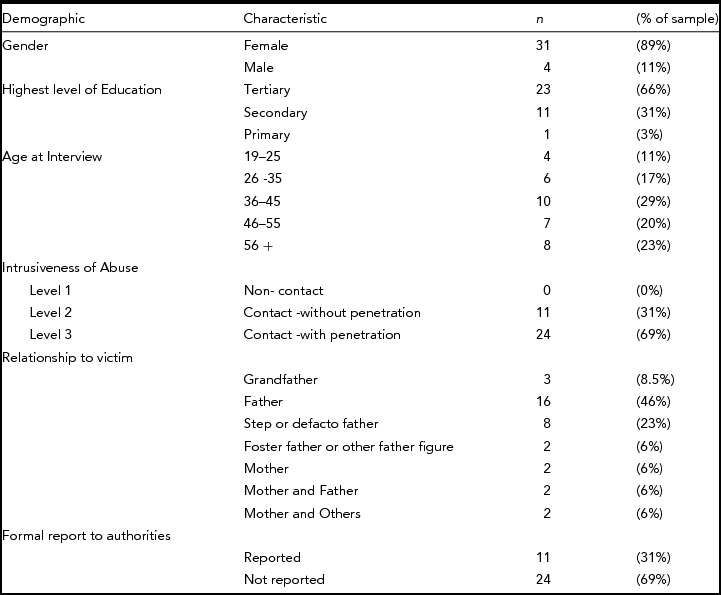
Table 1 contains a summary of the demographic information gathered in the Background Information Questionnaire. It provides a breakdown according to gender, level of education, age at interview, severity of abuse, and the offender's relationship to his or her victim. The sample was predominantly female and two-thirds were tertiary educated. The majority of participants were between 36–45 years old but almost 25% of the sample was over 56. There were twice as many survivors of Level 3 (penetrative abuse) as Level 2 (non-penetrative abuse) abuse in the participant sample, and almost half of the participants were abused by their biological fathers. Half as many again were abused by step or defacto fathers. However, a number of participants were abused by their biological mothers, either acting alone or in collaboration with their partners or others. The authorities had been involved and psychological support provided for about a third of the sample of participants. Slightly more than two-thirds had either not disclosed to the family or had dealt with the abuse informally in the family. Most participants had sought counselling help to deal with the effects of the abuse at some stage in their lives.
Participant sample characteristics.

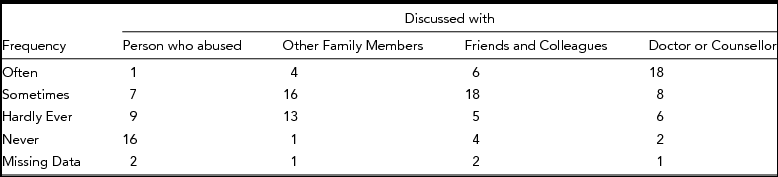
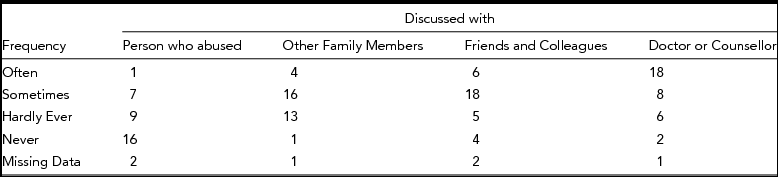
Table 2 summarises information about the frequency with which these participants had discussed their abuse with other people. Although all participants met the criterion of having had some level of contact with the parent who offended against them after the abuse stopped, only 17 of the 35 had actually raised the issue of the abuse with their offending parent. Two of the participants reported that they had not remembered their abuse until after their offending parent had died.
Speaking about the abuse.
Relational Functioning at Time of Interview
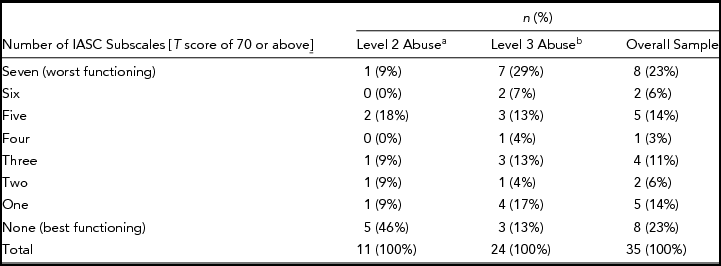
The number of clinically significant subscale scores on the IASC was used as a basic indicator of the level of the participant's relational functioning at the time of the interview. This information has been amalgamated in Table 3 which shows the number of participants at each level of functioning in the whole sample, and by the level of abuse suffered. The greater the number of clinically significant IASC subscales (out of seven), the more difficulties in relating to self and others are likely to be present. Overall, 77% of the participants had one or more areas of clinically significant dysfunction on this measure, which fits with the expectation that survivors’ capacity for future relationships will be affected by the breach of trust inherent in intrafamilial sexual abuse (Briere, Reference Briere2000). Proportionally more survivors of Level 3 abuse (49%) than Level 2 abuse (30%) had five or more clinically significant IASC subscales at the time of the interview. This aligns with research that has found that more intrusive abuse tends to produce higher levels of psychopathology (e.g., Cutajar et al., Reference Cutajar, Mullen, Ogloff, Thomas, Wells and Spataro2010) and lends support to the theory that many of the mental health problems of adult life are second-order effects from the fundamental damage inflicted on the abused child's developing capacities for trust, intimacy, and agency (Mullen & Fleming, as cited in Fergus & Keel, Reference Fergus and Keel2005).
Level of relational functioning by level of abuse as indicated by IASC subscale scores.
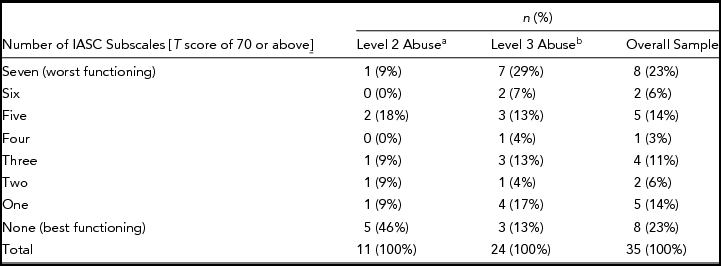
aContact abuse without penetration.
bContact abuse with penetration.
Contexts and Themes
Definitions
In IPNB terms, humans are constantly seeking to develop a coherent and complex sense of themselves-in-the-world, and use both self-organised (intrapersonal) and dyadic (mutual or interpersonal) regulatory and meaning-making processes to integrate their experiences in order to do this (e.g., Siegel, Reference Siegel2012; Tronick, Reference Tronick2007).
The process of striving for integration of the abuse experience by survivors of ICSA is referred to here as recovery(verb); the achievement of this state is referred to as closure or recovery(noun); and the means by which it is achieved (i.e., the self-organised and dyadic processes) are referred to as relational processes.
Contextual Analysis
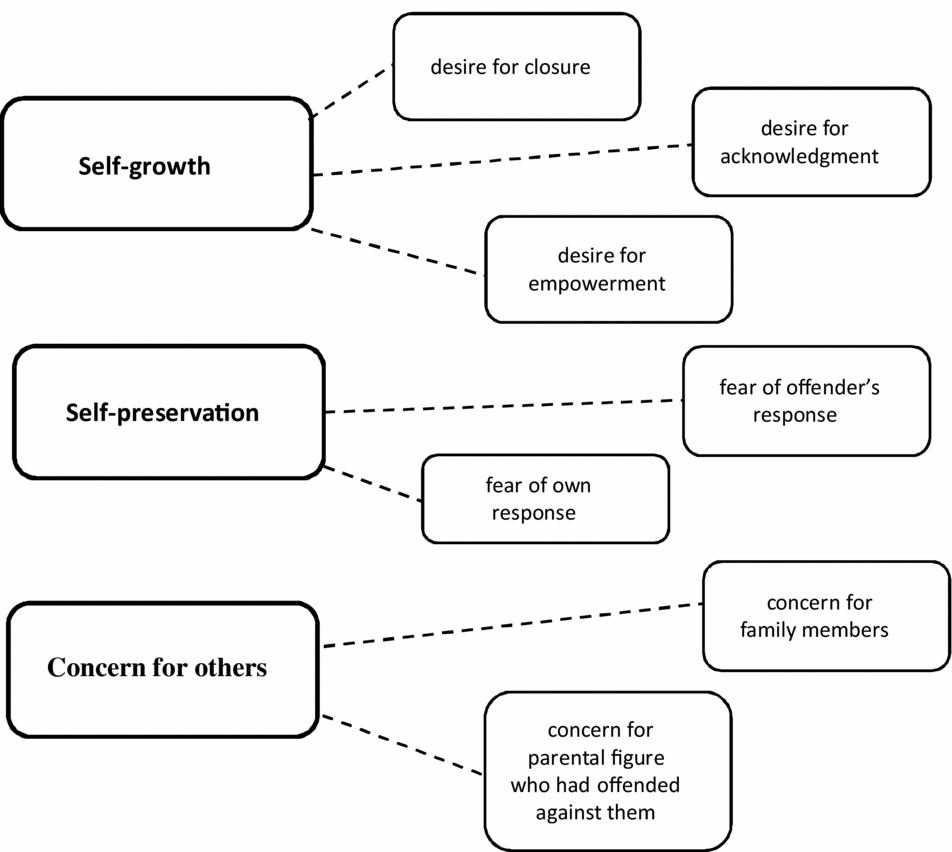
The IPA data analysis fell naturally into a contextual framework: the Pre-Contact period when motivations for and against making contact were being assessed, the actual Contact event, and the Post-Contact evaluation period. The superordinate and master themes identified in each of these contexts, together with the relational processes that appear to be taking place at the time, are displayed in Figures 1 to 3 and explained in the text.
Pre-contact considerations. Recovery-related activity: Assessing weight of reasons for and against making contact.
Pre-Contact
The seven master themes relating to this period reflected the participants’ motivations for and against attempting to contact and to seek information from the parental figures who abused them as children. These master themes clustered under the three superordinate theme titles of Self-Growth, Self-Protection, and Concern for Others, as shown in Figure 1.
The recovery-related activity in this pre-contact period, i.e., assessing the weight of reasons for and against making contact with their offending parent, can be seen as an intra-personal self-organising process being driven by the desire to achieve added coherence in the case of Self-Growth; or to avoid further loss of coherence in the case of Self-Protection.
Concern for Others tended to reflect the participants’ desire to add coherence by extending him or herself for the sake of others, while doing everything possible to avoid losing coherence in the process.
Self-Growth
The drive to regain coherence appeared to be focused on making sense of the abuse experience, in particular, needing to find an answer to the question “why me?” that could be lived with. Although counsellors and other supporters had helped by emphasising that the abuse was never a child's fault, some participants felt that this question could really only be answered by their offending parent, and this desire for mutual meaning-making motivated their contact.
Desire for closure
This theme encompasses the drive to know what the offending parent is thinking and feeling toward them and about the abuse. One participant explained “I just wanted to. .you know. . hear from him. To get something from him”. Another shared “I wanted to be able to get my own peace of mind! To be able to close it off. . .”. In the best case scenario, the drive for closure would achieve added coherence through a match of meanings (via the offender's admission, acknowledgment, and apology), but in any event, the participant's need was to know where he or she stood in relation to the offending parent so that a better informed decision could be made (and lived with) about future actions.
Desire for acknowledgement
The desire for acknowledgement from the offending parent went further than the need to hear an acceptance of total responsibility for the abuse, it required that the offending parent appreciated the harm that had been done and the extent of the troubles their abusive behaviour had caused the victim and other family members. One participant explained it this way “I think I needed him to acknowledge that I was just a kid, that I really was just a kid. . . .There was this shame, a lot of shame.. . . Maybe that was a big part of it, that if I talked to him about it, I could perhaps get past the shame and perhaps in a sense really feel–like not just know intellectually, but feel–that it wasn't my fault”. In most cases of ICSA, the offending parent is the only other person who knows exactly what happened between them, and so it is understandable that his or her acknowledgment of total responsibility could feel like a powerful antidote to shame for some victims.
Unprocessed guilt and shame arising from internal attributions and self-blame is common in CSA survivors (e.g., Cashmore & Shackel, Reference Cashmore and Shackel2013), so attribution researchers, Feiring, Taska, and Chen (Reference Feiring, Taska and Chen2002), were surprised at how often their CSA victim participants attributed total responsibility to the offender when answering a tick-box questionnaire. Feiring et al. suggested this could be a result of child victims learning what they “should” think after being told that they are not to blame. In their efforts to help, counsellors and others may block the processing of shame by not allowing space for the child's actual beliefs and self-blame to be processed adequately.
Desire for empowerment
Seeking empowerment was often a motive for contact where the offending parental figure had also been abusive in other ways in the family. Participants spoke of the desire to face the offender as an adult and be able to speak out after years of being silent and afraid. One participant shared “I remember the feeling of wanting to go and take back control and power of my life. . . .I was going there with the intention of saying, ‘This is what you did and this is what the consequences are’ and to say ‘You own all of that; you are responsible for all of that. You know, we carry all of this around’. So it was really important for me to go and do that”
Self-Protection
Generally, survivor participants who had been separated from their offending parent after disclosing, had spent a considerable amount of time during their estrangement worrying about what might happen if the offender reappeared unexpectedly in their lives. This concern was reflected in the motivations against face to face contact that were expressed by some participants. They included fear of what the parent might do and say (e.g., be angry and blaming), and fear of their own reaction (being de-stabilised by being around the parent if he or she reacted that way). One or two participants were concerned that they would be “sweet-talked” into trusting their abusers against their better judgment, but participants rarely felt in danger of being re-abused sexually now that they were adult and could fight back.
Fear of offender's response
Fear often overrode participants’ desire for acknowledgment. “If he turned up at my door, I would be petrified. ., but at the same time I want him to acknowledge that what he did was wrong. But contact is not something that I would actively seek because if he reacted the way I don't want him to react, I think that would be more traumatic”. This fear of the offender's inappropriate response is reflected in the reservations expressed by some professionals (e.g., Stubbs, Reference Stubbs, Strang and Braithwaite2002) about the use of Restorative Justice in ICSA cases.
Fear of own response
This was an issue for several participants. Most were concerned that they might end up in jail for their violent reaction if their parent did not accept responsibility for the offending and acknowledge their suffering. Often, initial contact by phone or Internet felt much safer for participants than a face to face meeting; and being able to confront at a distance facilitated their expression of anger while safeguarding them from the consequences of their own violence or vulnerability. For example, one participant confessed “I think if I saw them I’d lash out, . . . talking on the phone is alright. I can abuse them. But if I’m in person, I couldn't – I’d just withdraw, or I’d melt and just give in to them!” This participant was basing her projection on her previous experiences in face-to-face contact with her offending parents. Being more susceptible to influence is a common problem for survivors of ICSA (e.g., Briere, Reference Briere2000), and concern that child survivors might believe offenders who deny the abuse or blame the child, is a major reason why some victim advocates assert that there should be no post-abuse contact between victim and offender, at least during childhood (e.g., Stubbs, Reference Stubbs, Strang and Braithwaite2002).
Other-Focused Concern
Other-focused concerns were salient for many participants who were able to tolerate contact in certain circumstances for the sake of other people.
Concern for family members
Several participants spoke about attending weddings, funerals and other significant family events for the sake of other loved family members, and one participant shared that she chose not to report her father for coming to the family home while she was there because she knew he needed to be there to see her young brother.
Concern for the parent who offended
In some cases, contact was driven by the participant's concern for the offending parental figure. One participant shared that she had agreed to help her mother care for her father who was the one who had abused her as a child. Initially this was for her mother's sake, but now she continues to visit for his sake. “Because after everything that he has done, I just couldn't just let him suffer!. . .I can't let him be lonely and die, he doesn't deserve that, regardless”. Another participant also felt unwilling to abandon the person who had abused her, chiding other family members: “Regardless of what happened, our father needs help. You can't just throw him away here! He's a human being!” The view that the offending family member is a human being with a problem who needs help, rather than a criminal who deserves to be punished, was espoused by many of the participants in this sample, especially among those who had not reported their abuse to the authorities. It echoes Purvis and Joyce's (Reference Purvis and Joyce2005) proposition that “child sexual abuse should not just be thought of as a crime, but as a serious social and public health issue requiring urgent attention” (p. 334).
Contact Experience
As explored above, the motivations for these participants to make contact differed, as did their expectations of what might take place. The actual contact experience appeared to trigger a powerful intrapersonal regulatory process, which may or may not have been followed by an overt attempt at dyadic or mutual meaning-making. For many participants, the relational activity of dyadic meaning-making occurred over a number of contact events.
The master themes identified in the context of the contact event are clustered under two main superordinate themes. Most participants spoke about the powerful impact of the first sight of the offending parent, and the master themes under the superordinate theme of Emotional Impact of Contact highlight the fact that the nature of the emotions involved differed depending on whether the contact was expected or not. The other superordinate theme, Elements in Matching Meanings, covers the master themes identified as the most important aspects of what took place during the contact events that led to the success or failure to achieve a matched meaning about the abuse. These superordinate and master themes are set out in Figure 2.
Experience during contact. Relational activities: Initial self-organised regulatory processes followed in some cases by dyadic (Mutual) meaning-making.
Emotional Impact of Contact
Preparation was clearly a key issue for contact experiences, and accidental or unexpected offender-initiated contacts were very destabilising for many of the estranged victim/survivors; whereas, planned, expected, and survivor-initiated contact experiences most often resulted in a dramatic lessening of fear and enhanced feelings of empowerment.
Offender-initiated or accidental contact
These experiences tended to trigger anger, fear, panic, or all three. As one participant shared “I saw them sitting in the car and Mum sitting in the car with Dad and I’m like ‘Oh Fuck, Why did she bring him? Why did she bring him?’ You know, like panic, sheer panic, ‘Why did she bring him here?’”
Survivor-initiated or planned contact
These contact experiences tended to have quite a different effect. Although participants still reported feeling anxious and scared initially, the first sight of the offender most often brought a reduction in that fear, and a realisation that the impression that they carried of the parent who had offended them was based in the context of childhood. For example, one participant said “It was good for me to see him. . .like me being an adult and seeing him in reality without those distortions of childhood that I grew up with. I think as soon as I saw him, I just felt stronger and better”. However, another participant told about feeling disempowered when coming into her father's presence, and this strong reaction was very different to the healing experience she had expected. “[I went back home] anticipating that I could have some dialogue with him about it and sort out some more stuff, get some more answers, get some insight into what motivated him, but I couldn't do it . . .I was just paralysed around him, which makes me sad”. Several other participants also expressed regret for missing opportunities to discuss the abuse with their offenders. However, news of their offender's death brought some relief to most participants because they no longer had to worry about the possibility of the status quo being disrupted by his or her appearance if estranged, or by being let down again if reconciled.
Elements in Matching Meanings
Some offender parents were deeply ashamed of their behaviour, and the mere “raising of the subject” by the participant had been enough to elicit expressions of remorse and apologies. Participants often shared that they had not planned to raise the issue when they did, and felt that it happened spontaneously, which left them feeling very vulnerable during the ensuing interaction. However, most had been experiencing the urge to confront for years and had just been waiting for an opportunity when they felt emotionally strong enough to risk it.
Asking why?
When a participant did ask their parent “why?” directly, the answer they received often failed to satisfy, especially if the focus of the answer was on the difficulties that the parent had experienced as a child or as a parent. In some cases, participants became enraged and expressed their anger verbally. Such an outcome could feel disastrous at the time as it created a lot of emotional turmoil for the participants, however, there were distinct benefits from being able to express their bottled up grief and anger to the person who had caused it. Two participants who shared such an experience both achieved resolution later: one by appreciating the reality check, and being much more reconciled to having no further contact with her father, and the other by reconnecting with father when he understood more about the effects of his treatment of her and made an appropriate response to her some years later.
Acknowledgment
There is no doubt that receiving an acknowledgement was uppermost on the list of victim/survivors needs in this project, and having the abuse acknowledged was generally more important than receiving an apology. At minimum, the desire was for an admission that the abuse happened, but ideally, it would reflect a much more comprehensive understanding of the nature of the wound they had inflicted, and the losses and hardships that the child had suffered because of it. “I would like him to acknowledge it and own up to it and hear the impact that this has had on me and for him to understand what he was doing, to take responsibility for his actions. . . .The main thing is that he would understand the impact and how much I have struggled in my life because of that”.
Generally, offending parents needed to hear about the impact of their behaviour on their children before they were able to fully comprehend the damage that they had inflicted. This created another dilemma for some survivors because it clashed with their need to protect themselves psychologically. For example: “I hope that he understands. Even though I doubt he does, but I would like for him to understand the impact that his behaviour had on me. At the same time I don't want him to know because I don't want him to have any sense of satisfaction that he has fucked up my life”. The notion that the offending parental figure would gain some gratification from knowing that the victim/survivor had been negatively impacted was voiced by another participant, who declared “I would HATE for him to know that it impacted on my children and my life and that I’m 47 and it's still a huge thing! It still shapes my life a lot. I’d HATE for him to know that because it would feel like it was giving him the power”.
For those participants who had not spoken out about the abuse and had continued in contact with their offending parent after the abuse stopped, the desire for acknowledgment meant that the offending parent needed to understand that not telling was a survival technique; it did not mean that the abuse was acceptable to them. Similarly, tolerating or even enjoying continued interaction in family situations didn't mean that the abuse has been forgotten or forgiven. Most importantly, the fact that the survivor appears to be doing well in life really doesn't mean that he or she wasn't affected, or that the wounds have healed.
Apology
Like many of the aspects of ICSA, the role of an apology is more complex than might be expected, and participants disclosed a variety of understandings. Some thought that an apology wasn't needed because it couldn't fix anything, while others believed that receiving an apology was insufficient but essential. For at least one participant, it made no difference. “He said sorry and I believe he meant it, but it didn't change anything”. Even so, participants who no longer had the opportunity to receive an apology or acknowledgement often expressed their anger or sadness about this. For example, “At the time when he was dying, I wanted him to apologise. I wanted to hear things. . . .I really wanted him to apologise without forcing him to – without confronting him, and I was angry that this didn't happen”
Inadequate or withheld apologies
Receiving a “non-apology” could create quite severe emotional turmoil as demonstrated by one participant, as she described her stepfather's attempts to address his abuse of her and move on: “He came up to me and started chatting. . . He said ‘You know, I know there was a lot happen between us but like, let's just try and move on’ It was just too weird! It was just as if he’d thrown my ball over the fence or something! You know. . . . and . . . he didn't play fair!” That interaction triggered a new round of attempted contact from him: “He rang me a few times [later] but after that my husband would always tell him that I don't want to speak to him, which is probably right [but] I remember even then thinking. . .and that's another thing you go through, this horrible ‘well, shall I speak to him or shan't I speak to him? what does he want to say?”
Withheld apologies didn't always represent mismatches of meaning as another participant explained: “He has acknowledged it. . . . He hasn't apologised to me, but I think it was kind of rightfully so. He said, ‘I can't remember doing it, so I’m not going to apologise for something I can't remember’. I thought, ‘Well, good on you. Yeah, that is fair enough, I suppose’. It is a bit like, ‘Oh, I can see how that would have been bad for you, though’. You know, it was that kind of distance from it”.
Receiving an apology
The healing effect of receiving a meaningful apology was evident in some participants’ stories, and one gave a particularly vivid account of how much her father's apology had helped her to integrate and recover from the abuse experience. Her father had completed a prison-based treatment programme and she had just started to visit him in prison after receiving his letter of apology some years before.
“I went in there with the attitude that I am not going to take crap. And I wanted to talk to him about stuff. He actually said before I said anything, “I want to say something”. He said, “I am genuinely appalled at what I have done and I am so sorry for how it has messed up your life”. He goes, “I don't have any expectations that you will believe me or that you will do anything because of me saying this but I need to say this to you that I am really, really sorry”. He was crying, and I have never seen my Dad cry before. . . .I remember it was freezing cold and we were outside because I wanted to have a smoke. He had his big prison jacket on and he took it off and he put it on me, and that was huge. I cried, yeah. Yeah, it was a big moment”.
Another participant described receiving an apology from her abusive stepfather in a family conference situation: “He apologised, said that he is so, so sorry! Said it to me first and then to the whole family . . .Just the look on his face, and the way he said it, I definitely [believed it]! I cried, he cried, Mum cried. My sister cried. And we’ve been moving forward since then”.
Showing remorse
It seemed that it was not essential for the parent who offended to apologise in words, or to be able to answer the question “Why?” articulately, in order to help his or her victim's recovery, provided that genuine remorse was shown. One participant told what had happened when she met her father for the first time many years after his abuse of her: “We both looked each other in the face for a moment. Then his head dropped down onto my shoulder, and he began crying. During this moment, I felt an inner strength. When he lifted his head, I asked him ‘why? Why did you do all of those things to us?’ By now I had also begun to cry. He looked up at me again, and said ‘I don't know, I don't know why! I can't explain it’. . .[but] it felt as though a heavy burden had been lifted off of my shoulders”.
Another participant explained “He showed remorse, but he didn't necessarily verbally provide it or anything. But he has shown a side of – I never know if it is compassion. I don't even really know what it is, and I don't want to give it too much credence, but it is some sort of showing of acknowledgement, and that for me was reassuring”. And another participant reported that seeing his mother's contrition was the biggest thing for his recovery. “She wanted to be my mother in the true sense in the last couple of years of her life”.
Acknowledgement and remorse have been identified as important victim-focused elements in a recently developed theory of apology (Slocum, Allan, & Allan, Reference Slocum, Allan and Allan2011), in which apology is viewed as a process rather than a discrete event. A full and complete apology is seen as having three components: affect, affirmation, and action, each of which has an element that is focussed on the wrongdoer (e.g., regret), and an element that is focussed on the wronged person (e.g., remorse).
Post-Contact Evaluation
As shown, these participants’ stories suggest that recovery from ICSA is a non-linear, organic process, in which contact events and other abuse related experiences like disclosure, create major shifts in emotional and psychological wellbeing. The relational activity in the immediate post-contact period again appears to be a self-organised regulatory process aimed at stabilising after the emotional impact. Once a sense of stability is achieved, the activity of self-organised meaning-making takes over. Victim/survivors’ pre-existing meanings about their offending parent and themselves-in-the-world are consolidated or challenged as they reassess their understanding after each new contact event or abuse-related experience. Questions such as “What do I make of what happened?” “What does this mean about him?” “What does this mean about my sense of self?” “Are these meanings that I can live with? (i.e., have I achieved closure?)”. “If not, what else do I need?” and “how can I get these needs met?” are raised as the drive for added coherence and recovery continues.
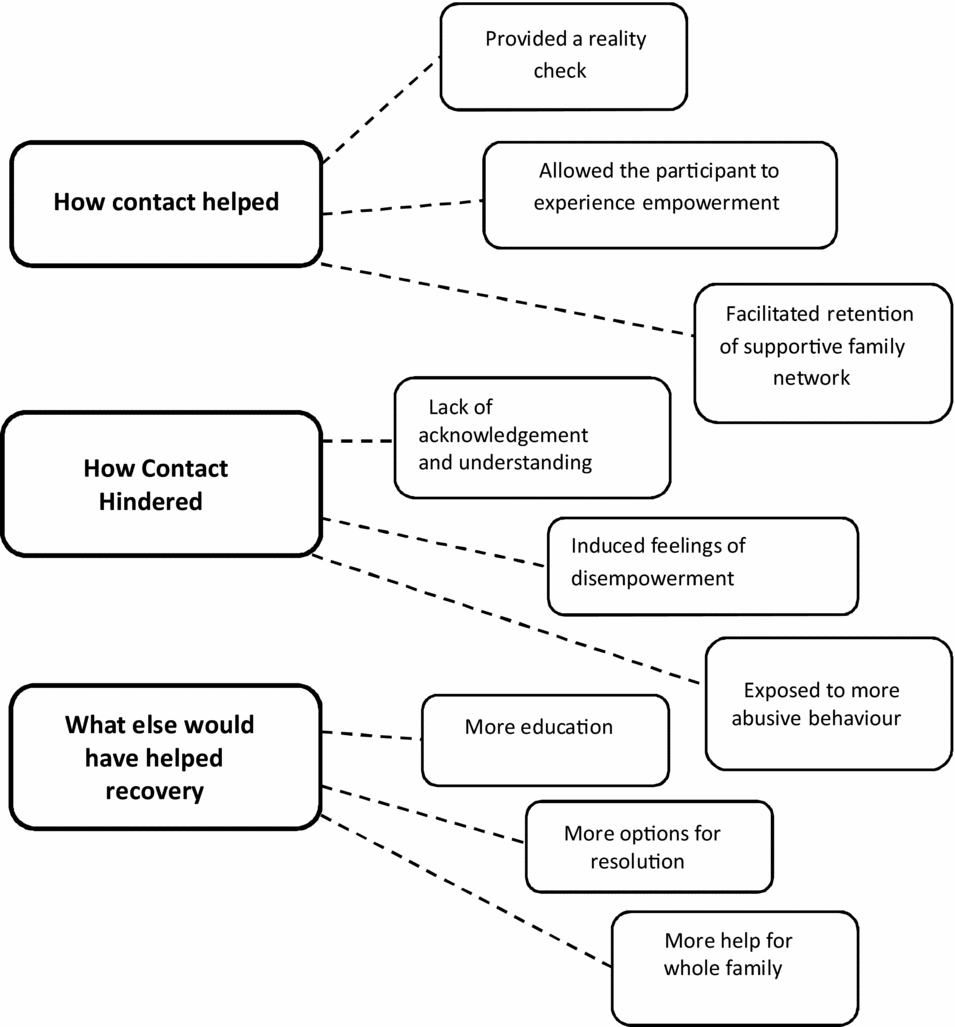
The impact of what was said and done during a contact event was influenced by numerous factors, such as who initiated the contact, how the contact was made (letter, phone, face-to-face), where it took place, and who else was there, but participants were asked if they thought that their contact with their offending parent had helped or hindered their recovery. Master themes clustered naturally under three superordinate themes: How contact helped, How contact hindered, and What else would have helped recovery as shown in Figure 3.
Post-contact evaluation. Relational activities: Self-organised regulatory and meaning making stage.
How Contact Helped
It appears that most participants who had sought contact for themes related to Self-Growth (i.e., for closure, acknowledgement, or empowerment), found that their desires were, at least partially, fulfilled. Even when major mismatches occurred in the communication between the survivor and their parent, most participants reported being able to take something positive from the experience. Unexpected benefits were also experienced by participants.
A reality check
As described previously in the Contact Event section, many participants reported that, where they had initiated or agreed to the contact, the initial impact of seeing the reality of the person helped them release their old childhood images and powerfully defused their perceptions of the offender's power and menace. This created an immediate benefit that lasted even if there was no acknowledgement of the abuse by the offender, or the contact was unhelpful for other reasons. For example, one participant said “I think the visit was really huge because I didn't feel afraid of him . . .so he lost a lot of power in my mind. . .I used to dream about him coming and getting my kids and doing things to them - those horrible things to them, and I don't have those dreams anymore”. Another explained “I had been a child in my head for sixteen years, feeling the same fears and feelings! But then, suddenly I wasn’t!”
In the same vein, apparently disastrous contact events could actually be cathartic and result in a new understanding and added coherence for the survivor. One participant had asked her father “why” in an online conversation, and this led to them getting into an argument about the facts of the abuse, and him telling her not to contact him anymore. She shared that, initially, she had cried harder than she could ever remember doing, but only for about 15 minutes. Then “as soon as after I’d had that cry, I felt fine. . .I felt relieved. I felt like I’d moved on, I suppose. I just felt like a total weight lifted off my shoulders, and a lot of stuff, so yeah, it was a positive thing! . . .It was such a relief to be able to find out where I stand with him”.
Empowerment
This feeling was experienced by many participants, and could be very powerful: “The fact that I could hear my voice and it was speaking to him was a big part. It felt incredible. So it was such a powerful experience of me almost feeling bigger than him and tougher and stronger in myself. It wouldn't be correct for everybody, but in terms of me, it has been extremely beneficial”.
Other participants felt empowered by having clear in their minds what they wanted to achieve and how to keep themselves safe. “Being in control of the situation and having the avenue to leave, yeah, I think, made it positive, like helpful. Like there were outcomes; I went in with specific objectives and I was able to have outcomes”.
Although none of the participants in this research had mentioned needing a sense of “justice” before the contact, it was sometimes an unexpected benefit and a form of empowerment: “It makes me feel better in the world generally to have seen those expressions on his face. I don't get joy from that. I’m not pleased by any means that he is miserable and, you know, doesn't have these things [his children and grandchildren]. I just see that as a consequence and that it is a reality and that is a justice”.
Family relationships and support
Unlike the participants in Julich's (Reference Julich2001) study, participants in this study hadn't specified “mending the relationship” as a unique motivator for making contact, but an improved relationship was a side product of the contact for at least two participants. One of them explained “It[contact] helped a lot - and me hearing him say sorry and being able to put some kind of context and understanding around what happened, and that there is a man there that is alive that is my dad that does care that didn't know how to care before; it has helped”.
Retaining their access to a supportive family structure was often cited as a motivation for not disclosing the abuse to other family members, or not reporting the abuse to the authorities. Having the ongoing contact was helpful for many participants, possibly because their abuse had been brief and not particularly intrusive. For example, “I think it's important! . . .if I never saw my father again, I think that that would have probably been more devastating!” and “Our continuation as a family was dependent on my silence, and so I kept silent [but] it was tremendously helpful”.
Another participant said she had been greatly relieved as a child when her father was allowed to return home by the authorities after his sexual abuse had been dealt with. However, she revealed that, although he never reoffended sexually, her father had continued to drink and to treat her mother very badly. “I do wonder if. . . I would have grown up and missed him or felt like I had missed out on a Dad. . . .I really don't know. It's almost like saying that you needed to go through all these years of bullshit to realise that you are better off without him”.
How Contact Hindered
The downsides of contact described here were often balanced, if not outweighed, by the gains, however some participants could not identify any positives from their later contact.
Lack of acknowledgement and understanding
Although participants who only had occasional contact with their offender could manage their feelings around this aspect fairly well, if it was in the context of almost daily contact it became very difficult as described here : “[Contact was] probably more harmful than helpful, because I had to accept the fact that she was never going to see the wrong. . . . (Mum had Alzheimer’s.) The only time I sort of confronted Mum a bit was when I was in the height of my drug addiction because my inhibitions were down a bit with the drugs and that. . . .[Her reaction was]total denial; didn't even connect with the problem, didn't even recognise that she could have possibly have had anything to do with it”.
Perceptions of disempowerment or humiliation
One or two participants found that they had experienced feeling disempowered or humiliated or both during a face-to-face contact event, especially if they had acted to make contact spontaneously. As shared here: “Gawd, he had the last laugh REALLY because there I was standing in front of him, overweight, obviously not loved, more or less a victim”. This participant said that she would like to go back again in the future when she had her university qualifications on a business card “so I could really LOOK to be successful, because he wouldn't see that just standing there in front of him was a huge triumph for me. I’d like him to be able to SEE how much of a triumph it was, and I don't know how I could convey that”.
Attack and criticism from others
More than one participant spoke of being confronted by their offending parent's new family and friends. For some participants, confrontation happened outside of Court, but one participant got into this situation when she decided to confront her stepfather unannounced. She said: “When I left, I felt angrier because I’d had three people telling me my life wasn't my life; that my reality wasn't my reality. IT NEVER HAPPENED and that sort of thing! I was really, really angry. I didn't want those other people there in the room. I just wanted to hear from him. I didn't get anything I wanted and I was very shaky as I drove away”.
Further abusive behaviour
Two participants disclosed that they had been set back by further abuse in post-disclosure contact as children. One shared that she had been re-abused in an unsupervised contact visit with her parents while she was in foster care, and the other had confided in a telephone helpline counsellor who traced the number and called the police. She said: “the night that I found out that they knew where I lived, and that the police were going to come whether I liked it or not, was probably the scariest night of my life . . .I was just really, really scared”. She reported that she’d been too scared to tell her mother, and was alone with her stepfather when the police arrived. They asked her about her allegation in front of him so she retracted her statement, but after they left, her stepfather's abuse intensified in retaliation for her attempt to disclose. This latter experience, in particular, demonstrates how easily our best endeavours to protect children can make things worse when we act in ways that disrespect their wishes and continue to disempower them. Recent research has found that children want their viewpoints to be heard and considered when adults are making decisions that impact heavily on them, and family law practitioners are attempting to find ways to respect that in custody cases (Cashmore, Reference Cashmore2011). This all accentuates the importance of finding a way to work with children to solve the problem of ICSA.
What else Would Have Helped Recovery?
The participants’ contributions to this research have highlighted that recovery from ICSA is a difficult journey that is not especially helped by the current simplistic approach of prioritising punishment of the crime over the continued viability of the family unit.
More education
Many participants highlighted the need for more public education about the realities of CSA: who offenders are most likely to be and what behaviours to look out for, how to intervene to help stop abuse before it happens, and how to facilitate and react to disclosures in a way that helps the child. In effect, they wanted a public awareness campaign like those that have targeted drug awareness, smoking, and drink driving.
More options
The majority of participants said that, while the behaviour was clearly wrong and needed to be stopped, they did not necessarily see the offending parent's imprisonment as a helpful option for themselves or the rest of the family. They wanted more options, including treatment, to be available.
More help
Several participants thought having more help available for the whole family in the immediate aftermath of disclosure would be invaluable, because it isn't realistic to expect their non-offending parent to know what to do for the best at a time when they are clearly traumatised by their own betrayal by the offender. This view is substantiated by research showing how badly non-offending parents are affected by the discovery that their child has been sexual abused (Elliot & Carnes, Reference Elliot and Carnes2001). One participant felt that if an independent, non-judgmental professional or agency had been available to provide information on the different options and to hold the space for her family, her mother and brothers would have come to believe her, and her stepfather would have admitted the abuse, saving years of relational trauma in the family, and allowing her to recover very much sooner.
Conclusion
The experiences shared by the participants in this study have allowed a look behind the scenes at the complexity of the ICSA situation, and at the relational activities involved in the recovery process as survivors attempt to make sense of the abuse experience and find closure. From the participants’ sharing of what helped and hindered their recovery, it appears that contact with their offending parent does provide intrapersonal and mutual meaning-making opportunities that can lead to a sense of added coherence, greater integration, and better relational functioning in the recovering person. The potential for benefit is greatest where a mutual understanding is established (e.g., both agree that the abuse did happen and that the parent was responsible), although even when there is no mutual agreement (e.g., the parent disagrees that the acts were abusive, or even denies that they took place), the long-term benefits in fear reduction and knowing “where I stand” seem to outweigh the short-term costs of disempowerment and criticism, provided that the contact situation was physically safe.
It is clear that most of the themes that were identified in Julich's (Reference Julich2001) study are also reflected here, albeit sometimes with a different emphasis. For instance, Julich's participants had felt the need to educate outsiders about the complexity of the issues involved in their experience of abuse. While the implication in that study was that this would be done in a court room or similar, seeking justice through the courts was not a priority for most of this study's participants. However, the need to educate outsiders was reflected in the oft-stated desire for society to recognise the complexities of their situation so that more options for dealing with the abuse could be made available (e.g., family counselling, offender treatment). In particular, some participants desired that a confidential non-judgmental space could be available for all members of the family where they could be supported through the initial trauma of disclosure, before being helped to make an educated and empowered choice about how to deal with the harm done to the victim (instead of automatically prioritising the criminal response).
In the current study, the participants’ main desire was for the offending parents to understand the extent of the relational harm done by the rupture in the normal parent–child relationship. Although about half of the participants in this current study had taken the initiative to speak with their offender about their abuse, only a few of them had the support of other family members or counsellors in doing this. Research has indicated that secondary victims (closely related others who are negatively impacted by what happened to the victim, e.g., siblings, parents, grandparents, and partners) are much less likely to consider later contact between the survivor and the offender as potentially helpful (Maurice, Reference Maurice2009). The secrecy required to protect these significant others was a large part of what made the desired contact difficult for many participants.
There is a need to educate other family members so they can, at least, understand the role of later contact in the meaning-making process of recovery. The contributions of some participants in this study indicate that there is a substantial difference in the experience of living “protected” by other people from contact with the offender, and living without contact after being empowered to make your own decision, especially in terms of ongoing fear and uncertainty about the offender's intentions.
The current study indicates that many ICSA survivors are highly invested in maintaining or re-establishing a connection with their family of origin and that the drive for a mutual understanding with the offending parent is strong. Even if they had no desire to continue a relationship with the offender, at least half of these participants had made some attempt to discuss the abuse in the hope of receiving some acknowledgement, and a sense that the parent could understand that what they had done to their child went far beyond taking his or her sexual innocence. Where they were successful, the impact on recovery of the offending parent's acknowledgment, apology, and remorse was profound in terms of resolving the hurt and fear. Only five participants mentioned forgiveness, and only two reported telling their offender “I forgive you”. The other three indicated that it wasn't possible for them to forgive the behaviour, but they used the word “forgiveness” to describe how they had been able to release themselves from the ties of resentment and anger toward the person. This understanding of forgiveness as a relinquishing of ties is also recognised in recent research on the forgiveness process in primary and secondary victims of violent and sexual crimes (Cooney et al., Reference Cooney, Allan, Allan, McKillop and Drake2011).
The experiences of the 17 participants who spoke about the issue of their abuse with their offending parents, indicate that the risks of serious re-abuse or long-term adverse reactions following a negative offender response may be lower than previously thought, and that there is, in fact, potential for substantial benefit from post-abuse contact for ICSA survivors who choose to pursue it. Many other participants who had not felt capable of confronting their offender in this way voiced their unmet desire to hear an acknowledgement, and would have liked to have this opportunity if only they could be sure of their physical and emotional safety. It seems likely that they, too, could achieve a greater level of closure through dyadic meaning-making, if family or professional help could be garnered to support them and to facilitate the contact and communication. Professionally supported contact, within the context of Restorative Justice Interventions (e.g., Young, Reference Young2007), and offender treatment programmes (e.g., Pauls, Reference Pauls2007), is known to have been successful in helping ICSA victims to recover more quickly in countries where that option is available.
Limitations
A major limitation of the study is the small sample size. Of the total sample, only 17 participants had actually spoken about the abuse with the offending parent and the majority of these were female. The themes identified are specific to the meanings made of their experiences by these particular individuals at this time in their lives. Inferences are therefore limited but do identify some promising directions for future research. Furthermore, the validity could have been improved by involvement of participants in the reviewing of themes. This was considered at the planning stage, but was seen as an additional burden to impose on individuals who might already be disturbed by the interview process. In the event, the participants appeared to feel benefit from having talked about their abuse in such detail and would likely have been more than willing to participate in a review role.
Despite these limitations, this research project has provided an opportunity to hear from ICSA survivors about what has helped and hindered their recovery processes in respect to post-abuse contact with their offending parent. It has also provided the opportunity to discover how survivors’ seemingly counter-intuitive desire for contact with their offending parents can actually be a functional way of fulfilling their drive for recovery through the relational process of dyadic meaning-making, and can lead to integration and closure without implying forgiveness or an ongoing relationship.
It is hoped that the preliminary work here will inspire others to replicate the research, ideally with children who are having professionally supervised contact with their offending parent, because these findings do suggest a different and more healing response to ICSA may be possible for our children if the role of post-abuse contact can be better understood in our society.