



The first one who, having enclosed a field or bit of land, decided to exclude everything there, was the true founder of the following historical era. Agriculture and culture have the same origin or the same foundation, a white spot that realizes a rupture of equilibrium, a clean spot constituted through expulsion.Footnote 1
Between 1868, when the saladeros (or meat-salting plants) were closed by decree from the city of Buenos Aires, and 1940, Argentina became one of the largest producers of meat in the world.Footnote 2 In the last five years of this period, motions were made on several fronts to turn agriculture into an urban function, bringing the city into the countryside and the countryside into the city.Footnote 3 Revealing the convergence of two usually separated movements – hygenics and eugenics – the meat industry in the province of Buenos Aires created a scientifically supported arena for the biopolitical appropriation of land and resources, including human and non-human animal bodies, bearing out a unified ideology of purification, medicalization, aestheticization and productivity. The movement to eradicate blood, offal and stench from the city's waterways and streets was paralleled by industrialists’ desires for productive land in the Pampas, the large grassy lowlands surrounding Buenos Aires, cleansed of its native ‘unproductive’ inhabitants by General Julio Argentino Roca's Conquest of the Desert (1878–84).Footnote 4 Appropriating the iconic gaucho (or cowboy) traditions of the Argentine Pampas, a globalized appetite for meat worked, almost invisibly, to transform the city of Buenos Aires and the natural resources of the countryside into an industrial commodifying machine of global proportions. The division of human and non-human animals required for the bulwarking of culture, alongside the dual processes of taming and bestializing populations undergirded Argentine elites’ civilizing agenda which begins this story of modernization through pastoralization.
Analysing the escalation of capital, focusing on the augmentation of productivity in human eugenics and its correlate in animal husbandry, specifically in Buenos Aires and the surrounding Pampas, this study explores the contradictions between modernization and the raw materials and primal exigency of the meat industry. By exploring the contradictory forces at work between the circulation of bodies and capital's territorial fixity – its necessary dependence on the built environment – our work contributes to a body of scholarship that evaluates the power dynamics underlying the production of urban space, seeing the countryside as a critical component of urban history. It is impossible to evaluate the historical development of the city of Buenos Aires without considering its dynamic relations with the countryside. While modern discourses on the built environment often focus on urban development and architectural icons, a careful examination of the meat industry within Buenos Aires and its surrounding Pampas makes clear that modernization does not always take place where things look modern: it takes place in the perceived vacancies of so-called nature, in the open and seemingly deserted areas which offer the raw materials for modernity.Footnote 5
Selective breeding
In the last decades of the nineteenth century, during the governments of Domingo F. Sarmiento, Nicolás Avellaneda and Julio Argentino Roca, three simultaneous movements of people and animals changed the face of the city of Buenos Aires and the surrounding Pampas. First, ploughing the territory for modernization, the military operation known as the Conquest of the Desert displaced and killed thousands of native peoples along with rural strongmen, known as caudillos, and the so-called racially inferior gauchos who were considered obstacles to the progress of the country.Footnote 6 Simultaneously, following Argentine political theorist Juan Bautista Alberdi's call to think of populations in agricultural terms, equating immigration with grafting, politicians, scientists and technocrats were readying the soil of the cities for the growth of a new, more industrious imported northern European population.Footnote 7 Third, a series of laws were implemented to prohibit further unhygienic meat processing operations within city limits and to re-route incoming undesirable immigrants to both the countryside and the meatpacking district in the south of the city, in the interest of eliminating all living bodies thought to carry pests and diseases, both physical and ideological.
From its inception as a nation-state, Argentina welcomed immigration. Its first constitution of 1853 stated, ‘The Federal Government will encourage European immigration, and it will not restrict, limit or burden with any taxes the entrance into Argentine territory of foreigners who come with the goal of working the land, improving the industries and teaching the sciences and the arts.’Footnote 8 Working an elaborate, embodied, agricultural metaphor, Juan Bautista Alberdi, one of the framers of the constitution and a core inventor of modern Argentina, wrote: ‘Each European who comes to our shores brings more civilization in his habits, which will later be passed onto our inhabitants, than many books of philosophy. . .A hard-working man is the most edifying catechism. . .Let us bring living pieces of these qualities. . .and let us plant them here’, After which, Alberdi announced, ‘To govern is to populate.’Footnote 9 Attempting to bring the continent of Europe to Argentina, ‘on wings of commerce and industry’ lured by ‘the richness of our continent’, between 1901 and 1910 over one million people immigrated to Argentina. While the majority of immigrants were Italian, thousands of people from Spain, Poland, Russia, France, Germany and Austria, as well as Greece, Portugal, Ukraine, the Czech Republic, Ireland, England, Holland, Scandinavia, Syria and Lebanon also immigrated to Argentina's shores.Footnote 10 With the construction of an elaborate system of transnational railways, many of these immigrants were drawn from the littoral regions of the country into the interior, and by 1900, 25 per cent of Argentine lands and 38 per cent of businesses in the country were owned by Italian immigrants.Footnote 11 From this rich international diorama, selective interbreeding, and more prudent immigration laws to root out political and ideological offenders, would, Alberdi and others hoped, produce higher intellectual and cultural yields for the new Argentine nation.
Recognizing that immigration had not been as selective as hoped, many of the Argentine elite felt threatened by these unpredictable crowds and called for more aggressive immigration policies and the medicalization of physical space – urban and rural. This sparked overwhelming support for the national institutionalization of eugenics – the biological and social movement that sought nothing less than the construction of a ‘perfect’ race. As Alberdi's rhetoric made clear, a specific form of eugenics that emerged in France and was eagerly adopted in Latin America was revitalized as the human analogue of agriculture for the scientific cultivation of the human, using heredity and the environment as its primary tools.Footnote 12 Due to this reliance on the French notion of milieu – understood as a relational system that brings together space and society in a state of contingency – in Argentina, eugenics and hygienics collapsed into each other.Footnote 13 Both were part of a new form of hygiene, social hygiene, which turned its attention to society at large as an integral part of modernization, and focused on the products of human capital: production and reproduction. As French natalist Sicard de Plauzoles defined it: social hygiene is an economic science, producing and reproducing human capital through eugenics and puericulture, conserving this capital through hygiene and medicine, while training and augmenting this same capital through professional and physical education, for the sake of ever-increasing productivity.Footnote 14 Adding to the fear of yellow fever, cholera and other contagious diseases were two primary concerns, the contamination produced in the city by slaughterhouses and meat-salting plants, and a fear of degeneration, inherited from the French, which was thought to be remedied through selective immigration and the medical sciences.
Influenced by Social Darwinism, and reversing Alberdi's position on immigration, José María Ramos Mejía, the physician and politician who was one of the first interpreters of European scientific ideas in Argentina, considered these ‘modern crowds’ to be endangering the ‘quality’ of Argentina's national population. Echoing Gustave Le Bon's 1895 book, The Crowd (Psychologie des foules), Ramos Mejía conceived Argentine society as a collective organism that requires cultivation. As he argues:
When I was studying the admirable progression adopted by nature as it slowly developed organic types (from our modest Silurian ancestor, to the primitive fish, right up to man), it seemed reasonable to me that in the formation of this society something analogous must have happened. That at a certain stage in its development the first embryo, the immigrant, must have given the social order something like the anatomical structure of fish, later that of amphibians, and finally that of mammals. By that I mean that the immigrant would have followed a similar series of transformations in perfecting his intellectual and moral development.Footnote 15
According to Ramos Mejía, the immigrant's amelioration was only possible through medical science and spatial order, as he explains: ‘When he [the immigrant] first begins to walk on our land, he is, in part, the vigorous protoplasm of the new race. We must convince ourselves that this unpolished peasant does not feel as we, the Creole elite. . .But the environment works marvels on the moldable submissiveness of his almost virgin brain.’Footnote 16 As in France, degeneration in Argentina was conceived as a national disorder, biologically and environmentally based, that could only be remedied through medicalization. Ramos Mejía criticized the optimism that embraced the large masses of immigrants but was still able to visualize a future Argentine race through the prophylaxis of those modern crowds – a selective intervention that sought to discriminate and eliminate so-called unpalatable characteristics of this new heterogeneous population.Footnote 17 To do this, he not only conceptualized a systematic apparatus for identifying degenerate immigrants that effectively weeded out those he considered inherently pathological; but he also called for the re-engineering of those without criminal propensities who, with the help of science, could be re-bred into the nation.Footnote 18 Insisting that the ‘biology of the crowd’ should be under surveillance, Ramos Mejía's ideology infiltrated the mindset of the elites, orchestrating a nationalist movement fuelled by xenophobia, anti-Semitism, with class and gender prejudices.
Yet again, medicalization and immigration emerged as the principal regenerative agents of modern Argentina. Physicians were at the centre of a state bureaucratic machine aimed to consolidate a clinical view of the modern nation. The process of building Argentina's social hygiene infrastructure required the creation of government organizations. It was clear that ‘the model chosen by Argentina's reformist elites in the name of progress and civilization was medical’.Footnote 19 From 1880, the year in which Buenos Aires was declared the capital of the Republic under direct control of the federal government, new institutions were created to transform the city into a medical object and the countryside into a healthy productive machine. Focusing on the city, with the creation of two main public health authorities, the National Department of Hygiene (Departamento Nacional de Higiene) in 1880 and the Municipal Department of Public Welfare (Departamento de Asistencia Pública) in 1881, the Argentine government established the basis for the institutionalization of eugenics – the model that would ‘normalize’ Argentine society.Footnote 20 Worried that the city's development would drain the countryside of productive labour, a new institution, the Museo Social Argentino, launched a programme called Hogar Agrícola, which focused on agricultural development and worked to bring the so-called ‘right kind of immigrants’ into the sparsely populated countryside to run the nation's agricultural industries.Footnote 21 Exploring the spatial dynamics of production and bodies, the conjunction of top-down actions in both the city and the countryside demonstrate how Argentina's nation-state formation was constructed by racialized ideas of progress and modernity, creating a nearly homogeneous clinical machine made primarily of human and non-human animal parts.
A silent laboratory for the social
Between urban and rural domains, seemingly mundane processes created to rationalize population and productivity contributed to the mono-culturalization of the human population in early twentieth-century Argentina.Footnote 22 The underbelly and perhaps the purest form of these processes of separation, hierarchy and control were realized in the industrial workings of food production which resulted, in Argentina, from the simultaneous rise of the commodities export economy and the migration of rural subsistence farmers, in pursuit of manufacturing, construction and other trades, to urban climes. Increased urban density made the classical subsistence farming model impossible for urban populations with little land to farm, while also increasing the urban population in need of available and accessible food. Between 1870 and 1914, the population of Buenos Aires grew by 800 per cent to 1,576,000 and by 1940, to more than 3,000,000: each of these new mouths had to be fed.Footnote 23
As internal demands grew, new external demands for food and capital emerged from what we might soundly consider some of the earliest processes of globalization, predating the current concerns by at least a century. Some of the most important frigoríficos from Argentina's Golden Era (1880–1920s) were owned jointly by British public and private interests, with the support of French distributing companies, as well as by American cattle companies, with much smaller interests held by Argentine capital. After the so-called Meat War of the 1920s, the United States solidified legal rights to 54.9 per cent of meat distribution, while the British secured 35.1 per cent, and Argentina held only the right to the remaining 10 per cent of its own national production.Footnote 24 England's pursuit of Argentina's wheat and meat industries gave implicit economic impetus to military land razings, like the Conquest of the Desert, which opened up new farm and grazing land for the development of hybridized Argentine and continental livestock. While Argentine Criollo cattle were heartier and could reproduce at higher rates under intense nutritional constraints, European stock had been bred to produce fattier and more desirable meat.Footnote 25 So, as estancieros (or cattle barons) in Argentina began to import cattle breeds such as the English Shorthorn in 1826, and the Hereford in 1858, along with the Scottish Aberdeen Angus in 1879, to interbreed with the so-called native stock, brought to Argentina by the Spanish Conquistadors, the initial potential for cross-fertilization and increased diversity was sacrificed. In sync with the majority of commodity producing agribusinesses, which thrive on assembly line processing of like products for efficiency, the range of cattle breeds available to the market dwindled from 57 registered breeds to the active use of less than five dominating breed types (Figures 1–2).Footnote 26
Photos from Dr Pedro Escudero's Album, c. 1940, Frigorífico Gualeguaychú, Ministry of Agriculture. FO.AR.01.3.07, Fototeca Benito Panunzi of the Biblioteca Nacional Mariano Moreno de la República Argentina, Buenos Aires.
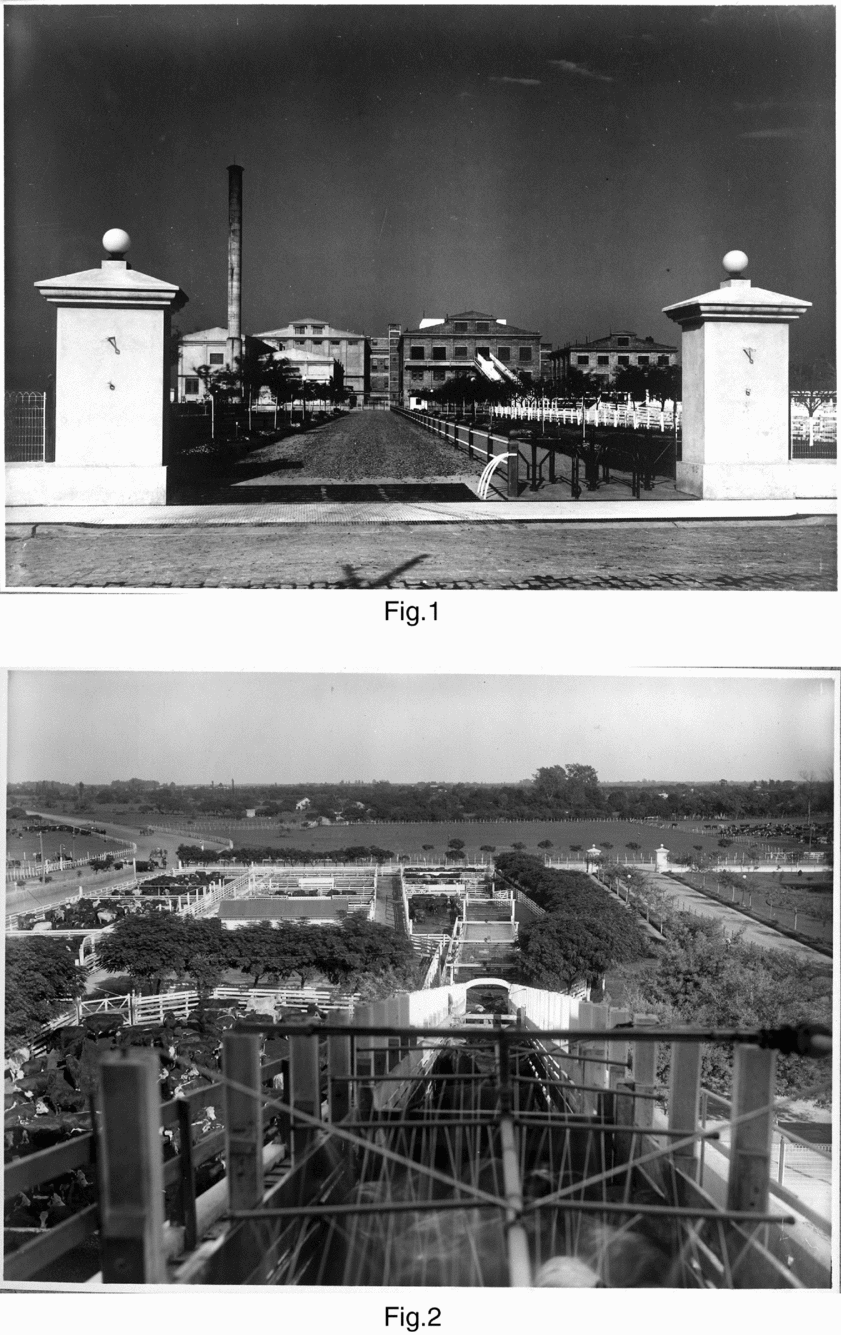
Much like the eugenic practices operative within the human realm, meat became a silent laboratory for the social. All of modernity's social experiments, be they eugenic, genetic, pharmacological, economic or political, after going underground in the human realm, continued to be enacted in food production, supply and distribution. Productivity was paramount in the modernizing of the meat industry. Performance testing, backfat probes and other selection tools were applied to ensure quality while railways, docks, storage facilities, fertilizers, improved ships and labour-saving machinery, provided by England first, and then the United States, also helped dramatically improve the calories per square kilometre cultivated on the Argentine plains.Footnote 27 The architectures of the meat industry were increasingly more efficient, moving away from the Parisian artisan model, where a single butcher processed every part of the animal himself, to the Chicago stockyard model in the mid-1880s, where cattle were purchased en masse, slaughtered en masse and then frozen, canned or packaged as bullion for foreign sale.Footnote 28 With the introduction of freezer cars and monumental refrigerated meatpacking facilities, known in Argentina as frigoríficos, the industrial prototype for all of Argentina's agro-exports emerged.Footnote 29 A triangulation of motion, consumption and spectacle, it was the meatpacking dis-assembly line within these frigoríficos, and their American counterparts, that first inspired Ford's mechanization of production, and allowed Argentina to slaughter, freeze, can and export more beef than any other nation worldwide by the 1930s.Footnote 30 And yet while the assembly line creates something new from an agglomeration of parts, the frigoríficos focused on a mechanical and clinical dis-assembly of a once living animal, breaking down the nation's traditions from within.
Taking a job which once belonged to a single, skilled butcher and dividing it up among more than seven discrete and repetitive jobs, each worker became a single cog within a giant meat processing machine. The established system was as follows: first, a sanitary inspector checks each animal slated for sale for disease. If authorized by the veterinarian, the animals arrived to the frigorífico by rail, where they were placed in holding pens, called bretes. From the pens, they moved through a series of canals and ramps where they were cleaned off before entering the frigorífico. Once inside, one set of workers stunned the cattle while another hung them up onto the processing line by their hind legs. Another set of workers severed the carotid artery of each animal with a knife, and as the cattle moved through the facility, draining blood, they die from exsanguination. After death, a third crew of workers removed their head and feet, while a fourth cut around the very end of the digestive tract, attempting to prevent fecal contamination. A fifth crew removed the animal's hide while a sixth removed the internal organs which were inspected for parasites and signs of disease. A government inspector then evaluated the carcass for safety, and bacteria reduction processes, such as steaming or organic acid applications, ensued. The remaining animal, made meat, was then dissected into the prime cuts while bone and lard were separated for rendering. In contrast to the aims of this mechanized, medicalized process, it was impossible to get rid of the physicality and the grime of the work as the labourers, rooted within the rural Argentine gaucho tradition, resisted their own replacement in this modern machine made up of living and non-living parts (Figures 3–5).Footnote 31
Photos from Dr Pedro Escudero's Album, c. 1940, Frigorífico Gualeguaychú, Ministry of Agriculture. FO.AR.01.3.07, Fototeca Benito Panunzi of the Biblioteca Nacional Mariano Moreno de la República Argentina, Buenos Aires.

Pastoralizing the city, metropolizing the countryside
Drawing a permeable perimeter between the city of Buenos Aires and the surrounding countryside, the Matanzas River (literally the Slaughter river in English) and the south-western neighbourhoods of Mataderos and Liniers together formed an industrial L-shaped band around the south of the city – a zone of archaism and modernization, where rural, urban and globalized activities and products converged.Footnote 32 In the 1870s, replacing an older form of animal processing, where the killing floor was used equally as the platform for slaughter, dissection and cut selection, with the skin of the animal serving as the only separation between slices of meat and the bloody contaminated floor, a new set of facilities and methods were mandated.Footnote 33 These older local meat processing facilities were expelled from the more central neighbourhoods of Buenos Aires, and slated for Mataderos, a new southern border neighbourhood far from the city centre, with easy access to the countryside.Footnote 34 Officially called Nueva Chicago, Mataderos took this second name to rival the modern North American meat processing city.Footnote 35
In 1871, architect Carlos Enrique Pellegrini provided the design for a new typology of meat facilities which became the model for all national slaughterhouses. Within these facilities, the cattle pens, holding chutes and slaughter floor were arranged in a rationalized design, following the medicalized systems described above, making slaughter increasingly more efficient, hygienic and effective, if no less bloody.Footnote 36 In 1898, adopting Pelligrini's model, Adolfo J. Bullrich, the city mayor from 1898 to 1902, finished the construction of the new slaughter facilities in Liniers.Footnote 37 This new industrial complex became the centre of the neighbourhood – where a main plaza might have otherwise been built, meat processing facilities emerged. At the heart of these facilities, where the playa de matanzas (or killing floor) might have been, electric plants, hydraulic pumps and machine rooms took control.Footnote 38 The beating technological heart of the neighbourhood was soon permeated by trams and trains to transport workers to the new facilities, to bring animals in from the countryside and to deliver commodities to market.Footnote 39 Here in these new industrial neighbourhoods, as in Chicago, a capitalist landscape emerged, drawn equally from the rural grass covered outskirts of the Pampas, as from the modern machinery of the urban slaughterhouse.Footnote 40
From 1871 to 1902, prior to the construction of the new industrial meat complex at Mataderos and Liniers, Buenos Aires’ largest meat processing facilities at the time, called Mataderos del Sur, were located in the south central region of the city. This area, known then as Corrales, newly devoid of its primary industry and shunned for its former filth, became an open field for hygienic practices and ideology. To re-develop this region, the well-known French landscape architect Charles Thays designed what was known as a new ‘lung’ for the city, the Parque de los Patricios.Footnote 41 The idea that urban parks could operate as ‘lungs for the city’ was one of the most prevalent metaphors used during this period by the Argentine elite. From physicians and scientific journalists using this metaphor in eco-medical utopias, to people in the government such as Torcuato de Alvear, the first mayor of the new national capital, many advocated the construction of green spaces that would serve as ‘lungs for the city’.Footnote 42 It was a clear metaphor that brought one of the so-called social diseases – tuberculosis – immediately to mind. The correlation between the development of green urban spaces and the health of the city's population was at the centre of both hygienic and eugenic discourses. Even Nicolas Avellaneda argued that the city's green spaces were necessary to ‘soften, improve, purify and ennoble the sentiment of the multitudes’.Footnote 43 At the inauguration of the Parque de los Patricios, Bullrich addressed the young men recruited from the Correctional Prison to build and maintain the park, saying that their ‘instincts and perversions’ would be replaced with more desirable productive habits through the civilizing virtues of parks. According to the city mayor, the first beneficiaries of the Parque de los Patricios would be these prisoners now ‘converted into useful citizens for the country and the family’.Footnote 44 The hygienist Eduardo Wilde lobbied for the creation of urban parks because they ‘send surges of oxygen to the city, to regenerate our blood’, and because ‘every city needs, as an essential hygienic element, the proximity of a neighborhood jungle, a forest, a plain – that is, sites with trees’.Footnote 45 Although modern architecture's clinical agenda was central to modernism at large, Argentina, obsessed with the struggle between civilization and barbarism, placed hygiene at the centre of its modernization quest. In this way, this central area, once the site of slaughter and animal processing, became the site of new regenerative green areas and hospitals. As a result, natural and architectural space became a major constituent in the transformation of the city itself into an agent of the normative.
On the other side of the industrial, L-shaped band framing the city, exactly as the geography suggests, the animal processing that took place along the Matanzas River was taken out to sea for international distribution, while the production emerging from Mataderos was used to supply meat to the local markets. Between the 1880s and the 1930s, some of the most important exporting frigoríficos, dealing with nine-tenths of Argentina's total meat output, were built on the Matanzas River, also known as the Riachuelo, including La Blanca, La Negra, Anglo and Wilson.Footnote 46 These modern and primarily monumental structures were built to exude the height of industrialization. Due to the brutal quality of the necessary slaughter within, no amount of circulation provided by the river or hygiene exuding the latest in technological and medical advances could wash away the actual messy, bloody killing done inside many of these modern white walls. Standing between the city and the countryside, supplying meat to the world's growing appetites, each facility participated in the metabolism of Argentina's human and animal populations, ‘in an apparent victory over the limits of nature’.Footnote 47 In this convergence of the rural and the urban, it becomes clear that modernization does not take place where things look modern: it takes place in the perceived vacancies of nature, in the open and seemingly deserted areas, which offer the raw materials for modernity (Figure 6).
Diagram: slaughterhouses and railways in the Argentine Pampas.
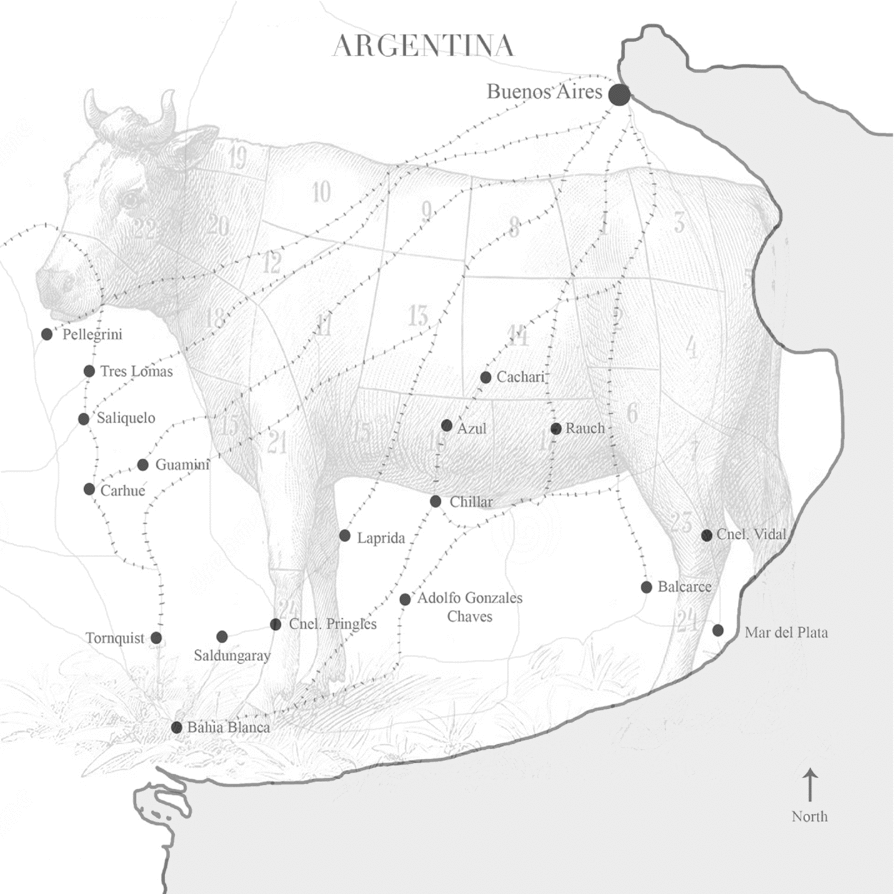
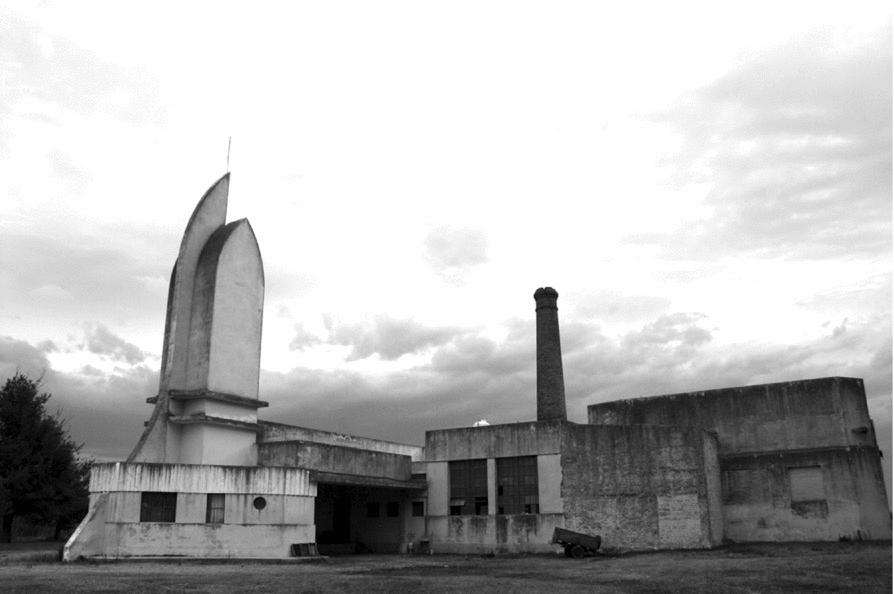
In an effort to appropriate these rural, open spaces, in the first decades of the twentieth century a group of physicians, architects and urban planners began to see agriculture as an urban function and implemented a new regional programme to colonize the Pampas. Making a slight change to the name of the late nineteenth-century military campaign known as the ‘Conquest of the Desert’, the so called ‘colonización del desierto’ (colonization of the desert) proposed by the influential group of technocrats, Los Amigos de la Ciudad, made vogue the idea that the countryside should be infused with metropolitan modernism.Footnote 48 In sync with this line of thinking, the conservative government of Manuel Antonio Fresco implemented a series of monumental and stylish architectural projects in remote towns in the Argentine Pampas. Fresco, a hygienist physician and ‘orthodox eugenicist’, modelling himself on Mussolini, constructed his governorship along a strictly fascist model.Footnote 49 Ruling by military force, Fresco's sovereign figure was singular, solid and unyielding. As was his approach to the modernization of the Pampas: within a four year span, between 1936 and 1941, Francisco Salamone, just one of the architects set to work by Fresco in the Pampas, designed and constructed over 60 public works within a smattering of small towns that grew out of former military outposts used to advance on native populations during the ‘Conquest of the Desert’.Footnote 50 Salamone designed three types of projects for Fresco's state: slaughterhouses, municipal buildings and cemeteries, located in various towns including Balcarce, Carhué, Guaminí, Coronel Pringles, Azul, Laprida, Vedia, Villa Epecuén, Salliqueló and Carlos Pellegrini. Built in a combination of Italian futurist and art deco styles, it is the rounded volumes of streamline design that most closely tie these projects back to Fresco's own association with eugenics. Consistent with the ideological underpinnings of the streamlining movement, recognized by art historian Christina Cogdell, the rounded, aerodynamic corners and details of Salamone's slaughterhouses reveal an underlying approach to buildings which mirrored and announced the state's own eugenic approach to bodies.Footnote 51 Harnessing the energy of the primitive in art deco, and reaching toward a smooth flowing, perfectible future, as signalled through the streamline form, Salamone's architecture embodied Fresco's and Los Amigos de la Ciudad's aims for the continual improvement of both human and non-human animal populations and the built environment. Reflecting the tripartite programme of Fresco's governorship, labour–order–death, each of Salamone's slaughterhouses, municipal buildings and cemeteries gave the ideologies of masterful efficiency built form. In civic government, the inaccessible towers of Salamone's work signalled a height to be reached by a future, more perfect civic body. These same inaccessible towers, when they appear on Salamone's slaughterhouses, took on clear knife and sceptre iconography when seen from the flat lowlands of the Pampas, as if the state's future would be carved out of its animal past. Through death, monumentalized in the ostentatious gates of Salamone's cemeteries, the old unrefined populations die off to make way for the new, more evolved Argentina. Reinforcing the theme of territorialization but with an unparalleled nuance, these buildings, in direct antithesis to the panopticon, were built to be seen not only from all positions on the prairies, to stand in for the all-seeing eye and the monumental body of the state, but to be seen by future, more perfect generations (Figures 7–10).
Francisco Salamone, Carhué Municipal Slaughterhouse, Carhué, Argentina, late 1930s. © Photo by Mato, 2015.
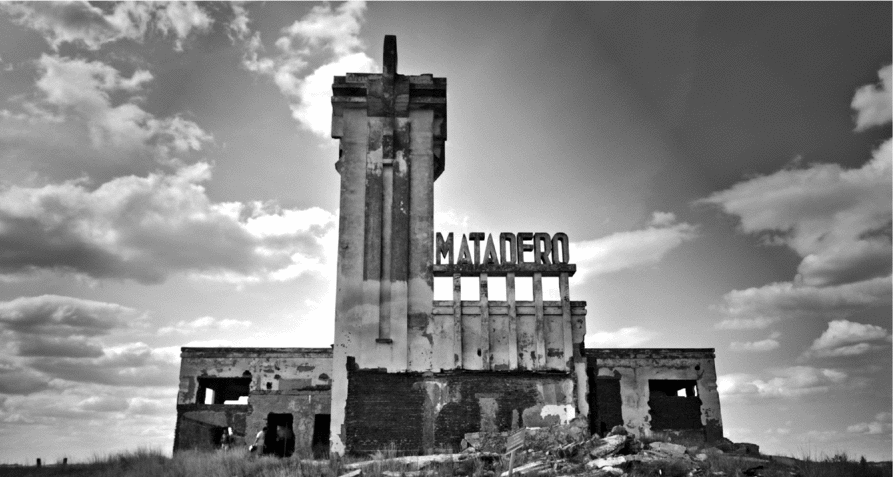
Francisco Salamone, Salliqueló Municipal Slaughterhouse, Salliqueló, Argentina, late 1930s. © Photo by Lucas Martin, 2012.
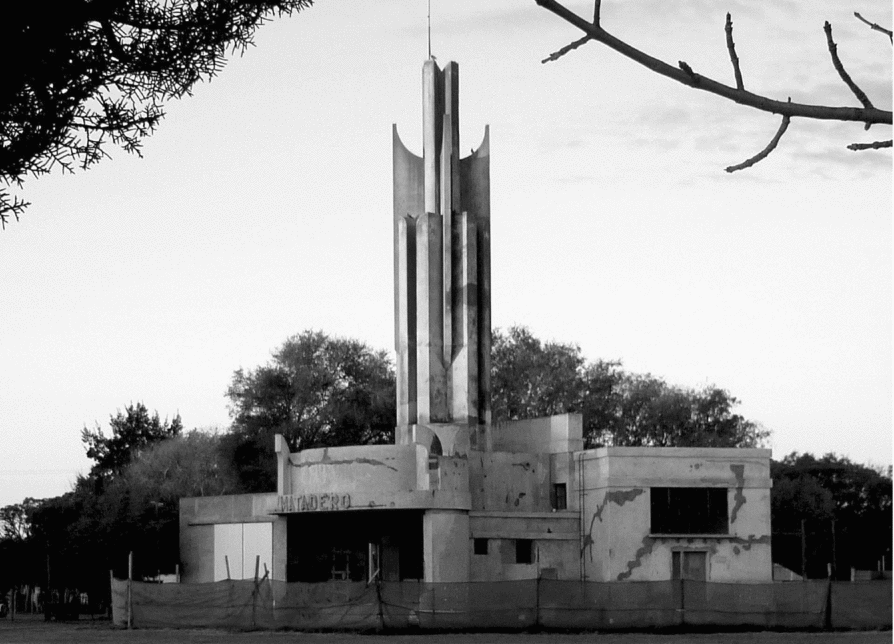
Francisco Salaomone, Azul Municipal Slaughterhouse, Azul, Argentina, late 1930s. © Photo by Christian Ostrosky, 2010.
Guaminí Municipal Slaughterhouse, Guaminí, Argentina, late 1930s. © Photo by Luis Beltrán, 2008.
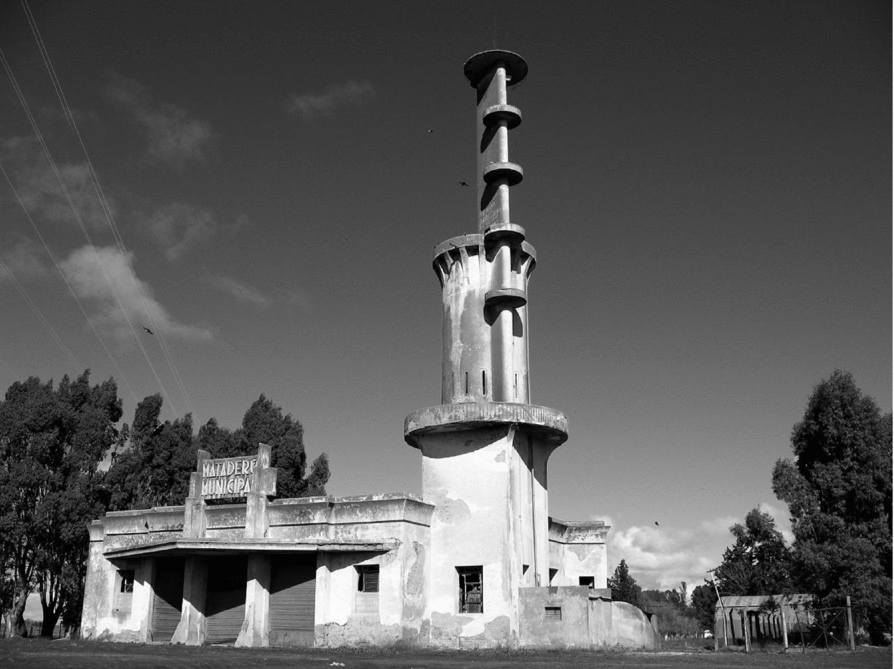
The overall result of Fresco and Salamone's partnership in the Pampas is an intricate appropriation of the pastoral, set apart as the space to cultivate the pseudo-scientific height of modernism. As British theorist of ecology Timothy Morton writes, ‘the way the land appears unoccupied is not a relic of an ancient or prehistoric past, but a function of modernity’, which, in rural Argentina, gave form to the domestication, commodification and urbanization of the countryside through the promise of future transformation.Footnote 52
Epilogue: appropriations of the pastoral
Through the juxtapositions of cattle-raising traditions, the medicalization of cities and populations and the rise of global capitalism, Argentina became a fertile territory for massive change in the guise of the status quo. What was happening in Argentina between 1868 and 1940 under the rubric of local traditions was actually a radical transformation of the land, the city and their populations both human and animal, in the interest of an international appetite for beef and profit. While relevant scholarship on the meat industry in Argentina tracks how eighteenth- and nineteenth-century hygiene movements created a series of technical and clinical apparatuses within what was once an artisanal sphere of labour and food production; our research shows how, as the site of the modern transubstantiation just described, the architecture of the meat industry provided the mechanisms for the deconstruction of this culture, utilizing the language and labour of tradition to do so. The very trope of the lone gaucho, driving cattle over the Pampas and living off the land itself, by which modern Argentine literature and the avant-garde movement was symbolically marked, arose as the artisanal cowboy culture of Argentina pitted itself against the mechanizations of North American and European cattle companies and their transforming technologies. The gaucho Martin Fierro – the lonely cowboy of José Hernandez's famous poem – became a trope for the nation through the work of the avant-garde movement who took his namesake to emphasize the strength of Argentine values through a paradoxical embrace of universalism, in order to defy the pressures of imperialism.Footnote 53 While the surface of traditional life continued on in one tenth of the country's meat production, the remaining nine-tenth operated at the behest of the dispositifs of a new form of sovereignty and species distinctions – one in which capital takes the place of the sovereign, while humans and animals fall to the status of bare life and labour, becoming the targets of control and exploitation.Footnote 54
It is not by chance that the site of this reformulation of the national trope, from the inside out, was also the site of persistent bloodletting. As both the literal and figurative sacrificial sites, within the walls of the frigoríficos that lined the Matanzas River, the Mataderos neighbourhood and the surrounding Pampas, Argentina gave up its only newly acquired national sovereignty for the sake of a more modern future. This was made possible through the rise and application of biopolitics – where life enhancement technologies became the concern of the state in order to harvest the productivity of populations as if they were natural resources. In Argentina's new capital and its surroundings, biopolitics took architectural form: first, along the Matanzas River, the monumental scale and competitive processing capacity of the two most active frigoríficos, La Negra and La Blanca, flanked each side of the river like gargantuan gates to the city and to the sea. Between them the river, the circulatory system for this industrial zone, swept both blood and offal out with over one million tons of commodities annually (Figure 11).
Transbordador Nicolás Avellaneda Bridge, 1913. Archive: Colección Museo Nacional Ferroviario.
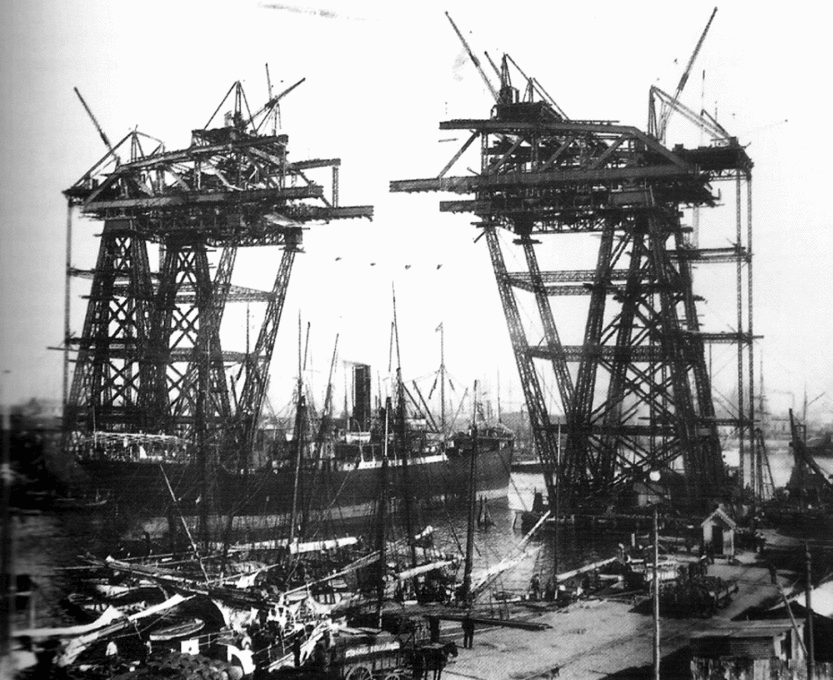
Bridging this same river, the Transbordador Nicolás Avellaneda, marked by Le Corbusier as the emblem of his 1939–40s Plan Director de Buenos Aires, became part of an untouchable region, preserved in almost every master plan for the city.Footnote 55 Second, in the adjacent Mataderos neighbourhood, the stockyards, frigoríficos and meat market emerged in place of the traditional town square, replacing the square's social and political functions with spaces of productivity and commodification. Finally, in the Pampas, the use of art deco in slaughterhouse architecture, like streamlining in industrial objects in North America, shows how style and architecture embodied eugenic ideologies. In the quests for hygiene, efficiency and productivity, reformers and architects approached buildings in the same way that eugenicists approached human bodies, merging a vitalist past and a modern utopian future in pursuit of an ideal type. At the same time, these stylized buildings acted as marks upon the territory and signs of conquest.
Mapping out new signs of sovereignty on the body of the nation, architecture became a primary tool of social hygiene and its capitalist aims for the biopolitical conversion of both the city and the countryside. As Michel Foucault wrote in the History of Sexuality, the age of sanguinity, when privilege was written into the human anatomy by blood, gave way in modern times to a new form of biopolitics, activated through mechanisms of heightened control and surveillance of all the faculties and institutions of sex.Footnote 56 And yet what the history of the meat industry in Argentina continued to show is that as the human population became subjects of social hygiene through health, production and reproduction using heredity and milieu as its tools, just one rung down, in the non-human animal realm, blood continued to do the work of subjugation that it had done in humans for centuries prior.



