I. INTRODUCTION
Solventborne laminating adhesives are dominant in the manufacturing processes especially for flexible packaging. However, as highlighted by the Environmental Protection Agency, the volatile organic compound emissions from anthropogenic sources are in urgent need of restriction, since they are hazardous air pollutants. 1 As a consequence, waterborne acrylics (WACs) are currently being explored as a replacement for the solventborne adhesives. These adhesives offer excellent durability, optical clarity, ultraviolet (UV) resistance, toughness, and oil tolerance. Reference Romo-Uribe, Arcos-Casarrubias, Hernandez-Vargas, Reyes-Mayer, Aguilar-Franco and Bagdhachi2–Reference Ebnesajjad4 However, on occasion waterborne adhesives have been reported to have a catastrophic loss of adhesion, resulting in a failure of bonded joints. Reference Packham5 Thus, new approaches are needed for the waterborne adhesives to replace the solventborne systems. As one possible solution to the serious debonding problem, WAC adhesives based on an organic/inorganic hybrid structure are being developed. Reference Sanchez, Julián, Belleville and Popall6
Generally, a small percentage (less than 5 wt%) of nanoinorganic fillers, including clay mineral, Reference Solhi, Atai, Nodehi, Imani, Ghaemi and Khosravi7–Reference Mičušík, Bonnefond, Paulis and Leiza9 titania, Reference Xiang and Zhang10 alumina, Reference Campos, Urbano and Rivas11,Reference Rong, Ji, Zhang and Friedrich12 nanosilica, Reference Chang, Oyang, Chen, Hwang and Cheng13,Reference Lin, Don, Chen, Lin, Lee and Cheng14 and calcium carbonate, Reference Gumfekar, Kunte, Ramjee, Kate and Sonawane15 are mechanically blended into the adhesives resulting in dramatic enhancement of the adhesive properties with clay being the most favorable. In case of pressure-sensitive adhesives (PSAs), Bonnefond et al. studied the morphology and properties of the waterborne films from n-butyl acrylate/methyl methacrylate/montmorillonite clay (MMT) hybrid adhesives. Reference Bonnefond, Mičušík, Paulis, Leiza, Teixeira and Bon16 The peel resistance increased for the formulations containing MMT. The most remarkable result was obtained for 2% weight based on monomers (wbm%) of MMT, 0.23 wbm% of allyl methacrylate, and 0.15 wbm% of n-dodecyl mercaptan with 180° peel strength of 250 N/m. In 2013, acrylic/MMT PSAs were synthesized by Oh et al. via in situ emulsion polymerization and mechanical blending. Reference Oh, Park, Lee, Park and Kim17 A greater dispersion of MMT and higher peel strength of 370 g f was reported by using an in situ emulsion polymerization technique, where the polymerization was performed in the presence of the clay additive. In another work, a solventless UV-crosslinkable acrylic approach was taken to formulate PSAs. Reference Kajtna, Šebenik and Krajnc18 With increasing MMT, a maximum of 1000 N/m peel strength was achieved with 3–5 wt% of MMT Cloisite depending on type. However, there has been a lack of systematic development of waterborne laminating adhesives that can give definitive direction for the flexible packaging industry. In a previous report, a relatively new class of mesoporous materials, porous clay heterostructure (PCH), with a specific surface area of approximately 500–1000 m2/g, was used successfully in waterborne polyurethane laminating adhesives. After modification, the amino-functionalized PCH was reported to greatly improve the viscosity, thermal, and adhesion properties of waterborne polyurethane hybrid adhesives, as well as lowering the crystallinity and glass transition temperature (T g) of the polyurethane matrix.
In this study, the synthetic strategy for generating effective WAC hybrid adhesives is the combination of an acrylic polymeric matrix (a soft domain with flexibility and ductility) and an inorganic filler (a hard domain with rigidity and thermal stability) through a covalent bond. The PCH nanoparticles were functionalized using a silylation reaction with 3-(trimethoxysilyl)propyl methacrylate (TSPM) acting as a coupling agent, Reference Kango, Kalia, Celli, Njuguna, Habibi and Kumar19 where the resultant methacrylate-functionalized PCH (MPCH) can covalently bond with the acrylic matrix reducing any tendency for macroscopic phase separation between the filler and matrix. Reference Mičušík, Bonnefond, Paulis and Leiza9,Reference Guo, Wang, Zhang, Liu, Zhang and Qu20 A new acrylic latex adhesive matrix was designed using mostly 2-ethylhexyl acrylate (EHA) and ethylene glycol methyl ether acrylate (EGMA), with small quantities of styrene, 2-(hydroxyethyl) methacrylate (HEMA), and acrylic acid. The acrylic acid on the latex particle surfaces was used to facilitate the emulsion stability and, after film formation, the physical crosslinking via ionic clusters. Reference Landfester21,Reference Foster, Lovell and Rabjohns22 The in situ emulsion polymerization of these monomers in the presence of MPCH was designed to be industrially scalable. Reference Araújo, Abad, de la Cal, Pinto and Asua23 The influence of MPCH concentration on the morphology, structural, physical, and thermal properties of the WAC hybrid adhesives was investigated using Fourier transform infrared spectroscopy (FTIR), scanning electron microscopy (SEM), energy dispersive X-ray analysis (EDX), Brookfield viscosity, DuNouy surface tension, dynamic light scattering (DLS), differential scanning calorimetry (DSC), and thermogravimetric (TG) analyses. The adhesion properties of the synthesized WAC hybrid adhesives on an oriented polypropylene (OPP)/paper lamination were determined by measurement of their 180° peel strength.
II. EXPERIMENTAL
A. Materials
Commercial sodium-activated bentonite (BTN) with a cationic exchange capacity of 44.5 mmol/100 g was supplied by Thai Nippon Chemical Industry Co., Ltd. (Bangkok, Thailand). Cetyltrimethylammonium chloride (CTAC), from Italmar Co. Ltd. (Bangkok, Thailand), was used as the cationic surfactant, while TSPM and tetraethoxysilane (TEOS) were purchased from Sigma Aldrich (St. Louis, Missouri) as silica sources. Dodecylamine, sodium acetate trihydrate (CH3COONa·3H2O) and acetic acid (CH3COOH) were obtained from Sigma Aldrich and used as the dispersing medium. Methanol (CH3OH) and 37% hydrochloric acid (HCl) were acquired from RCI Labscan Ltd (Bangkok, Thailand). Monomers, including EHA, EGMA, HEMA, styrene, and acrylic acid, were purchased from Sigma Aldrich (St. Louis, Missouri). All monomers were purified using an inhibitor removal resin (Alfa Aesar, Tewksbury, Massachusetts) to remove contaminants. Triton™ X-100, sodium dodecyl sulfate (SDS), sodium bicarbonate (NaHCO3), and ammonium persulfate (APS) were purchased from Sigma Aldrich (St. Louis, Missouri) as the surfactants, buffer, and initiator in the emulsion polymerization process, respectively.
B. Preparation of MPCH
Mesoporous materials were accomplished as follows: approximately 50 g of BTN was dispersed in 0.1 M CTAC solution at 50 °C for 24 h until equilibrium to obtain the cationic exchange reaction. The synthesized product was filtered and then washed with a mixture of deionized water and methanol (1:1) until at pH of 9. Organo-modified BTN (OBTN) was agitated in dodecylamine at 50 °C for 30 min, followed by TEOS to derive the co-condensation at room temperature for 4 h (OBTN: dodecylamine: TEOS (v/v/v) of 1:20:150). The dried OBTN was purified via solvent extraction (CH3OH:HCl (v/v) of 9:1) and screened through a mesh size of #325 to obtain the PCH with an apparent density of 1.99 g/cm3. The PCH was then suspended in a freshly prepared solution of 5% (v/v) TSPM in 0.05 M sodium acetate buffer (pH = 4.0) and the silylation process proceeded at 70 °C for 4 h. The obtained MPCH was then thoroughly washed with excess deionized water to remove the residual unlinked TSPM.
C. Preparation of the WAC hybrid adhesives
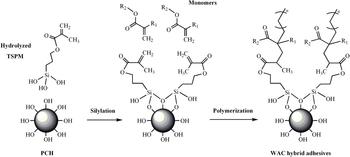
The WAC hybrid adhesives with a molecular weight (M w) of 309,128 g/mol were synthesized through batchwise emulsion polymerization, as shown in Fig. 1. Briefly, MPCH at various weight fractions (0, 0.5, 1.0, 1.5, and 2.0 wt%) was dispersed in entire monomers using an ultrasonic bath (Fisher Scientific FS20, Thermo Fisher Scientific, Tewksbury, Massachusetts) for 50 min. The pre-emulsion was prepared by homogeneous dissolution of monomers, 0.08 M surfactant, and 0.7 g buffer in deionized water, and then charged to the Optimax™ 1001 working station (Mettler Toledo, Columbus, Ohio) equipped with a thermocouple, reflux condenser, and a mechanical stirrer at 350 rpm. The polymerization was performed at 70 °C under nitrogen (N2) protection and slowly initiated by the dropwise addition of 0.45 M APS solution (a feeding rate of 0.2 mL/min). The reaction temperature was then carefully raised to 80 °C, avoiding overheating from the exothermic reaction and held for 4 h to ensure maximal conversion. The WAC hybrid adhesives were obtained with a 50 wt% solid content (according to ISO124:1997) and the pH was regulated to 7.0.
Schematic description of the grafting-to approach for WAC hybrid adhesives.

D. Film preparation
The WAC hybrid adhesive films were prepared by casting latex adhesives (20 mL) on a polytetrafluoroethylene surface. The remaining trapped water was allowed to completely evaporate at 60 °C for 24 h in a vacuum drying oven. The obtained film (typically of 0.5 mm thickness) was then stored in a desiccator at ambient temperature prior to characterization.
E. Characterization techniques
1. Structural properties by FTIR analysis
The structural properties were investigated by FTIR on a Thermo Scientific Nicolet iS50 instrument (Thermo Fisher Scientific, Grand Island, New York) with an attenuated total reflectance Smart iTX-diamond mode. The FTIR spectra were accurately recorded in an absorption mode over the wavenumber region of 4000–500 cm−1 with 16 scans and a resolution of 4 cm−1.
2. Surface area analysis
The N2 adsorption–desorption isotherms were determined using a Micromeritics TriStar II (Micrometrics, Norcross, Georgia) at 77 K following sample preparation (Micrometrics FlowPrep™ 060, Micrometrics, Norcross, Georgia) at 423 K for 15 h under vacuum. Specific surface area, pore volume, and pore size were calculated through the Brunauer–Emmett–Teller (BET) equation. Reference Brunauer, Emmett and Teller24 The pore size distribution was defined based on the Barrett–Joyner–Halenda (BJH) method Reference Barrett, Joyner and Halenda25 using the adsorption branch of the isotherm.
3. Surface morphology by field emission SEM (FE-SEM) analysis
The surface morphology of adhesives was observed by FE-SEM using a Hitachi S-4800 (Hitachi Ltd., Tokyo, Japan) model microscope with a 5.0 kV accelerating voltage. The specimen was coated with platinum by sputtering for 200 s to reduce the surface charging during electron irradiation.
4. Elemental analysis by EDX
Elemental composition within the adhesives was identified using EDX (operated together with the FE-SEM) at a 20.0 kV accelerating voltage and a working distance of 15.0 mm. The quantitative analysis was performed through mapping and point & ID modes.
5. Brookfield viscosity measurement
The viscosity characteristics were inspected via Brookfield viscometer (model DV-II+Pro) with a LV-25 spindle, Brookfield Engineering Labs. Inc (Middleboro, Massachusetts). The test temperature and speed were set at 25 °C and 100 rpm, respectively.
6. Particle size analysis by DLS
Particle size and its distribution were determined by DLS using a NanoBrook ZetaPALS Potential Analyzer (Brookhaven Instruments Co., Holtsville, New York). The latex samples were diluted to 0.5 wt% in an aqueous solution of SDS and NaHCO3. Samples were measured at room temperature through a 90° scattering angle.
7. DuNouy surface tension
Measurement of the surface tension was performed using a DuNouy tensiometer from CSC Scientific Co., Inc. (Fairfax, Virginia), and is reported in the CGS unit of dyne/cm.
8. T g analysis by DSC
The T g was characterized by DSC using a model Q2000 instrument (TA Instruments, New Castle, Delaware). The inflection point of the second heating scan was measured in a temperature range between −80 and 120 °C at a heating rate of 20 °C/min. The temperature program was designed for a heat–cool–heat system under a N2 purge rate of 50 mL/min. Approximately 5 mg of each sample was sealed in a hermetic aluminum crucible of 40 μL.
9. Thermal stability and grafting ratio (R g) analysis by TGA
The thermal decomposition was studied using a high resolution TGA model TA Q50 instrument (TA Instruments, New Castle, Delaware) under a continuous N2 atmosphere at a purge rate of 40 mL/min over the temperature range of 50–800 °C at a heating rate of 10 °C/min. Approximately 10 mg of each sample was loaded on a platinum crucible.
The R g of TSPM on the mesoporous surface was calculated from Eq. (1) Reference Kango, Kalia, Celli, Njuguna, Habibi and Kumar19 :
 $${R_{\rm{g}}} = \left( {{{W_1^\prime } \over {{W_1}}} - {{W_0^\prime } \over {{W_0}}}} \right) \times 100\% \quad ,$$
where W
1 is the starting weight of MPCH;
 $W_1^\prime$
is the residual weight of MPCH at 750 °C; W
0 is the starting weight of PCH; and
 $W_0^\prime$
is the residual weight of PCH at 750 °C.
10. Measurement of the 180° peel strength
The adhesion property of the WAC hybrid adhesives was investigated in terms of the 180° peel strength in tension testing mode according to ASTM D1876 using a Tensiometer-Instron 5567 instrument (Instron Co., Norwood, Massachusetts) equipped with a 100 N static load cell, a crosshead speed of 150 mm/min, and a gauge length of 50 mm. Laminated test panels consisted of two rectangular-shaped adherends, paper and untreated OPP film, were properly prepared and then bonded together in accordance with the WAC hybrid adhesive. Specially prepared specimens were 25 mm (1 in.) wide by 305 mm (12 in.) long, but bonded only over approximately 241 mm (9 in.) of their length. The WAC hybrid adhesive was applied on paper using a BYK drawdown bar with an average coating thickness of 24 μm and suddenly adhered to untreated OPP film. The OPP/WAC hybrid adhesive/paper laminated joints were postcured at 60 °C. The 76 mm (3 in.) long unbounded ends bent apart, perpendicular to the glue line, for clamping in the grips of the testing machine. An autographic curve of peeling was calculated as the average peeling load in N/m of the specimen width required to separate the adherends.
III. RESULTS AND DISCUSSION
A. Synthesis and characterization of MPCH
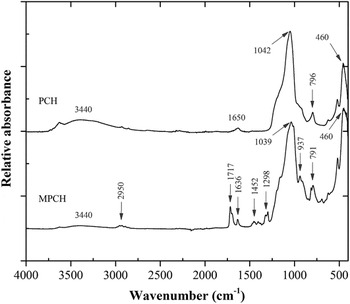
The different vibration modes of chemical groups in the PCH and MPCH materials were assigned from the FTIR spectra, as indicated in Fig. 2. The characteristic FTIR bands of the stretching vibrations of Si–O–Si linkages in asymmetric and symmetric modes were centered at 1042 cm−1 and 796 cm−1, respectively, in PCH, while they were at 1039 cm−1 and 791 cm−1, respectively, in MPCH. The bending vibrations of these linkages were located at 460 cm−1. The broad absorptions at 3440 and 1650 cm−1 were ascribed to the Si–OH stretching and the bending vibrations of hydrogen-bonded surface silanol groups, which were physically adsorbed water. Reference Hair26,Reference Bunnak, Ummartyotin, Laoratanakul, Bhalla and Manuspiya27 Moreover, the reduction in the intensity of these absorption bands in MPCH indicates the total surface modification of PCH via the silylation reaction between the –OH groups on the PCH surface and the hydrolyzed TSPM. Reference Kango, Kalia, Celli, Njuguna, Habibi and Kumar19 After this silane treatment, C–H asymmetric and symmetric stretching vibrations at around 2900–2800 cm−1; C=O stretching vibrations at 1717 cm−1 associated with carbonyl ester compounds; C=C stretching vibrations at 1636 cm−1; –CH2 and –CH3 asymmetric deformations at 1452 cm−1; C–O–C asymmetric stretching vibrations at 1298 cm−1; and CH=CH2 out of plane deformations in vinyl compounds at 937 cm−1 were all in evidence. Therefore, the FTIR analysis revealed the successful functionalization of methacrylate groups on the surface silanol groups of PCH, confirming the formation of MPCH.
Attenuated total reflectance-FTIR spectra of PCH and MPCH.

The exact amount of methacrylate groups anchored on MPCH was then determined by TG analysis, where the decomposition ratio of organic compounds corresponds to their R g. Reference Wenfang, Zhaoxia and Jian28 The greater the weight loss, the higher the obtained grafting level. The untreated PCH had a total weight loss of 8.8 wt% up to 200 °C, which was due to the elimination of physically adsorbed water. Meanwhile, MPCH had a total weight loss of 34.8% at 387.8 °C, which was due to the degradation of covalently grafted methacrylate-functional silane groups on the surface. Reference Kango, Kalia, Celli, Njuguna, Habibi and Kumar19 By contrast, there was no adsorption of water on MPCH due to the replacement of the hydrophilic silanol groups of PCH with methacrylate groups in MPCH, as confirmed by the FTIR results. Thus, the R g, expressed as the percentage of add-on, and calculated using Eq. (1) was 26.1% of methacrylate-functional silanes on MPCH.
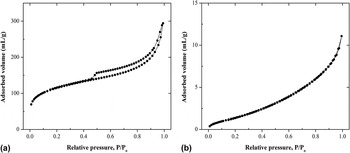
The measurement of the amount of N2 adsorbed over a range of partial pressures at 77 K gave the N2/77 K adsorption–desorption isotherms, which were used to describe the surface morphology and physical properties of the porous materials. According to the Brunauer–Deming–Deming–Teller (BDDT) classification, Reference Brunauer, Deming, Deming and Teller29 a type-IV isotherm was exhibited by the untreated PCH [Fig. 3(a)], which is characteristic of mesoporous materials with a strong adsorbate–adsorbent interaction. In addition, its adsorption and desorption branches do not coincide, indicating a hysteresis loop at a high relative pressure (P/P o). From the IUPAC classification, Reference Sing, Everett, Hual, Moscou, Pierotti, Rouquérol and Siemieniewska30 a type-H3 loop can be attributed to the slit-shaped pores with wide bodies and narrow short necks. A BDDT type-II isotherm was exhibited by MPCH [Fig. 3(b)], which is typical of nonporous solids with capillary condensation at a P/P o of 0.85, suggesting that the methacrylate groups replaced the continuous pore area of the PCH host material.
N2/77 K adsorption–desorption isotherms of (a) PCH and (b) MPCH.

The linear relation of the BET equation Reference Brunauer, Emmett and Teller24,Reference Vega-Baudrit, Navarro-Bañón, Vázquez and Martín-Martínez31 in the P/P o range of 0.05–0.30 is mainly used to determine the monolayer adsorption capacity (V m) of materials, using Eq. (2):
 $${P \over {{V_{{\rm{ads}}}}\left( {{P_{\rm{o}}} - P} \right)}} = {1 \over {{V_{\rm{m}}}C}} + {{\left( {C - 1} \right)P} \over {{V_{\rm{m}}}C{P_{\rm{o}}}}}\quad ,$$
where V ads is the adsorption volume of N2, P is the equilibrium pressure, P o is the saturation pressure, and C is a parameter related to the heat of adsorptive interactions of monolayer.
The specific surface area (S BET) is obtained from the V m values by applying Eq. (3):
 $${S_{{\rm{BET}}}} = {{{a_{\rm{m}}}{V_{\rm{m}}}{N_{\rm{A}}}} \over {{V_{\rm{M}}}}}\quad ,$$
where a m is the cross section of the N2 molecule (16.2 × 10⁻²⁰ m2), N A is Avogadro’s number, and V M is the molar volume of N2 (22,414 cm3/mol).
The application of the BET equation gave a S BET and C BET of 415.8 ± 2.3 m2/g and 178.0, respectively, for untreated PCH with a BJH pore diameter and pore volume of 4.43 nm and 0.46 cc/g (calculated from the adsorption branches of isotherms), respectively. The S BET of PCH was relatively high due to its porous structures at the nanometer scale. After modification of PCH to MPCH, the S BET and C BET values were significantly decreased (96.7- and 3.7-fold, respectively) to 4.3 ± 0.1 m2/g and 48.6, respectively, indicating the small cavities, assumed then to be a nonporous material. In fact, when the porous material was fully filled cavities across its depth, its characteristic was changed to be the nonporous material with a very low S BET. In the case of MPCH, the preferential adsorption of the long-chain methacrylate-functional silanes, either in the pores or on the surfaces of the PCH host material led to the significant changes in the surface morphology of MPCH and its S BET. Finally, MPCH transformed into the nonporous material.
B. Hybrid WAC adhesives
As a result of MPCH, the emulsion polymerization was then occurred between acrylic monomers and methacrylate groups of TSPM anchoring either in the pores or on the surfaces of MPCH. Therefore, the internal strength was increased through a strong chemical bonding. On the other hand, the modification of clay mineral by TSPM caused the methacrylate groups anchoring only on its surfaces so the reinforcement was not as strong as when using MPCH.
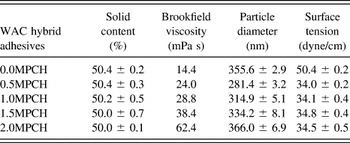
The characteristics of the WAC hybrid adhesives prepared by batchwise emulsion polymerization, including the solid content, Brookfield viscosity, particle size and surface tension, are summarized in Table I. The solid contents of the adhesives, in terms of the ISO124:1997 standard, were almost identical to the theoretical designed value with ∼99% conversion levels, which implies that there was no residual monomer at the end of the polymerization. The Brookfield viscosity of the latex adhesives exponentially increased from 14.4 to 62.4 mPa s with increasing MPCH contents, which is due to the unfolding of the polymer molecules (thickening behavior). The viscosity of latex adhesives is a function of the volume fraction of the dispersed phase. Reference Arevalillo, do Amaral and Asua32 The presence of MPCH and its intramolecular interaction via chemical bonding within the WAC chains might considerably decrease the polymer chain entanglement, increase the effective volume fraction, and hence the viscosity of latex adhesives. A much larger volume fraction of MPCH led to an aggregation of MPCH and to undergo conformation changes, which are thought to result in unfolding the structure of the WAC hybrid adhesives.
Physical characteristics of the WAC hybrid adhesives.

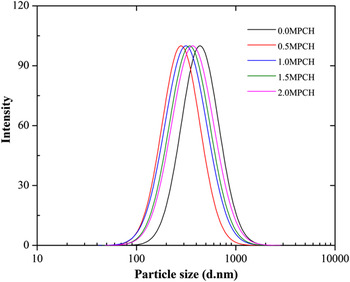
The DLS curves of WAC hybrid adhesives exhibited a single narrow peak, indicating a monodisperse particle size distribution of the synthesized latex adhesives (Fig. 4). The average particle diameters and surface tensions of the WAC hybrid adhesives were much lower than that of the neat adhesive, resulting in a good wettability and stability of the latex adhesives. The MPCH could be encapsulated by either latex particles or on the surfaces of the latex, so the average adhesive particle size was enhanced with increasing MPCH content, ranging from 281 nm to 366 nm as the MPCH contents increased from 0.5 to 2.0 wt%, respectively.
DLS curves of WAC hybrid adhesives. Curves shown are representative of those seen from five samples.

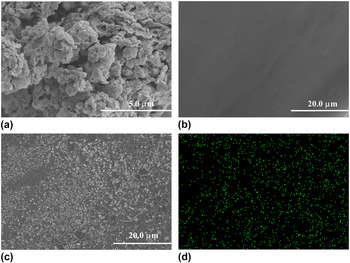
The surface morphologies of MPCH and WAC hybrid adhesives were examined by FE-SEM, with representative images shown in Figs. 5(a)–5(c). The MPCH exhibited a rough surface with small cavities due to the placement of methacrylate-functional silanes inside or on the surfaces of the PCH pores. The synthesized WAC hybrid adhesive showed a good dispersion and distribution of MPCH compared to the neat WAC adhesive, which was due to the strong chemical bonding of vinyl groups. The quantitative elemental composition in the WAC hybrid adhesives was evaluated by EDX analysis [Fig. 5(d)], where the surface of 2.0 wt% MPCH was found to clearly be covered with silicon atoms (green dots) at 12.6%, which was confirmed by the point and ID method.
FE-SEM micrographs of (a) MPCH (10.0 kx magnification, scale bar = 5 μm), (b) 0.0MPCH, (c) 2.0MPCH (2.0 kx magnification, scale bar = 20 μm), and (d) EDX analysis showing the silicon mapping of 2.0MPCH.

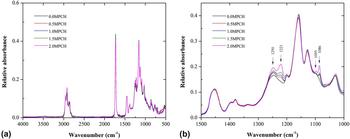
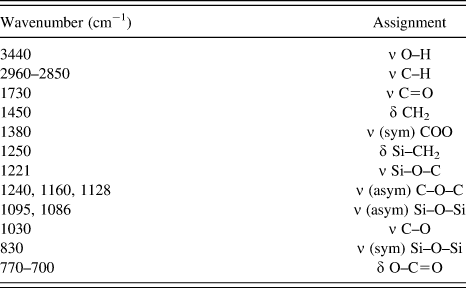
The interfacial interactions of MPCH with the acrylic adhesives were examined using FTIR spectra (Fig. 6). The prominent absorption bands are assigned in Table II. Reference Romo-Uribe, Arcos-Casarrubias, Hernandez-Vargas, Reyes-Mayer, Aguilar-Franco and Bagdhachi2,Reference Lin, Yang, Wang, Shieh and Chen33,Reference Feldgitscher, Peterlik, Ivanovici, Puchberger and Kickelbick34 The neat WAC adhesive displayed a broad O–H stretching vibration (very weak) band at 3440 cm−1 from the residual adsorbed water. In addition, there were asymmetric and symmetric C–H stretching vibrations at 2960–2850 cm−1, and the corresponding bending vibration at 1450 cm−1, C=O stretching vibration at 1730 cm−1, symmetric vibration of COO at 1380 cm−1, and the ester C–O–C asymmetric vibration at 1240–1128 cm−1 (two bands). These absorbances showed the connectivity between MPCH and acrylic matrix due to the disappearance of C=C bonds, assuming that entire C=C bonds from TSPM and monomers completely reacted. Meanwhile, the absorption bands of siloxane and its derivatives were observed in the presence of MPCH [see enlargement in Fig. 6(b)]. The spectra revealed absorbances associated with the neat WAC adhesive. The asymmetric Si–O–Si stretching vibrations, symmetric Si–O–Si stretching vibration, C–H symmetric deformation of Si–CH2, together with the Si–O–C stretching vibration located at 1095–1086, 830, 1250, and 1221 cm−1, respectively, were strongly increased with increasing MPCH contents. This explicitly indicates the formation of MPCH structural units in the WAC hybrid adhesives.
(a) Full range and (b) enlarged wave number range of 1000–1500 cm−1 FTIR spectra of the WAC hybrid adhesives with different MPCH contents.

The most characteristic FTIR bands of the WAC hybrid adhesives.

ν: stretching, δ: bending, sym: symmetric, asym: asymmetric.
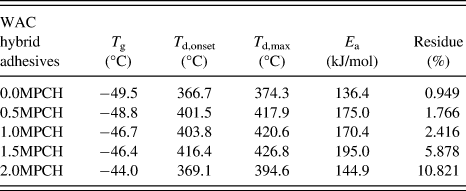
Representative DSC thermograms of WAC hybrid adhesives are shown in Fig. S1. During heating, a single low-centered T g was obtained, consistent with an exothermic process. The T g values of the WAC hybrid adhesives were affected by the MPCH content as well as its coupling agents. Reference Mahkam and Vakhshouri35 With the addition of MPCH filler, the T g values were gradually shifted to a higher temperature range from −49.5 °C to −44.0 °C (Table III). Hence, the reduction in flexibility of their phase in which the MPCH reacted to the polymer chains and its ability to inhibit polymer motion presumably via covalent attachment were achieved, resulting in the enhanced T g.
Glass transition temperature (T g), decomposition temperature (T d), activation energy (E a) and residue of the WAC hybrid adhesives.

T d,onset is the thermal degradation onset temperature, T d,max is the thermal degradation maximum temperature and E a is the apparent activation energy for each polymer.
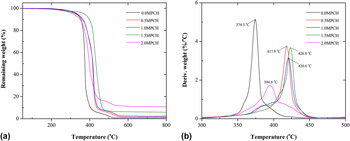
The thermal stability of WAC hybrid adhesives was evaluated by TG analysis, where the weight loss and weight derivative are exhibited as a function of the temperature. When increasing the temperature, one degradation stage appeared in the range of 360–430 °C [Fig. 7(a)], which was attributed to the complex procedure of depolymerization and decomposition. The neat WAC adhesive was thermally stable with a weight loss up to 360 °C, and then thermal degradation rapidly occurred at an onset temperature of 366.7 °C, which is typical of acrylic polymers. Reference Campos, Urbano and Rivas11,Reference de la Fuente, Fernández-García and Madruga36 The TG and derivative TG (DTG) curves were considerably shifted to higher temperature ranges with increasing MPCH contents up to 1.5 wt%, where the maximum degradation temperature was about 52.5 °C higher than that of the neat WAC adhesive [Fig. 7(b)]. Therefore, the WAC hybrid adhesives had a higher thermal stability and slower decomposition rate when incorporating the MPCH moiety due to the greater bonding energy of the Si–O bond compared to the C–C and C–O bonds. Reference Sun, Miao, Zhang, Kim and Yuan37 Conversely, the decomposition temperature was then significantly decreased when increasing the MPCH loading to 2 wt%, because the aggregation of excess MPCH particles led to phase separation between the reinforcing filler and matrix, resulting in a lower thermal stability.
(a) TG and (b) DTG thermograms of the WAC hybrid adhesives with different MPCH contents.

Additionally, the activation energies (E
a) for thermal decomposition of the WAC hybrid adhesives were investigated through modulated TG analyses using the Hotowitz and Metzger equation,
Reference Horowitz and Metzger38
shown in Eq. (4), where the activation energy was calculated from the slope
 $\hbox( {{{{E_{\rm{a}}}} \over {RT_{\max }^{\rm{2}}}}} \hbox)$
of the plot of
 $\ln \hbox[ {\ln \hbox( {{{{W_0}} \over {{W_T}}}} \hbox)} \hbox]$
versus θ for the main stage of the thermal degradation (assuming that the order of reaction is the unit), as depicted in Fig. S2. The results are listed in Table III.
 $$\ln \left[ {\ln \left( {{{{W_0}} \over {{W_T}}}} \right)} \right] = {{{E_{\rm{a}}}\theta } \over {RT_{\max }^2}}\quad ,$$
where E a is the apparent activation energy, W 0 is the initial weight of polymer, W T is the residual weight of polymer at temperature T, θ is T − T max, and R is the gas constant [8.314 J/(mol K)].
As expected, the activation energy of the neat WAC adhesive (136.4 kJ/mol) was much lower than that of the WAC hybrid adhesives. Increasing the MPCH loading levels up to 1.5 wt% increased the activation energy up to 195.0 kJ/mol. Thus, the hybrid adhesives required a greater maximum energy to destroy their chemical bonding, affirming the TG and DTG results. This indicates that the introduction of MPCH into the acrylic adhesive structure gave good thermal properties.
C. Adhesion properties
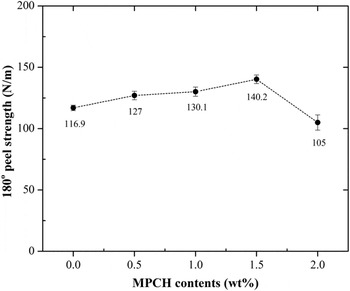
The 180° peel strength measurement, defined as the average load at plateau, is a reliable method for studying the adhesion property of OPP/WAC hybrid adhesives/paper joints with good reproducibility and sensitivity. The effect of the MPCH concentration on the adhesion properties of WAC hybrid adhesives is shown in Fig. 8. Unmodified WAC adhesive generally had an undesirable cohesive failure in its bulk layer due to the lack of cohesive (internal) strength. Both the cohesive and adhesive strengths could be improved by reinforcing the interfacial bond strength. With increasing MPCH concentrations, the 180° peel strength value was initially increased up to 140.2 N/m at 1.5 wt% MPCH, but then sharply decreased. An excess of MPCH reduced flexibility and, as a consequence, adhesion performance (decreased peel strength). The peel strength of the commercial adhesive is 126.6 N/m, which was lower than that of the synthesized WAC hybrid adhesive.
Average 180° peel strength of the WAC hybrid adhesives with different MPCH contents. Data are shown as the average derived from ten measurements.

The nonmonotonic trend in adhesion and thermal properties was due to the kinetics of polymerization. The observed kinetic behavior of the emulsion polymerization process can be roughly divided into three intervals of (i) particle nucleation, (ii) monomer transfer, and (iii) constant size and number of particles. Reference Mirzataheri, Mahdavian and Atai39 However, the addition of MPCH into the system has a slight retarding effect on the polymerization rate and fractional conversion. It was found that the particle morphology depended on the ability of MPCH to disperse and chemically bond throughout the polymer particles. The use of small amounts of acrylic acid as an auxiliary monomer promoted MPCH adhesion and dispersion onto the polymer surface during the batch emulsion polymerization process of the overall hydrophobic monomers. When the reactions were strictly under kinetic control, where the higher amounts of MPCH were unable to disperse during emulsion polymerization, the aggregation was observed. Thus, a reduction in the peel strength and thermal properties was exhibited at 2 wt% MPCH.
IV. CONCLUSION
A series of WAC hybrid laminating adhesives were successfully synthesized using the batch emulsion polymerization based on organic/inorganic structures. This approach added in a systematic way to the knowledge skill set needed for the waterborne adhesives to fully replace the presently used solventborne systems. PCHs with an extremely high specific surface area (415.8 m2/g) were modified with TSPM through a simple sol–gel process. The resultant MPCH, functionalized either in the pores or on the surfaces of the PCH, was then confirmed by the FTIR. The replacement of slit-shaped cavities of PCH host material with TSPM led to the nonporous MPCH (S BET of 4.3 m2/g). The WAC hybrid adhesives containing MPCH offered excellent thermal properties (low T g values and high degradation temperature) in all samples due to the increased internal strength via the covalent attachment between acrylic matrix and MPCH. The optimal formulation was found to be with 1.5 wt% MPCH, giving a laminated joint 180° peel strength of 140.2 N/m. This WAC hybrid based adhesive system has the possibility of replacing solventborne technology for use in the flexible packaging industry.
Supplementary Material
To view supplementary material for this article, please visit https://doi.org/10.1557/jmr.2017.332.
ACKNOWLEDGMENTS
This research was financially supported by Research and Researchers for Industries (RRI), the Thailand Research Fund (TRF) Grant number PHD56I0019. Additionally, the authors are thankful for the utilization of the experimental facilities at College of Polymer Science and Polymer Engineering National Polymer Innovation Center, The University of Akron and the certificated proofreader, Dr. Robert Butcher, at the Publication Counseling Unit, Science Department, Chulalongkorn University.