Introduction
The protective influence of cognitive reserve in cerebral disease is well established (Stern, Reference Stern2009). Reserve theory posits that some individuals are better able to cope with brain pathology, with Reserve postulated to moderate the relationship between pathology and a functional outcome such as cognitive function. Broadly speaking, the “Reserve” construct explains how persons maintain function in the face of cerebral injury, in cognitive as well as other functional domains (e.g., physical, social, etc.). Moderating effects were shown in numerous neurological populations including Alzheimer’s disease (AD; Stern, Reference Stern2012), multiple sclerosis (MS; Amato et al., Reference Amato, Razzolini, Goretti, Stromillo, Rossi, Giorgio and De Stefano2013), Parkinson’s disease (PD; Hindle et al., Reference Hindle, Hurt, Burn, Brown, Samuel, Wilson and Clare2016), and amyotrophic lateral sclerosis (ALS; Montuschi et al., Reference Montuschi, Iazzolino, Calvo, Moglia, Lopiano, Restagno and Chio2015). The buffering effects of Reserve have been most studied in the cognitive domains of episodic memory and processing speed (Modica et al., Reference Modica, Bergsland, Dwyer, Ramasamy, Carl, Zivadinov and Benedict2016; Sumowski et al., Reference Sumowski, Rocca, Leavitt, Dackovic, Mesaros, Drulovic and Filippi2014).
Estimates of past, or premorbid, Reserve include proxies for cognitive (and presumably neural) development such as education years, occupational achievement, and engagement in intellectually enriching and social activities during childhood (Sumowski, Wylie, Gonnella, Chiaravalloti, & Deluca, Reference Sumowski, Wylie, Gonnella, Chiaravalloti and Deluca2010). In addition, there is a growing interest in how current behavior maintains Reserve in adulthood. Older adults who regularly engage in leisure activities are 38% less likely to develop dementia (Scarmeas, Levy, Tang, Manly, & Stern, Reference Scarmeas, Levy, Tang, Manly and Stern2001), and current enrichment activities can delay onset of cognitive processing problems by up to 8 years (Vemuri et al., Reference Vemuri, Lesnick, Przybelski, Machulda, Knopman, Mielke and Jack2014). Another study showed that maintenance of recreational activity attenuated the impact of gray matter (GM) atrophy on cognitive processing speed in MS patients (Booth et al., Reference Booth, Rodgers, Schwartz, Quaranto, Weinstock-Guttman, Zivadinov and Benedict2013).
Personality may also moderate the effects of cerebral disease on functional outcomes. The most widely studied and validated personality model is the Five Factor Model (FFM; Costa & McCrae, Reference Costa and McCrae1992) comprising five phenotypical traits—Neuroticism, Extraversion, Openness, Agreeableness, and Conscientiousness. In MS, high Conscientiousness protects against impaired cognitive processing speed among patients with greater brain atrophy (Benedict, Schwartz, et al., Reference Benedict, Schwartz, Duberstein, Healy, Hoogs, Bergsland and Zivadinov2013). In AD, low Conscientiousness is a risk factor for transitioning from mild cognitive impairment to dementia (Wilson, Schneider, Arnold, Bienias, & Bennett, Reference Wilson, Schneider, Arnold, Bienias and Bennett2007).
Reserve and FFM constructs are not necessarily independent. For example, Openness correlates with both fluid and crystallized intelligence (DeYoung, Peterson, & Higgins, Reference DeYoung, Peterson and Higgins2005) as well as years of education (von Stumm & Ackerman, Reference von Stumm and Ackerman2013). People high in Openness also engage more often in cognitively activating tasks, a component of Reserve maintenance. This greater exposure to cognitive activity is believed to keep the brain active and promote neuroplasticity (Duberstein et al., Reference Duberstein, Chapman, Tindle, Sink, Bamonti, Robbins and Franks2011). With respect to other FFM traits, extroverts are more likely than introverts to engage in competitive leisure pursuits such as team-based sports and social club membership (Argyle & Lu, Reference Argyle and Lu1990). Average Neuroticism, low Extraversion, high Openness, and high Conscientiousness are all associated with greater academic success (O’Connor & Paunonen, Reference O’Connor and Paunonen2007). Thus, Reserve and personality seem to be related and may develop interactively.
In the present work, we endeavored to elucidate the relationship between multiple components of the Reserve construct and the FFM traits. MS was judged to be an ideal disease for such research, as both Reserve and FFM are known to impact adaptation to cerebral injury in this disease.
Methods
Subjects
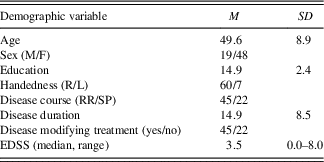
A sample of 67 MS patients (19 male, 48 female) was studied, representing a subset of a larger previously described cohort (Benedict, Schwartz, et al., Reference Benedict, Schwartz, Duberstein, Healy, Hoogs, Bergsland and Zivadinov2013) who complied with a comprehensive cognitive and psychiatric assessment as well as a detailed measure of Reserve-related activities. As the Reserve measure was only administered at follow-up, the current analysis is limited to this second time point. Exclusion criteria included current or past substance abuse, and any major medical, neurological, or psychological disorder aside from MS. Patients were also excluded if they suffered a relapse or underwent steroid treatment within 8 weeks of study entry. Patient characteristics are summarized in Table 1. The study was approved by the Institutional Review Board of the State University of New York at Buffalo, and informed consent was obtained from all participants.
MS patient characteristics (n=67)

Brain MRI Acquisition and Analysis
All participants were examined on a 3T GE Signa Excite HD 12.0 Twin Speed 8-channel scanner with a maximal slew rate of 150 T m−1 s−1 and maximal gradient amplitude in each orthogonal plane of 50 mT/m. We acquired the following sequences: two-dimensional (2D) multiplanar dual-fast spin-echo proton density and T2-weighted image (WI), fluid-attenuated inversion-recovery, and 3D high-resolution T1-WI using a fast-spoiled gradient echo with magnetization-prepared inversion-recovery (IR) pulse and spin-echo T1-WI. All sequences were acquired with a 256×192 matrix (frequency×phase) and a field of view of 25.6×19.2 cm (256×256 matrix) for an in-plane resolution of 1×1 mm. For all 2D scans, 48 slices were collected with a thickness of 3 mm and no gap between slices. For the 3D high-resolution IR fast-spoiled gradient echo, 128 locations were acquired (1.5 mm thick).
Other relevant parameters were as follows: for dual-fast spin-echo proton density/T2, echo and repetition times (TE and TR) were TE1/TE2/TR=9/98/5300 ms, flip angle (FA)=90, and echo train length=14; for fluid-attenuated inversion recovery, TE/TI/TR=120/2100/8500 ms (TI-inversion time), FA=90, and echo train length=24; for spin-echo T1-WI, TE/TR=16/600 ms and FA=90; and for 3D HIRES T1-WI, TE/TI/TR=2.8/900/5.9 ms and FA=10. Scans were acquired in an axial-oblique orientation, parallel to the subcallosal line. The SIENAX cross-sectional software tool was applied (version 2.6) (Smith et al., Reference Smith, Zhang, Jenkinson, Chen, Matthews, Federico and De Stefano2002) to obtain normalized brain tissue volumes. Owing to the known effect of T1-hypointensities on automated tissue segmentation, the 3D high-resolution T1-WI was pre-processed using a lesion in-painting (Zivadinov et al., Reference Zivadinov, Heininen-Brown, Schirda, Poloni, Bergsland, Magnano and Dwyer2012) tool before SIENAX processing. Although several MRI metrics were available for analysis, we selected only normalized gray matter volume, which corrects for head size.
Cognitive and Personality Testing
Behavioral testing was conducted under the supervision of a board-certified neuropsychologist (R.H.B.B.). Analysis focused on the Symbol Digit Modalities Test (SDMT; Smith, Reference Smith1982). The SDMT is a measure of cognitive processing speed strongly correlated with GM volume and highly sensitive to cognitive dysfunction in MS (Parmenter, Weinstock-Guttman, Garg, Munschauer, & Benedict, Reference Parmenter, Weinstock-Guttman, Garg, Munschauer and Benedict2007). The NEO-FFI was used to assess personality traits. It is a 60-item questionnaire that assesses the FFM traits: Neuroticism, Extraversion, Openness, Agreeableness, and Conscientiousness. There are 12 items pertaining to each of the five traits. Subjects are asked to rate the degree to which they agree with each statement as it relates to their own beliefs or attributes, on a 5-point Likert scale (strongly disagree, disagree, neutral, agree, or strongly agree). Raw scores are converted into T-scores in accordance with published manual guidelines (Costa & McCrae, Reference Costa and McCrae1992). The NEO-FFI has been validated in the MS population (Schwartz, Chapman, Duberstein, Weinstock-Guttman, & Benedict, Reference Schwartz, Chapman, Duberstein, Weinstock-Guttman and Benedict2011).
Reserve was measured using the Past Reserve-Building and Current Reserve-Building subscales of the DeltaQuest Cognitive Reserve measure (DQCR), a 20-item questionnaire assessing activities associated with the Reserve construct. It was originally based on three existing but unvalidated measures related to Reserve: the Stern Leisure Activities measure (Scarmeas et al., Reference Scarmeas, Levy, Tang, Manly and Stern2001), the Sole-Padulles Childhood Enrichment measure (Sole-Padulles et al., Reference Sole-Padulles, Bartres-Faz, Junque, Vendrell, Rami, Clemente and Molinuevo2009), and the Godin Leisure-Time Exercise Questionnaire (Godin & Shephard, Reference Godin and Shephard1985). The DQCR items have been modified from the above-mentioned tools to track a broader range of items, and response options were expanded.
Past Reserve-Building subscales include Childhood Enrichment and Childhood Social. Childhood Enrichment includes items related to the person’s premorbid achievement (e.g., educational achievement, occupational attainment), parental education, and childhood/adolescent enrichment activities (e.g., involvement in the arts, intellectual pursuits). Childhood Social taps social participation and friendships as a child or adolescent. Current activities relate to Current Exercise (e.g., strenuous, moderate, or mild exercise activities), Current Hobbies (e.g., crafts, music-related, reading, etc.), Current Social activities (e.g., group social activities, volunteer work, etc.), and Current Receptive behaviors (e.g., listening to the radio, watching movies, etc.). The DQCR is administered through an online survey engine. Occupational data used for the Childhood Enrichment score are coded using the Occupational Information Network (O*NET) classification system, a national source of information that characterizes the amount of education, experience, and/or skill is required to do a particular job (Peterson, Mumford, Borman, Richard, & Fleishman, Reference Peterson, Mumford, Borman, Richard and Fleishman1999).
Psychometric statistics for the DQCR were conducted in a previous study (Schwartz, Ayandeh, Rodgers, et al., Reference Schwartz, Ayandeh, Rodgers, Duberstein, Weinstock-Guttman and Benedict2015). Alpha coefficients for internal consistency reliability of the six subscales were as follows: Childhood Enrichment (α=0.65), Childhood Social (α=0.59), Current Exercise (α=0.60), Current Hobbies (α=0.54), Current Social activities (α=0.53), and Current Receptive behaviors (α=0.33). To assess construct validity of the Past Reserve-Building component of the DQCR, the North American Adult Reading Test (NAART) (Uttl, Reference Uttl2002) was included in this previous study. The NAART has been used as a proxy of premorbid reserve in previous research (Benedict, Morrow, Weinstock-Guttman, Cookfair, & Schretlen, Reference Benedict, Morrow, Weinstock-Guttman, Cookfair and Schretlen2010). The Past Enrichment factor was correlated moderately with the NAART (r=−0.46; p<.001), supporting construct validity of the DQCR measure. The interested reader is referred to Schwartz et al. (Schwartz, Ayandeh, Rodgers, et al., Reference Schwartz, Ayandeh, Rodgers, Duberstein, Weinstock-Guttman and Benedict2015) for further details on the reliability and validity of the DQCR.
Statistical Analysis
To examine associations between aspects of Reserve and personality, bivariate correlations were computed between each of the five FFM traits and the six DQCR subscales. To further examine how Reserve-related activities and the FFM independently and interactively predict SDMT performance, a series of hierarchical regression analyses were built using a purposeful selection procedure as described by Hosmer and colleagues (Hosmer & Lemeshow, Reference Hosmer and Lemeshow1989). This approach uses a more relaxed alpha level of 0.10 to select relevant covariates in univariate models, and a more stringent alpha level of 0.05 for multivariate modeling. Starting with a relaxed p-value allows us to examine individual associations without the interfering effects related to collinearity. However, in the end, we want the most parsimonious model.
While deleting model variables from the multivariate model might introduce bias, it will improve precision of parameter estimates. Both sets of models were used to test a-priori-specified hypotheses, hence we retain the standard Type I error rate of 0.05. The predictors tested in univariate regressions included age, sex, disease duration, EDSS, normalized GM volume, each of the five FFM traits, each of the two past Reserve DQCR subscales (i.e., Childhood Enrichment and Childhood Social), and each of the four current DQCR subscales (i.e., Current Exercise, Current Hobbies, Current Social, and Current Receptive). Variables that significantly predicted SDMT scores were later entered into the hierarchical regression. Examination of residual and scatter plots indicated that the assumptions of normality, linearity, and homoscedasticity were all satisfied. Collinearity statistics (Tolerance, and Variance Inflation Factor) were also within normal limits.
Results
Reserve and Personality Associations
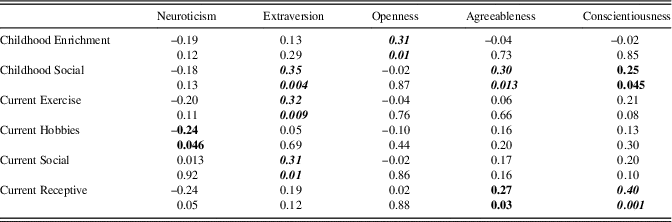
Results from bivariate DQCR/NEOFFI correlations are shown in Table 2. Childhood Enrichment was positively correlated with Openness (p=.01), and Childhood Social was positively correlated with Extraversion, Agreeableness, and Conscientiousness (p=.004, .013, and .045, respectively). Current Exercise and Current Social were positively correlated with Extraversion (p=.009 and .01, respectively). Current Hobbies was negatively correlated with Neuroticism (p=.046), and Current Receptive was positively correlated with Agreeableness and Conscientiousness (p=.03 and .001, respectively).
Correlation matrix of DQCR reserve-building subscales and FFM personality scales

Cell entries represent Pearson correlation coefficients on the top line and p-values on the bottom line.
Bolded values represent significant correlations.
Values in italics indicates medium effect sizes; values without italics indicate small effect sizes.
Moderating Effects
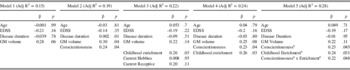
Univariate regressions revealed that SDMT was significantly predicted by age (p=.042), EDSS (p=.003), disease duration (p=.019), GM volume (p=.001), Conscientiousness (p=.011), Childhood Enrichment (p=.03), Current Hobbies (p=.047), and Current Receptive (p=.016). Detailed results of the univariate regression models can be seen in Supplementary Table 1. The significant variables were next entered into the hierarchical regression analysis (see Table 3). Model 1 represented the base model in our regression analysis, to which other variables were sequentially added.
Multivariate models predicting SDMT (n=67)

a Variables are centered (i.e., subtracted from the item mean).
The predictors in this base model include age, EDSS, disease duration, and GM volume. There were no significant predictors of SDMT in this model (Adjusted R2=0.15). Model 2, including variables from the base model along with Conscientiousness, showed that disease duration, GM volume, and Conscientiousness were significant predictors of SDMT (Adjusted R2=0.19). Model 3 included the base model, along with Childhood Enrichment, Current Hobbies, and Current Receptive. This model retained only Childhood Enrichment (Adjusted R2=0.22). Model 4 tested the base model along with Conscientiousness and Childhood Enrichment and found that Conscientiousness and Childhood Enrichment were significant predictors of SDMT performance (Adjusted R2=0.24).
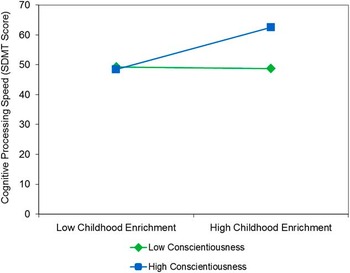
In the final model, Model 5, all the variables from Model 4 were included as well as an interaction term for Conscientiousness and Childhood Enrichment. In this model, the Conscientiousness and Childhood Enrichment variables were centered (i.e., subtracted from subscale mean) to facilitate interpretation of the interaction term. The best model retained Conscientiousness, Childhood Enrichment, and the interaction of Conscientiousness and Childhood Enrichment as significant predictors of SDMT (Adjusted R2=0.28). The significant interaction demonstrates that being high in both Childhood Enrichment and Conscientiousness is predictive of better SDMT performance.Footnote 1 The pattern of the interaction is plotted in Figure 1.
The pattern of the interaction.

Discussion
To the best of our knowledge, this is the first investigation of the relationship between Reserve and personality traits, and how these constructs together explain the association between GM volume and cognitive processing speed in MS. Results revealed that Childhood Enrichment activities are correlated only with the FFM trait of Openness, consistent with previously reported correlation between Openness and intelligence in healthy people (DeYoung et al., Reference DeYoung, Peterson and Higgins2005; O’Connor & Paunonen, Reference O’Connor and Paunonen2007). Furthermore, Childhood Social activities are correlated with Extraversion, Agreeableness, and Conscientiousness. Current activities were correlated with Neuroticism, Extraversion, Agreeableness, and Conscientiousness. These findings suggest that remaining active and fully engaged in activities is associated with adaptive personality characteristics. These same traits are associated with treatment adherence (Axelsson, Brink, Lundgren, & Lötvall, Reference Axelsson, Brink, Lundgren and Lötvall2011; Hill & Roberts, Reference Hill and Roberts2011), suggesting a constellation of positive influence on treatment outcomes.
We examined how FFM traits interact with past and current behaviors commonly associated with the Reserve construct. Previous research has repeatedly shown that GM volume is a robust predictor of cognitive dysfunction in MS (Benedict & Zivadinov, Reference Benedict and Zivadinov2011; Rocca et al., Reference Rocca, Amato, De Stefano, Enzinger, Geurts and Penner2015). We also know that past (Sumowski, Chiaravalloti, Wylie, & Deluca, Reference Sumowski, Chiaravalloti, Wylie and Deluca2009) and current Reserve-related activities (Booth et al., 2013) and personality traits (Benedict, Schwartz, et al., Reference Benedict, Schwartz, Duberstein, Healy, Hoogs, Bergsland and Zivadinov2013) moderate this relationship. The current study is one of the first to combine these three moderators in the same analysis. Our results show that Conscientiousness and enrichment activities reported from childhood and young adult years, presumably before disease onset, interact in predicting cognitive processing speed after accounting for age, GM volume, and neurological disability. More specifically, the combination of such activity and high Conscientiousness was predictive of faster processing speed than either high Conscientiousness or high childhood enrichment activities alone.
Reserve and personality are related, but the mechanisms are unclear. Given that personality is established early in life (McCrae et al., Reference McCrae, Costa, Terracciano, Parker, Mills, De Fruyt and Mervielde2002), personality structure may predispose an individual to engage in particular activities that foster development of Reserve throughout the lifespan (von Stumm & Ackerman, Reference von Stumm and Ackerman2013). Thus, having an adaptive personality structure is not only independently beneficial for future cognitive health, but may also establish an individual’s potential for maximal Reserve development. High Openness, Extraversion, and Agreeableness may be critical traits during early development. As individuals emerge into adulthood, and are challenged by disease, Conscientiousness may play a unique role in maintaining Reserve.
If an adaptive personality structure promotes engagement in potentially Reserve-related activities and has benefits for other aspects of well-being, what then is the prognosis for individuals with less adaptive personality traits? Moreover, as in Alzheimer’s disease (Robins Wahlin & Byrne, Reference Robins Wahlin and Byrne2011), there is evidence that MS has an adverse impact on personality, increasing Neuroticism, and lowering Extraversion and Conscientiousness; cross-sectional work reveals correlation between these adverse traits and reduction in cortical gray matter volume (Benedict et al., Reference Benedict, Hussein, Englert, Dwyer, Abdelrahman, Cox and Zivadinov2008).
Is there any remedy for these people who may have either baseline, or acquired, personality vulnerability? For decades, personality was believed to be relatively stable throughout the lifespan. However, more recently, it has been suggested that personality may be modifiable via psychological intervention (Chapman, Hampson, & Clarkin, Reference Chapman, Hampson and Clarkin2014). A study with depressed individuals showed that cognitive behavioral therapy was associated with a reduction in Neuroticism and an increase in Extraversion (Tang et al., Reference Tang, DeRubeis, Hollon, Amsterdam, Shelton and Schalet2009). Another study aimed at reducing physician burnout demonstrated that intensive mindfulness training led to reduced Neuroticism and higher Conscientiousness (Krasner et al., Reference Krasner, Epstein, Beckman, Suchman, Chapman, Mooney and Quill2009). Thus, psychotherapy may provide an entry point into personality change which may impact future health outcomes. Further research is needed to study such interventions in neurological populations that may have accompanying cognitive impairments.
Similar to personality, Reserve was traditionally believed to be a fixed capacity of resilience to brain pathology that was predominantly based on early life activities (e.g., educational attainment). However, Reserve may also be a modifiable disposition (Sumowski et al., Reference Sumowski, Rocca, Leavitt, Dackovic, Mesaros, Drulovic and Filippi2014). The concept of Reserve has evolved into a more fluid, dynamic, process which raises the possibility for continued Reserve-building throughout the lifespan. It is still, however, unclear whether ongoing engagement in recreational activities promotes further development of Reserve or simply maintains existing Reserve. Nonetheless, the possibility of both personality change and ongoing Reserve development provide potential avenues toward the best possible outcome for people with cerebral disease.
The limitations of the present work should be acknowledged. First, there may be some concern with including occupational attainment as a component of past Reserve-related activities because many individuals with MS are diagnosed as young adults, when they are still in the process of pursuing occupational goals. While we believe that this interruption has direct relevance to Reserve, we decided to examine the empirical relationships in our data by doing a sensitivity analysis of sorts: we re-ran the regression analysis using the Childhood Enrichment subscale score without occupational attainment. Our results did not change: the interaction of Childhood Enrichment and Conscientiousness in Model 5 remained significant (see Supplementary Table 2). Thus, our results are robust to effects of possible earlier disease onset.
Another potential limitation relates to the relatively small sample size (n=67), which may have limited our statistical power to detect moderate or small correlation coefficients (Cohen, Reference Cohen1992). With a larger sample size (i.e., 700 or more participants), it is likely the negative correlation between Neuroticism and Current Receptive would have been statistically significant. It would also have been worthwhile to compare findings between MS patients and healthy controls to determine whether findings were specific to MS patients or hold true for the general healthy population as well.
Although we have collected data from control subjects, the relatively small sample size of controls (n=26) does not allow for appropriate comparison between groups. Other work done by members of our group on a larger sample (n=810) has documented that MS patients engage in fewer strenuous and non-strenuous Reserve-related activities than healthy controls (Schwartz, Ayandeh, Ramanathan, et al., Reference Schwartz, Ayandeh, Ramanathan, Benedict, Dwyer, Weinstock-Guttman and Zivadinov2015). Future work might replicate these findings. Given that cognitive processing speed is commonly impaired in MS patients, we chose to use the SDMT as our primary outcome measure. However, we acknowledge that there may be limitations of using a single measure and that future work should focus on using several measures of a construct rather than an individual test. In addition, it will be important to examine the interaction of FFM traits and Reserve on other cognitive domains in other neurological populations. Expanding this research beyond MS will help to determine whether the relationship between personality and Reserve varies in a wider context.
In conclusion, current findings confirm that GM atrophy is a powerful predictor of cognitive impairment and further highlight the importance of identifying potential modifiers of this relationship. Prior studies have shown that Reserve-related activities and personality individually predict the cognitive impact of brain atrophy. Our results demonstrate that these constructs share significant variance and synergistically moderate the effects of neuropathology on cognitive processing speed. In addition, we present possible clinical applications aimed at maximizing future cognitive outcome in the context of neurological disorder. Expanding this research from MS to other neurological populations will be of great value in further elucidating the nature of interaction between Reserve and personality in influencing cognitive function.
Acknowledgments
This work was supported in part by a National Multiple Sclerosis Society Pilot Grant (RG4060A3/1) to Dr. Benedict and by the University of Rochester Hendershott Fund. The DeltaQuest Cognitive Reserve Measure is a copyrighted tool owned and licensed by DeltaQuest Foundation, a not-for-profit research organization engaged in quality of life research (www.deltaquest.org). Conflict of Interest Statement: M. Dwyer receives consulting fees from Claret Medical and EMD Serono. R. Zivadinov receives personal compensation from Teva Pharmaceuticals, Biogen, EMD Serono, Novartis, Claret Medical and Genzyme-Sanofi for speaking and consultant fees, and receives financial support for research activities from Biogen, Teva Pharmaceuticals, EMD Serono, Novarits, Claret Medical and Genzyme-Sanofi. B. Weinstock-Guttman has participated in speaker bureau and served as a consultant for Biogen, Teva Neurosciences, EMD Serono, Pfizer, Novartis, Genzyme and Acorda. Excluding Genzyme, she has also received grant/research support from the agencies listed above as well as ITN, Mallinckrodt. and Shire. R.H.B. Benedict receives research support from Accorda, Novartis, Genzyme, Biogen, and Mallinckrodt Pharmaceuticals; is on the speakers’ bureau for EMD Serono (designing CME courses); consults for Biogen Genentech, Novartis, and Teva; and receives royalties from Psychological Assessment Resources.
Supplementary material
To view supplementary material for this article, please visit http://dx.doi.org/10.1017/S1355617716000333